1
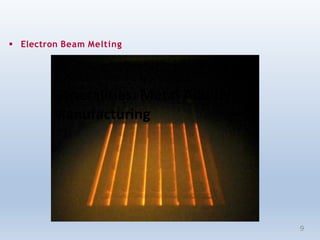
Electron Beam Melting
BY:-
Anmar Talal
University of Diyala
College Of Engineering
Materials
Engineering Department
Introduction
• bonding of the metal, ceramic or plastic powders
together when heated to temperatures in excess of
approximately half the absolute melting
temperature.
• In the industry, sintering is mainly used for metal
and ceramic parts (Powder Metallurgy).
• After pressing (compaction) of the powder inside
mold for deforming into high densities, while
providing the shape and dimensional control, the
compacted parts are then sintered for achieving
bonding of the powders metallurgically.
2
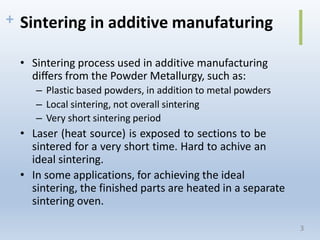
+ Sintering in additive manufaturing
• Sintering process used in additive manufacturing
differs from the Powder Metallurgy, such as:
– Plastic based powders, in addition to metal powders
– Local sintering, not overall sintering
– Very short sintering period
• Laser (heat source) is exposed to sections to be
sintered for a very short time. Hard to achive an
ideal sintering.
• In some applications, for achieving the ideal
sintering, the finished parts are heated in a separate
sintering oven.
3
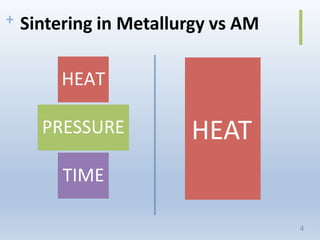
+ Sintering in Metallurgy vs AM
HEAT
PRESSURE
TIME
HEAT
4
+ Electron Beam Melting (EBM)
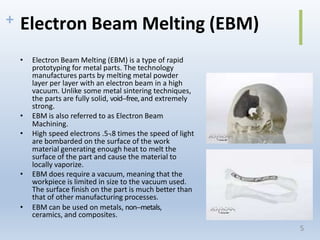
• Electron Beam Melting (EBM) is a type of rapid
prototyping for metal parts. The technology
manufactures parts by melting metal powder
layer per layer with an electron beam in a high
vacuum. Unlike some metal sintering techniques,
the parts are fully solid, void-‐free,and extremely
strong.
• EBM is also referred to as Electron Beam
Machining.
• High speed electrons .5-
‐
.8 times the speed of light
are bombarded on the surface of the work
material generating enough heat to melt the
surface of the part and cause the material to
locally vaporize.
• EBM does require a vacuum, meaning that the
workpiece is limited in size to the vacuum used.
The surface finish on the part is much better than
that of other manufacturing processes.
• EBM can be used on metals, non-‐metals,
ceramics, and composites.
5
+ Electron Beam Melting (EBM)
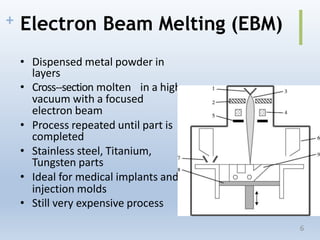
• Dispensed metal powder in
layers
• Cross-‐section molten in a high
vacuum with a focused
electron beam
• Process repeated until part is
completed
• Stainless steel, Titanium,
Tungsten parts
• Ideal for medical implants and
injection molds
• Still very expensive process
6
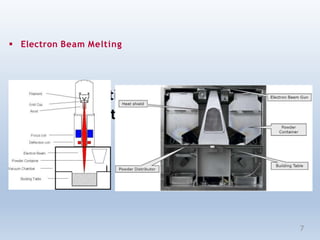
Generalities: Metal Additive
Manufacturing
 Electron Beam Melting
7
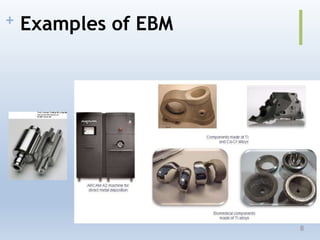
+ Examples of EBM
8
Generalities: Metal Additive
Manufacturing
 Electron Beam Melting
9
+ EMB benefit
• High productivity
• Suitable for very massive parts
• No residual internal stress (constant 680-‐720°C build
temperature)
• Less supports are needed for manufacturing of parts
• Possibility to stack parts on top of each other (mass
production)
• Sintered powder = good for thermal conductivity = less
supports
• Process under vacuum (no gaz contaminations)
• Very fine microstructures (Ti6Al4V), very good
mechanical and fatigue results (Ti6Al4V)
10
+ EBM drawbacks
• Powder is sintered -‐>tricky to remove (e.g.
interior channels)
• Long dead time between 2 productions (8
hours for cooling – A2, A2X, A2XX systems)
• Tricky to work with fine powder
• Expensive maintenance contract
11
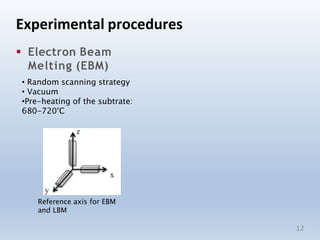
Experimental procedures
 Electron Beam
Melting (EBM)
• Random scanning strategy
• Vacuum
•Pre-heating of the subtrate:
680-720°C
Reference axis for EBM
and LBM
12
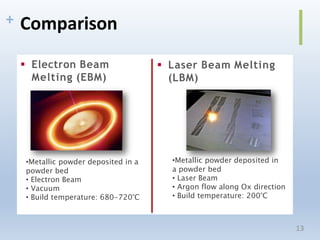
+ Comparison
 Electron Beam
Melting (EBM)
 Laser Beam Melting
(LBM)
•Metallic powder deposited in a
powder bed
• Electron Beam
• Vacuum
• Build temperature: 680-720°C
•Metallic powder deposited in
a powder bed
• Laser Beam
• Argon flow along Ox direction
• Build temperature: 200°C
13
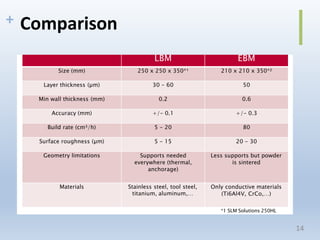
+ Comparison
LBM EBM
Size (mm) 250 x 250 x 350*¹ 210 x 210 x 350*²
Layer thickness (µm) 30 - 60 50
Min wall thickness (mm) 0.2 0.6
Accuracy (mm) +/- 0.1 +/- 0.3
Build rate (cm³/h) 5 - 20 80
Surface roughness (µm) 5 - 15 20 - 30
Geometry limitations Supports needed
everywhere (thermal,
anchorage)
Less supports but powder
is sintered
Materials Stainless steel, tool steel,
titanium, aluminum,…
Only conductive materials
(Ti6Al4V, CrCo,…)
*1 SLM Solutions 250HL
14
+ Comparison
15
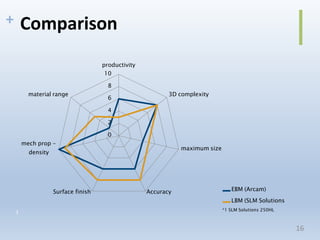
+ Comparison
10
8
6
4
2
0
productivity
3D complexity
maximum size
Accuracy
Surface finish
mech prop -
density
material range
EBM (Arcam)
LBM (SLM Solutions
*1 SLM Solutions 250HL
16
References
1. "ASTM F2792 - 12a Standard Terminology for Additive Manufacturing
Technologies, (Withdrawn 2015)". Astm.org.
2. "Electron Beam Melting". Thre3d.com. Archived from the original on
3 February 2014. Retrieved 28 January 2014.
3. Sames; et al. (2014). "Thermal effects on microstructural
heterogeneity of Inconel 718 materials fabricated by electron beam
melting". Journal of Materials Research. .
4. "ORNL research reveals unique capabilities of 3-D printing |
ornl.gov".
5. Guo, Qianying; Kirka, Michael; Lin, Lianshan; Shin, Dongwon; Peng,
Jian; Unocic, Kinga A. (September 2020). "In situ transmission electron
microscopy deformation and mechanical responses of additively
manufactured Ni-based superalloy". Scripta Materialia. 186: 57–62.
17

Electron Beam Melting.pptx

  • 1.
    1 Electron Beam Melting BY:- AnmarTalal University of Diyala College Of Engineering Materials Engineering Department
  • 2.
    Introduction • bonding ofthe metal, ceramic or plastic powders together when heated to temperatures in excess of approximately half the absolute melting temperature. • In the industry, sintering is mainly used for metal and ceramic parts (Powder Metallurgy). • After pressing (compaction) of the powder inside mold for deforming into high densities, while providing the shape and dimensional control, the compacted parts are then sintered for achieving bonding of the powders metallurgically. 2
  • 3.
    + Sintering inadditive manufaturing • Sintering process used in additive manufacturing differs from the Powder Metallurgy, such as: – Plastic based powders, in addition to metal powders – Local sintering, not overall sintering – Very short sintering period • Laser (heat source) is exposed to sections to be sintered for a very short time. Hard to achive an ideal sintering. • In some applications, for achieving the ideal sintering, the finished parts are heated in a separate sintering oven. 3
  • 4.
    + Sintering inMetallurgy vs AM HEAT PRESSURE TIME HEAT 4
  • 5.
    + Electron BeamMelting (EBM) • Electron Beam Melting (EBM) is a type of rapid prototyping for metal parts. The technology manufactures parts by melting metal powder layer per layer with an electron beam in a high vacuum. Unlike some metal sintering techniques, the parts are fully solid, void-‐free,and extremely strong. • EBM is also referred to as Electron Beam Machining. • High speed electrons .5- ‐ .8 times the speed of light are bombarded on the surface of the work material generating enough heat to melt the surface of the part and cause the material to locally vaporize. • EBM does require a vacuum, meaning that the workpiece is limited in size to the vacuum used. The surface finish on the part is much better than that of other manufacturing processes. • EBM can be used on metals, non-‐metals, ceramics, and composites. 5
  • 6.
    + Electron BeamMelting (EBM) • Dispensed metal powder in layers • Cross-‐section molten in a high vacuum with a focused electron beam • Process repeated until part is completed • Stainless steel, Titanium, Tungsten parts • Ideal for medical implants and injection molds • Still very expensive process 6
  • 7.
  • 8.
  • 9.
  • 10.
    + EMB benefit •High productivity • Suitable for very massive parts • No residual internal stress (constant 680-‐720°C build temperature) • Less supports are needed for manufacturing of parts • Possibility to stack parts on top of each other (mass production) • Sintered powder = good for thermal conductivity = less supports • Process under vacuum (no gaz contaminations) • Very fine microstructures (Ti6Al4V), very good mechanical and fatigue results (Ti6Al4V) 10
  • 11.
    + EBM drawbacks •Powder is sintered -‐>tricky to remove (e.g. interior channels) • Long dead time between 2 productions (8 hours for cooling – A2, A2X, A2XX systems) • Tricky to work with fine powder • Expensive maintenance contract 11
  • 12.
    Experimental procedures  ElectronBeam Melting (EBM) • Random scanning strategy • Vacuum •Pre-heating of the subtrate: 680-720°C Reference axis for EBM and LBM 12
  • 13.
    + Comparison  ElectronBeam Melting (EBM)  Laser Beam Melting (LBM) •Metallic powder deposited in a powder bed • Electron Beam • Vacuum • Build temperature: 680-720°C •Metallic powder deposited in a powder bed • Laser Beam • Argon flow along Ox direction • Build temperature: 200°C 13
  • 14.
    + Comparison LBM EBM Size(mm) 250 x 250 x 350*¹ 210 x 210 x 350*² Layer thickness (µm) 30 - 60 50 Min wall thickness (mm) 0.2 0.6 Accuracy (mm) +/- 0.1 +/- 0.3 Build rate (cm³/h) 5 - 20 80 Surface roughness (µm) 5 - 15 20 - 30 Geometry limitations Supports needed everywhere (thermal, anchorage) Less supports but powder is sintered Materials Stainless steel, tool steel, titanium, aluminum,… Only conductive materials (Ti6Al4V, CrCo,…) *1 SLM Solutions 250HL 14
  • 15.
  • 16.
    + Comparison 10 8 6 4 2 0 productivity 3D complexity maximumsize Accuracy Surface finish mech prop - density material range EBM (Arcam) LBM (SLM Solutions *1 SLM Solutions 250HL 16
  • 17.
    References 1. "ASTM F2792- 12a Standard Terminology for Additive Manufacturing Technologies, (Withdrawn 2015)". Astm.org. 2. "Electron Beam Melting". Thre3d.com. Archived from the original on 3 February 2014. Retrieved 28 January 2014. 3. Sames; et al. (2014). "Thermal effects on microstructural heterogeneity of Inconel 718 materials fabricated by electron beam melting". Journal of Materials Research. . 4. "ORNL research reveals unique capabilities of 3-D printing | ornl.gov". 5. Guo, Qianying; Kirka, Michael; Lin, Lianshan; Shin, Dongwon; Peng, Jian; Unocic, Kinga A. (September 2020). "In situ transmission electron microscopy deformation and mechanical responses of additively manufactured Ni-based superalloy". Scripta Materialia. 186: 57–62. 17