Oxyacetylene Welding (OAW)
•

by
WAQAS AHMED
Oxyacetylene Welding (OAW)
The oxyacetylene welding process
uses a combination of oxygen and
acetylene gas to provide a high
temperature flame.
Oxyacetylene Welding (OAW)
• OAW is a manual process in which the
welder must personally control the the torch
movement and filler rod application
• The term oxyfuel gas welding outfit refers
to all the equipment needed to weld.
• Cylinders contain oxygen and acetylene gas
at extremely high pressure.
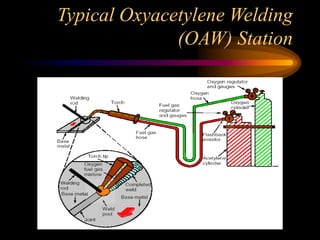
Typical Oxyacetylene Welding
(OAW) Station
Oxygen Cylinders
• Oxygen is stored within cylinders of various
sizes and pressures ranging from 20002640 PSI. (Pounds Per square inch)
• Oxygen cylinders are forged from solid
armor plate steel. No part of the cylinder
may be less than 1/4” thick.
• Cylinders are then tested to over 3,300 PSI
using a (NDE) hydrostatic pressure test.
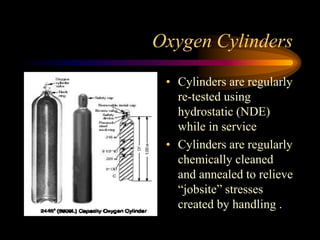
Oxygen Cylinders
• Cylinders are regularly
re-tested using
hydrostatic (NDE)
while in service
• Cylinders are regularly
chemically cleaned
and annealed to relieve
“jobsite” stresses
created by handling .
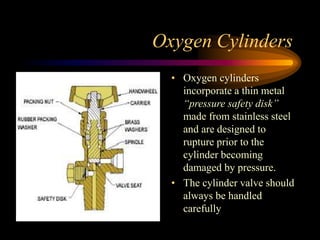
Oxygen Cylinders
• Oxygen cylinders
incorporate a thin metal
“pressure safety disk”
made from stainless steel
and are designed to
rupture prior to the
cylinder becoming
damaged by pressure.
• The cylinder valve should
always be handled
carefully
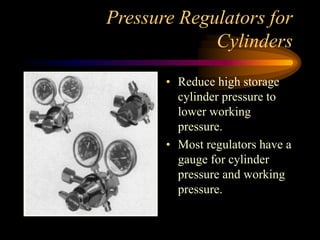
Pressure Regulators for
Cylinders
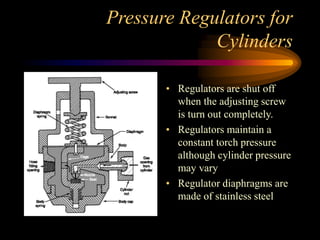
• Reduce high storage
cylinder pressure to
lower working
pressure.
• Most regulators have a
gauge for cylinder
pressure and working
pressure.
Pressure Regulators for
Cylinders
• Regulators are shut off
when the adjusting screw
is turn out completely.
• Regulators maintain a
constant torch pressure
although cylinder pressure
may vary
• Regulator diaphragms are
made of stainless steel
Pressure Regulators Gauges
Using a “Bourdon” movement
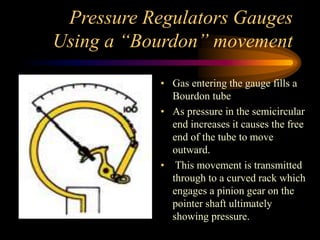
• Gas entering the gauge fills a
Bourdon tube
• As pressure in the semicircular
end increases it causes the free
end of the tube to move
outward.
• This movement is transmitted
through to a curved rack which
engages a pinion gear on the
pointer shaft ultimately
showing pressure.
Regulator Hoses
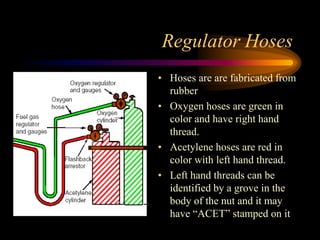
• Hoses are are fabricated from
rubber
• Oxygen hoses are green in
color and have right hand
thread.
• Acetylene hoses are red in
color with left hand thread.
• Left hand threads can be
identified by a grove in the
body of the nut and it may
have “ACET” stamped on it
Check Valves &
Flashback Arrestors
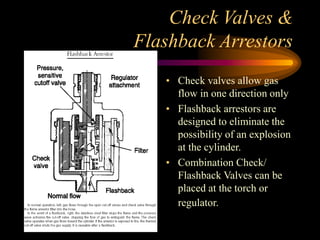
• Check valves allow gas
flow in one direction only
• Flashback arrestors are
designed to eliminate the
possibility of an explosion
at the cylinder.
• Combination Check/
Flashback Valves can be
placed at the torch or
regulator.
Acetylene Gas
• Virtually all the acetylene distributed for welding and cutting use
is created by allowing calcium carbide (a man made product) to
react with water.
• The nice thing about the calcium carbide method of producing
acetylene is that it can be done on almost any scale desired.
Placed in tightly-sealed cans, calcium carbide keeps indefinitely.
For years, miners’ lamps produced acetylene by adding water, a
drop at a time, to lumps of carbide.
• Before acetylene in cylinders became available in almost every
community of appreciable size produced their own gas from
calcium carbide.
Acetylene Cylinders
• Acetylene is stored in cylinders specially designed
for this purpose only.
• Acetylene is extremely unstable in its pure form at
pressure above 15 PSI (Pounds per Square Inch)
• Acetone is also present within the cylinder to
stabilize the acetylene.
• Acetylene cylinders should always be stored in the
upright position to prevent the acetone form
escaping thus causing the acetylene to become
unstable.
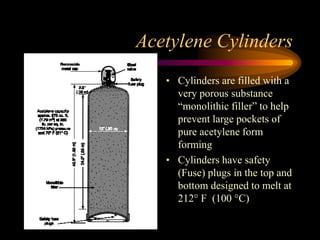
Acetylene Cylinders
• Cylinders are filled with a
very porous substance
“monolithic filler” to help
prevent large pockets of
pure acetylene form
forming
• Cylinders have safety
(Fuse) plugs in the top and
bottom designed to melt at
212° F (100 °C)
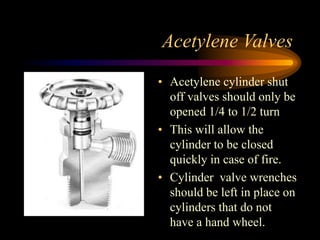
Acetylene Valves
• Acetylene cylinder shut
off valves should only be
opened 1/4 to 1/2 turn
• This will allow the
cylinder to be closed
quickly in case of fire.
• Cylinder valve wrenches
should be left in place on
cylinders that do not
have a hand wheel.
Oxygen and Acetylene Regulator
Pressure Settings
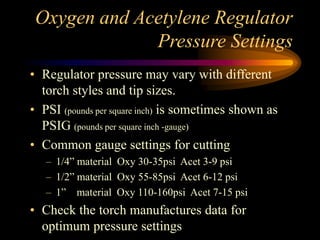
• Regulator pressure may vary with different
torch styles and tip sizes.
• PSI (pounds per square inch) is sometimes shown as
PSIG (pounds per square inch -gauge)
• Common gauge settings for cutting
– 1/4” material Oxy 30-35psi Acet 3-9 psi
– 1/2” material Oxy 55-85psi Acet 6-12 psi
– 1” material Oxy 110-160psi Acet 7-15 psi

• Check the torch manufactures data for
optimum pressure settings
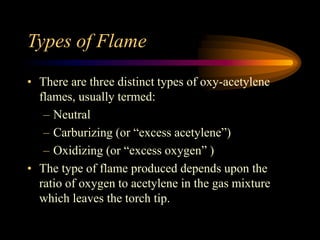
Types of Flame
• There are three distinct types of oxy-acetylene
flames, usually termed:
– Neutral
– Carburizing (or “excess acetylene”)
– Oxidizing (or “excess oxygen” )
• The type of flame produced depends upon the
ratio of oxygen to acetylene in the gas mixture
which leaves the torch tip.
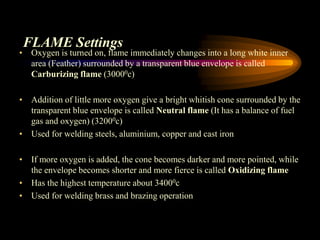
FLAME Settings

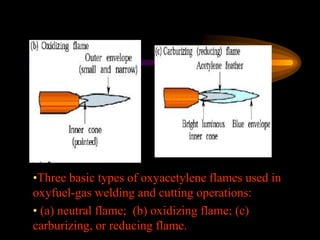
• Oxygen is turned on, flame immediately changes into a long white inner
area (Feather) surrounded by a transparent blue envelope is called
Carburizing flame (30000c)
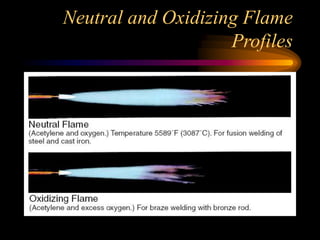
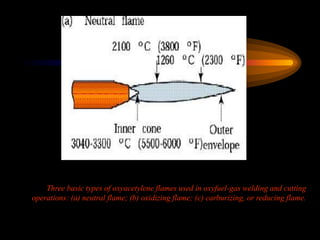
• Addition of little more oxygen give a bright whitish cone surrounded by the
transparent blue envelope is called Neutral flame (It has a balance of fuel
gas and oxygen) (32000c)
• Used for welding steels, aluminium, copper and cast iron
• If more oxygen is added, the cone becomes darker and more pointed, while
the envelope becomes shorter and more fierce is called Oxidizing flame
• Has the highest temperature about 34000c
• Used for welding brass and brazing operation
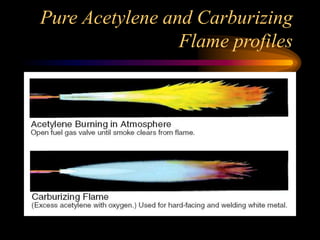
Pure Acetylene and Carburizing
Flame profiles
Neutral and Oxidizing Flame
Profiles
Three basic types of oxyacetylene flames used in oxyfuel-gas welding and cutting
operations: (a) neutral flame; (b) oxidizing flame; (c) carburizing, or reducing flame.
•Three basic types of oxyacetylene flames used in
oxyfuel-gas welding and cutting operations:
• (a) neutral flame; (b) oxidizing flame; (c)
carburizing, or reducing flame.
Oxy acetylene welding

Oxy acetylene welding

  • 2.
  • 3.
    Oxyacetylene Welding (OAW) Theoxyacetylene welding process uses a combination of oxygen and acetylene gas to provide a high temperature flame.
  • 4.
    Oxyacetylene Welding (OAW) •OAW is a manual process in which the welder must personally control the the torch movement and filler rod application • The term oxyfuel gas welding outfit refers to all the equipment needed to weld. • Cylinders contain oxygen and acetylene gas at extremely high pressure.
  • 5.
  • 6.
    Oxygen Cylinders • Oxygenis stored within cylinders of various sizes and pressures ranging from 20002640 PSI. (Pounds Per square inch) • Oxygen cylinders are forged from solid armor plate steel. No part of the cylinder may be less than 1/4” thick. • Cylinders are then tested to over 3,300 PSI using a (NDE) hydrostatic pressure test.
  • 7.
    Oxygen Cylinders • Cylindersare regularly re-tested using hydrostatic (NDE) while in service • Cylinders are regularly chemically cleaned and annealed to relieve “jobsite” stresses created by handling .
  • 8.
    Oxygen Cylinders • Oxygencylinders incorporate a thin metal “pressure safety disk” made from stainless steel and are designed to rupture prior to the cylinder becoming damaged by pressure. • The cylinder valve should always be handled carefully
  • 9.
    Pressure Regulators for Cylinders •Reduce high storage cylinder pressure to lower working pressure. • Most regulators have a gauge for cylinder pressure and working pressure.
  • 10.
    Pressure Regulators for Cylinders •Regulators are shut off when the adjusting screw is turn out completely. • Regulators maintain a constant torch pressure although cylinder pressure may vary • Regulator diaphragms are made of stainless steel
  • 11.
    Pressure Regulators Gauges Usinga “Bourdon” movement • Gas entering the gauge fills a Bourdon tube • As pressure in the semicircular end increases it causes the free end of the tube to move outward. • This movement is transmitted through to a curved rack which engages a pinion gear on the pointer shaft ultimately showing pressure.
  • 12.
    Regulator Hoses • Hosesare are fabricated from rubber • Oxygen hoses are green in color and have right hand thread. • Acetylene hoses are red in color with left hand thread. • Left hand threads can be identified by a grove in the body of the nut and it may have “ACET” stamped on it
  • 13.
    Check Valves & FlashbackArrestors • Check valves allow gas flow in one direction only • Flashback arrestors are designed to eliminate the possibility of an explosion at the cylinder. • Combination Check/ Flashback Valves can be placed at the torch or regulator.
  • 14.
    Acetylene Gas • Virtuallyall the acetylene distributed for welding and cutting use is created by allowing calcium carbide (a man made product) to react with water. • The nice thing about the calcium carbide method of producing acetylene is that it can be done on almost any scale desired. Placed in tightly-sealed cans, calcium carbide keeps indefinitely. For years, miners’ lamps produced acetylene by adding water, a drop at a time, to lumps of carbide. • Before acetylene in cylinders became available in almost every community of appreciable size produced their own gas from calcium carbide.
  • 15.
    Acetylene Cylinders • Acetyleneis stored in cylinders specially designed for this purpose only. • Acetylene is extremely unstable in its pure form at pressure above 15 PSI (Pounds per Square Inch) • Acetone is also present within the cylinder to stabilize the acetylene. • Acetylene cylinders should always be stored in the upright position to prevent the acetone form escaping thus causing the acetylene to become unstable.
  • 16.
    Acetylene Cylinders • Cylindersare filled with a very porous substance “monolithic filler” to help prevent large pockets of pure acetylene form forming • Cylinders have safety (Fuse) plugs in the top and bottom designed to melt at 212° F (100 °C)
  • 17.
    Acetylene Valves • Acetylenecylinder shut off valves should only be opened 1/4 to 1/2 turn • This will allow the cylinder to be closed quickly in case of fire. • Cylinder valve wrenches should be left in place on cylinders that do not have a hand wheel.
  • 18.
    Oxygen and AcetyleneRegulator Pressure Settings • Regulator pressure may vary with different torch styles and tip sizes. • PSI (pounds per square inch) is sometimes shown as PSIG (pounds per square inch -gauge) • Common gauge settings for cutting – 1/4” material Oxy 30-35psi Acet 3-9 psi – 1/2” material Oxy 55-85psi Acet 6-12 psi – 1” material Oxy 110-160psi Acet 7-15 psi • Check the torch manufactures data for optimum pressure settings
  • 19.
    Types of Flame •There are three distinct types of oxy-acetylene flames, usually termed: – Neutral – Carburizing (or “excess acetylene”) – Oxidizing (or “excess oxygen” ) • The type of flame produced depends upon the ratio of oxygen to acetylene in the gas mixture which leaves the torch tip.
  • 20.
    FLAME Settings • Oxygenis turned on, flame immediately changes into a long white inner area (Feather) surrounded by a transparent blue envelope is called Carburizing flame (30000c) • Addition of little more oxygen give a bright whitish cone surrounded by the transparent blue envelope is called Neutral flame (It has a balance of fuel gas and oxygen) (32000c) • Used for welding steels, aluminium, copper and cast iron • If more oxygen is added, the cone becomes darker and more pointed, while the envelope becomes shorter and more fierce is called Oxidizing flame • Has the highest temperature about 34000c • Used for welding brass and brazing operation
  • 21.
    Pure Acetylene andCarburizing Flame profiles
  • 22.
    Neutral and OxidizingFlame Profiles
  • 23.
    Three basic typesof oxyacetylene flames used in oxyfuel-gas welding and cutting operations: (a) neutral flame; (b) oxidizing flame; (c) carburizing, or reducing flame.
  • 24.
    •Three basic typesof oxyacetylene flames used in oxyfuel-gas welding and cutting operations: • (a) neutral flame; (b) oxidizing flame; (c) carburizing, or reducing flame.