1 Requirement of post processing in additive manufacturing:
Post-processing in additive manufacturing (AM) is a crucial stage that involves various techniques to
enhance the final properties, aesthetics, and functionality of printed parts. While additive manufacturing
technologies have advanced significantly, post-processing remains essential to meet specific
requirements and improve the overall quality of the manufactured components. Here's a detailed look
at the requirements of post-processing in additive manufacturing:
1. Surface Finish Improvement:
Requirement: Achieving a desired surface finish for functional or aesthetic reasons.
Processes: Sanding, polishing, micro-finishing, or chemical treatments.
Significance: Enhances the visual appeal, reduces roughness, and can be crucial for applications with
strict cosmetic requirements.
2. Dimensional Accuracy:
Requirement: Ensuring that printed parts meet precise dimensional specifications.
Processes: Machining, milling, or precision grinding.
Significance: Post-processing helps achieve tight tolerances and desired part geometries not achievable
with the additive process alone.
3. Support Removal:
Requirement: Eliminating support structures generated during the printing process.
Processes: Manual or automated removal.
Significance: Enables the production of intricate designs and features, leaving a clean, functional part.
4. Surface Coating and Plating:
Requirement: Enhancing properties such as corrosion resistance, wear resistance, or adding specific
functionalities.
Processes: Application of coatings, platings, or specialty treatments.
Significance: Improves material performance for specific applications and environments.
5. Heat Treatment:
Requirement: Modifying material properties, relieving residual stresses, or optimizing microstructure.
Processes: Annealing, quenching, tempering, or other heat treatment methods.
Significance: Enhances mechanical properties, reduces brittleness, and improves part stability.
6. Surface Roughness Reduction:
Requirement: Minimizing irregularities on part surfaces.
Processes: Abrasive blasting, tumbling, or chemical treatments.
Significance: Reduces friction, improves wear resistance, and can be crucial for applications with
specific functional requirements.
7. Porosity Reduction:
Requirement: Minimizing or eliminating pores within the material.
Processes: HIP (Hot Isostatic Pressing), additional heat treatment, or infiltration.
Significance: Enhances material density, improving mechanical properties and fatigue resistance.
8. Coloring and Dyeing:
Requirement: Adding color for identification, branding, or aesthetic purposes.
Processes: Dyeing or painting.
Significance: Enhances part visibility, customization options, and branding possibilities.
9. Mechanical Finishing:
Requirement: Achieving specific mechanical properties and surface characteristics.
Processes: Shot peening, laser ablation, or other mechanical finishing techniques.
Significance: Can introduce compressive stresses, improve fatigue resistance, and modify surface
features.
10. Functionalizing:
Requirement: Adding specific functionalities to the part.
Processes: Embedding sensors, adding electronics, or integrating other functional components.
Significance: Enables the production of parts with enhanced features beyond the material properties.
Post-processing in additive manufacturing is a multifaceted requirement that addresses the diverse
needs of different industries and applications. Whether for achieving high-quality surface finishes,
meeting tight tolerances, or enhancing material properties, post-processing is integral to unlocking the
full potential of additive manufacturing technologies. The choice of post-processing techniques depends
on the specific material, part geometry, and application requirements.
### Shot Peening:
**Process:**
Shot peening is a surface treatment process used to enhance the fatigue life and durability of metal
components. In this process:
1. Small, spherical media, such as steel or ceramic shots, are propelled at high velocities onto the surface
of a part.
2. The impacts induce controlled plastic deformation, creating compressive residual stresses on the
surface.
3. The repeated impacts refine the surface, promoting the formation of a layer with enhanced mechanical
properties.
**Advantages:**
1. **Fatigue Life Improvement:** Shot peening induces compressive stresses, enhancing the resistance
of the material to fatigue failure.
2. **Surface Hardening:** The process increases the surface hardness of the material, improving wear
resistance.
3. **Dimensional Stability:** Compressive stresses help to counteract tensile stresses, reducing the risk
of part distortion.
### HIPS (High Impact Polystyrene) Removal:
**Process:**
HIPS is often used as a support material in additive manufacturing, especially in Fused Deposition
Modeling (FDM). The removal process involves:
1. Immersing the printed part in a suitable solvent, such as limonene.
2. The solvent selectively dissolves the HIPS support material without affecting the primary printed
material.
**Advantages:**
1. **Non-Destructive Support Removal:** HIPS removal is a gentle process that doesn't damage the
main printed material.
2. **Clean and Efficient:** Leaves a clean, finished part with minimal residue.
3. **Suitable for Complex Geometries:** Effective for removing supports from intricate and complex
structures.
### Micro-Finishing:
**Process:**
Micro-finishing is a mechanical post-processing technique that involves refining the surface of a part
to achieve a smoother and more polished finish. Processes may include:
1. **Abrasive Blasting:** Using fine abrasives to remove surface imperfections.
2. **Sanding and Polishing:** Employing abrasive materials of varying grits to achieve the desired
surface finish.
3. **Chemical Treatments:** Using chemicals to etch or smooth the surface.
**Advantages:**
1. **Improved Surface Finish:** Micro-finishing removes layer lines and other imperfections, resulting
in a smoother surface.
2. **Enhanced Aesthetics:** Creates a more aesthetically pleasing appearance for parts with visible
surfaces.
3. **Reduced Friction:** Smoother surfaces reduce friction and wear, especially in moving or sliding
components.
Each of these post-processing techniques addresses specific aspects of additive manufacturing to
enhance the final properties and characteristics of the printed parts. The choice of which technique to
use depends on factors such as the material used, the desired final properties, and the specific
requirements of the application.
2 Chemical Treatment processes in Additive Manufacturing
Chemical treatments in post-processing play a vital role in improving the surface finish, corrosion
resistance, and other material properties of both metal and non-metal parts produced through various
additive manufacturing processes. Here's an overview of chemical treatments for post-processing:
Metal Parts:
2.1 Pickling and Passivation:
Process:
Pickling: Involves removing scales, oxides, or other impurities from the metal surface using an acidic
solution.
Passivation: Follows pickling and forms a protective oxide layer on the metal surface, enhancing
corrosion resistance.
Advantages:
Improves surface cleanliness.
Enhances corrosion resistance in metals like stainless steel.
2.2 Anodizing:
Process:
Involves immersing the metal part in an electrolyte solution and applying an electric current to induce
controlled oxidation.
Produces an oxide layer on the surface, which can be further sealed for improved corrosion resistance.
Advantages:
Provides a decorative finish.
Increases wear resistance and hardness.
Can impart color to the metal.
2.3 Chemical Conversion Coating:
Process:
Metal parts are treated with a chemical solution that forms a thin conversion coating on the surface.
Common coatings include phosphating, chromating, or black oxide coatings.
Advantages:
 Enhances corrosion resistance.
 Provides a base for subsequent coatings.
2.4 Electroplating:
Process:
Involves depositing a layer of metal onto the surface of the part through an electrochemical process.
Common metals for plating include nickel, chromium, zinc, and gold.
Advantages:
Enhances wear resistance.
Improves aesthetics.
Non-Metal Parts:
2.5 Chemical Vapor Smoothing:
Process:
Parts are exposed to a chemical vapor that selectively melts the outer layer, smoothing the surface.
Often used for thermoplastic polymers.
Advantages:
Improves surface finish.
Reduces visible layer lines.
2.6 Surface Coating:
Process:
Application of coatings, such as paints, varnishes, or specialty coatings, to enhance properties.
Can include anti-static, anti-microbial, or other functional coatings.
Advantages:
Adds specific functionalities to the part.
Enhances aesthetics.
2.7 Dyeing and Coloring:
Process:
Parts are immersed in a dye or colorant solution to achieve desired colors.
Commonly used for polymers like High Impact Polystyrene (HIPS).
Advantages:
Adds customization options.
Aesthetically pleasing finishes.
2.8 Chemical Etching:
Process:
Involves selectively removing material from the part's surface using a chemical solution.
Creates textured or engraved surfaces.
Advantages:
Customizes surface appearance.
Can be used for branding or labeling.
Considerations:
 Material Compatibility: Ensure that the chemical treatment is compatible with the base
material.
 Environmental Impact: Consider the environmental impact of the chemicals used and adhere to
safety regulations.
 Process Control: Precise control of parameters is essential to achieve desired results.
In summary, chemical treatments in post-processing contribute significantly to enhancing the properties
and appearance of both metal and non-metal parts produced through additive manufacturing processes.
The choice of treatment depends on the material, intended application, and desired final characteristics
of the part.
3 Heat treatment processes for metal additive manufacturing (AM)
Heat treatment processes for metal additive manufacturing (AM) involve controlled heating and cooling
cycles to modify the microstructure and properties of the printed metal parts. The specific heat treatment
processes depend on the metal alloy used and the desired material properties. Here's an overview of
common heat treatment processes for metal AM:
3.1 Solution Heat Treatment:
• Purpose: Primarily used for precipitation-hardening alloys (e.g., certain aluminum and titanium
alloys).
• Process:
• Parts are heated to a specific temperature (solutionizing temperature) to dissolve alloying
elements into the matrix.
• Held at that temperature for a specified time.
• Rapid quenching follows to "freeze" the solute atoms in a supersaturated solution.
• Benefits:
• Homogenizes the alloy composition.
• Enhances mechanical properties by creating a uniform microstructure.
3.2 2. Aging (Precipitation Hardening):
• Purpose: To strengthen alloys by promoting the formation of fine precipitates.
• Process:
• After solution heat treatment, the material is aged at an elevated temperature for a specific
duration.
• Precipitates form, providing additional strengthening.
• Benefits:
• Increases hardness and strength.
• Improves fatigue resistance.
3.3 3. Annealing:
• Purpose: Relieve residual stresses, improve machinability, and enhance ductility.
• Process:
• Parts are heated to a specific temperature (annealing temperature).
• Held at that temperature for a defined time.
• Slow cooling follows.
• Benefits:
• Reduces internal stresses.
• Softens the material, making it more ductile.
3.4 4. Normalizing:
• Purpose: Refine grain structure and improve mechanical properties.
• Process:
• Parts are heated to a temperature above the critical range.
• Held for a specified time.
• Air cooling follows.
• Benefits:
• Uniformly refines grain structure.
• Enhances mechanical properties.
3.5 5. Quenching:
• Purpose: Rapidly cool the material to achieve high hardness.
• Process:
• Parts are heated to an elevated temperature.
• Rapidly quenched in a quenching medium (e.g., oil, water).
• Benefits:
• Increases hardness.
• May introduce residual stresses.
3.6 6. Tempering:
• Purpose: Reduce hardness and brittleness while maintaining strength.
Process:
• After quenching, the material is reheated to a lower temperature (tempering temperature).
• Held for a specific time.
• Air cooling or quenching follows.
Benefits:
• Reduces hardness and brittleness.
• Improves toughness and ductility.
3.7 Stress Relieving:
Purpose: Reduce residual stresses.
Process:
 Parts are heated to a temperature below the lower critical temperature.
 Held at that temperature.
 Slow cooling follows.
Benefits:
• Minimizes distortion.
• Improves dimensional stability.
Considerations:
• The specific temperatures and durations for each process depend on the material being used.
• Cooling rates, quenching media, and atmosphere control are critical for achieving desired
properties.
• Heat treatment may be applied as a standalone process or as part of a multi-step thermal
processing strategy.
These heat treatment processes play a crucial role in optimizing the microstructure and properties of
metal AM parts, ensuring they meet the required standards for strength, hardness, and durability. The
selection of the appropriate heat treatment depends on the specific metal alloy, part geometry, and
intended application.
4 Machining as a post-processing technique.
Machining is a post-processing technique often employed to achieve precise dimensions, tight
tolerances, and specific surface finishes in additive manufacturing (AM) parts. While AM technologies
offer the advantage of producing complex geometries with minimal material waste, machining is
sometimes necessary to meet stringent requirements or achieve critical features. Here's an overview of
the requirement of machining in the post-processing of additive manufacturing parts with examples
based on different AM processes:
1. Selective Laser Melting (SLM) or Direct Metal Laser Sintering (DMLS):
Requirement:
Achieving tight tolerances and precise dimensions.
Surface finish improvement for critical surfaces.
Examples:
Aerospace Components: Machining is often used to achieve the precise dimensions required for critical
aerospace components produced using SLM or DMLS, ensuring that parts meet specific industry
standards.
2. Fused Deposition Modeling (FDM) or Material Extrusion:
Requirement:
Removal of support structures.
Achieving tight tolerances in critical areas.
Examples:
Prototyping: Machining is employed to remove support structures and achieve precise features in
prototypes, ensuring that the final part matches the intended design.
3. Stereolithography (SLA) or Digital Light Processing (DLP):
Requirement:
Achieving fine details and smooth surfaces.
Surface finish improvement for aesthetic applications.
Examples:
Medical Models: Machining may be used to refine intricate details in medical models produced using
SLA, ensuring accuracy in anatomical representations.
4. Binder Jetting:
Requirement:
Achieving precision in critical dimensions.
Surface finish improvement for functional or aesthetic reasons.
Examples:
Custom Tooling: In the production of custom tooling using binder jetting, machining may be applied to
achieve precise dimensions for tooling that requires tight tolerances.
5. Laminated Object Manufacturing (LOM):
Requirement:
Trimming excess material and achieving final dimensions.
Surface finish improvement for certain applications.
Examples:
Prototyping in Architecture: LOM produces layered models, and machining may be applied to trim
excess material and achieve the final architectural model's dimensions.
6. Electron Beam Melting (EBM):
Requirement:
Achieving specific geometries or features.
Surface finish improvement for critical components.
Examples:+++
Orthopedic Implants: In the production of orthopedic implants using EBM, machining may be necessary
to achieve precise shapes and dimensions for optimal implant fit.
Considerations:
Material Selection: Machinability varies with materials, and considerations should be given to material
properties.
Complex Geometry: Machining is often required for complex or critical features that cannot be achieved
through AM alone.
Cost and Time: Machining adds cost and time to the overall production process, and its application
should be judicious.
In summary, machining in the post-processing of additive manufacturing parts is driven by the need for
achieving specific tolerances, dimensions, or surface finishes that may be challenging to attain solely
through the additive process. The decision to employ machining depends on the application
requirements, material characteristics, and the desired final properties of the part.
5 Post -Processing Allowances :
In the context of additive manufacturing (AM), allowances refer to additional material or design
considerations that are intentionally included to account for factors encountered during post-processing.
These allowances help ensure that the final part meets the desired specifications, tolerances, and surface
finishes after undergoing various post-processing steps. Here are some common allowances considered
in AM post-processing:
1. Machining Allowance:
Purpose: To provide additional material for machining operations such as milling, turning, or drilling.
Considerations: Achieving tight tolerances and precise dimensions may require removing excess
material through machining.
Example: Designing a part with slightly oversized features to be machined down to the final
specifications.
2. Surface Finishing Allowance:
Purpose: To account for material that will be removed during surface finishing processes.
Considerations: Surface treatments like polishing, grinding, or chemical treatments may remove a layer
of material, affecting the final surface finish.
Example: Adding extra material to accommodate abrasive processes that improve the part's appearance.
3. Support Structure Allowance:
Purpose: To compensate for the material used in support structures during the additive manufacturing
process.
Considerations: After printing, support structures are often removed, and this can result in localized
material loss.
Example: Designing the part with additional material in areas where supports are expected to ensure
the final geometry is as intended.
4. Heat Treatment Allowance:
Purpose: To consider dimensional changes or distortions that may occur during heat treatment
processes.
Considerations: Heat treatment can influence the part's size and shape, necessitating allowances to meet
final specifications.
Example: Designing a part slightly larger to account for dimensional changes during heat treatment.
5. Chemical Treatment Allowance:
Purpose: To accommodate material loss during chemical treatments like pickling, passivation, or
coating applications.
Considerations: Chemical processes may alter the surface or remove material, impacting final
dimensions and properties.
Example: Providing extra material to ensure the part remains within tolerance after chemical treatment.
6. Post-Processing Time Allowance:
Purpose: To account for the additional time required for post-processing steps.
Considerations: Certain treatments or finishing methods may extend the overall production time.
Example: Considering the impact of post-processing on lead times and production schedules.
7. Assembly Allowance:
Purpose: To facilitate assembly by providing clearances or tolerances between mating components.
Considerations: Parts that need to be assembled may require allowances for proper fit and functionality.
Example: Designing parts with intentional clearances to ensure ease of assembly.
Considerations:
Material Properties: Different materials may behave differently during post-processing, requiring
specific allowances.
Process-Specific Considerations: The type of post-processing steps employed will influence the
required allowances.
Final Application Requirements: The end-use and functional requirements of the part will impact the
allowances needed.
In summary, allowances in additive manufacturing are intentional design considerations that account
for material removal, changes in dimensions, or other factors during post-processing. These allowances
are crucial for achieving the desired final properties and functionality of the manufactured parts.
6 Post-processing techniques used in Selective Laser Melting (SLM)
Post-processing techniques are often employed in Selective Laser Melting (SLM) to refine the
properties, dimensions, and surface finish of the printed metal parts. Here are several post-processing
techniques commonly used in conjunction with SLM, along with examples:
1. Heat Treatment:
Purpose: Relieve residual stresses, enhance material properties, and optimize microstructure.
Process:
Solution Heat Treatment: Heating the part to dissolve alloying elements followed by rapid quenching.
Aging: Subsequent heat treatment to encourage the formation of precipitates for increased strength.
Example: Titanium alloy parts produced by SLM often undergo heat treatment to improve mechanical
properties and reduce residual stresses.
2. Surface Finishing:
Purpose: Improve surface quality, remove layer lines, and enhance aesthetics.
Process:
Mechanical Polishing: Abrasive processes to achieve a smoother surface.
Vibratory Finishing: Parts placed in a vibrating container with abrasives for surface refinement.
Example: Aerospace components produced by SLM may undergo surface finishing for improved
aerodynamics and fatigue resistance.
3. Machining:
Purpose: Achieve precise dimensions and tolerances.
Process:
CNC Machining: Material removal using computer-controlled machines.
Milling or Turning: Cutting processes to refine features.
Example: SLM-produced parts may be machined to meet tight tolerances for critical dimensions in
automotive applications.
4. Support Structure Removal:
Purpose: Eliminate support structures generated during the printing process.
Process:
Manual Removal: Breaking or cutting away supports.
Automated Removal: Using machinery or equipment to remove supports.
Example: Medical implants produced by SLM require precise removal of support structures to ensure
biocompatibility and dimensional accuracy.
5. Powder Removal:
Purpose: Extract unused powder from internal channels and features.
Process:
Blowing or Vacuuming: Removing excess powder from intricate geometries.
Ultrasonic Cleaning: Using high-frequency vibrations to dislodge powder particles.
Example: Complex aerospace components may require thorough powder removal to ensure optimal
functionality and structural integrity.
6. Shot Peening:
Purpose: Introduce compressive stresses and enhance fatigue resistance.
Process:
Blasting metal shots onto the part's surface.
Controlled plastic deformation improves mechanical properties.
Example: SLM-produced parts for automotive or aerospace applications may undergo shot peening for
increased strength and durability.
7. Coating and Plating:
Purpose: Enhance corrosion resistance, aesthetics, or introduce specific functionalities.
Process:
Electroplating: Depositing a thin layer of metal onto the part's surface.
Coating: Applying protective or functional coatings.
Example: SLM-produced components for marine environments may undergo coating or plating to resist
corrosion.
Considerations:
Material Specificity: Post-processing techniques should be selected based on the specific metal alloy
used in SLM.
Application Requirements: The intended application of the part influences the choice of post-processing
techniques.
Material Thickness: Thin-walled structures may require different post-processing considerations
compared to thicker parts.
In summary, post-processing techniques in Selective Laser Melting are diverse and tailored to meet the
specific needs of the final application. The choice of techniques depends on the material, geometry, and
functional requirements of the SLM-produced parts.
7 Post-processing techniques in Binder Jetting
Post-processing techniques are essential to enhance the properties, accuracy, and aesthetics of parts
produced through binder jetting, a powder bed fusion additive manufacturing process. Here are several
post-processing techniques commonly used in conjunction with binder jetting, along with examples:
1. Debinding:
Purpose: Remove the binder material from the green (un-sintered) part.
Process:
Thermal Debinding: Heat is applied to volatilize and remove the binder.
Solvent Debinding: The part is immersed in a solvent to dissolve the binder.
Example: After binder jetting, metal or ceramic parts typically undergo debinding to prepare them for
the sintering process.
2. Sintering:
Purpose: Fuse the powder particles together, resulting in a solid, dense part.
Process:
Parts are heated to a temperature below their melting point, causing powder particles to bond.
Sintering also helps burn off any remaining organic binders.
Example: Metal or ceramic parts produced by binder jetting are commonly sintered to achieve the final
desired properties.
3. Infiltration:
Purpose: Improve the mechanical properties and density of the part.
Process:
Molten metal or resin is introduced into the porous structure created during sintering.
Example: Infiltration is often applied to enhance the strength and density of parts, especially those
produced with binder jetting of metals or ceramics.
4. Surface Finishing:
Purpose: Improve the surface quality, remove layer lines, and enhance aesthetics.
Process:
Sanding, polishing, or abrasive blasting.
Chemical treatments for smoothing or coloring.
Example: Parts produced by binder jetting for consumer products may undergo surface finishing for
improved visual appeal.
5. Heat Treatment:
Purpose: Optimize material properties, relieve stresses, or induce specific microstructures.
Process:
Annealing, tempering, or stress relieving depending on the material.
Example: Metal parts produced through binder jetting may undergo heat treatment to enhance
mechanical properties.
6. Support Structure Removal:
Purpose: Eliminate support structures generated during the printing process.
Process:
Manual removal, breaking, or cutting away supports.
Automated removal using mechanical or chemical means.
Example: Complex geometries produced by binder jetting may require careful removal of supports to
avoid damaging the final part.
7. Powder Recovery:
Purpose: Reclaim unused powder for reuse in subsequent printing jobs.
Process:
Sieving, vacuuming, or other methods to separate and collect unused powder.
Example: In binder jetting, efficient powder recovery is crucial for reducing material waste and cost.
Considerations:
Material Compatibility: Post-processing techniques must be compatible with the specific materials used
in binder jetting.
Geometry Complexity: Complex geometries may require special attention during support removal or
surface finishing.
Application Requirements: The intended application of the part influences the choice of post-processing
techniques.
In summary, post-processing techniques in binder jetting are integral to achieving the desired properties
and aesthetics of the final parts. The choice of techniques depends on the material, geometry, and
functional requirements of the binder jetted components.
8 Post-processing techniques in FDM
Post-processing techniques play a significant role in improving the properties, surface finish, and
overall quality of parts produced through Fused Deposition Modeling (FDM). Here are several post-
processing techniques commonly used in conjunction with FDM, along with examples:
1. Support Structure Removal:
Purpose: Eliminate support structures generated during the printing process.
Process:
Manual removal using tools or pliers.
Water-soluble support materials for easier removal.
Example: A complex FDM-printed part with overhangs or intricate features may require careful
removal of support structures to achieve the desired final geometry.
2. Layer Smoothing:
Purpose: Reduce visible layer lines and improve surface finish.
Process:
Mechanical sanding or filing.
Chemical smoothing using solvents (e.g., acetone for ABS).
Example: Aesthetic models or prototypes with a smooth, polished appearance can be achieved through
layer smoothing.
3. Surface Coating:
Purpose: Enhance properties such as strength, durability, or appearance.
Process:
Applying coatings like paints, varnishes, or specialty coatings.
Epoxy resin coating for increased strength and stability.
Example: FDM-printed parts used in automotive applications may undergo coating for improved
weather resistance and aesthetics.
4. Vapor Polishing:
Purpose: Smooth and gloss the surface of thermoplastic parts.
Process:
Exposing the part to vaporized solvent, such as acetone.
Controlled heating to create a glossy finish.
Example: Polycarbonate or ABS parts produced by FDM can be vapor-polished to achieve a smooth,
glossy surface.
5. Painting and Coloring:
Purpose: Add color or decorative finishes to the part.
Process:
Traditional painting with suitable paints.
Dyeing or coloring using specialized dyes for certain thermoplastics.
Example: Consumer products or prototypes may undergo painting or coloring for branding,
identification, or aesthetic purposes.
6. Mechanical Finishing:
Purpose: Achieve tight tolerances, smooth surfaces, and precise geometries.
Process:
CNC machining for critical features.
Sanding, milling, or turning for surface refinement.
Example: FDM-printed parts for functional prototypes may undergo machining to meet precise
dimensional requirements.
7. Insertion of Metal Components:
Purpose: Enhance structural integrity or functionality.
Process:
Embedding metal inserts during or after the FDM process.
Post-insertion of threaded inserts or other components.
Example: FDM-printed parts for assembly may include metal inserts to provide strength and durability
in areas subject to high stress.
8. Annealing:
Purpose: Improve mechanical properties and relieve internal stresses.
Process:
Heating the part to a specific temperature followed by controlled cooling.
Example: FDM-printed parts made from certain thermoplastics, like PLA, may undergo annealing to
enhance their strength and heat resistance.
Considerations:
Material Compatibility: Each post-processing technique must be suitable for the specific thermoplastic
material used in FDM.
Part Complexity: The complexity of the part geometry influences the choice and complexity of post-
processing steps.
Application Requirements: The intended application of the part dictates the need for certain post-
processing techniques.
In summary, post-processing techniques are crucial for maximizing the potential of FDM-printed parts,
ensuring they meet specific requirements for functionality, appearance, and performance. The choice
of techniques depends on the material, application, and desired final properties of the FDM-produced
components.
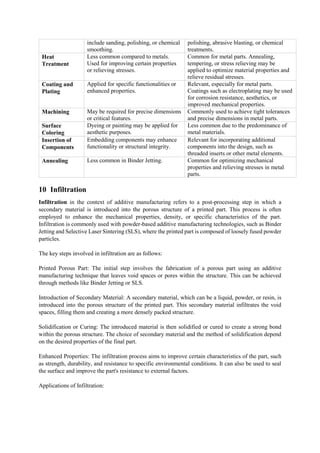
9 comparison of post-processing techniques commonly used in Binder
Jetting and Selective Laser Melting (SLM):
Post-
Processing
Technique
Binder Jetting Selective Laser Melting (SLM)
Debinding Commonly required, especially for
metal or ceramic parts. Involves
removing the binder material before
sintering.
Not typically required as the laser
selectively melts and fuses the metal
powder, eliminating the need for a separate
debinding step.
Sintering Often required for metal or ceramic
parts after debinding. Enhances part
density and mechanical properties.
Essential for metal parts. Involves heating
the part to fuse metal powder particles,
achieving full density and improving
mechanical properties.
Infiltration Applied to increase part strength and
density. Involves introducing a
secondary material (e.g., metal or resin)
into the part's porous structure.
Not a standard step. SLM produces fully
dense metal parts without the need for
infiltration.
Support
Removal
Common step. Supports are either
manually or automatically removed
after printing.
Support structures are not as prominent in
SLM due to the nature of selective melting,
but manual or automated removal may still
be required for certain geometries.
Powder
Recovery
Relevant for minimizing material
waste. Involves collecting and sieving
unused powder for reuse.
Similar to Binder Jetting, powder recovery
is crucial for minimizing waste and costs.
Unused powder is often reclaimed and
reused in subsequent prints.
Surface
Finishing
Necessary for improving surface
quality, removing layer lines, and
enhancing aesthetics. Techniques
Important for achieving a smooth surface
finish. Techniques may include mechanical
include sanding, polishing, or chemical
smoothing.
polishing, abrasive blasting, or chemical
treatments.
Heat
Treatment
Less common compared to metals.
Used for improving certain properties
or relieving stresses.
Common for metal parts. Annealing,
tempering, or stress relieving may be
applied to optimize material properties and
relieve residual stresses.
Coating and
Plating
Applied for specific functionalities or
enhanced properties.
Relevant, especially for metal parts.
Coatings such as electroplating may be used
for corrosion resistance, aesthetics, or
improved mechanical properties.
Machining May be required for precise dimensions
or critical features.
Commonly used to achieve tight tolerances
and precise dimensions in metal parts.
Surface
Coloring
Dyeing or painting may be applied for
aesthetic purposes.
Less common due to the predominance of
metal materials.
Insertion of
Components
Embedding components may enhance
functionality or structural integrity.
Relevant for incorporating additional
components into the design, such as
threaded inserts or other metal elements.
Annealing Less common in Binder Jetting. Common for optimizing mechanical
properties and relieving stresses in metal
parts.
10 Infiltration
Infiltration in the context of additive manufacturing refers to a post-processing step in which a
secondary material is introduced into the porous structure of a printed part. This process is often
employed to enhance the mechanical properties, density, or specific characteristics of the part.
Infiltration is commonly used with powder-based additive manufacturing technologies, such as Binder
Jetting and Selective Laser Sintering (SLS), where the printed part is composed of loosely fused powder
particles.
The key steps involved in infiltration are as follows:
Printed Porous Part: The initial step involves the fabrication of a porous part using an additive
manufacturing technique that leaves void spaces or pores within the structure. This can be achieved
through methods like Binder Jetting or SLS.
Introduction of Secondary Material: A secondary material, which can be a liquid, powder, or resin, is
introduced into the porous structure of the printed part. This secondary material infiltrates the void
spaces, filling them and creating a more densely packed structure.
Solidification or Curing: The introduced material is then solidified or cured to create a strong bond
within the porous structure. The choice of secondary material and the method of solidification depend
on the desired properties of the final part.
Enhanced Properties: The infiltration process aims to improve certain characteristics of the part, such
as strength, durability, and resistance to specific environmental conditions. It can also be used to seal
the surface and improve the part's resistance to external factors.
Applications of Infiltration:
Metal Parts: In metal additive manufacturing processes like SLS, infiltration is used to enhance the
density and mechanical properties of the printed metal parts. The secondary material, often a metal
alloy, is introduced to fill the pores and improve the overall integrity of the part.
Ceramic Parts: In ceramic 3D printing, infiltration is employed to strengthen and densify the printed
ceramic structures. Liquid precursors or suspensions can be infiltrated into the porous ceramic part and
then solidified through sintering.
Polymer Parts: For polymer-based additive manufacturing, infiltration may involve introducing resins,
adhesives, or other materials to improve the part's mechanical properties or add specific functionalities.
Composite Materials: Infiltration can be used to introduce reinforcing fibers, nanoparticles, or other
additives into a printed composite material, enhancing its overall performance.
In summary, infiltration is a versatile post-processing technique in additive manufacturing that enables
the modification and improvement of the properties of 3D-printed parts. The choice of secondary
material and the specific process depend on the material used in the printing process and the desired
characteristics of the final part.
11 Quality control and reliability considerations
Quality control and reliability considerations are crucial in additive manufacturing processes, including
Fused Deposition Modeling (FDM), Selective Laser Sintering (SLS), and Selective Laser Melting
(SLM). Identifying and mitigating defects is essential to ensure the production of high-quality, reliable
parts. Here are considerations specific to each process:
11.1 Fused Deposition Modeling (FDM):
Layer Adhesion:
Consideration: Ensure proper adhesion between layers to prevent delamination.
Mitigation: Optimize print parameters, such as layer height and temperature, to achieve strong layer
bonding.
Overhangs and Supports:
Consideration: Overhangs and unsupported features may lead to sagging or deformation.
Mitigation: Use support structures strategically. Design parts with self-supporting geometries where
possible.
Warpage:
Consideration: Thermal stresses during cooling may cause warping.
Mitigation: Use a heated build plate and optimize print settings to minimize temperature gradients.
Implement effective part cooling.
Material Quality:
Consideration: Inconsistent filament quality can lead to variations in part properties.
Mitigation: Source high-quality filaments, store them properly, and verify material specifications.
11.2 Selective Laser Sintering (SLS):
Powder Quality:
Consideration: Powder particle size and distribution affect part quality.
Mitigation: Use high-quality, consistent powders. Implement powder recycling and sieving to maintain
powder integrity.
Overheating and Sintering Issues:
Consideration: Overheating can cause melting or clumping of powder.
Mitigation: Optimize laser parameters to control energy input. Monitor and control the sintering process
to prevent overheating.
Powder Distribution:
Consideration: Inhomogeneous powder distribution can lead to density variations.
Mitigation: Ensure even powder distribution in the build chamber. Implement effective powder
recoating.
Cooling Control:
Consideration: Rapid cooling can lead to thermal stresses and warping.
Mitigation: Implement controlled cooling processes. Gradual cooldown can reduce thermal stresses.
11.3 Selective Laser Melting (SLM):
Powder Composition:
Consideration: Powder composition affects material properties.
Mitigation: Use certified powders with consistent particle size, composition, and flowability.
Scan Speed and Energy Density:
Consideration: Incorrect scan speed and energy density can lead to defects.
Mitigation: Optimize laser parameters for the specific material being processed. Control energy input
to achieve desired properties.
Oxygen Control:
Consideration: Exposure to oxygen can lead to oxidation of metal powders.
Mitigation: Operate in controlled atmospheres (e.g., inert gases) to minimize oxygen exposure during
the printing process.
Build Chamber Atmosphere:
Consideration: Atmospheric conditions can affect part quality.
Mitigation: Maintain a controlled build chamber atmosphere to prevent contamination and ensure
consistent printing conditions.
General Considerations:
Process Monitoring:
Consideration: Implement real-time monitoring to detect deviations during the printing process.
Mitigation: Use sensors and monitoring systems to track parameters such as temperature, layer
adhesion, and powder distribution.
Quality Assurance Protocols:
Consideration: Establish comprehensive quality assurance protocols.
Mitigation: Regularly calibrate machines, conduct in-process inspections, and perform post-processing
inspections.
Material Testing:
Consideration: Material properties can vary between batches.
Mitigation: Conduct material testing and validation to ensure consistency and adherence to
specifications.
By addressing these considerations and implementing appropriate mitigation strategies, manufacturers
can enhance the quality and reliability of parts produced through FDM, SLS, and SLM processes.
Regular monitoring, testing, and adherence to best practices contribute to the overall success of additive
manufacturing operations.
12 The parameters for heat treatment of 3D-printed parts include:
Explore the critical parameters involved in the heat treatment of 3D-printed parts.
• Heat treatment temperature
This is a crucial factor for heat treatment, as it determines the microstructural changes that occur in the
material of the 3D parts. The temperature must be carefully controlled to ensure that the desired
properties are achieved.
• Duration of heat treatment
The time taken to heat treat the 3D parts is also important. The longer the 3D part is held at the desired
temperature, the more time it has to reach equilibrium, and the greater the chances of the desired
microstructural changes occurring.
• Atmosphere in the heat treatment furnace
The atmosphere surrounding the 3D part during heat treatment is also important. Controlled
atmospheres can be used to prevent unwanted reactions during the heat treatment process.
• Cooling rate
The rate at which the 3D part is cooled after heat treatment also affects its properties.
• Equipment (furnace for heat treatment)
The furnace used for heat treatment can also affect the outcome. For example, the type of furnace used
can impact the temperature uniformity, heating rate, and cooling rate of the 3D-printed parts.
• Post-processing operations
Any post-processing, such as machining, sanding, or polishing, should be performed after heat
treatment to avoid affecting the desired properties.
The parameters for heat treatment of 3D-printed parts are crucial for achieving the desired properties
in the final product. Careful consideration and control of temperature, time, atmosphere, cooling rate,
equipment, and post-processing is essential for successful heat treatment.
13 Limitations that prove the need for post-processing treatments
However, despite the many benefits of 3D printing, there are also limitations that prove the need for
post-processing treatments. Some of the limitations include:
• Surface finish
The printed parts often have a rough and porous surface that requires post-processing treatments such
as sanding, smoothing, and painting.
• Strength and durability
The 3D-printed parts are often weaker than conventionally manufactured parts and require additional
post-processing treatments such as reinforcement and hardening.
• Accuracy
The additive printing technology is still developing, and the accuracy of printed parts can vary
depending on the technology used. Post-processing treatments such as finishing and calibration are
often necessary to achieve the desired level of accuracy.
• Costs
The technology can be expensive, and post-processing treatments can add to the overall cost of the
process.
14 Additive printing technology and its applications are
Additive printing technology and its applications are vast, ranging from healthcare to aerospace. Some
of the most significant applications of 3D printing technology are:
_ Healthcare
Prosthetics, implants, and surgical instruments. In some cases, 3D printing has been used to produce
patient-specific models for surgical planning, allowing for more accurate procedures.
_ Aerospace
Light and complex parts for aircraft, such as engine components and wing structures. This technology
has allowed for faster and more efficient production processes.
_ Manufacturing
Prototyping and production of small batches of parts, such as in the automotive and electronics
industries.
_ Architecture and construction
Production of small-scale models of buildings, allowing architects and engineers to visualize designs
and make modifications before construction begins.
_ Education
Used in education to teach students about engineering, design, and manufacturing principles.
15 heat treatment of additive manufactured parts can provide a number of
benefits, which are listed below:
 _ Improved mechanical properties of additive parts, including hardness and strength. Additive
parts can have internal stresses and micro-cracks that can affect their strength and durability.
Heat treatments can reduce these stresses and harden the material, improving part strength and
durability;
 _ Elimination of internal stresses. The 3D printing process can create internal stresses in parts,
and heat treatments can help eliminate these stresses, reducing the risk of parts breaking or
cracking. The process can also reduce thermal distortion and shrinkage that occurs during the
manufacturing process, improving the dimensional stability of parts;
 _ Improved geometric accuracy. Heat treatment can help reduce non-uniform deformation and
shrinkage during the production process, which can improve the geometric accuracy of parts;
 _ Uniformity/homogeneity of part structure. The 3D printing process can produce parts with a
porous structure, and heat treatments can help strengthen the structure by eliminating porosity
and voids, thus increasing the homogeneity of the materials used in 3D printing, which can lead
to better quality printed parts;
 _ Impurity removal. The 3D printing process can introduce impurities into the material used,
and heat treatments can help remove these impurities;
 _ Improved adhesion between layers. Heat treatments can increase adhesion between layers of
material, which can lead to better stability and strength of printed parts;
 _ Reduced brittleness. Some materials used in 3D printing can be brittle, and heat treatments
can help reduce brittleness by improving hardness and strength;
 _ Improved ductility. Heat treatments can increase the ductility of some materials, resulting in
a better ability to deform under stress;
 _ Increased corrosion resistance. Parts produced by additive technology can be more susceptible
to corrosion than parts produced by other methods. Heat treatments can increase the corrosion
resistance of materials, which can extend the life of printed parts;
 _ Improved surface finish. Heat treatments can also provide the appropriate surface roughness
required for certain technical applications, improving the quality and appearance of parts;
 _ Improved ductility. Parts produced by additive technology can be more brittle than parts
produced by other methods. Heat treatments can improve the ductility of the material, making
it less susceptible to cracking or fracture;
 _ Increased thermal and electrical conductivity. Parts produced by additive technology may
have lower thermal and/or electrical conductivity than parts produced by other methods. Heat
treatments can increase the thermal and/or electrical conductivity of parts, improving their
ability to transfer heat;
16 problems/disadvantages may arise in the use of post-processing heat
treatments:
Part distortion. If inappropriate temperature regimes are used, they can lead to deformation of additive
manufactured parts;
Undesirable changes in mechanical properties. Additive technology is a manufacturing process that
involves the variation of many specific factors that give parts certain mechanical properties. Heat
treatments can affect these properties, often in unexpected ways, which can lead to reduced
performance;
Increased porosity. Post-treatment heat treatments can lead to increased porosity in additive
manufactured parts, which can adversely affect both the strength and durability of the parts;
Irregularities on part surfaces. Heat treatments applied to parts produced by additive technology can
cause irregularities on the surface of the parts, which can affect their accuracy and quality;
Increased production time. The length of heat-treatment cycles often involves additional heating,
holding, and cooling time, which can significantly increase the production time of parts;
17 Requirement post-treatments to L-PBF parts
The principal motivation for applying post-treatments to L-PBF parts are presented as follows and the
primary factors behind the implementation of post-processing techniques on L-PBF parts lies in the
pursuit of enhanced material properties and improved functional performance of the fabricated
components:
Residual stress [2,3];
Microstructure high porosity [4,5];
Microstructure instability [5–8];
Homogenization, microstructural refinement, and martensite-to-austenite reversion [9];
Parts distortion [6];
Heterogeneous microstructure [10];
Coarse plate martensite with uneven distribution [11];
Anisotropic microstructures [12];
Low material density [13];
Martensite matrix with trace amount of austenite phase [14,15];
Enhance superelasticity of NiTi structures [16–18];
Stress-induced cracks and residual porosity [19];
Intermetallic precipitates [20];
Internal defects, such as entrapped-gas-pores or lack-of-fusion [21];
High nitrogen content [22];
Porosity, grain morphology and precipitates [23,24].
18 Hot Isostatic Pressing (HIP)
Hot Isostatic Pressing (HIP) is a post-processing technology that can be used to improve the quality
and performance of parts produced by various types of additive technologies.
The reasons why HIP is beneficial for both plastic and metal parts produced by different additive
technologies are outlined below.
Parts produced by various additive technologies are prone to porosity due to the layer-by-layer
deposition process. This can lead to defects such as voids, cracks, andinclusions that can weaken the
part and reduce its mechanical properties. HIP can be used to reduce porosity and improve hardness by
applying a high temperature and pressure to the part. The high pressure forces the gas to diffuse out of
the part, while the high temperature promotes plastic deformation and defect healing, resulting in a
denser and more uniform microstructure.
Additively manufactured parts often exhibit lower mechanical properties compared to conventionally
manufactured parts due to their microstructural anomalies. HIP treatment can improve the mechanical
properties of additive manufacturing parts by eliminating or reducing defects such as porosity,
inclusions, and microcracks. This leads to an increase in strength, ductility and hardness, making the
parts more suitable for demanding applications.
In addition, HIP treatment can be used to improve the surface finish and aesthetics of additive
manufacturing parts by applying high temperature and pressure to the part, resulting in plastic
deformation of surface irregularities and creating a more uniform surface. This can make the part more
visually appealing and suitable for applications requiring a smooth surface finish.
Parts produced using additive technologies often contain residual stresses due to the thermal cycling
involved in the printing process. These stresses can affect the mechanical properties of the part and lead
to deformation or failure under stress. HIP treatment can be used to remove residual stresses by applying
a high temperature and pressure to the part,
which promotes plastic deformation and stress reduction.
HIP treatment can be used to achieve certain material properties of parts produced by additive
technologies by strictly controlling the parameters applied during the process, namely pressure and
temperature. This allows the desired microstructure and part properties to be achieved for a specific
application.
To improve the quality and performance of parts produced by additive technologies, HIP treatment is a
valuable post-processing technique. It is capable of reducing porosity, enhancing mechanical properties,
improving surface finish and appearance, removing residual stresses, and adjusting matrix properties.
Due to their tendency to exhibit porosity and microstructural anomalies, HIP treatment is particularly
beneficial for additive plastic and metal parts. As the industry continues to embrace additive
technologies, HIP will become increasingly important to help ensure the quality and reliaility of these
complex parts.
What is hot isostatic pressing (HIP)?
Hot isostatic pressing (also called HIP or HIPing) is a process that consolidates material and closes
pores within parts through the application of heat and pressure. It can be applied to many different
materials including metals and ceramics. Like furnaces used for more general heat treating of metal
parts, HIP furnaces relieve thermal stresses in cast, sintered and additively manufactured parts.
However, HIP can also improve part density, ductility, fatigue resistance and other material properties.
The HIP process can also include quenching, aging and other postprocessing steps.
How does HIPing work?
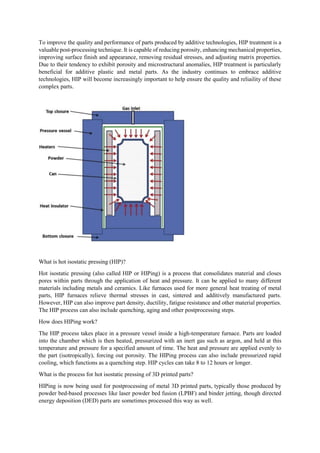
The HIP process takes place in a pressure vessel inside a high-temperature furnace. Parts are loaded
into the chamber which is then heated, pressurized with an inert gas such as argon, and held at this
temperature and pressure for a specified amount of time. The heat and pressure are applied evenly to
the part (isotropically), forcing out porosity. The HIPing process can also include pressurized rapid
cooling, which functions as a quenching step. HIP cycles can take 8 to 12 hours or longer.
What is the process for hot isostatic pressing of 3D printed parts?
HIPing is now being used for postprocessing of metal 3D printed parts, typically those produced by
powder bed-based processes like laser powder bed fusion (LPBF) and binder jetting, though directed
energy deposition (DED) parts are sometimes processed this way as well.
Printed parts — either cut off or still on their build plates — are loaded into baskets and transferred to
the HIP furnace’s chamber. The chamber is filled with inert gas, heated and pressurized, then held at
temperature and pressure for a specified length of time. HIPing “recipes” are customized to the
particular material and desired final properties.
Why HIP 3D printed parts?
Powder-based metal 3D printed parts can suffer from issues like poor layer adhesion, porosity and other
defects; HIP offers a way to mitigate these issues by consolidating the material and potentially reducing
the severity of any remaining defects. HIPing creates a uniform microstructure in the material, which
can improve properties.
Hot isostatic pressing also offers consolidation of steps in the manufacturing process. Many metal 3D
printed parts require heat treat after printing to relieve residual thermal stresses; the HIP furnace can
accomplish this heat treat alongside quenching, aging and other beneficial processes, saving time in the
overall production of metal parts.
Laser Polishing
Laser polishing is considered a potential method for improving the surface roughness of AM parts.
During laser polishing, morphology apexes can reach the melting temperature rapidly when the energy
source irradiates the material surface. The liquid material redistributes to the same level after molten-
pool formation because of the effect of gravity and surface tension. Once the laser beam stops scanning
the surface, the temperature of the heat-affected zone (HAZ) drops rapidly, resulting in the solidification
of the molten pool, and the surface roughness reduces accordingly [114–116]. Laser polishing is an
automated process that changes surface morphology by re-melting without changing or affecting the
bulk properties [117].
Laser Peening
Laser peening is a process of plastic compression of material perpendicular to the surface, resulting in
lateral expansions. When laser peening is performed on thick or constrained parts, the ability to resist
transverse strain leads to the accumulation of local compressive stresses [90,91]. For thinner parts, laser
peening causes changes in strain and shape. Similar effects are also caused by other compressive surface
treatments, which include deep cold rolling and ultrasonic peening. Figure 5 shows the principle of laser
shot peening. It is worth noting that the concepts of lateral expansion and plastic compression are
common in all deformation-based post-processing treatments.
Laser peening is widely utilized to improve the fatigue life of compressor blades and jet engine fans,
most recently in nuclear-spent fuel storage tanks and aircraft structures [90]. Laser peening technology
has also been applied to improve the surface properties of processed maraging steels [92–94], as well
as bend and stretch the thick sections of aircraft fenders to provide accurate aerodynamic models. In the
laser peening processes, the short intense laser pulse generates plasma in the confined geometry and
thereby produces pressure pulses, causing local plastic deformations. The generated pressure can be
increased by using a water compactor, thus making the process more effective [90]. The existing
residual compressive stress, the expected strain, and microstructure, as well as the modification of stress
state and/or shape in the component can be modeled point by point accurately according to the material
and geometry

POST PROCESSING IN ADDITIVE MANUFACTURING

  • 1.
    1 Requirement ofpost processing in additive manufacturing: Post-processing in additive manufacturing (AM) is a crucial stage that involves various techniques to enhance the final properties, aesthetics, and functionality of printed parts. While additive manufacturing technologies have advanced significantly, post-processing remains essential to meet specific requirements and improve the overall quality of the manufactured components. Here's a detailed look at the requirements of post-processing in additive manufacturing: 1. Surface Finish Improvement: Requirement: Achieving a desired surface finish for functional or aesthetic reasons. Processes: Sanding, polishing, micro-finishing, or chemical treatments. Significance: Enhances the visual appeal, reduces roughness, and can be crucial for applications with strict cosmetic requirements. 2. Dimensional Accuracy: Requirement: Ensuring that printed parts meet precise dimensional specifications. Processes: Machining, milling, or precision grinding. Significance: Post-processing helps achieve tight tolerances and desired part geometries not achievable with the additive process alone. 3. Support Removal: Requirement: Eliminating support structures generated during the printing process. Processes: Manual or automated removal. Significance: Enables the production of intricate designs and features, leaving a clean, functional part. 4. Surface Coating and Plating: Requirement: Enhancing properties such as corrosion resistance, wear resistance, or adding specific functionalities. Processes: Application of coatings, platings, or specialty treatments. Significance: Improves material performance for specific applications and environments. 5. Heat Treatment: Requirement: Modifying material properties, relieving residual stresses, or optimizing microstructure. Processes: Annealing, quenching, tempering, or other heat treatment methods. Significance: Enhances mechanical properties, reduces brittleness, and improves part stability. 6. Surface Roughness Reduction: Requirement: Minimizing irregularities on part surfaces. Processes: Abrasive blasting, tumbling, or chemical treatments. Significance: Reduces friction, improves wear resistance, and can be crucial for applications with specific functional requirements. 7. Porosity Reduction: Requirement: Minimizing or eliminating pores within the material. Processes: HIP (Hot Isostatic Pressing), additional heat treatment, or infiltration. Significance: Enhances material density, improving mechanical properties and fatigue resistance. 8. Coloring and Dyeing: Requirement: Adding color for identification, branding, or aesthetic purposes. Processes: Dyeing or painting. Significance: Enhances part visibility, customization options, and branding possibilities. 9. Mechanical Finishing: Requirement: Achieving specific mechanical properties and surface characteristics. Processes: Shot peening, laser ablation, or other mechanical finishing techniques. Significance: Can introduce compressive stresses, improve fatigue resistance, and modify surface features. 10. Functionalizing: Requirement: Adding specific functionalities to the part.
  • 2.
    Processes: Embedding sensors,adding electronics, or integrating other functional components. Significance: Enables the production of parts with enhanced features beyond the material properties. Post-processing in additive manufacturing is a multifaceted requirement that addresses the diverse needs of different industries and applications. Whether for achieving high-quality surface finishes, meeting tight tolerances, or enhancing material properties, post-processing is integral to unlocking the full potential of additive manufacturing technologies. The choice of post-processing techniques depends on the specific material, part geometry, and application requirements. ### Shot Peening: **Process:** Shot peening is a surface treatment process used to enhance the fatigue life and durability of metal components. In this process: 1. Small, spherical media, such as steel or ceramic shots, are propelled at high velocities onto the surface of a part. 2. The impacts induce controlled plastic deformation, creating compressive residual stresses on the surface. 3. The repeated impacts refine the surface, promoting the formation of a layer with enhanced mechanical properties. **Advantages:** 1. **Fatigue Life Improvement:** Shot peening induces compressive stresses, enhancing the resistance of the material to fatigue failure. 2. **Surface Hardening:** The process increases the surface hardness of the material, improving wear resistance. 3. **Dimensional Stability:** Compressive stresses help to counteract tensile stresses, reducing the risk of part distortion. ### HIPS (High Impact Polystyrene) Removal: **Process:** HIPS is often used as a support material in additive manufacturing, especially in Fused Deposition Modeling (FDM). The removal process involves: 1. Immersing the printed part in a suitable solvent, such as limonene. 2. The solvent selectively dissolves the HIPS support material without affecting the primary printed material. **Advantages:** 1. **Non-Destructive Support Removal:** HIPS removal is a gentle process that doesn't damage the main printed material. 2. **Clean and Efficient:** Leaves a clean, finished part with minimal residue. 3. **Suitable for Complex Geometries:** Effective for removing supports from intricate and complex structures. ### Micro-Finishing: **Process:** Micro-finishing is a mechanical post-processing technique that involves refining the surface of a part to achieve a smoother and more polished finish. Processes may include:
  • 3.
    1. **Abrasive Blasting:**Using fine abrasives to remove surface imperfections. 2. **Sanding and Polishing:** Employing abrasive materials of varying grits to achieve the desired surface finish. 3. **Chemical Treatments:** Using chemicals to etch or smooth the surface. **Advantages:** 1. **Improved Surface Finish:** Micro-finishing removes layer lines and other imperfections, resulting in a smoother surface. 2. **Enhanced Aesthetics:** Creates a more aesthetically pleasing appearance for parts with visible surfaces. 3. **Reduced Friction:** Smoother surfaces reduce friction and wear, especially in moving or sliding components. Each of these post-processing techniques addresses specific aspects of additive manufacturing to enhance the final properties and characteristics of the printed parts. The choice of which technique to use depends on factors such as the material used, the desired final properties, and the specific requirements of the application.
  • 4.
    2 Chemical Treatmentprocesses in Additive Manufacturing Chemical treatments in post-processing play a vital role in improving the surface finish, corrosion resistance, and other material properties of both metal and non-metal parts produced through various additive manufacturing processes. Here's an overview of chemical treatments for post-processing: Metal Parts: 2.1 Pickling and Passivation: Process: Pickling: Involves removing scales, oxides, or other impurities from the metal surface using an acidic solution. Passivation: Follows pickling and forms a protective oxide layer on the metal surface, enhancing corrosion resistance. Advantages: Improves surface cleanliness. Enhances corrosion resistance in metals like stainless steel. 2.2 Anodizing: Process: Involves immersing the metal part in an electrolyte solution and applying an electric current to induce controlled oxidation. Produces an oxide layer on the surface, which can be further sealed for improved corrosion resistance. Advantages: Provides a decorative finish. Increases wear resistance and hardness. Can impart color to the metal. 2.3 Chemical Conversion Coating: Process: Metal parts are treated with a chemical solution that forms a thin conversion coating on the surface. Common coatings include phosphating, chromating, or black oxide coatings. Advantages:  Enhances corrosion resistance.  Provides a base for subsequent coatings. 2.4 Electroplating: Process: Involves depositing a layer of metal onto the surface of the part through an electrochemical process. Common metals for plating include nickel, chromium, zinc, and gold. Advantages: Enhances wear resistance. Improves aesthetics. Non-Metal Parts: 2.5 Chemical Vapor Smoothing: Process: Parts are exposed to a chemical vapor that selectively melts the outer layer, smoothing the surface. Often used for thermoplastic polymers. Advantages: Improves surface finish. Reduces visible layer lines. 2.6 Surface Coating: Process: Application of coatings, such as paints, varnishes, or specialty coatings, to enhance properties. Can include anti-static, anti-microbial, or other functional coatings. Advantages:
  • 5.
    Adds specific functionalitiesto the part. Enhances aesthetics. 2.7 Dyeing and Coloring: Process: Parts are immersed in a dye or colorant solution to achieve desired colors. Commonly used for polymers like High Impact Polystyrene (HIPS). Advantages: Adds customization options. Aesthetically pleasing finishes. 2.8 Chemical Etching: Process: Involves selectively removing material from the part's surface using a chemical solution. Creates textured or engraved surfaces. Advantages: Customizes surface appearance. Can be used for branding or labeling. Considerations:  Material Compatibility: Ensure that the chemical treatment is compatible with the base material.  Environmental Impact: Consider the environmental impact of the chemicals used and adhere to safety regulations.  Process Control: Precise control of parameters is essential to achieve desired results. In summary, chemical treatments in post-processing contribute significantly to enhancing the properties and appearance of both metal and non-metal parts produced through additive manufacturing processes. The choice of treatment depends on the material, intended application, and desired final characteristics of the part. 3 Heat treatment processes for metal additive manufacturing (AM) Heat treatment processes for metal additive manufacturing (AM) involve controlled heating and cooling cycles to modify the microstructure and properties of the printed metal parts. The specific heat treatment processes depend on the metal alloy used and the desired material properties. Here's an overview of common heat treatment processes for metal AM: 3.1 Solution Heat Treatment: • Purpose: Primarily used for precipitation-hardening alloys (e.g., certain aluminum and titanium alloys). • Process: • Parts are heated to a specific temperature (solutionizing temperature) to dissolve alloying elements into the matrix. • Held at that temperature for a specified time. • Rapid quenching follows to "freeze" the solute atoms in a supersaturated solution. • Benefits: • Homogenizes the alloy composition. • Enhances mechanical properties by creating a uniform microstructure. 3.2 2. Aging (Precipitation Hardening): • Purpose: To strengthen alloys by promoting the formation of fine precipitates. • Process: • After solution heat treatment, the material is aged at an elevated temperature for a specific duration. • Precipitates form, providing additional strengthening. • Benefits: • Increases hardness and strength.
  • 6.
    • Improves fatigueresistance. 3.3 3. Annealing: • Purpose: Relieve residual stresses, improve machinability, and enhance ductility. • Process: • Parts are heated to a specific temperature (annealing temperature). • Held at that temperature for a defined time. • Slow cooling follows. • Benefits: • Reduces internal stresses. • Softens the material, making it more ductile. 3.4 4. Normalizing: • Purpose: Refine grain structure and improve mechanical properties. • Process: • Parts are heated to a temperature above the critical range. • Held for a specified time. • Air cooling follows. • Benefits: • Uniformly refines grain structure. • Enhances mechanical properties. 3.5 5. Quenching: • Purpose: Rapidly cool the material to achieve high hardness. • Process: • Parts are heated to an elevated temperature. • Rapidly quenched in a quenching medium (e.g., oil, water). • Benefits: • Increases hardness. • May introduce residual stresses. 3.6 6. Tempering: • Purpose: Reduce hardness and brittleness while maintaining strength. Process: • After quenching, the material is reheated to a lower temperature (tempering temperature). • Held for a specific time. • Air cooling or quenching follows. Benefits: • Reduces hardness and brittleness. • Improves toughness and ductility. 3.7 Stress Relieving: Purpose: Reduce residual stresses. Process:  Parts are heated to a temperature below the lower critical temperature.  Held at that temperature.  Slow cooling follows. Benefits: • Minimizes distortion. • Improves dimensional stability. Considerations: • The specific temperatures and durations for each process depend on the material being used. • Cooling rates, quenching media, and atmosphere control are critical for achieving desired properties. • Heat treatment may be applied as a standalone process or as part of a multi-step thermal processing strategy.
  • 7.
    These heat treatmentprocesses play a crucial role in optimizing the microstructure and properties of metal AM parts, ensuring they meet the required standards for strength, hardness, and durability. The selection of the appropriate heat treatment depends on the specific metal alloy, part geometry, and intended application. 4 Machining as a post-processing technique. Machining is a post-processing technique often employed to achieve precise dimensions, tight tolerances, and specific surface finishes in additive manufacturing (AM) parts. While AM technologies offer the advantage of producing complex geometries with minimal material waste, machining is sometimes necessary to meet stringent requirements or achieve critical features. Here's an overview of the requirement of machining in the post-processing of additive manufacturing parts with examples based on different AM processes: 1. Selective Laser Melting (SLM) or Direct Metal Laser Sintering (DMLS): Requirement: Achieving tight tolerances and precise dimensions. Surface finish improvement for critical surfaces. Examples: Aerospace Components: Machining is often used to achieve the precise dimensions required for critical aerospace components produced using SLM or DMLS, ensuring that parts meet specific industry standards. 2. Fused Deposition Modeling (FDM) or Material Extrusion: Requirement: Removal of support structures. Achieving tight tolerances in critical areas. Examples: Prototyping: Machining is employed to remove support structures and achieve precise features in prototypes, ensuring that the final part matches the intended design. 3. Stereolithography (SLA) or Digital Light Processing (DLP): Requirement: Achieving fine details and smooth surfaces. Surface finish improvement for aesthetic applications. Examples: Medical Models: Machining may be used to refine intricate details in medical models produced using SLA, ensuring accuracy in anatomical representations. 4. Binder Jetting: Requirement: Achieving precision in critical dimensions. Surface finish improvement for functional or aesthetic reasons. Examples: Custom Tooling: In the production of custom tooling using binder jetting, machining may be applied to achieve precise dimensions for tooling that requires tight tolerances. 5. Laminated Object Manufacturing (LOM): Requirement: Trimming excess material and achieving final dimensions. Surface finish improvement for certain applications. Examples: Prototyping in Architecture: LOM produces layered models, and machining may be applied to trim excess material and achieve the final architectural model's dimensions. 6. Electron Beam Melting (EBM):
  • 8.
    Requirement: Achieving specific geometriesor features. Surface finish improvement for critical components. Examples:+++ Orthopedic Implants: In the production of orthopedic implants using EBM, machining may be necessary to achieve precise shapes and dimensions for optimal implant fit. Considerations: Material Selection: Machinability varies with materials, and considerations should be given to material properties. Complex Geometry: Machining is often required for complex or critical features that cannot be achieved through AM alone. Cost and Time: Machining adds cost and time to the overall production process, and its application should be judicious. In summary, machining in the post-processing of additive manufacturing parts is driven by the need for achieving specific tolerances, dimensions, or surface finishes that may be challenging to attain solely through the additive process. The decision to employ machining depends on the application requirements, material characteristics, and the desired final properties of the part. 5 Post -Processing Allowances : In the context of additive manufacturing (AM), allowances refer to additional material or design considerations that are intentionally included to account for factors encountered during post-processing. These allowances help ensure that the final part meets the desired specifications, tolerances, and surface finishes after undergoing various post-processing steps. Here are some common allowances considered in AM post-processing: 1. Machining Allowance: Purpose: To provide additional material for machining operations such as milling, turning, or drilling. Considerations: Achieving tight tolerances and precise dimensions may require removing excess material through machining. Example: Designing a part with slightly oversized features to be machined down to the final specifications. 2. Surface Finishing Allowance: Purpose: To account for material that will be removed during surface finishing processes. Considerations: Surface treatments like polishing, grinding, or chemical treatments may remove a layer of material, affecting the final surface finish. Example: Adding extra material to accommodate abrasive processes that improve the part's appearance. 3. Support Structure Allowance: Purpose: To compensate for the material used in support structures during the additive manufacturing process. Considerations: After printing, support structures are often removed, and this can result in localized material loss. Example: Designing the part with additional material in areas where supports are expected to ensure the final geometry is as intended. 4. Heat Treatment Allowance: Purpose: To consider dimensional changes or distortions that may occur during heat treatment processes. Considerations: Heat treatment can influence the part's size and shape, necessitating allowances to meet final specifications. Example: Designing a part slightly larger to account for dimensional changes during heat treatment. 5. Chemical Treatment Allowance:
  • 9.
    Purpose: To accommodatematerial loss during chemical treatments like pickling, passivation, or coating applications. Considerations: Chemical processes may alter the surface or remove material, impacting final dimensions and properties. Example: Providing extra material to ensure the part remains within tolerance after chemical treatment. 6. Post-Processing Time Allowance: Purpose: To account for the additional time required for post-processing steps. Considerations: Certain treatments or finishing methods may extend the overall production time. Example: Considering the impact of post-processing on lead times and production schedules. 7. Assembly Allowance: Purpose: To facilitate assembly by providing clearances or tolerances between mating components. Considerations: Parts that need to be assembled may require allowances for proper fit and functionality. Example: Designing parts with intentional clearances to ensure ease of assembly. Considerations: Material Properties: Different materials may behave differently during post-processing, requiring specific allowances. Process-Specific Considerations: The type of post-processing steps employed will influence the required allowances. Final Application Requirements: The end-use and functional requirements of the part will impact the allowances needed. In summary, allowances in additive manufacturing are intentional design considerations that account for material removal, changes in dimensions, or other factors during post-processing. These allowances are crucial for achieving the desired final properties and functionality of the manufactured parts. 6 Post-processing techniques used in Selective Laser Melting (SLM) Post-processing techniques are often employed in Selective Laser Melting (SLM) to refine the properties, dimensions, and surface finish of the printed metal parts. Here are several post-processing techniques commonly used in conjunction with SLM, along with examples: 1. Heat Treatment: Purpose: Relieve residual stresses, enhance material properties, and optimize microstructure. Process: Solution Heat Treatment: Heating the part to dissolve alloying elements followed by rapid quenching. Aging: Subsequent heat treatment to encourage the formation of precipitates for increased strength. Example: Titanium alloy parts produced by SLM often undergo heat treatment to improve mechanical properties and reduce residual stresses. 2. Surface Finishing: Purpose: Improve surface quality, remove layer lines, and enhance aesthetics. Process: Mechanical Polishing: Abrasive processes to achieve a smoother surface. Vibratory Finishing: Parts placed in a vibrating container with abrasives for surface refinement. Example: Aerospace components produced by SLM may undergo surface finishing for improved aerodynamics and fatigue resistance. 3. Machining: Purpose: Achieve precise dimensions and tolerances. Process: CNC Machining: Material removal using computer-controlled machines. Milling or Turning: Cutting processes to refine features. Example: SLM-produced parts may be machined to meet tight tolerances for critical dimensions in automotive applications.
  • 10.
    4. Support StructureRemoval: Purpose: Eliminate support structures generated during the printing process. Process: Manual Removal: Breaking or cutting away supports. Automated Removal: Using machinery or equipment to remove supports. Example: Medical implants produced by SLM require precise removal of support structures to ensure biocompatibility and dimensional accuracy. 5. Powder Removal: Purpose: Extract unused powder from internal channels and features. Process: Blowing or Vacuuming: Removing excess powder from intricate geometries. Ultrasonic Cleaning: Using high-frequency vibrations to dislodge powder particles. Example: Complex aerospace components may require thorough powder removal to ensure optimal functionality and structural integrity. 6. Shot Peening: Purpose: Introduce compressive stresses and enhance fatigue resistance. Process: Blasting metal shots onto the part's surface. Controlled plastic deformation improves mechanical properties. Example: SLM-produced parts for automotive or aerospace applications may undergo shot peening for increased strength and durability. 7. Coating and Plating: Purpose: Enhance corrosion resistance, aesthetics, or introduce specific functionalities. Process: Electroplating: Depositing a thin layer of metal onto the part's surface. Coating: Applying protective or functional coatings. Example: SLM-produced components for marine environments may undergo coating or plating to resist corrosion. Considerations: Material Specificity: Post-processing techniques should be selected based on the specific metal alloy used in SLM. Application Requirements: The intended application of the part influences the choice of post-processing techniques. Material Thickness: Thin-walled structures may require different post-processing considerations compared to thicker parts. In summary, post-processing techniques in Selective Laser Melting are diverse and tailored to meet the specific needs of the final application. The choice of techniques depends on the material, geometry, and functional requirements of the SLM-produced parts.
  • 12.
    7 Post-processing techniquesin Binder Jetting Post-processing techniques are essential to enhance the properties, accuracy, and aesthetics of parts produced through binder jetting, a powder bed fusion additive manufacturing process. Here are several post-processing techniques commonly used in conjunction with binder jetting, along with examples: 1. Debinding: Purpose: Remove the binder material from the green (un-sintered) part. Process: Thermal Debinding: Heat is applied to volatilize and remove the binder. Solvent Debinding: The part is immersed in a solvent to dissolve the binder. Example: After binder jetting, metal or ceramic parts typically undergo debinding to prepare them for the sintering process. 2. Sintering: Purpose: Fuse the powder particles together, resulting in a solid, dense part. Process: Parts are heated to a temperature below their melting point, causing powder particles to bond. Sintering also helps burn off any remaining organic binders. Example: Metal or ceramic parts produced by binder jetting are commonly sintered to achieve the final desired properties. 3. Infiltration: Purpose: Improve the mechanical properties and density of the part. Process: Molten metal or resin is introduced into the porous structure created during sintering. Example: Infiltration is often applied to enhance the strength and density of parts, especially those produced with binder jetting of metals or ceramics. 4. Surface Finishing: Purpose: Improve the surface quality, remove layer lines, and enhance aesthetics. Process: Sanding, polishing, or abrasive blasting. Chemical treatments for smoothing or coloring. Example: Parts produced by binder jetting for consumer products may undergo surface finishing for improved visual appeal. 5. Heat Treatment: Purpose: Optimize material properties, relieve stresses, or induce specific microstructures. Process: Annealing, tempering, or stress relieving depending on the material. Example: Metal parts produced through binder jetting may undergo heat treatment to enhance mechanical properties. 6. Support Structure Removal: Purpose: Eliminate support structures generated during the printing process. Process: Manual removal, breaking, or cutting away supports. Automated removal using mechanical or chemical means. Example: Complex geometries produced by binder jetting may require careful removal of supports to avoid damaging the final part. 7. Powder Recovery: Purpose: Reclaim unused powder for reuse in subsequent printing jobs. Process: Sieving, vacuuming, or other methods to separate and collect unused powder. Example: In binder jetting, efficient powder recovery is crucial for reducing material waste and cost. Considerations:
  • 13.
    Material Compatibility: Post-processingtechniques must be compatible with the specific materials used in binder jetting. Geometry Complexity: Complex geometries may require special attention during support removal or surface finishing. Application Requirements: The intended application of the part influences the choice of post-processing techniques. In summary, post-processing techniques in binder jetting are integral to achieving the desired properties and aesthetics of the final parts. The choice of techniques depends on the material, geometry, and functional requirements of the binder jetted components.
  • 14.
    8 Post-processing techniquesin FDM Post-processing techniques play a significant role in improving the properties, surface finish, and overall quality of parts produced through Fused Deposition Modeling (FDM). Here are several post- processing techniques commonly used in conjunction with FDM, along with examples: 1. Support Structure Removal: Purpose: Eliminate support structures generated during the printing process. Process: Manual removal using tools or pliers. Water-soluble support materials for easier removal. Example: A complex FDM-printed part with overhangs or intricate features may require careful removal of support structures to achieve the desired final geometry. 2. Layer Smoothing: Purpose: Reduce visible layer lines and improve surface finish. Process: Mechanical sanding or filing. Chemical smoothing using solvents (e.g., acetone for ABS). Example: Aesthetic models or prototypes with a smooth, polished appearance can be achieved through layer smoothing. 3. Surface Coating: Purpose: Enhance properties such as strength, durability, or appearance. Process: Applying coatings like paints, varnishes, or specialty coatings. Epoxy resin coating for increased strength and stability. Example: FDM-printed parts used in automotive applications may undergo coating for improved weather resistance and aesthetics. 4. Vapor Polishing: Purpose: Smooth and gloss the surface of thermoplastic parts. Process: Exposing the part to vaporized solvent, such as acetone. Controlled heating to create a glossy finish. Example: Polycarbonate or ABS parts produced by FDM can be vapor-polished to achieve a smooth, glossy surface. 5. Painting and Coloring: Purpose: Add color or decorative finishes to the part. Process: Traditional painting with suitable paints. Dyeing or coloring using specialized dyes for certain thermoplastics. Example: Consumer products or prototypes may undergo painting or coloring for branding, identification, or aesthetic purposes. 6. Mechanical Finishing: Purpose: Achieve tight tolerances, smooth surfaces, and precise geometries. Process: CNC machining for critical features. Sanding, milling, or turning for surface refinement. Example: FDM-printed parts for functional prototypes may undergo machining to meet precise dimensional requirements. 7. Insertion of Metal Components: Purpose: Enhance structural integrity or functionality. Process: Embedding metal inserts during or after the FDM process.
  • 15.
    Post-insertion of threadedinserts or other components. Example: FDM-printed parts for assembly may include metal inserts to provide strength and durability in areas subject to high stress. 8. Annealing: Purpose: Improve mechanical properties and relieve internal stresses. Process: Heating the part to a specific temperature followed by controlled cooling. Example: FDM-printed parts made from certain thermoplastics, like PLA, may undergo annealing to enhance their strength and heat resistance. Considerations: Material Compatibility: Each post-processing technique must be suitable for the specific thermoplastic material used in FDM. Part Complexity: The complexity of the part geometry influences the choice and complexity of post- processing steps. Application Requirements: The intended application of the part dictates the need for certain post- processing techniques. In summary, post-processing techniques are crucial for maximizing the potential of FDM-printed parts, ensuring they meet specific requirements for functionality, appearance, and performance. The choice of techniques depends on the material, application, and desired final properties of the FDM-produced components. 9 comparison of post-processing techniques commonly used in Binder Jetting and Selective Laser Melting (SLM): Post- Processing Technique Binder Jetting Selective Laser Melting (SLM) Debinding Commonly required, especially for metal or ceramic parts. Involves removing the binder material before sintering. Not typically required as the laser selectively melts and fuses the metal powder, eliminating the need for a separate debinding step. Sintering Often required for metal or ceramic parts after debinding. Enhances part density and mechanical properties. Essential for metal parts. Involves heating the part to fuse metal powder particles, achieving full density and improving mechanical properties. Infiltration Applied to increase part strength and density. Involves introducing a secondary material (e.g., metal or resin) into the part's porous structure. Not a standard step. SLM produces fully dense metal parts without the need for infiltration. Support Removal Common step. Supports are either manually or automatically removed after printing. Support structures are not as prominent in SLM due to the nature of selective melting, but manual or automated removal may still be required for certain geometries. Powder Recovery Relevant for minimizing material waste. Involves collecting and sieving unused powder for reuse. Similar to Binder Jetting, powder recovery is crucial for minimizing waste and costs. Unused powder is often reclaimed and reused in subsequent prints. Surface Finishing Necessary for improving surface quality, removing layer lines, and enhancing aesthetics. Techniques Important for achieving a smooth surface finish. Techniques may include mechanical
  • 16.
    include sanding, polishing,or chemical smoothing. polishing, abrasive blasting, or chemical treatments. Heat Treatment Less common compared to metals. Used for improving certain properties or relieving stresses. Common for metal parts. Annealing, tempering, or stress relieving may be applied to optimize material properties and relieve residual stresses. Coating and Plating Applied for specific functionalities or enhanced properties. Relevant, especially for metal parts. Coatings such as electroplating may be used for corrosion resistance, aesthetics, or improved mechanical properties. Machining May be required for precise dimensions or critical features. Commonly used to achieve tight tolerances and precise dimensions in metal parts. Surface Coloring Dyeing or painting may be applied for aesthetic purposes. Less common due to the predominance of metal materials. Insertion of Components Embedding components may enhance functionality or structural integrity. Relevant for incorporating additional components into the design, such as threaded inserts or other metal elements. Annealing Less common in Binder Jetting. Common for optimizing mechanical properties and relieving stresses in metal parts. 10 Infiltration Infiltration in the context of additive manufacturing refers to a post-processing step in which a secondary material is introduced into the porous structure of a printed part. This process is often employed to enhance the mechanical properties, density, or specific characteristics of the part. Infiltration is commonly used with powder-based additive manufacturing technologies, such as Binder Jetting and Selective Laser Sintering (SLS), where the printed part is composed of loosely fused powder particles. The key steps involved in infiltration are as follows: Printed Porous Part: The initial step involves the fabrication of a porous part using an additive manufacturing technique that leaves void spaces or pores within the structure. This can be achieved through methods like Binder Jetting or SLS. Introduction of Secondary Material: A secondary material, which can be a liquid, powder, or resin, is introduced into the porous structure of the printed part. This secondary material infiltrates the void spaces, filling them and creating a more densely packed structure. Solidification or Curing: The introduced material is then solidified or cured to create a strong bond within the porous structure. The choice of secondary material and the method of solidification depend on the desired properties of the final part. Enhanced Properties: The infiltration process aims to improve certain characteristics of the part, such as strength, durability, and resistance to specific environmental conditions. It can also be used to seal the surface and improve the part's resistance to external factors. Applications of Infiltration:
  • 17.
    Metal Parts: Inmetal additive manufacturing processes like SLS, infiltration is used to enhance the density and mechanical properties of the printed metal parts. The secondary material, often a metal alloy, is introduced to fill the pores and improve the overall integrity of the part. Ceramic Parts: In ceramic 3D printing, infiltration is employed to strengthen and densify the printed ceramic structures. Liquid precursors or suspensions can be infiltrated into the porous ceramic part and then solidified through sintering. Polymer Parts: For polymer-based additive manufacturing, infiltration may involve introducing resins, adhesives, or other materials to improve the part's mechanical properties or add specific functionalities. Composite Materials: Infiltration can be used to introduce reinforcing fibers, nanoparticles, or other additives into a printed composite material, enhancing its overall performance. In summary, infiltration is a versatile post-processing technique in additive manufacturing that enables the modification and improvement of the properties of 3D-printed parts. The choice of secondary material and the specific process depend on the material used in the printing process and the desired characteristics of the final part.
  • 18.
    11 Quality controland reliability considerations Quality control and reliability considerations are crucial in additive manufacturing processes, including Fused Deposition Modeling (FDM), Selective Laser Sintering (SLS), and Selective Laser Melting (SLM). Identifying and mitigating defects is essential to ensure the production of high-quality, reliable parts. Here are considerations specific to each process: 11.1 Fused Deposition Modeling (FDM): Layer Adhesion: Consideration: Ensure proper adhesion between layers to prevent delamination. Mitigation: Optimize print parameters, such as layer height and temperature, to achieve strong layer bonding. Overhangs and Supports: Consideration: Overhangs and unsupported features may lead to sagging or deformation. Mitigation: Use support structures strategically. Design parts with self-supporting geometries where possible. Warpage: Consideration: Thermal stresses during cooling may cause warping. Mitigation: Use a heated build plate and optimize print settings to minimize temperature gradients. Implement effective part cooling. Material Quality: Consideration: Inconsistent filament quality can lead to variations in part properties. Mitigation: Source high-quality filaments, store them properly, and verify material specifications. 11.2 Selective Laser Sintering (SLS): Powder Quality: Consideration: Powder particle size and distribution affect part quality. Mitigation: Use high-quality, consistent powders. Implement powder recycling and sieving to maintain powder integrity. Overheating and Sintering Issues: Consideration: Overheating can cause melting or clumping of powder. Mitigation: Optimize laser parameters to control energy input. Monitor and control the sintering process to prevent overheating. Powder Distribution: Consideration: Inhomogeneous powder distribution can lead to density variations. Mitigation: Ensure even powder distribution in the build chamber. Implement effective powder recoating. Cooling Control: Consideration: Rapid cooling can lead to thermal stresses and warping. Mitigation: Implement controlled cooling processes. Gradual cooldown can reduce thermal stresses. 11.3 Selective Laser Melting (SLM): Powder Composition: Consideration: Powder composition affects material properties. Mitigation: Use certified powders with consistent particle size, composition, and flowability. Scan Speed and Energy Density: Consideration: Incorrect scan speed and energy density can lead to defects. Mitigation: Optimize laser parameters for the specific material being processed. Control energy input to achieve desired properties.
  • 19.
    Oxygen Control: Consideration: Exposureto oxygen can lead to oxidation of metal powders. Mitigation: Operate in controlled atmospheres (e.g., inert gases) to minimize oxygen exposure during the printing process. Build Chamber Atmosphere: Consideration: Atmospheric conditions can affect part quality. Mitigation: Maintain a controlled build chamber atmosphere to prevent contamination and ensure consistent printing conditions. General Considerations: Process Monitoring: Consideration: Implement real-time monitoring to detect deviations during the printing process. Mitigation: Use sensors and monitoring systems to track parameters such as temperature, layer adhesion, and powder distribution. Quality Assurance Protocols: Consideration: Establish comprehensive quality assurance protocols. Mitigation: Regularly calibrate machines, conduct in-process inspections, and perform post-processing inspections. Material Testing: Consideration: Material properties can vary between batches. Mitigation: Conduct material testing and validation to ensure consistency and adherence to specifications. By addressing these considerations and implementing appropriate mitigation strategies, manufacturers can enhance the quality and reliability of parts produced through FDM, SLS, and SLM processes. Regular monitoring, testing, and adherence to best practices contribute to the overall success of additive manufacturing operations.
  • 20.
    12 The parametersfor heat treatment of 3D-printed parts include: Explore the critical parameters involved in the heat treatment of 3D-printed parts. • Heat treatment temperature This is a crucial factor for heat treatment, as it determines the microstructural changes that occur in the material of the 3D parts. The temperature must be carefully controlled to ensure that the desired properties are achieved. • Duration of heat treatment The time taken to heat treat the 3D parts is also important. The longer the 3D part is held at the desired temperature, the more time it has to reach equilibrium, and the greater the chances of the desired microstructural changes occurring. • Atmosphere in the heat treatment furnace The atmosphere surrounding the 3D part during heat treatment is also important. Controlled atmospheres can be used to prevent unwanted reactions during the heat treatment process. • Cooling rate The rate at which the 3D part is cooled after heat treatment also affects its properties. • Equipment (furnace for heat treatment) The furnace used for heat treatment can also affect the outcome. For example, the type of furnace used can impact the temperature uniformity, heating rate, and cooling rate of the 3D-printed parts. • Post-processing operations Any post-processing, such as machining, sanding, or polishing, should be performed after heat treatment to avoid affecting the desired properties. The parameters for heat treatment of 3D-printed parts are crucial for achieving the desired properties in the final product. Careful consideration and control of temperature, time, atmosphere, cooling rate, equipment, and post-processing is essential for successful heat treatment.
  • 21.
    13 Limitations thatprove the need for post-processing treatments However, despite the many benefits of 3D printing, there are also limitations that prove the need for post-processing treatments. Some of the limitations include: • Surface finish The printed parts often have a rough and porous surface that requires post-processing treatments such as sanding, smoothing, and painting. • Strength and durability The 3D-printed parts are often weaker than conventionally manufactured parts and require additional post-processing treatments such as reinforcement and hardening. • Accuracy The additive printing technology is still developing, and the accuracy of printed parts can vary depending on the technology used. Post-processing treatments such as finishing and calibration are often necessary to achieve the desired level of accuracy. • Costs The technology can be expensive, and post-processing treatments can add to the overall cost of the process. 14 Additive printing technology and its applications are Additive printing technology and its applications are vast, ranging from healthcare to aerospace. Some of the most significant applications of 3D printing technology are: _ Healthcare Prosthetics, implants, and surgical instruments. In some cases, 3D printing has been used to produce patient-specific models for surgical planning, allowing for more accurate procedures. _ Aerospace Light and complex parts for aircraft, such as engine components and wing structures. This technology has allowed for faster and more efficient production processes. _ Manufacturing Prototyping and production of small batches of parts, such as in the automotive and electronics industries. _ Architecture and construction Production of small-scale models of buildings, allowing architects and engineers to visualize designs and make modifications before construction begins. _ Education Used in education to teach students about engineering, design, and manufacturing principles. 15 heat treatment of additive manufactured parts can provide a number of benefits, which are listed below:  _ Improved mechanical properties of additive parts, including hardness and strength. Additive parts can have internal stresses and micro-cracks that can affect their strength and durability. Heat treatments can reduce these stresses and harden the material, improving part strength and durability;  _ Elimination of internal stresses. The 3D printing process can create internal stresses in parts, and heat treatments can help eliminate these stresses, reducing the risk of parts breaking or cracking. The process can also reduce thermal distortion and shrinkage that occurs during the manufacturing process, improving the dimensional stability of parts;
  • 22.
     _ Improvedgeometric accuracy. Heat treatment can help reduce non-uniform deformation and shrinkage during the production process, which can improve the geometric accuracy of parts;  _ Uniformity/homogeneity of part structure. The 3D printing process can produce parts with a porous structure, and heat treatments can help strengthen the structure by eliminating porosity and voids, thus increasing the homogeneity of the materials used in 3D printing, which can lead to better quality printed parts;  _ Impurity removal. The 3D printing process can introduce impurities into the material used, and heat treatments can help remove these impurities;  _ Improved adhesion between layers. Heat treatments can increase adhesion between layers of material, which can lead to better stability and strength of printed parts;  _ Reduced brittleness. Some materials used in 3D printing can be brittle, and heat treatments can help reduce brittleness by improving hardness and strength;  _ Improved ductility. Heat treatments can increase the ductility of some materials, resulting in a better ability to deform under stress;  _ Increased corrosion resistance. Parts produced by additive technology can be more susceptible to corrosion than parts produced by other methods. Heat treatments can increase the corrosion resistance of materials, which can extend the life of printed parts;  _ Improved surface finish. Heat treatments can also provide the appropriate surface roughness required for certain technical applications, improving the quality and appearance of parts;  _ Improved ductility. Parts produced by additive technology can be more brittle than parts produced by other methods. Heat treatments can improve the ductility of the material, making it less susceptible to cracking or fracture;  _ Increased thermal and electrical conductivity. Parts produced by additive technology may have lower thermal and/or electrical conductivity than parts produced by other methods. Heat treatments can increase the thermal and/or electrical conductivity of parts, improving their ability to transfer heat; 16 problems/disadvantages may arise in the use of post-processing heat treatments: Part distortion. If inappropriate temperature regimes are used, they can lead to deformation of additive manufactured parts; Undesirable changes in mechanical properties. Additive technology is a manufacturing process that involves the variation of many specific factors that give parts certain mechanical properties. Heat treatments can affect these properties, often in unexpected ways, which can lead to reduced performance; Increased porosity. Post-treatment heat treatments can lead to increased porosity in additive manufactured parts, which can adversely affect both the strength and durability of the parts; Irregularities on part surfaces. Heat treatments applied to parts produced by additive technology can cause irregularities on the surface of the parts, which can affect their accuracy and quality; Increased production time. The length of heat-treatment cycles often involves additional heating, holding, and cooling time, which can significantly increase the production time of parts; 17 Requirement post-treatments to L-PBF parts The principal motivation for applying post-treatments to L-PBF parts are presented as follows and the primary factors behind the implementation of post-processing techniques on L-PBF parts lies in the pursuit of enhanced material properties and improved functional performance of the fabricated components: Residual stress [2,3];
  • 23.
    Microstructure high porosity[4,5]; Microstructure instability [5–8]; Homogenization, microstructural refinement, and martensite-to-austenite reversion [9]; Parts distortion [6]; Heterogeneous microstructure [10]; Coarse plate martensite with uneven distribution [11]; Anisotropic microstructures [12]; Low material density [13]; Martensite matrix with trace amount of austenite phase [14,15]; Enhance superelasticity of NiTi structures [16–18]; Stress-induced cracks and residual porosity [19]; Intermetallic precipitates [20]; Internal defects, such as entrapped-gas-pores or lack-of-fusion [21]; High nitrogen content [22]; Porosity, grain morphology and precipitates [23,24]. 18 Hot Isostatic Pressing (HIP) Hot Isostatic Pressing (HIP) is a post-processing technology that can be used to improve the quality and performance of parts produced by various types of additive technologies. The reasons why HIP is beneficial for both plastic and metal parts produced by different additive technologies are outlined below. Parts produced by various additive technologies are prone to porosity due to the layer-by-layer deposition process. This can lead to defects such as voids, cracks, andinclusions that can weaken the part and reduce its mechanical properties. HIP can be used to reduce porosity and improve hardness by applying a high temperature and pressure to the part. The high pressure forces the gas to diffuse out of the part, while the high temperature promotes plastic deformation and defect healing, resulting in a denser and more uniform microstructure. Additively manufactured parts often exhibit lower mechanical properties compared to conventionally manufactured parts due to their microstructural anomalies. HIP treatment can improve the mechanical properties of additive manufacturing parts by eliminating or reducing defects such as porosity, inclusions, and microcracks. This leads to an increase in strength, ductility and hardness, making the parts more suitable for demanding applications. In addition, HIP treatment can be used to improve the surface finish and aesthetics of additive manufacturing parts by applying high temperature and pressure to the part, resulting in plastic deformation of surface irregularities and creating a more uniform surface. This can make the part more visually appealing and suitable for applications requiring a smooth surface finish. Parts produced using additive technologies often contain residual stresses due to the thermal cycling involved in the printing process. These stresses can affect the mechanical properties of the part and lead to deformation or failure under stress. HIP treatment can be used to remove residual stresses by applying a high temperature and pressure to the part, which promotes plastic deformation and stress reduction. HIP treatment can be used to achieve certain material properties of parts produced by additive technologies by strictly controlling the parameters applied during the process, namely pressure and temperature. This allows the desired microstructure and part properties to be achieved for a specific application.
  • 24.
    To improve thequality and performance of parts produced by additive technologies, HIP treatment is a valuable post-processing technique. It is capable of reducing porosity, enhancing mechanical properties, improving surface finish and appearance, removing residual stresses, and adjusting matrix properties. Due to their tendency to exhibit porosity and microstructural anomalies, HIP treatment is particularly beneficial for additive plastic and metal parts. As the industry continues to embrace additive technologies, HIP will become increasingly important to help ensure the quality and reliaility of these complex parts. What is hot isostatic pressing (HIP)? Hot isostatic pressing (also called HIP or HIPing) is a process that consolidates material and closes pores within parts through the application of heat and pressure. It can be applied to many different materials including metals and ceramics. Like furnaces used for more general heat treating of metal parts, HIP furnaces relieve thermal stresses in cast, sintered and additively manufactured parts. However, HIP can also improve part density, ductility, fatigue resistance and other material properties. The HIP process can also include quenching, aging and other postprocessing steps. How does HIPing work? The HIP process takes place in a pressure vessel inside a high-temperature furnace. Parts are loaded into the chamber which is then heated, pressurized with an inert gas such as argon, and held at this temperature and pressure for a specified amount of time. The heat and pressure are applied evenly to the part (isotropically), forcing out porosity. The HIPing process can also include pressurized rapid cooling, which functions as a quenching step. HIP cycles can take 8 to 12 hours or longer. What is the process for hot isostatic pressing of 3D printed parts? HIPing is now being used for postprocessing of metal 3D printed parts, typically those produced by powder bed-based processes like laser powder bed fusion (LPBF) and binder jetting, though directed energy deposition (DED) parts are sometimes processed this way as well.
  • 25.
    Printed parts —either cut off or still on their build plates — are loaded into baskets and transferred to the HIP furnace’s chamber. The chamber is filled with inert gas, heated and pressurized, then held at temperature and pressure for a specified length of time. HIPing “recipes” are customized to the particular material and desired final properties. Why HIP 3D printed parts? Powder-based metal 3D printed parts can suffer from issues like poor layer adhesion, porosity and other defects; HIP offers a way to mitigate these issues by consolidating the material and potentially reducing the severity of any remaining defects. HIPing creates a uniform microstructure in the material, which can improve properties. Hot isostatic pressing also offers consolidation of steps in the manufacturing process. Many metal 3D printed parts require heat treat after printing to relieve residual thermal stresses; the HIP furnace can accomplish this heat treat alongside quenching, aging and other beneficial processes, saving time in the overall production of metal parts.
  • 26.
    Laser Polishing Laser polishingis considered a potential method for improving the surface roughness of AM parts. During laser polishing, morphology apexes can reach the melting temperature rapidly when the energy source irradiates the material surface. The liquid material redistributes to the same level after molten- pool formation because of the effect of gravity and surface tension. Once the laser beam stops scanning the surface, the temperature of the heat-affected zone (HAZ) drops rapidly, resulting in the solidification of the molten pool, and the surface roughness reduces accordingly [114–116]. Laser polishing is an automated process that changes surface morphology by re-melting without changing or affecting the bulk properties [117]. Laser Peening Laser peening is a process of plastic compression of material perpendicular to the surface, resulting in lateral expansions. When laser peening is performed on thick or constrained parts, the ability to resist transverse strain leads to the accumulation of local compressive stresses [90,91]. For thinner parts, laser peening causes changes in strain and shape. Similar effects are also caused by other compressive surface treatments, which include deep cold rolling and ultrasonic peening. Figure 5 shows the principle of laser shot peening. It is worth noting that the concepts of lateral expansion and plastic compression are common in all deformation-based post-processing treatments. Laser peening is widely utilized to improve the fatigue life of compressor blades and jet engine fans, most recently in nuclear-spent fuel storage tanks and aircraft structures [90]. Laser peening technology has also been applied to improve the surface properties of processed maraging steels [92–94], as well as bend and stretch the thick sections of aircraft fenders to provide accurate aerodynamic models. In the laser peening processes, the short intense laser pulse generates plasma in the confined geometry and thereby produces pressure pulses, causing local plastic deformations. The generated pressure can be increased by using a water compactor, thus making the process more effective [90]. The existing residual compressive stress, the expected strain, and microstructure, as well as the modification of stress state and/or shape in the component can be modeled point by point accurately according to the material and geometry