INTRODUCTION AND
OVERVIEW OF MANUFACTURING
PROCESS
By
Praveen Kumar
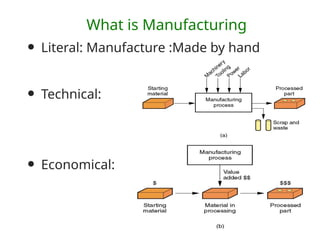
What is Manufacturing
• Literal: Manufacture :Made by hand
• Technical:
• Economical:
Manufacturing Industries
Industry means
• Enterprises or Organizations
Manufacturing Industries
 Industries can be classified as:
1. Primary industries - those that exploit natural
resources, e.g., mining, farming, fishing, petroleum
2. Secondary industries - automotive, computers,
electronics
3. Tertiary industries - service sector
e.g., banking, education, communication, hotels
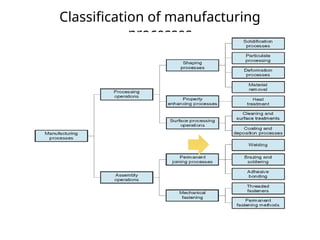
Manufacturing Processes
• Two basic types:
1. Processing - transform a work material
from one state of completion to a more
advanced state
2. Assembly - join two or more components
to create a new entity
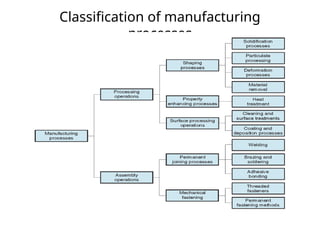
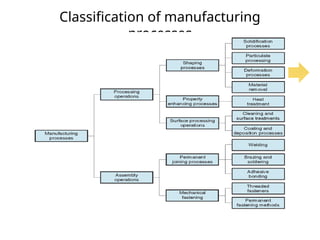
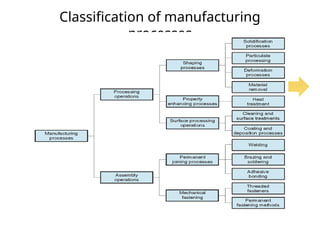
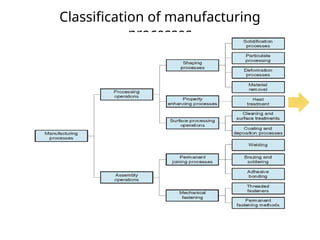
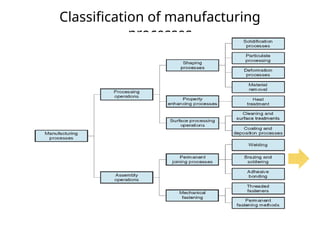
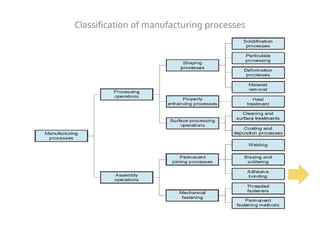
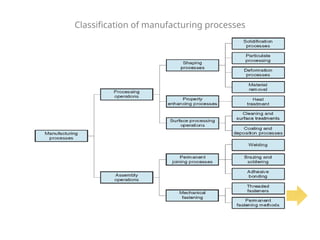
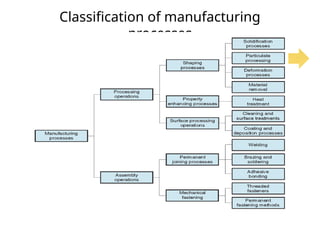
Classification of manufacturing
processes
Processing Operations
 Three categories of processing operations:
1. Shaping - alter the geometry of the starting work
material
2. Property enhancing - improve physical properties
• Heat treatment of metals & glass
3. Surface processing –
• Cleaning
• Surface treatments
• Coating and thin film deposition
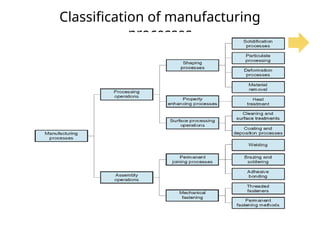
Classification of manufacturing
processes
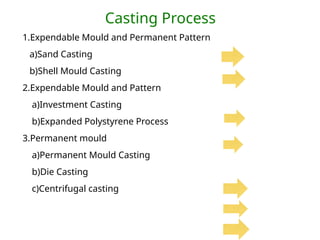
Casting Process
1.Expendable Mould and Permanent Pattern
a)Sand Casting
b)Shell Mould Casting
2.Expendable Mould and Pattern
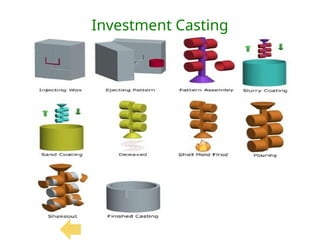
a)Investment Casting
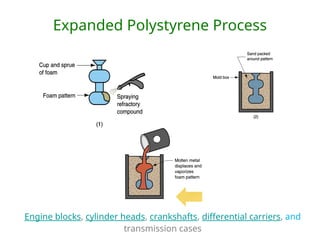
b)Expanded Polystyrene Process
3.Permanent mould
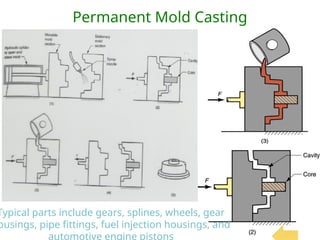
a)Permanent Mould Casting
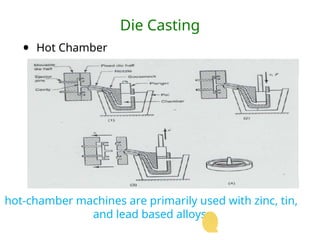
b)Die Casting
c)Centrifugal casting
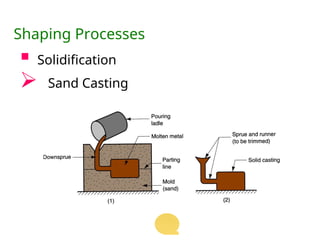
 Solidification
 Sand Casting
Shaping Processes
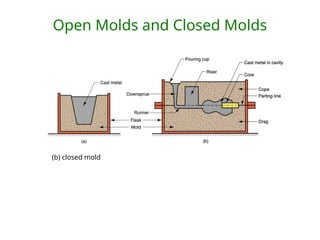
Open Molds and Closed Molds
(a) open mold,
(b) closed mold
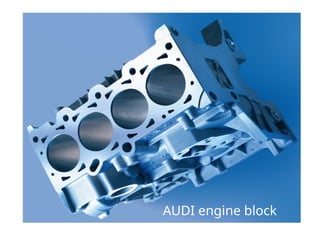
AUDI engine block
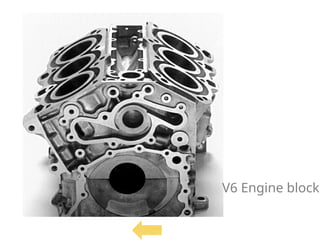
V6 Engine block
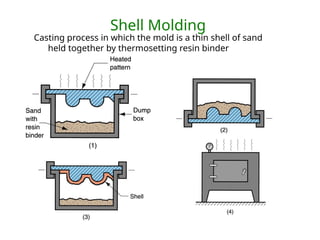
Shell Molding
Casting process in which the mold is a thin shell of sand
held together by thermosetting resin binder
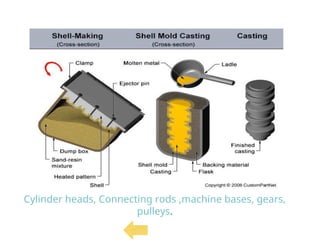
Cylinder heads, Connecting rods ,machine bases, gears,
pulleys.
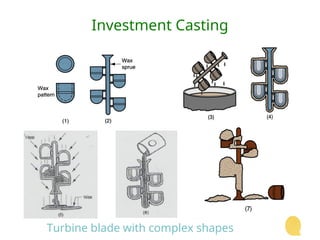
Investment Casting
Turbine blade with complex shapes
Investment Casting
Expanded Polystyrene Process
Engine blocks, cylinder heads, crankshafts, differential carriers, and
transmission cases
Permanent Mold Casting
Typical parts include gears, splines, wheels, gear
ousings, pipe fittings, fuel injection housings, and
automotive engine pistons
Die Casting
• Hot Chamber
hot-chamber machines are primarily used with zinc, tin,
and lead based alloys.
Die Casting
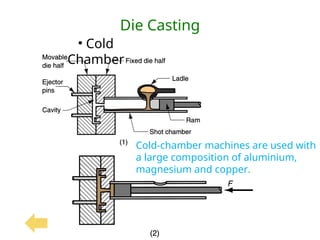
• Cold
Chamber
Cold-chamber machines are used with
a large composition of aluminium,
magnesium and copper.
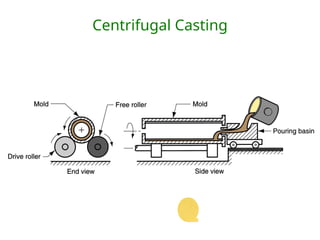
Centrifugal Casting
Classification of manufacturing
processes
Forming Processes: Deformation
• Bulk Deformation
• Sheet Metal Forming
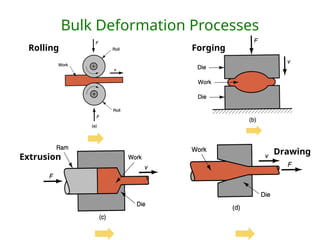
Bulk Deformation Processes
Rolling
Extrusion
Drawing
Forging
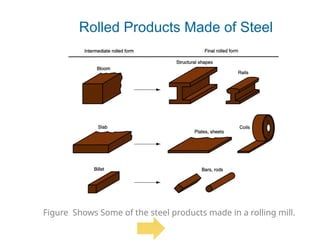
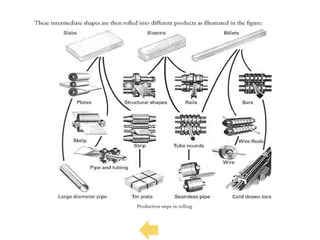
Figure Shows Some of the steel products made in a rolling mill.
Rolled Products Made of Steel
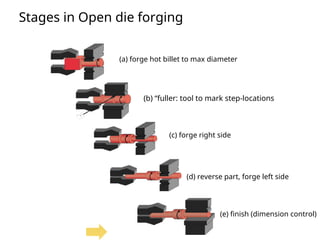
(a) forge hot billet to max diameter
(b) “fuller: tool to mark step-locations
(c) forge right side
(d) reverse part, forge left side
(e) finish (dimension control)
t
Stages in Open die forging
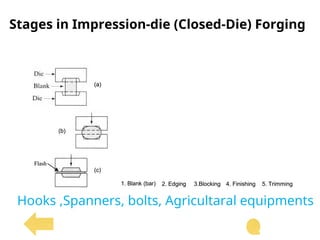
1. Blank (bar) 2. Edging 3.Blocking 4. Finishing 5. Trimming
Flash
(a)
(b)
(c)
1. Blank (bar) 2. Edging 3.Blocking 4. Finishing 5. Trimming
Flash
(a)
(b)
(c)
Flash
(a)
(b)
(c)
Stages in Impression-die (Closed-Die) Forging
Hooks ,Spanners, bolts, Agricultaral equipments
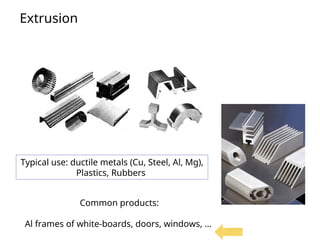
Extrusion
Typical use: ductile metals (Cu, Steel, Al, Mg),
Plastics, Rubbers
Common products:
Al frames of white-boards, doors, windows, …
Extrusion
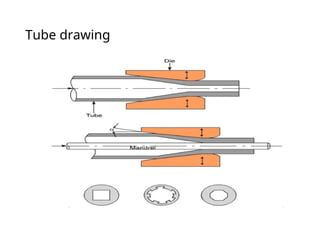
Tube drawing
Forming Processes: Deformation
• Bulk Deformation
• Sheet Metal Forming
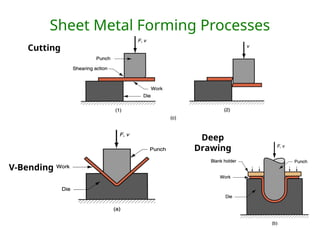
Cutting
Deep
Drawing
Sheet Metal Forming Processes
V-Bending
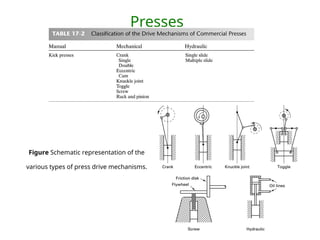
Presses
Figure Schematic representation of the
various types of press drive mechanisms.
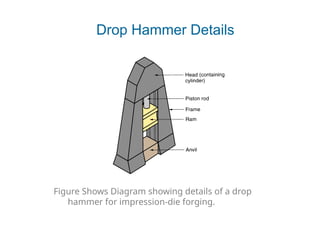
Figure Shows Diagram showing details of a drop
hammer for impression‑die forging.
Drop Hammer Details
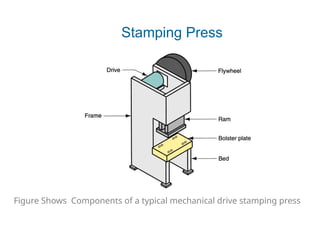
Figure Shows Components of a typical mechanical drive stamping press
Stamping Press
Classification of manufacturing
processes
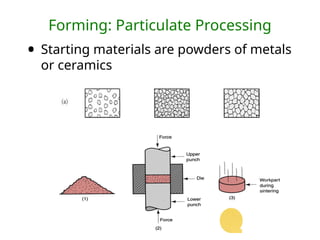
Forming: Particulate Processing
• Starting materials are powders of metals
or ceramics
Classification of manufacturing
processes
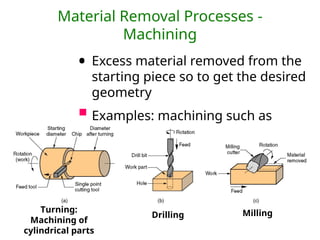
Material Removal Processes -
Machining
• Excess material removed from the
starting piece so to get the desired
geometry
 Examples: machining such as
turning, drilling, and milling; also
grinding and nontraditional
processes
Turning:
Machining of
cylindrical parts
Drilling Milling
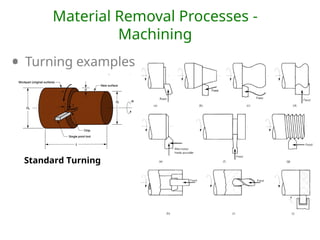
Material Removal Processes -
Machining
• Turning examples
Standard Turning
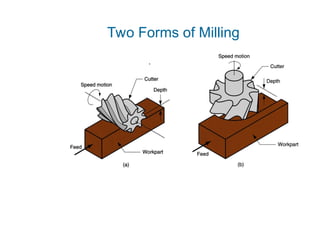
Two Forms of Milling
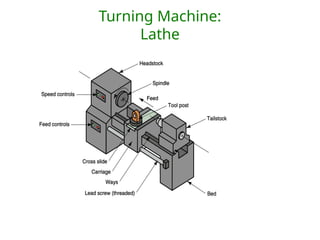
Turning Machine:
Lathe
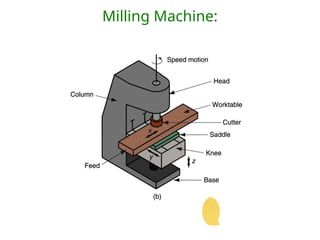
Milling Machine:
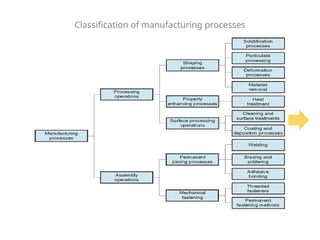
Classification of manufacturing
processes
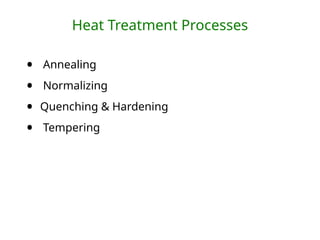
Heat Treatment Processes
• Annealing
• Normalizing
• Quenching & Hardening
• Tempering
Classification of manufacturing processes
Surface Processing Operations
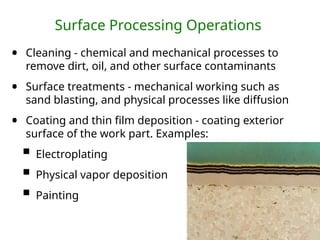
• Cleaning - chemical and mechanical processes to
remove dirt, oil, and other surface contaminants
• Surface treatments - mechanical working such as
sand blasting, and physical processes like diffusion
• Coating and thin film deposition - coating exterior
surface of the work part. Examples:
 Electroplating
 Physical vapor deposition
 Painting
Classification of manufacturing
processes
Figure 31.1 Basic configuration of an arc welding process.
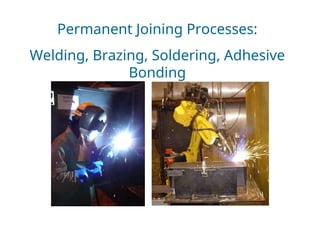
Permanent Joining Processes:
Welding, Brazing, Soldering, Adhesive
Bonding
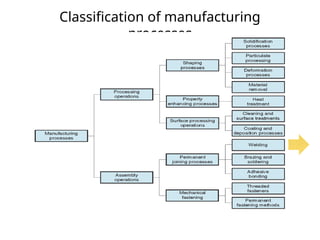
Classification of manufacturing
processes
Welding
• Heat
• Pressure
 Examples: Metallic Parts & Plastics
Types of Welding Processes
• Solid state welding processes
• Liquid state welding processes
• Solid / Liquid state bonding processes
Solid State Welding Processes
Steps Solid State:
• Heating the surfaces without causing
melting and applying normal pressure
• Providing relative motion between the
two surfaces and applying light normal
pressure
• Applying high pressure without melting
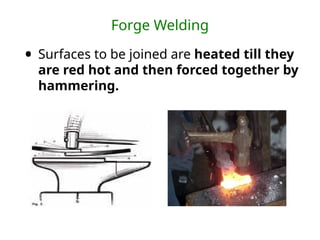
Forge Welding
• Surfaces to be joined are heated till they
are red hot and then forced together by
hammering.
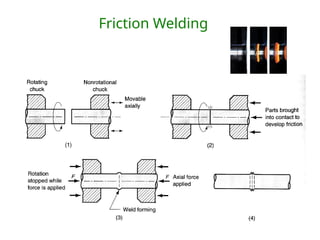
Friction Welding
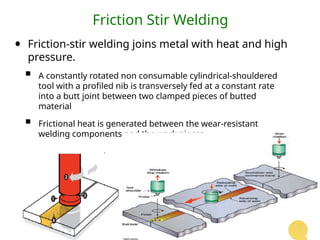
Friction Stir Welding
• Friction-stir welding joins metal with heat and high
pressure.
 A constantly rotated non consumable cylindrical-shouldered
tool with a profiled nib is transversely fed at a constant rate
into a butt joint between two clamped pieces of butted
material
 Frictional heat is generated between the wear-resistant
welding components and the work pieces
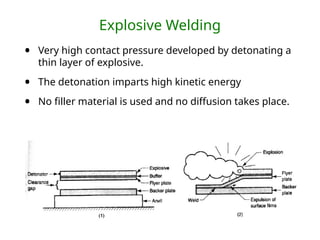
Explosive Welding
• Very high contact pressure developed by detonating a
thin layer of explosive.
• The detonation imparts high kinetic energy
• No filler material is used and no diffusion takes place.
Liquid State Welding
• Arc Welding
• Resistance welding
• Oxyfuel gas welding
Arc Welding
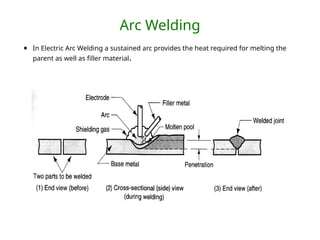
• In Electric Arc Welding a sustained arc provides the heat required for melting the
parent as well as filler material.
Figure 31.1 Basic configuration of an arc welding process.
Arc Welding
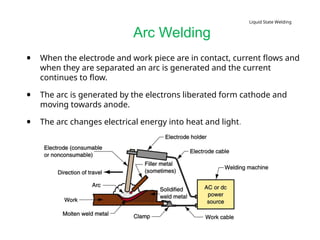
• When the electrode and work piece are in contact, current flows and
when they are separated an arc is generated and the current
continues to flow.
• The arc is generated by the electrons liberated form cathode and
moving towards anode.
• The arc changes electrical energy into heat and light.
Liquid State Welding
Shielded Arc Welding
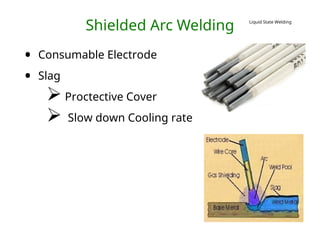
• Consumable Electrode
• Slag
 Proctective Cover
 Slow down Cooling rate
Liquid State Welding
Gas Metal Arc Welding
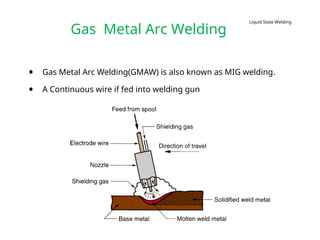
• Gas Metal Arc Welding(GMAW) is also known as MIG welding.
• A Continuous wire if fed into welding gun
Liquid State Welding
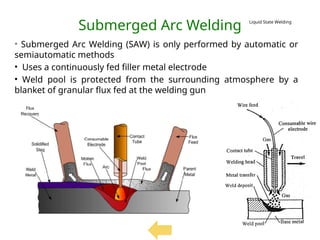
Submerged Arc Welding
• Submerged Arc Welding (SAW) is only performed by automatic or
semiautomatic methods
• Uses a continuously fed filler metal electrode
• Weld pool is protected from the surrounding atmosphere by a
blanket of granular flux fed at the welding gun
Liquid State Welding
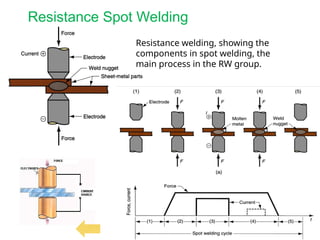
Resistance Spot Welding
Resistance welding, showing the
components in spot welding, the
main process in the RW group.
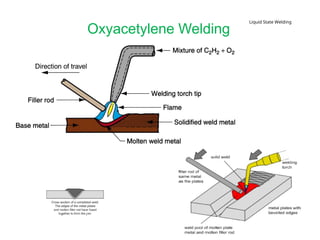
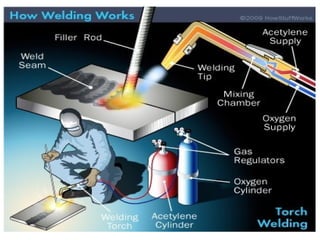
Oxyacetylene Welding
Liquid State Welding
Classification of manufacturing
processes
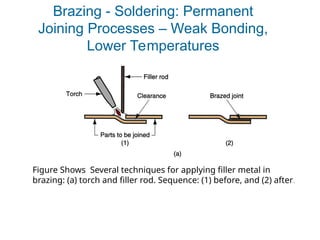
Figure Shows Several techniques for applying filler metal in
brazing: (a) torch and filler rod. Sequence: (1) before, and (2) after.
Brazing - Soldering: Permanent
Joining Processes – Weak Bonding,
Lower Temperatures
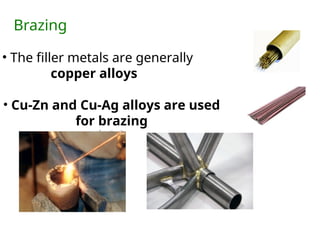
Brazing
• The filler metals are generally
copper alloys.
• Cu-Zn and Cu-Ag alloys are used
for brazing
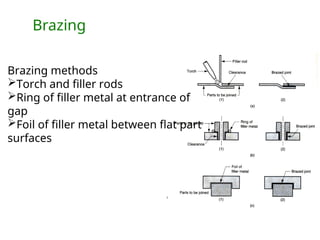
Brazing methods
Torch and filler rods
Ring of filler metal at entrance of
gap
Foil of filler metal between flat part
surfaces
Brazing
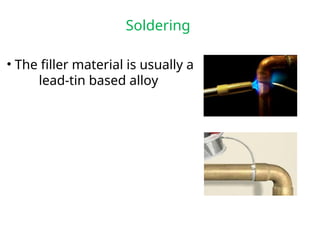
Soldering
• The filler material is usually a
lead-tin based alloy
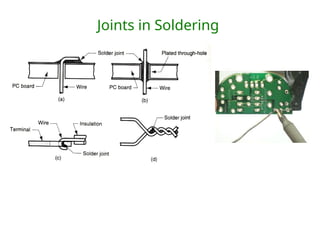
Joints in Soldering
Classification of manufacturing processes
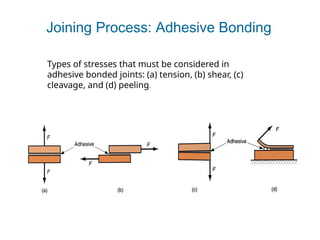
Types of stresses that must be considered in
adhesive bonded joints: (a) tension, (b) shear, (c)
cleavage, and (d) peeling.
Joining Process: Adhesive Bonding
Classification of manufacturing processes
Mechanical Fastening
Threaded ,Permanent
1. Methods that allow for disassembly
Example: threaded fasteners
2.Methods that create a permanent joint
Example: rivets
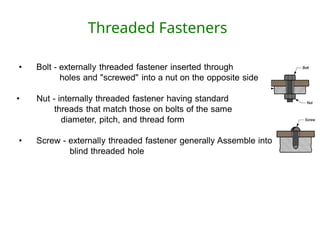
Threaded Fasteners
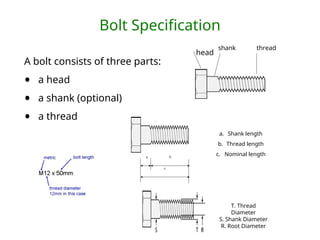
Bolt Specification
A bolt consists of three parts:
• a head
• a shank (optional)
• a thread
T. Thread
Diameter
S. Shank Diameter
R. Root Diameter
a b
c
a. Shank length
b. Thread length
c. Nominal length
shank thread
head
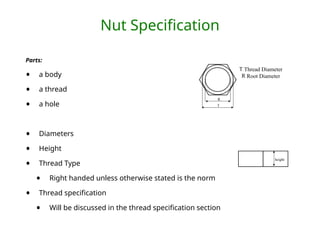
Nut Specification
Parts:
• a body
• a thread
• a hole
• Diameters
• Height
• Thread Type
• Right handed unless otherwise stated is the norm
• Thread specification
• Will be discussed in the thread specification section
R
T
T Thread Diameter
R Root Diameter
height
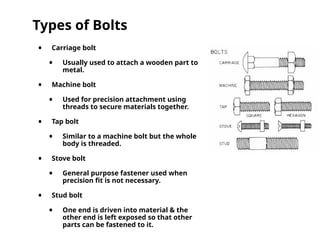
Types of Bolts
• Carriage bolt
• Usually used to attach a wooden part to
metal.
• Machine bolt
• Used for precision attachment using
threads to secure materials together.
• Tap bolt
• Similar to a machine bolt but the whole
body is threaded.
• Stove bolt
• General purpose fastener used when
precision fit is not necessary.
• Stud bolt
• One end is driven into material & the
other end is left exposed so that other
parts can be fastened to it.
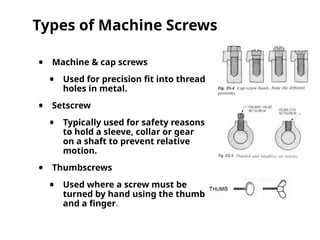
Types of Machine Screws
• Machine & cap screws
• Used for precision fit into thread
holes in metal.
• Setscrew
• Typically used for safety reasons
to hold a sleeve, collar or gear
on a shaft to prevent relative
motion.
• Thumbscrews
• Used where a screw must be
turned by hand using the thumb
and a finger.
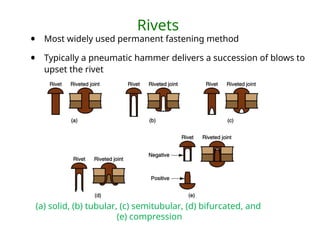
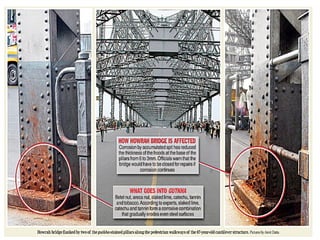
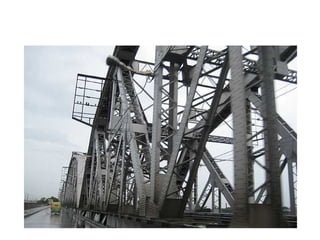
Rivets
• Most widely used permanent fastening method
• Typically a pneumatic hammer delivers a succession of blows to
upset the rivet
Types: (a) solid, (b) tubular, (c) semitubular, (d) bifurcated, and (e)
compression.
(a) solid, (b) tubular, (c) semitubular, (d) bifurcated, and
(e) compression
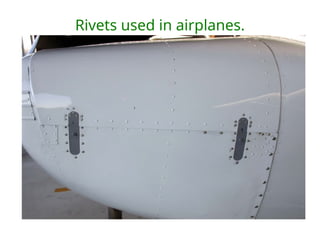
Rivets used in airplanes.
THANKYOU

manufacturing-2214116021115-da894d23.ppt