
Dayalbagh Education Institute
1
 The process of permanently joining two or more
metal parts, by melting both materials. The
molten materials quickly cool, and the two metals
are permanently bonded.
Advantage:
 Higher mechanical properties
 Fixing stress cracks
 Reinforcing weak joints
 Cutting or shaping new parts
2
Oxygen-Acetylene Welding
 Oxygen tank (green)
 Acetylene tank (red, or black with a red top)
 Oxygen pressure valves have a right-hand internal thread
 Acetylene pressure valve has an external left-hand thread.
 An oxygen-acetylene flame is very hot, approaching 3500°F.
3
 Fusion weld is to place the two pieces against each other
and melt their surfaces together.
 Reducing flame is used to melt low-melting-point metals
and alloys because it does not oxidize or corrode the metals.
 Neutral flame is the hottest one possible and is the proper
adjustment for welding.
 Oxidizing flame that can cause corrosion in the metal. It is
only used for cutting flames or burning pieces of metal from
a piece of stock. (Fig 14-9)
4
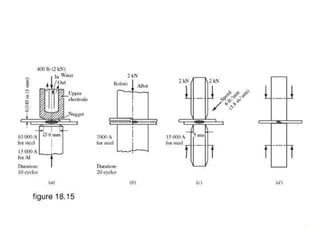
 Resistance Welding – The two parts are pressed
together and an alternating current (A/C) is passed
through the contact zone.
 Spot welding – used extensively on sheet metals
(holds handles on pots, car body together)
 Ribbon welding rollers. - parts to be welded are
drawn between electrodes rollers while electricity
is applied.
5
6
A sustained arc generates the heat for melting the
work piece and filler material.
 Consumable electrodes
 Non-consumable electrodes
7
 Flux Core Arc Welding (FCAW) developed in the early 1950s as
an adaptation to SMAW to overcome limitation imposed by the
use of a stick electrodes. Uses a spool of filler wire fed through the
hand-piece. A core of flux is inside the wire
 Two versions
 Self-shielded flux-cored arc welding – includes not only fluxes
but also ingredients that generate shielding gases for
protecting the arc.
 Gas-shielded flux-cored arc welding – developed primarily for
welding steels, obtains a shielding from externally supplied
gases, similar to GMAW
8
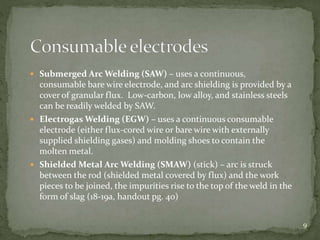
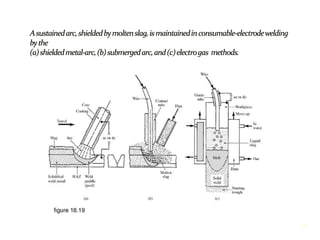
 Submerged Arc Welding (SAW) – uses a continuous,
consumable bare wire electrode, and arc shielding is provided by a
cover of granular flux. Low-carbon, low alloy, and stainless steels
can be readily welded by SAW.
 Electrogas Welding (EGW) – uses a continuous consumable
electrode (either flux-cored wire or bare wire with externally
supplied shielding gases) and molding shoes to contain the
molten metal.
 Shielded Metal Arc Welding (SMAW) (stick) – arc is struck
between the rod (shielded metal covered by flux) and the work
pieces to be joined, the impurities rise to the top of the weld in the
form of slag (18-19a, handout pg. 40)
9
10
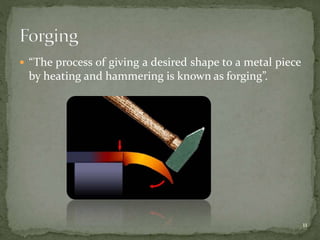
 “The process of giving a desired shape to a metal piece
by heating and hammering is known as forging”.
11
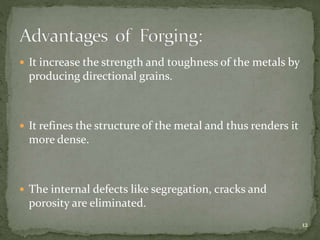
 It increase the strength and toughness of the metals by
producing directional grains.
 It refines the structure of the metal and thus renders it
more dense.
 The internal defects like segregation, cracks and
porosity are eliminated.
12
 Brittle material like cast iron cannot be forged.
 Complex shapes can easily be produced by casting and
not by forging.
 Cost of forging dies is high.
13
 A forged component has the ability to withstand
higher load during service.
 A forged components can be produced to close
tolerance.
 It reduces the machining time, material and labor
considerably.
14
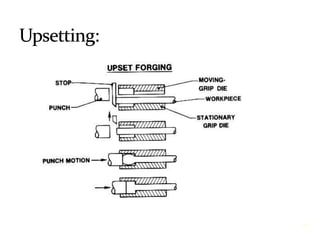
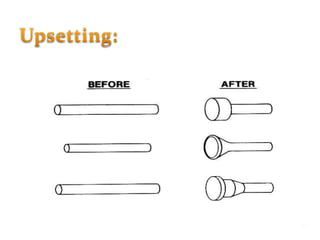
 Upsetting:
upsetting is the process in which the cross
sectional diameter of a hot metal work piece is
increased with a corresponding reduction in its length.
During this process the hot metal piece is held in a tong
and placed on the anvil in vertical position and then is
stroke with a hammer.
15
16
17
 It is also known as drawing down.
 Exactly the reverse of upsetting
 Contrary to upsetting this process is used to reduce the
thickness/width/diameters or increasing the length of
red hot work piece.
18
 Cutting operation is required for removing extra metal
from the job.
 For cutting operation three major things required,
hammer, cutting tool set and the stock.
19
 The process of giving the desired angle or curves to a
hot metal work piece is known as bending.
 The process is done on the edge of anvil.
 Circular shaped, eye bolts, hooks or any other types of
bent shape can be prepared with this operation.
20
 Punching is the operation in which a rough hole is
made into the hot work piece by forcing a punch
through it.
 A red hot job is placed on the anvil and by using a
sledge hammer, the punch is forced to the pierce the
metal up to half of its thickness.
21
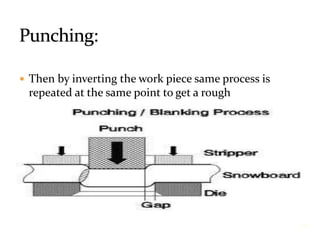
 Then by inverting the work piece same process is
repeated at the same point to get a rough hole.
22
 Is an operation of finishing and enlarging the hole by
hammering a tapered drift into the hole until the
required bore size is reached.
 Is similar to punching and followed by it.
23
 Swaging is the operation of reducing and finishing a
work piece to different desired shapes usually circular,
hexagonal and square.
 Swaging operation is performed with the help of
swages and swag blocks.
 Swages are used for small jobs.
 Swag blocks are used for large jobs.
24
 It is the operation of reducing the thickness of a work
piece.
 In this process the bottom fuller is held in the hole of
the anvil.
 Hot work piece is placed in the grooves of the lower
fuller and then the top fuller is placed over it.
 The hammering operation is carried out until the
piece gets squared thickness.
25
 This operation is performed to level the job surface.
 The red hot metal work piece is placed on the anvil
and is stroked hardly using hammer set to flatten the
metal work piece.
26
 The process of joining two metals by heating and
hammering is known as forge welding.
 The metal pieces to be joined are cleaned and heated
in a furnace up to the welding temperature.
 With the help of tongs these are kept overlapping each
other at the one of their ends on the anvil and are
subjected to hammering.
27
28
 Forge/Furnace/Hearth : Heating furnace
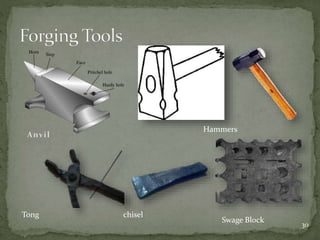
 Anvil :Supporting Tool
 Hammers & set Hammers : Striking Tool
 Tongs: Holding Tool
 Chisels: Cutting Or Shaping Tool
 Fullers: Grooving Tool
 Swages & Swage Block: Shaping Tools
29
Hammers
Tong chisel
Swage Block
30
 Pitting: occurs on the surface of forging due to scales.
 Cold shuts or laps : Short cracks that occurs on the
corners of the surface that are at right angles to each
other
 Die shift : Caused due to misalignment between to
halves of forging dies.
31
 Dents :Caused due to careless working.
 Oxidation & Decarburization : Occur due to
overheating of stock.
 Fins and rags : Small projection or loose metal driven
into the forging surface
32
 Some other common defect are
(a) Incomplete filing of dies
(b) Burnt and overheated metals
(c) Flakes: Internal breaks and rupture
(d) Incorrect size of forging
(e) Tears
(f) Blowholes
(g) Internal cracks
33
Credit to : Amit Gupta
34

Welding

  • 1.
  • 2.
     The processof permanently joining two or more metal parts, by melting both materials. The molten materials quickly cool, and the two metals are permanently bonded. Advantage:  Higher mechanical properties  Fixing stress cracks  Reinforcing weak joints  Cutting or shaping new parts 2
  • 3.
    Oxygen-Acetylene Welding  Oxygentank (green)  Acetylene tank (red, or black with a red top)  Oxygen pressure valves have a right-hand internal thread  Acetylene pressure valve has an external left-hand thread.  An oxygen-acetylene flame is very hot, approaching 3500°F. 3
  • 4.
     Fusion weldis to place the two pieces against each other and melt their surfaces together.  Reducing flame is used to melt low-melting-point metals and alloys because it does not oxidize or corrode the metals.  Neutral flame is the hottest one possible and is the proper adjustment for welding.  Oxidizing flame that can cause corrosion in the metal. It is only used for cutting flames or burning pieces of metal from a piece of stock. (Fig 14-9) 4
  • 5.
     Resistance Welding– The two parts are pressed together and an alternating current (A/C) is passed through the contact zone.  Spot welding – used extensively on sheet metals (holds handles on pots, car body together)  Ribbon welding rollers. - parts to be welded are drawn between electrodes rollers while electricity is applied. 5
  • 6.
  • 7.
    A sustained arcgenerates the heat for melting the work piece and filler material.  Consumable electrodes  Non-consumable electrodes 7
  • 8.
     Flux CoreArc Welding (FCAW) developed in the early 1950s as an adaptation to SMAW to overcome limitation imposed by the use of a stick electrodes. Uses a spool of filler wire fed through the hand-piece. A core of flux is inside the wire  Two versions  Self-shielded flux-cored arc welding – includes not only fluxes but also ingredients that generate shielding gases for protecting the arc.  Gas-shielded flux-cored arc welding – developed primarily for welding steels, obtains a shielding from externally supplied gases, similar to GMAW 8
  • 9.
     Submerged ArcWelding (SAW) – uses a continuous, consumable bare wire electrode, and arc shielding is provided by a cover of granular flux. Low-carbon, low alloy, and stainless steels can be readily welded by SAW.  Electrogas Welding (EGW) – uses a continuous consumable electrode (either flux-cored wire or bare wire with externally supplied shielding gases) and molding shoes to contain the molten metal.  Shielded Metal Arc Welding (SMAW) (stick) – arc is struck between the rod (shielded metal covered by flux) and the work pieces to be joined, the impurities rise to the top of the weld in the form of slag (18-19a, handout pg. 40) 9
  • 10.
  • 11.
     “The processof giving a desired shape to a metal piece by heating and hammering is known as forging”. 11
  • 12.
     It increasethe strength and toughness of the metals by producing directional grains.  It refines the structure of the metal and thus renders it more dense.  The internal defects like segregation, cracks and porosity are eliminated. 12
  • 13.
     Brittle materiallike cast iron cannot be forged.  Complex shapes can easily be produced by casting and not by forging.  Cost of forging dies is high. 13
  • 14.
     A forgedcomponent has the ability to withstand higher load during service.  A forged components can be produced to close tolerance.  It reduces the machining time, material and labor considerably. 14
  • 15.
     Upsetting: upsetting isthe process in which the cross sectional diameter of a hot metal work piece is increased with a corresponding reduction in its length. During this process the hot metal piece is held in a tong and placed on the anvil in vertical position and then is stroke with a hammer. 15
  • 16.
  • 17.
  • 18.
     It isalso known as drawing down.  Exactly the reverse of upsetting  Contrary to upsetting this process is used to reduce the thickness/width/diameters or increasing the length of red hot work piece. 18
  • 19.
     Cutting operationis required for removing extra metal from the job.  For cutting operation three major things required, hammer, cutting tool set and the stock. 19
  • 20.
     The processof giving the desired angle or curves to a hot metal work piece is known as bending.  The process is done on the edge of anvil.  Circular shaped, eye bolts, hooks or any other types of bent shape can be prepared with this operation. 20
  • 21.
     Punching isthe operation in which a rough hole is made into the hot work piece by forcing a punch through it.  A red hot job is placed on the anvil and by using a sledge hammer, the punch is forced to the pierce the metal up to half of its thickness. 21
  • 22.
     Then byinverting the work piece same process is repeated at the same point to get a rough hole. 22
  • 23.
     Is anoperation of finishing and enlarging the hole by hammering a tapered drift into the hole until the required bore size is reached.  Is similar to punching and followed by it. 23
  • 24.
     Swaging isthe operation of reducing and finishing a work piece to different desired shapes usually circular, hexagonal and square.  Swaging operation is performed with the help of swages and swag blocks.  Swages are used for small jobs.  Swag blocks are used for large jobs. 24
  • 25.
     It isthe operation of reducing the thickness of a work piece.  In this process the bottom fuller is held in the hole of the anvil.  Hot work piece is placed in the grooves of the lower fuller and then the top fuller is placed over it.  The hammering operation is carried out until the piece gets squared thickness. 25
  • 26.
     This operationis performed to level the job surface.  The red hot metal work piece is placed on the anvil and is stroked hardly using hammer set to flatten the metal work piece. 26
  • 27.
     The processof joining two metals by heating and hammering is known as forge welding.  The metal pieces to be joined are cleaned and heated in a furnace up to the welding temperature.  With the help of tongs these are kept overlapping each other at the one of their ends on the anvil and are subjected to hammering. 27
  • 28.
  • 29.
     Forge/Furnace/Hearth :Heating furnace  Anvil :Supporting Tool  Hammers & set Hammers : Striking Tool  Tongs: Holding Tool  Chisels: Cutting Or Shaping Tool  Fullers: Grooving Tool  Swages & Swage Block: Shaping Tools 29
  • 30.
  • 31.
     Pitting: occurson the surface of forging due to scales.  Cold shuts or laps : Short cracks that occurs on the corners of the surface that are at right angles to each other  Die shift : Caused due to misalignment between to halves of forging dies. 31
  • 32.
     Dents :Causeddue to careless working.  Oxidation & Decarburization : Occur due to overheating of stock.  Fins and rags : Small projection or loose metal driven into the forging surface 32
  • 33.
     Some othercommon defect are (a) Incomplete filing of dies (b) Burnt and overheated metals (c) Flakes: Internal breaks and rupture (d) Incorrect size of forging (e) Tears (f) Blowholes (g) Internal cracks 33
  • 34.
    Credit to :Amit Gupta 34