SURFACE MODIFICATION OF
MATERIALS
I. Mechanical surface treatment and coating
II. Case hardening
III. Hardfacing
By
SHINE GEORGE
27/02/2016
SURFACE MODIFICATION OF MATERIALS
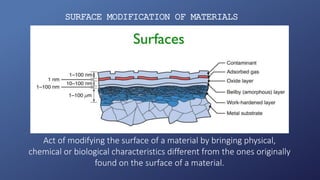
Act of modifying the surface of a material by bringing physical,
chemical or biological characteristics different from the ones originally
found on the surface of a material.
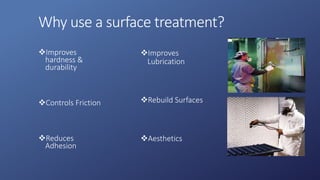
Why use a surface treatment?
Improves
hardness &
durability
Controls Friction
Reduces
Adhesion
Improves
Lubrication
Rebuild Surfaces
Aesthetics
SURFACE MODIFICATION OF MATERIALS
Types
 Mechanical surface treatment and coating
 Case hardening and hardfacing
 Thermal spraying
 Vapour deposition
 Ion implantation
 Diffusion coating
 Electroplating and Electroforming
 Conversion coating
 Ceramic and organic coating
 Diamond coating
 Advanced surface modification of steels.
SURFACE MODIFICATION OF MATERIALS
Here we are discussing the following
 Mechanical surface treatment and coating
 Case hardening
 Hardfacing
MECHANICAL SURFACE TREATMENTAND COATING
 Surface treatment
1.Shot peening
2.Water-jet peening
3.Laser peening
4.Explosive hardening
 Coating
1. Mechanical plating
MECHANICAL SURFACETREATMENTS
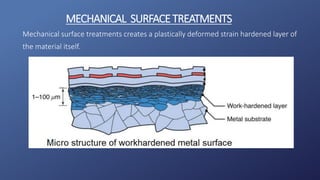
Mechanical surface treatments creates a plastically deformed strain hardened layer of
the material itself.
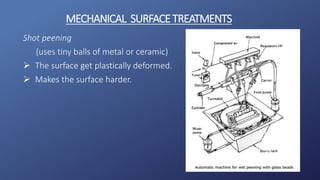
Shot peening
(uses tiny balls of metal or ceramic)
 The surface get plastically deformed.
 Makes the surface harder.
MECHANICAL SURFACETREATMENTS
Examples
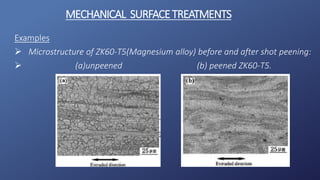
 Microstructure of ZK60-T5(Magnesium alloy) before and after shot peening:
 (a)unpeened (b) peened ZK60-T5.
MECHANICAL SURFACETREATMENTS
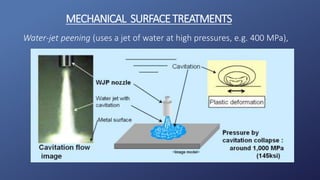
Water-jet peening (uses a jet of water at high pressures, e.g. 400 MPa),
MECHANICAL SURFACETREATMENTS
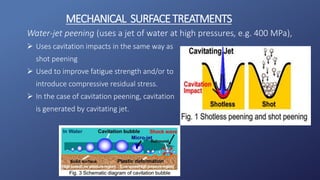
Water-jet peening (uses a jet of water at high pressures, e.g. 400 MPa),
 Uses cavitation impacts in the same way as
shot peening
 Used to improve fatigue strength and/or to
introduce compressive residual stress.
 In the case of cavitation peening, cavitation
is generated by cavitating jet.
MECHANICAL SURFACETREATMENTS
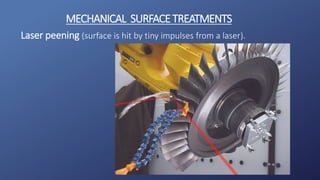
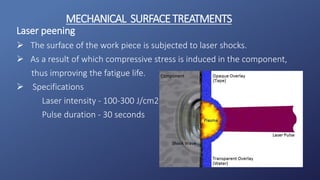
Laser peening (surface is hit by tiny impulses from a laser).
MECHANICAL SURFACETREATMENTS
Laser peening
 The surface of the work piece is subjected to laser shocks.
 As a result of which compressive stress is induced in the component,
thus improving the fatigue life.
 Specifications
Laser intensity - 100-300 J/cm2
Pulse duration - 30 seconds
MECHANICAL SURFACETREATMENTS
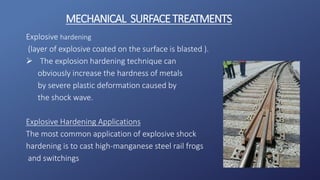
Explosive hardening
(layer of explosive coated on the surface is blasted ).
 The explosion hardening technique can
obviously increase the hardness of metals
by severe plastic deformation caused by
the shock wave.
Explosive Hardening Applications
The most common application of explosive shock
hardening is to cast high-manganese steel rail frogs
and switchings
MECHANICAL SURFACETREATMENTS
Features of Explosive Hardening
Hardening effects deepen and increase through subsequent applications of the
explosive-hardening process.
This effect begins to taper off significantly after four applications of the process.
Hardness values in cast manganese steel components have shown hardness
increases of 230 Bhn, and up to 1/4″ deep.
Metallurgical analysis of shock hardened Hadfield’s steel and high-manganese steel
have shown a martensitic transformation in the hardened zone.
There are essentially no size or configuration limits to the application of explosive
shock hardening.
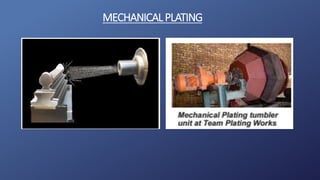
MECHANICALPLATING
MECHANICALPLATING
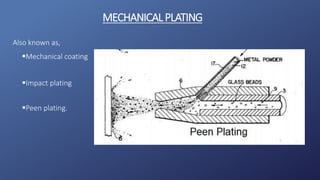
Also known as,
Mechanical coating
Impact plating
Peen plating.
MECHANICALPLATING
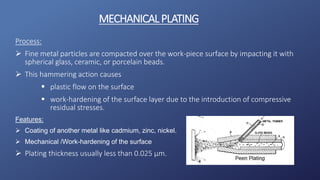
Process:
 Fine metal particles are compacted over the work-piece surface by impacting it with
spherical glass, ceramic, or porcelain beads.
 This hammering action causes
 plastic flow on the surface
 work-hardening of the surface layer due to the introduction of compressive
residual stresses.
Features:
 Coating of another metal like cadmium, zinc, nickel.
 Mechanical /Work-hardening of the surface
 Plating thickness usually less than 0.025 µm.
MECHANICALPLATING
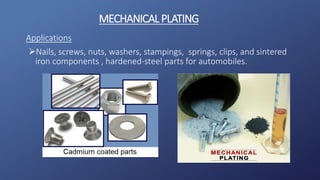
Applications
Nails, screws, nuts, washers, stampings, springs, clips, and sintered
iron components , hardened-steel parts for automobiles.
MECHANICALPLATING
MECHANICAL SURFACE TREATMENTAND COATING
Precautions
 Overpeening reduces fatigue strength of the product.
 The surface of the substrate must be thoroughly cleaned before mechanical
coating
 Adequate cooling must be provided to avoid heating of the work piece while
processing
 Necessary masking should be provided in the case of products with
complicated cross sections.
 The work should be free from any cracks.
 Use of Cadmium and such additives may be subjected to legislation.
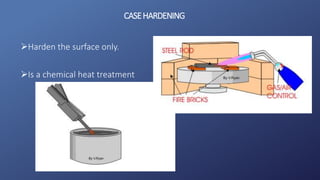
CASEHARDENING
Harden the surface only.
Is a chemical heat treatment
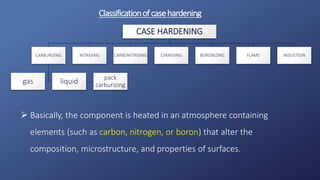
Classificationofcasehardening
CASE HARDENING
CARBURIZING
liquid
pack
carburizinggas
NITRIDING CARBONITRIDING CYANIDING BORONIZING FLAME INDUCTION
 Basically, the component is heated in an atmosphere containing
elements (such as carbon, nitrogen, or boron) that alter the
composition, microstructure, and properties of surfaces.
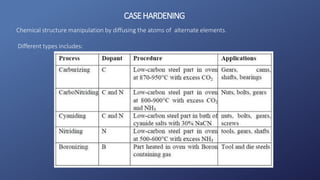
Chemical structure manipulation by diffusing the atoms of alternate elements.
Different types includes:
CASEHARDENING
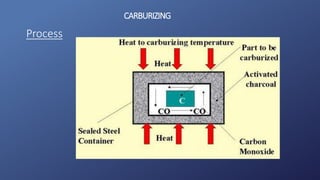
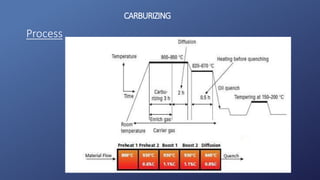
CARBURIZING
Process
CARBURIZING
Process
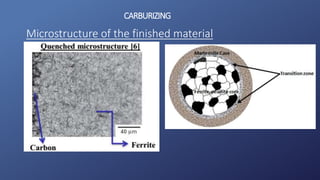
CARBURIZING
Microstructure of the finished material
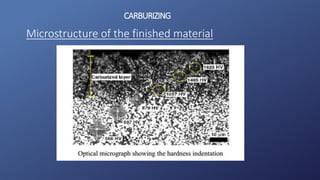
CARBURIZING
Microstructure of the finished material
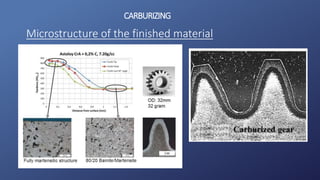
CARBURIZING
Microstructure of the finished material
CARBURIZING
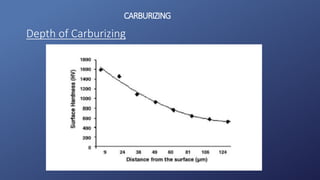
Depth of Carburizing
CARBURIZING
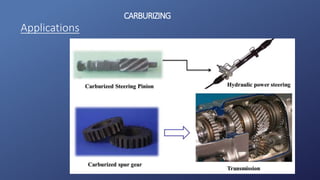
Applications
NITRIDING
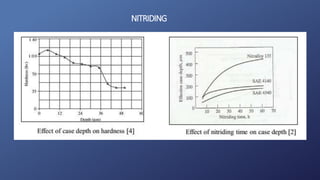
 Nitrogen is diffused into the surface of the component being treated.
 Nitriding Temperature: 500-600°C [2]
NITRIDING
NITRIDING
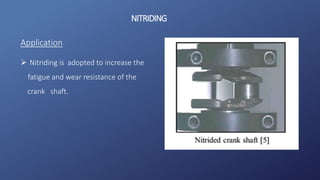
Application
 Nitriding is adopted to increase the
fatigue and wear resistance of the
crank shaft.
CARBONITRIDING
 Carbonitriding introduces carbon and nitrogen into the austenite of steel.
 This treatment is similar to carburizing .
 Nitrogen enhances hardenability,
 Thus it is possible the use of low-carbon steel to achieve surface hardness
equivalent to that of high-alloy carburized steel.
 No need for drastic quenching, resulting in less distortion and minimizing potential
for cracks.
INDUCTIONHARDENING
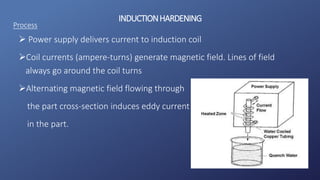
 Power supply delivers current to induction coil
Coil currents (ampere-turns) generate magnetic field. Lines of field
always go around the coil turns
Alternating magnetic field flowing through
the part cross-section induces eddy current
in the part.
Process
INDUCTIONHARDENING
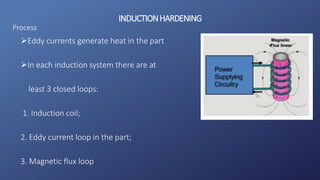
Eddy currents generate heat in the part
In each induction system there are at
least 3 closed loops:
1. Induction coil;
2. Eddy current loop in the part;
3. Magnetic flux loop
Process
INDUCTIONHARDENING
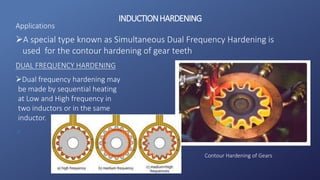
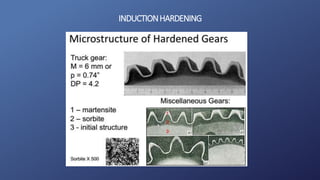
A special type known as Simultaneous Dual Frequency Hardening is
used for the contour hardening of gear teeth
DUAL FREQUENCY HARDENING
Dual frequency hardening may
be made by sequential heating
at Low and High frequency in
two inductors or in the same
inductor.

Applications
Contour Hardening of Gears
INDUCTIONHARDENING
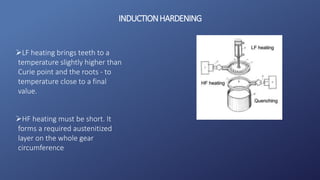
LF heating brings teeth to a
temperature slightly higher than
Curie point and the roots - to
temperature close to a final
value.
HF heating must be short. It
forms a required austenitized
layer on the whole gear
circumference
INDUCTIONHARDENING
INDUCTIONHARDENING
Features and advantages
 Induction hardening is characterized by precise
energy metering.
 Ultra low power consumption.
 Short process times.
 Targets surface layer alone.
 Save energy and reduce rework effort.
Advantages Of Case Hardening Over Through Hardening
Improves properties desirable to surface only such as
resistance to surface indentation, fatigue, and wear.
Gives toughness for intended applications.
 Prevention of propagation of any surface crack through the part which
may otherwise cause total failure.
 Case-hardened parts have a hardness gradient. Typically, the
hardness is greatest at the surface and decreases below the surface,
the rate of decrease depending on the composition of the metal and
process variables.
 Carburization produces hard, wear resistant layer on the surface.
 Typically, case hardens low carbon steel.
Advantagesoverthroughhardening
CASEHARDENING
Precautions
 Except induction and flame hardening, the substrate should be of
low carbon content.
 Temperature and duration of heating should be controlled
precisely.
 Quantity of enriching gas should be adequate.
 To avoid distortion and cracking of the product, Quenching must
be done carefully
HARD FACING
Process
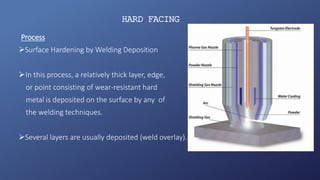
Surface Hardening by Welding Deposition
In this process, a relatively thick layer, edge,
or point consisting of wear-resistant hard
metal is deposited on the surface by any of
the welding techniques.
Several layers are usually deposited (weld overlay).
HARD FACING
 Hard coatings of tungsten carbide, chromium, and molybdenum carbide can
also be deposited using an electric arc in a process called spark hardening,
electric spark hardening, or electrospark deposition.
 Hard-facing alloys are available as electrodes, rods, wire, and powder.
HARD FACING
Applications
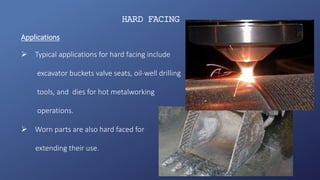
 Typical applications for hard facing include
excavator buckets valve seats, oil-well drilling
tools, and dies for hot metalworking
operations.
 Worn parts are also hard faced for
extending their use.
REFERENCES
1. Anon., Surface Treatment, Coating and
Cleaning,http://www.ielm.ust.hk/dfaculty/ajay/courses/ieem215/lecs/9_surfacetreatment.pdf,retrieved on
29.12.2012.
2. Kenneth G. Budinski and Michael K. Budinski., (2009) Engineering Materials: Properties and Selection, 9th
edition, Prentice Hall Publishers.
3. Anon., Heat Treatment Properties, http://www.tohokusteel.com/en/pages/kirin1.htm, retrieved on 29.12.2012.
4. Hiroshi Yamagatta – “Science and technology of materials” [pg 180 onwards].
5. Induction hardening - http://www.ustudy.in/node/4157
6. Mark davis – “Gear hardening goes green”
http://www.eldec.de/fileadmin/00_Dateien/PDF/Veroeffentlichungen/0909_GearSolutions.pdf
REFERENCES
7. Daewei heating machine co., ltd - http://www.dw-inductionheating.com/hardeninginduction-
heating-applications.html/hardening-induction-heating, retrieved on 29.12.2012
8. Volume 05 Surface Engineering - Cleaning, Finishing and Coating- by ASM
9. Effect of Shot Peening on Surface Characteristics and Fatigue Properties of T5-Treated ZK60 Alloy-
Wencai Liu 1, Jie Dong 1 ;*, Ping Zhang 2, Chunquan Zhai 1 ; 3 and Wenjiang Ding 1 ; 3 1 National
Engineering Research Center of Light Alloy Net Forming, School of Materials Science and
Engineering,
10. http://mechanicalplating.com/glass_be.htm]
11. H. Soyama and O. Takakuwa, Journal of Fluid Science and Technology, Vol. 6 (2011), pp. 510-521.
Queries
Mechanical Plating,Casehardening ,Hardfacing

Mechanical Plating,Casehardening ,Hardfacing

  • 1.
    SURFACE MODIFICATION OF MATERIALS I.Mechanical surface treatment and coating II. Case hardening III. Hardfacing By SHINE GEORGE 27/02/2016
  • 2.
    SURFACE MODIFICATION OFMATERIALS Act of modifying the surface of a material by bringing physical, chemical or biological characteristics different from the ones originally found on the surface of a material.
  • 3.
    Why use asurface treatment? Improves hardness & durability Controls Friction Reduces Adhesion Improves Lubrication Rebuild Surfaces Aesthetics
  • 4.
    SURFACE MODIFICATION OFMATERIALS Types  Mechanical surface treatment and coating  Case hardening and hardfacing  Thermal spraying  Vapour deposition  Ion implantation  Diffusion coating  Electroplating and Electroforming  Conversion coating  Ceramic and organic coating  Diamond coating  Advanced surface modification of steels.
  • 5.
    SURFACE MODIFICATION OFMATERIALS Here we are discussing the following  Mechanical surface treatment and coating  Case hardening  Hardfacing
  • 6.
    MECHANICAL SURFACE TREATMENTANDCOATING  Surface treatment 1.Shot peening 2.Water-jet peening 3.Laser peening 4.Explosive hardening  Coating 1. Mechanical plating
  • 7.
    MECHANICAL SURFACETREATMENTS Mechanical surfacetreatments creates a plastically deformed strain hardened layer of the material itself.
  • 8.
    Shot peening (uses tinyballs of metal or ceramic)  The surface get plastically deformed.  Makes the surface harder. MECHANICAL SURFACETREATMENTS
  • 9.
    Examples  Microstructure ofZK60-T5(Magnesium alloy) before and after shot peening:  (a)unpeened (b) peened ZK60-T5. MECHANICAL SURFACETREATMENTS
  • 10.
    Water-jet peening (usesa jet of water at high pressures, e.g. 400 MPa), MECHANICAL SURFACETREATMENTS
  • 11.
    Water-jet peening (usesa jet of water at high pressures, e.g. 400 MPa),  Uses cavitation impacts in the same way as shot peening  Used to improve fatigue strength and/or to introduce compressive residual stress.  In the case of cavitation peening, cavitation is generated by cavitating jet. MECHANICAL SURFACETREATMENTS
  • 12.
    Laser peening (surfaceis hit by tiny impulses from a laser). MECHANICAL SURFACETREATMENTS
  • 13.
    Laser peening  Thesurface of the work piece is subjected to laser shocks.  As a result of which compressive stress is induced in the component, thus improving the fatigue life.  Specifications Laser intensity - 100-300 J/cm2 Pulse duration - 30 seconds MECHANICAL SURFACETREATMENTS
  • 14.
    Explosive hardening (layer ofexplosive coated on the surface is blasted ).  The explosion hardening technique can obviously increase the hardness of metals by severe plastic deformation caused by the shock wave. Explosive Hardening Applications The most common application of explosive shock hardening is to cast high-manganese steel rail frogs and switchings MECHANICAL SURFACETREATMENTS
  • 15.
    Features of ExplosiveHardening Hardening effects deepen and increase through subsequent applications of the explosive-hardening process. This effect begins to taper off significantly after four applications of the process. Hardness values in cast manganese steel components have shown hardness increases of 230 Bhn, and up to 1/4″ deep. Metallurgical analysis of shock hardened Hadfield’s steel and high-manganese steel have shown a martensitic transformation in the hardened zone. There are essentially no size or configuration limits to the application of explosive shock hardening. MECHANICALPLATING
  • 16.
    MECHANICALPLATING Also known as, Mechanicalcoating Impact plating Peen plating.
  • 17.
  • 18.
    Process:  Fine metalparticles are compacted over the work-piece surface by impacting it with spherical glass, ceramic, or porcelain beads.  This hammering action causes  plastic flow on the surface  work-hardening of the surface layer due to the introduction of compressive residual stresses. Features:  Coating of another metal like cadmium, zinc, nickel.  Mechanical /Work-hardening of the surface  Plating thickness usually less than 0.025 µm. MECHANICALPLATING
  • 19.
    Applications Nails, screws, nuts,washers, stampings, springs, clips, and sintered iron components , hardened-steel parts for automobiles. MECHANICALPLATING
  • 20.
    MECHANICAL SURFACE TREATMENTANDCOATING Precautions  Overpeening reduces fatigue strength of the product.  The surface of the substrate must be thoroughly cleaned before mechanical coating  Adequate cooling must be provided to avoid heating of the work piece while processing  Necessary masking should be provided in the case of products with complicated cross sections.  The work should be free from any cracks.  Use of Cadmium and such additives may be subjected to legislation.
  • 21.
    CASEHARDENING Harden the surfaceonly. Is a chemical heat treatment
  • 22.
    Classificationofcasehardening CASE HARDENING CARBURIZING liquid pack carburizinggas NITRIDING CARBONITRIDINGCYANIDING BORONIZING FLAME INDUCTION  Basically, the component is heated in an atmosphere containing elements (such as carbon, nitrogen, or boron) that alter the composition, microstructure, and properties of surfaces.
  • 23.
    Chemical structure manipulationby diffusing the atoms of alternate elements. Different types includes: CASEHARDENING
  • 24.
  • 25.
  • 26.
  • 27.
  • 28.
  • 29.
  • 30.
  • 31.
    NITRIDING  Nitrogen isdiffused into the surface of the component being treated.  Nitriding Temperature: 500-600°C [2]
  • 32.
  • 33.
    NITRIDING Application  Nitriding isadopted to increase the fatigue and wear resistance of the crank shaft.
  • 34.
    CARBONITRIDING  Carbonitriding introducescarbon and nitrogen into the austenite of steel.  This treatment is similar to carburizing .  Nitrogen enhances hardenability,  Thus it is possible the use of low-carbon steel to achieve surface hardness equivalent to that of high-alloy carburized steel.  No need for drastic quenching, resulting in less distortion and minimizing potential for cracks.
  • 35.
    INDUCTIONHARDENING  Power supplydelivers current to induction coil Coil currents (ampere-turns) generate magnetic field. Lines of field always go around the coil turns Alternating magnetic field flowing through the part cross-section induces eddy current in the part. Process
  • 36.
    INDUCTIONHARDENING Eddy currents generateheat in the part In each induction system there are at least 3 closed loops: 1. Induction coil; 2. Eddy current loop in the part; 3. Magnetic flux loop Process
  • 37.
    INDUCTIONHARDENING A special typeknown as Simultaneous Dual Frequency Hardening is used for the contour hardening of gear teeth DUAL FREQUENCY HARDENING Dual frequency hardening may be made by sequential heating at Low and High frequency in two inductors or in the same inductor.  Applications Contour Hardening of Gears
  • 38.
    INDUCTIONHARDENING LF heating bringsteeth to a temperature slightly higher than Curie point and the roots - to temperature close to a final value. HF heating must be short. It forms a required austenitized layer on the whole gear circumference
  • 39.
  • 40.
    INDUCTIONHARDENING Features and advantages Induction hardening is characterized by precise energy metering.  Ultra low power consumption.  Short process times.  Targets surface layer alone.  Save energy and reduce rework effort.
  • 41.
    Advantages Of CaseHardening Over Through Hardening Improves properties desirable to surface only such as resistance to surface indentation, fatigue, and wear. Gives toughness for intended applications.  Prevention of propagation of any surface crack through the part which may otherwise cause total failure.
  • 42.
     Case-hardened partshave a hardness gradient. Typically, the hardness is greatest at the surface and decreases below the surface, the rate of decrease depending on the composition of the metal and process variables.  Carburization produces hard, wear resistant layer on the surface.  Typically, case hardens low carbon steel. Advantagesoverthroughhardening
  • 43.
    CASEHARDENING Precautions  Except inductionand flame hardening, the substrate should be of low carbon content.  Temperature and duration of heating should be controlled precisely.  Quantity of enriching gas should be adequate.  To avoid distortion and cracking of the product, Quenching must be done carefully
  • 44.
    HARD FACING Process Surface Hardeningby Welding Deposition In this process, a relatively thick layer, edge, or point consisting of wear-resistant hard metal is deposited on the surface by any of the welding techniques. Several layers are usually deposited (weld overlay).
  • 45.
    HARD FACING  Hardcoatings of tungsten carbide, chromium, and molybdenum carbide can also be deposited using an electric arc in a process called spark hardening, electric spark hardening, or electrospark deposition.  Hard-facing alloys are available as electrodes, rods, wire, and powder.
  • 46.
    HARD FACING Applications  Typicalapplications for hard facing include excavator buckets valve seats, oil-well drilling tools, and dies for hot metalworking operations.  Worn parts are also hard faced for extending their use.
  • 47.
    REFERENCES 1. Anon., SurfaceTreatment, Coating and Cleaning,http://www.ielm.ust.hk/dfaculty/ajay/courses/ieem215/lecs/9_surfacetreatment.pdf,retrieved on 29.12.2012. 2. Kenneth G. Budinski and Michael K. Budinski., (2009) Engineering Materials: Properties and Selection, 9th edition, Prentice Hall Publishers. 3. Anon., Heat Treatment Properties, http://www.tohokusteel.com/en/pages/kirin1.htm, retrieved on 29.12.2012. 4. Hiroshi Yamagatta – “Science and technology of materials” [pg 180 onwards]. 5. Induction hardening - http://www.ustudy.in/node/4157 6. Mark davis – “Gear hardening goes green” http://www.eldec.de/fileadmin/00_Dateien/PDF/Veroeffentlichungen/0909_GearSolutions.pdf
  • 48.
    REFERENCES 7. Daewei heatingmachine co., ltd - http://www.dw-inductionheating.com/hardeninginduction- heating-applications.html/hardening-induction-heating, retrieved on 29.12.2012 8. Volume 05 Surface Engineering - Cleaning, Finishing and Coating- by ASM 9. Effect of Shot Peening on Surface Characteristics and Fatigue Properties of T5-Treated ZK60 Alloy- Wencai Liu 1, Jie Dong 1 ;*, Ping Zhang 2, Chunquan Zhai 1 ; 3 and Wenjiang Ding 1 ; 3 1 National Engineering Research Center of Light Alloy Net Forming, School of Materials Science and Engineering, 10. http://mechanicalplating.com/glass_be.htm] 11. H. Soyama and O. Takakuwa, Journal of Fluid Science and Technology, Vol. 6 (2011), pp. 510-521.
  • 49.