Electricity Distribution SystemJasjit Singh Jolly EEE-7thsem0311324908
BSES Rajdhani power ltdBSES: Bombay suburban electricity supplyBRPL distrbutes power to an area spread over 750 km serving over 12.2 lakh customers spread over 19 districts across south and west zones of Delhi including Alaknanda, khanpur, saket, nehru place, vasant vihar etc bses has invested rs 3500cr in Delhi.
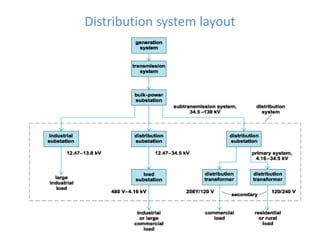
Distribution system layout
The generation generally takes place at voltages around 3.3kV to around 22kV which is medium voltage.The voltage is then stepped up to a level of 110kV or 220 kV (high voltage) or even 400kV (extra high voltage) depending on the amount of power to be transmitted .
At distribution stations the power is stepped down to a voltage of 430/250 V for customers taking into account the voltage drop in distribution lines.
In India the power supply to the residential premises is at 240V,single phase, 50Hz ac. The three phase supply is at 415V. Saket D-block substationTotal no. of transformers: 2Oil immersed step down delta/star transformersCapacity : 1250kVARated Primary Voltage : 11KVSecondary Voltage : 416/240VInput HT lines: 11kV from Malviya Nagar grid& 11kV from LadoSaraiIntegral part of the ring main distribution system
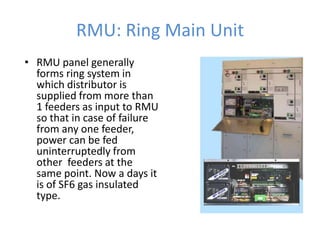
RMU: Ring Main UnitRMU panel generally forms ring system in which distributor is supplied from more than 1 feeders as input to RMU so that in case of failure from any one feeder, power can be fed uninterruptedly from other  feeders at the same point. Now a days it is of SF6 gas insulated type.
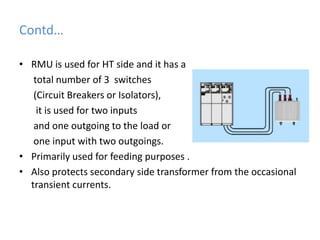
Contd…RMU is used for HT side and it has a     total number of 3  switches(Circuit Breakers or Isolators),it is used for two inputs     and one outgoing to the load or      one input with two outgoings. Primarily used for feeding purposes .Also protects secondary side transformer from the occasional transient currents.
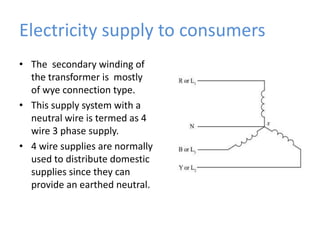
Electricity supply to consumersThe  secondary winding of the transformer is  mostly  of wye connection type.This supply system with a neutral wire is termed as 4 wire 3 phase supply.4 wire supplies are normally used to distribute domestic supplies since they can provide an earthed neutral.
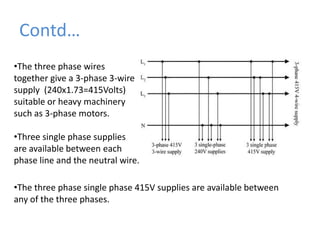
Contd…The three phase wires together give a 3-phase 3-wire supply  (240x1.73=415Volts) suitable or heavy machinery such as 3-phase motors.
Three single phase supplies are available between each phase line and the neutral wire.
The three phase single phase 415V supplies are available between any of the three phases.Contd…For distribution to consumers either overhead or underground lines are used.The underground system is much expensive as compared to overhead system and is only used in areas where safety and good appearance are of prime importance.For domestic users a phase and a neutral connection is supplied whereas  for those with heavy load requirements 3 wire connection is supplied.
Faults in distribution linesTransient Faults: A transient fault is a fault that is no longer present if power is disconnected for a short time. For eg - momentary tree or bird contact.Persistent Faults: A persistent fault does not disappear when power is disconnected. Faults in underground power cables are often persistent. These occur due to some external damage.
Contd…Faults can further be classified as symmetric or asymmetric faults.Symmetric faults: Equal fault currents in line with 120 deg displacement.  Rare in nature. Eg - (L-L-L) or (L-L-L-G) faults.Asymmetric faults: Unequal fault currents with unequal phase displacement. Most likely to occur. Eg – (L-L) or (L-L-G) or (L-G) faults.
Fault detectionTo detect the exact location of a high resistance fault in underground transmission lines Arc Reflection Method (ARM) is used.LSG 300 surge generator manufactured by sebaKMT is use to testing purposes.
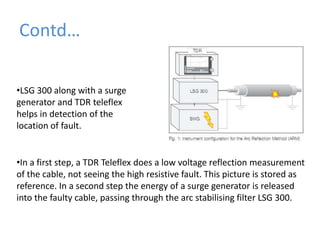
Contd…LSG 300 along with a surge generator and TDR teleflex helps in detection of the location of fault.
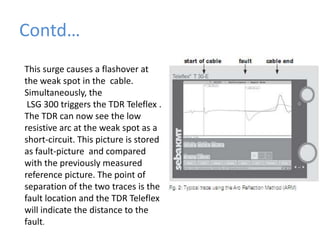
In a first step, a TDR Teleflex does a low voltage reflection measurement of the cable, not seeing the high resistive fault. This picture is stored as reference. In a second step the energy of a surge generator is released into the faulty cable, passing through the arc stabilising filter LSG 300. Contd…This surge causes a flashover at the weak spot in the  cable. Simultaneously, the LSG 300 triggers the TDR Teleflex . The TDR can now see the low resistive arc at the weak spot as a short-circuit. This picture is stored as fault-picture  and compared with the previously measured reference picture. The point of separation of the two traces is the fault location and the TDR Teleflex will indicate the distance to the fault.

Electricity distribution system in india

  • 1.
    Electricity Distribution SystemJasjitSingh Jolly EEE-7thsem0311324908
  • 2.
    BSES Rajdhani powerltdBSES: Bombay suburban electricity supplyBRPL distrbutes power to an area spread over 750 km serving over 12.2 lakh customers spread over 19 districts across south and west zones of Delhi including Alaknanda, khanpur, saket, nehru place, vasant vihar etc bses has invested rs 3500cr in Delhi.
  • 3.
  • 4.
    The generation generallytakes place at voltages around 3.3kV to around 22kV which is medium voltage.The voltage is then stepped up to a level of 110kV or 220 kV (high voltage) or even 400kV (extra high voltage) depending on the amount of power to be transmitted .
  • 5.
    At distribution stationsthe power is stepped down to a voltage of 430/250 V for customers taking into account the voltage drop in distribution lines.
  • 6.
    In India thepower supply to the residential premises is at 240V,single phase, 50Hz ac. The three phase supply is at 415V. Saket D-block substationTotal no. of transformers: 2Oil immersed step down delta/star transformersCapacity : 1250kVARated Primary Voltage : 11KVSecondary Voltage : 416/240VInput HT lines: 11kV from Malviya Nagar grid& 11kV from LadoSaraiIntegral part of the ring main distribution system
  • 7.
    RMU: Ring MainUnitRMU panel generally forms ring system in which distributor is supplied from more than 1 feeders as input to RMU so that in case of failure from any one feeder, power can be fed uninterruptedly from other feeders at the same point. Now a days it is of SF6 gas insulated type.
  • 8.
    Contd…RMU is usedfor HT side and it has a total number of 3 switches(Circuit Breakers or Isolators),it is used for two inputs and one outgoing to the load or one input with two outgoings. Primarily used for feeding purposes .Also protects secondary side transformer from the occasional transient currents.
  • 9.
    Electricity supply toconsumersThe secondary winding of the transformer is mostly of wye connection type.This supply system with a neutral wire is termed as 4 wire 3 phase supply.4 wire supplies are normally used to distribute domestic supplies since they can provide an earthed neutral.
  • 10.
    Contd…The three phasewires together give a 3-phase 3-wire supply (240x1.73=415Volts) suitable or heavy machinery such as 3-phase motors.
  • 11.
    Three single phasesupplies are available between each phase line and the neutral wire.
  • 12.
    The three phasesingle phase 415V supplies are available between any of the three phases.Contd…For distribution to consumers either overhead or underground lines are used.The underground system is much expensive as compared to overhead system and is only used in areas where safety and good appearance are of prime importance.For domestic users a phase and a neutral connection is supplied whereas for those with heavy load requirements 3 wire connection is supplied.
  • 13.
    Faults in distributionlinesTransient Faults: A transient fault is a fault that is no longer present if power is disconnected for a short time. For eg - momentary tree or bird contact.Persistent Faults: A persistent fault does not disappear when power is disconnected. Faults in underground power cables are often persistent. These occur due to some external damage.
  • 14.
    Contd…Faults can furtherbe classified as symmetric or asymmetric faults.Symmetric faults: Equal fault currents in line with 120 deg displacement. Rare in nature. Eg - (L-L-L) or (L-L-L-G) faults.Asymmetric faults: Unequal fault currents with unequal phase displacement. Most likely to occur. Eg – (L-L) or (L-L-G) or (L-G) faults.
  • 15.
    Fault detectionTo detectthe exact location of a high resistance fault in underground transmission lines Arc Reflection Method (ARM) is used.LSG 300 surge generator manufactured by sebaKMT is use to testing purposes.
  • 16.
    Contd…LSG 300 alongwith a surge generator and TDR teleflex helps in detection of the location of fault.
  • 17.
    In a firststep, a TDR Teleflex does a low voltage reflection measurement of the cable, not seeing the high resistive fault. This picture is stored as reference. In a second step the energy of a surge generator is released into the faulty cable, passing through the arc stabilising filter LSG 300. Contd…This surge causes a flashover at the weak spot in the cable. Simultaneously, the LSG 300 triggers the TDR Teleflex . The TDR can now see the low resistive arc at the weak spot as a short-circuit. This picture is stored as fault-picture and compared with the previously measured reference picture. The point of separation of the two traces is the fault location and the TDR Teleflex will indicate the distance to the fault.