Introduction
1
Evolution of Electric Power Systems
 An electric power system is a network of electrical
components deployed to supply, transfer, store, and use
electric power
 The first complete electric power system was built by
Thomas Edison- the historic Pearl Street Station in New
York City which began operation in September 1882.
• Comprising a generator, cable, fuse, meter and loads.
• It was dc system:-steam engine driven dc generator
• 59 customers in 1.5 km radius
• Load: incandescent lamps
• Underground cable system, 110 v.
2
Cont’d…
Within a few years similar systems were in operation
in most large cities throughout the world.
With the development of motors by Frank Sprague in
1884, motor loads were added to such systems.
By 1886, the limitations of dc systems were becoming
increasingly apparent. They could deliver power only a
short distance from the generators.
3
Cont’d…
L. Gaulard and J.D. Gibbs of Paris, France developed
transformer and ac transmission.
In 1886, William Stanley developed and tested a
commercially practical transformer and ac distribution
system for 150 lamps at Great Barrington,
Massachusetts.
In 1889, the first ac transmission line in North America
was put in to operation. It was a single phase line
transmitting power at 4,000 V over a distance of 21 km.
4
Cont’d…
With the development of poly phase systems by Nikola
Tesla, the ac system became even more attractive.
In the 1890s, there was considerable controversy over
whether the electric utility industry should be
standardized on dc or ac.
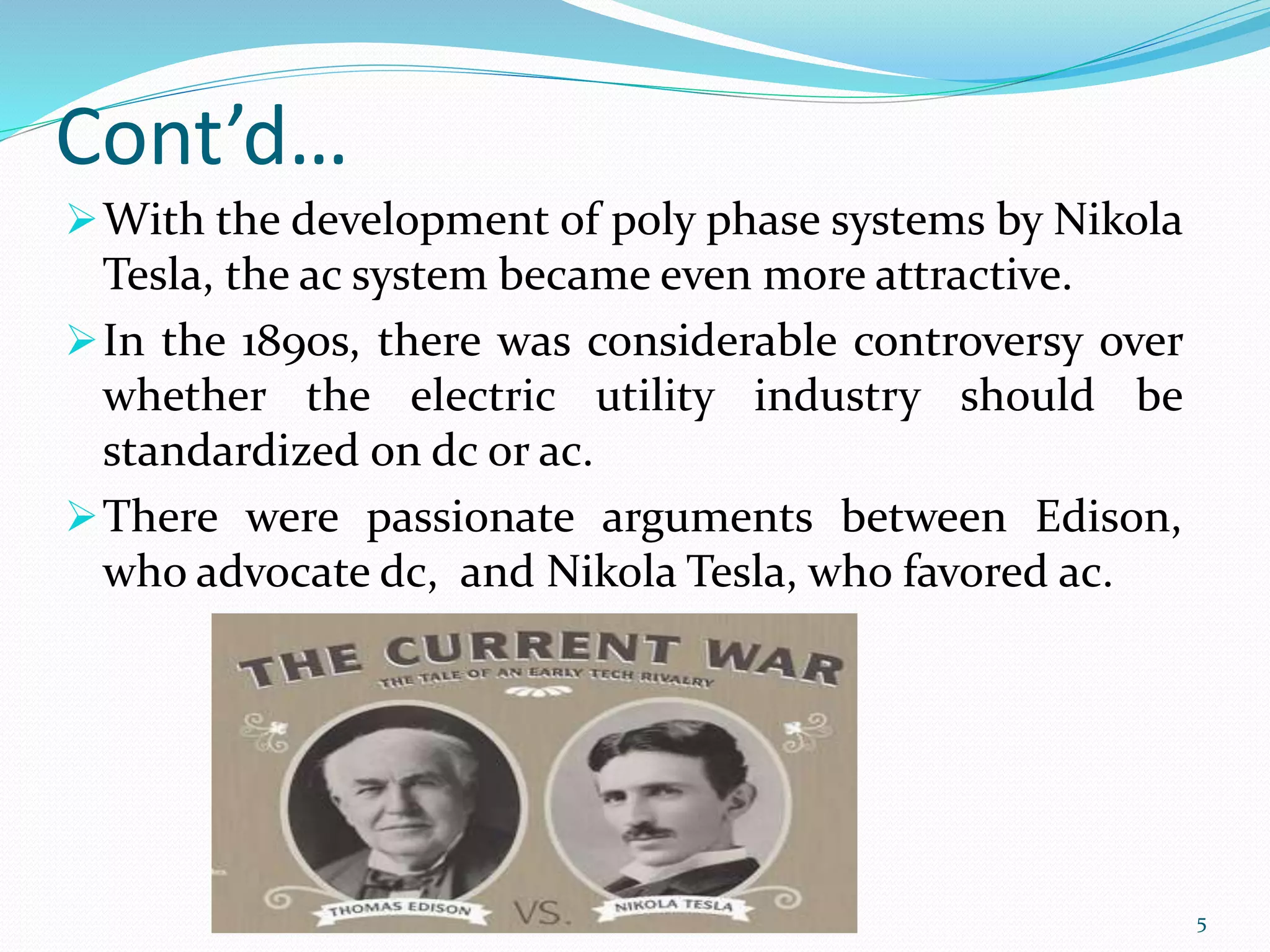
There were passionate arguments between Edison,
who advocate dc, and Nikola Tesla, who favored ac.
5
Cont’d…
By the turn of the century, the ac system had won out
over the dc system for the following reasons:
• Voltage levels can be easily transformed in ac
systems, thus providing the flexibility for use of
different voltages for generation, transmission and
consumption.
• AC generators are much simpler than dc generators.
• AC motors are much simpler and cheaper than dc
motors.
6
Cont’d…
The first three phase line in North America went in to
operation in 1893 , a 2300V, 12km line.
In the early period of ac power transmission, frequency
was not standardized.
Many different frequencies were in use: 25, 50, 60, 125
and 133 Hz.
60 Hz was adopted as standard in North America and
many other countries use 50 Hz.
7
Cont’d…
The increasing need for transmitting larger amounts of
power over longer distances created an incentive to use
progressively higher voltage levels.
To avoid the proliferation of an unlimited number of
voltages, the industry has standardized voltage levels.
With the development of mercury arc valves in the early
1950s, high voltage dc (HVDC) transmission systems
became economical in special situations.
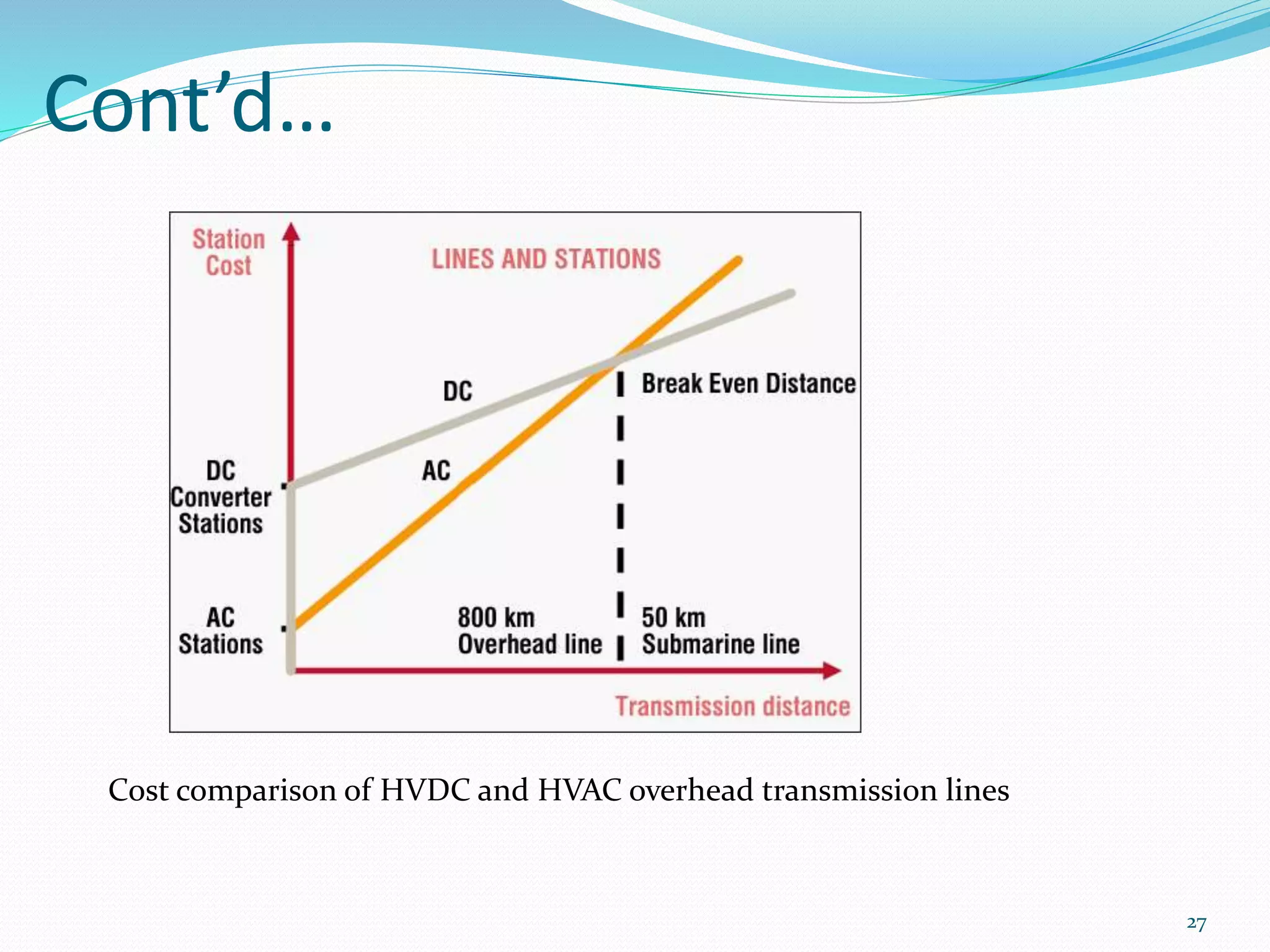
The cross over point beyond which dc transmission may
become a competitive alternative to ac transmission is
around 500 km for over head lines and 50 km for
underground or submarine cables.
8
Cont’d…
HVDC transmission also provides an asynchronous
link between systems where ac interconnection would
be impractical because of system stability
considerations or because nominal frequencies of the
systems are different.
The first modern commercial application of HVDC
transmission occurred in 1954 when the Swedish
mainland and the island of Gotland were
interconnected by a 96 km submarine cable.

9
Cont’d…
With the advent of thyristor valve converters, HVDC
transmission became even more attractive.
The first application of an HVDC system using
thyristor valves was at Eel River in 1972.
With the cost and size of conversion equipment
decreasing and its reliability increasing, there has been
a steady increase in the use of HVDC transmission.
10
Sources of Energy
The major sources of primary energy are:
 Fossil fuels: coal, natural gas and oil
 Water power: Hydroelectric power
 Nuclear power: fission and fusion
 Solar energy: heat radiation from the sun
 Geothermal energy: thermal springs due to inner
strata of earth at a very high temperature
 Wind power: wind turbines
 Tidal power: tides of ocean
11
Cont’d…
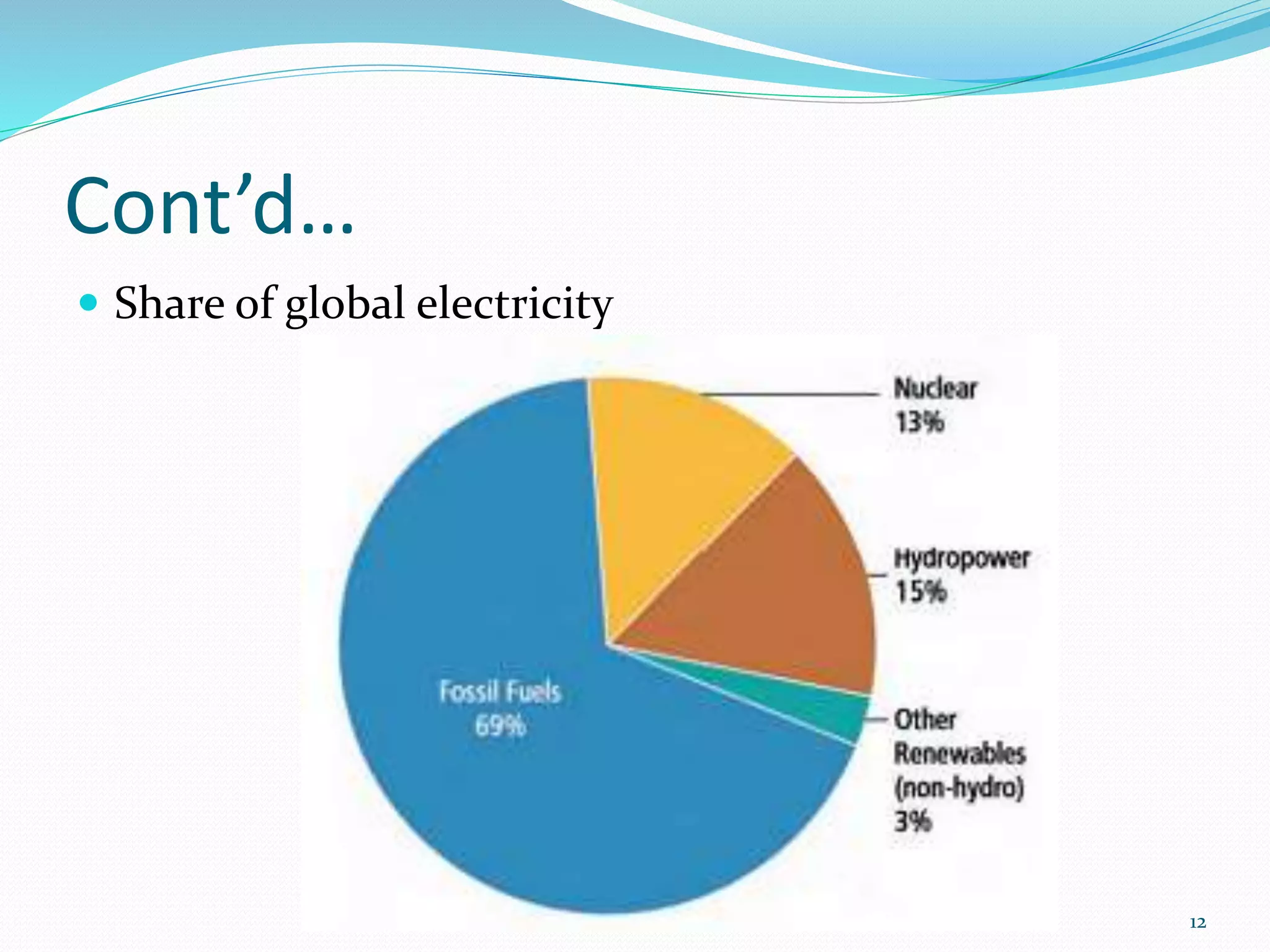
 Share of global electricity
12
Cont’d…
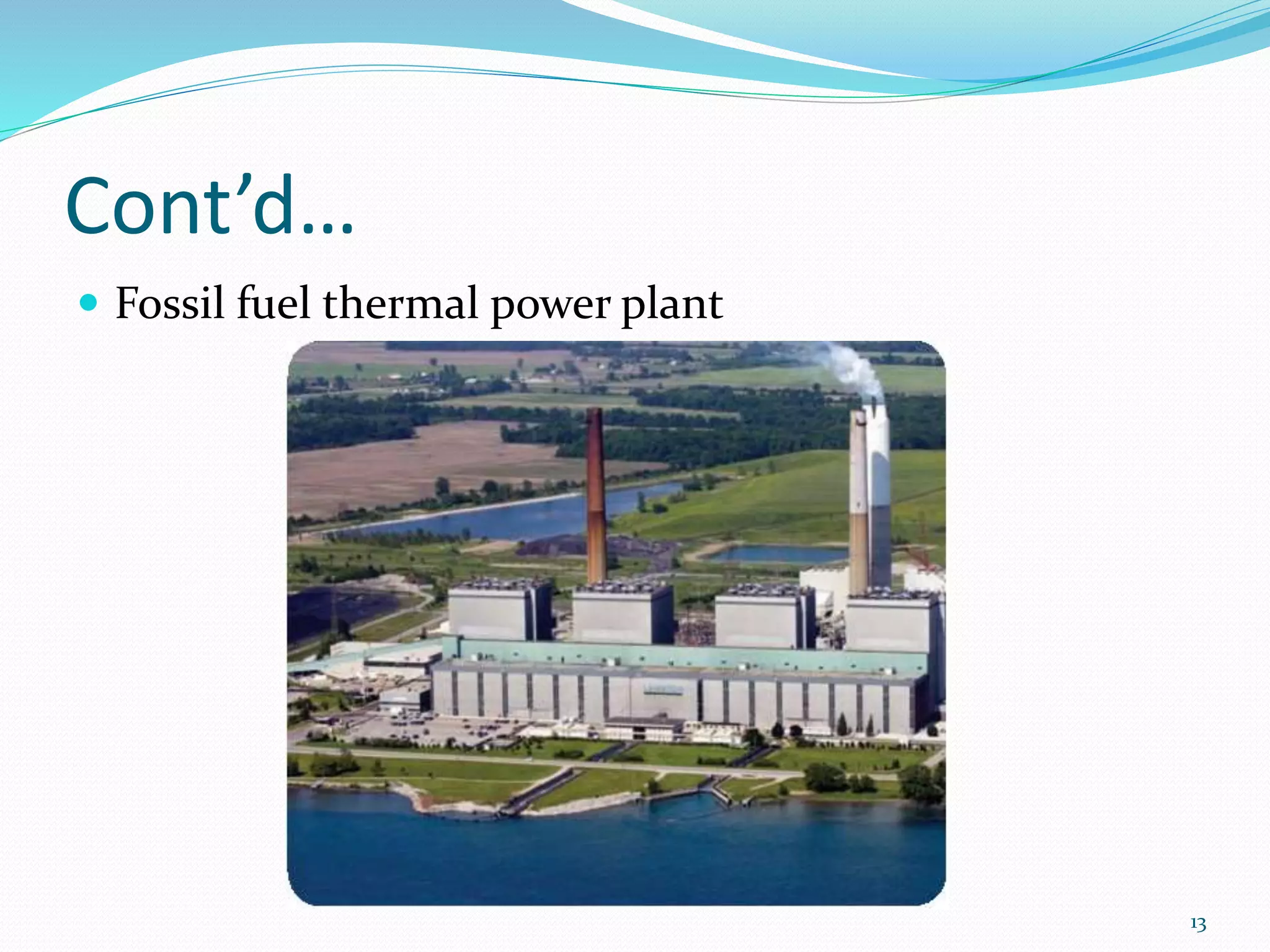
 Fossil fuel thermal power plant
13
Cont’d…
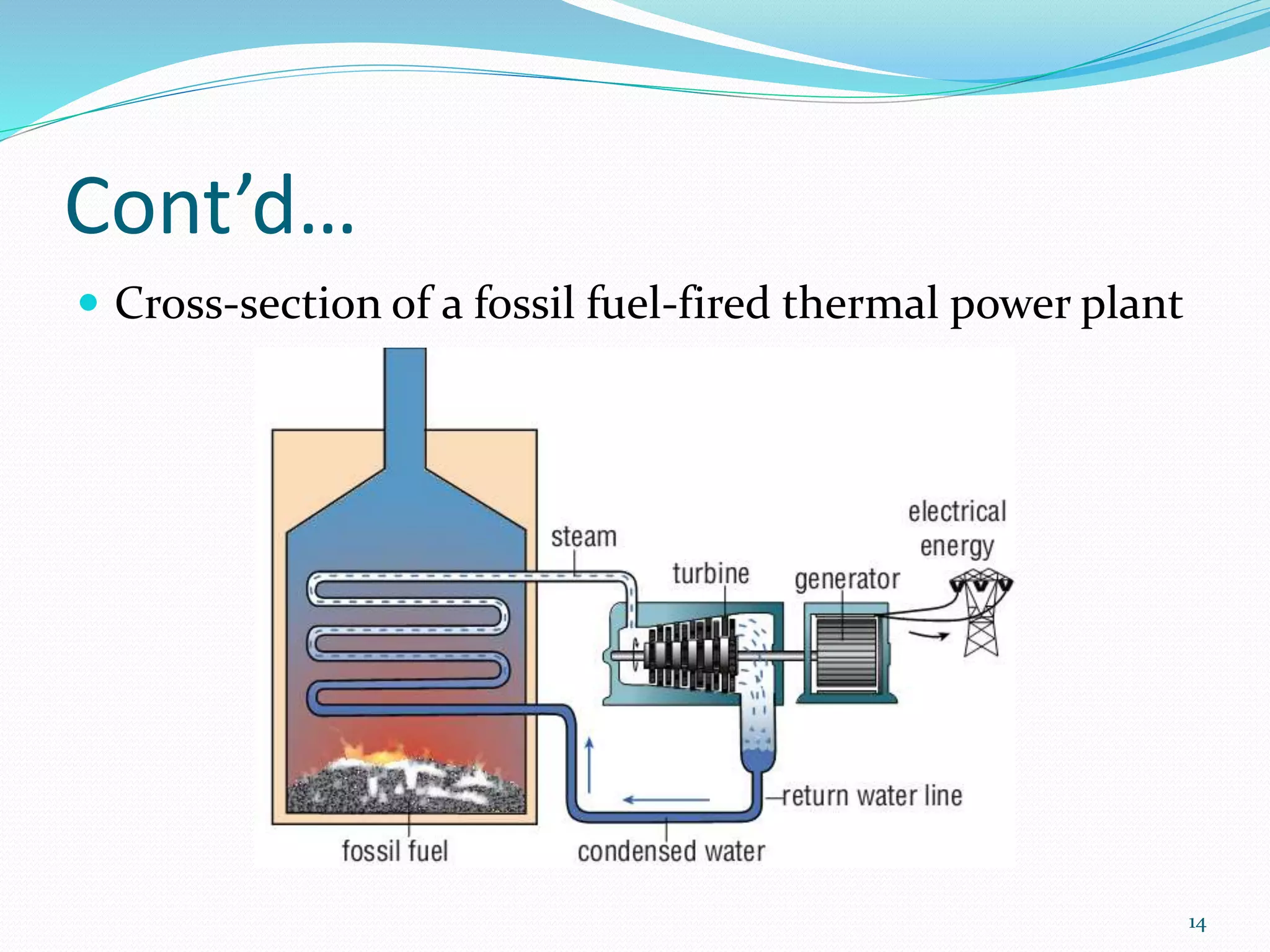
 Cross-section of a fossil fuel-fired thermal power plant
14
Cont’d…
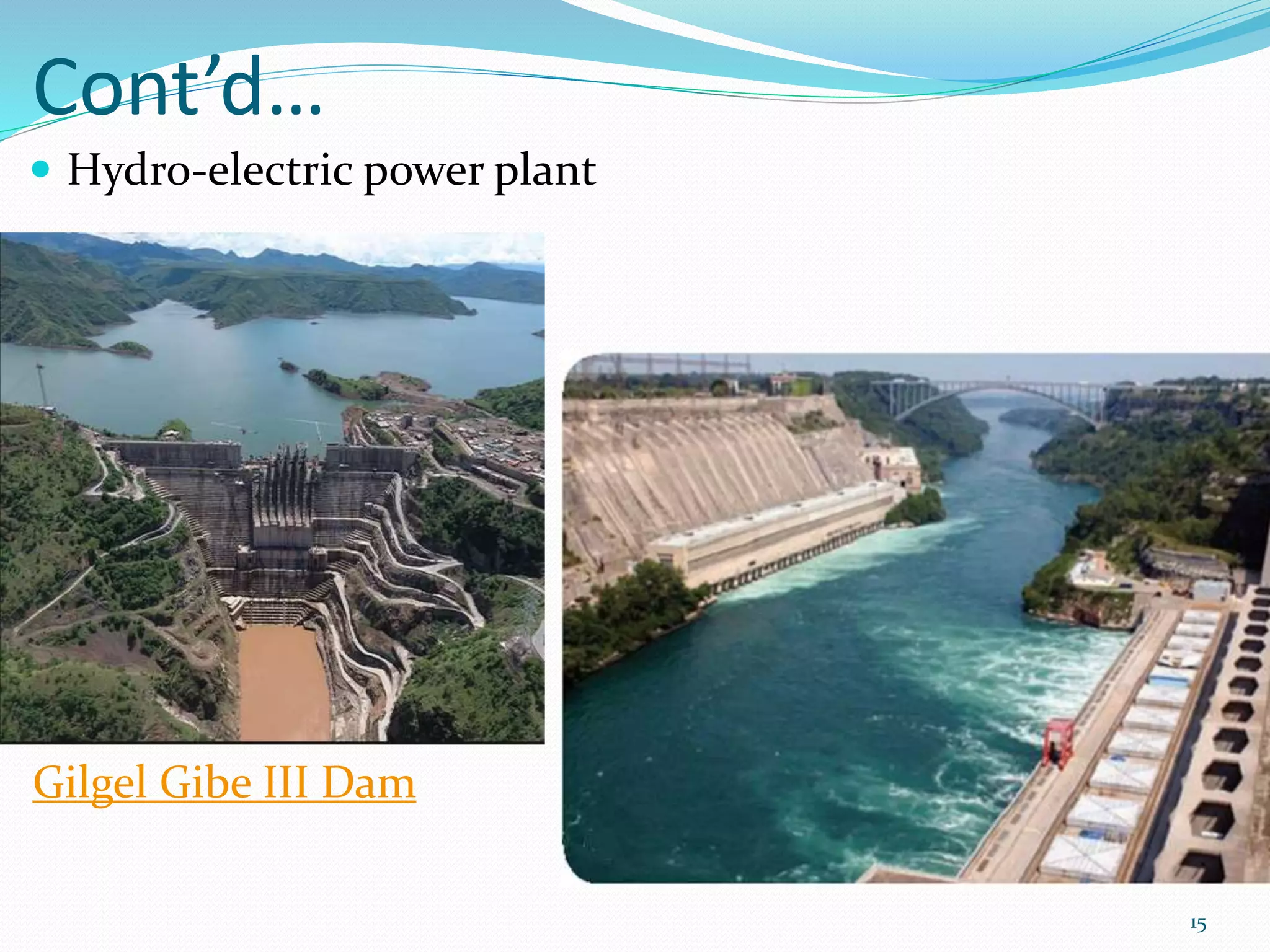
 Hydro-electric power plant
15
Gilgel Gibe III Dam
Cont’d…
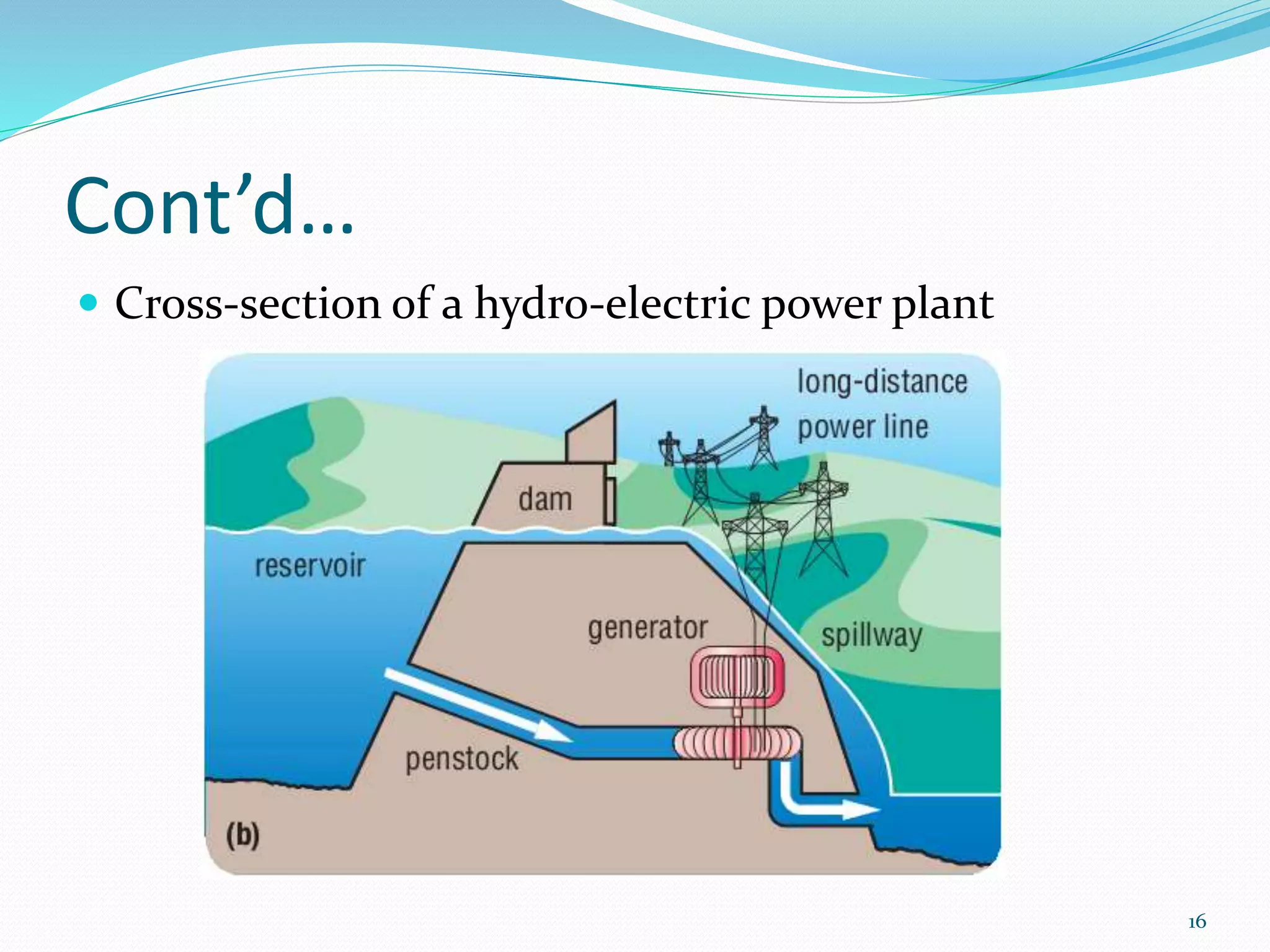
 Cross-section of a hydro-electric power plant
16
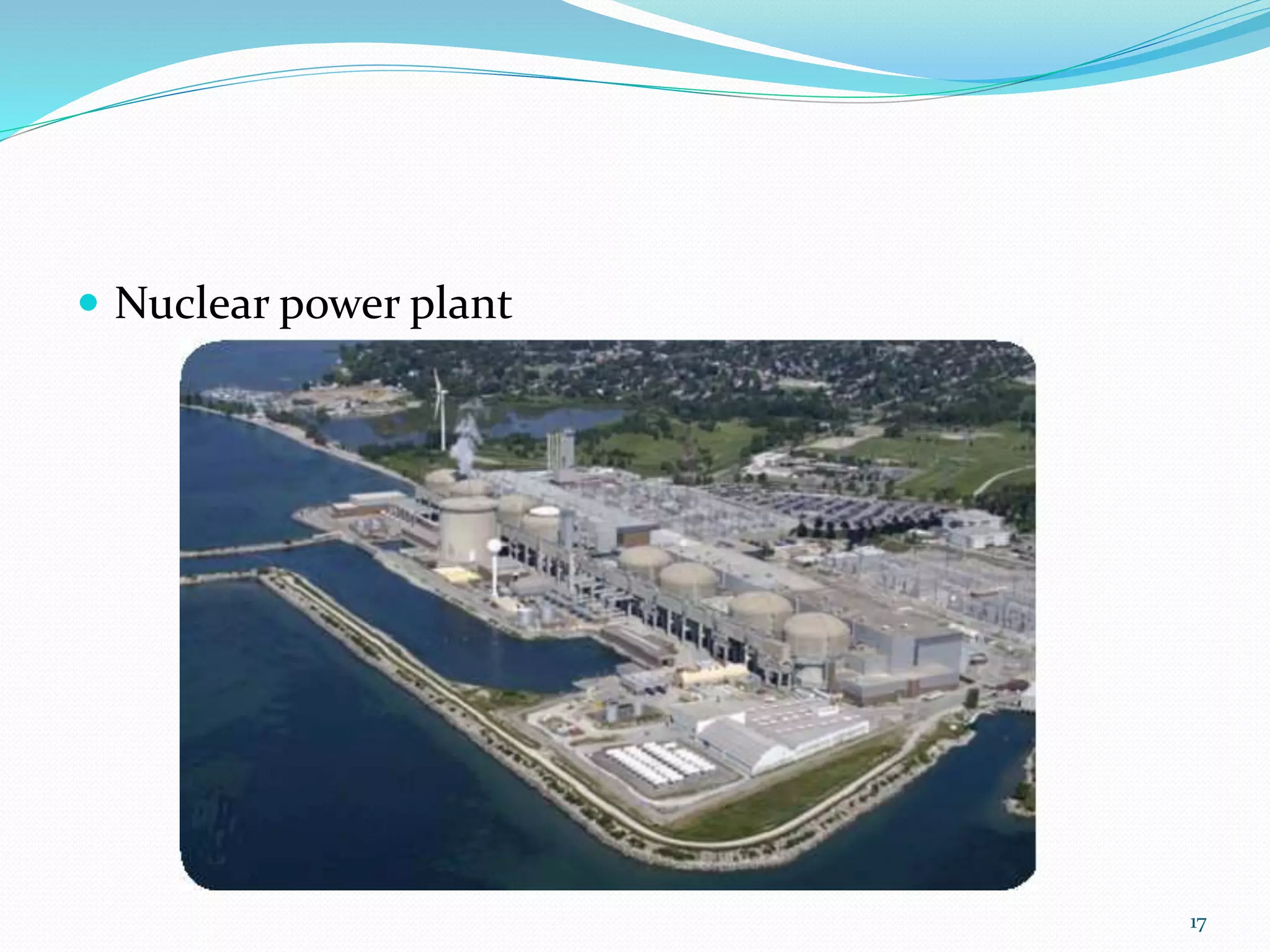
 Nuclear power plant
17
Cont’d…
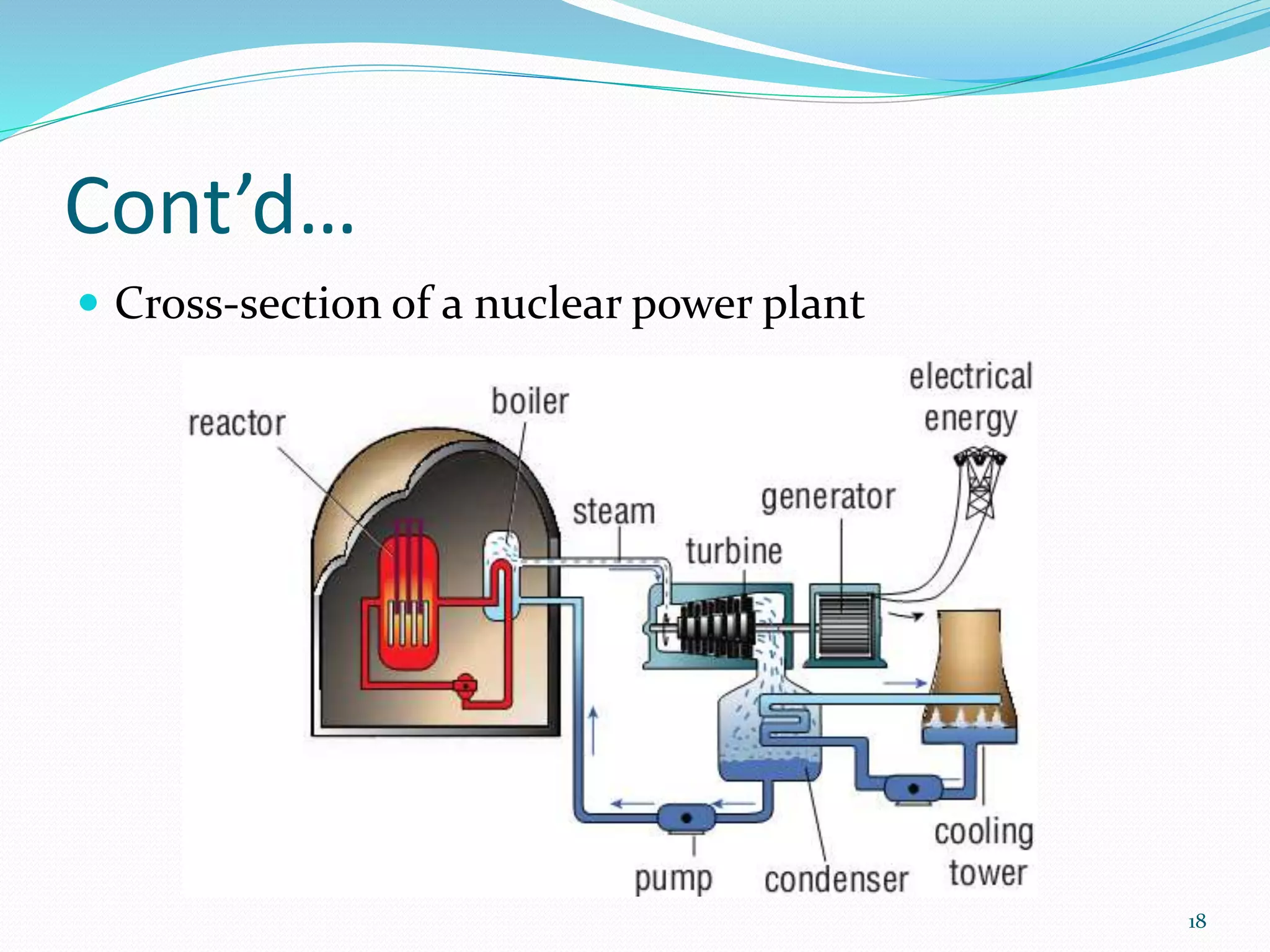
 Cross-section of a nuclear power plant
18
Cont’d…
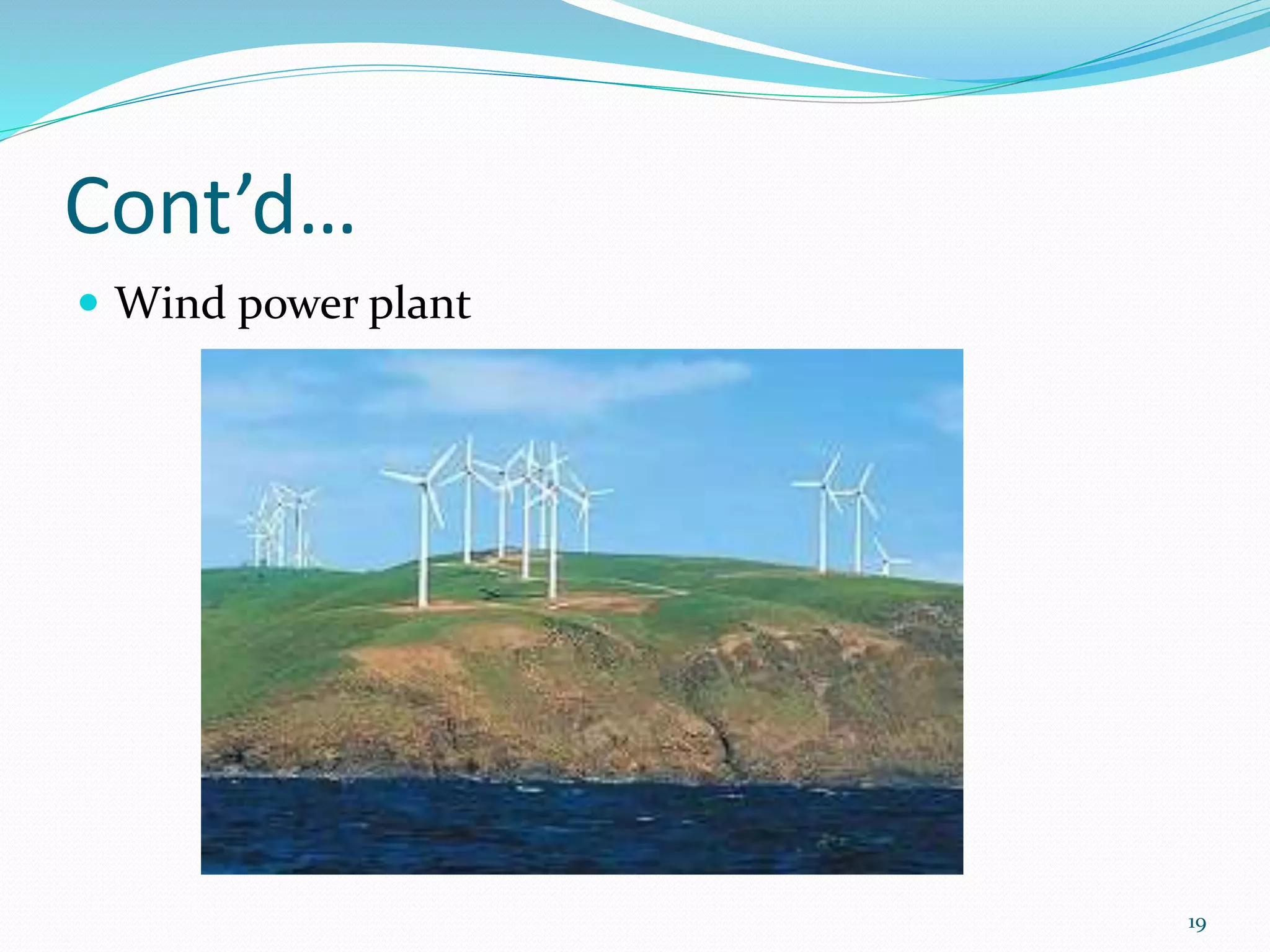
 Wind power plant
19
Cont’d…
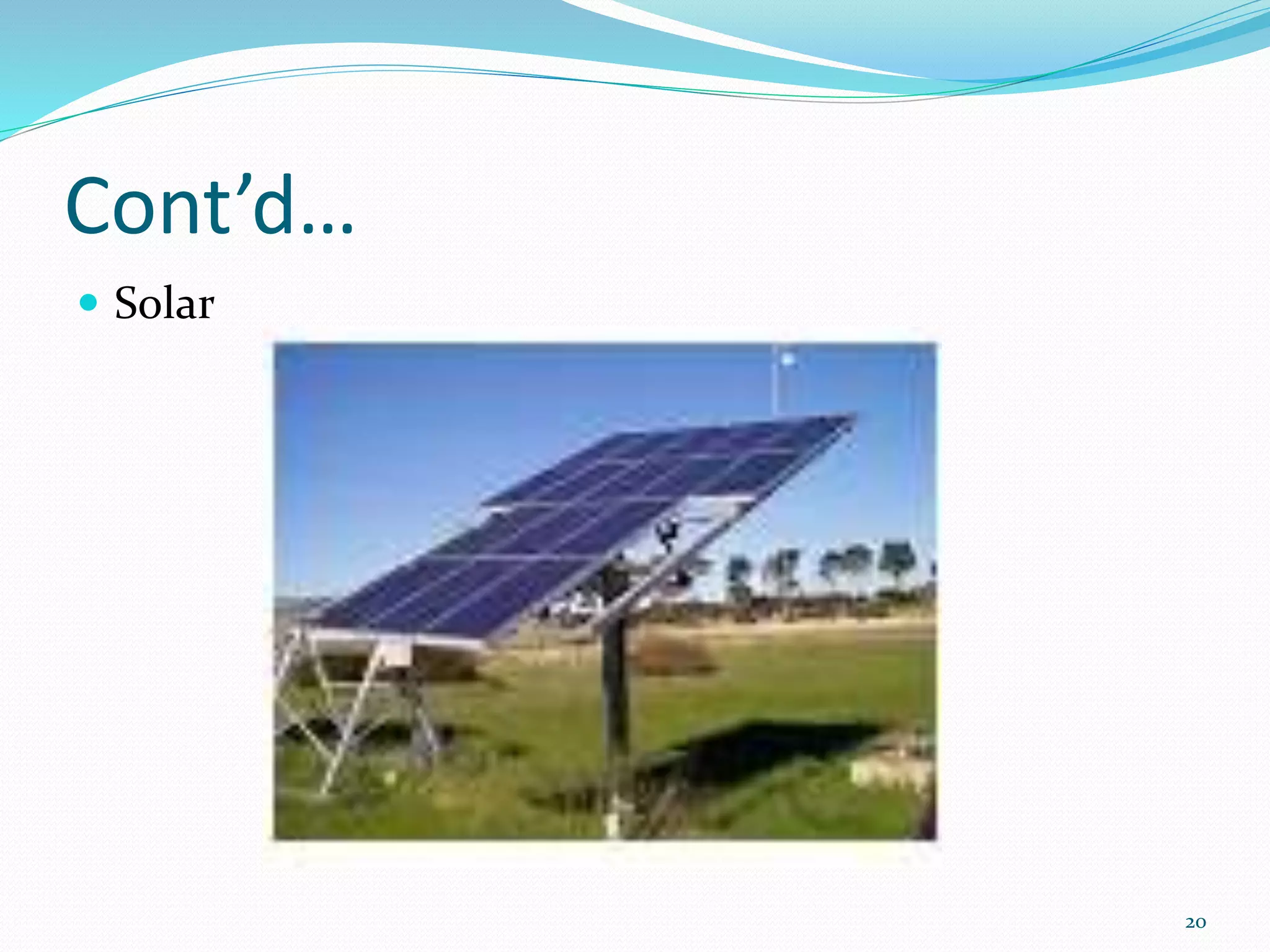
 Solar
20
Cont’d…
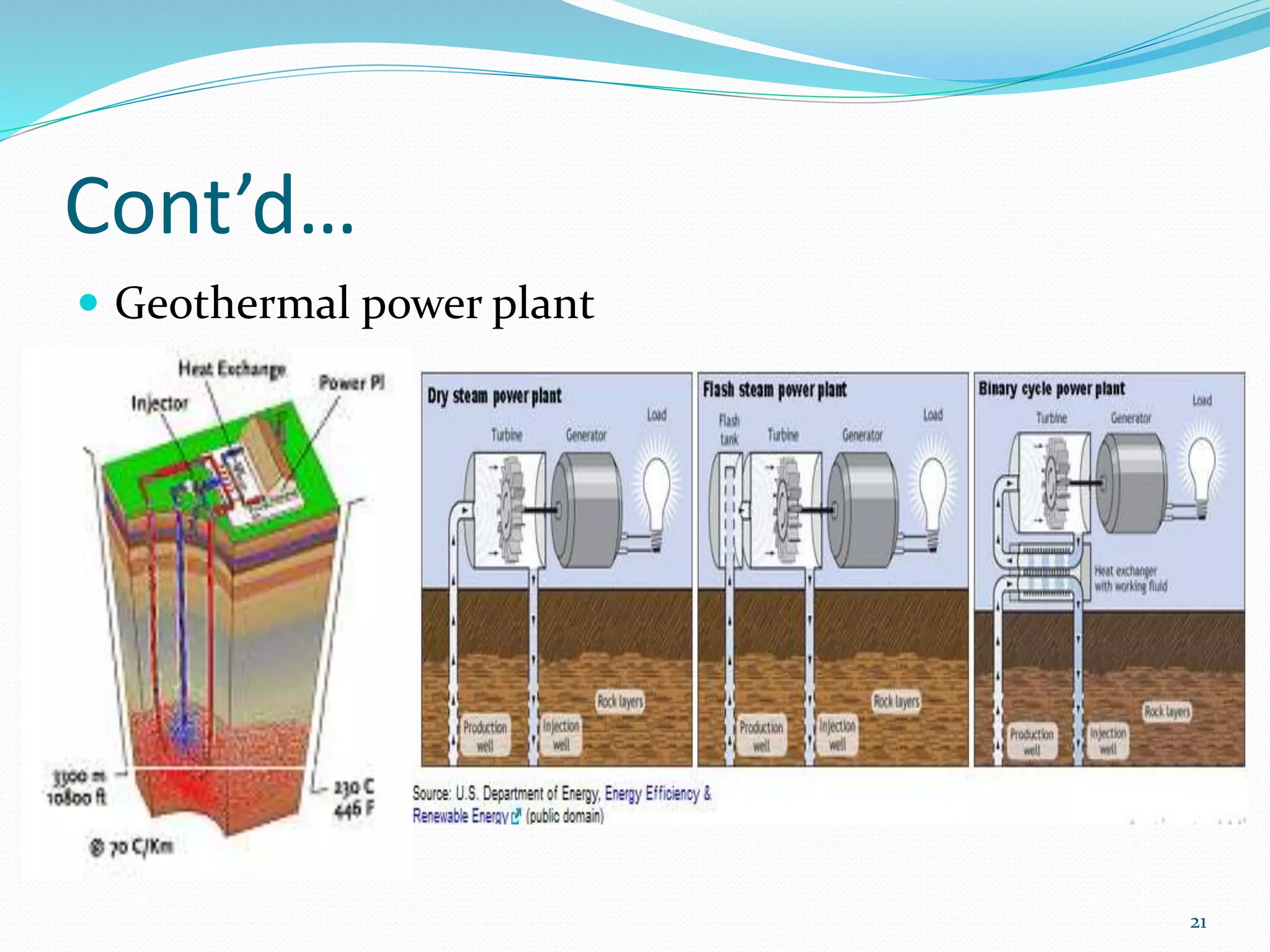
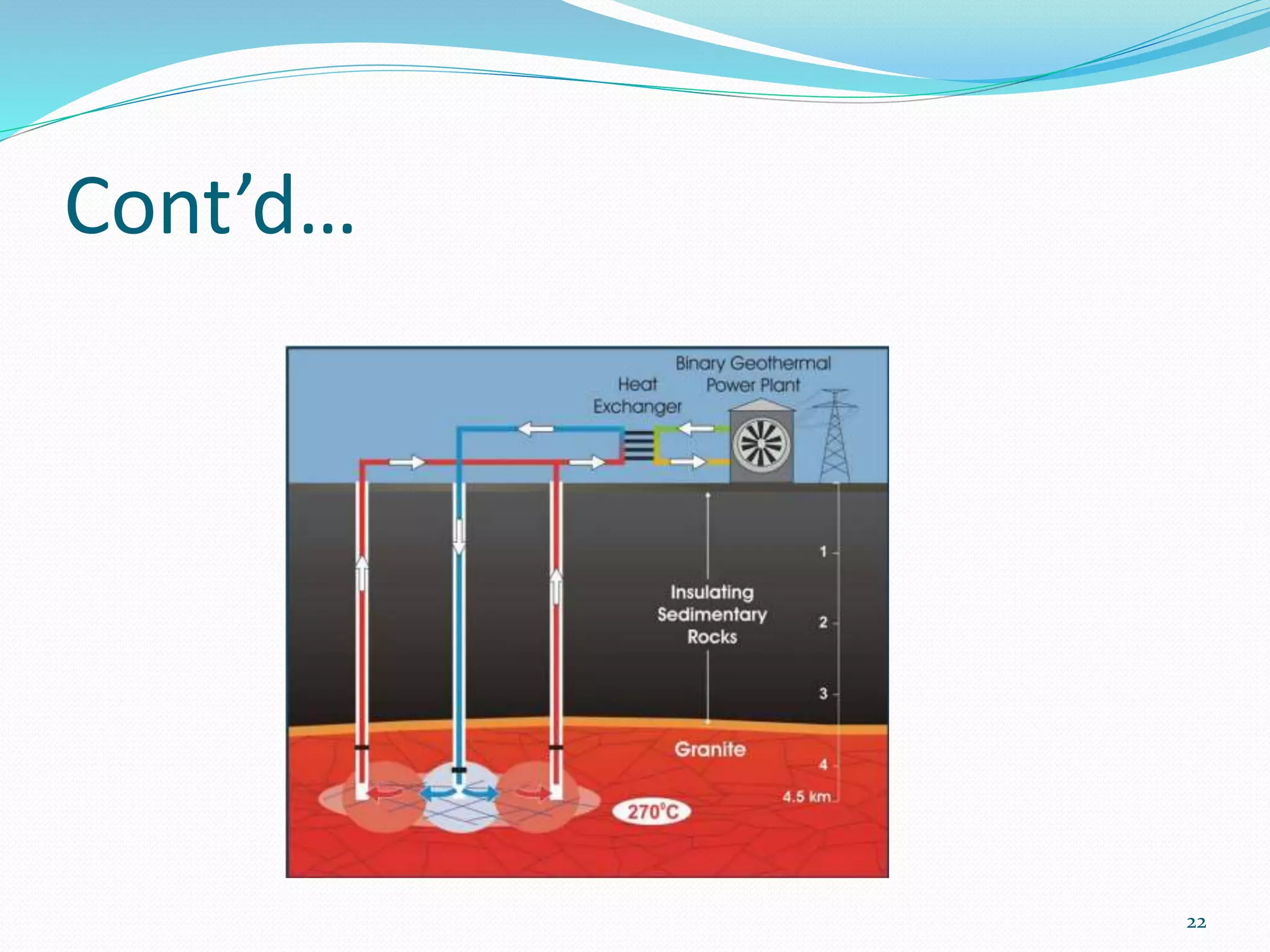
 Geothermal power plant
21
Cont’d…
22
Cont’d…
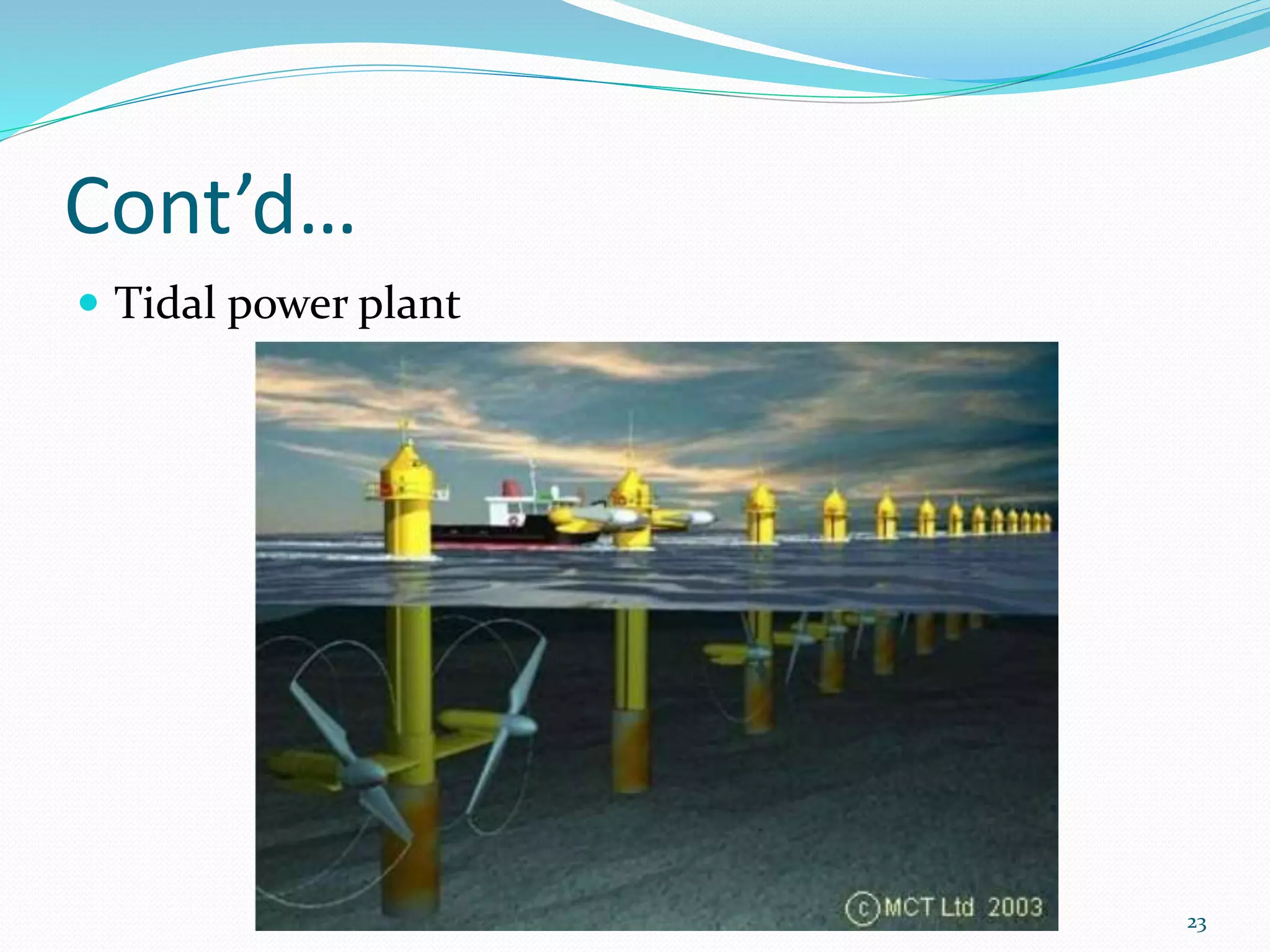
 Tidal power plant
23
AC and DC transmission
Comparison of AC and DC Transmission
Electric Power can either be transmitted by means of AC or DC
Advantages of DC Transmission:
• Power transmission by means of DC requires only two
conductors as compared to three conductors required for AC.
• There is no inductance, capacitance, phase displacement and
surge problem in DC transmission.
• Due to absence of inductance, the voltage drop in DC
transmission is less than the AC transmission for same load
and receiving end voltage.
• A DC transmission line has less Corona and hence efficiency is
improved.
• In DC transmission, there is no stability and synchronization
problem.
24
Cont’d…
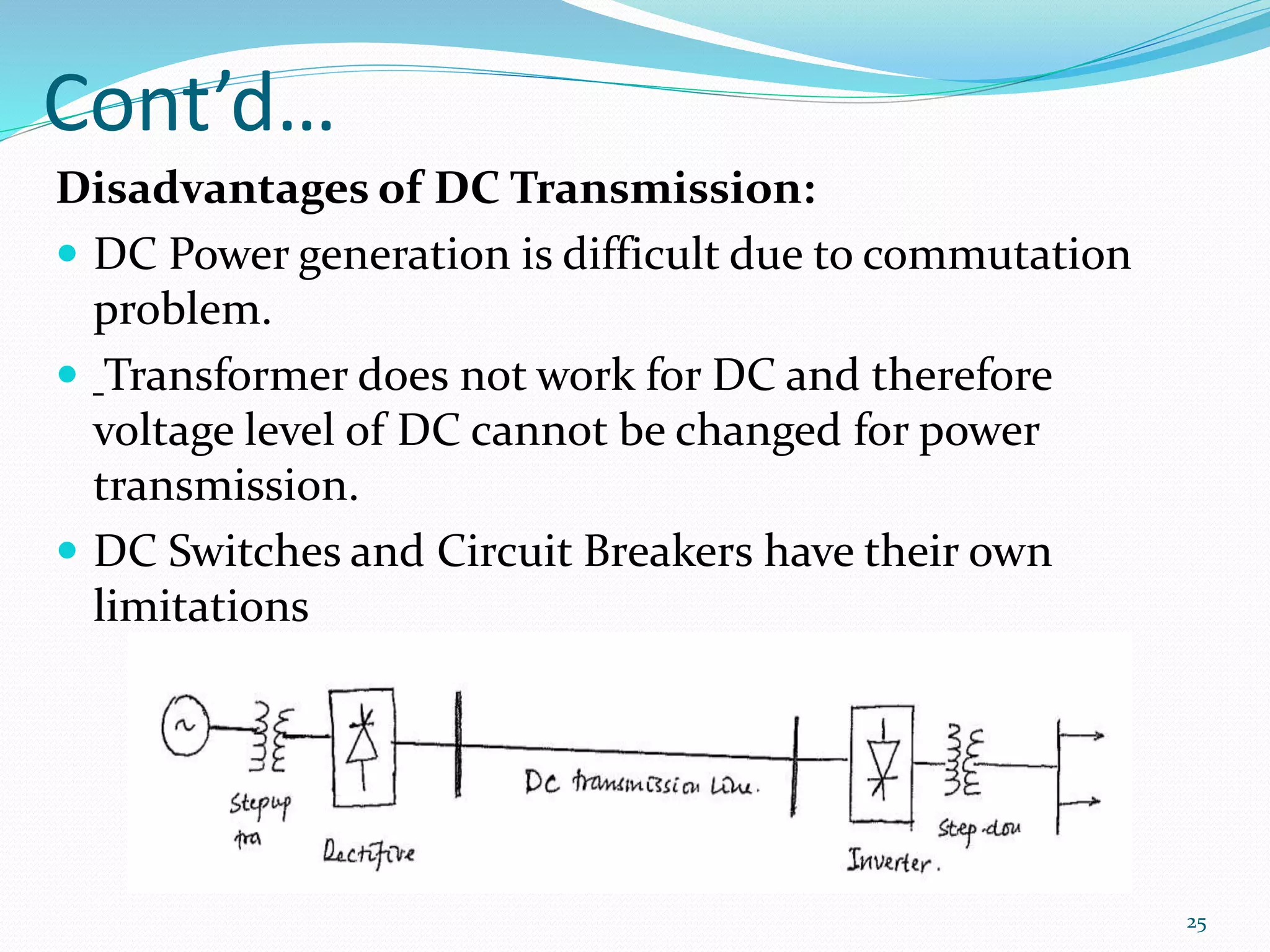
Disadvantages of DC Transmission:
 DC Power generation is difficult due to commutation
problem.
 Transformer does not work for DC and therefore
voltage level of DC cannot be changed for power
transmission.
 DC Switches and Circuit Breakers have their own
limitations
25
Cont’d…
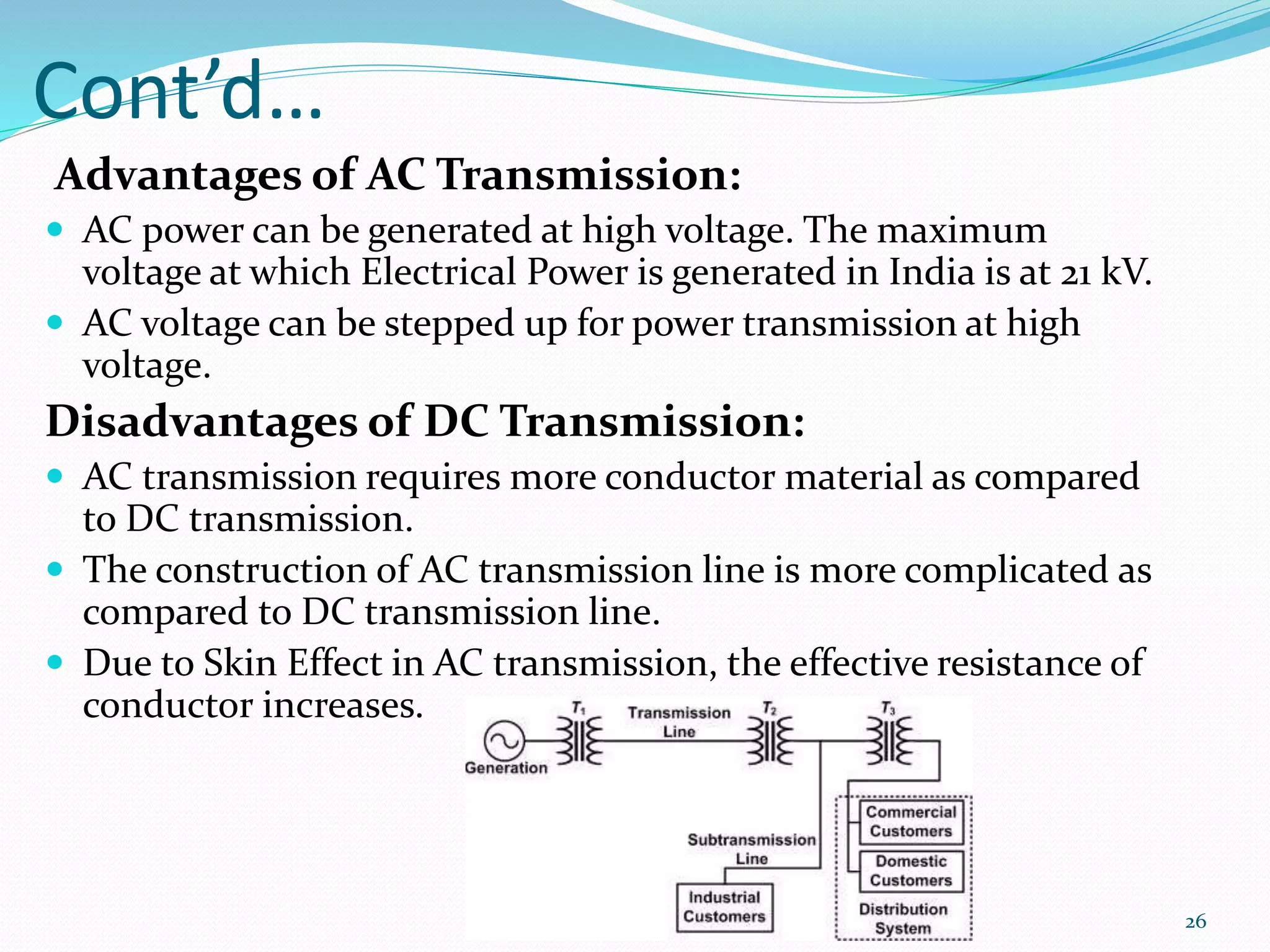
Advantages of AC Transmission:
 AC power can be generated at high voltage. The maximum
voltage at which Electrical Power is generated in India is at 21 kV.
 AC voltage can be stepped up for power transmission at high
voltage.
Disadvantages of DC Transmission:
 AC transmission requires more conductor material as compared
to DC transmission.
 The construction of AC transmission line is more complicated as
compared to DC transmission line.
 Due to Skin Effect in AC transmission, the effective resistance of
conductor increases.
26
Cont’d…
27
Cost comparison of HVDC and HVAC overhead transmission lines
3 phase vs Single phase systems
Advantages of a three phase system over a single phase
power system
 The rating, i.e. the output of a three-phase machine is
nearly 1.5 times the rating (output) of a single phase
machine of the same size
 In single phase circuits, the power delivered is pulsating.
Whereas, in the polyphase system, the power delivered is
almost constant when the loads are in balanced condition
 Single Phase induction motors are not self starting as it
does not have starting torque, where as Three phase
induction motors are self starting.
 3 Phase system requires less copper and aluminium for the
transmission system in comparison to a single phase
transmission system.
28
Cont’d…
 In 3 phase motor, the frequency of vibrations is less as
compared to single phase motor because in single phase
the power transferred is a function of current and varies
constantly
 3 Phase system requires less copper and aluminium for the
transmission system in comparison to a single phase
transmission system.
Disadvantages of 3 phase system over single phase
 Unbalanced loading ( can cause voltage fluctuations )
 Complex System (requires symmetrical components for
analysis and operation )
 Phase Sequence needed to be kept in mind while making
connections
29
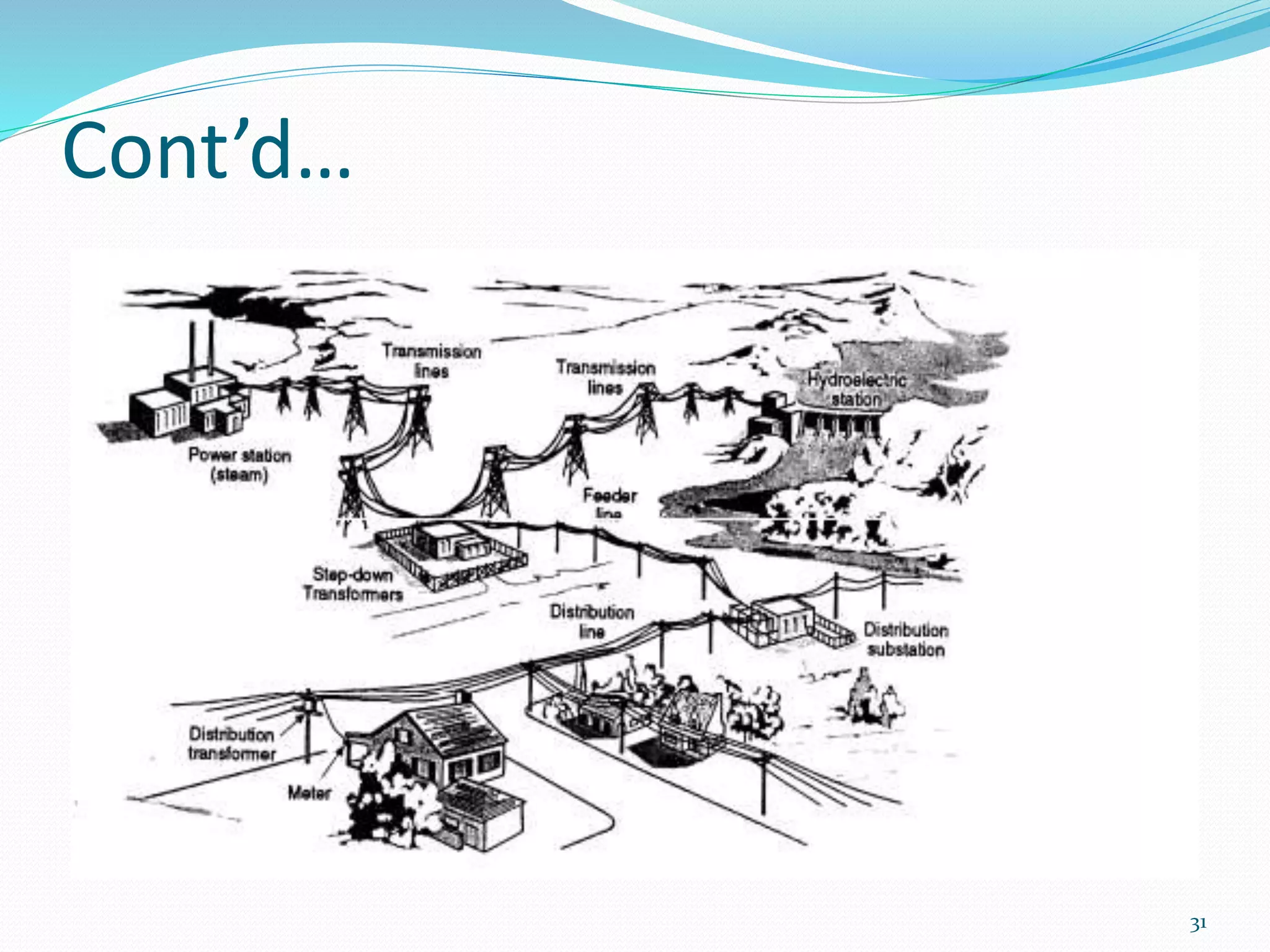
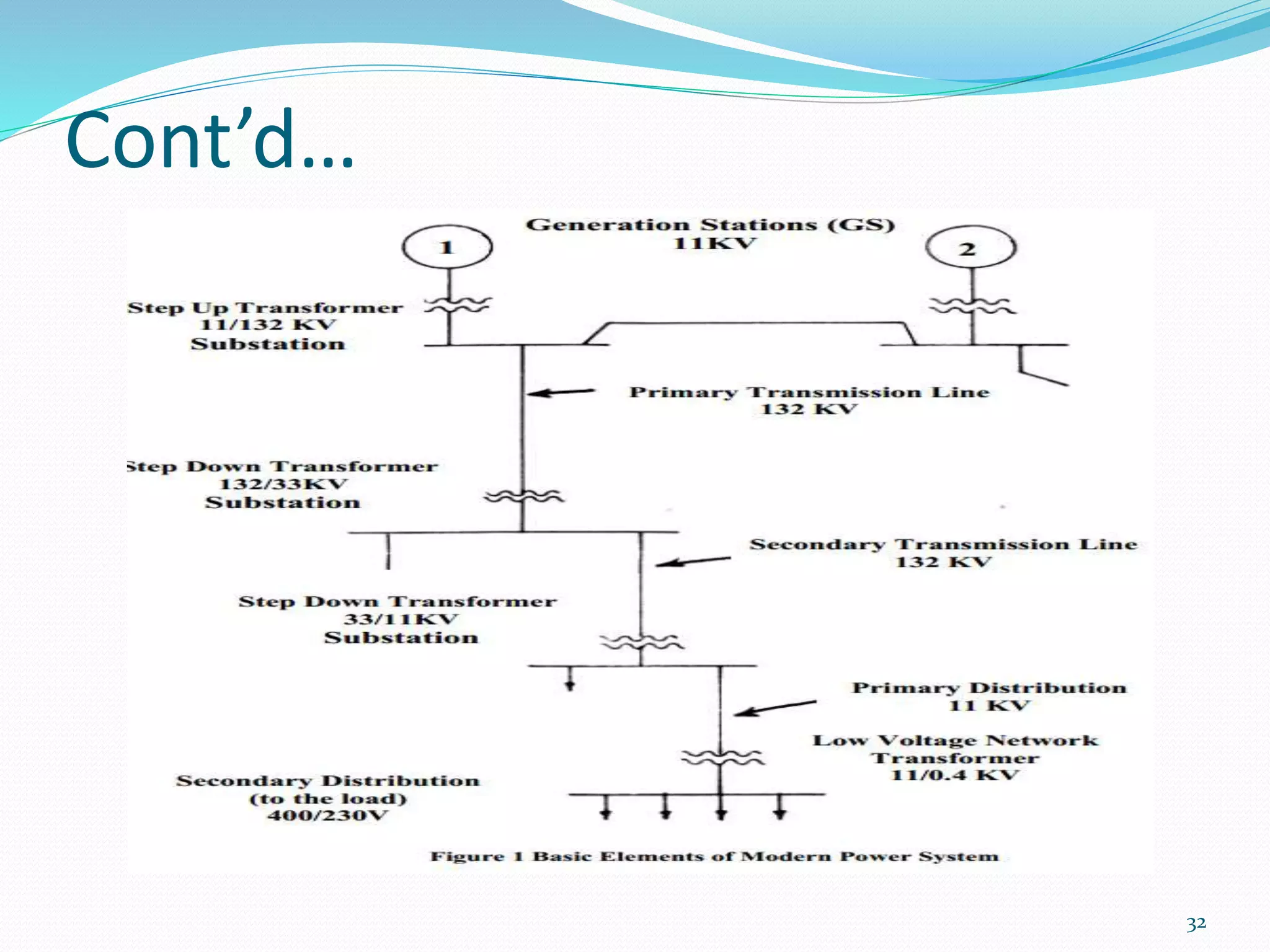
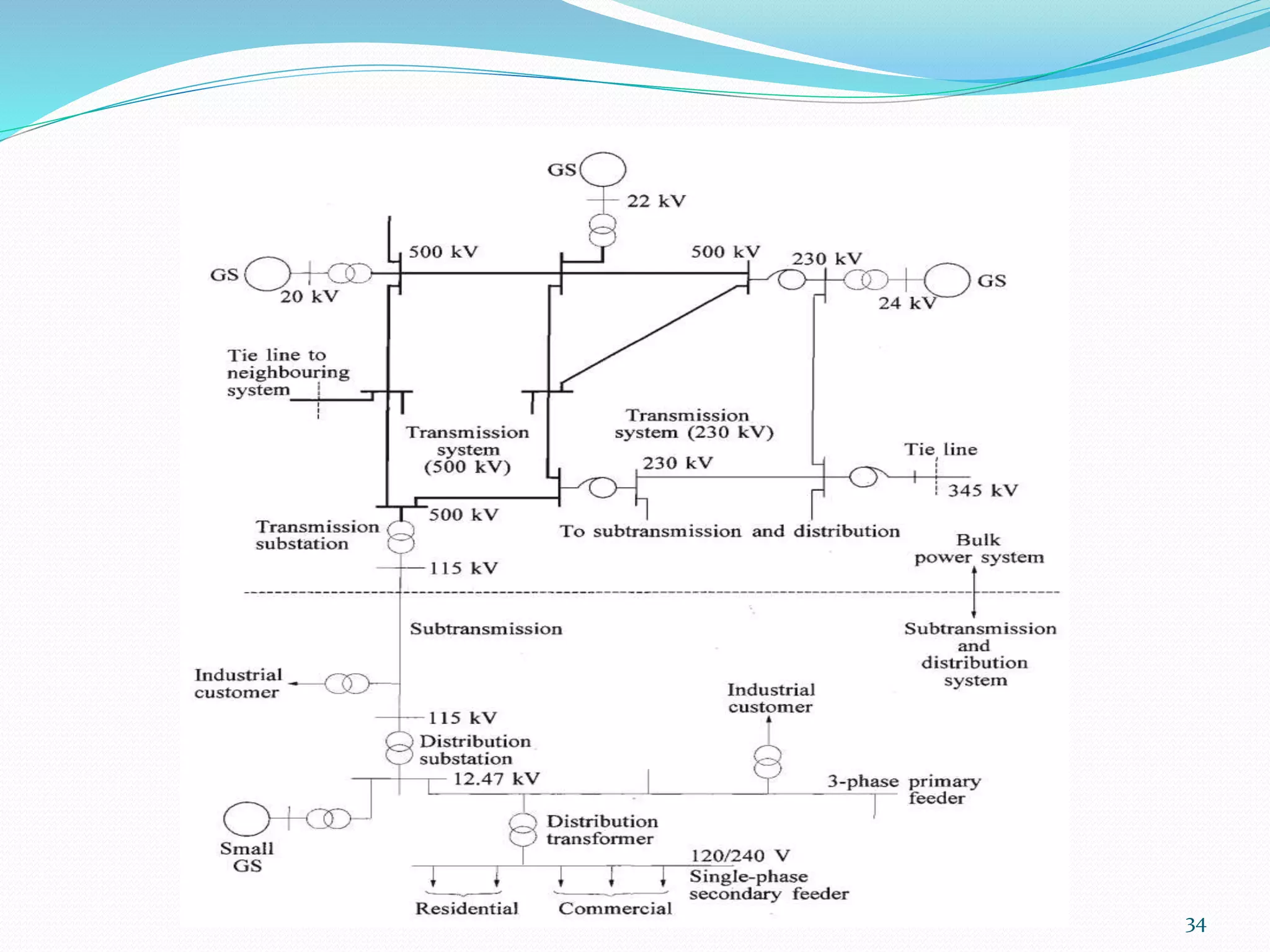
Structure of the Power System
Electrical systems vary in size and structural
components.
However, they all have the same basic
characteristics.
 Generation system
 Transmission system
 Sub-transmission system
 Distribution system
30
Cont’d…
31
Cont’d…
32
33
34
35

introduction to power system

  • 1.
  • 2.
    Evolution of ElectricPower Systems  An electric power system is a network of electrical components deployed to supply, transfer, store, and use electric power  The first complete electric power system was built by Thomas Edison- the historic Pearl Street Station in New York City which began operation in September 1882. • Comprising a generator, cable, fuse, meter and loads. • It was dc system:-steam engine driven dc generator • 59 customers in 1.5 km radius • Load: incandescent lamps • Underground cable system, 110 v. 2
  • 3.
    Cont’d… Within a fewyears similar systems were in operation in most large cities throughout the world. With the development of motors by Frank Sprague in 1884, motor loads were added to such systems. By 1886, the limitations of dc systems were becoming increasingly apparent. They could deliver power only a short distance from the generators. 3
  • 4.
    Cont’d… L. Gaulard andJ.D. Gibbs of Paris, France developed transformer and ac transmission. In 1886, William Stanley developed and tested a commercially practical transformer and ac distribution system for 150 lamps at Great Barrington, Massachusetts. In 1889, the first ac transmission line in North America was put in to operation. It was a single phase line transmitting power at 4,000 V over a distance of 21 km. 4
  • 5.
    Cont’d… With the developmentof poly phase systems by Nikola Tesla, the ac system became even more attractive. In the 1890s, there was considerable controversy over whether the electric utility industry should be standardized on dc or ac. There were passionate arguments between Edison, who advocate dc, and Nikola Tesla, who favored ac. 5
  • 6.
    Cont’d… By the turnof the century, the ac system had won out over the dc system for the following reasons: • Voltage levels can be easily transformed in ac systems, thus providing the flexibility for use of different voltages for generation, transmission and consumption. • AC generators are much simpler than dc generators. • AC motors are much simpler and cheaper than dc motors. 6
  • 7.
    Cont’d… The first threephase line in North America went in to operation in 1893 , a 2300V, 12km line. In the early period of ac power transmission, frequency was not standardized. Many different frequencies were in use: 25, 50, 60, 125 and 133 Hz. 60 Hz was adopted as standard in North America and many other countries use 50 Hz. 7
  • 8.
    Cont’d… The increasing needfor transmitting larger amounts of power over longer distances created an incentive to use progressively higher voltage levels. To avoid the proliferation of an unlimited number of voltages, the industry has standardized voltage levels. With the development of mercury arc valves in the early 1950s, high voltage dc (HVDC) transmission systems became economical in special situations. The cross over point beyond which dc transmission may become a competitive alternative to ac transmission is around 500 km for over head lines and 50 km for underground or submarine cables. 8
  • 9.
    Cont’d… HVDC transmission alsoprovides an asynchronous link between systems where ac interconnection would be impractical because of system stability considerations or because nominal frequencies of the systems are different. The first modern commercial application of HVDC transmission occurred in 1954 when the Swedish mainland and the island of Gotland were interconnected by a 96 km submarine cable.  9
  • 10.
    Cont’d… With the adventof thyristor valve converters, HVDC transmission became even more attractive. The first application of an HVDC system using thyristor valves was at Eel River in 1972. With the cost and size of conversion equipment decreasing and its reliability increasing, there has been a steady increase in the use of HVDC transmission. 10
  • 11.
    Sources of Energy Themajor sources of primary energy are:  Fossil fuels: coal, natural gas and oil  Water power: Hydroelectric power  Nuclear power: fission and fusion  Solar energy: heat radiation from the sun  Geothermal energy: thermal springs due to inner strata of earth at a very high temperature  Wind power: wind turbines  Tidal power: tides of ocean 11
  • 12.
    Cont’d…  Share ofglobal electricity 12
  • 13.
    Cont’d…  Fossil fuelthermal power plant 13
  • 14.
    Cont’d…  Cross-section ofa fossil fuel-fired thermal power plant 14
  • 15.
    Cont’d…  Hydro-electric powerplant 15 Gilgel Gibe III Dam
  • 16.
    Cont’d…  Cross-section ofa hydro-electric power plant 16
  • 17.
  • 18.
    Cont’d…  Cross-section ofa nuclear power plant 18
  • 19.
  • 20.
  • 21.
  • 22.
  • 23.
  • 24.
    AC and DCtransmission Comparison of AC and DC Transmission Electric Power can either be transmitted by means of AC or DC Advantages of DC Transmission: • Power transmission by means of DC requires only two conductors as compared to three conductors required for AC. • There is no inductance, capacitance, phase displacement and surge problem in DC transmission. • Due to absence of inductance, the voltage drop in DC transmission is less than the AC transmission for same load and receiving end voltage. • A DC transmission line has less Corona and hence efficiency is improved. • In DC transmission, there is no stability and synchronization problem. 24
  • 25.
    Cont’d… Disadvantages of DCTransmission:  DC Power generation is difficult due to commutation problem.  Transformer does not work for DC and therefore voltage level of DC cannot be changed for power transmission.  DC Switches and Circuit Breakers have their own limitations 25
  • 26.
    Cont’d… Advantages of ACTransmission:  AC power can be generated at high voltage. The maximum voltage at which Electrical Power is generated in India is at 21 kV.  AC voltage can be stepped up for power transmission at high voltage. Disadvantages of DC Transmission:  AC transmission requires more conductor material as compared to DC transmission.  The construction of AC transmission line is more complicated as compared to DC transmission line.  Due to Skin Effect in AC transmission, the effective resistance of conductor increases. 26
  • 27.
    Cont’d… 27 Cost comparison ofHVDC and HVAC overhead transmission lines
  • 28.
    3 phase vsSingle phase systems Advantages of a three phase system over a single phase power system  The rating, i.e. the output of a three-phase machine is nearly 1.5 times the rating (output) of a single phase machine of the same size  In single phase circuits, the power delivered is pulsating. Whereas, in the polyphase system, the power delivered is almost constant when the loads are in balanced condition  Single Phase induction motors are not self starting as it does not have starting torque, where as Three phase induction motors are self starting.  3 Phase system requires less copper and aluminium for the transmission system in comparison to a single phase transmission system. 28
  • 29.
    Cont’d…  In 3phase motor, the frequency of vibrations is less as compared to single phase motor because in single phase the power transferred is a function of current and varies constantly  3 Phase system requires less copper and aluminium for the transmission system in comparison to a single phase transmission system. Disadvantages of 3 phase system over single phase  Unbalanced loading ( can cause voltage fluctuations )  Complex System (requires symmetrical components for analysis and operation )  Phase Sequence needed to be kept in mind while making connections 29
  • 30.
    Structure of thePower System Electrical systems vary in size and structural components. However, they all have the same basic characteristics.  Generation system  Transmission system  Sub-transmission system  Distribution system 30
  • 31.
  • 32.
  • 33.
  • 34.
  • 35.