
• This presentation was compiled from freely
available resources like the websites of FDA,
EMA, WHO.
• “Drug Regulations” is a non profit organization
which provides free online resource to the
Pharmaceutical Professional.
• Visit http://www.drugregulations.org for latest
information from the world of Pharmaceuticals.
Supplier Selection
7/27/2015 1
Drug Regulations : Online Resource for
Latest Information
• Manufacture of Medicinal
Products & API’s
–Subjected to cGMP’s
–Ensures Quality, Safety & Efficacy.
Supplier Selection
2
Drug Regulations : Online Resource for Latest Information
Supplier Selection
Manufacturer
3
Drug Regulations : Online Resource for Latest Information
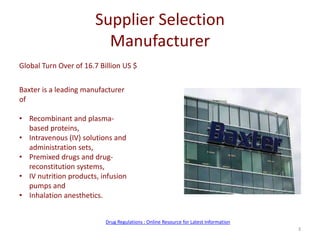
Baxter is a leading manufacturer
of
• Recombinant and plasma-
based proteins,
• Intravenous (IV) solutions and
administration sets,
• Premixed drugs and drug-
reconstitution systems,
• IV nutrition products, infusion
pumps and
• Inhalation anesthetics.
Global Turn Over of 16.7 Billion US $
Supplier Selection
Product
4
Drug Regulations : Online Resource for Latest Information
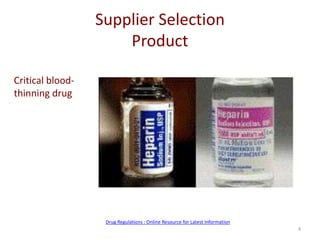
Critical blood-
thinning drug
Supplier Selection
Supplier
5
Drug Regulations : Online Resource for Latest Information
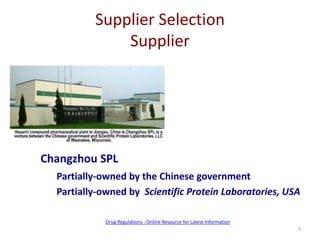
Changzhou SPL
Partially-owned by the Chinese government
Partially-owned by Scientific Protein Laboratories, USA
Supplier Selection
6
Drug Regulations : Online Resource for Latest Information
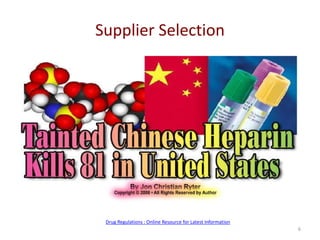
Situation on the Ground
7
• Business pressures to reduce costs
• Sourcing APIs and the raw materials at the lowest
cost
• This per se does not create non-compliance
• Create an opportunity for unscrupulous suppliers
• Introduction of substandard materials
Situation on the Ground
8
• Need for clarity
–Expectations
–Requirements
–Supplier quality and assurance of the full
supply chain.
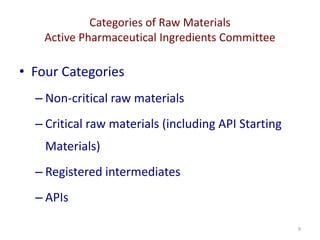
Categories of Raw Materials
Active Pharmaceutical Ingredients Committee
9
• Four Categories
– Non-critical raw materials
– Critical raw materials (including API Starting
Materials)
– Registered intermediates
– APIs
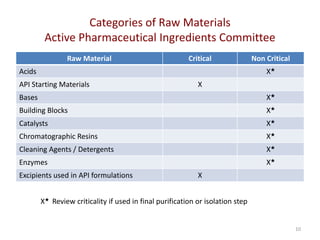
Categories of Raw Materials
Active Pharmaceutical Ingredients Committee
10
Raw Material Critical Non Critical
Acids X★
API Starting Materials X
Bases X★
Building Blocks X★
Catalysts X★
Chromatographic Resins X★
Cleaning Agents / Detergents X★
Enzymes X★
Excipients used in API formulations X
X★ Review criticality if used in final purification or isolation step
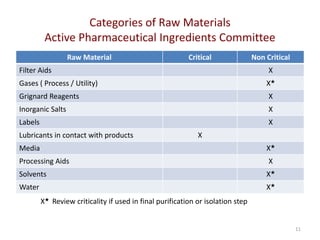
Categories of Raw Materials
Active Pharmaceutical Ingredients Committee
11
Raw Material Critical Non Critical
Filter Aids X
Gases ( Process / Utility) X★
Grignard Reagents X
Inorganic Salts X
Labels X
Lubricants in contact with products X
Media X★
Processing Aids X
Solvents X★
Water X★
X★ Review criticality if used in final purification or isolation step
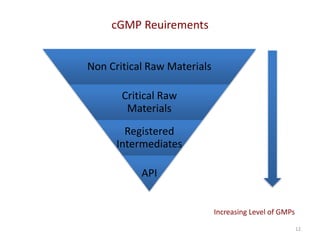
cGMP Reuirements
12
Increasing Level of GMPs
Non Critical Raw Materials
Critical Raw
Materials
Registered
Intermediates
API
Regulatory Agency Expectations
13
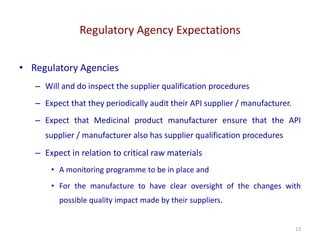
• Regulatory Agencies
– Will and do inspect the supplier qualification procedures
– Expect that they periodically audit their API supplier / manufacturer.
– Expect that Medicinal product manufacturer ensure that the API
supplier / manufacturer also has supplier qualification procedures
– Expect in relation to critical raw materials
• A monitoring programme to be in place and
• For the manufacture to have clear oversight of the changes with
possible quality impact made by their suppliers.
Regulatory Agency Expectations
14
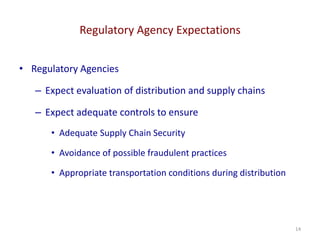
• Regulatory Agencies
– Expect evaluation of distribution and supply chains
– Expect adequate controls to ensure
• Adequate Supply Chain Security
• Avoidance of possible fraudulent practices
• Appropriate transportation conditions during distribution
Supplier Management Process
Life Cycle Approach
15
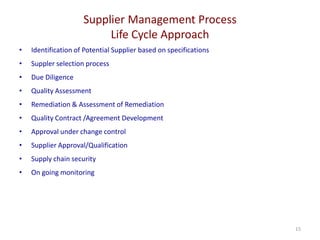
• Identification of Potential Supplier based on specifications
• Suppler selection process
• Due Diligence
• Quality Assessment
• Remediation & Assessment of Remediation
• Quality Contract /Agreement Development
• Approval under change control
• Supplier Approval/Qualification
• Supply chain security
• On going monitoring
Supplier Selection Process
16
• The supplier selection process starts with
– Definition of the user requirements for the materials(s)
– Should contain as a minimum:
– Name of the product (including formulae and CAS number
when available)
– Material specifications
– Quantity required
Supplier Selection Process
17
• The following information from the supplier should be requested as
part of the Suppliers Questionnaire
– Specifications
– Manufacturing/packaging/labeling details
– Materials Safety Data Sheets
– Logistic information (lead time to produce, delivery time,)
– Certificates regarding Quality system,
– Residual solvents
– BSE/TSE evaluation
– Analytical test method
Supplier Selection Process
18
• Pre-requisite
– To demonstrate that the material provided by the potential
supplier meets the specification as defined,
– Compliance to the specifications should be verified by
analytical testing of a sample.
– The sample (representative of commercial production) can
be pre-shipment sample(s) (with appropriate controls) or
– The release sample of the first delivery.
Supplier Selection Process
19
• For critical raw materials, intermediates and APIs
• It is likely that the data to be requested and collected
from the potential suppliers will be more elaborate
comprehensive than for raw materials.
Key Selection Criteria
For Critical raw materials, Registered intermediates and APIs
20
• Key selection criteria
1. Assurance of Supply
2. Quality & Regulatory compliance
3. Cost/Procurement aspects
4. Technical/Innovation
5. Communication capabilities & responsiveness
Key Selection Criteria
21
1. Assurance of Supply
• Essential element
• Guarantees appropriate supply chain management
• Consider following aspects
– Capacity (Scale equipment, batch size, chemistry experience,
etc....)
– Safety/Health/Environmental Risk
– Inventory management
Key Selection Criteria
22
1. Assurance of Supply
• Consider following aspects
– Financial solvency/business stability
– REACH requirements
• Registration, Evaluation, Authorization and Restriction of Chemicals
– Delivery performance
– Supply chain management of the material in question
Key Selection Criteria
23
2. Quality & Regulatory compliance
– Consider & evaluate quality and regulatory track record.
– Obtain a comprehensive compliance status,
Key Selection Criteria
24
2. Quality & Regulatory compliance
• Consider following aspects
– cGMP Compliance & regulatory track record
– 􏰀Recalls & Complaints
– Change/Deviation Management 􏰀
– Materials management controls
Key Selection Criteria
25
2. Quality & Regulatory compliance
• Consider following aspects
– Quality Management Systems
– Quality Agreement
– Quality Culture
– Production Facilities & Equipment
– Product Quality Review
– Process Validation approach:
– QOTIF % (On time in Full)
– Documentation standard
Key Selection Criteria
26
3. Cost/Procurement aspects
– Price of the material
– Cost Management (Cost visibility)
– 􏰀Presence in Low Cost Countries (Emerging markets)
– 􏰀 Ability to achieve the target price
Key Selection Criteria
27
4. Technical/Innovation
• Understand technical competences of the supplier
– Technology Specialization
– Plant capabilities
– Laboratory capabilities
– Business problems resolving capabilities
– Technical skills/ Staff Qualifications
Key Selection Criteria
28
4. Technical/Innovation
• Understand technical competences of the supplier
• Control systems
• Development capability
• Process development expertise
• Project management
• Willingness to innovate
• Intellectual property
Key Selection Criteria
29
5. Communication capabilities & responsiveness
• Consider following aspects
– Rapidity project assessment
– Resource availability
– Flexibility(Attitude)
– Functional contacts definition
– Openness
– Ease of communication (understanding of English)
– Pro-activeness
Selection of Suppliers
Process
30
• For critical raw materials, registered intermediates and APIs
– Form a multidisciplinary team
– Assess all data.
– Prepare a shortlist
– Analyze samples if available.
– Use analytical results to support the GO/NO GO decision
– Qualify identified supplier
– Complete due diligence procedure
– Document evidence of the supplier's suitability
– Prepare a shortlist of potential suppliers
Selection of Suppliers
Process
31
• Non critical raw materials
– Assess compliance to defined user requirements
– Start quality assessment
– Upon positive outcome of quality assessment continue
progressing with the supplier.
Due Diligence
32
• Not applicable for Non-critical materials
• Due diligence can be based on Risk assessment ( ICH Q 9)
• Assure that the appropriate due diligence is conducted prior to
contracting with the supplier.
• Evaluate the possibility of establishing long term relationship
• Assess & challenge existing system & facility
• Evaluate capability of supplier to meet customer requirement
• Documented evidence should be assembled to support the Go/No Go
decision process
Due Diligence
33
• Form a cross functional team
– Engineering,
– Regulatory,
– Environmental/ Health / Safety,
– Technical Experts e.g. Chemical/Biological Process
Engineer(s)
– QBD experts
– Procurement
Due Diligence
34
• Form a cross functional team
– Each member to
– Document information
– Formulate a decision and/or action proposal related to his/her
expertise field.
– Present combined information to the Senior Management in the
form of a recommendation.
–
Due Diligence: Areas to be challenged
35
1. General Material Information
2. Quality Systems
3. Plant Tour / Organization
4. Documentation / Organization
5. Process
6. Analytics & stability
7. Regulatory
8. Economics
9. IP
10. Environment , Health and Safety
Due Diligence: Areas to be challenged
36
• General Material Information based on
The general material information to be challenged can be based on
1. Sample evaluation results where available,
2. Possible impurity profile issues,
3. Quality system pre-assessment and/or
4. Supply chain assurance.
Due Diligence: Areas to be challenged
37
• General Material Information
• Following can be challenged & verified
– Sufficient capacity to assure supply chain
– Anti Counterfeiting measurements
– Audit sustainability (qualification of the total supply chain)
–
Due Diligence: Areas to be challenged
38
• Quality System
– Evaluate implemented Quality System based on ICH Q 7
– Evaluation of Quality system can be reduced based on the QRM as per ICH Q
9.
– If ICH Q 7 is not applicable challenge the system as per ISO 9001
– Use of Quality by design
– Implementation of system for continuous Quality improvement
– Implementation & use of Risk Management
Due Diligence: Areas to be challenged
39
• Plant Tour & Organization
• Examples of items to be challenged during the plant
tour are:
– Contamination prevention,
– Utilities: Water system, HVAC, Nitrogen, Steam, Cool media,
– Equipment calibration and maintenance (production and QC),
– Laboratory controls and product release procedures
– Warehouse controls
Due Diligence: Areas to be challenged
40
• Document / Organization
– Evaluation of capability of the organization to
demonstrate
– Traceability,
– Compliance to the manufacturing process
– Compliance to ICH Q7 and/or
– The General Quality System in place.
Due Diligence: Areas to be challenged
41
• Document / Organization
• Examples of documentation that can be challenged during review
are:
– Master records, batch production records, laboratory records
– Training and personnel qualification,
– Quality systems
• (product release, change control, deviation handling, failure
investigations, stability program, etc.).
Due Diligence: Areas to be challenged
42
• Process
• Evaluate capability to manufacture material of
– Consistent quality
– Compliant to ICH Q7 if applicable (examples: API and
registered intermediates) or
– Compliant to the General Quality System in place.
Due Diligence: Areas to be challenged
43
• Process : Chemical Synthesis
• Examples of items that can be assessed are:
– Critical process parameters
– Associated critical quality attributes identified
– Chemical development history/report
Due Diligence: Areas to be challenged
44
• Process : Bio Chemical Synthesis
• Examples of items that can be assessed are:
– Cultivation Process
– Purification Process
– Cell bank maintenance
Due Diligence: Areas to be challenged
45
• Process : Manufacturing Process( Chemical & Biological)
– Examples of items that can be assessed are:
– Process trending (Yield, Quality, etc.),
– Rework / Reprocess
– Validation protocols and reports,
Due Diligence: Areas to be challenged
46
• Physical Properties of the Material
– Evaluate
– Consistency of the Physical Chemistry of the
material
– Evaluation of the manufacturability of the material
in next process steps.
Due Diligence: Areas to be challenged
47
• Physical Properties of the Material
– Examples of Physical properties that can be assessed
are:
• Solubility profile
• Polymorphism
• Documentation on most stable polymorph
• Particle size
• Degradation products
Due Diligence: Areas to be challenged
48
• Analytics
• Evaluate
– Analytical and stability results
– Consistency of the quality of the material
– Quality profile
– Accuracy of implemented storage conditions
Due Diligence: Areas to be challenged
49
• Regulatory
• Evaluate for all intended countries
– Regulatory status
– Compliance status
Due Diligence: Areas to be challenged
50
• Economics
• Evaluate economic contribution to the decision
process related to the
– Location of the manufacturing site
– Supply chain
– Business continuity assurance
Due Diligence: Areas to be challenged
51
• Intellectual Property
• Evaluate patent situation
– Production process
– Manufacturing technologies used
Due Diligence: Areas to be challenged
52
• Safety, Environment & Health
• Evaluate
– Implemented safety, environment & health
systems
– Compliance to local authorities' requirements
– People health protection
Due Diligence: Areas to be challenged
53
• Safety, Environment & Health
• Examples of items that can be challenged are:
– Industrial Hygiene aspects,
– Child labour
– Synthesis steps with extreme conditions (temperature, pressure,
reagents),
– Waste Management
– Licences
– SHE Quality Systems such as ISO 14001
Due Diligence: Areas to be challenged
54
• Conclusion & Recommendation
– Issue an overall report
– Use combined information to formulate a final
recommendation to Senior Management
– Escalate issues to senior management if
• Critical issues (Quality, Safety, Health, Environment,
Regulatory, Business continuity) are identified or
• If there is no clearly defined actions for remediation
Due Diligence: Areas to be challenged
55
• Conclusion & Recommendation
– If Critical Quality and GMP issues are identified
– Prepare an accurate mitigation plan
– Approve the mitigation plan
– Execute Quality Audit after this is in place.
– Senior Management is responsible for the final
Go/No-Go decision.
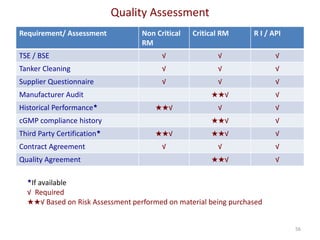
Quality Assessment
56
Requirement/ Assessment Non Critical
RM
Critical RM R I / API
TSE / BSE √ √ √
Tanker Cleaning √ √ √
Supplier Questionnaire √ √ √
Manufacturer Audit ★★√ √
Historical Performance★ ★★√ √ √
cGMP compliance history ★★√ √
Third Party Certification★ ★★√ ★★√ √
Contract Agreement √ √ √
Quality Agreement ★★√ √
★If available
√ Required
★★√ Based on Risk Assessment performed on material being purchased
Quality Assessment
57
• Format of Quality Assessment
– Dependent on
• Criticality of the Material being purchased
• Out come of the risk assessment being
performed.
Format of Quality Assessment
58
• Non critical Raw Materials
• Limited evaluation
• Out come of the risk assessment being performed
• Provision of an ISO 9001:2008 or equivalent
certificate
• Satisfactory past performance by the supplier
Format of Quality Assessment
59
• Critical Raw Materials
• Out come of the risk assessment being performed
• Level of In house analysis being performed
• If reduced testing is planned then use
“Manufacturer’s questionnaire or perform audit.
Format of Quality Assessment
60
• Registered Intermediates and API’s
– Quality audit a key part of the quality assessment.
Quality Assessment
General Considerations ( For all )
61
• TSE/BSE Assessment
• Supplier certification required
• For compliance with TSE guidance
• For all raw materials/ source materials and any other
materials (i.e. cleaning agents)
Quality Assessment
General Considerations ( For all )
62
• Materials delivered in tankers
• Assess if tanker is dedicated to one material
• If not assess tanker cleaning verification
– Cleaning certificates
– Testing for trace impurities or
– An audit of the tanker cleaning procedure
Quality Assessment
Timeline
63
• Non Critical Raw Materials
• Quality Assessment can be concurrent with production
assessment if
– TSE & Tanker cleaning assessment are in place
– Material is tested and meets specification
Quality Assessment
Timeline
64
• Critical Raw Materials
• Initiate quality assessments as early as possible
• It may not always be possible to have a manufacturer
questionnaire response or manufacturer audit performed
prior to the production assessment process.
Quality Assessment
Timeline
65
• Critical Raw Materials
• At a minimum
• TSE and tanker cleaning certification must be in place and
• Full testing to specification must be performed prior to the
production assessment going ahead, with the manufacturer
questionnaire having been sent (if previously deemed
necessary).
Quality Assessment
Timeline
66
• Critical Raw Materials
• At a minimum
• In some cases the risk may be such that the production assessment does
not go ahead until the manufacturer questionnaire / audit have been
performed and satisfactory responses have been obtained.
• The customer cannot implement reduced testing until the manufacturer
evaluation has been completed as per in house SOPs and the
requirements of ICHQ7 section 7.3 have been met.
Quality Assessment
Timeline
67
• Registered Intermediates and API’s
• Complete quality assessment before any production.
• Schedule activities like questionnaire , audit ,
response to audit , remediation , re-audit , close
out , quality agreement signing appropriately.
Quality Assessment
Roles and Responsibilities
68
– Under complete control of Quality Unit
– Assistance from other departments for specialized
knowledge.
– Go/No Go decision by quality unit
– Lead auditor should be experienced/ certified
– Third party auditor with relevant experience in the
field
Quality Assessment
Manufacturer Questionnaire
69
– Tailor questionnaire to material being purchased
– Format can mimic pre audit questionnaire
– Manufacturers of critical raw materials may not
work to GMP standards
– Use appropriate alternate standards
Quality Assessment
Audit standard :
70
• Critical Raw Materials
– Materials are not always manufactured to cGMP.
– Alternative quality standard or no quality standard
at all.
– Consider manufacturers quality system and the
customers requirements for audit
Quality Assessment
Audit standard :
71
• Registered Intermediates and API
– Preferred standard for audit : ICH Q 7
– Consider potential sales region of the Finished Goods
• World wide
• Local
• BP/USP/JP considerations
– Define acceptance criteria prior to audit
Quality Assessment
Performance of Audit
72
– Country/State of audit
– Spoken & written language
– Need for an interpreter
– Interpreter independent of the company
– Audit for intended API / Raw Material / Intermediate
– Scope for future expansion
– Ability to meet different audit standards
– Consider Supply chain complexity & Risk assessment
Quality Assessment
Audit Report
73
– Issue report in a timely manner
– Each observation should be rated ( Critical , major, other)
– Report should state if
• Pre determined requirements have been met
• If not, Remediation action should be specified
– Request response with timelines
– Response should have responsible person for each
observation
Quality Assessment
Audit Report
74
• Critical raw materials
• If critical or major deficiencies identified
• A risk assessment must be performed on whether the deficiencies are such that
the customer's product may be at risk from the raw material supplied.
• At this stage the customer must maintain full testing of the raw material.
• The manufacturer must agree that a need for remediation has been identified
and a commitment made to remediate with a time line.
• A re-audit may be performed if the deficiencies warrant it.
Quality Assessment
Audit Report
75
• Critical raw materials
• Other deficiencies
• Assessment can proceed as long as remediation has been
identified and a commitment made to remediate.
• If remediation is not required then the quality assessment can
be completed.
Quality Assessment
Audit Report
76
• Registered Intermediates / API’s
• Critical / Major deficiency :
– Assessment process can not be completed till remediation is identified &
completed.
• Other Deficiency :
 The assessment can proceed as long as remediation has been identified and a
commitment made to remediate.
• If remediation is not required complete quality assessment
• Quality Agreement can be signed (if the assessment outcome is GO).
Quality Assessment
Audit Report
77
Registered Intermediates / API’s
• Remediation
– Agreement of timelines
– No production till critical & Major observations are addressed
– Decide on level of checks required post remediation
• Quality Agreement can be signed if the re assessment outcome
is satisfactory.
Completion of Quality Assessment
78
–Collate and review all data
–Some data may have been reviewed
during due diligence
–However this review should be done
again
Completion of Quality Assessment
79
• Non critical Raw Materials
– If the quality assessment is satisfactory then the decision is GO
• Critical raw materials
– If the quality assessment is satisfactory then the decision is GO.
– If the customer wishes to consider reduced testing then the criteria outlined in
ICHQ7 section 7.3 must also be met
• Registered Intermediates and API’s
– If the quality assessment is satisfactory then the decision is GO, on the signing
of the Quality Agreement.
Quality Contract / Agreement
80
• Non critical Raw Materials
– A purchase contract will do which could include specific quality issues.
• Critical raw materials
– A purchasing / Quality contract is required. This could be supplemented
with Quality Agreement
Quality Contract / Agreement
81
Registered Intermediates and API’s
• Quality Agreement must be drawn
• The Quality agreement must be approved and signed by both parties
before any manufacturing takes place.
• The Quality Agreement should address the need for
– Notification of any potential changes that may impact the quality of the product and
– No changes to be made without prior approval.
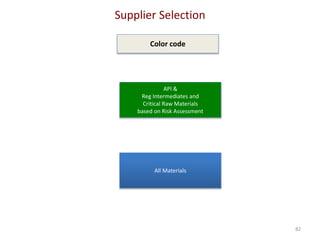
Supplier Selection
82
API &
Reg Intermediates and
Critical Raw Materials
based on Risk Assessment
All Materials
Color code
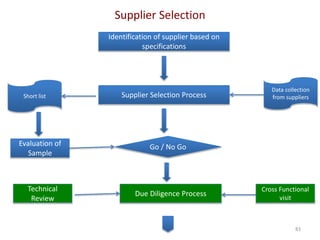
Supplier Selection
83
Identification of supplier based on
specifications
Supplier Selection Process
Data collection
from suppliersShort list
Evaluation of
Sample
Go / No Go
Due Diligence Process
Technical
Review
Cross Functional
visit
Supplier Selection
84
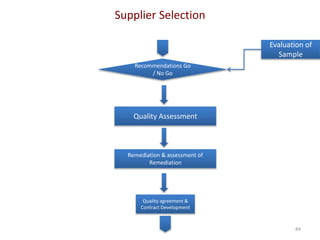
Recommendations Go
/ No Go
Quality Assessment
Quality agreement &
Contract Development
Evaluation of
Sample
Remediation & assessment of
Remediation
Supplier Selection
85
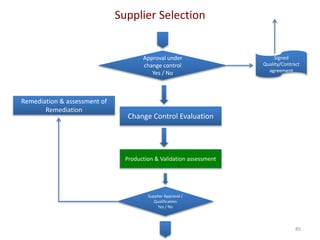
Approval under
change control
Yes / No
Change Control Evaluation
Production & Validation assessment
Signed
Quality/Contract
agreement
Supplier Approval /
Qualification
Yes / No
Remediation & assessment of
Remediation
Supplier Selection
86
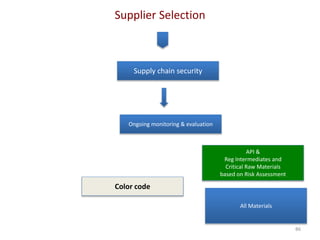
Supply chain security
Ongoing monitoring & evaluation
API &
Reg Intermediates and
Critical Raw Materials
based on Risk Assessment
All Materials
Color code
• This presentation was compiled from freely
available resources like the websites of FDA,
EMA, WHO.
• “Drug Regulations” is a non profit organization
which provides free online resource to the
Pharmaceutical Professional.
• Visit http://www.drugregulations.org for latest
information from the world of Pharmaceuticals.
Supplier Selection
7/27/2015 87
Drug Regulations : Online Resource for
Latest Information
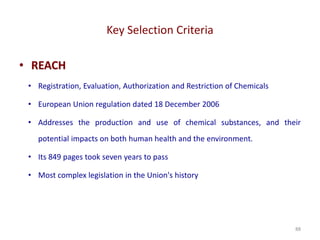
Key Selection Criteria
88
• REACH
• Registration, Evaluation, Authorization and Restriction of Chemicals
• European Union regulation dated 18 December 2006
• Addresses the production and use of chemical substances, and their
potential impacts on both human health and the environment.
• Its 849 pages took seven years to pass
• Most complex legislation in the Union's history
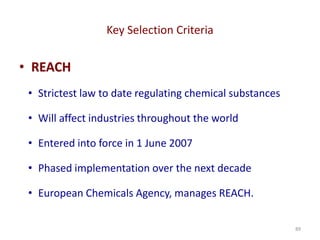
Key Selection Criteria
89
• REACH
• Strictest law to date regulating chemical substances
• Will affect industries throughout the world
• Entered into force in 1 June 2007
• Phased implementation over the next decade
• European Chemicals Agency, manages REACH.
Supplier Selection

Supplier Selection

  • 1.
    • This presentationwas compiled from freely available resources like the websites of FDA, EMA, WHO. • “Drug Regulations” is a non profit organization which provides free online resource to the Pharmaceutical Professional. • Visit http://www.drugregulations.org for latest information from the world of Pharmaceuticals. Supplier Selection 7/27/2015 1 Drug Regulations : Online Resource for Latest Information
  • 2.
    • Manufacture ofMedicinal Products & API’s –Subjected to cGMP’s –Ensures Quality, Safety & Efficacy. Supplier Selection 2 Drug Regulations : Online Resource for Latest Information
  • 3.
    Supplier Selection Manufacturer 3 Drug Regulations: Online Resource for Latest Information Baxter is a leading manufacturer of • Recombinant and plasma- based proteins, • Intravenous (IV) solutions and administration sets, • Premixed drugs and drug- reconstitution systems, • IV nutrition products, infusion pumps and • Inhalation anesthetics. Global Turn Over of 16.7 Billion US $
  • 4.
    Supplier Selection Product 4 Drug Regulations: Online Resource for Latest Information Critical blood- thinning drug
  • 5.
    Supplier Selection Supplier 5 Drug Regulations: Online Resource for Latest Information Changzhou SPL Partially-owned by the Chinese government Partially-owned by Scientific Protein Laboratories, USA
  • 6.
    Supplier Selection 6 Drug Regulations: Online Resource for Latest Information
  • 7.
    Situation on theGround 7 • Business pressures to reduce costs • Sourcing APIs and the raw materials at the lowest cost • This per se does not create non-compliance • Create an opportunity for unscrupulous suppliers • Introduction of substandard materials
  • 8.
    Situation on theGround 8 • Need for clarity –Expectations –Requirements –Supplier quality and assurance of the full supply chain.
  • 9.
    Categories of RawMaterials Active Pharmaceutical Ingredients Committee 9 • Four Categories – Non-critical raw materials – Critical raw materials (including API Starting Materials) – Registered intermediates – APIs
  • 10.
    Categories of RawMaterials Active Pharmaceutical Ingredients Committee 10 Raw Material Critical Non Critical Acids X★ API Starting Materials X Bases X★ Building Blocks X★ Catalysts X★ Chromatographic Resins X★ Cleaning Agents / Detergents X★ Enzymes X★ Excipients used in API formulations X X★ Review criticality if used in final purification or isolation step
  • 11.
    Categories of RawMaterials Active Pharmaceutical Ingredients Committee 11 Raw Material Critical Non Critical Filter Aids X Gases ( Process / Utility) X★ Grignard Reagents X Inorganic Salts X Labels X Lubricants in contact with products X Media X★ Processing Aids X Solvents X★ Water X★ X★ Review criticality if used in final purification or isolation step
  • 12.
    cGMP Reuirements 12 Increasing Levelof GMPs Non Critical Raw Materials Critical Raw Materials Registered Intermediates API
  • 13.
    Regulatory Agency Expectations 13 •Regulatory Agencies – Will and do inspect the supplier qualification procedures – Expect that they periodically audit their API supplier / manufacturer. – Expect that Medicinal product manufacturer ensure that the API supplier / manufacturer also has supplier qualification procedures – Expect in relation to critical raw materials • A monitoring programme to be in place and • For the manufacture to have clear oversight of the changes with possible quality impact made by their suppliers.
  • 14.
    Regulatory Agency Expectations 14 •Regulatory Agencies – Expect evaluation of distribution and supply chains – Expect adequate controls to ensure • Adequate Supply Chain Security • Avoidance of possible fraudulent practices • Appropriate transportation conditions during distribution
  • 15.
    Supplier Management Process LifeCycle Approach 15 • Identification of Potential Supplier based on specifications • Suppler selection process • Due Diligence • Quality Assessment • Remediation & Assessment of Remediation • Quality Contract /Agreement Development • Approval under change control • Supplier Approval/Qualification • Supply chain security • On going monitoring
  • 16.
    Supplier Selection Process 16 •The supplier selection process starts with – Definition of the user requirements for the materials(s) – Should contain as a minimum: – Name of the product (including formulae and CAS number when available) – Material specifications – Quantity required
  • 17.
    Supplier Selection Process 17 •The following information from the supplier should be requested as part of the Suppliers Questionnaire – Specifications – Manufacturing/packaging/labeling details – Materials Safety Data Sheets – Logistic information (lead time to produce, delivery time,) – Certificates regarding Quality system, – Residual solvents – BSE/TSE evaluation – Analytical test method
  • 18.
    Supplier Selection Process 18 •Pre-requisite – To demonstrate that the material provided by the potential supplier meets the specification as defined, – Compliance to the specifications should be verified by analytical testing of a sample. – The sample (representative of commercial production) can be pre-shipment sample(s) (with appropriate controls) or – The release sample of the first delivery.
  • 19.
    Supplier Selection Process 19 •For critical raw materials, intermediates and APIs • It is likely that the data to be requested and collected from the potential suppliers will be more elaborate comprehensive than for raw materials.
  • 20.
    Key Selection Criteria ForCritical raw materials, Registered intermediates and APIs 20 • Key selection criteria 1. Assurance of Supply 2. Quality & Regulatory compliance 3. Cost/Procurement aspects 4. Technical/Innovation 5. Communication capabilities & responsiveness
  • 21.
    Key Selection Criteria 21 1.Assurance of Supply • Essential element • Guarantees appropriate supply chain management • Consider following aspects – Capacity (Scale equipment, batch size, chemistry experience, etc....) – Safety/Health/Environmental Risk – Inventory management
  • 22.
    Key Selection Criteria 22 1.Assurance of Supply • Consider following aspects – Financial solvency/business stability – REACH requirements • Registration, Evaluation, Authorization and Restriction of Chemicals – Delivery performance – Supply chain management of the material in question
  • 23.
    Key Selection Criteria 23 2.Quality & Regulatory compliance – Consider & evaluate quality and regulatory track record. – Obtain a comprehensive compliance status,
  • 24.
    Key Selection Criteria 24 2.Quality & Regulatory compliance • Consider following aspects – cGMP Compliance & regulatory track record – 􏰀Recalls & Complaints – Change/Deviation Management 􏰀 – Materials management controls
  • 25.
    Key Selection Criteria 25 2.Quality & Regulatory compliance • Consider following aspects – Quality Management Systems – Quality Agreement – Quality Culture – Production Facilities & Equipment – Product Quality Review – Process Validation approach: – QOTIF % (On time in Full) – Documentation standard
  • 26.
    Key Selection Criteria 26 3.Cost/Procurement aspects – Price of the material – Cost Management (Cost visibility) – 􏰀Presence in Low Cost Countries (Emerging markets) – 􏰀 Ability to achieve the target price
  • 27.
    Key Selection Criteria 27 4.Technical/Innovation • Understand technical competences of the supplier – Technology Specialization – Plant capabilities – Laboratory capabilities – Business problems resolving capabilities – Technical skills/ Staff Qualifications
  • 28.
    Key Selection Criteria 28 4.Technical/Innovation • Understand technical competences of the supplier • Control systems • Development capability • Process development expertise • Project management • Willingness to innovate • Intellectual property
  • 29.
    Key Selection Criteria 29 5.Communication capabilities & responsiveness • Consider following aspects – Rapidity project assessment – Resource availability – Flexibility(Attitude) – Functional contacts definition – Openness – Ease of communication (understanding of English) – Pro-activeness
  • 30.
    Selection of Suppliers Process 30 •For critical raw materials, registered intermediates and APIs – Form a multidisciplinary team – Assess all data. – Prepare a shortlist – Analyze samples if available. – Use analytical results to support the GO/NO GO decision – Qualify identified supplier – Complete due diligence procedure – Document evidence of the supplier's suitability – Prepare a shortlist of potential suppliers
  • 31.
    Selection of Suppliers Process 31 •Non critical raw materials – Assess compliance to defined user requirements – Start quality assessment – Upon positive outcome of quality assessment continue progressing with the supplier.
  • 32.
    Due Diligence 32 • Notapplicable for Non-critical materials • Due diligence can be based on Risk assessment ( ICH Q 9) • Assure that the appropriate due diligence is conducted prior to contracting with the supplier. • Evaluate the possibility of establishing long term relationship • Assess & challenge existing system & facility • Evaluate capability of supplier to meet customer requirement • Documented evidence should be assembled to support the Go/No Go decision process
  • 33.
    Due Diligence 33 • Forma cross functional team – Engineering, – Regulatory, – Environmental/ Health / Safety, – Technical Experts e.g. Chemical/Biological Process Engineer(s) – QBD experts – Procurement
  • 34.
    Due Diligence 34 • Forma cross functional team – Each member to – Document information – Formulate a decision and/or action proposal related to his/her expertise field. – Present combined information to the Senior Management in the form of a recommendation. –
  • 35.
    Due Diligence: Areasto be challenged 35 1. General Material Information 2. Quality Systems 3. Plant Tour / Organization 4. Documentation / Organization 5. Process 6. Analytics & stability 7. Regulatory 8. Economics 9. IP 10. Environment , Health and Safety
  • 36.
    Due Diligence: Areasto be challenged 36 • General Material Information based on The general material information to be challenged can be based on 1. Sample evaluation results where available, 2. Possible impurity profile issues, 3. Quality system pre-assessment and/or 4. Supply chain assurance.
  • 37.
    Due Diligence: Areasto be challenged 37 • General Material Information • Following can be challenged & verified – Sufficient capacity to assure supply chain – Anti Counterfeiting measurements – Audit sustainability (qualification of the total supply chain) –
  • 38.
    Due Diligence: Areasto be challenged 38 • Quality System – Evaluate implemented Quality System based on ICH Q 7 – Evaluation of Quality system can be reduced based on the QRM as per ICH Q 9. – If ICH Q 7 is not applicable challenge the system as per ISO 9001 – Use of Quality by design – Implementation of system for continuous Quality improvement – Implementation & use of Risk Management
  • 39.
    Due Diligence: Areasto be challenged 39 • Plant Tour & Organization • Examples of items to be challenged during the plant tour are: – Contamination prevention, – Utilities: Water system, HVAC, Nitrogen, Steam, Cool media, – Equipment calibration and maintenance (production and QC), – Laboratory controls and product release procedures – Warehouse controls
  • 40.
    Due Diligence: Areasto be challenged 40 • Document / Organization – Evaluation of capability of the organization to demonstrate – Traceability, – Compliance to the manufacturing process – Compliance to ICH Q7 and/or – The General Quality System in place.
  • 41.
    Due Diligence: Areasto be challenged 41 • Document / Organization • Examples of documentation that can be challenged during review are: – Master records, batch production records, laboratory records – Training and personnel qualification, – Quality systems • (product release, change control, deviation handling, failure investigations, stability program, etc.).
  • 42.
    Due Diligence: Areasto be challenged 42 • Process • Evaluate capability to manufacture material of – Consistent quality – Compliant to ICH Q7 if applicable (examples: API and registered intermediates) or – Compliant to the General Quality System in place.
  • 43.
    Due Diligence: Areasto be challenged 43 • Process : Chemical Synthesis • Examples of items that can be assessed are: – Critical process parameters – Associated critical quality attributes identified – Chemical development history/report
  • 44.
    Due Diligence: Areasto be challenged 44 • Process : Bio Chemical Synthesis • Examples of items that can be assessed are: – Cultivation Process – Purification Process – Cell bank maintenance
  • 45.
    Due Diligence: Areasto be challenged 45 • Process : Manufacturing Process( Chemical & Biological) – Examples of items that can be assessed are: – Process trending (Yield, Quality, etc.), – Rework / Reprocess – Validation protocols and reports,
  • 46.
    Due Diligence: Areasto be challenged 46 • Physical Properties of the Material – Evaluate – Consistency of the Physical Chemistry of the material – Evaluation of the manufacturability of the material in next process steps.
  • 47.
    Due Diligence: Areasto be challenged 47 • Physical Properties of the Material – Examples of Physical properties that can be assessed are: • Solubility profile • Polymorphism • Documentation on most stable polymorph • Particle size • Degradation products
  • 48.
    Due Diligence: Areasto be challenged 48 • Analytics • Evaluate – Analytical and stability results – Consistency of the quality of the material – Quality profile – Accuracy of implemented storage conditions
  • 49.
    Due Diligence: Areasto be challenged 49 • Regulatory • Evaluate for all intended countries – Regulatory status – Compliance status
  • 50.
    Due Diligence: Areasto be challenged 50 • Economics • Evaluate economic contribution to the decision process related to the – Location of the manufacturing site – Supply chain – Business continuity assurance
  • 51.
    Due Diligence: Areasto be challenged 51 • Intellectual Property • Evaluate patent situation – Production process – Manufacturing technologies used
  • 52.
    Due Diligence: Areasto be challenged 52 • Safety, Environment & Health • Evaluate – Implemented safety, environment & health systems – Compliance to local authorities' requirements – People health protection
  • 53.
    Due Diligence: Areasto be challenged 53 • Safety, Environment & Health • Examples of items that can be challenged are: – Industrial Hygiene aspects, – Child labour – Synthesis steps with extreme conditions (temperature, pressure, reagents), – Waste Management – Licences – SHE Quality Systems such as ISO 14001
  • 54.
    Due Diligence: Areasto be challenged 54 • Conclusion & Recommendation – Issue an overall report – Use combined information to formulate a final recommendation to Senior Management – Escalate issues to senior management if • Critical issues (Quality, Safety, Health, Environment, Regulatory, Business continuity) are identified or • If there is no clearly defined actions for remediation
  • 55.
    Due Diligence: Areasto be challenged 55 • Conclusion & Recommendation – If Critical Quality and GMP issues are identified – Prepare an accurate mitigation plan – Approve the mitigation plan – Execute Quality Audit after this is in place. – Senior Management is responsible for the final Go/No-Go decision.
  • 56.
    Quality Assessment 56 Requirement/ AssessmentNon Critical RM Critical RM R I / API TSE / BSE √ √ √ Tanker Cleaning √ √ √ Supplier Questionnaire √ √ √ Manufacturer Audit ★★√ √ Historical Performance★ ★★√ √ √ cGMP compliance history ★★√ √ Third Party Certification★ ★★√ ★★√ √ Contract Agreement √ √ √ Quality Agreement ★★√ √ ★If available √ Required ★★√ Based on Risk Assessment performed on material being purchased
  • 57.
    Quality Assessment 57 • Formatof Quality Assessment – Dependent on • Criticality of the Material being purchased • Out come of the risk assessment being performed.
  • 58.
    Format of QualityAssessment 58 • Non critical Raw Materials • Limited evaluation • Out come of the risk assessment being performed • Provision of an ISO 9001:2008 or equivalent certificate • Satisfactory past performance by the supplier
  • 59.
    Format of QualityAssessment 59 • Critical Raw Materials • Out come of the risk assessment being performed • Level of In house analysis being performed • If reduced testing is planned then use “Manufacturer’s questionnaire or perform audit.
  • 60.
    Format of QualityAssessment 60 • Registered Intermediates and API’s – Quality audit a key part of the quality assessment.
  • 61.
    Quality Assessment General Considerations( For all ) 61 • TSE/BSE Assessment • Supplier certification required • For compliance with TSE guidance • For all raw materials/ source materials and any other materials (i.e. cleaning agents)
  • 62.
    Quality Assessment General Considerations( For all ) 62 • Materials delivered in tankers • Assess if tanker is dedicated to one material • If not assess tanker cleaning verification – Cleaning certificates – Testing for trace impurities or – An audit of the tanker cleaning procedure
  • 63.
    Quality Assessment Timeline 63 • NonCritical Raw Materials • Quality Assessment can be concurrent with production assessment if – TSE & Tanker cleaning assessment are in place – Material is tested and meets specification
  • 64.
    Quality Assessment Timeline 64 • CriticalRaw Materials • Initiate quality assessments as early as possible • It may not always be possible to have a manufacturer questionnaire response or manufacturer audit performed prior to the production assessment process.
  • 65.
    Quality Assessment Timeline 65 • CriticalRaw Materials • At a minimum • TSE and tanker cleaning certification must be in place and • Full testing to specification must be performed prior to the production assessment going ahead, with the manufacturer questionnaire having been sent (if previously deemed necessary).
  • 66.
    Quality Assessment Timeline 66 • CriticalRaw Materials • At a minimum • In some cases the risk may be such that the production assessment does not go ahead until the manufacturer questionnaire / audit have been performed and satisfactory responses have been obtained. • The customer cannot implement reduced testing until the manufacturer evaluation has been completed as per in house SOPs and the requirements of ICHQ7 section 7.3 have been met.
  • 67.
    Quality Assessment Timeline 67 • RegisteredIntermediates and API’s • Complete quality assessment before any production. • Schedule activities like questionnaire , audit , response to audit , remediation , re-audit , close out , quality agreement signing appropriately.
  • 68.
    Quality Assessment Roles andResponsibilities 68 – Under complete control of Quality Unit – Assistance from other departments for specialized knowledge. – Go/No Go decision by quality unit – Lead auditor should be experienced/ certified – Third party auditor with relevant experience in the field
  • 69.
    Quality Assessment Manufacturer Questionnaire 69 –Tailor questionnaire to material being purchased – Format can mimic pre audit questionnaire – Manufacturers of critical raw materials may not work to GMP standards – Use appropriate alternate standards
  • 70.
    Quality Assessment Audit standard: 70 • Critical Raw Materials – Materials are not always manufactured to cGMP. – Alternative quality standard or no quality standard at all. – Consider manufacturers quality system and the customers requirements for audit
  • 71.
    Quality Assessment Audit standard: 71 • Registered Intermediates and API – Preferred standard for audit : ICH Q 7 – Consider potential sales region of the Finished Goods • World wide • Local • BP/USP/JP considerations – Define acceptance criteria prior to audit
  • 72.
    Quality Assessment Performance ofAudit 72 – Country/State of audit – Spoken & written language – Need for an interpreter – Interpreter independent of the company – Audit for intended API / Raw Material / Intermediate – Scope for future expansion – Ability to meet different audit standards – Consider Supply chain complexity & Risk assessment
  • 73.
    Quality Assessment Audit Report 73 –Issue report in a timely manner – Each observation should be rated ( Critical , major, other) – Report should state if • Pre determined requirements have been met • If not, Remediation action should be specified – Request response with timelines – Response should have responsible person for each observation
  • 74.
    Quality Assessment Audit Report 74 •Critical raw materials • If critical or major deficiencies identified • A risk assessment must be performed on whether the deficiencies are such that the customer's product may be at risk from the raw material supplied. • At this stage the customer must maintain full testing of the raw material. • The manufacturer must agree that a need for remediation has been identified and a commitment made to remediate with a time line. • A re-audit may be performed if the deficiencies warrant it.
  • 75.
    Quality Assessment Audit Report 75 •Critical raw materials • Other deficiencies • Assessment can proceed as long as remediation has been identified and a commitment made to remediate. • If remediation is not required then the quality assessment can be completed.
  • 76.
    Quality Assessment Audit Report 76 •Registered Intermediates / API’s • Critical / Major deficiency : – Assessment process can not be completed till remediation is identified & completed. • Other Deficiency :  The assessment can proceed as long as remediation has been identified and a commitment made to remediate. • If remediation is not required complete quality assessment • Quality Agreement can be signed (if the assessment outcome is GO).
  • 77.
    Quality Assessment Audit Report 77 RegisteredIntermediates / API’s • Remediation – Agreement of timelines – No production till critical & Major observations are addressed – Decide on level of checks required post remediation • Quality Agreement can be signed if the re assessment outcome is satisfactory.
  • 78.
    Completion of QualityAssessment 78 –Collate and review all data –Some data may have been reviewed during due diligence –However this review should be done again
  • 79.
    Completion of QualityAssessment 79 • Non critical Raw Materials – If the quality assessment is satisfactory then the decision is GO • Critical raw materials – If the quality assessment is satisfactory then the decision is GO. – If the customer wishes to consider reduced testing then the criteria outlined in ICHQ7 section 7.3 must also be met • Registered Intermediates and API’s – If the quality assessment is satisfactory then the decision is GO, on the signing of the Quality Agreement.
  • 80.
    Quality Contract /Agreement 80 • Non critical Raw Materials – A purchase contract will do which could include specific quality issues. • Critical raw materials – A purchasing / Quality contract is required. This could be supplemented with Quality Agreement
  • 81.
    Quality Contract /Agreement 81 Registered Intermediates and API’s • Quality Agreement must be drawn • The Quality agreement must be approved and signed by both parties before any manufacturing takes place. • The Quality Agreement should address the need for – Notification of any potential changes that may impact the quality of the product and – No changes to be made without prior approval.
  • 82.
    Supplier Selection 82 API & RegIntermediates and Critical Raw Materials based on Risk Assessment All Materials Color code
  • 83.
    Supplier Selection 83 Identification ofsupplier based on specifications Supplier Selection Process Data collection from suppliersShort list Evaluation of Sample Go / No Go Due Diligence Process Technical Review Cross Functional visit
  • 84.
    Supplier Selection 84 Recommendations Go /No Go Quality Assessment Quality agreement & Contract Development Evaluation of Sample Remediation & assessment of Remediation
  • 85.
    Supplier Selection 85 Approval under changecontrol Yes / No Change Control Evaluation Production & Validation assessment Signed Quality/Contract agreement Supplier Approval / Qualification Yes / No Remediation & assessment of Remediation
  • 86.
    Supplier Selection 86 Supply chainsecurity Ongoing monitoring & evaluation API & Reg Intermediates and Critical Raw Materials based on Risk Assessment All Materials Color code
  • 87.
    • This presentationwas compiled from freely available resources like the websites of FDA, EMA, WHO. • “Drug Regulations” is a non profit organization which provides free online resource to the Pharmaceutical Professional. • Visit http://www.drugregulations.org for latest information from the world of Pharmaceuticals. Supplier Selection 7/27/2015 87 Drug Regulations : Online Resource for Latest Information
  • 88.
    Key Selection Criteria 88 •REACH • Registration, Evaluation, Authorization and Restriction of Chemicals • European Union regulation dated 18 December 2006 • Addresses the production and use of chemical substances, and their potential impacts on both human health and the environment. • Its 849 pages took seven years to pass • Most complex legislation in the Union's history
  • 89.
    Key Selection Criteria 89 •REACH • Strictest law to date regulating chemical substances • Will affect industries throughout the world • Entered into force in 1 June 2007 • Phased implementation over the next decade • European Chemicals Agency, manages REACH.