 FDA’s Mission
 References
 Background
 Quality Systems
 Six Quality Systems
 Inspection Outcome
 Conclusion
 U. S. Food and Drug Administration, 5600 Fishers
Lane, Rockville MD 20857-0001, 1-888-INFO-FDA
(1-888-463-6332)
 Centre for Drug Evaluation and Research,
http://www.fda.gov/cder/
 Guidance for Industry: Quality Systems Approach
to Pharmaceutical CGMP Regulations –
September 2006
 Pharmaceutical cGMP’s for the 21st Century – A
Risk-Based Approach – September 2005
 Warning Letters, www.fdawarningletter.com
 Protect consumers’ health and safety under the
Federal Food, Drug and Cosmetic Act
 Two basic strategies:
– Monitoring the quality of products through
surveillance activities, e.g. sampling and
analyzing products in distribution
- Evaluating through factory inspections,
including the collection and analysis of
associated samples
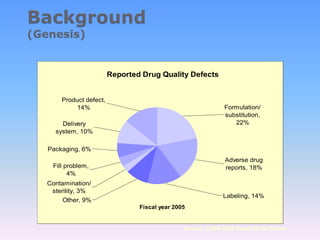
Source: CDER 2005 Report to the Nation
Reported Drug Quality Defects
Other, 9%
Contamination/
sterility, 3%
Fill problem,
4%
Packaging, 6%
Delivery
system, 10%
Product defect,
14% Formulation/
substitution,
22%
Adverse drug
reports, 18%
Labeling, 14%
Fiscal year 2005
 Limited resources and increased volume of work
 August 2002 – FDA announced the
Pharmaceutical cGMP’s for the 21st Century – A
Risk Based Approach
 Focus on the greatest potential risk to the public
 FDA’s intent to integrate quality systems and risk
management approaches - to modernize FDA’s
regulations
 Encourage industry to adopt modern and
innovative manufacturing technologies as well as
modern quality system approaches
 Necessity of harmonizing the cGMP’s with other
non-U.S. regulatory agency’s / systems
 Need to harmonize with FDA’s own medical
device quality systems regulations
 Encourage Risk-Based approaches which focus
on critical elements
 Ensure FDA’s Review, Compliance and Inspection
Policies – based on state-of-art pharmaceutical
science
 Risk-Based Approach to Manufacturing and
Regulation
• Pharmaceutical Inspectorate
– Experienced Field Investigators
• Process Analytical Technology (PAT) Guidance
– Real-time measurements
• Process Validation Guidance
– Life Cycle Approach – Quality-by-Design,
not Quality-by-Testing
• 21 CFR 11 Electronic Records Guidance
• Quality Systems Guidance
- September 2006 – FDA issued the final
version of the “Guidance for Industry on
Quality Systems Approach to
Pharmaceutical CGMP Regulations”
• Systems-Based Inspection
• 6 systems
Quality should be built into the
product, and testing alone
cannot be relied on to ensure
product quality.
Ref: Guidance for Industry: Quality Systems Approach to
Pharmaceutical CGMP Regulations – September 2006
 Human Drugs – Centre for Drug
Evaluation and Research (CDER)
 Veterinary Drugs – Centre for Veterinary
Medicine (CVM)
 Biological Drugs – Centre for Biologics
Evaluation and Research (CBER)
 Manufacturers of Components, including
APIs
State-of-Control
 FD&C Act and other laws to ensure that products are
developed, manufactured and held in a state of
control, i.e. contribute to SISPQ (Safety, Identity,
Strength, Purity, Quality)
 Detailed inspection of a system so that the findings
reflect the state of control in that system for every
product / profile class
 If one of the six systems is out of control, the
company is considered out-of-control
 Management Responsibilities
 Resources
 Manufacturing
 Evaluation / Review processes
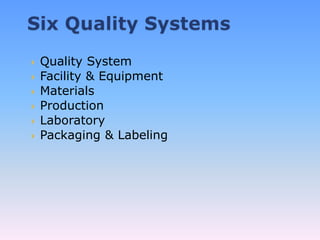
 Quality System
 Facility & Equipment
 Materials
 Production
 Laboratory
 Packaging & Labeling
 Assure overall compliance with cGMP regulations and
all quality systems.
 Quality by Design in the processes
 Quality Assurance comes from
- Design of robust process based on thorough knowledge of
the, process and the sources of variability
Process Analytical Technology (PAT) is a system for designing,
analyzing and controlling manufacturing through ‘real time’
measurements of critical quality attributes of raw and in-process
materials and processes, with the goal of ensuring final product
quality
- Science based approach
– Process Validation – Life cycle approach from development
to market
– Quality System review and trending
– Continuous improvement within well characterized process
 Quality Function & Responsibilities:
- The Quality Unit and all of its review and approval duties.
- Assures overall compliance with cGMP’s
 Quality Unit reviews and approves:
- Annual Product Quality Reviews
- Complaints
- Deviations / Failure Investigations
- Change Control
- CAPA (Corrective and Preventive Action)
- Re-processing / Re-working
- Validation / Re-validation
- Rejections
- Stability Failures / Out of Trend data
- Quarantine Products
- Documented Training – GMP and Job Related
 Location, design and construction, is appropriate to
facilitate operations, maintenance and cleaning
 Layout and air-handling systems designed and
constructed to prevent (cross) contamination
 Flow of materials and personnel - designed to
prevent mix-ups or contamination
- Incoming Materials – ID, quarantine and segregation
- Sampling Area – Prevent cross- contamination, cleaning
- Quarantine Area – API’s and Intermediates
- Released Area – Labeling, MRP
- Rejection of materials
 Separate facilities or containment where needed,
e.g., penicillins, hormones, highly potent
compounds, etc.
 Appropriate design, size, location, and non-reactive
product contact surfaces
 Identification of equipment – clearly marked
 Equipment qualification – DQ, IQ, OP, PQ
 Equipment calibration – schedule & procedures
 Preventative maintenance - schedule & procedures
 Equipment cleaning procedures and validation –
prevent contamination and mix-ups
 Equipment usage log – use, cleaning & maintenance
 Lubricants, thermal fluids – not contact / alter
product quality
 Closed or contained equipment
 Line clearance & pre use inspection
 Electricity and wiring drawings – qualified, approved
and appropriately monitored
 Pipe work – Permanently installed and appropriately
identified
 Drains of adequate size
 Process water at minimum meeting WHO guidelines
for potable water
 Justify and establish specifications
 Validate water treatment facilities
 API for Sterile Dosage Form – Water used in later
stages should be monitored and controlled for total
microbial counts, objectionable organizations and
endotoxins
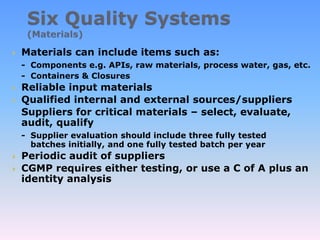
 Materials can include items such as:
- Components e.g. APIs, raw materials, process water, gas, etc.
- Containers & Closures
 Reliable input materials
 Qualified internal and external sources/suppliers
Suppliers for critical materials – select, evaluate,
audit, qualify
- Supplier evaluation should include three fully tested
batches initially, and one fully tested batch per year
 Periodic audit of suppliers
 CGMP requires either testing, or use a C of A plus an
identity analysis
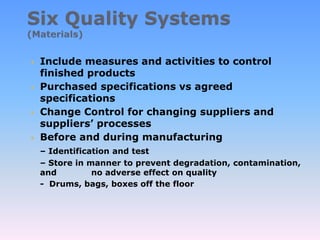
 Include measures and activities to control
finished products
 Purchased specifications vs agreed
specifications
 Change Control for changing suppliers and
suppliers’ processes
 Before and during manufacturing
– Identification and test
– Store in manner to prevent degradation, contamination,
and no adverse effect on quality
- Drums, bags, boxes off the floor
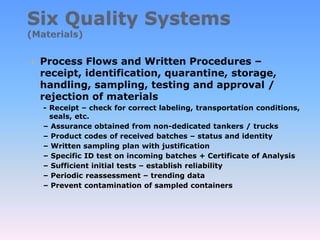
 Process Flows and Written Procedures –
receipt, identification, quarantine, storage,
handling, sampling, testing and approval /
rejection of materials
- Receipt – check for correct labeling, transportation conditions,
seals, etc.
– Assurance obtained from non-dedicated tankers / trucks
– Product codes of received batches – status and identity
– Written sampling plan with justification
– Specific ID test on incoming batches + Certificate of Analysis
– Sufficient initial tests – establish reliability
– Periodic reassessment – trending data
– Prevent contamination of sampled containers
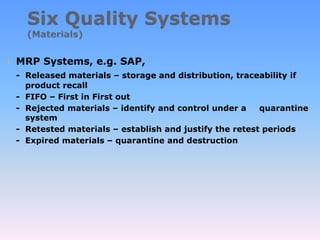
 MRP Systems, e.g. SAP,
- Released materials – storage and distribution, traceability if
product recall
- FIFO – First in First out
- Rejected materials – identify and control under a quarantine
system
- Retested materials – establish and justify the retest periods
- Expired materials – quarantine and destruction
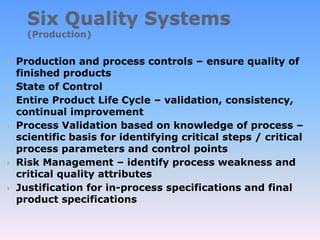
 Production and process controls – ensure quality of
finished products
 State of Control
 Entire Product Life Cycle – validation, consistency,
continual improvement
 Process Validation based on knowledge of process –
scientific basis for identifying critical steps / critical
process parameters and control points
 Risk Management – identify process weakness and
critical quality attributes
 Justification for in-process specifications and final
product specifications
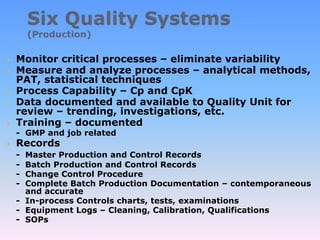
 Monitor critical processes – eliminate variability
 Measure and analyze processes – analytical methods,
PAT, statistical techniques
 Process Capability – Cp and CpK
 Data documented and available to Quality Unit for
review – trending, investigations, etc.
 Training – documented
- GMP and job related
 Records
- Master Production and Control Records
- Batch Production and Control Records
- Change Control Procedure
- Complete Batch Production Documentation – contemporaneous
and accurate
- In-process Controls charts, tests, examinations
- Equipment Logs – Cleaning, Calibration, Qualifications
- SOPs
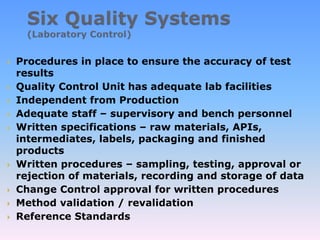
 Procedures in place to ensure the accuracy of test
results
 Quality Control Unit has adequate lab facilities
 Independent from Production
 Adequate staff – supervisory and bench personnel
 Written specifications – raw materials, APIs,
intermediates, labels, packaging and finished
products
 Written procedures – sampling, testing, approval or
rejection of materials, recording and storage of data
 Change Control approval for written procedures
 Method validation / revalidation
 Reference Standards
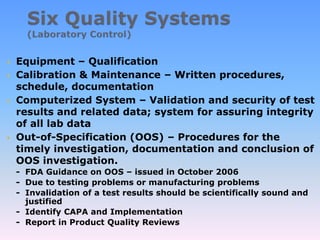
 Equipment – Qualification
 Calibration & Maintenance – Written procedures,
schedule, documentation
 Computerized System – Validation and security of test
results and related data; system for assuring integrity
of all lab data
 Out-of-Specification (OOS) – Procedures for the
timely investigation, documentation and conclusion of
OOS investigation.
- FDA Guidance on OOS – issued in October 2006
- Due to testing problems or manufacturing problems
- Invalidation of a test results should be scientifically sound and
justified
- Identify CAPA and Implementation
- Report in Product Quality Reviews
 Samples - Description of samples
 Methods - Identification of method used, method
number, compendial number
 Raw data – sample, standards, reagents, equipment,
testing results
 Calculations – manual, calculators, spreadsheets,
software program
 Test Results – Compare with established acceptance
criteria, statement of test results
 Signatures
- Person(s) who performed each test, date(s) performed
- Second Person who reviewed original test records for accuracy,
- completeness and compliance with established standards
 Process Flows and Written Procedures – receipt,
identification, quarantine, sampling, testing and
approval/rejection of packaging and labeling
materials
 Specifications
 Each shipment – maintain records of receipt,
transportation, examination, test results
 Containers & Closures – protective, clean, not alter
product quality
 Label Storage Area – enclosed (locked), limited
access
 Written procedures – reconciliation, investigation if
discrepancy
 All excess labels coded with batch number – to be
destroyed and documented
 Printing device controlled to insure accuracy of label
against batch record
 Print labels checked against master and a copy
placed with the batch record
 Documented procedures to assure correct packaging
materials / labels used
 Packaging operations designed to prevent mix-ups
 Line clearance documentation
 Shift changes documentation
 Packaged and labeled intermediates
 Tamper-evident seals
 Child resistant features
 Labels with barcodes
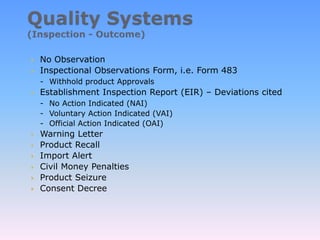
 No Observation
 Inspectional Observations Form, i.e. Form 483
- Withhold product Approvals
 Establishment Inspection Report (EIR) – Deviations cited
- No Action Indicated (NAI)
- Voluntary Action Indicated (VAI)
- Official Action Indicated (OAI)
 Warning Letter
 Product Recall
 Import Alert
 Civil Money Penalties
 Product Seizure
 Consent Decree
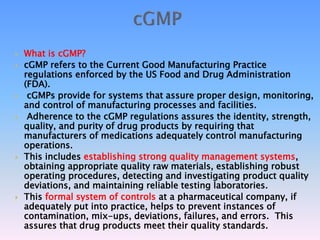
 What is cGMP?
 cGMP refers to the Current Good Manufacturing Practice
regulations enforced by the US Food and Drug Administration
(FDA).
 cGMPs provide for systems that assure proper design, monitoring,
and control of manufacturing processes and facilities.
 Adherence to the cGMP regulations assures the identity, strength,
quality, and purity of drug products by requiring that
manufacturers of medications adequately control manufacturing
operations.
 This includes establishing strong quality management systems,
obtaining appropriate quality raw materials, establishing robust
operating procedures, detecting and investigating product quality
deviations, and maintaining reliable testing laboratories.
 This formal system of controls at a pharmaceutical company, if
adequately put into practice, helps to prevent instances of
contamination, mix-ups, deviations, failures, and errors. This
assures that drug products meet their quality standards.
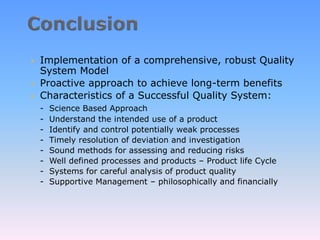
 Implementation of a comprehensive, robust Quality
System Model
 Proactive approach to achieve long-term benefits
 Characteristics of a Successful Quality System:
- Science Based Approach
- Understand the intended use of a product
- Identify and control potentially weak processes
- Timely resolution of deviation and investigation
- Sound methods for assessing and reducing risks
- Well defined processes and products – Product life Cycle
- Systems for careful analysis of product quality
- Supportive Management – philosophically and financially
Quality system gmp

Quality system gmp

  • 2.
     FDA’s Mission References  Background  Quality Systems  Six Quality Systems  Inspection Outcome  Conclusion
  • 3.
     U. S.Food and Drug Administration, 5600 Fishers Lane, Rockville MD 20857-0001, 1-888-INFO-FDA (1-888-463-6332)  Centre for Drug Evaluation and Research, http://www.fda.gov/cder/  Guidance for Industry: Quality Systems Approach to Pharmaceutical CGMP Regulations – September 2006  Pharmaceutical cGMP’s for the 21st Century – A Risk-Based Approach – September 2005  Warning Letters, www.fdawarningletter.com
  • 4.
     Protect consumers’health and safety under the Federal Food, Drug and Cosmetic Act  Two basic strategies: – Monitoring the quality of products through surveillance activities, e.g. sampling and analyzing products in distribution - Evaluating through factory inspections, including the collection and analysis of associated samples
  • 5.
    Source: CDER 2005Report to the Nation Reported Drug Quality Defects Other, 9% Contamination/ sterility, 3% Fill problem, 4% Packaging, 6% Delivery system, 10% Product defect, 14% Formulation/ substitution, 22% Adverse drug reports, 18% Labeling, 14% Fiscal year 2005
  • 6.
     Limited resourcesand increased volume of work  August 2002 – FDA announced the Pharmaceutical cGMP’s for the 21st Century – A Risk Based Approach  Focus on the greatest potential risk to the public  FDA’s intent to integrate quality systems and risk management approaches - to modernize FDA’s regulations  Encourage industry to adopt modern and innovative manufacturing technologies as well as modern quality system approaches
  • 7.
     Necessity ofharmonizing the cGMP’s with other non-U.S. regulatory agency’s / systems  Need to harmonize with FDA’s own medical device quality systems regulations  Encourage Risk-Based approaches which focus on critical elements  Ensure FDA’s Review, Compliance and Inspection Policies – based on state-of-art pharmaceutical science
  • 8.
     Risk-Based Approachto Manufacturing and Regulation • Pharmaceutical Inspectorate – Experienced Field Investigators • Process Analytical Technology (PAT) Guidance – Real-time measurements • Process Validation Guidance – Life Cycle Approach – Quality-by-Design, not Quality-by-Testing
  • 9.
    • 21 CFR11 Electronic Records Guidance • Quality Systems Guidance - September 2006 – FDA issued the final version of the “Guidance for Industry on Quality Systems Approach to Pharmaceutical CGMP Regulations” • Systems-Based Inspection • 6 systems
  • 10.
    Quality should bebuilt into the product, and testing alone cannot be relied on to ensure product quality. Ref: Guidance for Industry: Quality Systems Approach to Pharmaceutical CGMP Regulations – September 2006
  • 11.
     Human Drugs– Centre for Drug Evaluation and Research (CDER)  Veterinary Drugs – Centre for Veterinary Medicine (CVM)  Biological Drugs – Centre for Biologics Evaluation and Research (CBER)  Manufacturers of Components, including APIs
  • 12.
    State-of-Control  FD&C Actand other laws to ensure that products are developed, manufactured and held in a state of control, i.e. contribute to SISPQ (Safety, Identity, Strength, Purity, Quality)  Detailed inspection of a system so that the findings reflect the state of control in that system for every product / profile class  If one of the six systems is out of control, the company is considered out-of-control
  • 13.
     Management Responsibilities Resources  Manufacturing  Evaluation / Review processes
  • 14.
     Quality System Facility & Equipment  Materials  Production  Laboratory  Packaging & Labeling
  • 15.
     Assure overallcompliance with cGMP regulations and all quality systems.  Quality by Design in the processes  Quality Assurance comes from - Design of robust process based on thorough knowledge of the, process and the sources of variability Process Analytical Technology (PAT) is a system for designing, analyzing and controlling manufacturing through ‘real time’ measurements of critical quality attributes of raw and in-process materials and processes, with the goal of ensuring final product quality - Science based approach – Process Validation – Life cycle approach from development to market – Quality System review and trending – Continuous improvement within well characterized process
  • 16.
     Quality Function& Responsibilities: - The Quality Unit and all of its review and approval duties. - Assures overall compliance with cGMP’s  Quality Unit reviews and approves: - Annual Product Quality Reviews - Complaints - Deviations / Failure Investigations - Change Control - CAPA (Corrective and Preventive Action) - Re-processing / Re-working - Validation / Re-validation - Rejections - Stability Failures / Out of Trend data - Quarantine Products - Documented Training – GMP and Job Related
  • 17.
     Location, designand construction, is appropriate to facilitate operations, maintenance and cleaning  Layout and air-handling systems designed and constructed to prevent (cross) contamination  Flow of materials and personnel - designed to prevent mix-ups or contamination - Incoming Materials – ID, quarantine and segregation - Sampling Area – Prevent cross- contamination, cleaning - Quarantine Area – API’s and Intermediates - Released Area – Labeling, MRP - Rejection of materials  Separate facilities or containment where needed, e.g., penicillins, hormones, highly potent compounds, etc.
  • 18.
     Appropriate design,size, location, and non-reactive product contact surfaces  Identification of equipment – clearly marked  Equipment qualification – DQ, IQ, OP, PQ  Equipment calibration – schedule & procedures  Preventative maintenance - schedule & procedures  Equipment cleaning procedures and validation – prevent contamination and mix-ups  Equipment usage log – use, cleaning & maintenance  Lubricants, thermal fluids – not contact / alter product quality  Closed or contained equipment  Line clearance & pre use inspection
  • 19.
     Electricity andwiring drawings – qualified, approved and appropriately monitored  Pipe work – Permanently installed and appropriately identified  Drains of adequate size  Process water at minimum meeting WHO guidelines for potable water  Justify and establish specifications  Validate water treatment facilities  API for Sterile Dosage Form – Water used in later stages should be monitored and controlled for total microbial counts, objectionable organizations and endotoxins
  • 20.
     Materials caninclude items such as: - Components e.g. APIs, raw materials, process water, gas, etc. - Containers & Closures  Reliable input materials  Qualified internal and external sources/suppliers Suppliers for critical materials – select, evaluate, audit, qualify - Supplier evaluation should include three fully tested batches initially, and one fully tested batch per year  Periodic audit of suppliers  CGMP requires either testing, or use a C of A plus an identity analysis
  • 21.
     Include measuresand activities to control finished products  Purchased specifications vs agreed specifications  Change Control for changing suppliers and suppliers’ processes  Before and during manufacturing – Identification and test – Store in manner to prevent degradation, contamination, and no adverse effect on quality - Drums, bags, boxes off the floor
  • 22.
     Process Flowsand Written Procedures – receipt, identification, quarantine, storage, handling, sampling, testing and approval / rejection of materials - Receipt – check for correct labeling, transportation conditions, seals, etc. – Assurance obtained from non-dedicated tankers / trucks – Product codes of received batches – status and identity – Written sampling plan with justification – Specific ID test on incoming batches + Certificate of Analysis – Sufficient initial tests – establish reliability – Periodic reassessment – trending data – Prevent contamination of sampled containers
  • 23.
     MRP Systems,e.g. SAP, - Released materials – storage and distribution, traceability if product recall - FIFO – First in First out - Rejected materials – identify and control under a quarantine system - Retested materials – establish and justify the retest periods - Expired materials – quarantine and destruction
  • 24.
     Production andprocess controls – ensure quality of finished products  State of Control  Entire Product Life Cycle – validation, consistency, continual improvement  Process Validation based on knowledge of process – scientific basis for identifying critical steps / critical process parameters and control points  Risk Management – identify process weakness and critical quality attributes  Justification for in-process specifications and final product specifications
  • 25.
     Monitor criticalprocesses – eliminate variability  Measure and analyze processes – analytical methods, PAT, statistical techniques  Process Capability – Cp and CpK  Data documented and available to Quality Unit for review – trending, investigations, etc.  Training – documented - GMP and job related  Records - Master Production and Control Records - Batch Production and Control Records - Change Control Procedure - Complete Batch Production Documentation – contemporaneous and accurate - In-process Controls charts, tests, examinations - Equipment Logs – Cleaning, Calibration, Qualifications - SOPs
  • 26.
     Procedures inplace to ensure the accuracy of test results  Quality Control Unit has adequate lab facilities  Independent from Production  Adequate staff – supervisory and bench personnel  Written specifications – raw materials, APIs, intermediates, labels, packaging and finished products  Written procedures – sampling, testing, approval or rejection of materials, recording and storage of data  Change Control approval for written procedures  Method validation / revalidation  Reference Standards
  • 27.
     Equipment –Qualification  Calibration & Maintenance – Written procedures, schedule, documentation  Computerized System – Validation and security of test results and related data; system for assuring integrity of all lab data  Out-of-Specification (OOS) – Procedures for the timely investigation, documentation and conclusion of OOS investigation. - FDA Guidance on OOS – issued in October 2006 - Due to testing problems or manufacturing problems - Invalidation of a test results should be scientifically sound and justified - Identify CAPA and Implementation - Report in Product Quality Reviews
  • 28.
     Samples -Description of samples  Methods - Identification of method used, method number, compendial number  Raw data – sample, standards, reagents, equipment, testing results  Calculations – manual, calculators, spreadsheets, software program  Test Results – Compare with established acceptance criteria, statement of test results  Signatures - Person(s) who performed each test, date(s) performed - Second Person who reviewed original test records for accuracy, - completeness and compliance with established standards
  • 29.
     Process Flowsand Written Procedures – receipt, identification, quarantine, sampling, testing and approval/rejection of packaging and labeling materials  Specifications  Each shipment – maintain records of receipt, transportation, examination, test results  Containers & Closures – protective, clean, not alter product quality  Label Storage Area – enclosed (locked), limited access  Written procedures – reconciliation, investigation if discrepancy
  • 30.
     All excesslabels coded with batch number – to be destroyed and documented  Printing device controlled to insure accuracy of label against batch record  Print labels checked against master and a copy placed with the batch record  Documented procedures to assure correct packaging materials / labels used  Packaging operations designed to prevent mix-ups  Line clearance documentation  Shift changes documentation
  • 31.
     Packaged andlabeled intermediates  Tamper-evident seals  Child resistant features  Labels with barcodes
  • 32.
     No Observation Inspectional Observations Form, i.e. Form 483 - Withhold product Approvals  Establishment Inspection Report (EIR) – Deviations cited - No Action Indicated (NAI) - Voluntary Action Indicated (VAI) - Official Action Indicated (OAI)  Warning Letter  Product Recall  Import Alert  Civil Money Penalties  Product Seizure  Consent Decree
  • 33.
     What iscGMP?  cGMP refers to the Current Good Manufacturing Practice regulations enforced by the US Food and Drug Administration (FDA).  cGMPs provide for systems that assure proper design, monitoring, and control of manufacturing processes and facilities.  Adherence to the cGMP regulations assures the identity, strength, quality, and purity of drug products by requiring that manufacturers of medications adequately control manufacturing operations.  This includes establishing strong quality management systems, obtaining appropriate quality raw materials, establishing robust operating procedures, detecting and investigating product quality deviations, and maintaining reliable testing laboratories.  This formal system of controls at a pharmaceutical company, if adequately put into practice, helps to prevent instances of contamination, mix-ups, deviations, failures, and errors. This assures that drug products meet their quality standards.
  • 34.
     Implementation ofa comprehensive, robust Quality System Model  Proactive approach to achieve long-term benefits  Characteristics of a Successful Quality System: - Science Based Approach - Understand the intended use of a product - Identify and control potentially weak processes - Timely resolution of deviation and investigation - Sound methods for assessing and reducing risks - Well defined processes and products – Product life Cycle - Systems for careful analysis of product quality - Supportive Management – philosophically and financially