Vendor Rating: A Tool for Quality
in Supply Chain Management

Presenter:

Chandrmouli Singh
MBA (AB) II Year
Overview
 Introduction

 Objectives
 Methods
 Vendor rating: Industrial process
 Observations
 Deming’s fourth point
 Conclusion
 References
Introduction
 Price was considered primary base for procurement
decisions, and business contracts were awarded to the
lowest bidder in 1980s
 Vendor rating is a tool
 Insures quality in the supply chain
 Supplier quality management is essential for improved
operational performance
 Origin: To improve the overall performance, many firms
are focusing on their
core
competencies
and
outsourcing non-core activities

Specifying

Communicating

Dynamic
monitoring
 Increased outsourcing: increased the reliance of buyers on
their suppliers
 Need for effectively managing supplier performance
capabilities
 Strategy for improvement
Purchasing objectives
Quality
Place

Quantity

7
Rights

Service

Source

Time

Price
 Capability and selection of vendor, report of the visiting
team and analysis of vendor questionnaire is used
 A tools for benchmarking their supplier’s performance
Objectives
 The system for assessing the performance of one vendor in
comparison with others
 To reduce large amount of data into manageable
information for decision making and to identify future
trends
Functions
 Provide objective, qualified measures of supplier’s
performance
 Aid in arriving at a balanced judgment of supplier’s
performance for all categories of buyer needs
 Provide both buyer and supplier with common factual
information on overall performance
 Minimize the risk of being stampeded by isolated
instances of failure
 Provide the supplier with a detailed and factual record
of problems for corrective action
 Enhance the relationship between the customer and the
supplier
 Draw a comparative scale that can be used for
vendor selection and distribution of the requirements
 Update quality plan to most economic levels either by
increasing or decreasing amount of inspection
 Discontinue the vendor in case of consistently poor rating
 Improve effectiveness of supply chain management
Methods
 Categorical plan
 Weighted point plan
 Cost ratio plan
Vendor Rating: Industry Practices
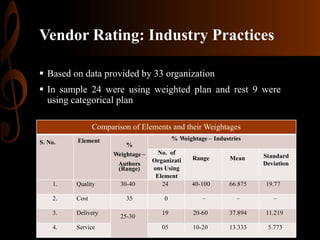
 Based on data provided by 33 organization

 In sample 24 were using weighted plan and rest 9 were
using categorical plan
Comparison of Elements and their Weightages
S. No.

Element

% Weightage – Industries

%

30-40

No. of
Organizati
ons Using
Element
24

35

0

Weightage –
Authors
(Range)
1.

Quality

2.

Cost

3.

Delivery

4.

Service

25-30

Range

Mean

40-100

66.875

–

Standard
Deviation
19.77

–

–

19

20-60

37.894

11.219

05

10-20

13.333

5.773
Weightages for Sub-Elements – Quality
Sub-Elements
(Quality)

No. of
Maximum
Organizations Weight (%)

Minimum
Weight (%)

Mean

Standard
Deviation

Quantity accepted

19

1.00

1.00

1.0

0

Quantity accepted with
deviation

10

0.75

0.25

0.6

0.184

Segregated and accepted
quantity

6

0.95

0.75

0.8

0.077

Segregated,
reworked and
accepted quantity

10

1.00

0.25

0.6

0.200

Quantity rejected

12

0

0

0

0
Weightages for Sub-Elements – Delivery

Sub-Elements
(Delivery)

No. of
Organizations

Maximum
Weightage (%)

On-time delivery

13

1

0.4

0.82

0.273

5

1

0.5

0.67

0.288

Quantity reliability

Minimum
Average
Weightage (%)

Standard
Deviation
Observations
 Five organizations have rated the vendors based on quality
performance alone
 Some of them have had mentioning of technology and
innovation. It subtly stresses that
companies are also
assessing vendors based on technology transition to predecide further scope of work to be outsourced. One
organization has also mentioned third party certification and
Production Part Approval Process (PPAP).
 Two organizations have awarded weightage criteria based on
criticality of repair and rework (major/minor/critical), this is in
line with IS: 12040-1987 guidelines
 One organization adjusts the rating when the supplies are
modified and are used for alternative applications
 Two organizations have been assessing multiple item
suppliers based on individual items rating leading to overall
supplier rating
 Work stoppage incidents have been separately identified
for rejected components and for delayed deliveries
 Only one organization has considered line rejections
 One organization has been calculating overall vendor
rating by considering previous months performance
 There is an isolated instance where there is a mention of
cost of quality
 There are also separate instances of considering
customer
disruptions and special status customer
notification as a criterion for vendor rating

 The 90% performance or rating levels can be reasonably
assumed excellent
Deming’s fourth point
 Stop awarding business based on price tag alone (Deming,
1986)
 customer satisfaction is closely linked with consistently
supplying quality as per schedule
 Very few organizations have considered work stoppage
incidents, service performance, line rejection, criticality of
components and multiple component supplies
 Electronic data processing systems may ease the work, but
it also will be limited to the compatibility and capability to
support the rating system
Conclusion
 Vendor rating is an important defect prevention tool to be
used on the upstream (supply side) supply chain
 It should be developed logically to suit the organizational
requirements
 Companies should emphasize the importance of quality
and delivery performance not only to their suppliers, but
also to their (supplier’s) suppliers
 Weightages recognized during study would help
organizations to understand the explicit and implied
requirements of their customers and decide the priorities
to develop the strategies for improvement in their vendor
rating
Reference
Mandave, H. A., Khodke, P. M., (2010). Vendor Rating: A
Tool for Quality in Supply Chain Management. The IUP
Journal of Supply Chain Management, VII(3)
Thank you....
Welcome for your Queries
Weighted point plan
Weightages Given by Authors (%)

Vendor Rating
Elements

Juran and Gryna
(1996)

Feigenbaum
(1991)

Sinha et al. (1985)

Quality

40

40

30

Cost

35

35

40

Service and
Delivery

25

25

30

Vendor rating system

  • 1.
    Vendor Rating: ATool for Quality in Supply Chain Management Presenter: Chandrmouli Singh MBA (AB) II Year
  • 2.
    Overview  Introduction  Objectives Methods  Vendor rating: Industrial process  Observations  Deming’s fourth point  Conclusion  References
  • 3.
    Introduction  Price wasconsidered primary base for procurement decisions, and business contracts were awarded to the lowest bidder in 1980s  Vendor rating is a tool  Insures quality in the supply chain  Supplier quality management is essential for improved operational performance
  • 4.
     Origin: Toimprove the overall performance, many firms are focusing on their core competencies and outsourcing non-core activities Specifying Communicating Dynamic monitoring
  • 5.
     Increased outsourcing:increased the reliance of buyers on their suppliers  Need for effectively managing supplier performance capabilities  Strategy for improvement
  • 6.
  • 7.
     Capability andselection of vendor, report of the visiting team and analysis of vendor questionnaire is used  A tools for benchmarking their supplier’s performance
  • 8.
    Objectives  The systemfor assessing the performance of one vendor in comparison with others  To reduce large amount of data into manageable information for decision making and to identify future trends
  • 9.
    Functions  Provide objective,qualified measures of supplier’s performance  Aid in arriving at a balanced judgment of supplier’s performance for all categories of buyer needs  Provide both buyer and supplier with common factual information on overall performance  Minimize the risk of being stampeded by isolated instances of failure  Provide the supplier with a detailed and factual record of problems for corrective action
  • 10.
     Enhance therelationship between the customer and the supplier  Draw a comparative scale that can be used for vendor selection and distribution of the requirements  Update quality plan to most economic levels either by increasing or decreasing amount of inspection  Discontinue the vendor in case of consistently poor rating  Improve effectiveness of supply chain management
  • 11.
    Methods  Categorical plan Weighted point plan  Cost ratio plan
  • 12.
    Vendor Rating: IndustryPractices  Based on data provided by 33 organization  In sample 24 were using weighted plan and rest 9 were using categorical plan Comparison of Elements and their Weightages S. No. Element % Weightage – Industries % 30-40 No. of Organizati ons Using Element 24 35 0 Weightage – Authors (Range) 1. Quality 2. Cost 3. Delivery 4. Service 25-30 Range Mean 40-100 66.875 – Standard Deviation 19.77 – – 19 20-60 37.894 11.219 05 10-20 13.333 5.773
  • 13.
    Weightages for Sub-Elements– Quality Sub-Elements (Quality) No. of Maximum Organizations Weight (%) Minimum Weight (%) Mean Standard Deviation Quantity accepted 19 1.00 1.00 1.0 0 Quantity accepted with deviation 10 0.75 0.25 0.6 0.184 Segregated and accepted quantity 6 0.95 0.75 0.8 0.077 Segregated, reworked and accepted quantity 10 1.00 0.25 0.6 0.200 Quantity rejected 12 0 0 0 0
  • 14.
    Weightages for Sub-Elements– Delivery Sub-Elements (Delivery) No. of Organizations Maximum Weightage (%) On-time delivery 13 1 0.4 0.82 0.273 5 1 0.5 0.67 0.288 Quantity reliability Minimum Average Weightage (%) Standard Deviation
  • 15.
    Observations  Five organizationshave rated the vendors based on quality performance alone  Some of them have had mentioning of technology and innovation. It subtly stresses that companies are also assessing vendors based on technology transition to predecide further scope of work to be outsourced. One organization has also mentioned third party certification and Production Part Approval Process (PPAP).  Two organizations have awarded weightage criteria based on criticality of repair and rework (major/minor/critical), this is in line with IS: 12040-1987 guidelines  One organization adjusts the rating when the supplies are modified and are used for alternative applications  Two organizations have been assessing multiple item suppliers based on individual items rating leading to overall supplier rating
  • 16.
     Work stoppageincidents have been separately identified for rejected components and for delayed deliveries  Only one organization has considered line rejections  One organization has been calculating overall vendor rating by considering previous months performance  There is an isolated instance where there is a mention of cost of quality  There are also separate instances of considering customer disruptions and special status customer notification as a criterion for vendor rating  The 90% performance or rating levels can be reasonably assumed excellent
  • 17.
    Deming’s fourth point Stop awarding business based on price tag alone (Deming, 1986)  customer satisfaction is closely linked with consistently supplying quality as per schedule  Very few organizations have considered work stoppage incidents, service performance, line rejection, criticality of components and multiple component supplies  Electronic data processing systems may ease the work, but it also will be limited to the compatibility and capability to support the rating system
  • 18.
    Conclusion  Vendor ratingis an important defect prevention tool to be used on the upstream (supply side) supply chain  It should be developed logically to suit the organizational requirements  Companies should emphasize the importance of quality and delivery performance not only to their suppliers, but also to their (supplier’s) suppliers  Weightages recognized during study would help organizations to understand the explicit and implied requirements of their customers and decide the priorities to develop the strategies for improvement in their vendor rating
  • 19.
    Reference Mandave, H. A.,Khodke, P. M., (2010). Vendor Rating: A Tool for Quality in Supply Chain Management. The IUP Journal of Supply Chain Management, VII(3)
  • 20.
  • 21.
    Weighted point plan WeightagesGiven by Authors (%) Vendor Rating Elements Juran and Gryna (1996) Feigenbaum (1991) Sinha et al. (1985) Quality 40 40 30 Cost 35 35 40 Service and Delivery 25 25 30

Editor's Notes

  • #4 used by the organizations to assess the performance of their vendors to ensure efficient and effective upstream supply chainas conformance to mutually agreed-upon requirements among the partner firms with the aim of improving the performance of the transactions taking place in the chain
  • #5 2. for outsourced products and services3. Vendor rating is a tool used in this regard for‘specifying’, ‘communicating’, and ‘dynamic monitoring of the fulfillment’ of customer’s expectations.
  • #6 1. When suppliers know what is expected of them and how they are evaluated, they can focus on developingpurchasing decision based on the lowest price may lead to more repairs and replacements, and in turn more overall cost of use of the product
  • #8 Customers in the process of communicating their expectations to suppliers are using vendor questionnaire as a tool along with a visit to supplier’s plant by a team consisting of representatives from quality assurance, purchase, process planning, design, etc.Supplier or vendor rating system against the performance of similar suppliers serving the company
  • #9 with a view to draw a comparative scale that can be used for vendor selection, distribution of requirements, management policy, quality inspection and developing long-term relationship
  • #18 3. These elements may complicate the computing of vendor rating, as it requires more and updated record keeping
  • #19 if it is used in an atmosphere of interdependence between the vendor and the customer. . In industrial market, a supplier’s overall rating is a reflection of the buyer’s satisfaction with a supplier.