REGULATORY BODY:
Medical & Healthcare Products
Regulatory Agency (MHRA)
1. INTRODUCTION
• The MHRA (1903) is a government agency which is responsible for
ensuring that medicines and medical devices work, and are acceptably
safe.
• Medical Control Agency (MCA) + Medical Devices Agency (MDA) =
MHRA
• It was located in Vauxhall, London and is now relocated to New
London.
AIMS
• Protecting public health through regulation, with acceptable
benefit-risk profiles for medicines and devices.
• Promoting public health by helping people who use these products
to understand their benefits and risks.
• Improving public health by encouraging and facilitating
developments in products that will benefit people.
2.
COMPOSITIONAND STRUCTURE
• The agency board is made up of
 Non-Executive Chairman
Six Non-Executive Member
Agency’s Chief Executive Officer
• The Agency’s Chief Executive is responsible for service delivery and resources.
• The Executive Board consisting of Agency’s Directors.
• The Agency Board is chaired by the MHRA Chairman.
• Government Agency of UK
• Department of Health and Social Care
• FOUNDED : 1 April 2003
• Executive Agency Executive: Michael
Rawlins
• Chairman: Ian Hudson
CE
O
AGENCY BOARD
The agency is responsible for:
• Ensuring that medicines, medical devices and blood components for transfusion meet applicable standards of safety, quality
and efficacy
• Ensuring that the supply chain for medicines, medical devices and blood components is safe and secure
• Promoting international standardisation and harmonisation to assure the effectiveness and safety of biological medicines
• Helping to educate the public and healthcare professionals about the risks and benefits of medicines, medical devices and
blood components, leading to safer and more effective use
• Supporting innovation and research and development that’s beneficial to public health
• Influencing UK, EU and international regulatory frameworks so that they are risk-proportionate and effective at protecting
public health
3.
SALIENT FEATURES, COMMITTEES/WORKING GROUPS:
MHRA has the power to withdraw a product from market and suspend production of medicines
A manufacturer or distributor can be prosecuted if the law has been broken
Regulatory decisions are impartial
Different products are treated differently
MHRA collaborates with:
US Food and Drug Administration
NPSA National Patient Safety Agency
NICE National Institute for Health and Clinical Excellence
Applicati
on of
Clinical
Trials
Evaluation
by MHRA
If satisfied
then
CLINICAL
TRIALS
Assessment
of Data by
Experts
Marketing
Authorization
LICENSING PROCESS
OTHER FEATURES
TYPES OF
APPLICATIONS
Full Applications
For New Drug
Substance
Abridged
Applications
Existing drugs
with new forms,
routes and
indications
Well established
drugs and
products
Existing drugs in
new combinations
Informed Consent
and Change of
Ownership
Applications
SUBMISSIONOF APPLICATION
CTD Common Technical Dossier
e-CTD Electronic Common Technical Dossier
PDF only format
TYPES OF
PROCEDURE
Centralized National
Mutual
Recognition
Decentralized
RENEWAL OF LICENSE
New Marketing Authorization are valid for 5 years
Renewal is done on the basis of re-evaluation of risk benefit balance
Once renewed, Marketing Authorization will be valid for either 5 years or unlimited period
Application for renewal should be submitted at least 6 months before expiry
CANCELLATIONOF LICENSE
If MA holder does not file an application for renewal within specified time, MA expires
If MA holder does not wish to renew the license, a letter should be sent indicating
cancellation
MHRA has authority to cancel license of product if it affects public health
•A non-executive
Chairman
•Six non-executive
members
•Chief executive officer
• Responsible for service
delivery and resources
AGENCY BOARD
•Agency’s Directors
• Responsible for day to
day management,
strategic, policy,
operational and resource
management
EXECUTIVE
BOARD
• Provides independent
feedback to chief executive and
management board on the
effectiveness of risk
management procedures
RISK AND AUDIT
COMMITTE
COMMITTEES
Advisory Board on the Registration of Homeopathic Products
Herbal Medicines Advisory Committee
The Review Panel
Independent Scientific Advisory Committee for Database Research
Medicines Industry Liaison Group
Innovation Office
Blood Consultative Committee
Devices Expert Advisory Committee
WORKING GROUPS
4.
KEY FUNCTIONS
CLINICAL TRIALS
MECHANISM OF
ACTION
PREFORMULATION
AND LABORATORY
TESTS
DRUG DISCOVERY
MHRA has no interest in
these early phases of drug
development.
MHRA comes to play when
the company wants to start the
clinical trials.
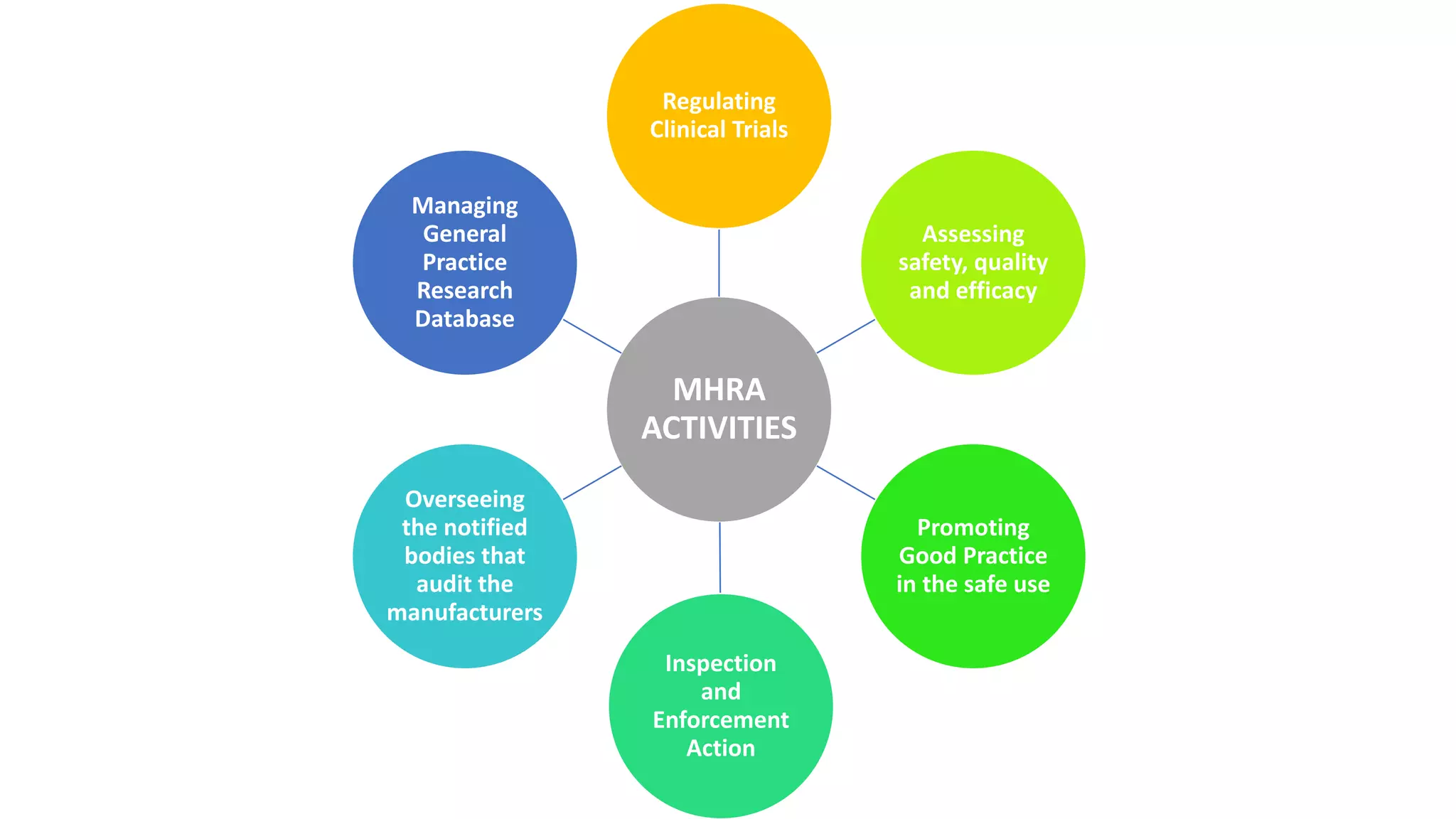
MHRA
ACTIVITIES
Regulating
Clinical Trials
Assessing
safety, quality
and efficacy
Promoting
Good Practice
in the safe use
Inspection
and
Enforcement
Action
Overseeing
the notified
bodies that
audit the
manufacturers
Managing
General
Practice
Research
Database
WHAT DOES
MHRA
REGULATE??
MEDICINE
NANOTECHNOLOGY
BLOODDEVICE
ADVANCED
THERAPEUTIC
MEDICINAL
PRODUCTS
INSPECT MANUFACTURERS AND WHOLESALERS OF MEDICINE
LICENSING
ACCESS APPLICATIONS TO UNDERTAKE CLINICAL TRIALS
ACCESS APPLICATIONS FOR MARKETING MEDICINAL
PRODUCTS
Post Marketing Surveillance- Pharmacovigilance, quality
defect monitoring, sample testing, product recalls
Issue certificates to companies wishing to export their
medicinal products to countries outside the EU
ENFORCE STATUTORY GUIDELINES COVERING GCP AND
MEDICINE CONTROL
PUBLISH QUALITY STANDARDS FOR DRUG SUBSTANCES
THROUGH BRISTISH PHARMACOPOEIA
4.
GUIDELINES
• Guidelines for Manufacturers on Clinical Investigations to be
carried out in the UK.
• Inspected UK Contract GMP Quality Control Laboratories.
• BLUE GUIDE: Advertising and Promotion of medicines in
the UK.
• ORANGE GUIDE: Rules and Guidelines for
Pharmaceutical Manufacturers and Distributors.
• Good Pharmacovigilance Practice Guide.
• Guidelines on Process Validation
• Guide to UK GLP Regulations 1999
• Recommendations on the control and monitoring of storage
and transportation temperatures of medicinal products.
• Guide to defective medicinal products.
• Introduction of a Risk Based Inspection Programme for GMP
Labs.
5.
GLOBAL IMPACT
REFERENCES
• https://www.gov.uk/government/organisations/medicines-and-
healthcare-products-regulatory-agency
• https://www.gov.uk/government/news/welcome-to-our-new-mhra-
website
• https://in.linkedin.com/showcase/mhra
• https://www.meddra.org/about-meddra/organisation/management-
board/uk-mhra
• https://www.abpi.org.uk/media-centre/news/2018/august/abpi-
response-mhra-guidance-on-brexit-implementation/
Thank You
APOORVA PATNI
PRIYAL BAGWE
OMKAR JOSHI
SHREYA SHAH
ISHA KALGUTKAR

Medical & Healthcare Products Regulatory Agency (MHRA)

  • 1.
    REGULATORY BODY: Medical &Healthcare Products Regulatory Agency (MHRA)
  • 2.
    1. INTRODUCTION • TheMHRA (1903) is a government agency which is responsible for ensuring that medicines and medical devices work, and are acceptably safe. • Medical Control Agency (MCA) + Medical Devices Agency (MDA) = MHRA • It was located in Vauxhall, London and is now relocated to New London.
  • 3.
    AIMS • Protecting publichealth through regulation, with acceptable benefit-risk profiles for medicines and devices. • Promoting public health by helping people who use these products to understand their benefits and risks. • Improving public health by encouraging and facilitating developments in products that will benefit people.
  • 4.
    2. COMPOSITIONAND STRUCTURE • Theagency board is made up of  Non-Executive Chairman Six Non-Executive Member Agency’s Chief Executive Officer • The Agency’s Chief Executive is responsible for service delivery and resources. • The Executive Board consisting of Agency’s Directors. • The Agency Board is chaired by the MHRA Chairman.
  • 5.
    • Government Agencyof UK • Department of Health and Social Care • FOUNDED : 1 April 2003 • Executive Agency Executive: Michael Rawlins • Chairman: Ian Hudson CE O
  • 6.
    AGENCY BOARD The agencyis responsible for: • Ensuring that medicines, medical devices and blood components for transfusion meet applicable standards of safety, quality and efficacy • Ensuring that the supply chain for medicines, medical devices and blood components is safe and secure • Promoting international standardisation and harmonisation to assure the effectiveness and safety of biological medicines • Helping to educate the public and healthcare professionals about the risks and benefits of medicines, medical devices and blood components, leading to safer and more effective use • Supporting innovation and research and development that’s beneficial to public health • Influencing UK, EU and international regulatory frameworks so that they are risk-proportionate and effective at protecting public health
  • 7.
    3. SALIENT FEATURES, COMMITTEES/WORKINGGROUPS: MHRA has the power to withdraw a product from market and suspend production of medicines A manufacturer or distributor can be prosecuted if the law has been broken Regulatory decisions are impartial Different products are treated differently MHRA collaborates with: US Food and Drug Administration NPSA National Patient Safety Agency NICE National Institute for Health and Clinical Excellence
  • 8.
    Applicati on of Clinical Trials Evaluation by MHRA Ifsatisfied then CLINICAL TRIALS Assessment of Data by Experts Marketing Authorization LICENSING PROCESS OTHER FEATURES
  • 9.
    TYPES OF APPLICATIONS Full Applications ForNew Drug Substance Abridged Applications Existing drugs with new forms, routes and indications Well established drugs and products Existing drugs in new combinations Informed Consent and Change of Ownership Applications
  • 10.
    SUBMISSIONOF APPLICATION CTD CommonTechnical Dossier e-CTD Electronic Common Technical Dossier PDF only format
  • 11.
  • 12.
    RENEWAL OF LICENSE NewMarketing Authorization are valid for 5 years Renewal is done on the basis of re-evaluation of risk benefit balance Once renewed, Marketing Authorization will be valid for either 5 years or unlimited period Application for renewal should be submitted at least 6 months before expiry
  • 13.
    CANCELLATIONOF LICENSE If MAholder does not file an application for renewal within specified time, MA expires If MA holder does not wish to renew the license, a letter should be sent indicating cancellation MHRA has authority to cancel license of product if it affects public health
  • 14.
    •A non-executive Chairman •Six non-executive members •Chiefexecutive officer • Responsible for service delivery and resources AGENCY BOARD •Agency’s Directors • Responsible for day to day management, strategic, policy, operational and resource management EXECUTIVE BOARD • Provides independent feedback to chief executive and management board on the effectiveness of risk management procedures RISK AND AUDIT COMMITTE COMMITTEES
  • 15.
    Advisory Board onthe Registration of Homeopathic Products Herbal Medicines Advisory Committee The Review Panel Independent Scientific Advisory Committee for Database Research Medicines Industry Liaison Group Innovation Office Blood Consultative Committee Devices Expert Advisory Committee WORKING GROUPS
  • 16.
    4. KEY FUNCTIONS CLINICAL TRIALS MECHANISMOF ACTION PREFORMULATION AND LABORATORY TESTS DRUG DISCOVERY MHRA has no interest in these early phases of drug development. MHRA comes to play when the company wants to start the clinical trials.
  • 17.
    MHRA ACTIVITIES Regulating Clinical Trials Assessing safety, quality andefficacy Promoting Good Practice in the safe use Inspection and Enforcement Action Overseeing the notified bodies that audit the manufacturers Managing General Practice Research Database
  • 18.
  • 19.
    INSPECT MANUFACTURERS ANDWHOLESALERS OF MEDICINE LICENSING ACCESS APPLICATIONS TO UNDERTAKE CLINICAL TRIALS ACCESS APPLICATIONS FOR MARKETING MEDICINAL PRODUCTS Post Marketing Surveillance- Pharmacovigilance, quality defect monitoring, sample testing, product recalls Issue certificates to companies wishing to export their medicinal products to countries outside the EU ENFORCE STATUTORY GUIDELINES COVERING GCP AND MEDICINE CONTROL PUBLISH QUALITY STANDARDS FOR DRUG SUBSTANCES THROUGH BRISTISH PHARMACOPOEIA
  • 20.
    4. GUIDELINES • Guidelines forManufacturers on Clinical Investigations to be carried out in the UK. • Inspected UK Contract GMP Quality Control Laboratories. • BLUE GUIDE: Advertising and Promotion of medicines in the UK. • ORANGE GUIDE: Rules and Guidelines for Pharmaceutical Manufacturers and Distributors. • Good Pharmacovigilance Practice Guide.
  • 21.
    • Guidelines onProcess Validation • Guide to UK GLP Regulations 1999 • Recommendations on the control and monitoring of storage and transportation temperatures of medicinal products. • Guide to defective medicinal products. • Introduction of a Risk Based Inspection Programme for GMP Labs.
  • 22.
  • 23.
    REFERENCES • https://www.gov.uk/government/organisations/medicines-and- healthcare-products-regulatory-agency • https://www.gov.uk/government/news/welcome-to-our-new-mhra- website •https://in.linkedin.com/showcase/mhra • https://www.meddra.org/about-meddra/organisation/management- board/uk-mhra • https://www.abpi.org.uk/media-centre/news/2018/august/abpi- response-mhra-guidance-on-brexit-implementation/
  • 24.
    Thank You APOORVA PATNI PRIYALBAGWE OMKAR JOSHI SHREYA SHAH ISHA KALGUTKAR