STORE DESIGN

           Prepared By,
          Sagar Gadekar
Store Design
 Meaning of Store Design.
 Importance of Store Design.


 Components of Store Design.
e)Store Exterior.
f) Store Interior.
Store Exterior.
 Place of location.
 Marques.
 Store Entrance.
 Widow Display.
 Door Types.
 Walkways.
 Size of the Building.
 Colors and Materials.
 Theft Prevention.
Store Interiors.
 Envelope.


 Internal.


 Methods of Displays.


 Signage.


 Visual Merchandising.
 Store Layout


 “Store  layout needs to guide the customer silently
 about where he/she wants to go and for exposing him/
 her to the entire store offering”. (The store itself it’s
 the most meaningful communication between the
 retailer and the customer)
Store Layout
 To develop the good store layout, stores designers
  must balance objectives that often conflict. For
  examples, the store layout should entice costumers to
  move around the store to purchase more
  merchandise than they may have originally planned.
 However the layout is to complex, customers may find
  it difficult to locate the merchandise they are looking
  for and decide not to patronize the store.
 Objectives of the Store Design.
o To guide the customer around the store and entice increase
  purchase.
o To create balance between sales and shopping space.
o To create effective merchandising Presentation.
o Use multi level to Provide sense and variety.
Factors Affecting Store Layout.
 Total space Available.
 Types of Product/Merchandise offered by the store.
 Number of department in store .
 Volume and variety ratio in the product line carried.
 Mode of Operation.
 Movement required in the store locating, picking,
  storing the product.
 Target customers and the average no. of customers
  visiting the store.
 Degree of changes in operation.
 Stock/inventory level.
Types of Store Layout.

 Free Flow/ Boutique Layout.


 Grid Layout.


 Loop Layout.


 Spine Layout.
Free Flow/ Boutique Layout.
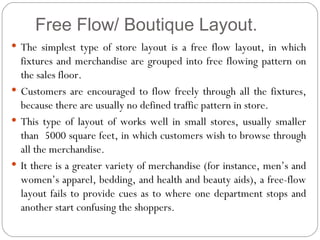
 The simplest type of store layout is a free flow layout, in which
  fixtures and merchandise are grouped into free flowing pattern on
  the sales floor.
 Customers are encouraged to flow freely through all the fixtures,
  because there are usually no defined traffic pattern in store.
 This type of layout of works well in small stores, usually smaller
  than 5000 square feet, in which customers wish to browse through
  all the merchandise.
 It there is a greater variety of merchandise (for instance, men’s and
  women’s apparel, bedding, and health and beauty aids), a free-flow
  layout fails to provide cues as to where one department stops and
  another start confusing the shoppers.
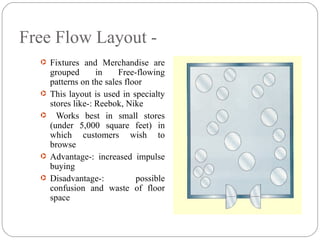
Free Flow Layout -
  · Fixtures and Merchandise are
      grouped       in    Free-flowing
      patterns on the sales floor
  ·   This layout is used in specialty
      stores like-: Reebok, Nike
  ·     Works best in small stores
      (under 5,000 square feet) in
      which customers wish to
      browse
  ·   Advantage-: increased impulse
      buying
  ·   Disadvantage-:           possible
      confusion and waste of floor
      space
The Disney Store’s at EDM
(Free-Flow Design)
Grid Layout.
 Another traditional form of store layout is grid layout, in which the
  counters and fixtures are placed in long rows or runs., usually at
  right angels, throughout the stores. In grid layout, customers
  circulate up down through the fixtures, and in fact the grid layout is
  often reoffered to as maze.
 The most familiar example of the grid layout is are supermarket and
  drugstore.
 The grid is a true sopping layout, best used in retail environment in
  which the majority of customers wish to shop the entire store.
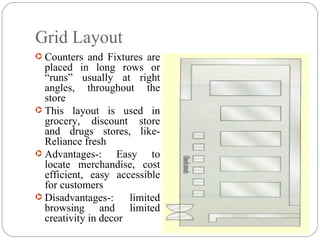
Grid Layout
· Counters and Fixtures are
  placed in long rows or
  “runs” usually at right
  angles, throughout the
  store
· This layout is used in
  grocery, discount store
  and drugs stores, like-
  Reliance fresh
· Advantages-:      Easy to
  locate merchandise, cost
  efficient, easy accessible
  for customers
· Disadvantages-:      limited
  browsing and limited
  creativity in decor
Grid (Straight) Design
                    • Best used in retail environments
                    in which majority of customers
                    shop the entire store

                    • Can be confusing and frustrating
                    because it is difficult to see over
                    the fixtures to other merchandise


                    • Should be employed carefully;
                    forcing customers to back of large
                    store may frustrate and cause
                    them to look elsewhere


                    • Most familiar examples for
                    supermarkets and drugstores
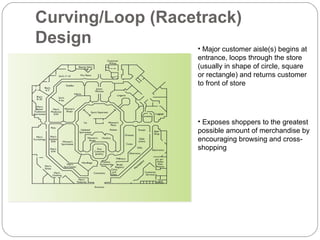
Curving/Loop (Racetrack)
Design            • Major customer aisle(s) begins at
                               entrance, loops through the store
                               (usually in shape of circle, square
                               or rectangle) and returns customer
                               to front of store


                               • Exposes shoppers to the greatest
                               possible amount of merchandise by
                               encouraging browsing and cross-
                               shopping
Race Track
· The major customer aisle
  begins at the entrance,
  loops through the store
  and returns customer to
  the front of the store
· Used in departmental
  stores such as-: Shopper’s
  Stop, Ritu Wear.
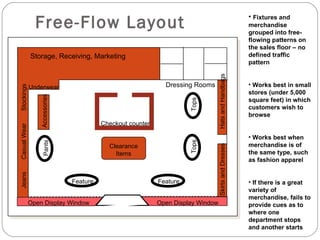
Free-Flow Layout
                                                                                                        • Fixtures and
                                                                                                        merchandise
                                                                                                        grouped into free-
                                                                                                        flowing patterns on
                                                                                                        the sales floor – no
              Storage, Receiving, Marketing                                                             defined traffic
                                                                                                        pattern


                                                                                   Hats and Handbags
              Underwear                                        Dressing Rooms                           • Works best in small
Stockings


                                                                                                        stores (under 5,000
                  Accessories


                                                                                                        square feet) in which


                                                                       Tops
                                                                                                        customers wish to
                                                                                                        browse
                                          Checkout counter
Casual Wear


                                                                                                        • Works best when


                                                                       Tops
                    Pants


                                            Clearance                                                   merchandise is of


                                                                                   Skirts and Dresses
                                              Items                                                     the same type, such
                                                                                                        as fashion apparel
Jeans


                                Feature                      Feature                                    • If there is a great
                                                                                                        variety of
                                                                                                        merchandise, fails to
              Open Display Window                            Open Display Window                        provide cues as to
                                                                                                        where one
                                                                                                        department stops
                                                                                                        and another starts
Spine Layout
               • Variation of grid, loop and free-form
               layouts

               • Based on single main aisle running from
               the front to the back of the store
               (transporting customers in both directions)


               • On either side of spine, merchandise
               departments branch off toward the back or
               side walls


               • Heavily used by medium-sized specialty
               stores ranging from 2,000 – 10,000 square
               feet


               • In fashion stores the spine is often subtly
               offset by a change in floor coloring or
               surface and is not perceived as an aisle
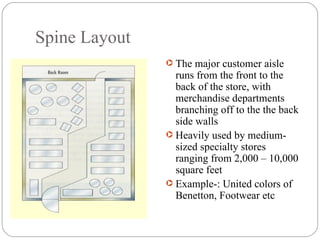
Spine Layout
               · The major customer aisle
                 runs from the front to the
                 back of the store, with
                 merchandise departments
                 branching off to the the back
                 side walls
               · Heavily used by medium-
                 sized specialty stores
                 ranging from 2,000 – 10,000
                 square feet
               · Example-: United colors of
                 Benetton, Footwear etc
Example of Spine layout
(United Colors of Benetton at Pacific Mall)
Herringbone Layout

     Herringbone Circulation
 is used for a narrow store
 of maximum 40 feet width
 where the highway is a
 single two way one,
 bisecting the store along
 its length with side roads
 leading to the walls from
 it.

   Example: Toy Shop in
 Sab Mall, Music World,
 Plant-M
Store Image
 Store Image Mix.
 Employees Types and Density.
 Merchandise Types and Density.
 Fixture types and Density.
 Sound types and Density.
 Odor Types and Density.
 Visual Types and factors.
Internet Store / Online Retailing
 Internet store or E retailers is any business enterprises whose sales
  volume comes primarily from e retailing. E-retailing means using
  interactive computer technology to present a sales message and
  communicate the sale. E retailing includes all activities involved in
  selling goods or services directly to final consumer for personal
  non business use.
 Characteristics of Internet Store
 Navigation and Convenience.
 Merchandise Mix.
 Pricing.
 Customer Services.
 Security.
Store design

Store design

  • 1.
    STORE DESIGN Prepared By, Sagar Gadekar
  • 2.
    Store Design  Meaningof Store Design.  Importance of Store Design.  Components of Store Design. e)Store Exterior. f) Store Interior.
  • 3.
    Store Exterior.  Placeof location.  Marques.  Store Entrance.  Widow Display.  Door Types.  Walkways.  Size of the Building.  Colors and Materials.  Theft Prevention.
  • 4.
    Store Interiors.  Envelope. Internal.  Methods of Displays.  Signage.  Visual Merchandising.
  • 5.
     Store Layout “Store layout needs to guide the customer silently about where he/she wants to go and for exposing him/ her to the entire store offering”. (The store itself it’s the most meaningful communication between the retailer and the customer)
  • 6.
    Store Layout  Todevelop the good store layout, stores designers must balance objectives that often conflict. For examples, the store layout should entice costumers to move around the store to purchase more merchandise than they may have originally planned.  However the layout is to complex, customers may find it difficult to locate the merchandise they are looking for and decide not to patronize the store.  Objectives of the Store Design. o To guide the customer around the store and entice increase purchase. o To create balance between sales and shopping space. o To create effective merchandising Presentation. o Use multi level to Provide sense and variety.
  • 7.
    Factors Affecting StoreLayout.  Total space Available.  Types of Product/Merchandise offered by the store.  Number of department in store .  Volume and variety ratio in the product line carried.  Mode of Operation.  Movement required in the store locating, picking, storing the product.  Target customers and the average no. of customers visiting the store.  Degree of changes in operation.  Stock/inventory level.
  • 8.
    Types of StoreLayout.  Free Flow/ Boutique Layout.  Grid Layout.  Loop Layout.  Spine Layout.
  • 9.
    Free Flow/ BoutiqueLayout.  The simplest type of store layout is a free flow layout, in which fixtures and merchandise are grouped into free flowing pattern on the sales floor.  Customers are encouraged to flow freely through all the fixtures, because there are usually no defined traffic pattern in store.  This type of layout of works well in small stores, usually smaller than 5000 square feet, in which customers wish to browse through all the merchandise.  It there is a greater variety of merchandise (for instance, men’s and women’s apparel, bedding, and health and beauty aids), a free-flow layout fails to provide cues as to where one department stops and another start confusing the shoppers.
  • 10.
    Free Flow Layout- · Fixtures and Merchandise are grouped in Free-flowing patterns on the sales floor · This layout is used in specialty stores like-: Reebok, Nike · Works best in small stores (under 5,000 square feet) in which customers wish to browse · Advantage-: increased impulse buying · Disadvantage-: possible confusion and waste of floor space
  • 11.
    The Disney Store’sat EDM (Free-Flow Design)
  • 12.
    Grid Layout.  Anothertraditional form of store layout is grid layout, in which the counters and fixtures are placed in long rows or runs., usually at right angels, throughout the stores. In grid layout, customers circulate up down through the fixtures, and in fact the grid layout is often reoffered to as maze.  The most familiar example of the grid layout is are supermarket and drugstore.  The grid is a true sopping layout, best used in retail environment in which the majority of customers wish to shop the entire store.
  • 13.
    Grid Layout · Countersand Fixtures are placed in long rows or “runs” usually at right angles, throughout the store · This layout is used in grocery, discount store and drugs stores, like- Reliance fresh · Advantages-: Easy to locate merchandise, cost efficient, easy accessible for customers · Disadvantages-: limited browsing and limited creativity in decor
  • 14.
    Grid (Straight) Design • Best used in retail environments in which majority of customers shop the entire store • Can be confusing and frustrating because it is difficult to see over the fixtures to other merchandise • Should be employed carefully; forcing customers to back of large store may frustrate and cause them to look elsewhere • Most familiar examples for supermarkets and drugstores
  • 15.
    Curving/Loop (Racetrack) Design • Major customer aisle(s) begins at entrance, loops through the store (usually in shape of circle, square or rectangle) and returns customer to front of store • Exposes shoppers to the greatest possible amount of merchandise by encouraging browsing and cross- shopping
  • 16.
    Race Track · Themajor customer aisle begins at the entrance, loops through the store and returns customer to the front of the store · Used in departmental stores such as-: Shopper’s Stop, Ritu Wear.
  • 17.
    Free-Flow Layout • Fixtures and merchandise grouped into free- flowing patterns on the sales floor – no Storage, Receiving, Marketing defined traffic pattern Hats and Handbags Underwear Dressing Rooms • Works best in small Stockings stores (under 5,000 Accessories square feet) in which Tops customers wish to browse Checkout counter Casual Wear • Works best when Tops Pants Clearance merchandise is of Skirts and Dresses Items the same type, such as fashion apparel Jeans Feature Feature • If there is a great variety of merchandise, fails to Open Display Window Open Display Window provide cues as to where one department stops and another starts
  • 18.
    Spine Layout • Variation of grid, loop and free-form layouts • Based on single main aisle running from the front to the back of the store (transporting customers in both directions) • On either side of spine, merchandise departments branch off toward the back or side walls • Heavily used by medium-sized specialty stores ranging from 2,000 – 10,000 square feet • In fashion stores the spine is often subtly offset by a change in floor coloring or surface and is not perceived as an aisle
  • 19.
    Spine Layout · The major customer aisle runs from the front to the back of the store, with merchandise departments branching off to the the back side walls · Heavily used by medium- sized specialty stores ranging from 2,000 – 10,000 square feet · Example-: United colors of Benetton, Footwear etc
  • 20.
    Example of Spinelayout (United Colors of Benetton at Pacific Mall)
  • 21.
    Herringbone Layout Herringbone Circulation is used for a narrow store of maximum 40 feet width where the highway is a single two way one, bisecting the store along its length with side roads leading to the walls from it. Example: Toy Shop in Sab Mall, Music World, Plant-M
  • 22.
    Store Image  StoreImage Mix.  Employees Types and Density.  Merchandise Types and Density.  Fixture types and Density.  Sound types and Density.  Odor Types and Density.  Visual Types and factors.
  • 23.
    Internet Store /Online Retailing  Internet store or E retailers is any business enterprises whose sales volume comes primarily from e retailing. E-retailing means using interactive computer technology to present a sales message and communicate the sale. E retailing includes all activities involved in selling goods or services directly to final consumer for personal non business use.  Characteristics of Internet Store  Navigation and Convenience.  Merchandise Mix.  Pricing.  Customer Services.  Security.