(NEW DRUG APPLICATION) 
R.MEENAKSHI 
M Pharm (Pharm. Chemistry) 
1
CONTENTS 
INTRODUCTION 
HISTORY 
NDA APPROVAL PROCESS 
REVIEW PROCESS 
ADVISORY COMMITTEE 
CONFIDENTIALITY OF INFORMATION 
AMILORIDE CASE POINT 
REFERENCES 
2 
R.MEENAKSHI M.PHARM(PHARMA 
CHEMISTRY)
3 
R.MEENAKSHI M.PHARM(PHARMA 
CHEMISTRY)
What are new drugs? 
A drug that contains as its active ingredient a new chemical 
entity would be considered to be a new drug. 
All definitions for a new drug appear in the Code Of 
Federal Regulations for a new drug entity. 
A drug’s recommended new use or change in 
recommended dosage, dosage form or route of 
administration also can be considered to be a new drug. 
4 
R.MEENAKSHI M.PHARM(PHARMA 
CHEMISTRY)
HISTORY 
When the Federal Food, drug and cosmetic act of 1938 was 
passed, a new era of drug product development began. 
 The act required the assurance of safety and stated minimum 
requirements for manufacturing and quality control. 
 It provided only 60 days for review by FDA before the distribution 
of any new drug product. 
 The 1962 kefauver-Harris Amendments to the act required 
greatly increased information concerning the safety , 
effectiveness,quality,sale,use,manufacturing and controls of the 
drug products. 
5 
R.MEENAKSHI M.PHARM(PHARMA 
CHEMISTRY)
NDA APPROVAL PROCESS 
The information of drug’s safety and efficacy collected 
during the animal and human trials during the IND process 
becomes part of NDA application. 
 NDA must be submitted complete in proper form and with 
all critical data 
6 
R.MEENAKSHI M.PHARM(PHARMA 
CHEMISTRY)
All NDA’S must contain the following information 
 Index 
 Summary 
 Chemistry, Manufacturing and Control 
 Samples, Methods Validation Package and 
Labeling 
 Non clinical Pharmacology and Toxicology 
 Human Pharmacokinetics and 
Bioavailability 
7 
R.MEENAKSHI M.PHARM(PHARMA 
CHEMISTRY)
 Microbiology ( for anti-microbial drugs only) 
 Clinical Data 
 Safety Update report ( typically submitted 120 days after the 
NDA’s submission ) 
 Statistical 
 Case Report Tabulations 
 Case Report Forms 
 Patent Information 
 Patent Certification & 
 Other Information 8 
R.MEENAKSHI M.PHARM(PHARMA 
CHEMISTRY)
FORMAT OF APPLICATION: 
3 copies of the application are required: 
Archival copy 
Review copy 
Field copy 
1. Archival copy: 
It is a complete copy of the application. 
9 
R.MEENAKSHI M.PHARM(PHARMA 
CHEMISTRY)
2. Review copy: 
Include the information needed by each review 
discipline for its evaluation. 
 Quality 
 Non clinical 
 Clinical – safety & efficacy documents for clinical reviewer 
 Clinical – safety & efficacy documents for statistical reviewer 
 Clinical – clinical pharmacology & pharmacokinetics documents 
 Clinical – clinical microbiology documents 
10 
R.MEENAKSHI M.PHARM(PHARMA 
CHEMISTRY)
3. Field copy: 
Separately bound copy of the quality section. It is 
directly send to the appropriate field office. 
FDA will maintain guidance documents on the 
format & content of applications to assist applicants in 
their preparation. 
11 
R.MEENAKSHI M.PHARM(PHARMA 
CHEMISTRY)
Application form: 
The applicant shall submit a completed & signed application 
form that contains: 
 The name & address of the applicant, 
 The date of the application, 
 The application number if previously issued, 
 The name of the product, including its established, proprietary, 
code & chemical names, 
 The dosage form & strength, the route of administration, 
 The identification numbers of all IND applications that are 
referenced in the application, 
 The drug products proposed indications for use. 
12 
R.MEENAKSHI M.PHARM(PHARMA 
CHEMISTRY)
 Whether the submission is an original submission or 
resubmission to an application. 
 Whether the applicant proposes to market the drug 
product as a prescription or an OTC product. 
 The applicant, or the applicant’s attorney, agent or other 
authorised official shall sign the application. 
b) Index: 
A comprehensive index by volume number & page 
number to the summary, the technical sections, & the 
supporting information. 
13 
R.MEENAKSHI M.PHARM(PHARMA 
CHEMISTRY)
c) Summary: 
 statement identifying the pharmacologic class of the drug & 
a discussion of the scientific rationale for the drug, its 
intended use, & the potential clinical benefits of the drug. 
 concluding discussion that represents benefit & risk 
considerations related to the drug. 
14 
R.MEENAKSHI M.PHARM(PHARMA 
CHEMISTRY)
d) Technical sections: 
 chemistry, manufacturing, & controls section: Describing 
the composition, manufacture, & specification of the drug 
substance & the drug product. 
 Non clinical pharmacology & toxicology section 
 Human pharmacokinetics & bioavailability section 
 Microbiology section (If the drug is anti-infective) 
15 
R.MEENAKSHI M.PHARM(PHARMA 
CHEMISTRY)
 A description of the biochemical basis of the drug action on 
microbial physiology. 
 A description of the antimicrobial spectra of the drug to 
demonstrate concentrations of the drug required for effective 
use 
 A description of any known mechanisms of resistance to the 
drug. 
 A description of clinical microbiology laboratory methods 
needed for effective use of drug. 
16 
R.MEENAKSHI M.PHARM(PHARMA 
CHEMISTRY)
Clinical data section: 
PHASE 1: Used to describe the human pharmacology of the 
drug and preferred route of administration. 
PHASE 2: Involves dosing of a limited number of patients for 
treatment or prevention of disease of interest. 
 It evaluates the effectiveness of the drug. 
PHASE 3: Drug is assessed for its safety, effectiveness and 
most desirable dosage for the disease to be treated and the 
results are corrected and verified in large number of 
patients. 
17 
R.MEENAKSHI M.PHARM(PHARMA 
CHEMISTRY)
Statistical section: 
 This section concerning the description & analysis of each 
controlled clinical study, & the documentation & supporting 
statistical analyses used in evaluating the controlled clinical 
studies. 
 A copy concerning a summary of information about the 
safety of the drug product, & the documentation & 
supporting statistical analyses used in evaluating the safety 
information. 
18 
R.MEENAKSHI M.PHARM(PHARMA 
CHEMISTRY)
Pediatric use section: 
 Includes the integrated summary of the information that is 
relevant to the 
safety 
effectiveness 
benefits 
risks of the drug in pediatric populations for the claimed 
indications. 
19 
R.MEENAKSHI M.PHARM(PHARMA 
CHEMISTRY)
e) Samples & labeling: 
Upon the request from FDA, the applicant shall 
submit the samples. 
The samples should be in sufficient quantity to permit FDA 
to perform 3 times each test. 
Which is described in the application to determine whether 
the drug substance & the drug product meet the 
specifications given in the application 
20 
R.MEENAKSHI M.PHARM(PHARMA 
CHEMISTRY)
 The drug product proposed for marketing 
 The drug substance used in the drug product from which 
the samples of the drug product were taken 
 Reference standards & blanks 
 Samples of the finished market package, if requested by 
FDA 
21 
R.MEENAKSHI M.PHARM(PHARMA 
CHEMISTRY)
f) Case report forms & tabulations: 
Case report tabulations: 
 Tabulations of the data from each adequate & well 
controlled study phase 2 & phase 3 studies. 
 Tabulations of the data from the earliest clinical 
pharmacology studies phase 1 studies 
 Tabulations of the safety data from other clinical studies. 
22 
R.MEENAKSHI M.PHARM(PHARMA 
CHEMISTRY)
Case report forms: 
 Copies of individual case report forms for each patient 
who died during a clinical study. 
 who did not complete the study because of an adverse 
event whether believed to be drug related or not, 
including patients receiving reference drugs or placebo. 
23 
R.MEENAKSHI M.PHARM(PHARMA 
CHEMISTRY)
g) Other: 
The applicant ordinarily is not required to resubmit information 
previously submitted, but may incorporate the information by 
reference. 
The applicant shall submit and accurate & complete English 
translation of each part of the application that is not in 
English. 
h) Patent information 
24 
R.MEENAKSHI M.PHARM(PHARMA 
CHEMISTRY)
If the FDA considers it acceptable it will then determine 
application completeness. 
If complete, the FDA considers the application “filed” and 
begin the review process within 60 days. 
The purpose of NDA from FDA perspective is to ensure that 
new drug meet the criteria to be safe and effective 
The FDA is required to review an application within 180 
days of filing. 
25 
R.MEENAKSHI M.PHARM(PHARMA 
CHEMISTRY)
Is the drug safe & effective in its proposed use, & do the 
benefits of the drug outweigh the risks? 
Is the drug’s proposed labeling (package insert) appropriate, & 
what should contain? 
Are the methods used in manufacturing (GMP) the drug & the 
controls used to maintain the drug’s quality adequate to 
preserve the drug’s identity, strength, quality & purity? 
26 
R.MEENAKSHI M.PHARM(PHARMA 
CHEMISTRY)
Review priority classification 
Under food drug and administration modernisation act 
(FDAMA) depending on the anticipated therapeutic or 
diagnostic value of submitted NDA, its review might receive 
priority (p) or standard (s) classification. 
Both original NDA’s and effective supplements receive a 
review priority classification. 
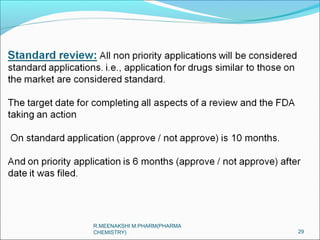
During the NDA evaluation there is no guidelines or 
rules that require open communication between FDA and 
sponser. 
27 
R.MEENAKSHI M.PHARM(PHARMA 
CHEMISTRY)
28 
R.MEENAKSHI M.PHARM(PHARMA 
CHEMISTRY)
29 
R.MEENAKSHI M.PHARM(PHARMA 
CHEMISTRY)
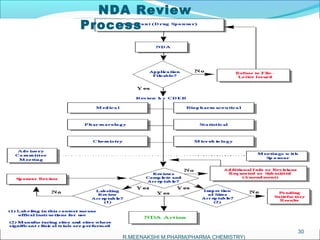
NDA Review 
Process 
30 
R.MEENAKSHI M.PHARM(PHARMA CHEMISTRY)
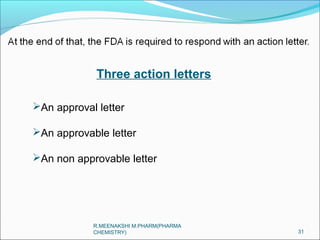
Three action letters 
An approval letter 
An approvable letter 
An non approvable letter 
31 
R.MEENAKSHI M.PHARM(PHARMA 
CHEMISTRY)
32 
R.MEENAKSHI M.PHARM(PHARMA 
CHEMISTRY)
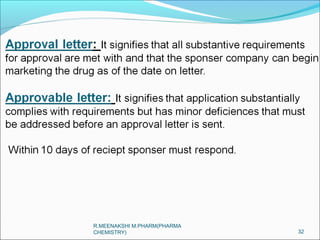
Non approvable letter: 
It signifies that FDA has a major concern with the 
application and will not approve the proposed drug 
product for marketing as submitted 
33 
R.MEENAKSHI M.PHARM(PHARMA 
CHEMISTRY)
34 
R.MEENAKSHI M.PHARM(PHARMA 
CHEMISTRY)
35 
R.MEENAKSHI M.PHARM(PHARMA 
CHEMISTRY)
Supplements are required if there is a proposed change in 
drug or its labelling. 
The changes cannot be put into effect until supplemental 
NDA has been approved by FDA 
36 
R.MEENAKSHI M.PHARM(PHARMA 
CHEMISTRY)
The Regulation provides certain changes that can be made 
without the approval of a supplemental application. 
They are… 
A different container size or closure system for solid oral 
dosage forms 
Change in a description of a drug that does not involve a 
change in a dosage strength or form 
 An editorial or minor change in labelling 
Deletion of a colour ingredient 
Addition of reasonable expiration data based on FDA 
approval protocol. R.MEENAKSHI M.PHARM(PHARMA 37 
CHEMISTRY)
38 
R.MEENAKSHI M.PHARM(PHARMA 
CHEMISTRY)
Upon approval, FDA issues a summary of the basis for 
the agency approval of the product , which describes the 
safety and effectiveness data on which the agency relied. 
In general, FDA will release the full data and information on 
safety and effectiveness after drug becomes subject to 
generic competition 
39 
R.MEENAKSHI M.PHARM(PHARMA 
CHEMISTRY)
40 
R.MEENAKSHI M.PHARM(PHARMA 
CHEMISTRY)
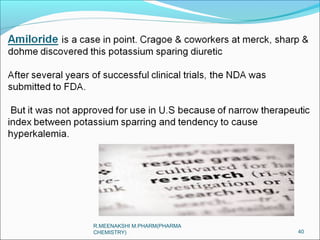
However, amiloride was introduced in several European 
countries & Asian countries. 
Its excellent tolerance & usefulness, especially when used in 
combination with hydro chlorthiazide, led finally to its 
approval by FDA in 1981. 
41 
R.MEENAKSHI M.PHARM(PHARMA 
CHEMISTRY)
42 
R.MEENAKSHI M.PHARM(PHARMA 
CHEMISTRY)
R.MEENAKSHI M.PHARM(PHARMA 
CHEMISTRY) 43

Nda

  • 1.
    (NEW DRUG APPLICATION) R.MEENAKSHI M Pharm (Pharm. Chemistry) 1
  • 2.
    CONTENTS INTRODUCTION HISTORY NDA APPROVAL PROCESS REVIEW PROCESS ADVISORY COMMITTEE CONFIDENTIALITY OF INFORMATION AMILORIDE CASE POINT REFERENCES 2 R.MEENAKSHI M.PHARM(PHARMA CHEMISTRY)
  • 3.
  • 4.
    What are newdrugs? A drug that contains as its active ingredient a new chemical entity would be considered to be a new drug. All definitions for a new drug appear in the Code Of Federal Regulations for a new drug entity. A drug’s recommended new use or change in recommended dosage, dosage form or route of administration also can be considered to be a new drug. 4 R.MEENAKSHI M.PHARM(PHARMA CHEMISTRY)
  • 5.
    HISTORY When theFederal Food, drug and cosmetic act of 1938 was passed, a new era of drug product development began.  The act required the assurance of safety and stated minimum requirements for manufacturing and quality control.  It provided only 60 days for review by FDA before the distribution of any new drug product.  The 1962 kefauver-Harris Amendments to the act required greatly increased information concerning the safety , effectiveness,quality,sale,use,manufacturing and controls of the drug products. 5 R.MEENAKSHI M.PHARM(PHARMA CHEMISTRY)
  • 6.
    NDA APPROVAL PROCESS The information of drug’s safety and efficacy collected during the animal and human trials during the IND process becomes part of NDA application.  NDA must be submitted complete in proper form and with all critical data 6 R.MEENAKSHI M.PHARM(PHARMA CHEMISTRY)
  • 7.
    All NDA’S mustcontain the following information  Index  Summary  Chemistry, Manufacturing and Control  Samples, Methods Validation Package and Labeling  Non clinical Pharmacology and Toxicology  Human Pharmacokinetics and Bioavailability 7 R.MEENAKSHI M.PHARM(PHARMA CHEMISTRY)
  • 8.
     Microbiology (for anti-microbial drugs only)  Clinical Data  Safety Update report ( typically submitted 120 days after the NDA’s submission )  Statistical  Case Report Tabulations  Case Report Forms  Patent Information  Patent Certification &  Other Information 8 R.MEENAKSHI M.PHARM(PHARMA CHEMISTRY)
  • 9.
    FORMAT OF APPLICATION: 3 copies of the application are required: Archival copy Review copy Field copy 1. Archival copy: It is a complete copy of the application. 9 R.MEENAKSHI M.PHARM(PHARMA CHEMISTRY)
  • 10.
    2. Review copy: Include the information needed by each review discipline for its evaluation.  Quality  Non clinical  Clinical – safety & efficacy documents for clinical reviewer  Clinical – safety & efficacy documents for statistical reviewer  Clinical – clinical pharmacology & pharmacokinetics documents  Clinical – clinical microbiology documents 10 R.MEENAKSHI M.PHARM(PHARMA CHEMISTRY)
  • 11.
    3. Field copy: Separately bound copy of the quality section. It is directly send to the appropriate field office. FDA will maintain guidance documents on the format & content of applications to assist applicants in their preparation. 11 R.MEENAKSHI M.PHARM(PHARMA CHEMISTRY)
  • 12.
    Application form: Theapplicant shall submit a completed & signed application form that contains:  The name & address of the applicant,  The date of the application,  The application number if previously issued,  The name of the product, including its established, proprietary, code & chemical names,  The dosage form & strength, the route of administration,  The identification numbers of all IND applications that are referenced in the application,  The drug products proposed indications for use. 12 R.MEENAKSHI M.PHARM(PHARMA CHEMISTRY)
  • 13.
     Whether thesubmission is an original submission or resubmission to an application.  Whether the applicant proposes to market the drug product as a prescription or an OTC product.  The applicant, or the applicant’s attorney, agent or other authorised official shall sign the application. b) Index: A comprehensive index by volume number & page number to the summary, the technical sections, & the supporting information. 13 R.MEENAKSHI M.PHARM(PHARMA CHEMISTRY)
  • 14.
    c) Summary: statement identifying the pharmacologic class of the drug & a discussion of the scientific rationale for the drug, its intended use, & the potential clinical benefits of the drug.  concluding discussion that represents benefit & risk considerations related to the drug. 14 R.MEENAKSHI M.PHARM(PHARMA CHEMISTRY)
  • 15.
    d) Technical sections:  chemistry, manufacturing, & controls section: Describing the composition, manufacture, & specification of the drug substance & the drug product.  Non clinical pharmacology & toxicology section  Human pharmacokinetics & bioavailability section  Microbiology section (If the drug is anti-infective) 15 R.MEENAKSHI M.PHARM(PHARMA CHEMISTRY)
  • 16.
     A descriptionof the biochemical basis of the drug action on microbial physiology.  A description of the antimicrobial spectra of the drug to demonstrate concentrations of the drug required for effective use  A description of any known mechanisms of resistance to the drug.  A description of clinical microbiology laboratory methods needed for effective use of drug. 16 R.MEENAKSHI M.PHARM(PHARMA CHEMISTRY)
  • 17.
    Clinical data section: PHASE 1: Used to describe the human pharmacology of the drug and preferred route of administration. PHASE 2: Involves dosing of a limited number of patients for treatment or prevention of disease of interest.  It evaluates the effectiveness of the drug. PHASE 3: Drug is assessed for its safety, effectiveness and most desirable dosage for the disease to be treated and the results are corrected and verified in large number of patients. 17 R.MEENAKSHI M.PHARM(PHARMA CHEMISTRY)
  • 18.
    Statistical section: This section concerning the description & analysis of each controlled clinical study, & the documentation & supporting statistical analyses used in evaluating the controlled clinical studies.  A copy concerning a summary of information about the safety of the drug product, & the documentation & supporting statistical analyses used in evaluating the safety information. 18 R.MEENAKSHI M.PHARM(PHARMA CHEMISTRY)
  • 19.
    Pediatric use section:  Includes the integrated summary of the information that is relevant to the safety effectiveness benefits risks of the drug in pediatric populations for the claimed indications. 19 R.MEENAKSHI M.PHARM(PHARMA CHEMISTRY)
  • 20.
    e) Samples &labeling: Upon the request from FDA, the applicant shall submit the samples. The samples should be in sufficient quantity to permit FDA to perform 3 times each test. Which is described in the application to determine whether the drug substance & the drug product meet the specifications given in the application 20 R.MEENAKSHI M.PHARM(PHARMA CHEMISTRY)
  • 21.
     The drugproduct proposed for marketing  The drug substance used in the drug product from which the samples of the drug product were taken  Reference standards & blanks  Samples of the finished market package, if requested by FDA 21 R.MEENAKSHI M.PHARM(PHARMA CHEMISTRY)
  • 22.
    f) Case reportforms & tabulations: Case report tabulations:  Tabulations of the data from each adequate & well controlled study phase 2 & phase 3 studies.  Tabulations of the data from the earliest clinical pharmacology studies phase 1 studies  Tabulations of the safety data from other clinical studies. 22 R.MEENAKSHI M.PHARM(PHARMA CHEMISTRY)
  • 23.
    Case report forms:  Copies of individual case report forms for each patient who died during a clinical study.  who did not complete the study because of an adverse event whether believed to be drug related or not, including patients receiving reference drugs or placebo. 23 R.MEENAKSHI M.PHARM(PHARMA CHEMISTRY)
  • 24.
    g) Other: Theapplicant ordinarily is not required to resubmit information previously submitted, but may incorporate the information by reference. The applicant shall submit and accurate & complete English translation of each part of the application that is not in English. h) Patent information 24 R.MEENAKSHI M.PHARM(PHARMA CHEMISTRY)
  • 25.
    If the FDAconsiders it acceptable it will then determine application completeness. If complete, the FDA considers the application “filed” and begin the review process within 60 days. The purpose of NDA from FDA perspective is to ensure that new drug meet the criteria to be safe and effective The FDA is required to review an application within 180 days of filing. 25 R.MEENAKSHI M.PHARM(PHARMA CHEMISTRY)
  • 26.
    Is the drugsafe & effective in its proposed use, & do the benefits of the drug outweigh the risks? Is the drug’s proposed labeling (package insert) appropriate, & what should contain? Are the methods used in manufacturing (GMP) the drug & the controls used to maintain the drug’s quality adequate to preserve the drug’s identity, strength, quality & purity? 26 R.MEENAKSHI M.PHARM(PHARMA CHEMISTRY)
  • 27.
    Review priority classification Under food drug and administration modernisation act (FDAMA) depending on the anticipated therapeutic or diagnostic value of submitted NDA, its review might receive priority (p) or standard (s) classification. Both original NDA’s and effective supplements receive a review priority classification. During the NDA evaluation there is no guidelines or rules that require open communication between FDA and sponser. 27 R.MEENAKSHI M.PHARM(PHARMA CHEMISTRY)
  • 28.
  • 29.
  • 30.
    NDA Review Process 30 R.MEENAKSHI M.PHARM(PHARMA CHEMISTRY)
  • 31.
    Three action letters An approval letter An approvable letter An non approvable letter 31 R.MEENAKSHI M.PHARM(PHARMA CHEMISTRY)
  • 32.
  • 33.
    Non approvable letter: It signifies that FDA has a major concern with the application and will not approve the proposed drug product for marketing as submitted 33 R.MEENAKSHI M.PHARM(PHARMA CHEMISTRY)
  • 34.
  • 35.
  • 36.
    Supplements are requiredif there is a proposed change in drug or its labelling. The changes cannot be put into effect until supplemental NDA has been approved by FDA 36 R.MEENAKSHI M.PHARM(PHARMA CHEMISTRY)
  • 37.
    The Regulation providescertain changes that can be made without the approval of a supplemental application. They are… A different container size or closure system for solid oral dosage forms Change in a description of a drug that does not involve a change in a dosage strength or form  An editorial or minor change in labelling Deletion of a colour ingredient Addition of reasonable expiration data based on FDA approval protocol. R.MEENAKSHI M.PHARM(PHARMA 37 CHEMISTRY)
  • 38.
  • 39.
    Upon approval, FDAissues a summary of the basis for the agency approval of the product , which describes the safety and effectiveness data on which the agency relied. In general, FDA will release the full data and information on safety and effectiveness after drug becomes subject to generic competition 39 R.MEENAKSHI M.PHARM(PHARMA CHEMISTRY)
  • 40.
  • 41.
    However, amiloride wasintroduced in several European countries & Asian countries. Its excellent tolerance & usefulness, especially when used in combination with hydro chlorthiazide, led finally to its approval by FDA in 1981. 41 R.MEENAKSHI M.PHARM(PHARMA CHEMISTRY)
  • 42.
  • 43.