VENDOR DEVELOPMENT
Department of Pharmaceutics
MCOPS, Manipal University
Presented by :
Shikha singh
160617009
Under the guidance of :
Dr . Mahalaxmi Rathanand
CONTENT
 INTRODUCTION
 VENDOR DEVELOPMENT
 VENDOR EVALUATION
 VENDOR RATING
 PROCEDURE
 APPROVED VENDOR LIST
 VENDOR CERTIFICATION
 CONCLUSION
 REFERENCES
2
INTRODUCTION
 VENDOR:
 Vendor means a person who sells & supplies his
products
 An intelligent purchasing involves the rational selection
of sources from which materials can be obtained
 Efforts are needed in identifying, developing and
evaluating the prospective suppliers
 Essential to continuously appraise the performance of
the current suppliers
3
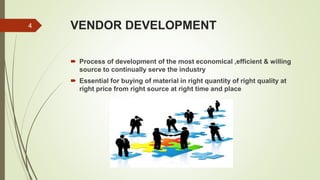
VENDOR DEVELOPMENT
 Process of development of the most economical ,efficient & willing
source to continually serve the industry
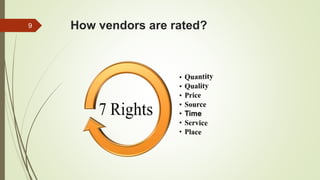
 Essential for buying of material in right quantity of right quality at
right price from right source at right time and place
4
Why we need vendor development?
 To provide a system to valuate suppliers to supply
materials such as raw & packing conforming to specified
requirement
 To make sure the vendors understand tasks which they
must be completed & verify and their completion
deadlines are reflected accurately on the project
schedule
 To interview the prospective key personnel both the
integrator and the manufacturer
5
VENDOR EVALUATION
 One of the most important processes performed in
organizations today is the evaluation, selection &
continuous measurement of suppliers
 Criteria's are fundamental to choose the best supplier
 The evaluation is done especially on two counts, namely
quality and delivery
 The purpose of vendor evaluation is to ensure a portfolio
of best in class suppliers is available for use
6
 Based on the information obtained via the evaluation, a
supplier is scored & either approved/unapproved as one
from whom to procure materials or services
 ASL- qualified supplier is then added
 Approved vendor- re-evaluated periodically or annually
 Suppliers are selected according to their ability to supply
quality goods
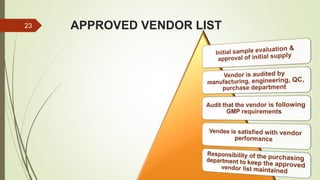
 AVL- listing of various types of suppliers & providers that
a company has agreed meets its standards in terms of
quality and price
7
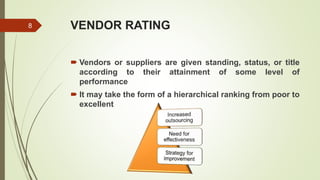
VENDOR RATING8
 Vendors or suppliers are given standing, status, or title
according to their attainment of some level of
performance
 It may take the form of a hierarchical ranking from poor to
excellent
How vendors are rated?9
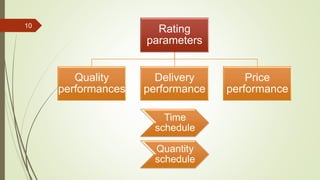
Rating
parameters
Quality
performances
Delivery
performance
Price
performance
10
Time
schedule
Quantity
schedule
Quality performance
 It is the measure of material not in conformance with given
specifications
 A supplier can be judged for quality performance from the
view point of rejected lots
 This takes into account the no. of defects as well as
seriousness of defects
 Ex: If a supplier has supplied 100 pieces and 10 pieces are
rejected from the lot, he has rating of 90%.
 (Number of lots accepted/Number of lots supplied)100 =
weightage
 (90/100) 100= 90%
11
Delivery performance
 It measures the promptness of vendor in keeping schedules of
delivery, removing of rejected materials and nature of response
to other activities
 Delivery performance thus can be made into 2 ways
1. ADHERENCE TO TIME SCHEDULE
It can be calculated by following formula
(No. of deliveries made in time/Total no of scheduled deliveries)
weightage
2. ADHERENCE TO QUANTITY SCHEDULE
It can be measured by the following formula
(Quantity supplied/Scheduled delivery) weightage
12
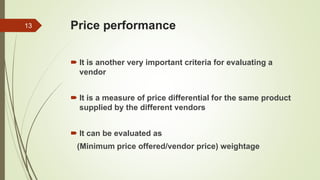
Price performance
 It is another very important criteria for evaluating a
vendor
 It is a measure of price differential for the same product
supplied by the different vendors
 It can be evaluated as
(Minimum price offered/vendor price) weightage
13
14
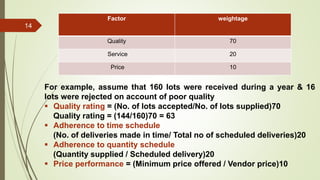
Factor weightage
Quality 70
Service 20
Price 10
For example, assume that 160 lots were received during a year & 16
lots were rejected on account of poor quality
 Quality rating = (No. of lots accepted/No. of lots supplied)70
Quality rating = (144/160)70 = 63
 Adherence to time schedule
(No. of deliveries made in time/ Total no of scheduled deliveries)20
 Adherence to quantity schedule
(Quantity supplied / Scheduled delivery)20
 Price performance = (Minimum price offered / Vendor price)10
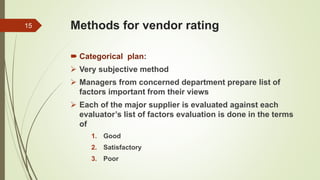
Methods for vendor rating
 Categorical plan:
 Very subjective method
 Managers from concerned department prepare list of
factors important from their views
 Each of the major supplier is evaluated against each
evaluator’s list of factors evaluation is done in the terms
of
1. Good
2. Satisfactory
3. Poor
15
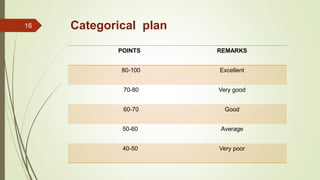
Categorical plan
POINTS REMARKS
80-100 Excellent
70-80 Very good
60-70 Good
50-60 Average
40-50 Very poor
16
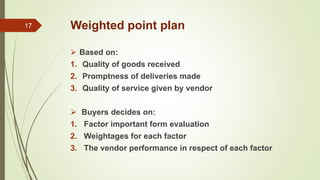
Weighted point plan
 Based on:
1. Quality of goods received
2. Promptness of deliveries made
3. Quality of service given by vendor
 Buyers decides on:
1. Factor important form evaluation
2. Weightages for each factor
3. The vendor performance in respect of each factor
17
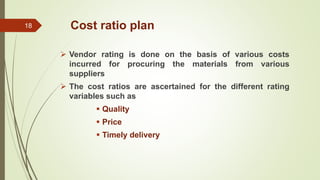
Cost ratio plan
 Vendor rating is done on the basis of various costs
incurred for procuring the materials from various
suppliers
 The cost ratios are ascertained for the different rating
variables such as
 Quality
 Price
 Timely delivery
18
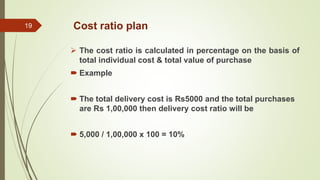
Cost ratio plan
 The cost ratio is calculated in percentage on the basis of
total individual cost & total value of purchase
 Example
 The total delivery cost is Rs5000 and the total purchases
are Rs 1,00,000 then delivery cost ratio will be
 5,000 / 1,00,000 x 100 = 10%
19
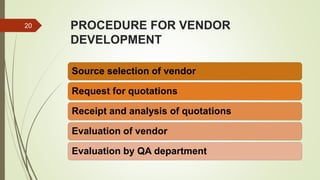
PROCEDURE FOR VENDOR
DEVELOPMENT
Source selection of vendor
Request for quotations
Receipt and analysis of quotations
Evaluation of vendor
Evaluation by QA department
20
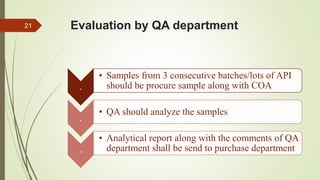
Evaluation by QA department
.
• Samples from 3 consecutive batches/lots of API
should be procure sample along with COA
.
• QA should analyze the samples
.
• Analytical report along with the comments of QA
department shall be send to purchase department
21
22
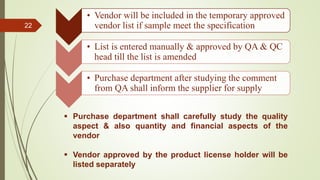
• Vendor will be included in the temporary approved
vendor list if sample meet the specification
• List is entered manually & approved by QA & QC
head till the list is amended
• Purchase department after studying the comment
from QA shall inform the supplier for supply
 Purchase department shall carefully study the quality
aspect & also quantity and financial aspects of the
vendor
 Vendor approved by the product license holder will be
listed separately
APPROVED VENDOR LIST23
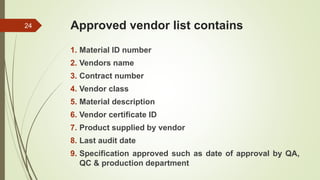
Approved vendor list contains
1. Material ID number
2. Vendors name
3. Contract number
4. Vendor class
5. Material description
6. Vendor certificate ID
7. Product supplied by vendor
8. Last audit date
9. Specification approved such as date of approval by QA,
QC & production department
24
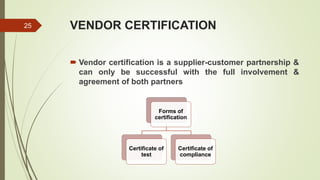
VENDOR CERTIFICATION
 Vendor certification is a supplier-customer partnership &
can only be successful with the full involvement &
agreement of both partners
25
Forms of
certification
Certificate of
test
Certificate of
compliance
 Certificate of test:- This document, issued by a test
laboratory, states that certain product was tested for
certain qualities the product is identified by description,
amount, lot no. etc
 Certificate of compliance:- This is an assertation the
product complies to specification. This certifies that the
material delivered under this contract is in accord with
the terms of the contract
 In some companies the formalising of this act includes
sending the vendors a document, that is a certificate to
attest to the fact that the vendor as reached the state of
qualification described in the document
 To designate the process used in formalising a vendor
contract
26
CONCLUSION
 It is important to have a good vendor development plan in
a company
 Vendor approval, vendor rating should be carried out
periodically & if need arises, companies should change
the vendors and approve vendors who can serve the
company in a better way
 It is equally important to have a good vendor-vendee
relations which helps companies to procure materials at
right time in right quantity and at right place
27
REFERENCES
1. Khanna O.P, Industrial Engineering and Management,
Revised 1st edition, pg: 23.9-23.11
2. Datta A.K, materials management procedures, text and
cases, 2nd edition, pg: 88-104
3. Amrine Harold T., Ritchey john a, Hulley Oliver s,
Manufacturing Organization and Management, 4th edition,
pg:250-253
28
29

Vendor development in pharmaceutical industry

  • 1.
    VENDOR DEVELOPMENT Department ofPharmaceutics MCOPS, Manipal University Presented by : Shikha singh 160617009 Under the guidance of : Dr . Mahalaxmi Rathanand
  • 2.
    CONTENT  INTRODUCTION  VENDORDEVELOPMENT  VENDOR EVALUATION  VENDOR RATING  PROCEDURE  APPROVED VENDOR LIST  VENDOR CERTIFICATION  CONCLUSION  REFERENCES 2
  • 3.
    INTRODUCTION  VENDOR:  Vendormeans a person who sells & supplies his products  An intelligent purchasing involves the rational selection of sources from which materials can be obtained  Efforts are needed in identifying, developing and evaluating the prospective suppliers  Essential to continuously appraise the performance of the current suppliers 3
  • 4.
    VENDOR DEVELOPMENT  Processof development of the most economical ,efficient & willing source to continually serve the industry  Essential for buying of material in right quantity of right quality at right price from right source at right time and place 4
  • 5.
    Why we needvendor development?  To provide a system to valuate suppliers to supply materials such as raw & packing conforming to specified requirement  To make sure the vendors understand tasks which they must be completed & verify and their completion deadlines are reflected accurately on the project schedule  To interview the prospective key personnel both the integrator and the manufacturer 5
  • 6.
    VENDOR EVALUATION  Oneof the most important processes performed in organizations today is the evaluation, selection & continuous measurement of suppliers  Criteria's are fundamental to choose the best supplier  The evaluation is done especially on two counts, namely quality and delivery  The purpose of vendor evaluation is to ensure a portfolio of best in class suppliers is available for use 6
  • 7.
     Based onthe information obtained via the evaluation, a supplier is scored & either approved/unapproved as one from whom to procure materials or services  ASL- qualified supplier is then added  Approved vendor- re-evaluated periodically or annually  Suppliers are selected according to their ability to supply quality goods  AVL- listing of various types of suppliers & providers that a company has agreed meets its standards in terms of quality and price 7
  • 8.
    VENDOR RATING8  Vendorsor suppliers are given standing, status, or title according to their attainment of some level of performance  It may take the form of a hierarchical ranking from poor to excellent
  • 9.
  • 10.
  • 11.
    Quality performance  Itis the measure of material not in conformance with given specifications  A supplier can be judged for quality performance from the view point of rejected lots  This takes into account the no. of defects as well as seriousness of defects  Ex: If a supplier has supplied 100 pieces and 10 pieces are rejected from the lot, he has rating of 90%.  (Number of lots accepted/Number of lots supplied)100 = weightage  (90/100) 100= 90% 11
  • 12.
    Delivery performance  Itmeasures the promptness of vendor in keeping schedules of delivery, removing of rejected materials and nature of response to other activities  Delivery performance thus can be made into 2 ways 1. ADHERENCE TO TIME SCHEDULE It can be calculated by following formula (No. of deliveries made in time/Total no of scheduled deliveries) weightage 2. ADHERENCE TO QUANTITY SCHEDULE It can be measured by the following formula (Quantity supplied/Scheduled delivery) weightage 12
  • 13.
    Price performance  Itis another very important criteria for evaluating a vendor  It is a measure of price differential for the same product supplied by the different vendors  It can be evaluated as (Minimum price offered/vendor price) weightage 13
  • 14.
    14 Factor weightage Quality 70 Service20 Price 10 For example, assume that 160 lots were received during a year & 16 lots were rejected on account of poor quality  Quality rating = (No. of lots accepted/No. of lots supplied)70 Quality rating = (144/160)70 = 63  Adherence to time schedule (No. of deliveries made in time/ Total no of scheduled deliveries)20  Adherence to quantity schedule (Quantity supplied / Scheduled delivery)20  Price performance = (Minimum price offered / Vendor price)10
  • 15.
    Methods for vendorrating  Categorical plan:  Very subjective method  Managers from concerned department prepare list of factors important from their views  Each of the major supplier is evaluated against each evaluator’s list of factors evaluation is done in the terms of 1. Good 2. Satisfactory 3. Poor 15
  • 16.
    Categorical plan POINTS REMARKS 80-100Excellent 70-80 Very good 60-70 Good 50-60 Average 40-50 Very poor 16
  • 17.
    Weighted point plan Based on: 1. Quality of goods received 2. Promptness of deliveries made 3. Quality of service given by vendor  Buyers decides on: 1. Factor important form evaluation 2. Weightages for each factor 3. The vendor performance in respect of each factor 17
  • 18.
    Cost ratio plan Vendor rating is done on the basis of various costs incurred for procuring the materials from various suppliers  The cost ratios are ascertained for the different rating variables such as  Quality  Price  Timely delivery 18
  • 19.
    Cost ratio plan The cost ratio is calculated in percentage on the basis of total individual cost & total value of purchase  Example  The total delivery cost is Rs5000 and the total purchases are Rs 1,00,000 then delivery cost ratio will be  5,000 / 1,00,000 x 100 = 10% 19
  • 20.
    PROCEDURE FOR VENDOR DEVELOPMENT Sourceselection of vendor Request for quotations Receipt and analysis of quotations Evaluation of vendor Evaluation by QA department 20
  • 21.
    Evaluation by QAdepartment . • Samples from 3 consecutive batches/lots of API should be procure sample along with COA . • QA should analyze the samples . • Analytical report along with the comments of QA department shall be send to purchase department 21
  • 22.
    22 • Vendor willbe included in the temporary approved vendor list if sample meet the specification • List is entered manually & approved by QA & QC head till the list is amended • Purchase department after studying the comment from QA shall inform the supplier for supply  Purchase department shall carefully study the quality aspect & also quantity and financial aspects of the vendor  Vendor approved by the product license holder will be listed separately
  • 23.
  • 24.
    Approved vendor listcontains 1. Material ID number 2. Vendors name 3. Contract number 4. Vendor class 5. Material description 6. Vendor certificate ID 7. Product supplied by vendor 8. Last audit date 9. Specification approved such as date of approval by QA, QC & production department 24
  • 25.
    VENDOR CERTIFICATION  Vendorcertification is a supplier-customer partnership & can only be successful with the full involvement & agreement of both partners 25 Forms of certification Certificate of test Certificate of compliance
  • 26.
     Certificate oftest:- This document, issued by a test laboratory, states that certain product was tested for certain qualities the product is identified by description, amount, lot no. etc  Certificate of compliance:- This is an assertation the product complies to specification. This certifies that the material delivered under this contract is in accord with the terms of the contract  In some companies the formalising of this act includes sending the vendors a document, that is a certificate to attest to the fact that the vendor as reached the state of qualification described in the document  To designate the process used in formalising a vendor contract 26
  • 27.
    CONCLUSION  It isimportant to have a good vendor development plan in a company  Vendor approval, vendor rating should be carried out periodically & if need arises, companies should change the vendors and approve vendors who can serve the company in a better way  It is equally important to have a good vendor-vendee relations which helps companies to procure materials at right time in right quantity and at right place 27
  • 28.
    REFERENCES 1. Khanna O.P,Industrial Engineering and Management, Revised 1st edition, pg: 23.9-23.11 2. Datta A.K, materials management procedures, text and cases, 2nd edition, pg: 88-104 3. Amrine Harold T., Ritchey john a, Hulley Oliver s, Manufacturing Organization and Management, 4th edition, pg:250-253 28
  • 29.