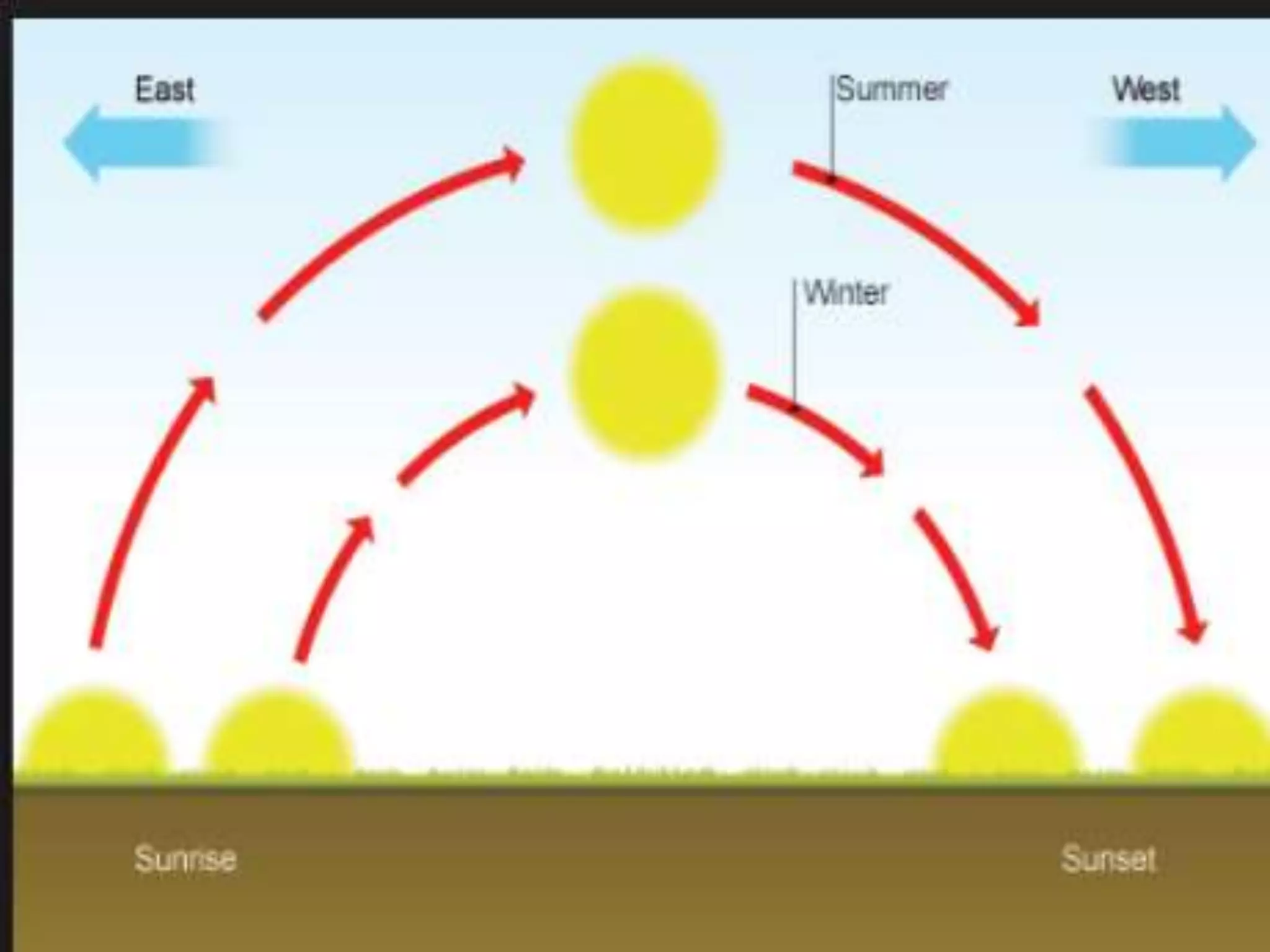
The document discusses sun paths and how knowledge of sun paths and climatic conditions is essential for making economic decisions about solar energy use and landscaping. It explains that the earth's axis is tilted 23.5 degrees relative to its orbit around the sun, creating differences between summer and winter sun paths and solar altitudes. Specifically, it notes that the northern side receives no direct sunlight but uniform daylight, making it suitable for work spaces, while the southern side receives the most solar radiation and can be carefully designed to manage summer heat and utilize winter sun.