CLIMATOLOGY :
FACTORS AND ELEMENTS
ROHIT KUMAR
ASSSISTANT PROFESSOR
MBS SPA 2015
CLIMATE
• From Greek word ‘klima’, it refers to ‘region 
with certain conditions of temperature, 
dryness, wind, light, etc.
• An integration in time of the physical states of 
the atmospheric environment characteristic 
of certain geographic conditions.
• Weather is the momentary state of the 
atmospheric environment at certain location.
FACTORS AFFECTING CLIMATE
These are the factors affecting climate on the global scale.
Intensity: (Physics term): Power transferred per unit area
SOLAR RADIATION QUALITY
The earth receives almost all its energy from sun.
The spectrum extends from 290 to 2300 nm.
• UV: 290‐380 nm
• Visible light: 380nm (violet) to 700nm (red)
• Infra red: 700‐2300nm  
General guidance of solar illumination: 100 
lumens/watt (Intensity of 100 lux for W/sq.m)
SOLAR RADIATION quality & quantity
General guidance of solar illumination: 100 
lumens/watt.
This would give an illumination of 100 lux for 1 
W/sq.m or 100,000 lux per kW/sq.m.
QUANTITY: 1395 W/sq.m is the intensity of solar 
radiation reaching upper surface of atmosphere.
Variation: +‐2% due to sun output
+‐3.5% due to change in earth‐sun 
distance.
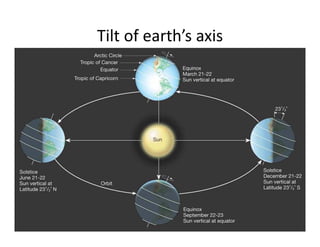
Tilt of earth’s axis
• Earth rotates around its own axis in 24 hours.
• The axis(Line joining N & S pole) is tilted at 66.5 
deg. to the plane of its elliptical orbit.
• Maximum intensity is received between 23.5 
deg. N and 23.5 deg. S.
• On June 21, areas along 23.5 deg. N are normal 
to sun’s rays‐ Longest day. (Summer solstice)
• December 21 (Winter solstice)
• Equinox on 21 March and 23 September.
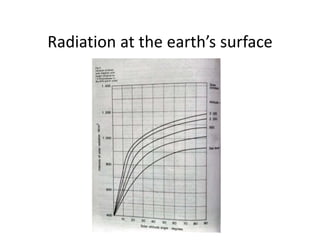
Radiation at the earth’s surface
• The earth‐sun relationship affects the amount 
of radiations received at a particular point on 
the earth’s surface in 3 ways:
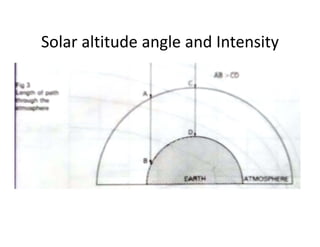
– Atmospheric depletion: Absorption of radiation by 
ozone, vapours and dust particles in atmosphere. (A 
factor of 0.2 to 0.7)
– Duration of sunshine: Length of daylight period.
– Cosine Law
Radiation at the earth’s surface
Solar altitude angle and Intensity
Radiation a the earth’s surface
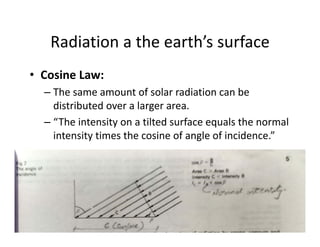
• Cosine Law: 
– The same amount of solar radiation can be 
distributed over a larger area.
– “The intensity on a tilted surface equals the normal 
intensity times the cosine of angle of incidence.”
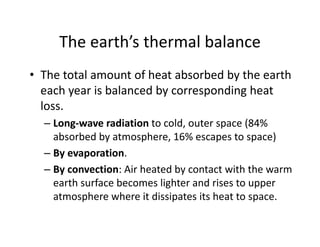
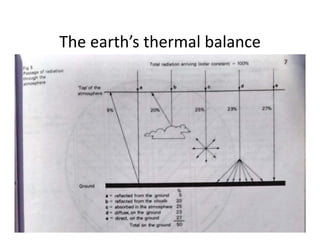
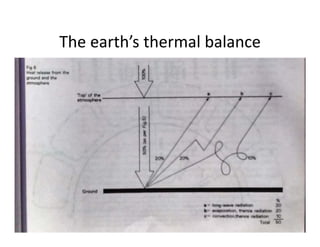
The earth’s thermal balance
• The total amount of heat absorbed by the earth 
each year is balanced by corresponding heat 
loss.
– Long‐wave radiation to cold, outer space (84% 
absorbed by atmosphere, 16% escapes to space)
– By evaporation.
– By convection: Air heated by contact with the warm 
earth surface becomes lighter and rises to upper 
atmosphere where it dissipates its heat to space.
The earth’s thermal balance
Winds: Thermal forces
•
Winds: Thermal forces
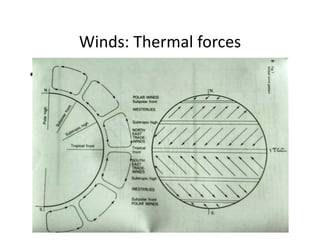
1. Winds are convection currents in the 
atmosphere that tend to even the differential 
heating of various zones.
2. Trade winds (0‐30 deg.): Winds blowing to 
direction opposite of earth’s rotation. The 
slippage at the boundary of earth surface and 
the atmosphere is caused by Coriolis force. 
3. Westerlies (30‐60 deg.): The law of 
conservation of angular momentum is the 
cause. 
TOPOGRAPHY
The force, direction and moisture content of air 
flows are strongly influenced by topography.
1. The influence of altitude (hill station).
2. The effect of sea to coastal areas.
3. Leeward and Windward side of a hill.
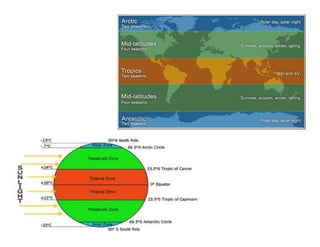
MAJOR CLIMATIC ZONES (WORLD)
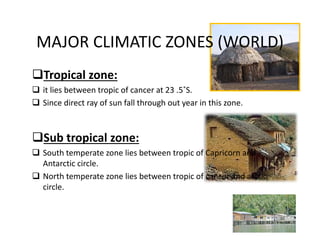
Tropical zone:
 it lies between tropic of cancer at 23 .5˚S.
 Since direct ray of sun fall through out year in this zone.
Sub tropical zone:
 South temperate zone lies between tropic of Capricorn and 
Antarctic circle.
 North temperate zone lies between tropic of cancer and arctic 
circle.
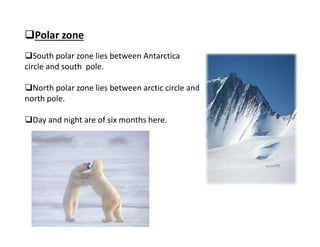
Polar zone
South polar zone lies between Antarctica 
circle and south  pole.
North polar zone lies between arctic circle and 
north pole.
Day and night are of six months here.
ELEMENTS OF CLIMATE
• Temperature
• Humidity
• Precipitation
• Sky conditions (presence or absence of 
clouds)
• Solar radiation
• Wind 
• Vegetation
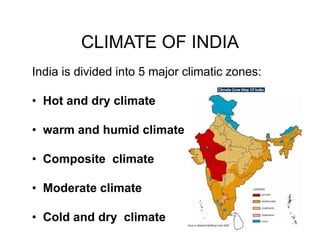
CLIMATE OF INDIA
India is divided into 5 major climatic zones:
• Hot and dry climate
• warm and humid climate
• Composite climate
• Moderate climate
• Cold and dry climate
BIBLIOGRAPHY
• Koenigsberger, O. H., Manual of Tropical 
Housing and building, Orient Longman private 
limited, 1973. 

1. climatology factors and elements