SOLAR ORIENTED
               ARCHITECTURE


GUIDED BY: VINAY JAIN
SUBMITTED BY:
      ABHISHEK              SOURABH
       SUMIT               GAJENDRA
      RITTICK              HARSHITA
       ISHITA                ASHISH
       YOGENDRA               SAKSHI
      NIDHIN                  ANANT
      DEVYANI                 SHREYA
      AAYUSHI                 ARUSHI
      TANWI                  MAYANK
      PRAASHU                ANTARA
                  GURTEG
INTRODUCTION
• Solar Energy reaching the earth is
  incredible. By one calculation, 30 days
  of sunshine striking the Earth have the
  energy equivalent of the total of all the
  planet’s fossil fuels, both used and
  unused!
• All chemical and radioactive polluting
  byproducts of the thermonuclear
  reactions remain behind on the sun,
  while only pure radiant energy reaches
  the Earth.
INTRODUCTION

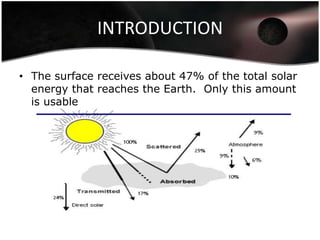
• The surface receives about 47% of the total solar
  energy that reaches the Earth. Only this amount
  is usable
Two categories of Solar
Energy
• Active Solar: A method specifically designed to
  acquire energy from sun and move it to where
  needed, including:
o      Photovoltaic electric power generation
o      Solar Thermal power generation
o      Active solar heating using solar collectors
• Passive Solar: A design of buildings that
  inherently takes advantage of the sun for
  daylighting and winter heating, and avoids solar
  gain in summer to minimize need for cooling.
Passive Solar

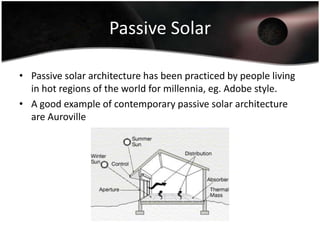
• Passive solar architecture has been practiced by people living
  in hot regions of the world for millennia, eg. Adobe style.
• A good example of contemporary passive solar architecture
  are Auroville
While designing
• Latitude, sun path, and insolation (sunshine)
• Seasonal variations in solar gain e.g. cooling or
  heating degree days, solar insolation, humidity
• Diurnal variations in temperature
• Micro-climate details related to
  breezes, humidity, vegetation and land contour
• Obstructions / Over-shadowing - to solar gain or
  local cross-winds
• Landscaping and interiors also play a major role.
TOPICS COVERED:

•   SUN CHART
•   SUN PATH
•   SHADED ENVELOPE
•   LIGHT PIPES
•   BUILDING ORIENTATION
•   THERMAL MASS
•   TROMBE WALL
•   SOLAR CHIMENY
SUN CHART
• A Sun chart is a graph of the ecliptic of
  the Sun through the sky throughout
  the year at a particular latitude.
• Most sun charts plot azimuth versus
  altitude throughout the days of the
  winter solstice and summer solstice, as
  well as a number of intervening days.
  Since the movement of the Sun is
  symmetrical about the solstice, it is
  only necessary to plot dates from one
  half of the year.
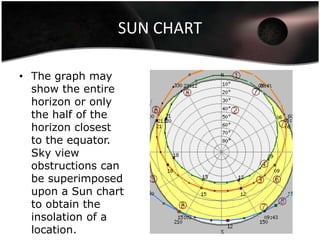
SUN CHART

• The graph may
  show the entire
  horizon or only
  the half of the
  horizon closest
  to the equator.
  Sky view
  obstructions can
  be superimposed
  upon a Sun chart
  to obtain the
  insolation of a
  location.
SUN PATH
SUN PATH

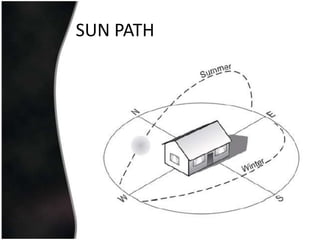
• South orientation receives maximum solar
  radiation during winters which is preferable as
  composite climate receives severe winters. East
  and West receive maximum solar radiation during
  summer.
• West is a crucial orientation because high
  intensity of solar radiation is received during
  summers.
• Orientation also plays an important role with
  respect to wind direction.
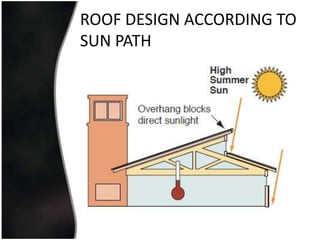
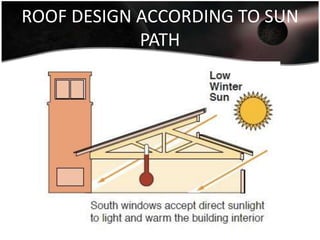
ROOF DESIGN ACCORDING TO
SUN PATH
ROOF DESIGN ACCORDING TO SUN
            PATH
SHADED ENVELOPE
• All the elements of a building are
  vulnerable to heat gains. Proper
  shading is therefore a very important
  aspect in solar passive building design.
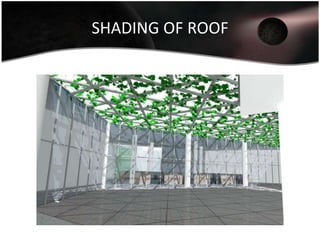
SHADING OF ROOF:
• Shading of roof through design
  features like pergolas or solar
  photovoltaic panels helps in reducing
  the incident direct solar radiation on
  the roof surface.
SHADING OF ROOF
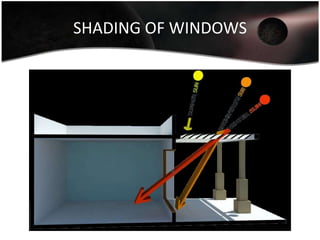
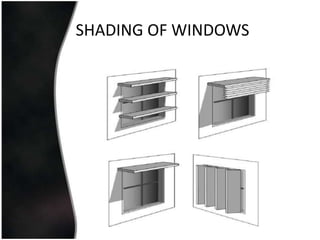
SHADING OF WINDOWS:
• Incorporation of shading elements with
  windows help in: keeping out the sun‘s
  heat, block uncomfortable direct
  sun, and soften harsh daylight
  contrasts. Shading devices are
  therefore necessary to allow glare free
  natural light.

• Shading devices for windows and walls
  moderate heat gains into the building.
SHADING OF WINDOWS
SHADING OF WINDOWS
SHADING OF WALLS

• Shading walls from direct sun can be one of the
  simplest and most effective ways of reducing the
  heat load on a building.
Impact of shaded wall:
• In day time use buildings shaded east and west
  walls have higher energy saving potential than
  insulating the external walls.
• The different kinds of shadings for wall are
  explained below:
DIFFERENT KINDS OF SHADING
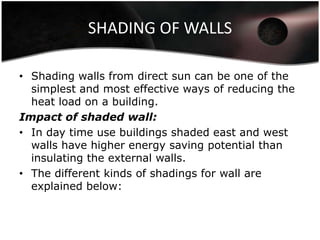
Deep porches and verandas:
• These are excellent at reducing the
  solar heat gain in a building because
  they completely shade the walls.
•
DIFFERENT KINDS OF SHADING

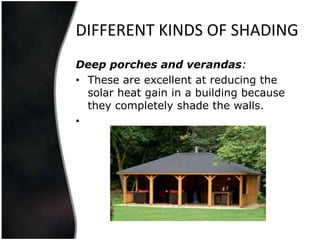
Sun-proof fabric covers:
• For porches, or sails these can be attached to the
  building itself, and are a good seasonal solution.
DIFFERENT KINDS OF SHADING
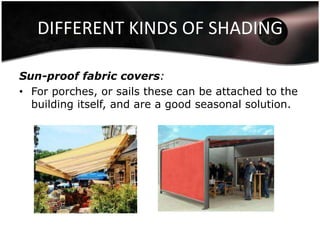
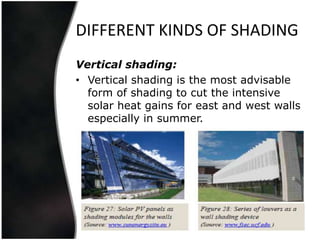
Vertical shading:
• Vertical shading is the most advisable
  form of shading to cut the intensive
  solar heat gains for east and west walls
  especially in summer.
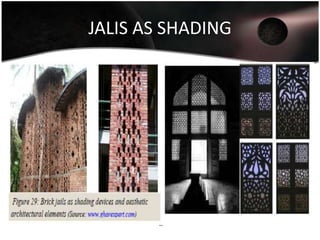
JALIS AS SHADING
LIGHT PIPES
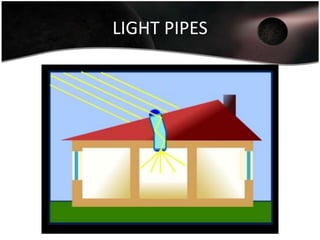
• Light tubes or light pipes are used for
  transporting or distributing natural or
  artificial light. In their application of
  day lighting, they are also called as
  sun pipes, solar pipes, solar light
  pipes, or day light pipes.
• They make it possible to transport
  daylight through thick roof structures
  and attics. They are easier to install in
  retrofit applications than skylights.
LIGHT PIPES
BUILDING ORIENTATION
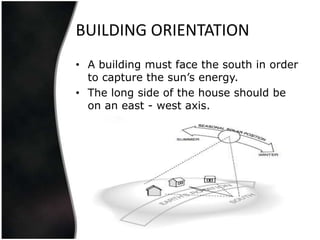
• A building must face the south in order
  to capture the sun’s energy.
• The long side of the house should be
  on an east - west axis.
THERMAL MASS

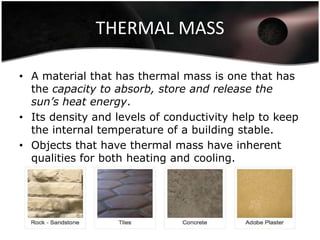
• A material that has thermal mass is one that has
  the capacity to absorb, store and release the
  sun’s heat energy.
• Its density and levels of conductivity help to keep
  the internal temperature of a building stable.
• Objects that have thermal mass have inherent
  qualities for both heating and cooling.
TROMBE WALL
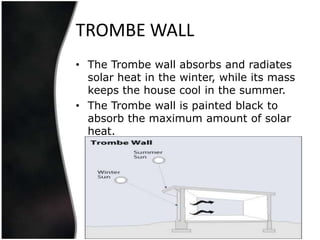
• The Trombe wall absorbs and radiates
  solar heat in the winter, while its mass
  keeps the house cool in the summer.
• The Trombe wall is painted black to
  absorb the maximum amount of solar
  heat.
TROMBE WALL-PRINCIPLE

• A Trombe wall combines the principles of thermal
  mass and a solarium.


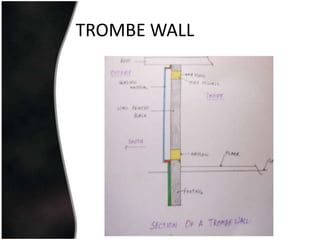
• A trombe wall consists of a sun-facing high
  thermal mass wall with vents at the top and
  bottom, placed behind insulated glazing with an
  air gap in between; together they act as a large
  solar thermal collector
TROMBE WALL
TROMBE WALL-APPLICATION

• During the day, the air between the glazing and
  the thermal mass wall gets heated up and flows
  through the vents into the interior space via
  convection, thus warming the interior space.
• At the same time the thermal mass wall absorbs
  and stores the incident solar radiation.
• During the night, the vents are closed and the
  thermal mass radiates the stored heat into the
  interior space through conduction and radiation.
SOLAR CHIMNEY
PRINCIPLE
• A solar chimney often, referred to as a
  thermal chimney is a way of improving
  the natural ventilation of buildings by
  using convection of air heated by
  passive solar energy.
• In its simplest form, the solar chimney
  consists of a black-painted
  chimney, with a partly glazed surface
  area towards the top.
PRINCIPLE

•    During the day, solar energy heats the chimney
    and the air within it, creating an updraft of air in
    the chimney.


• The suction created at the chimney's base can be
  used to ventilate and cool the building below
  through stack effect.
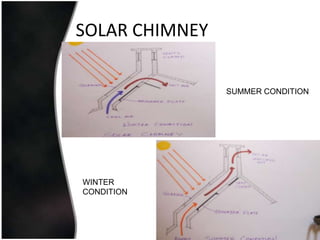
SOLAR CHIMNEY

                SUMMER CONDITION


WINTER
CONDITION
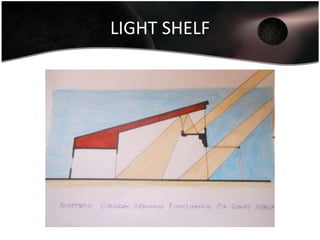
LIGHT SHELF
LIGHT SHELF-PRINCIPLE
• A horizontal shelf positioned (usually
  above eye level) to reflect daylight
  onto the ceiling and to shield direct
  glare from the sky.
• It will result in a more even light
  gradient.
• This indirect light supplements and/or
  delays the artificial lighting
  requirement and thus reduces energy
  consumption
LIGHT SHELF-APPLICATION

• A light shelf is a horizontal element installed
  within a window to divide it into two sections.
• The light shelf is opaque, with a highly reflective
  upper surface and a diffusing white under
  surface.
• Generally, the light shelf will split the window
  with one third of the glazing above and two thirds
  below.
• This will allow reflection of both daylight and
  sunlight up on to the ceiling, whilst not
  obstructing the view through the window.
THANK YOU

SOLAR ORIENTED ARCHITECTURE

  • 1.
    SOLAR ORIENTED ARCHITECTURE GUIDED BY: VINAY JAIN
  • 2.
    SUBMITTED BY: ABHISHEK SOURABH SUMIT GAJENDRA RITTICK HARSHITA ISHITA ASHISH YOGENDRA SAKSHI NIDHIN ANANT DEVYANI SHREYA AAYUSHI ARUSHI TANWI MAYANK PRAASHU ANTARA GURTEG
  • 3.
    INTRODUCTION • Solar Energyreaching the earth is incredible. By one calculation, 30 days of sunshine striking the Earth have the energy equivalent of the total of all the planet’s fossil fuels, both used and unused! • All chemical and radioactive polluting byproducts of the thermonuclear reactions remain behind on the sun, while only pure radiant energy reaches the Earth.
  • 4.
    INTRODUCTION • The surfacereceives about 47% of the total solar energy that reaches the Earth. Only this amount is usable
  • 5.
    Two categories ofSolar Energy • Active Solar: A method specifically designed to acquire energy from sun and move it to where needed, including: o Photovoltaic electric power generation o Solar Thermal power generation o Active solar heating using solar collectors • Passive Solar: A design of buildings that inherently takes advantage of the sun for daylighting and winter heating, and avoids solar gain in summer to minimize need for cooling.
  • 6.
    Passive Solar • Passivesolar architecture has been practiced by people living in hot regions of the world for millennia, eg. Adobe style. • A good example of contemporary passive solar architecture are Auroville
  • 7.
    While designing • Latitude,sun path, and insolation (sunshine) • Seasonal variations in solar gain e.g. cooling or heating degree days, solar insolation, humidity • Diurnal variations in temperature • Micro-climate details related to breezes, humidity, vegetation and land contour • Obstructions / Over-shadowing - to solar gain or local cross-winds • Landscaping and interiors also play a major role.
  • 8.
    TOPICS COVERED: • SUN CHART • SUN PATH • SHADED ENVELOPE • LIGHT PIPES • BUILDING ORIENTATION • THERMAL MASS • TROMBE WALL • SOLAR CHIMENY
  • 9.
    SUN CHART • ASun chart is a graph of the ecliptic of the Sun through the sky throughout the year at a particular latitude. • Most sun charts plot azimuth versus altitude throughout the days of the winter solstice and summer solstice, as well as a number of intervening days. Since the movement of the Sun is symmetrical about the solstice, it is only necessary to plot dates from one half of the year.
  • 10.
    SUN CHART • Thegraph may show the entire horizon or only the half of the horizon closest to the equator. Sky view obstructions can be superimposed upon a Sun chart to obtain the insolation of a location.
  • 11.
  • 12.
    SUN PATH • Southorientation receives maximum solar radiation during winters which is preferable as composite climate receives severe winters. East and West receive maximum solar radiation during summer. • West is a crucial orientation because high intensity of solar radiation is received during summers. • Orientation also plays an important role with respect to wind direction.
  • 13.
  • 14.
  • 15.
    SHADED ENVELOPE • Allthe elements of a building are vulnerable to heat gains. Proper shading is therefore a very important aspect in solar passive building design. SHADING OF ROOF: • Shading of roof through design features like pergolas or solar photovoltaic panels helps in reducing the incident direct solar radiation on the roof surface.
  • 16.
  • 17.
    SHADING OF WINDOWS: •Incorporation of shading elements with windows help in: keeping out the sun‘s heat, block uncomfortable direct sun, and soften harsh daylight contrasts. Shading devices are therefore necessary to allow glare free natural light. • Shading devices for windows and walls moderate heat gains into the building.
  • 18.
  • 19.
  • 20.
    SHADING OF WALLS •Shading walls from direct sun can be one of the simplest and most effective ways of reducing the heat load on a building. Impact of shaded wall: • In day time use buildings shaded east and west walls have higher energy saving potential than insulating the external walls. • The different kinds of shadings for wall are explained below:
  • 21.
    DIFFERENT KINDS OFSHADING Deep porches and verandas: • These are excellent at reducing the solar heat gain in a building because they completely shade the walls. •
  • 22.
    DIFFERENT KINDS OFSHADING Sun-proof fabric covers: • For porches, or sails these can be attached to the building itself, and are a good seasonal solution.
  • 23.
    DIFFERENT KINDS OFSHADING Vertical shading: • Vertical shading is the most advisable form of shading to cut the intensive solar heat gains for east and west walls especially in summer.
  • 24.
  • 25.
    LIGHT PIPES • Lighttubes or light pipes are used for transporting or distributing natural or artificial light. In their application of day lighting, they are also called as sun pipes, solar pipes, solar light pipes, or day light pipes. • They make it possible to transport daylight through thick roof structures and attics. They are easier to install in retrofit applications than skylights.
  • 26.
  • 27.
    BUILDING ORIENTATION • Abuilding must face the south in order to capture the sun’s energy. • The long side of the house should be on an east - west axis.
  • 28.
    THERMAL MASS • Amaterial that has thermal mass is one that has the capacity to absorb, store and release the sun’s heat energy. • Its density and levels of conductivity help to keep the internal temperature of a building stable. • Objects that have thermal mass have inherent qualities for both heating and cooling.
  • 29.
    TROMBE WALL • TheTrombe wall absorbs and radiates solar heat in the winter, while its mass keeps the house cool in the summer. • The Trombe wall is painted black to absorb the maximum amount of solar heat.
  • 30.
    TROMBE WALL-PRINCIPLE • ATrombe wall combines the principles of thermal mass and a solarium. • A trombe wall consists of a sun-facing high thermal mass wall with vents at the top and bottom, placed behind insulated glazing with an air gap in between; together they act as a large solar thermal collector
  • 31.
  • 32.
    TROMBE WALL-APPLICATION • Duringthe day, the air between the glazing and the thermal mass wall gets heated up and flows through the vents into the interior space via convection, thus warming the interior space. • At the same time the thermal mass wall absorbs and stores the incident solar radiation. • During the night, the vents are closed and the thermal mass radiates the stored heat into the interior space through conduction and radiation.
  • 33.
    SOLAR CHIMNEY PRINCIPLE • Asolar chimney often, referred to as a thermal chimney is a way of improving the natural ventilation of buildings by using convection of air heated by passive solar energy. • In its simplest form, the solar chimney consists of a black-painted chimney, with a partly glazed surface area towards the top.
  • 34.
    PRINCIPLE • During the day, solar energy heats the chimney and the air within it, creating an updraft of air in the chimney. • The suction created at the chimney's base can be used to ventilate and cool the building below through stack effect.
  • 35.
    SOLAR CHIMNEY SUMMER CONDITION WINTER CONDITION
  • 36.
  • 37.
    LIGHT SHELF-PRINCIPLE • Ahorizontal shelf positioned (usually above eye level) to reflect daylight onto the ceiling and to shield direct glare from the sky. • It will result in a more even light gradient. • This indirect light supplements and/or delays the artificial lighting requirement and thus reduces energy consumption
  • 38.
    LIGHT SHELF-APPLICATION • Alight shelf is a horizontal element installed within a window to divide it into two sections. • The light shelf is opaque, with a highly reflective upper surface and a diffusing white under surface. • Generally, the light shelf will split the window with one third of the glazing above and two thirds below. • This will allow reflection of both daylight and sunlight up on to the ceiling, whilst not obstructing the view through the window.
  • 39.