The Earth.
   Unit 1.
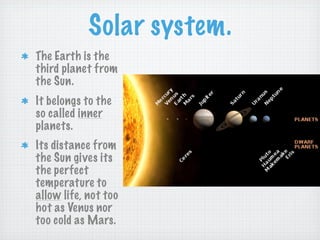
Solar system.
The Earth is the
third planet from
the Sun.
It belongs to the
so called inner
planets.
Its distance from
the Sun gives its
the perfect
temperature to
allow life, not too
hot as Venus nor
too cold as Mars.
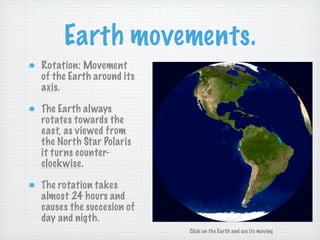
Earth movements.
Rotation: Movement
of the Earth around its
axis.

The Earth always
rotates towards the
east, as viewed from
the North Star Polaris
it turns counter-
clockwise.

The rotation takes
almost 24 hours and
causes the succesion of
day and nigth.
                          Click on the Earth and see its moving
Earth movements.
Rotation: Movement
of the Earth around its
axis.

The Earth always
rotates towards the
east, as viewed from
the North Star Polaris
it turns counter-
clockwise.

The rotation takes
almost 24 hours and
causes the succesion of
day and nigth.
                          Click on the Earth and see its moving
Earth movements
            Earth´s orbit. It´s
            the motion of the
            Earth around the
            Sun.
            It takes 365 days
            and 6 hours. Every
            four years they add
            a day, that year is
            called leap year.
            The Earth´s orbit
            causes the seasons
            because of the axis
            tilt.
Axial tilt or obliquity
                 Because of the axial tilt
                 the       northern
                 hemisphere gets more
                 light and heat in the
                 summer (June) and less
                 in                  the
                 win te r(De cembe r). In
                 the       southern
                 hemisphere it works
                 the other way around.
Daylight in different seasons.
Spring                         Summer
                               Tropic of
                                Cancer

Equator
                               Solstices
Equinoxes
                                Tropic of
                               Capriconr

Autunm                         Winter
Geographic coordinates system
The geographic
coordinates
system gives
us the chance
to locate
every point in
the planet.
It´s a net work
made of
parallels and
meridians
Equator and parallels.
                North hemisphere


                South hemisphere


The Equator is the prime parallel or zero degrees.
Look in an atlas and make a list of the equatorial countries
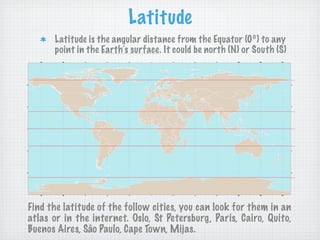
Latitude
      Latitude is the angular distance from the Equator (0º) to any
      point in the Earth´s surface. It could be north (N) or South (S)


Find the latitude of the follow cities, you can look for them in an
atlas or in the internet. Oslo, St Petersburg, Paris, Cairo, Quito,
Buenos Aires, Sâo Paulo, Cape Town, Mijas.
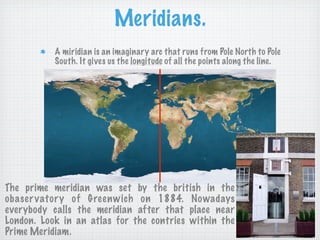
Meridians.
           A miridian is an imaginary arc that runs from Pole North to Pole
           South. It gives us the longitude of all the points along the line.


The prime meridian was set by the british in the
obaser vator y of Greenwich on 1884. Nowadays
everybody calls the meridian after that place near
London. Look in an atlas for the contries within the
Prime Meridiam.
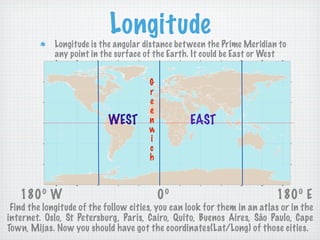
Longitude
             Longitude is the angular distance bet ween the Prime Meridian to
             any point in the surface of the Earth. It could be East or West


                                       G
                                       r
                                       e
                                       e
                            WEST       n          EAST
                                       w
                                       i
                                       c
                                       h


   180º W                                  0º                             180º E
 Find the longitude of the follow cities, you can look for them in an atlas or in the
internet. Oslo, St Petersburg, Paris, Cairo, Quito, Buenos Aires, Sâo Paulo, Cape
Town, Mijas. Now you should have got the coordinates(Lat/Long) of those cities.

The earth.

  • 1.
    The Earth. Unit 1.
  • 2.
    Solar system. The Earthis the third planet from the Sun. It belongs to the so called inner planets. Its distance from the Sun gives its the perfect temperature to allow life, not too hot as Venus nor too cold as Mars.
  • 3.
    Earth movements. Rotation: Movement ofthe Earth around its axis. The Earth always rotates towards the east, as viewed from the North Star Polaris it turns counter- clockwise. The rotation takes almost 24 hours and causes the succesion of day and nigth. Click on the Earth and see its moving
  • 4.
    Earth movements. Rotation: Movement ofthe Earth around its axis. The Earth always rotates towards the east, as viewed from the North Star Polaris it turns counter- clockwise. The rotation takes almost 24 hours and causes the succesion of day and nigth. Click on the Earth and see its moving
  • 5.
    Earth movements Earth´s orbit. It´s the motion of the Earth around the Sun. It takes 365 days and 6 hours. Every four years they add a day, that year is called leap year. The Earth´s orbit causes the seasons because of the axis tilt.
  • 6.
    Axial tilt orobliquity Because of the axial tilt the northern hemisphere gets more light and heat in the summer (June) and less in the win te r(De cembe r). In the southern hemisphere it works the other way around.
  • 7.
    Daylight in differentseasons. Spring Summer Tropic of Cancer Equator Solstices Equinoxes Tropic of Capriconr Autunm Winter
  • 8.
    Geographic coordinates system Thegeographic coordinates system gives us the chance to locate every point in the planet. It´s a net work made of parallels and meridians
  • 9.
    Equator and parallels. North hemisphere South hemisphere The Equator is the prime parallel or zero degrees. Look in an atlas and make a list of the equatorial countries
  • 10.
    Latitude Latitude is the angular distance from the Equator (0º) to any point in the Earth´s surface. It could be north (N) or South (S) Find the latitude of the follow cities, you can look for them in an atlas or in the internet. Oslo, St Petersburg, Paris, Cairo, Quito, Buenos Aires, Sâo Paulo, Cape Town, Mijas.
  • 11.
    Meridians. A miridian is an imaginary arc that runs from Pole North to Pole South. It gives us the longitude of all the points along the line. The prime meridian was set by the british in the obaser vator y of Greenwich on 1884. Nowadays everybody calls the meridian after that place near London. Look in an atlas for the contries within the Prime Meridiam.
  • 12.
    Longitude Longitude is the angular distance bet ween the Prime Meridian to any point in the surface of the Earth. It could be East or West G r e e WEST n EAST w i c h 180º W 0º 180º E Find the longitude of the follow cities, you can look for them in an atlas or in the internet. Oslo, St Petersburg, Paris, Cairo, Quito, Buenos Aires, Sâo Paulo, Cape Town, Mijas. Now you should have got the coordinates(Lat/Long) of those cities.

Editor's Notes