SOLAR CONTROL
By
Komal rathore
BIOCLIMATIC DESIGN AND PASSIVE SOLAR
SYSTEMS
 The building sector is responsible for almost 40% of the
total final energy consumption on a national level. This
consumption, either in the form of heat (using primarily
oil) or electricity, besides being a significant economic
burden due to the high cost of energy, results in large
scale atmospheric pollution, mainly carbon dioxide
(CO2) which is responsible for the greenhouse effect.
 The reduction of energy consumption in buildings can
be achieved by simple methods and techniques, using a
appropriate building design (bioclimatic architecture)
and energy efficient systems and technologies, such as
passive solar systems.
SOLAR CONTROL
INTRODUCTION
 There are many different reasons to want to control the
amount of sunlight that is admitted into a building.
 In warm, sunny climates excess solar gain may result in high
cooling energy consumption;
 in cold and temperate climates winter sun entering south-
facing windows can positively contribute to passive solar
heating;
 and in nearly all climates controlling and diffusing natural
illumination will improve day lighting.
 Well-designed sun control and shading devices can
dramatically reduce building peak heat gain and cooling
requirements and improve the natural lighting quality of
building interiors.
 Depending on the amount and location of fenestration,
reductions in annual cooling energy consumption of 5% to
15% have been reported
DESCRIPTION
 The use of sun control and shading devices is an important
aspect of many energy-efficient building design strategies.
 In particular, buildings that employ passive solar
heating or daylighting often depend on well-designed sun
control and shading devices.
 solar control and shading can be provided by a wide range of
building components including:
 -Landscape features such as mature trees or hedge rows;
 -Exterior elements such as overhangs or vertical fins;
 -Horizontal reflecting surfaces called light shelves;
 -Low shading coefficient (SC) glass; and,
 -Interior glare control devices such as Venetian blinds or
adjustable louvers.
THE SUN AND ITS POSITION
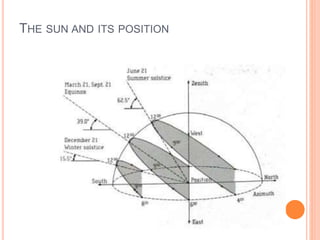
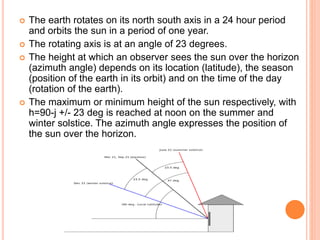
 The earth rotates on its north south axis in a 24 hour period
and orbits the sun in a period of one year.
 The rotating axis is at an angle of 23 degrees.
 The height at which an observer sees the sun over the horizon
(azimuth angle) depends on its location (latitude), the season
(position of the earth in its orbit) and on the time of the day
(rotation of the earth).
 The maximum or minimum height of the sun respectively, with
h=90-j +/- 23 deg is reached at noon on the summer and
winter solstice. The azimuth angle expresses the position of
the sun over the horizon.
SOLAR VERSES CLOCK TIME
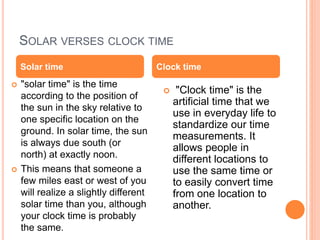
 "solar time" is the time
according to the position of
the sun in the sky relative to
one specific location on the
ground. In solar time, the sun
is always due south (or
north) at exactly noon.
 This means that someone a
few miles east or west of you
will realize a slightly different
solar time than you, although
your clock time is probably
the same.
 "Clock time" is the
artificial time that we
use in everyday life to
standardize our time
measurements. It
allows people in
different locations to
use the same time or
to easily convert time
from one location to
another.
Solar time Clock time
TRUE NORTH AND MAGNETIC DEVIATION
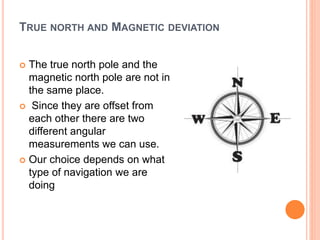
 The true north pole and the
magnetic north pole are not in
the same place.
 Since they are offset from
each other there are two
different angular
measurements we can use.
 Our choice depends on what
type of navigation we are
doing
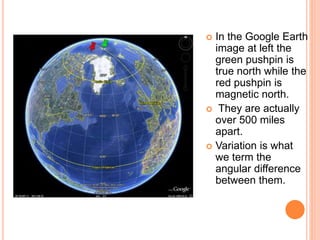
 In the Google Earth
image at left the
green pushpin is
true north while the
red pushpin is
magnetic north.
 They are actually
over 500 miles
apart.
 Variation is what
we term the
angular difference
between them.
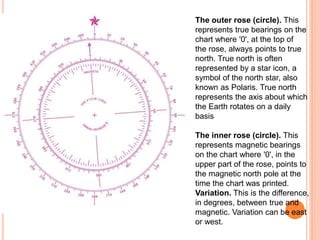
The outer rose (circle). This
represents true bearings on the
chart where '0', at the top of
the rose, always points to true
north. True north is often
represented by a star icon, a
symbol of the north star, also
known as Polaris. True north
represents the axis about which
the Earth rotates on a daily
basis
The inner rose (circle). This
represents magnetic bearings
on the chart where '0', in the
upper part of the rose, points to
the magnetic north pole at the
time the chart was printed.
Variation. This is the difference,
in degrees, between true and
magnetic. Variation can be east
or west.
MAGNETIC DEVIATION
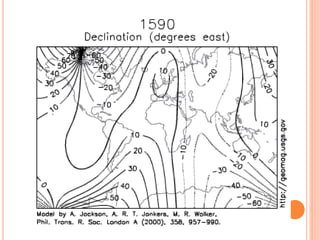
 Magnetic declination is the angle on the horizontal
plane between magnetic north (the direction the
north end of a compass needle points,
corresponding to the direction of the Earth's
magnetic field lines and true north .This angle
varies depending on position on the Earth's
surface, and changes over time.
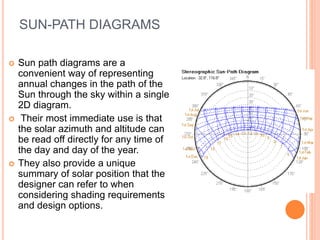
SUN-PATH DIAGRAMS
 Sun path diagrams are a
convenient way of representing
annual changes in the path of the
Sun through the sky within a single
2D diagram.
 Their most immediate use is that
the solar azimuth and altitude can
be read off directly for any time of
the day and day of the year.
 They also provide a unique
summary of solar position that the
designer can refer to when
considering shading requirements
and design options.
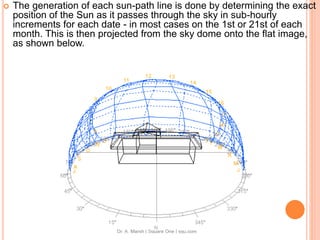
 The generation of each sun-path line is done by determining the exact
position of the Sun as it passes through the sky in sub-hourly
increments for each date - in most cases on the 1st or 21st of each
month. This is then projected from the sky dome onto the flat image,
as shown below.
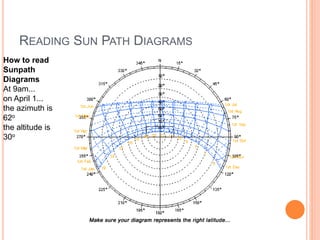
READING SUN PATH DIAGRAMS
How to read
Sunpath
Diagrams
At 9am...
on April 1...
the azimuth is
62o
the altitude is
30o
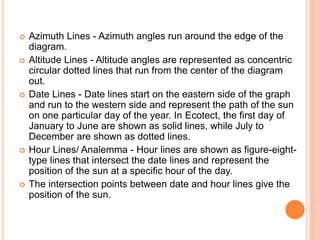
 Azimuth Lines - Azimuth angles run around the edge of the
diagram.
 Altitude Lines - Altitude angles are represented as concentric
circular dotted lines that run from the center of the diagram
out.
 Date Lines - Date lines start on the eastern side of the graph
and run to the western side and represent the path of the sun
on one particular day of the year. In Ecotect, the first day of
January to June are shown as solid lines, while July to
December are shown as dotted lines.
 Hour Lines/ Analemma - Hour lines are shown as figure-eight-
type lines that intersect the date lines and represent the
position of the sun at a specific hour of the day.
 The intersection points between date and hour lines give the
position of the sun.
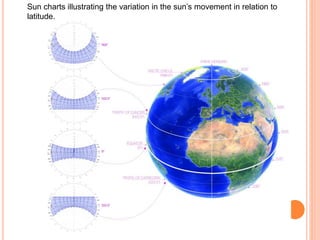
Sun charts illustrating the variation in the sun’s movement in relation to
latitude.
EXTERIOR SHADING DEVICE
Exterior shading device is primary used to control the
amount of radiation penetration to the interior of
buildings.
 Some of them are operable, i.e. they can be raised or
lowered.
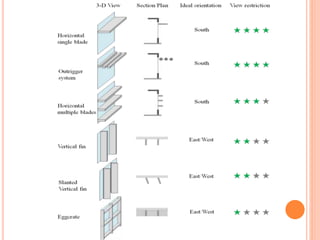
 Two basic types of exterior shading device are
horizontal and vertical
 Its effectiveness depends on its type and placement
relative to glass.
 When radiation strikes a shading device,
 a part of it is reflected outwards from its surface,
 another part is reflected onto the glazing
 remaining part is absorbed by itself, causing it to heat
up.
INTERIOR SHADING DEVICES
 Interior shading devices are mainly established in order to
provide visual comfort by eliminating glare.
 Further, interior shading devices can contribute to the interior
architectural design of rooms without influencing the exterior
façade of the building.
 Because of the heat absorption happening inside the building
(the transformation of short wave sunlight energy into long
wave heat energy) interior shading devices are not as efficient
as exterior shading solutions to reduce solar heat gains.
 Internal shading devices limit the glare resulting from solar
radiation.
 Internal shading devices usually are adjustable and allow
occupants to regulate the amount of direct light entering their
space. Most commonly these take the form of horizontal or
vertical blinds attached above windows.
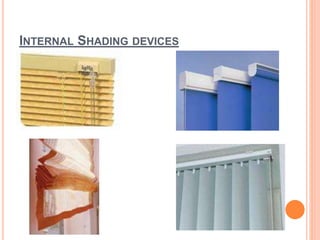
In rooms that are oriented north or east without risk for
overheating in the summer, the following interior shading
devices are in use :
 Venetian blinds – horizontal blade construction, which
can be lowered and elevated (1)
 Roller blinds - textile curtains or foils, which are rolled up
above the window (2)
 Pleats curtains – textile curtains, which are folded above
the window (3)
 Vertical-blades - textile vertical blade curtains (4)
 Curtains – textile curtains
INTERNAL SHADING DEVICES
DESIGN STRATEGY OF SHADING DEVICES
The design strategy of the shading device will depend on the
size and orientation of the window openings. Shading devices
can also affect the building appearance. Although the design
of external shading devices involves a number of factors, the
following recommendations are generally applied to all
designs:
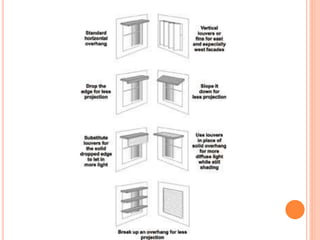
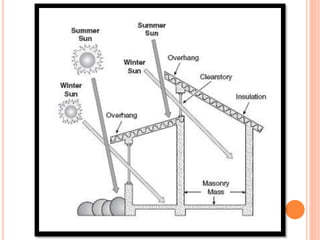
 Use fixed overhangs on south-facing glass
 Limit the area of east or west glass. Vertical or egg-crate fixed
shading can be considered if the shading projections are fairly
deep or close together; however these may limit views.
 North-facing glass receives little direct solar gain , usually no
shading is required to this exposure.
 Interior shading devices such as Venetian blinds or vertical
blades do not reduce cooling load since the solar gain has
already been admitted into the indoors. However these interior
devices do offer glare control.
 The durability of shading devices should be considered.
Operable shading devices usually require more maintenance
and repair.
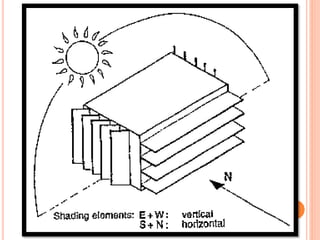
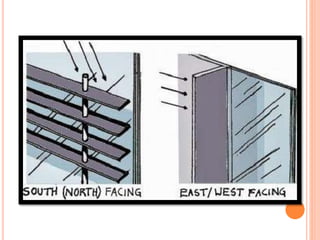
VERTICAL & HORIZONTAL SHADING DEVICE
Shading devices should be selected according to the
orientation of the window.
 Vertical Shading device is most effective when sun
is to one side of the elevation and at low angle,
such as eastern or western elevation.
 Horizontal Shading device is most effective when
sun is opposite to the building face considered and
at high angle, such as for north and south facing
walls.
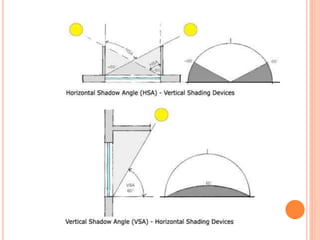
SHADOW ANGLES
Shadow angles are formed by sun shading devices or
projections on a wall exposed to the sun. Different
design of sun shading devices form different
shadow angles.
The performance of shading device is specified by
two angles :
 Horizontal shadow angle
 Vertical shadow angle
These angles depend on the position of the sun
and the orientation where the window is facing.
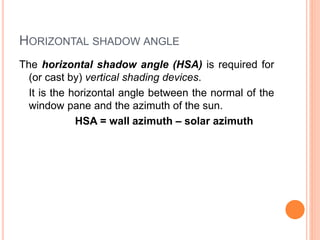
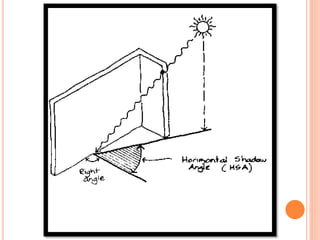
HORIZONTAL SHADOW ANGLE
The horizontal shadow angle (HSA) is required for
(or cast by) vertical shading devices.
It is the horizontal angle between the normal of the
window pane and the azimuth of the sun.
HSA = wall azimuth – solar azimuth
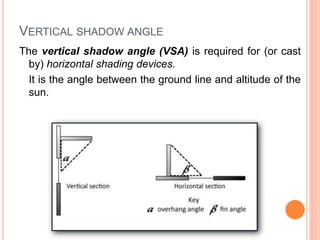
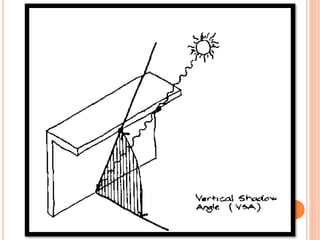
VERTICAL SHADOW ANGLE
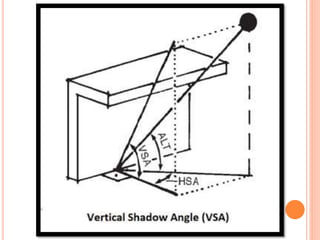
The vertical shadow angle (VSA) is required for (or cast
by) horizontal shading devices.
It is the angle between the ground line and altitude of the
sun.
Actually it is measured on a vertical plane normal to the
elevation considered. If we imagine a virtual plane
between the bottom left-hand and right-hand corners of
the window and the sun, then the VSA is the angle this
plane forms with the ground plane.
tan VSA = tan(altitude) / cos(HSA)
SOLAR ALTITUDE ANGLE &VSA
 Solar altitude angle describes sun’s position in
relation to the horizon, while VSA describes the
performance of the shading device.
 Numerically, the two coincide when, the sun is
exactly opposite the wall considered i.e. when solar
azimuth and wall azimuth angle are same and HSA
= 0.
 For all other cases, when the sun is sideways from
the perpendicular, the VSA is always larger than the
solar altitude angle.
SHADE DIMENSIONS
These two angles, HSA and VSA, can then be used
to determine the size of the shading device required
for a window. If the height value refers to the
vertical distance between the shade and the
window sill, then the depth of the shade and its
width from each side of the window can be
determined using relatively simple trigonometry.
 Shade Depth : The depth is given by:
depth = height / tan(VSA)
 Shade Width : The width is given by:
width = depth x tan(HSA)
DESIGN REQUIREMENTS
Requirement of shading largely depends upon the
climatic conditions. According to climatic zones,
there are three categories of shading requirement :
 Complete year round shading
 Complete year round shading but only during major
sunshine hours
 Shading during summer months only
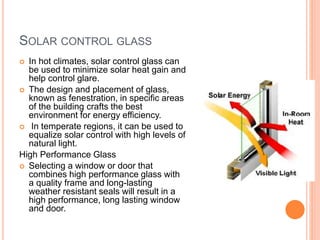
SOLAR CONTROL GLASS
 In hot climates, solar control glass can
be used to minimize solar heat gain and
help control glare.
 The design and placement of glass,
known as fenestration, in specific areas
of the building crafts the best
environment for energy efficiency.
 In temperate regions, it can be used to
equalize solar control with high levels of
natural light.
High Performance Glass
 Selecting a window or door that
combines high performance glass with
a quality frame and long-lasting
weather resistant seals will result in a
high performance, long lasting window
and door.
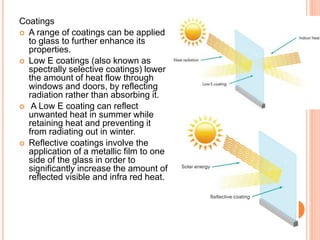
Coatings
 A range of coatings can be applied
to glass to further enhance its
properties.
 Low E coatings (also known as
spectrally selective coatings) lower
the amount of heat flow through
windows and doors, by reflecting
radiation rather than absorbing it.
 A Low E coating can reflect
unwanted heat in summer while
retaining heat and preventing it
from radiating out in winter.
 Reflective coatings involve the
application of a metallic film to one
side of the glass in order to
significantly increase the amount of
reflected visible and infra red heat.
Tinted Glass
 Tinted glass reduces outside glare,
minimising fading to furnishings by UV
rays and decreasing solar heat gain.
Green, grey, bronze and blue are the
most common tints, as they do not
significantly alter the colour of the
views through the window.
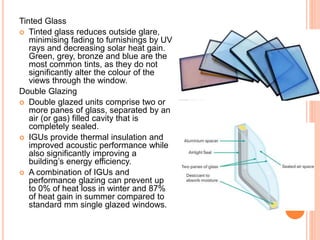
Double Glazing
 Double glazed units comprise two or
more panes of glass, separated by an
air (or gas) filled cavity that is
completely sealed.
 IGUs provide thermal insulation and
improved acoustic performance while
also significantly improving a
building’s energy efficiency.
 A combination of IGUs and
performance glazing can prevent up
to 0% of heat loss in winter and 87%
of heat gain in summer compared to
standard mm single glazed windows.
LANDSCAPING
 The use of landscape design principles for selection
of trees, hedges, and trellis-pergola features
with vines; all can be used to create summer
shading.
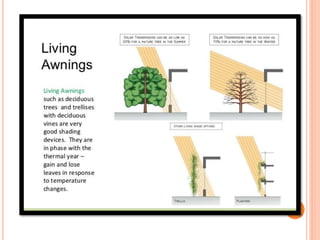
 For winter solar gain it is desirable to
use deciduous plants that drop their leaves in the
autumn gives year round passive solar benefits.
 Non-deciduous evergreen shrubs and trees can
be windbreaks, at variable heights and distances, to
create protection and shelter from winter wind chill.
THANK YOU

Solar control

  • 1.
  • 2.
    BIOCLIMATIC DESIGN ANDPASSIVE SOLAR SYSTEMS  The building sector is responsible for almost 40% of the total final energy consumption on a national level. This consumption, either in the form of heat (using primarily oil) or electricity, besides being a significant economic burden due to the high cost of energy, results in large scale atmospheric pollution, mainly carbon dioxide (CO2) which is responsible for the greenhouse effect.  The reduction of energy consumption in buildings can be achieved by simple methods and techniques, using a appropriate building design (bioclimatic architecture) and energy efficient systems and technologies, such as passive solar systems.
  • 3.
    SOLAR CONTROL INTRODUCTION  Thereare many different reasons to want to control the amount of sunlight that is admitted into a building.  In warm, sunny climates excess solar gain may result in high cooling energy consumption;  in cold and temperate climates winter sun entering south- facing windows can positively contribute to passive solar heating;  and in nearly all climates controlling and diffusing natural illumination will improve day lighting.  Well-designed sun control and shading devices can dramatically reduce building peak heat gain and cooling requirements and improve the natural lighting quality of building interiors.  Depending on the amount and location of fenestration, reductions in annual cooling energy consumption of 5% to 15% have been reported
  • 4.
    DESCRIPTION  The useof sun control and shading devices is an important aspect of many energy-efficient building design strategies.  In particular, buildings that employ passive solar heating or daylighting often depend on well-designed sun control and shading devices.  solar control and shading can be provided by a wide range of building components including:  -Landscape features such as mature trees or hedge rows;  -Exterior elements such as overhangs or vertical fins;  -Horizontal reflecting surfaces called light shelves;  -Low shading coefficient (SC) glass; and,  -Interior glare control devices such as Venetian blinds or adjustable louvers.
  • 5.
    THE SUN ANDITS POSITION
  • 6.
     The earthrotates on its north south axis in a 24 hour period and orbits the sun in a period of one year.  The rotating axis is at an angle of 23 degrees.  The height at which an observer sees the sun over the horizon (azimuth angle) depends on its location (latitude), the season (position of the earth in its orbit) and on the time of the day (rotation of the earth).  The maximum or minimum height of the sun respectively, with h=90-j +/- 23 deg is reached at noon on the summer and winter solstice. The azimuth angle expresses the position of the sun over the horizon.
  • 7.
    SOLAR VERSES CLOCKTIME  "solar time" is the time according to the position of the sun in the sky relative to one specific location on the ground. In solar time, the sun is always due south (or north) at exactly noon.  This means that someone a few miles east or west of you will realize a slightly different solar time than you, although your clock time is probably the same.  "Clock time" is the artificial time that we use in everyday life to standardize our time measurements. It allows people in different locations to use the same time or to easily convert time from one location to another. Solar time Clock time
  • 8.
    TRUE NORTH ANDMAGNETIC DEVIATION  The true north pole and the magnetic north pole are not in the same place.  Since they are offset from each other there are two different angular measurements we can use.  Our choice depends on what type of navigation we are doing
  • 9.
     In theGoogle Earth image at left the green pushpin is true north while the red pushpin is magnetic north.  They are actually over 500 miles apart.  Variation is what we term the angular difference between them.
  • 10.
    The outer rose(circle). This represents true bearings on the chart where '0', at the top of the rose, always points to true north. True north is often represented by a star icon, a symbol of the north star, also known as Polaris. True north represents the axis about which the Earth rotates on a daily basis The inner rose (circle). This represents magnetic bearings on the chart where '0', in the upper part of the rose, points to the magnetic north pole at the time the chart was printed. Variation. This is the difference, in degrees, between true and magnetic. Variation can be east or west.
  • 11.
    MAGNETIC DEVIATION  Magneticdeclination is the angle on the horizontal plane between magnetic north (the direction the north end of a compass needle points, corresponding to the direction of the Earth's magnetic field lines and true north .This angle varies depending on position on the Earth's surface, and changes over time.
  • 13.
    SUN-PATH DIAGRAMS  Sunpath diagrams are a convenient way of representing annual changes in the path of the Sun through the sky within a single 2D diagram.  Their most immediate use is that the solar azimuth and altitude can be read off directly for any time of the day and day of the year.  They also provide a unique summary of solar position that the designer can refer to when considering shading requirements and design options.
  • 14.
     The generationof each sun-path line is done by determining the exact position of the Sun as it passes through the sky in sub-hourly increments for each date - in most cases on the 1st or 21st of each month. This is then projected from the sky dome onto the flat image, as shown below.
  • 15.
    READING SUN PATHDIAGRAMS How to read Sunpath Diagrams At 9am... on April 1... the azimuth is 62o the altitude is 30o
  • 16.
     Azimuth Lines- Azimuth angles run around the edge of the diagram.  Altitude Lines - Altitude angles are represented as concentric circular dotted lines that run from the center of the diagram out.  Date Lines - Date lines start on the eastern side of the graph and run to the western side and represent the path of the sun on one particular day of the year. In Ecotect, the first day of January to June are shown as solid lines, while July to December are shown as dotted lines.  Hour Lines/ Analemma - Hour lines are shown as figure-eight- type lines that intersect the date lines and represent the position of the sun at a specific hour of the day.  The intersection points between date and hour lines give the position of the sun.
  • 17.
    Sun charts illustratingthe variation in the sun’s movement in relation to latitude.
  • 18.
    EXTERIOR SHADING DEVICE Exteriorshading device is primary used to control the amount of radiation penetration to the interior of buildings.  Some of them are operable, i.e. they can be raised or lowered.  Two basic types of exterior shading device are horizontal and vertical  Its effectiveness depends on its type and placement relative to glass.  When radiation strikes a shading device,  a part of it is reflected outwards from its surface,  another part is reflected onto the glazing  remaining part is absorbed by itself, causing it to heat up.
  • 21.
    INTERIOR SHADING DEVICES Interior shading devices are mainly established in order to provide visual comfort by eliminating glare.  Further, interior shading devices can contribute to the interior architectural design of rooms without influencing the exterior façade of the building.  Because of the heat absorption happening inside the building (the transformation of short wave sunlight energy into long wave heat energy) interior shading devices are not as efficient as exterior shading solutions to reduce solar heat gains.  Internal shading devices limit the glare resulting from solar radiation.  Internal shading devices usually are adjustable and allow occupants to regulate the amount of direct light entering their space. Most commonly these take the form of horizontal or vertical blinds attached above windows.
  • 22.
    In rooms thatare oriented north or east without risk for overheating in the summer, the following interior shading devices are in use :  Venetian blinds – horizontal blade construction, which can be lowered and elevated (1)  Roller blinds - textile curtains or foils, which are rolled up above the window (2)  Pleats curtains – textile curtains, which are folded above the window (3)  Vertical-blades - textile vertical blade curtains (4)  Curtains – textile curtains
  • 23.
  • 24.
    DESIGN STRATEGY OFSHADING DEVICES The design strategy of the shading device will depend on the size and orientation of the window openings. Shading devices can also affect the building appearance. Although the design of external shading devices involves a number of factors, the following recommendations are generally applied to all designs:  Use fixed overhangs on south-facing glass  Limit the area of east or west glass. Vertical or egg-crate fixed shading can be considered if the shading projections are fairly deep or close together; however these may limit views.  North-facing glass receives little direct solar gain , usually no shading is required to this exposure.  Interior shading devices such as Venetian blinds or vertical blades do not reduce cooling load since the solar gain has already been admitted into the indoors. However these interior devices do offer glare control.  The durability of shading devices should be considered. Operable shading devices usually require more maintenance and repair.
  • 25.
    VERTICAL & HORIZONTALSHADING DEVICE Shading devices should be selected according to the orientation of the window.  Vertical Shading device is most effective when sun is to one side of the elevation and at low angle, such as eastern or western elevation.  Horizontal Shading device is most effective when sun is opposite to the building face considered and at high angle, such as for north and south facing walls.
  • 28.
    SHADOW ANGLES Shadow anglesare formed by sun shading devices or projections on a wall exposed to the sun. Different design of sun shading devices form different shadow angles. The performance of shading device is specified by two angles :  Horizontal shadow angle  Vertical shadow angle These angles depend on the position of the sun and the orientation where the window is facing.
  • 30.
    HORIZONTAL SHADOW ANGLE Thehorizontal shadow angle (HSA) is required for (or cast by) vertical shading devices. It is the horizontal angle between the normal of the window pane and the azimuth of the sun. HSA = wall azimuth – solar azimuth
  • 32.
    VERTICAL SHADOW ANGLE Thevertical shadow angle (VSA) is required for (or cast by) horizontal shading devices. It is the angle between the ground line and altitude of the sun.
  • 33.
    Actually it ismeasured on a vertical plane normal to the elevation considered. If we imagine a virtual plane between the bottom left-hand and right-hand corners of the window and the sun, then the VSA is the angle this plane forms with the ground plane. tan VSA = tan(altitude) / cos(HSA)
  • 35.
    SOLAR ALTITUDE ANGLE&VSA  Solar altitude angle describes sun’s position in relation to the horizon, while VSA describes the performance of the shading device.  Numerically, the two coincide when, the sun is exactly opposite the wall considered i.e. when solar azimuth and wall azimuth angle are same and HSA = 0.  For all other cases, when the sun is sideways from the perpendicular, the VSA is always larger than the solar altitude angle.
  • 37.
    SHADE DIMENSIONS These twoangles, HSA and VSA, can then be used to determine the size of the shading device required for a window. If the height value refers to the vertical distance between the shade and the window sill, then the depth of the shade and its width from each side of the window can be determined using relatively simple trigonometry.  Shade Depth : The depth is given by: depth = height / tan(VSA)  Shade Width : The width is given by: width = depth x tan(HSA)
  • 38.
    DESIGN REQUIREMENTS Requirement ofshading largely depends upon the climatic conditions. According to climatic zones, there are three categories of shading requirement :  Complete year round shading  Complete year round shading but only during major sunshine hours  Shading during summer months only
  • 40.
    SOLAR CONTROL GLASS In hot climates, solar control glass can be used to minimize solar heat gain and help control glare.  The design and placement of glass, known as fenestration, in specific areas of the building crafts the best environment for energy efficiency.  In temperate regions, it can be used to equalize solar control with high levels of natural light. High Performance Glass  Selecting a window or door that combines high performance glass with a quality frame and long-lasting weather resistant seals will result in a high performance, long lasting window and door.
  • 41.
    Coatings  A rangeof coatings can be applied to glass to further enhance its properties.  Low E coatings (also known as spectrally selective coatings) lower the amount of heat flow through windows and doors, by reflecting radiation rather than absorbing it.  A Low E coating can reflect unwanted heat in summer while retaining heat and preventing it from radiating out in winter.  Reflective coatings involve the application of a metallic film to one side of the glass in order to significantly increase the amount of reflected visible and infra red heat.
  • 42.
    Tinted Glass  Tintedglass reduces outside glare, minimising fading to furnishings by UV rays and decreasing solar heat gain. Green, grey, bronze and blue are the most common tints, as they do not significantly alter the colour of the views through the window. Double Glazing  Double glazed units comprise two or more panes of glass, separated by an air (or gas) filled cavity that is completely sealed.  IGUs provide thermal insulation and improved acoustic performance while also significantly improving a building’s energy efficiency.  A combination of IGUs and performance glazing can prevent up to 0% of heat loss in winter and 87% of heat gain in summer compared to standard mm single glazed windows.
  • 43.
    LANDSCAPING  The useof landscape design principles for selection of trees, hedges, and trellis-pergola features with vines; all can be used to create summer shading.  For winter solar gain it is desirable to use deciduous plants that drop their leaves in the autumn gives year round passive solar benefits.  Non-deciduous evergreen shrubs and trees can be windbreaks, at variable heights and distances, to create protection and shelter from winter wind chill.
  • 45.