PASSIVE SOLAR SYSTEM Ar M.Waseem khan
Passive House
 refers to the rigorous, voluntary, Passivhaus
standard for energy efficiency in a building, reducing
its ecological footprint.
Ecological Footprint
The ecological footprint is a measure of human
demand on the Earth's ecosystems
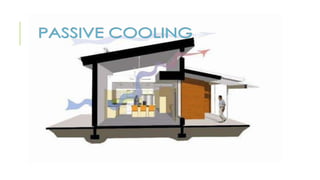
ž Passive Cooling
- Passive cooling refers to technologies or design
features used to cool buildings without power
consumption, such
as those technologies discussed in the Passive house
project.
The term "passive" implies that energy-consuming
mechanical components like pumps and fans are not
used.
Ø Passive cooling building design attempts to
integrate principles of physics into the building exterior
envelope to:
Ø Slow heat transfer into a building. This involves an
understanding of the mechanisms of heat transfer: heat
Ø Remove unwanted heat from a building. In mild
climates with cool dry nights this can be done with
In passive solar building design, windows, walls, and
floors are made to collect, store, and distribute solar
energy in the form of heat in the winter and reject
solar heat in the summer.
The key to design a passive solar building is to best
take advantage of the local climate performing an
accurate site analysis. Elements to be considered
include window placement and size,
and glazing type, thermal insulation, thermal mass,
and shading.
Passive solar design techniques can be applied most
ventilating. In hot humid climates with uncomfortable warm
/ humid nights, ventilation is counterproductive, and some
type of solar air conditioning may be cost effective.
Provides indoor comfort
Low maintenance
Zero/ Low energy consumption
Low running cost
Promotes healthy environment
SHADING:
Shading a building from solar radiation can be
achieved in many ways.
 Buildings can be orientated to take
advantage of winter sun (longer in the East / West
dimension), while shading walls and windows from
direct hot summer sun. This can be achieved by
designing locationspecific wide eaves or overhangs
above the Equator-side vertical windows (South side in
the Northern hemisphere, North side in the Southern
hemisphere).
VENTILATION
› The mechanical system or equipment used to
circulate air or to replace stale air with fresh air.
Ventilation in buildings has three main purposes:
To maintain a minimum air quality
To remove heat (or other pollutant)
To provide perceptible air movement to enhance
thermal comfort
Natural Ventilation
oStack Ventilation
oCross Ventilation
oNight Ventilation
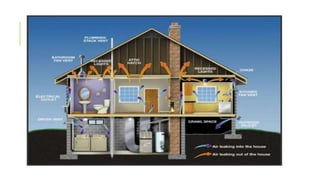
Stack ventilation is where air is driven through the
building by vertical pressure differences developed by
thermal buoyancy. The warm air inside the building is
less dense than cooler air outside, and thus will try to
escape from openings high up in the building
envelope; cooler denser air will enter openings lower
down. The process will continue if the air entering the
building is continuously heated, typically by casual or
solar gains.
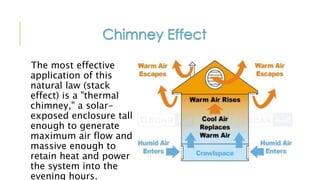
The most effective
application of this
natural law (stack
effect) is a "thermal
chimney," a solar-
exposed enclosure tall
enough to generate
maximum air flow and
massive enough to
retain heat and power
the system into the
evening hours.
on a
large
scale in
order to
cause a
minimum
flow
resistanc
e.
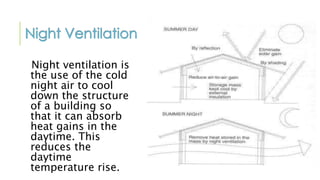
Night ventilation is
the use of the cold
night air to cool
down the structure
of a building so
that it can absorb
heat gains in the
daytime. This
reduces the
daytime
temperature rise.
PASSIVE HEATING SYSTEM
refers to
technologies or
design features
used to heat
buildings without
power consumption.
building design
attempts to
integrate the
principles of physics
into building
exterior envelope
to:
5 ELEMENTS OF PASSIVE HEATING
SYSTEM
•Aperture- the large glass area, usually a window, through
which sunlight enters the building. Typically, the aperture
faces within 30 degrees of true south and should avoid being
shaded by other buildings or trees between 9 a.m. to 3 p.m.
each day during the heating session
•Absorber- a hard, darkened surface of the storage element,
is the second element of the design.
The surface sits in the direct path of the sunlight, which hits
the surface and is absorbed as heat
5 ELEMENTS OF PASSIVE HEATING
SYSTEM• Distribution- the method by which solar heat
circulates from the collection and storage points to
the different areas of the house
• Control- During the summer months, roof overhangs
are used to shad the aperture. Other elements can be
used to control the under- and/or overheating
include electronic sensing devices, operable vents
and dampers, low-emissivity blinds, and awnings.
•Thermal mass-the materials that retain or store the
heat produced by the sunlight. Unlike the
absorber,which is in the direct path of the sunlight,
the thermal mass is the material below or behind the
Direct Solar Gain
Direct gain is the heat from
the sun being collected and
contained in an occupied
space. Direct solar gain is
important for any site that
needs heating, because it is
the simplest and least costly
way of passively heating a
building with the sun.
Avoiding direct solar gain is
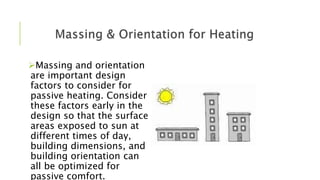
Massing and orientation
are important design
factors to consider for
passive heating. Consider
these factors early in the
design so that the surface
areas exposed to sun at
different times of day,
building dimensions, and
building orientation can
all be optimized for
passive comfort.
Windows and other
apertures bring in heat
from sunshine, but can
also lose heat by radiant
cooling and by conducting
heat better than most wall
or roof constructions.
Apertur es and shading
must be intelligently
placed to take advantage
of the sun's heat in cold
locations and seasons,
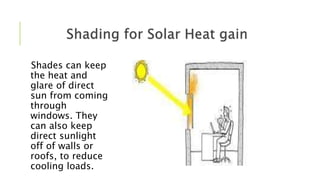
Shades can keep
the heat and
glare of direct
sun from coming
through
windows. They
can also keep
direct sunlight
off of walls or
roofs, to reduce
cooling loads.
Passive Heating and Cooling System

Passive Heating and Cooling System

  • 1.
    PASSIVE SOLAR SYSTEMAr M.Waseem khan
  • 2.
    Passive House  refersto the rigorous, voluntary, Passivhaus standard for energy efficiency in a building, reducing its ecological footprint. Ecological Footprint The ecological footprint is a measure of human demand on the Earth's ecosystems
  • 4.
    ž Passive Cooling -Passive cooling refers to technologies or design features used to cool buildings without power consumption, such as those technologies discussed in the Passive house project. The term "passive" implies that energy-consuming mechanical components like pumps and fans are not used. Ø Passive cooling building design attempts to integrate principles of physics into the building exterior envelope to: Ø Slow heat transfer into a building. This involves an understanding of the mechanisms of heat transfer: heat
  • 5.
    Ø Remove unwantedheat from a building. In mild climates with cool dry nights this can be done with In passive solar building design, windows, walls, and floors are made to collect, store, and distribute solar energy in the form of heat in the winter and reject solar heat in the summer. The key to design a passive solar building is to best take advantage of the local climate performing an accurate site analysis. Elements to be considered include window placement and size, and glazing type, thermal insulation, thermal mass, and shading. Passive solar design techniques can be applied most
  • 6.
    ventilating. In hothumid climates with uncomfortable warm / humid nights, ventilation is counterproductive, and some type of solar air conditioning may be cost effective. Provides indoor comfort Low maintenance Zero/ Low energy consumption Low running cost Promotes healthy environment
  • 7.
    SHADING: Shading a buildingfrom solar radiation can be achieved in many ways.  Buildings can be orientated to take advantage of winter sun (longer in the East / West dimension), while shading walls and windows from direct hot summer sun. This can be achieved by designing locationspecific wide eaves or overhangs above the Equator-side vertical windows (South side in the Northern hemisphere, North side in the Southern hemisphere).
  • 9.
    VENTILATION › The mechanicalsystem or equipment used to circulate air or to replace stale air with fresh air. Ventilation in buildings has three main purposes: To maintain a minimum air quality To remove heat (or other pollutant) To provide perceptible air movement to enhance thermal comfort
  • 10.
    Natural Ventilation oStack Ventilation oCrossVentilation oNight Ventilation
  • 11.
    Stack ventilation iswhere air is driven through the building by vertical pressure differences developed by thermal buoyancy. The warm air inside the building is less dense than cooler air outside, and thus will try to escape from openings high up in the building envelope; cooler denser air will enter openings lower down. The process will continue if the air entering the building is continuously heated, typically by casual or solar gains.
  • 13.
    The most effective applicationof this natural law (stack effect) is a "thermal chimney," a solar- exposed enclosure tall enough to generate maximum air flow and massive enough to retain heat and power the system into the evening hours.
  • 14.
    on a large scale in orderto cause a minimum flow resistanc e.
  • 15.
    Night ventilation is theuse of the cold night air to cool down the structure of a building so that it can absorb heat gains in the daytime. This reduces the daytime temperature rise.
  • 16.
    PASSIVE HEATING SYSTEM refersto technologies or design features used to heat buildings without power consumption. building design attempts to integrate the principles of physics into building exterior envelope to:
  • 17.
    5 ELEMENTS OFPASSIVE HEATING SYSTEM •Aperture- the large glass area, usually a window, through which sunlight enters the building. Typically, the aperture faces within 30 degrees of true south and should avoid being shaded by other buildings or trees between 9 a.m. to 3 p.m. each day during the heating session •Absorber- a hard, darkened surface of the storage element, is the second element of the design. The surface sits in the direct path of the sunlight, which hits the surface and is absorbed as heat
  • 18.
    5 ELEMENTS OFPASSIVE HEATING SYSTEM• Distribution- the method by which solar heat circulates from the collection and storage points to the different areas of the house • Control- During the summer months, roof overhangs are used to shad the aperture. Other elements can be used to control the under- and/or overheating include electronic sensing devices, operable vents and dampers, low-emissivity blinds, and awnings. •Thermal mass-the materials that retain or store the heat produced by the sunlight. Unlike the absorber,which is in the direct path of the sunlight, the thermal mass is the material below or behind the
  • 19.
    Direct Solar Gain Directgain is the heat from the sun being collected and contained in an occupied space. Direct solar gain is important for any site that needs heating, because it is the simplest and least costly way of passively heating a building with the sun. Avoiding direct solar gain is
  • 20.
    Massing and orientation areimportant design factors to consider for passive heating. Consider these factors early in the design so that the surface areas exposed to sun at different times of day, building dimensions, and building orientation can all be optimized for passive comfort.
  • 21.
    Windows and other aperturesbring in heat from sunshine, but can also lose heat by radiant cooling and by conducting heat better than most wall or roof constructions. Apertur es and shading must be intelligently placed to take advantage of the sun's heat in cold locations and seasons,
  • 22.
    Shades can keep theheat and glare of direct sun from coming through windows. They can also keep direct sunlight off of walls or roofs, to reduce cooling loads.