By-
Devansh Sharma
Priyansh Tirkey
Sharashij Biswas
Aditya Shakyawar
Vikash pandey
Saurabh Chourasia
HOT AND DRY
CLIMATE
This climatic condition generally
occurs at latitude between 15
degrees to 30 degrees on both
the hemispheres. Maximum
daytime summer temperature
goes as high as 45 degree
centigrade and relative humidity
as low up to 20 %.
This type of climate is
experienced in areas far from sea
coasts and do not receive heavy
rainfall. Thus, the humidity is very
low. So, the buildings in this
climatic zone should be
orientated based on solar point
of view so that the building
receives maximum solar radiation
during winter season and
minimum radiation during
summer season.
HOT AND DRY
CLIMATIC ZONES
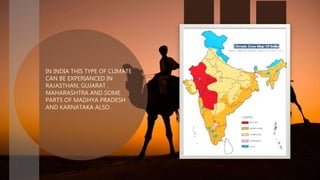
IN INDIA THIS TYPE OF CLIMATE
CAN BE EXPERIANCED IN
RAJASTHAN, GUJARAT ,
MAHARASHTRA AND SOME
PARTS OF MADHYA PRADESH
AND KARNATAKA ALSO .
TEMPERATURE
• IN THIS TYPE OF CLIMATE TEMPERATURE IS USUALLY VERY
HOT.
• IT CAN VERY EASILY GO UPTO 50* AND EVEN MORE IN
SUMMERS.
• THE DIFFRENCE BETWEEN DAY AND NIGHT TEMPERATURE
VERY HIGH (15 TO 20 DEGREE CELCIOUS).
HUMIDITY
• DUE TO VERY HOT AND HARSH SUN RAYS.
HUMIDITY IS VERY LOW.
• IT GENERALLY VARIES BETWEEN 10 TO 50 PERCENTAGE.
PRECIPITATION
• AS THE AIR IS TOTALLY HOT & DRY IN THIS TYPE OF CLIMATE.
PRECIPITATION IS VERY LOW.
• IT MAY VARY BETWEEN 50 TO 150 mm PER YEAR.
Characteristics Of
Hot and Dry
Climate
SKY CONDITIONS
• SKY IS NORMALLY CLEAR AND BLUE IN THIS TYPE OF CLIMATE.
• SOME TIMES DUST STORMS FILL COMPLETE SKY.
• AND THESE DUSTY SKIES CREATE UNBERABLE GLARE.
SOLAR RADIATIONS
• SOLAR RADIATIONS ARE DIRECT AND STRONG DURING DAY
TIMES.
• AND THESE OFTEN ESCAPES INTO OPEN CLEAR SKIES DURING
NIGHTS.
WIND
• HIGH SPEED DUSTY WINDS ARE VERY COMMON FOR THIS TYPE
OF CLIMATE.
• WIND SPEED MAY VARY BETWEEN 20 TO 30 KILOMETER PER
HOUR.
• WIND OFTEN CHANGE DIRECTIONS LOCALLY.
SOIL AND VEGITATION
• SOIL IS VERY LOOSE AND SANDY
• LOW HUMIDITY AND LESS RAIN FALL RESULTS IN POOR
VEGETATION.
• ONLY THICK LEAVES AND THORNY PLANTS CAN EASILY
SURVIVE HERE.
Characteristics Of
Hot and Dry
Climate
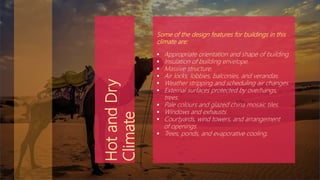
Some of the design features for buildings in this
climate are:
 Appropriate orientation and shape of building.
 Insulation of building envelope.
 Massive structure.
 Air locks, lobbies, balconies, and verandas.
 Weather stripping and scheduling air changes.
 External surfaces protected by overhangs,
trees.
 Pale colours and glazed china mosaic tiles.
 Windows and exhausts.
 Courtyards, wind towers, and arrangement
of openings.
 Trees, ponds, and evaporative cooling.
HotandDry
Climate
Sustainable Site Planning
•Utilizing existing infrastructure, laying outbuilding blocks
to benefit from existing landform, sun path and wind
while minimizing damage to prevalent soil , flora, water
and air quality.
Appropriate Landscaping
•Planting the right way to conserve water and improve
micro-climate.
Building Design Details
•Detailing building fenestration design and
construction details to promote shading, insulation
and heat loss.
Materials
•Choosing materials which are local, durable, utilize
have low embodied energy content, use less
water for processing and help insulate the building.
STAGES
OF
PLANNING
AND
DESIGN
DESIGNCONCEPT
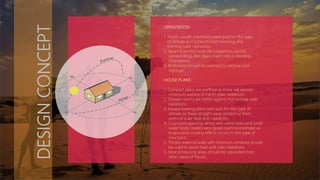
ORIENTATION
1. North –south orientation best suits for this type
of climate as it protects from morning and
Evening solar radiations.
2. Apart from this local site condetions and its
surroundings also plays major role in deciding
Orientation .
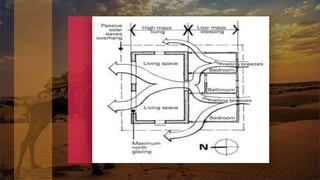
3. Bedrooms should be oriented to receive cool
night air.
HOUSE PLANS
1. Compact plans are preffred as these will expose
minimum surface to harsh solar radiations.
2. Deeper rooms are better against hot outside solar
radiations.
3. Inward looking plans best suits for this type of
climate as these straight away protect us from
external solar heat and radiations.
4. Courtyard planning along with some trees and small
water body creates very good cool microclimate as
evaporative cooling effects occurs in this type of
courtyard.
5. Thicker external walls with minimum windows should
be used to avoid heat and solar radiations.
6. Heat producing areas should be separated from
other areas of house.
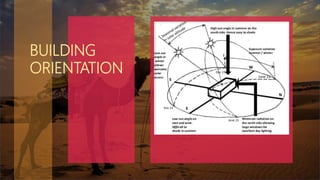
BUILDING
ORIENTATION
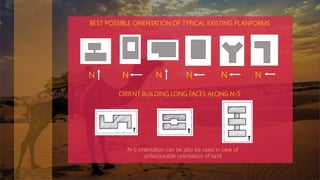
BEST POSSIBLE ORIENTATION OF TYPICAL EXISTING PLANFORMS
N-S orientation can be also be used in case of
unfavourable orientation of land
ORIENT BUILDING LONG FACES ALONG N-S
N N N N N N
DESIGNCONCEPT
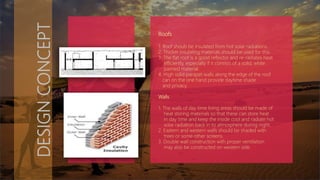
Roofs
1. Roof shouls be insulated from hot solar radiations.
2. Thicker insulating materials should be used for this.
3. The flat roof is a good reflector and re-radiates heat
efficiently, especially if it consists of a solid, white
painted material.
4. High solid parapet walls along the edge of the roof
can on the one hand provide daytime shade
and privacy.
Walls
1. The walls of day time living areas should be made of
heat storing materials so that these can store heat
in day time and keep the inside cool and radiate hot
solar radiation back in to atmosphere during night.
2. Eastern and western walls should be shaded with
trees or some other screens.
3. Double wall construction with proper ventilation
may also be constructed on western side.
DESIGNCONCEPT
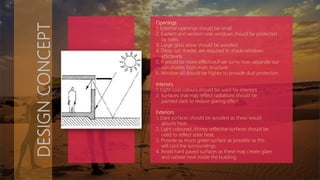
Openings
1. External openings should be small.
2. Eastern and western side windows should be protected
by trees.
3. Large glass areas should be avoided.
4. Deep sun shades are required to shade windows
effictevely.
5. It would be more effective,if we some how ,separate our
sun shades from main structure .
6. Window sill should be higher to provide dust protection.
Interiors
1. Light cool colours should be used for interiors .
2. Surfaces that may reflect radiations should be
painted dark to reduce glaring effect.
Exteriors
1. Dark surfaces should be avoided as these would
absorb heat.
2. Light coloured /shiney reflective surfaces should be
used to reflect solar heat.
3. Provide as much green surface as possible as this
will cool the surroundings.
4. Avoid hard paved surfaces as these may create glare
and radiate heat inside the building.
OUTDOOR
PLANNING
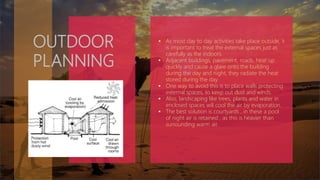
 As most day to day activities take place outside, it
is important to treat the external spaces just as
carefully as the indoors.
 Adjacent buildings, pavement, roads, heat up
quickly and cause a glare onto the building
during the day and night, they radiate the heat
stored during the day.
 One way to avoid this is to place walls protecting
external spaces, to keep out dust and winds.
 Also, landscaping like trees, plants and water in
enclosed spaces will cool the air by evaporation.
 The best solution is courtyards , in these a pool
of night air is retained , as this is heavier than
surrounding warm air.
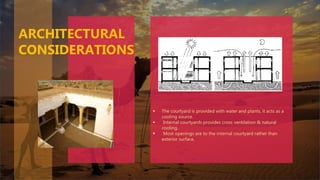
 The courtyard is provided with water and plants, it acts as a
cooling source.
 Internal courtyards provides cross ventilation & natural
cooling.
 Most openings are to the internal courtyard rather than
exterior surface.
ARCHITECTURAL
CONSIDERATIONS
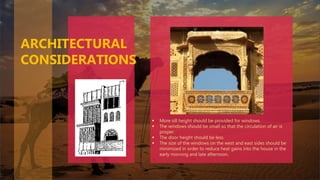
 More sill height should be provided for windows.
 The windows should be small so that the circulation of air is
proper.
 The door height should be less.
 The size of the windows on the west and east sides should be
minimized in order to reduce heat gains into the house in the
early morning and late afternoon.
ARCHITECTURAL
CONSIDERATIONS
ARCHITECTURAL
CONSIDERATIONS
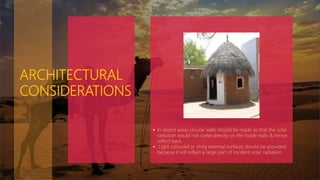
 In desert areas circular walls should be made so that the solar
radiation would not come directly on the inside walls & hence
reflect back.
 Light coloured or shiny external surfaces should be provided
because it will reflect a large part of incident solar radiation.
ARCHITECTURAL
CONSIDERATIONS
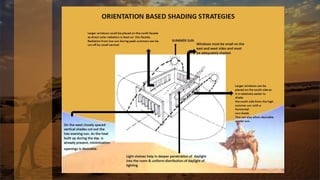
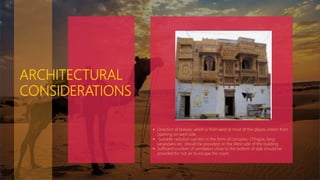
 Direction of breeze, which is from west at most of the places, enters from
opening on west side.
 Suitable radiation barriers in the form of canopies, Chhajjas, long
verandahs etc. should be provided on the West side of the building.
 Sufficient number of ventilators close to the bottom of slab should be
provided for hot air to escape the room.
ARCHITECTURAL
CONSIDERATIONS
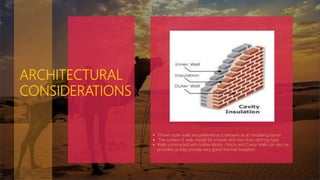
 Thicker outer walls are preferred as it behaves as an insulating barrier
 The surface of walls should be smooth and non-dust catching type.
 Walls constructed with hollow blocks / bricks and Cavity Walls can also be
provided as they provide very good thermal insulation.
ARCHITECTURAL
CONSIDERATIONS
 Roofs should be built up with good insulating material
having slope in windward direction and which reflects
the radiation and does not absorb heat.
 Terracing should be provided on the flat roof with mud
phuska, lime concrete, foamed concrete or burnt clay.
 False ceiling can be used to improve thermal
performance of building.
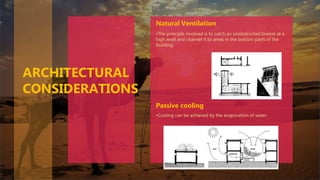
•The principle involved is to catch an unobstructed breeze at a
high level and channel it to areas in the bottom parts of the
building.
ARCHITECTURAL
CONSIDERATIONS
Natural Ventilation
•Cooling can be achieved by the evaporation of water.
Passive cooling
NIGHT
VENTILATION
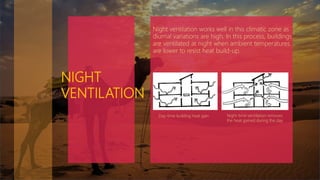
Night ventilation works well in this climatic zone as
diurnal variations are high. In this process, buildings
are ventilated at night when ambient temperatures
are lower to resist heat build-up.
Day-time building heat gain Night-time ventilation removes
the heat gained during the day.
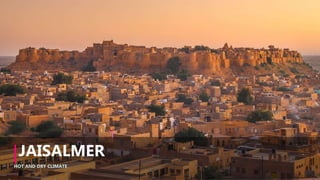
JAISALMER
HOT AND DRY CLIMATE
Very high daytime temperatures, with very little precipitation
and a short and mild winter season characterize this climate.
High diurnal temperature variations are seen i.e Very hot day
and very cold at night. This is due to the rapid radiative heat
loss from the ground or the building to the clear night sky.
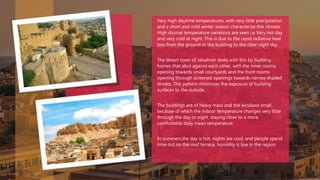
The desert town of Jaisalmer deals with this by building
homes that abut against each other, with the inner rooms
opening towards small courtyards and the front rooms
opening through screened openings towards narrow shaded
streets. This pattern minimizes the exposure of building
surfaces to the outside.
The buildings are of heavy mass and the windows small,
because of which the indoor temperature changes very little
through the day or night, staying close to a more
comfortable daily mean temperature.
In summers,the day is hot, nights are cool, and people spend
time out on the roof terrace. humidity is low in the region.
THANK YOU

Hot and dry climate

  • 1.
    By- Devansh Sharma Priyansh Tirkey SharashijBiswas Aditya Shakyawar Vikash pandey Saurabh Chourasia HOT AND DRY CLIMATE
  • 2.
    This climatic conditiongenerally occurs at latitude between 15 degrees to 30 degrees on both the hemispheres. Maximum daytime summer temperature goes as high as 45 degree centigrade and relative humidity as low up to 20 %. This type of climate is experienced in areas far from sea coasts and do not receive heavy rainfall. Thus, the humidity is very low. So, the buildings in this climatic zone should be orientated based on solar point of view so that the building receives maximum solar radiation during winter season and minimum radiation during summer season. HOT AND DRY CLIMATIC ZONES
  • 3.
    IN INDIA THISTYPE OF CLIMATE CAN BE EXPERIANCED IN RAJASTHAN, GUJARAT , MAHARASHTRA AND SOME PARTS OF MADHYA PRADESH AND KARNATAKA ALSO .
  • 4.
    TEMPERATURE • IN THISTYPE OF CLIMATE TEMPERATURE IS USUALLY VERY HOT. • IT CAN VERY EASILY GO UPTO 50* AND EVEN MORE IN SUMMERS. • THE DIFFRENCE BETWEEN DAY AND NIGHT TEMPERATURE VERY HIGH (15 TO 20 DEGREE CELCIOUS). HUMIDITY • DUE TO VERY HOT AND HARSH SUN RAYS. HUMIDITY IS VERY LOW. • IT GENERALLY VARIES BETWEEN 10 TO 50 PERCENTAGE. PRECIPITATION • AS THE AIR IS TOTALLY HOT & DRY IN THIS TYPE OF CLIMATE. PRECIPITATION IS VERY LOW. • IT MAY VARY BETWEEN 50 TO 150 mm PER YEAR. Characteristics Of Hot and Dry Climate
  • 5.
    SKY CONDITIONS • SKYIS NORMALLY CLEAR AND BLUE IN THIS TYPE OF CLIMATE. • SOME TIMES DUST STORMS FILL COMPLETE SKY. • AND THESE DUSTY SKIES CREATE UNBERABLE GLARE. SOLAR RADIATIONS • SOLAR RADIATIONS ARE DIRECT AND STRONG DURING DAY TIMES. • AND THESE OFTEN ESCAPES INTO OPEN CLEAR SKIES DURING NIGHTS. WIND • HIGH SPEED DUSTY WINDS ARE VERY COMMON FOR THIS TYPE OF CLIMATE. • WIND SPEED MAY VARY BETWEEN 20 TO 30 KILOMETER PER HOUR. • WIND OFTEN CHANGE DIRECTIONS LOCALLY. SOIL AND VEGITATION • SOIL IS VERY LOOSE AND SANDY • LOW HUMIDITY AND LESS RAIN FALL RESULTS IN POOR VEGETATION. • ONLY THICK LEAVES AND THORNY PLANTS CAN EASILY SURVIVE HERE. Characteristics Of Hot and Dry Climate
  • 6.
    Some of thedesign features for buildings in this climate are:  Appropriate orientation and shape of building.  Insulation of building envelope.  Massive structure.  Air locks, lobbies, balconies, and verandas.  Weather stripping and scheduling air changes.  External surfaces protected by overhangs, trees.  Pale colours and glazed china mosaic tiles.  Windows and exhausts.  Courtyards, wind towers, and arrangement of openings.  Trees, ponds, and evaporative cooling. HotandDry Climate
  • 7.
    Sustainable Site Planning •Utilizingexisting infrastructure, laying outbuilding blocks to benefit from existing landform, sun path and wind while minimizing damage to prevalent soil , flora, water and air quality. Appropriate Landscaping •Planting the right way to conserve water and improve micro-climate. Building Design Details •Detailing building fenestration design and construction details to promote shading, insulation and heat loss. Materials •Choosing materials which are local, durable, utilize have low embodied energy content, use less water for processing and help insulate the building. STAGES OF PLANNING AND DESIGN
  • 8.
    DESIGNCONCEPT ORIENTATION 1. North –southorientation best suits for this type of climate as it protects from morning and Evening solar radiations. 2. Apart from this local site condetions and its surroundings also plays major role in deciding Orientation . 3. Bedrooms should be oriented to receive cool night air. HOUSE PLANS 1. Compact plans are preffred as these will expose minimum surface to harsh solar radiations. 2. Deeper rooms are better against hot outside solar radiations. 3. Inward looking plans best suits for this type of climate as these straight away protect us from external solar heat and radiations. 4. Courtyard planning along with some trees and small water body creates very good cool microclimate as evaporative cooling effects occurs in this type of courtyard. 5. Thicker external walls with minimum windows should be used to avoid heat and solar radiations. 6. Heat producing areas should be separated from other areas of house.
  • 9.
  • 10.
    BEST POSSIBLE ORIENTATIONOF TYPICAL EXISTING PLANFORMS N-S orientation can be also be used in case of unfavourable orientation of land ORIENT BUILDING LONG FACES ALONG N-S N N N N N N
  • 11.
    DESIGNCONCEPT Roofs 1. Roof shoulsbe insulated from hot solar radiations. 2. Thicker insulating materials should be used for this. 3. The flat roof is a good reflector and re-radiates heat efficiently, especially if it consists of a solid, white painted material. 4. High solid parapet walls along the edge of the roof can on the one hand provide daytime shade and privacy. Walls 1. The walls of day time living areas should be made of heat storing materials so that these can store heat in day time and keep the inside cool and radiate hot solar radiation back in to atmosphere during night. 2. Eastern and western walls should be shaded with trees or some other screens. 3. Double wall construction with proper ventilation may also be constructed on western side.
  • 12.
    DESIGNCONCEPT Openings 1. External openingsshould be small. 2. Eastern and western side windows should be protected by trees. 3. Large glass areas should be avoided. 4. Deep sun shades are required to shade windows effictevely. 5. It would be more effective,if we some how ,separate our sun shades from main structure . 6. Window sill should be higher to provide dust protection. Interiors 1. Light cool colours should be used for interiors . 2. Surfaces that may reflect radiations should be painted dark to reduce glaring effect. Exteriors 1. Dark surfaces should be avoided as these would absorb heat. 2. Light coloured /shiney reflective surfaces should be used to reflect solar heat. 3. Provide as much green surface as possible as this will cool the surroundings. 4. Avoid hard paved surfaces as these may create glare and radiate heat inside the building.
  • 14.
    OUTDOOR PLANNING  As mostday to day activities take place outside, it is important to treat the external spaces just as carefully as the indoors.  Adjacent buildings, pavement, roads, heat up quickly and cause a glare onto the building during the day and night, they radiate the heat stored during the day.  One way to avoid this is to place walls protecting external spaces, to keep out dust and winds.  Also, landscaping like trees, plants and water in enclosed spaces will cool the air by evaporation.  The best solution is courtyards , in these a pool of night air is retained , as this is heavier than surrounding warm air.
  • 15.
     The courtyardis provided with water and plants, it acts as a cooling source.  Internal courtyards provides cross ventilation & natural cooling.  Most openings are to the internal courtyard rather than exterior surface. ARCHITECTURAL CONSIDERATIONS
  • 16.
     More sillheight should be provided for windows.  The windows should be small so that the circulation of air is proper.  The door height should be less.  The size of the windows on the west and east sides should be minimized in order to reduce heat gains into the house in the early morning and late afternoon. ARCHITECTURAL CONSIDERATIONS
  • 17.
    ARCHITECTURAL CONSIDERATIONS  In desertareas circular walls should be made so that the solar radiation would not come directly on the inside walls & hence reflect back.  Light coloured or shiny external surfaces should be provided because it will reflect a large part of incident solar radiation.
  • 18.
    ARCHITECTURAL CONSIDERATIONS  Direction ofbreeze, which is from west at most of the places, enters from opening on west side.  Suitable radiation barriers in the form of canopies, Chhajjas, long verandahs etc. should be provided on the West side of the building.  Sufficient number of ventilators close to the bottom of slab should be provided for hot air to escape the room.
  • 19.
    ARCHITECTURAL CONSIDERATIONS  Thicker outerwalls are preferred as it behaves as an insulating barrier  The surface of walls should be smooth and non-dust catching type.  Walls constructed with hollow blocks / bricks and Cavity Walls can also be provided as they provide very good thermal insulation.
  • 20.
    ARCHITECTURAL CONSIDERATIONS  Roofs shouldbe built up with good insulating material having slope in windward direction and which reflects the radiation and does not absorb heat.  Terracing should be provided on the flat roof with mud phuska, lime concrete, foamed concrete or burnt clay.  False ceiling can be used to improve thermal performance of building.
  • 21.
    •The principle involvedis to catch an unobstructed breeze at a high level and channel it to areas in the bottom parts of the building. ARCHITECTURAL CONSIDERATIONS Natural Ventilation •Cooling can be achieved by the evaporation of water. Passive cooling
  • 22.
    NIGHT VENTILATION Night ventilation workswell in this climatic zone as diurnal variations are high. In this process, buildings are ventilated at night when ambient temperatures are lower to resist heat build-up. Day-time building heat gain Night-time ventilation removes the heat gained during the day.
  • 24.
  • 25.
    Very high daytimetemperatures, with very little precipitation and a short and mild winter season characterize this climate. High diurnal temperature variations are seen i.e Very hot day and very cold at night. This is due to the rapid radiative heat loss from the ground or the building to the clear night sky. The desert town of Jaisalmer deals with this by building homes that abut against each other, with the inner rooms opening towards small courtyards and the front rooms opening through screened openings towards narrow shaded streets. This pattern minimizes the exposure of building surfaces to the outside. The buildings are of heavy mass and the windows small, because of which the indoor temperature changes very little through the day or night, staying close to a more comfortable daily mean temperature. In summers,the day is hot, nights are cool, and people spend time out on the roof terrace. humidity is low in the region.
  • 27.