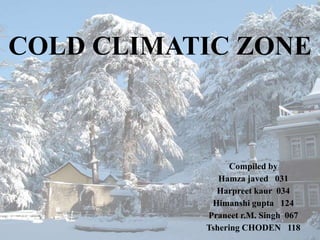
COLD CLIMATIC ZONE
Compiled by
Hamza javed 031
Harpreet kaur 034
Himanshi gupta 124
Praneet r.M. Singh 067
Tshering CHODEN 118
PASSIVE DESIGN
 Passive design is design that does not require
mechanical heating or cooling.
 Buildings that are passively designed take
advantage of natural energy flows to maintain
thermal comfort.
 When sunlight strikes a building, the building
materials can reflect, transmit, or absorb the
solar radiation.
 Additionally, the heat produced by the sun
causes air movement that can be predictable
in designed spaces.
 These basic responses to solar heat lead to
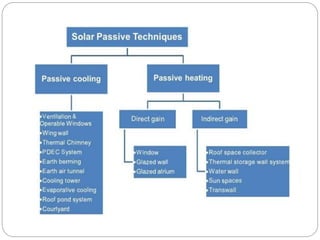
Passive heating
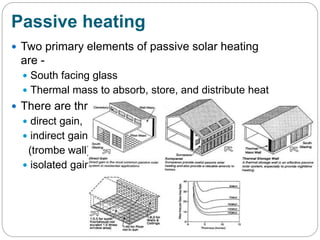
 Two primary elements of passive solar heating
are -
 South facing glass
 Thermal mass to absorb, store, and distribute heat
 There are three approaches to passive systems
 direct gain,
 indirect gain
(trombe wall)
 isolated gain.
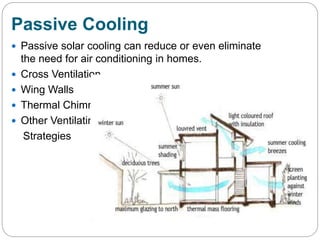
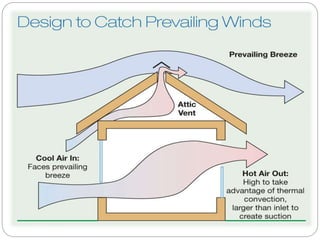
Passive Cooling
 Passive solar cooling can reduce or even eliminate
the need for air conditioning in homes.
 Cross Ventilation
 Wing Walls
 Thermal Chimney
 Other Ventilating
Strategies
Shimla- cold climatic region
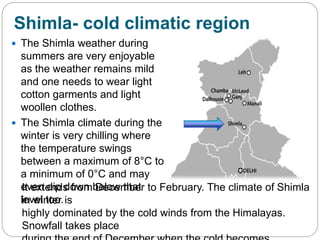
 The Shimla weather during
summers are very enjoyable
as the weather remains mild
and one needs to wear light
cotton garments and light
woollen clothes.
 The Shimla climate during the
winter is very chilling where
the temperature swings
between a maximum of 8°C to
a minimum of 0°C and may
even dip down below that
level too.
It extends from December to February. The climate of Shimla
in winter is
highly dominated by the cold winds from the Himalayas.
Snowfall takes place
CASE STUDIES
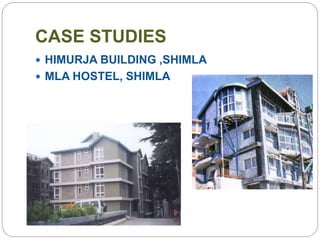
 HIMURJA BUILDING ,SHIMLA
 MLA HOSTEL, SHIMLA
HIMURJA BUILDING
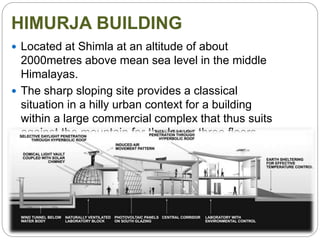
 Located at Shimla at an altitude of about
2000metres above mean sea level in the middle
Himalayas.
 The sharp sloping site provides a classical
situation in a hilly urban context for a building
within a large commercial complex that thus suits
against the mountain for the lower three floors
and inevitably has a deep plan.
DESIGN FEATURES
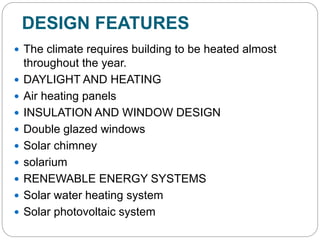
 The climate requires building to be heated almost
throughout the year.
 DAYLIGHT AND HEATING
 Air heating panels
 INSULATION AND WINDOW DESIGN
 Double glazed windows
 Solar chimney
 solarium
 RENEWABLE ENERGY SYSTEMS
 Solar water heating system
 Solar photovoltaic system
DAYLIGHT AND HEATING
 Both the plan and the 3d form of the building allows
maximum penetration of sun, maximizing both solar
heat gain and daylight.
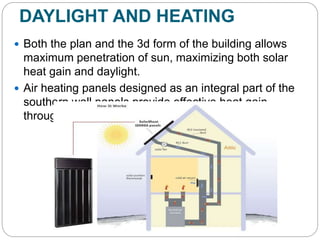
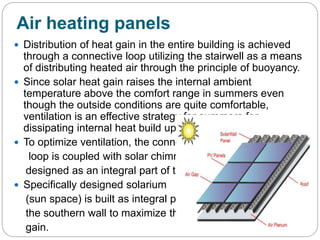
 Air heating panels designed as an integral part of the
southern wall panels provide effective heat gain
through a close connective loop.
Air heating panels
 Distribution of heat gain in the entire building is achieved
through a connective loop utilizing the stairwell as a means
of distributing heated air through the principle of buoyancy.
 Since solar heat gain raises the internal ambient
temperature above the comfort range in summers even
though the outside conditions are quite comfortable,
ventilation is an effective strategy for summers for
dissipating internal heat build up.
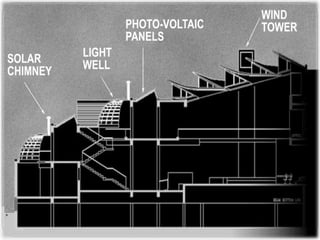
 To optimize ventilation, the connective
loop is coupled with solar chimneys
designed as an integral part of the roof.
 Specifically designed solarium
(sun space) is built as integral part of
the southern wall to maximize the heat
gain.
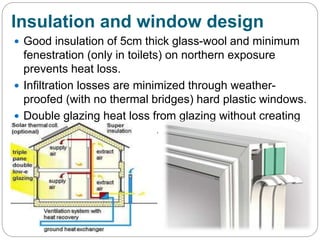
Insulation and window design
 Good insulation of 5cm thick glass-wool and minimum
fenestration (only in toilets) on northern exposure
prevents heat loss.
 Infiltration losses are minimized through weather-
proofed (with no thermal bridges) hard plastic windows.
 Double glazing heat loss from glazing without creating
any internal condensation.
Renewable energy systems
 The photovoltaic system of 1.5kWp meets the
energy demand for lighting whenever required.
Artificial lighting is seldom required ( except
during dark sky conditions sometimes in winters)
in the south oriented spaces, which are well day
lit during working hours.
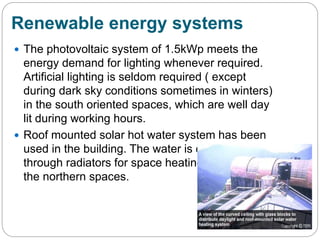
 Roof mounted solar hot water system has been
used in the building. The water is circulated
through radiators for space heating specially in
the northern spaces.
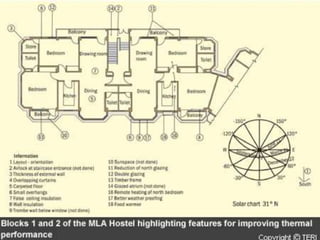
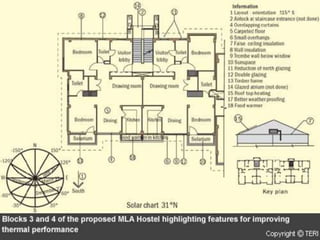
MLA HOSTEL
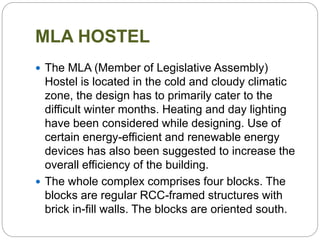
 The MLA (Member of Legislative Assembly)
Hostel is located in the cold and cloudy climatic
zone, the design has to primarily cater to the
difficult winter months. Heating and day lighting
have been considered while designing. Use of
certain energy-efficient and renewable energy
devices has also been suggested to increase the
overall efficiency of the building.
 The whole complex comprises four blocks. The
blocks are regular RCC-framed structures with
brick in-fill walls. The blocks are oriented south.
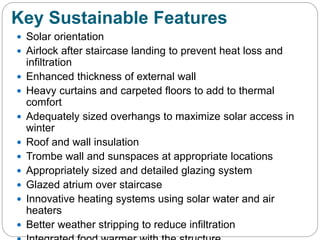
Key Sustainable Features
 Solar orientation
 Airlock after staircase landing to prevent heat loss and
infiltration
 Enhanced thickness of external wall
 Heavy curtains and carpeted floors to add to thermal
comfort
 Adequately sized overhangs to maximize solar access in
winter
 Roof and wall insulation
 Trombe wall and sunspaces at appropriate locations
 Appropriately sized and detailed glazing system
 Glazed atrium over staircase
 Innovative heating systems using solar water and air
heaters
 Better weather stripping to reduce infiltration
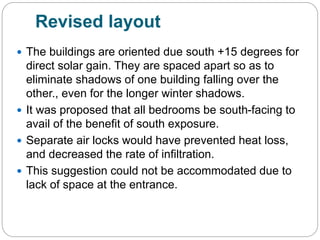
Revised layout
 The buildings are oriented due south +15 degrees for
direct solar gain. They are spaced apart so as to
eliminate shadows of one building falling over the
other., even for the longer winter shadows.
 It was proposed that all bedrooms be south-facing to
avail of the benefit of south exposure.
 Separate air locks would have prevented heat loss,
and decreased the rate of infiltration.
 This suggestion could not be accommodated due to
lack of space at the entrance.
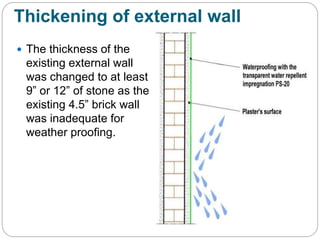
Thickening of external wall
 The thickness of the
existing external wall
was changed to at least
9” or 12” of stone as the
existing 4.5” brick wall
was inadequate for
weather proofing.
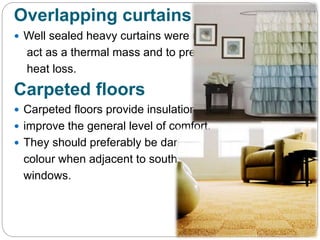
Overlapping curtains
 Well sealed heavy curtains were used to
act as a thermal mass and to prevent
heat loss.
Carpeted floors
 Carpeted floors provide insulation and
 improve the general level of comfort.
 They should preferably be dark in
colour when adjacent to south
windows.
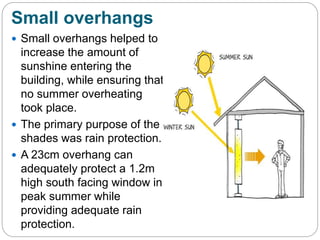
Small overhangs
 Small overhangs helped to
increase the amount of
sunshine entering the
building, while ensuring that
no summer overheating
took place.
 The primary purpose of the
shades was rain protection.
 A 23cm overhang can
adequately protect a 1.2m
high south facing window in
peak summer while
providing adequate rain
protection.
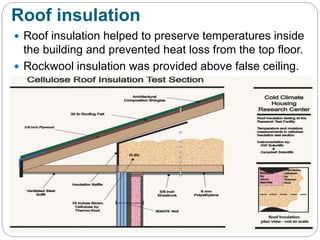
Roof insulation
 Roof insulation helped to preserve temperatures inside
the building and prevented heat loss from the top floor.
 Rockwool insulation was provided above false ceiling.
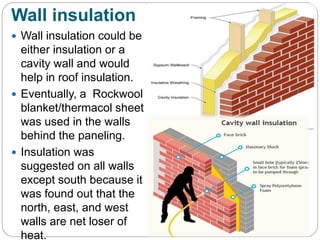
Wall insulation
 Wall insulation could be
either insulation or a
cavity wall and would
help in roof insulation.
 Eventually, a Rockwool
blanket/thermacol sheet
was used in the walls
behind the paneling.
 Insulation was
suggested on all walls
except south because it
was found out that the
north, east, and west
walls are net loser of
heat.
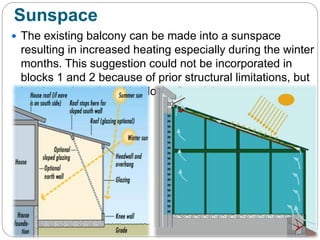
Sunspace
 The existing balcony can be made into a sunspace
resulting in increased heating especially during the winter
months. This suggestion could not be incorporated in
blocks 1 and 2 because of prior structural limitations, but
has been introduced in blocks 3 and 4.
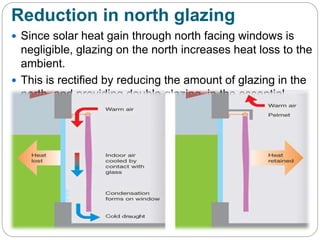
Reduction in north glazing
 Since solar heat gain through north facing windows is
negligible, glazing on the north increases heat loss to the
ambient.
 This is rectified by reducing the amount of glazing in the
north, and providing double glazing in the essential
windows.
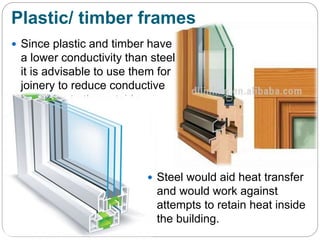
Plastic/ timber frames
 Since plastic and timber have
a lower conductivity than steel
it is advisable to use them for
joinery to reduce conductive
heat loss to the outside.
 Steel would aid heat transfer
and would work against
attempts to retain heat inside
the building.
Remote heating of north
bedroom
 This idea was proposed to trap heat on the south wall
and transport it to the north bedrooms.
 Small Trombe walls below and on the sides of the
kitchen window trap the heat which is conveyed through
a duct to the northern bedrooms.
 A small fan can be used to assist air movement.
Better weather proofing
 These measures at the openings helped to reduce
infiltration.
 Rubber stripping at the junctions of shutters and frames
and below doors helped in sealing the cracks.
 Keeping windows closed, and immediately replacing
broken panels especially during winter months would help
THANK YOU

Climatology Cold Climate Zone

  • 1.
    COLD CLIMATIC ZONE Compiledby Hamza javed 031 Harpreet kaur 034 Himanshi gupta 124 Praneet r.M. Singh 067 Tshering CHODEN 118
  • 2.
    PASSIVE DESIGN  Passivedesign is design that does not require mechanical heating or cooling.  Buildings that are passively designed take advantage of natural energy flows to maintain thermal comfort.  When sunlight strikes a building, the building materials can reflect, transmit, or absorb the solar radiation.  Additionally, the heat produced by the sun causes air movement that can be predictable in designed spaces.  These basic responses to solar heat lead to
  • 3.
    Passive heating  Twoprimary elements of passive solar heating are -  South facing glass  Thermal mass to absorb, store, and distribute heat  There are three approaches to passive systems  direct gain,  indirect gain (trombe wall)  isolated gain.
  • 4.
    Passive Cooling  Passivesolar cooling can reduce or even eliminate the need for air conditioning in homes.  Cross Ventilation  Wing Walls  Thermal Chimney  Other Ventilating Strategies
  • 7.
    Shimla- cold climaticregion  The Shimla weather during summers are very enjoyable as the weather remains mild and one needs to wear light cotton garments and light woollen clothes.  The Shimla climate during the winter is very chilling where the temperature swings between a maximum of 8°C to a minimum of 0°C and may even dip down below that level too. It extends from December to February. The climate of Shimla in winter is highly dominated by the cold winds from the Himalayas. Snowfall takes place
  • 8.
    CASE STUDIES  HIMURJABUILDING ,SHIMLA  MLA HOSTEL, SHIMLA
  • 9.
    HIMURJA BUILDING  Locatedat Shimla at an altitude of about 2000metres above mean sea level in the middle Himalayas.  The sharp sloping site provides a classical situation in a hilly urban context for a building within a large commercial complex that thus suits against the mountain for the lower three floors and inevitably has a deep plan.
  • 11.
    DESIGN FEATURES  Theclimate requires building to be heated almost throughout the year.  DAYLIGHT AND HEATING  Air heating panels  INSULATION AND WINDOW DESIGN  Double glazed windows  Solar chimney  solarium  RENEWABLE ENERGY SYSTEMS  Solar water heating system  Solar photovoltaic system
  • 12.
    DAYLIGHT AND HEATING Both the plan and the 3d form of the building allows maximum penetration of sun, maximizing both solar heat gain and daylight.  Air heating panels designed as an integral part of the southern wall panels provide effective heat gain through a close connective loop.
  • 13.
    Air heating panels Distribution of heat gain in the entire building is achieved through a connective loop utilizing the stairwell as a means of distributing heated air through the principle of buoyancy.  Since solar heat gain raises the internal ambient temperature above the comfort range in summers even though the outside conditions are quite comfortable, ventilation is an effective strategy for summers for dissipating internal heat build up.  To optimize ventilation, the connective loop is coupled with solar chimneys designed as an integral part of the roof.  Specifically designed solarium (sun space) is built as integral part of the southern wall to maximize the heat gain.
  • 14.
    Insulation and windowdesign  Good insulation of 5cm thick glass-wool and minimum fenestration (only in toilets) on northern exposure prevents heat loss.  Infiltration losses are minimized through weather- proofed (with no thermal bridges) hard plastic windows.  Double glazing heat loss from glazing without creating any internal condensation.
  • 15.
    Renewable energy systems The photovoltaic system of 1.5kWp meets the energy demand for lighting whenever required. Artificial lighting is seldom required ( except during dark sky conditions sometimes in winters) in the south oriented spaces, which are well day lit during working hours.  Roof mounted solar hot water system has been used in the building. The water is circulated through radiators for space heating specially in the northern spaces.
  • 16.
    MLA HOSTEL  TheMLA (Member of Legislative Assembly) Hostel is located in the cold and cloudy climatic zone, the design has to primarily cater to the difficult winter months. Heating and day lighting have been considered while designing. Use of certain energy-efficient and renewable energy devices has also been suggested to increase the overall efficiency of the building.  The whole complex comprises four blocks. The blocks are regular RCC-framed structures with brick in-fill walls. The blocks are oriented south.
  • 19.
    Key Sustainable Features Solar orientation  Airlock after staircase landing to prevent heat loss and infiltration  Enhanced thickness of external wall  Heavy curtains and carpeted floors to add to thermal comfort  Adequately sized overhangs to maximize solar access in winter  Roof and wall insulation  Trombe wall and sunspaces at appropriate locations  Appropriately sized and detailed glazing system  Glazed atrium over staircase  Innovative heating systems using solar water and air heaters  Better weather stripping to reduce infiltration
  • 20.
    Revised layout  Thebuildings are oriented due south +15 degrees for direct solar gain. They are spaced apart so as to eliminate shadows of one building falling over the other., even for the longer winter shadows.  It was proposed that all bedrooms be south-facing to avail of the benefit of south exposure.  Separate air locks would have prevented heat loss, and decreased the rate of infiltration.  This suggestion could not be accommodated due to lack of space at the entrance.
  • 21.
    Thickening of externalwall  The thickness of the existing external wall was changed to at least 9” or 12” of stone as the existing 4.5” brick wall was inadequate for weather proofing.
  • 22.
    Overlapping curtains  Wellsealed heavy curtains were used to act as a thermal mass and to prevent heat loss. Carpeted floors  Carpeted floors provide insulation and  improve the general level of comfort.  They should preferably be dark in colour when adjacent to south windows.
  • 23.
    Small overhangs  Smalloverhangs helped to increase the amount of sunshine entering the building, while ensuring that no summer overheating took place.  The primary purpose of the shades was rain protection.  A 23cm overhang can adequately protect a 1.2m high south facing window in peak summer while providing adequate rain protection.
  • 24.
    Roof insulation  Roofinsulation helped to preserve temperatures inside the building and prevented heat loss from the top floor.  Rockwool insulation was provided above false ceiling.
  • 25.
    Wall insulation  Wallinsulation could be either insulation or a cavity wall and would help in roof insulation.  Eventually, a Rockwool blanket/thermacol sheet was used in the walls behind the paneling.  Insulation was suggested on all walls except south because it was found out that the north, east, and west walls are net loser of heat.
  • 26.
    Sunspace  The existingbalcony can be made into a sunspace resulting in increased heating especially during the winter months. This suggestion could not be incorporated in blocks 1 and 2 because of prior structural limitations, but has been introduced in blocks 3 and 4.
  • 27.
    Reduction in northglazing  Since solar heat gain through north facing windows is negligible, glazing on the north increases heat loss to the ambient.  This is rectified by reducing the amount of glazing in the north, and providing double glazing in the essential windows.
  • 28.
    Plastic/ timber frames Since plastic and timber have a lower conductivity than steel it is advisable to use them for joinery to reduce conductive heat loss to the outside.  Steel would aid heat transfer and would work against attempts to retain heat inside the building.
  • 29.
    Remote heating ofnorth bedroom  This idea was proposed to trap heat on the south wall and transport it to the north bedrooms.  Small Trombe walls below and on the sides of the kitchen window trap the heat which is conveyed through a duct to the northern bedrooms.  A small fan can be used to assist air movement. Better weather proofing  These measures at the openings helped to reduce infiltration.  Rubber stripping at the junctions of shutters and frames and below doors helped in sealing the cracks.  Keeping windows closed, and immediately replacing broken panels especially during winter months would help
  • 30.