BEEP Camp 2020
N
S
E
W
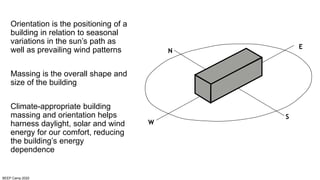
Orientation is the positioning of a
building in relation to seasonal
variations in the sun’s path as
well as prevailing wind patterns
Massing is the overall shape and
size of the building
Climate-appropriate building
massing and orientation helps
harness daylight, solar and wind
energy for our comfort, reducing
the building’s energy
dependence
BEEP Camp 2020
Role of good orientation and massing
Minimise amount of solar radiation when it is hot
Maximise amount of solar radiation in when it is cold
Maximise wind access when cooling through natural ventilation is possible
Maximise daylight – without glare – during the day
BEEP Camp 2020
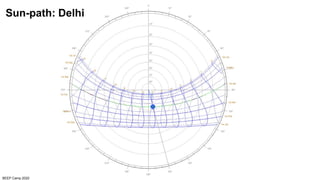
Sun-path: Delhi
BEEP Camp 2020
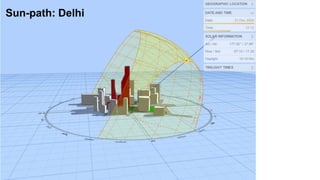
Sun-path: Delhi
BEEP Camp 2020
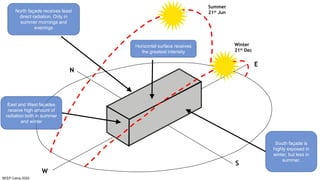
N
S
E
W
Winter
21st Dec
Summer
21st Jun
South façade is
highly exposed in
winter, but less in
summer.
North façade receives least
direct radiation. Only in
summer mornings and
evenings
Horizontal surface receives
the greatest intensity
East and West façades
receive high amount of
radiation both in summer
and winter
BEEP Camp 2020
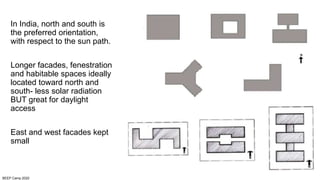
In India, north and south is
the preferred orientation,
with respect to the sun path.
Longer facades, fenestration
and habitable spaces ideally
located toward north and
south- less solar radiation
BUT great for daylight
access
East and west facades kept
small
BEEP Camp 2020
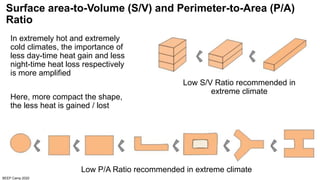
Surface area-to-Volume (S/V) and Perimeter-to-Area (P/A)
Ratio
In extremely hot and extremely
cold climates, the importance of
less day-time heat gain and less
night-time heat loss respectively
is more amplified
Here, more compact the shape,
the less heat is gained / lost
Low S/V Ratio recommended in
extreme climate
Low P/A Ratio recommended in extreme climate
BEEP Camp 2020
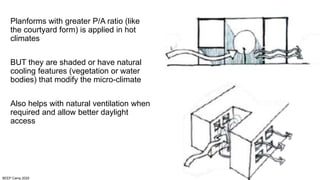
Planforms with greater P/A ratio (like
the courtyard form) is applied in hot
climates
BUT they are shaded or have natural
cooling features (vegetation or water
bodies) that modify the micro-climate
Also helps with natural ventilation when
required and allow better daylight
access
BEEP Camp 2020
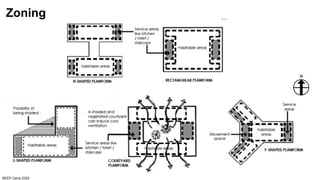
Zoning
BEEP Camp 2020
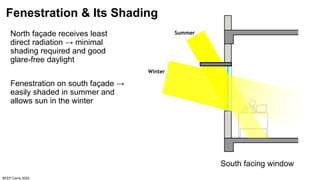
Fenestration & Its Shading
North façade receives least
direct radiation → minimal
shading required and good
glare-free daylight
Fenestration on south façade →
easily shaded in summer and
allows sun in the winter
Summer
Winter
South facing window
BEEP Camp 2020
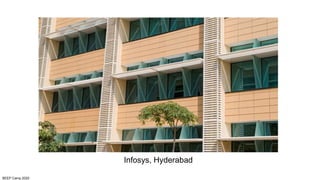
Infosys, Hyderabad
BEEP Camp 2020
Fenestration & Its Shading
N
S
E
W
Summer
Winter
Summer
21st Jun
Winter
21st Dec
Low sun on east and west
sides (low altitude angle) →
Vertical shading will be
appropriate
Solar azimuth angle also
changes between months
→ Fixed shade will not
work at all times
Movable shading best
suited
BEEP Camp 2020
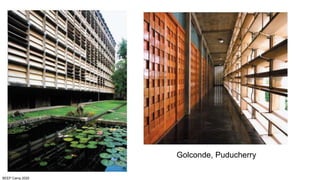
Golconde, Puducherry
BEEP Camp 2020
Butterflies Resilience Centre, Delhi
BEEP Camp 2020
Sun-path is constant for a given place
For India, broadly similar guideline for
orientation with respect to sun-path is
applicable
Wind direction however is not similar for
India.
Wind direction is unpredictable and even for
a given site, wind direction and speed will
change depending on the surroundings
Orientation with respect to wind
direction
BEEP Camp 2020
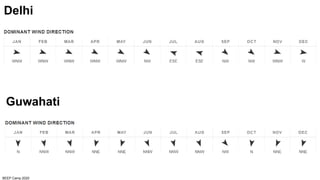
Guwahati
Delhi
BEEP Camp 2020
Kolkata
Mumbai
BEEP Camp 2020
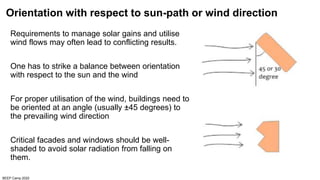
Orientation with respect to sun-path or wind direction
Requirements to manage solar gains and utilise
wind flows may often lead to conflicting results.
One has to strike a balance between orientation
with respect to the sun and the wind
For proper utilisation of the wind, buildings need to
be oriented at an angle (usually ±45 degrees) to
the prevailing wind direction
Critical facades and windows should be well-
shaded to avoid solar radiation from falling on
them.

Orientation and massing.pptx

  • 1.
    BEEP Camp 2020 N S E W Orientationis the positioning of a building in relation to seasonal variations in the sun’s path as well as prevailing wind patterns Massing is the overall shape and size of the building Climate-appropriate building massing and orientation helps harness daylight, solar and wind energy for our comfort, reducing the building’s energy dependence
  • 2.
    BEEP Camp 2020 Roleof good orientation and massing Minimise amount of solar radiation when it is hot Maximise amount of solar radiation in when it is cold Maximise wind access when cooling through natural ventilation is possible Maximise daylight – without glare – during the day
  • 3.
  • 4.
  • 5.
    BEEP Camp 2020 N S E W Winter 21stDec Summer 21st Jun South façade is highly exposed in winter, but less in summer. North façade receives least direct radiation. Only in summer mornings and evenings Horizontal surface receives the greatest intensity East and West façades receive high amount of radiation both in summer and winter
  • 6.
    BEEP Camp 2020 InIndia, north and south is the preferred orientation, with respect to the sun path. Longer facades, fenestration and habitable spaces ideally located toward north and south- less solar radiation BUT great for daylight access East and west facades kept small
  • 7.
    BEEP Camp 2020 Surfacearea-to-Volume (S/V) and Perimeter-to-Area (P/A) Ratio In extremely hot and extremely cold climates, the importance of less day-time heat gain and less night-time heat loss respectively is more amplified Here, more compact the shape, the less heat is gained / lost Low S/V Ratio recommended in extreme climate Low P/A Ratio recommended in extreme climate
  • 8.
    BEEP Camp 2020 Planformswith greater P/A ratio (like the courtyard form) is applied in hot climates BUT they are shaded or have natural cooling features (vegetation or water bodies) that modify the micro-climate Also helps with natural ventilation when required and allow better daylight access
  • 9.
  • 10.
    BEEP Camp 2020 Fenestration& Its Shading North façade receives least direct radiation → minimal shading required and good glare-free daylight Fenestration on south façade → easily shaded in summer and allows sun in the winter Summer Winter South facing window
  • 11.
  • 12.
    BEEP Camp 2020 Fenestration& Its Shading N S E W Summer Winter Summer 21st Jun Winter 21st Dec Low sun on east and west sides (low altitude angle) → Vertical shading will be appropriate Solar azimuth angle also changes between months → Fixed shade will not work at all times Movable shading best suited
  • 13.
  • 14.
    BEEP Camp 2020 ButterfliesResilience Centre, Delhi
  • 15.
    BEEP Camp 2020 Sun-pathis constant for a given place For India, broadly similar guideline for orientation with respect to sun-path is applicable Wind direction however is not similar for India. Wind direction is unpredictable and even for a given site, wind direction and speed will change depending on the surroundings Orientation with respect to wind direction
  • 16.
  • 17.
  • 18.
    BEEP Camp 2020 Orientationwith respect to sun-path or wind direction Requirements to manage solar gains and utilise wind flows may often lead to conflicting results. One has to strike a balance between orientation with respect to the sun and the wind For proper utilisation of the wind, buildings need to be oriented at an angle (usually ±45 degrees) to the prevailing wind direction Critical facades and windows should be well- shaded to avoid solar radiation from falling on them.

Editor's Notes

  • #2 Orientation is the positioning of a building in relation to seasonal variations in the sun’s path as well as prevailing wind patterns, whereas by massing we mean the overall shape and size of the building. If we are able to make best use of these 2 on our site (when I say best, I mean the most-appropriate for the climate), we start out with a solid footing for climate-responsive, and an energy efficient, design.
  • #3 Appropriate orientation and massing can: Minimise amount of solar radiation when it is hot Maximise amount of solar radiation in when it is cold Maximise wind access when cooling through natural ventilation is possible Maximise daylight – without glare – during the day
  • #4 This is a the sun path of New Delhi. You see here that in summer (April to September) the sun moves from the north eastern sky, follows a higher altitude angle (60 – 85 deg) as it travels across the southern sky hemisphere and sets in the north west. In winter (October to March), the sun rises from the south-east, follows a lower altitude angle (60 – 40 deg) across the southern sky and sets in the south-west.
  • #5 You can see this better here. So, in summer the sun is quite high on the south. In winter, the sun altitude angle is low. The sun’s path through the year is across the southern sky, and the east and west sides. This is the general trend in all locations in India.
  • #6 Because of this: North façade receives least direct radiation. Only in summer mornings and evenings South façade is highly exposed in winter, but less in summer. East and West façades receive high amount of radiation both in summer and winter Horizontal surface receives the greatest intensity
  • #7 Hence, north and south is the preferred orientation, with respect to the sun path. Longer facades, all your windows- glazing- and habitable spaces ideally located toward north and south, because on these faces you get less solar radiation BUT great daylight access. These are a few building configurations where the longer sides face north-south. Even when you have a site that has longer sides on the east and west, like here, there may still be ways to design the building mass in a way that the larger surfaces face north-south. Of course, this will also depend on the internal space layout required, where the access roads to the site are etc.
  • #8 The importance of less day-time heat gain in extremely hot climates and less night-time heat loss in extremely cold climates, is more amplified Here, more compact the shape i.e. a small S/V ratio and small P/A ratio, the less heat is gained or lost from the building.
  • #9 Planforms with greater perimeter to area ratio (like the courtyard form) can still be applied in hot climates BUT they should be shaded or have natural cooling features (vegetation or water bodies) that modify the micro-climate The courtyard also helps with natural ventilation when required and allow better daylight access.
  • #10 Depending upon the building use, choosing an appropriate planform and proper activity zoning at the initial design stages can help with heat gain reduction and optimising daylight where it is required. This approach is useful in placing un-inhabited spaces like toilets / storage areas / service areas / staircase etc. at locations where they can act as thermal barriers. Like, here you see that service areas are placed on the east and west sides. This way, the effect of an unfavourable plan orientation can also be reduced to some extent.
  • #11 Which direction your windows face will influence what kind of shading they’ll need. North façade receives least direct radiation. So it requires minimal shading and this is the best place to put your windows to get good glare-free daylight The south façade. While it does receive considerable solar radiation, it is also relatively easy to shade. As the sun angle is high in summer on the south, a horizontal overhang works very well to cut off the sun. In winter, when you’d like to have the sun in, this overhang does not obstruct it.
  • #12 This is an example from the Infosys Hyderabad building, which if you remember from the 1st module, has windows on the north and south faces.
  • #13 The sun is at a low angle on the east and awest. Hence, here vertical shading will be appropriate. However, Solar azimuth angle also changes between months. So, a fixed vertical shade (side fin) will only work for some times. Unless of course the shade is right in front of the window- which we do not want. But if this shade in front of the window is movable, it works- we can get in to shade when the sun is shining in directly and when not required, it can be moved out of the way.
  • #14 Here are some such examples of movable shading.
  • #16 Now, sun-path is constant for a given place. For India, broadly the same guideline for orientation with respect to sun-path is applicable. Wind direction however is not similar for India. Wind direction is unpredictable and even for a given site, wind direction and speed will change depending on the surroundings and specific atmospheric conditions. The monsoon winds have a major influence on the wind patterns in India and in this map you can see how the south-west monsoon and the north-east or retreating monsoon affects wind patterns at specific times of the year.
  • #17 These are the broad monthly wind patterns for some cities in India. You see here, for Delhi the wind generally comes from slightly north-west, but in the monsoon months of July-Aug it shows that mainly has a south-easterly direction. In Guwahati however, it is predominantly from the north throughout the year.
  • #18 In Kolkata, it varies between south and north across the year. In Mumbai, it is from the west almost throughout the year.
  • #19 Requirements to manage solar gains and utilise wind flows may often lead to conflicting results. For managing the solar heat gains, the best arrangement would be to orient the buildings with the longer faces facing north and south. On the other hand, the prominent wind direction in many places in India during the monsoon (when natural ventilation can effectively cool) is from the west or the east. In that case one has to strike a balance. For proper utilisation of the wind, buildings need to be oriented at an angle (usually ±45 degrees) to the prevailing wind direction. At the same time, care has to be taken that critical facades and windows are well shaded to avoid solar radiation from falling on them. Such conflicts need to be analysed for each individual case to find the optimum solution.