PASSIVE SOLAR
ARCHITECTURE
INTRODUCTION
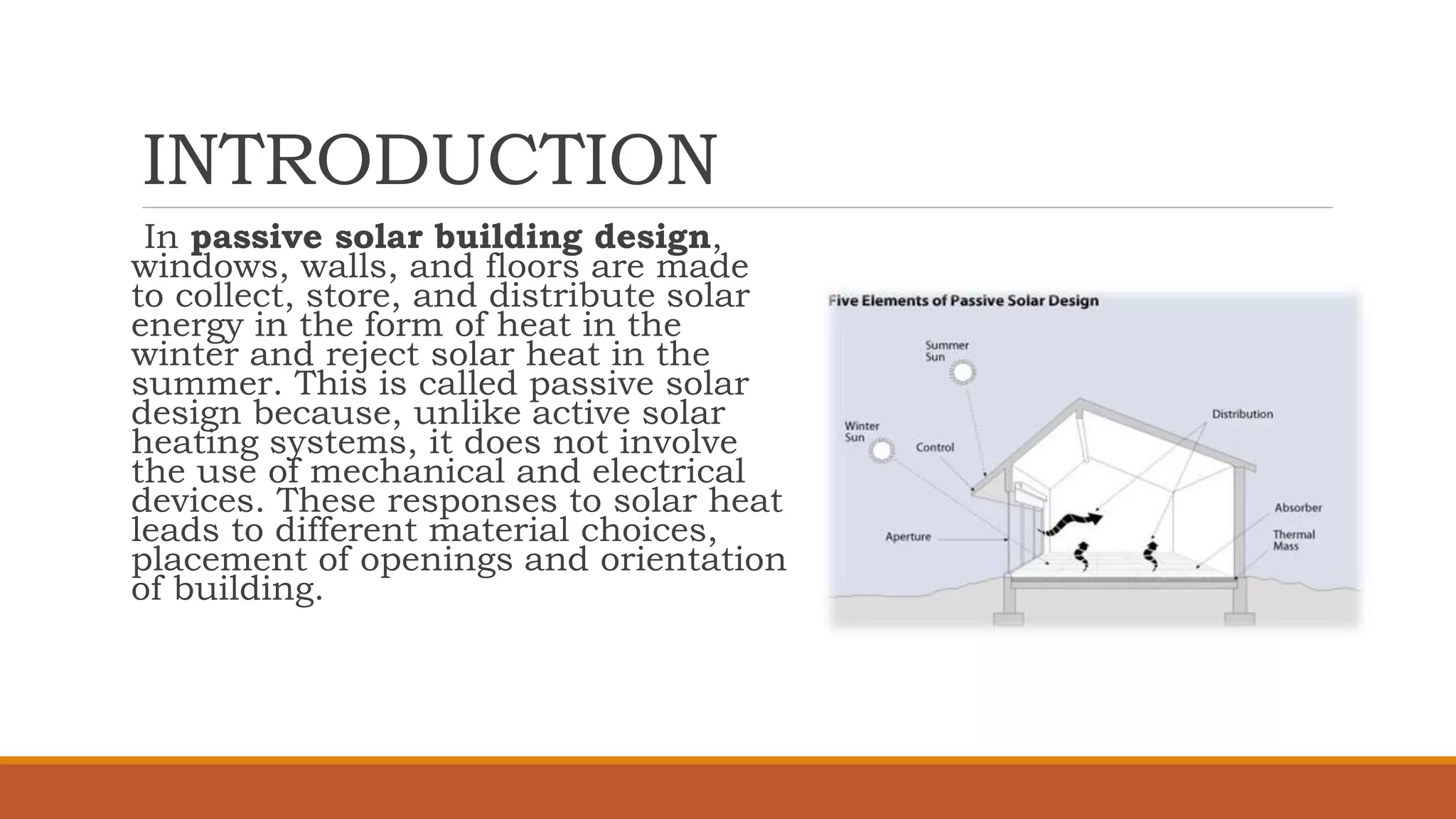
In passive solar building design,
windows, walls, and floors are made
to collect, store, and distribute solar
energy in the form of heat in the
winter and reject solar heat in the
summer. This is called passive solar
design because, unlike active solar
heating systems, it does not involve
the use of mechanical and electrical
devices. These responses to solar heat
leads to different material choices,
placement of openings and orientation
of building.
OBJECTIVES
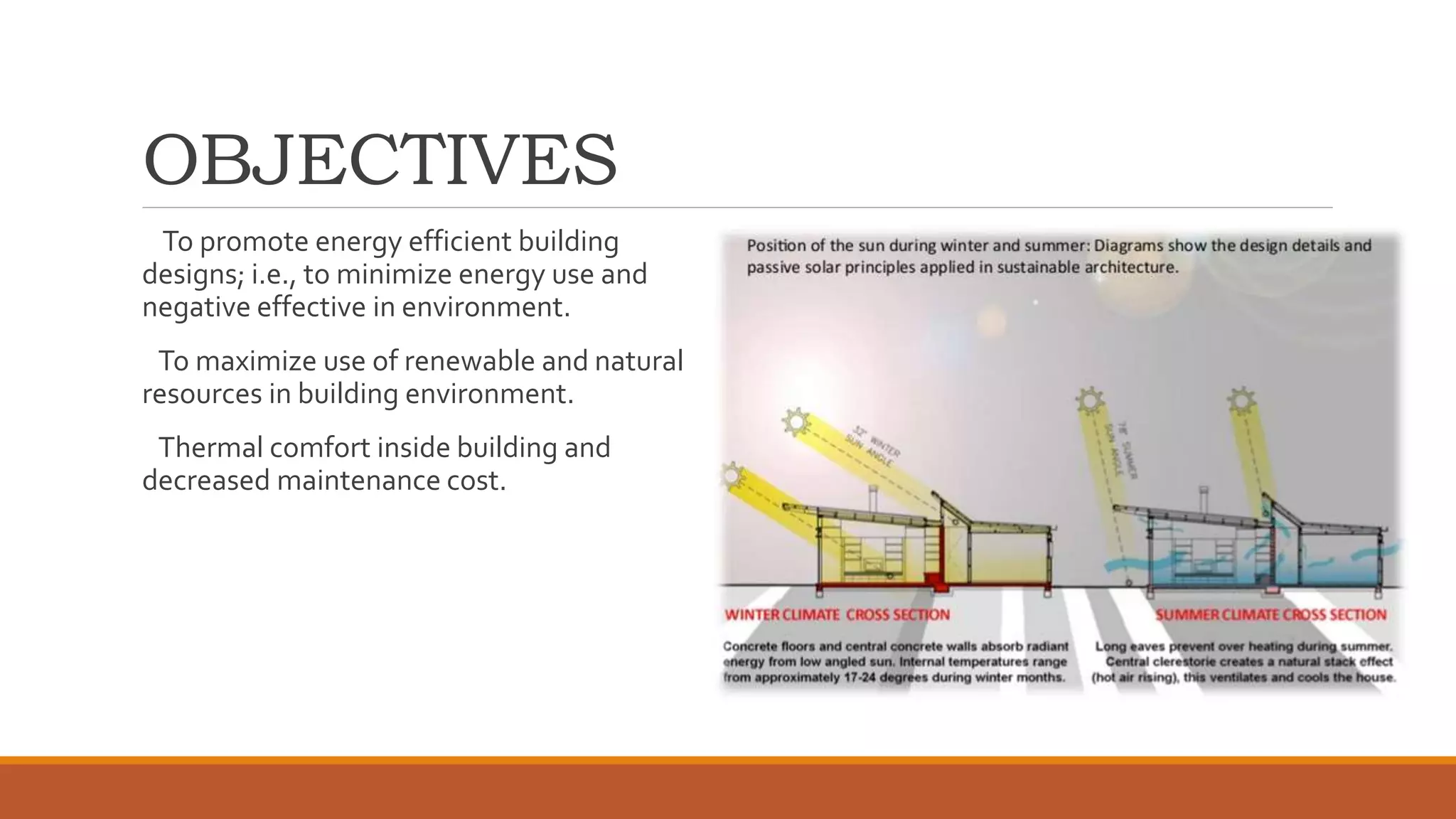
To promote energy efficient building
designs; i.e., to minimize energy use and
negative effective in environment.
To maximize use of renewable and natural
resources in building environment.
Thermal comfort inside building and
decreased maintenance cost.
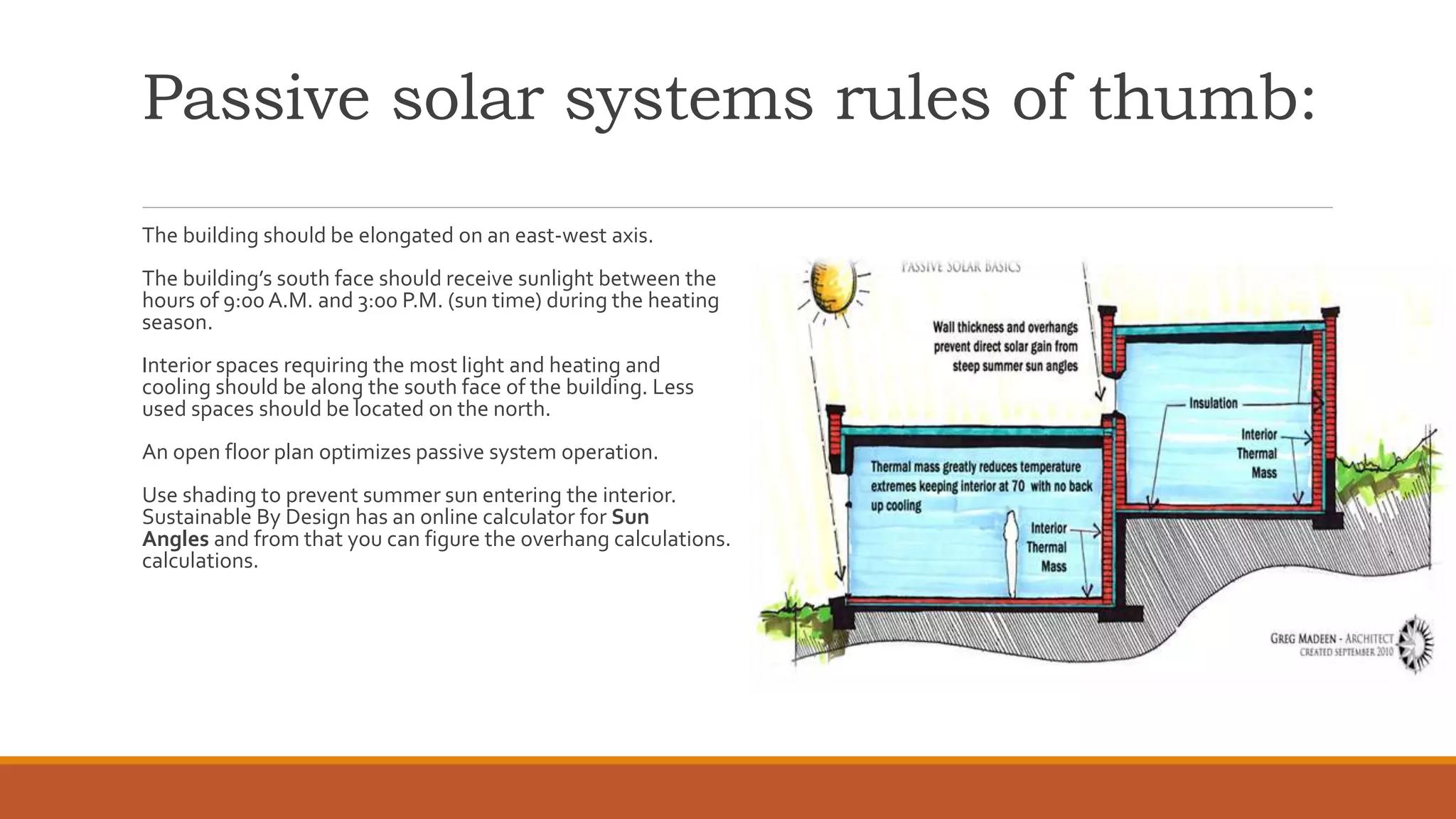
Passive solar systems rules of thumb:
The building should be elongated on an east-west axis.
The building’s south face should receive sunlight between the
hours of 9:00 A.M. and 3:00 P.M. (sun time) during the heating
season.
Interior spaces requiring the most light and heating and
cooling should be along the south face of the building. Less
used spaces should be located on the north.
An open floor plan optimizes passive system operation.
Use shading to prevent summer sun entering the interior.
Sustainable By Design has an online calculator for Sun
Angles and from that you can figure the overhang calculations.
calculations.
TECHNIQUES
PASSIVE SOLAR
HEATING
PASSIVE SOLAR
COOLING
PASSIVE SOLAR
HEATING
Two primary elements of passive solar heating are required:
South facing glass
Thermal mass to absorb, store, and distribute heat.
There are three approaches to passive systems – direct gain, indirect gain,
and isolated gain. The goal of all passive solar heating systems is to capture the
sun’s heat within the building’s elements and release that heat during periods
when the sun is not shining.
At the same time that the building’s elements (or materials) is absorbing heat
for later use, solar heat is available for keeping the space comfortable (not
overheated).
DIRECT GAIN
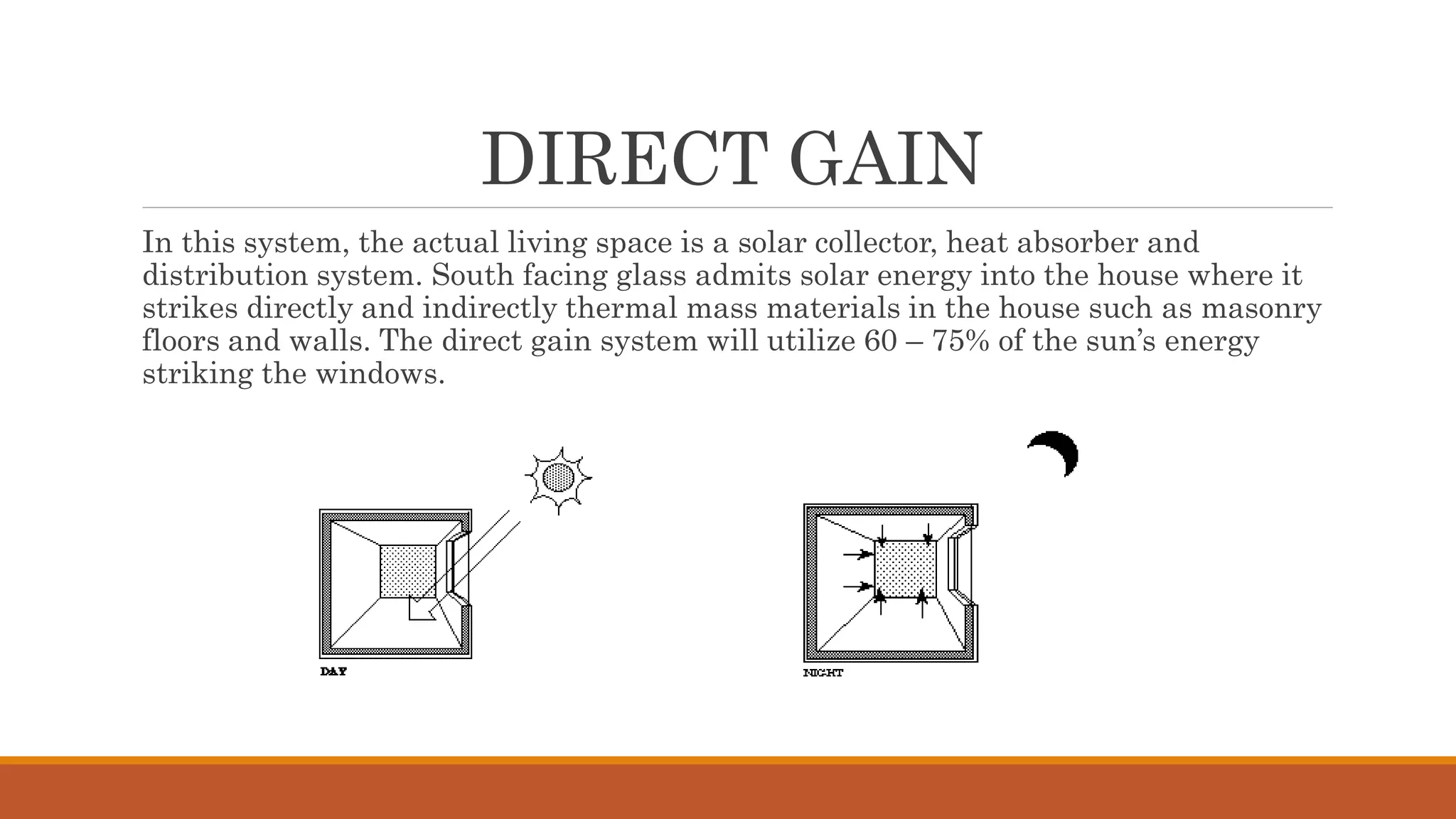
In this system, the actual living space is a solar collector, heat absorber and
distribution system. South facing glass admits solar energy into the house where it
strikes directly and indirectly thermal mass materials in the house such as masonry
floors and walls. The direct gain system will utilize 60 – 75% of the sun’s energy
striking the windows.
INDIRECT GAIN
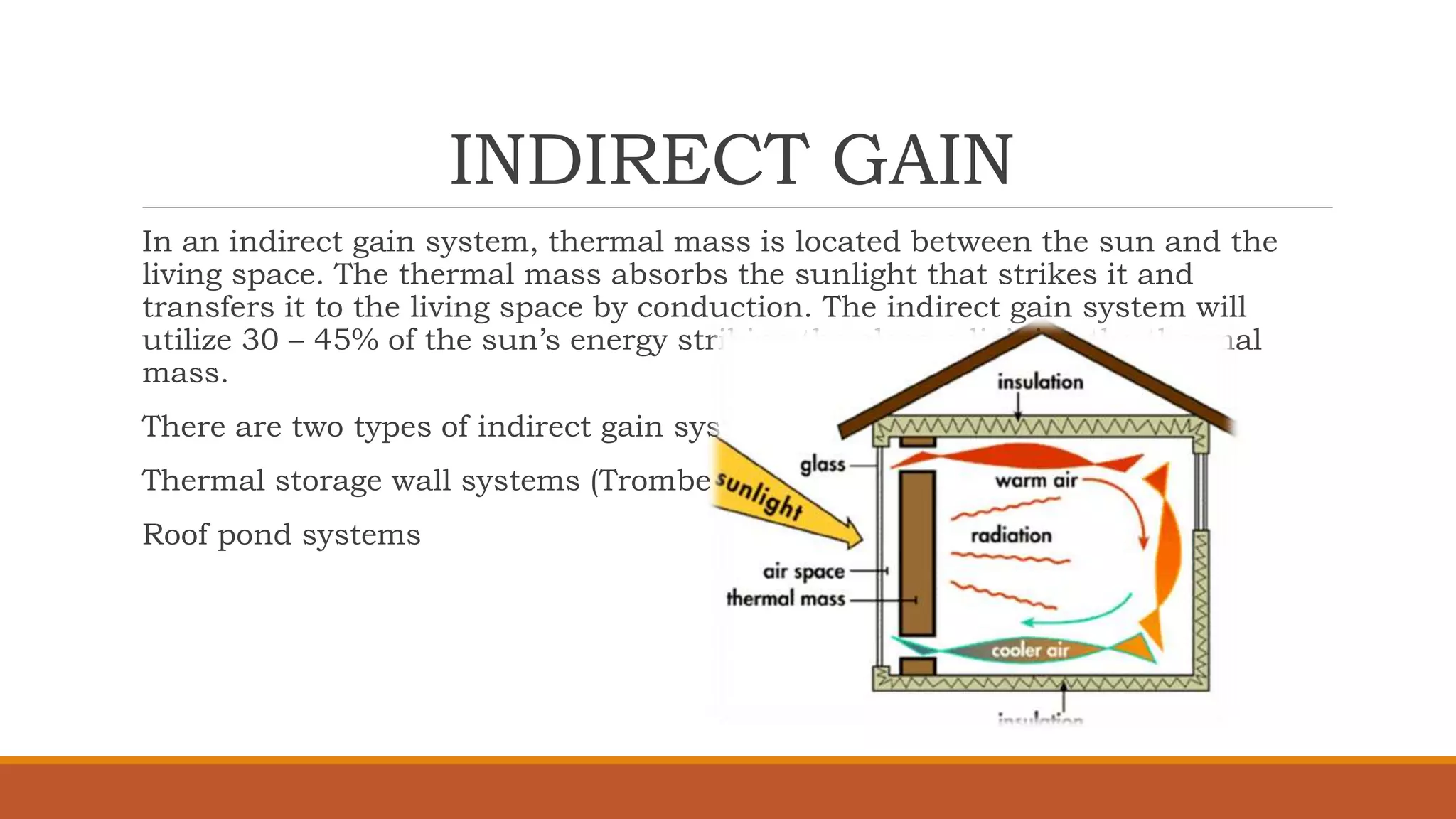
In an indirect gain system, thermal mass is located between the sun and the
living space. The thermal mass absorbs the sunlight that strikes it and
transfers it to the living space by conduction. The indirect gain system will
utilize 30 – 45% of the sun’s energy striking the glass adjoining the thermal
mass.
There are two types of indirect gain systems:
Thermal storage wall systems (Trombe Walls)
Roof pond systems
THERMAL STORAGE WALL
SYSTEMS ( TROMBE WALLS )
The thermal mass is located immediately
behind south facing glass in this system.
Operable vents at the top and bottom of
a thermal storage wall permit heat to
convict from between the wall and the
glass into the living space. When the
vents are closed at night radiant heat
from the wall heats the living space.
Roof pond
systems
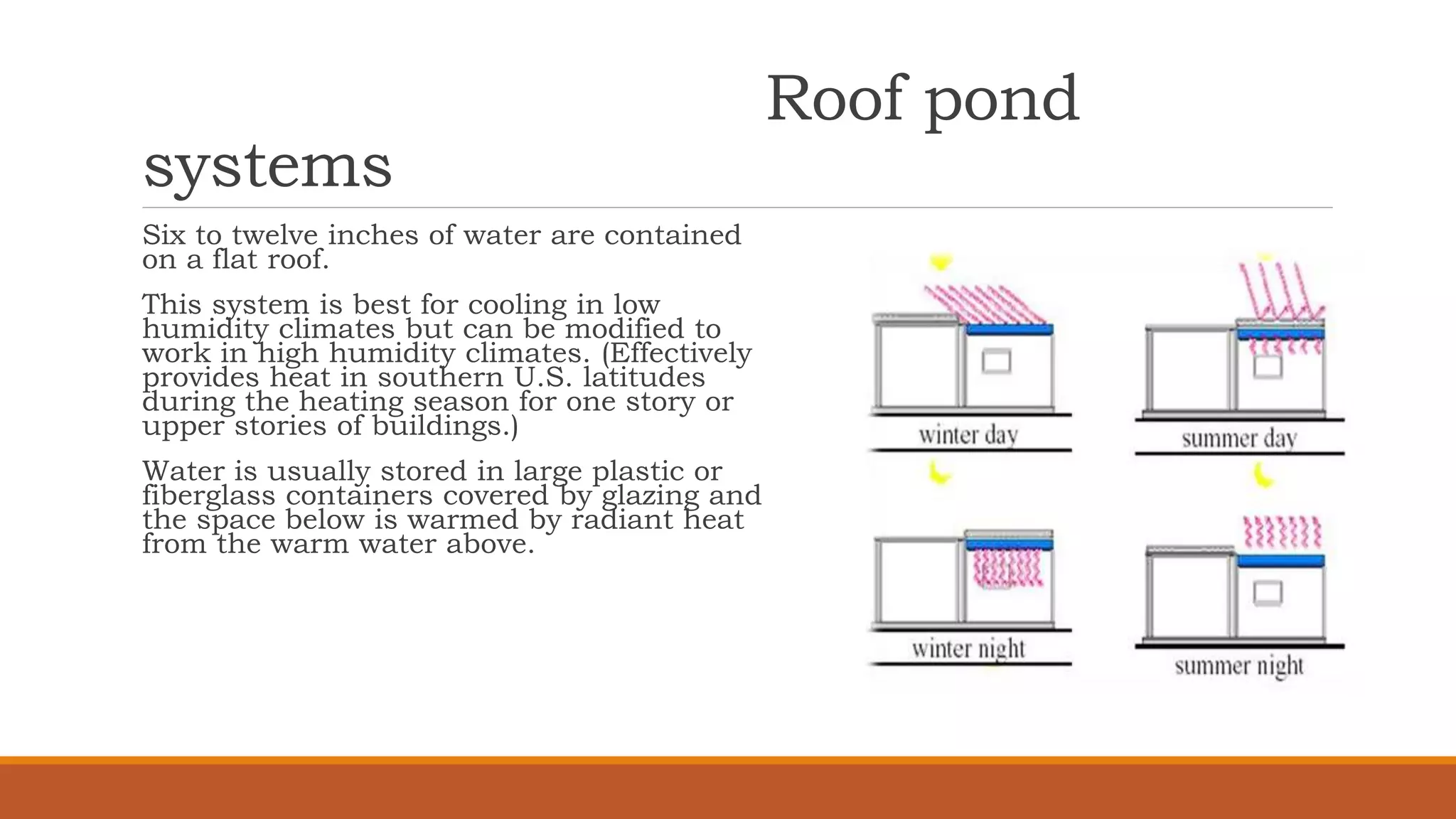
Six to twelve inches of water are contained
on a flat roof.
This system is best for cooling in low
humidity climates but can be modified to
work in high humidity climates. (Effectively
provides heat in southern U.S. latitudes
during the heating season for one story or
upper stories of buildings.)
Water is usually stored in large plastic or
fiberglass containers covered by glazing and
the space below is warmed by radiant heat
from the warm water above.
ISOLATED GAIN
An isolated gain system has its integral
parts separate from the main living area of
a house. Examples are a sunroom and a
convective loop through an air collector to a
storage system in the house. The ability to
isolate the system from the primary living
areas is the point of distinction for this
type of system.
The isolated gain system will utilize 15 –
30% of the sunlight striking the glazing
toward heating the adjoining living areas.
Solar energy is also retained in the
sunroom itself.
PASSIVE SOLAR
COOLING
Passive Solar Cooling
A primary strategy for cooling buildings without mechanical assistance (passive cooling) in hot
humid climates is to employ natural ventilation. (The Fan and Landscape sections also address
ventilation strategies.) Prevailing summer breezes are from the south and soutwest. This matches
nicely with the increased glazing on the south side needed for passive heating, making it possible to
achieve helpful solar gain and ventilation with the following strategies:
Place operable windows on the south exposure.
Casement windows offer the best airflow. Awning (or hopper) windows should be fully opened or air
will be directed to ceiling. Awning windows offer the best rain protection and perform better than
double hung windows.
If a room can have windows on only one side, use two widely spaced windows instead of one
window.
Wing Walls
Wing walls are vertical solid
panels placed alongside of
windows perpendicular to the
wall on the windward side of the
house.
Wing walls will accelerate the
natural wind speed due to
pressure differences created by
the wing wall.
Thermal
Chimney
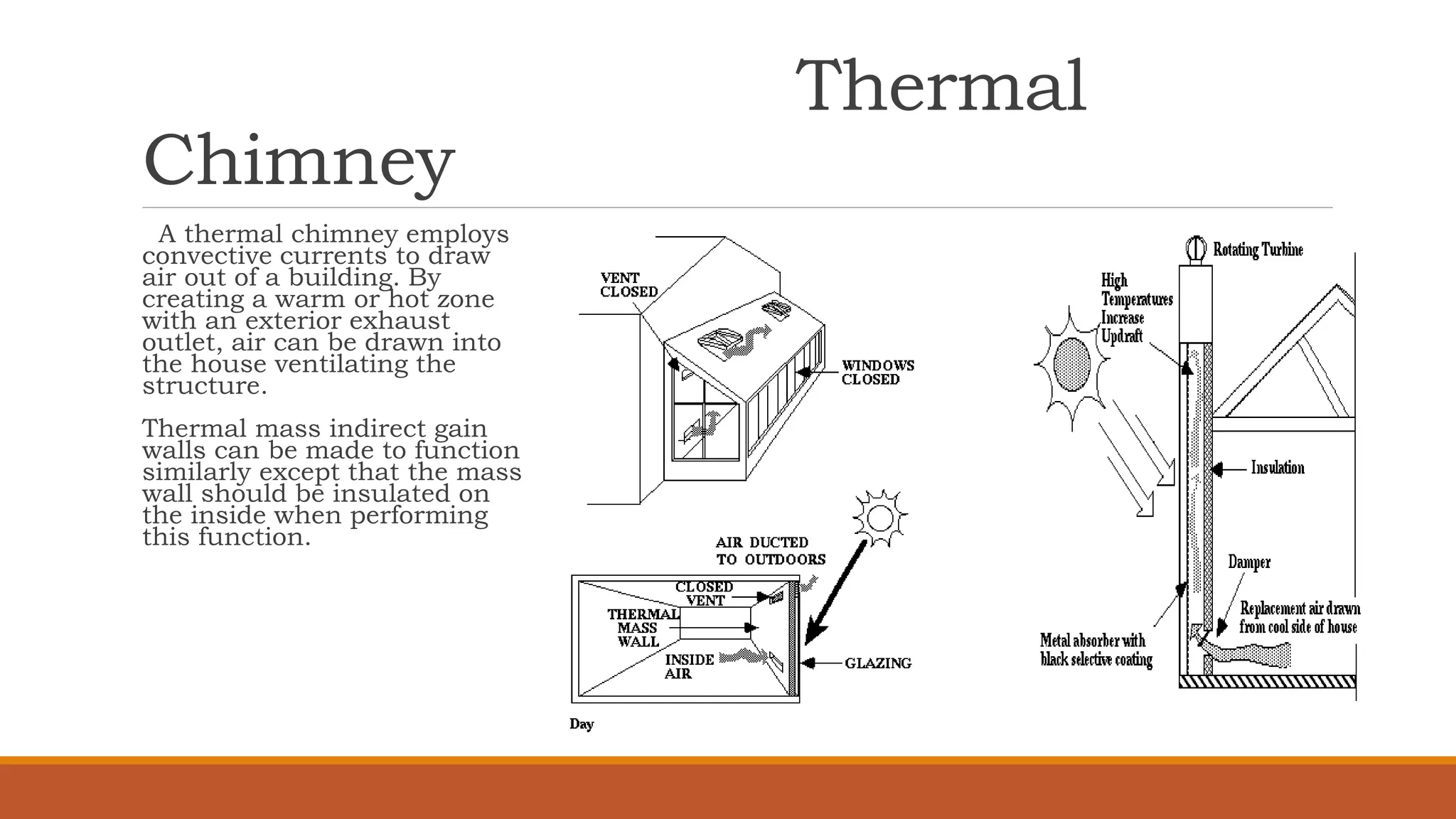
A thermal chimney employs
convective currents to draw
air out of a building. By
creating a warm or hot zone
with an exterior exhaust
outlet, air can be drawn into
the house ventilating the
structure.
Thermal mass indirect gain
walls can be made to function
similarly except that the mass
wall should be insulated on
the inside when performing
this function.
Other Ventilation Strategies
Make the outlet openings slightly
larger than the inlet openings.
Place the inlets at low to medium
heights to provide airflow at
occupant levels in the room.
CONCLUSION
PASSIVE SOLAR TECHNIQUES ARE BETTER THAN SOLAR HEATING
SYSTEMS AS IT WORKS ON THE PRINCIPLE OF NATURAL HEAT GAINING
AND REDUCING METHODS.
IN CORRESPONDENCE WITH THE SUN PATH AND THE WIND FLOW
DIRECTION OF THE PARTICULAR AREA AND DOESNT REQUIRE ANY
ELECTRICAL AND MECHANICAL ENERGY.
PALIWAL DHRITI
DADHANIA SHREYA
PATEL ARPITA
SHAH AAYUSHI
SHETA CHARMI
DESAI PEARL
PATEL UTSAVI
VESUWALA KRINA
THANK YOU

Passive Solar Architecture

  • 1.
  • 2.
    INTRODUCTION In passive solarbuilding design, windows, walls, and floors are made to collect, store, and distribute solar energy in the form of heat in the winter and reject solar heat in the summer. This is called passive solar design because, unlike active solar heating systems, it does not involve the use of mechanical and electrical devices. These responses to solar heat leads to different material choices, placement of openings and orientation of building.
  • 3.
    OBJECTIVES To promote energyefficient building designs; i.e., to minimize energy use and negative effective in environment. To maximize use of renewable and natural resources in building environment. Thermal comfort inside building and decreased maintenance cost.
  • 4.
    Passive solar systemsrules of thumb: The building should be elongated on an east-west axis. The building’s south face should receive sunlight between the hours of 9:00 A.M. and 3:00 P.M. (sun time) during the heating season. Interior spaces requiring the most light and heating and cooling should be along the south face of the building. Less used spaces should be located on the north. An open floor plan optimizes passive system operation. Use shading to prevent summer sun entering the interior. Sustainable By Design has an online calculator for Sun Angles and from that you can figure the overhang calculations. calculations.
  • 5.
  • 6.
    PASSIVE SOLAR HEATING Two primaryelements of passive solar heating are required: South facing glass Thermal mass to absorb, store, and distribute heat. There are three approaches to passive systems – direct gain, indirect gain, and isolated gain. The goal of all passive solar heating systems is to capture the sun’s heat within the building’s elements and release that heat during periods when the sun is not shining. At the same time that the building’s elements (or materials) is absorbing heat for later use, solar heat is available for keeping the space comfortable (not overheated).
  • 7.
    DIRECT GAIN In thissystem, the actual living space is a solar collector, heat absorber and distribution system. South facing glass admits solar energy into the house where it strikes directly and indirectly thermal mass materials in the house such as masonry floors and walls. The direct gain system will utilize 60 – 75% of the sun’s energy striking the windows.
  • 8.
    INDIRECT GAIN In anindirect gain system, thermal mass is located between the sun and the living space. The thermal mass absorbs the sunlight that strikes it and transfers it to the living space by conduction. The indirect gain system will utilize 30 – 45% of the sun’s energy striking the glass adjoining the thermal mass. There are two types of indirect gain systems: Thermal storage wall systems (Trombe Walls) Roof pond systems
  • 9.
    THERMAL STORAGE WALL SYSTEMS( TROMBE WALLS ) The thermal mass is located immediately behind south facing glass in this system. Operable vents at the top and bottom of a thermal storage wall permit heat to convict from between the wall and the glass into the living space. When the vents are closed at night radiant heat from the wall heats the living space.
  • 10.
    Roof pond systems Six totwelve inches of water are contained on a flat roof. This system is best for cooling in low humidity climates but can be modified to work in high humidity climates. (Effectively provides heat in southern U.S. latitudes during the heating season for one story or upper stories of buildings.) Water is usually stored in large plastic or fiberglass containers covered by glazing and the space below is warmed by radiant heat from the warm water above.
  • 11.
    ISOLATED GAIN An isolatedgain system has its integral parts separate from the main living area of a house. Examples are a sunroom and a convective loop through an air collector to a storage system in the house. The ability to isolate the system from the primary living areas is the point of distinction for this type of system. The isolated gain system will utilize 15 – 30% of the sunlight striking the glazing toward heating the adjoining living areas. Solar energy is also retained in the sunroom itself.
  • 12.
    PASSIVE SOLAR COOLING Passive SolarCooling A primary strategy for cooling buildings without mechanical assistance (passive cooling) in hot humid climates is to employ natural ventilation. (The Fan and Landscape sections also address ventilation strategies.) Prevailing summer breezes are from the south and soutwest. This matches nicely with the increased glazing on the south side needed for passive heating, making it possible to achieve helpful solar gain and ventilation with the following strategies: Place operable windows on the south exposure. Casement windows offer the best airflow. Awning (or hopper) windows should be fully opened or air will be directed to ceiling. Awning windows offer the best rain protection and perform better than double hung windows. If a room can have windows on only one side, use two widely spaced windows instead of one window.
  • 13.
    Wing Walls Wing wallsare vertical solid panels placed alongside of windows perpendicular to the wall on the windward side of the house. Wing walls will accelerate the natural wind speed due to pressure differences created by the wing wall.
  • 14.
    Thermal Chimney A thermal chimneyemploys convective currents to draw air out of a building. By creating a warm or hot zone with an exterior exhaust outlet, air can be drawn into the house ventilating the structure. Thermal mass indirect gain walls can be made to function similarly except that the mass wall should be insulated on the inside when performing this function.
  • 15.
    Other Ventilation Strategies Makethe outlet openings slightly larger than the inlet openings. Place the inlets at low to medium heights to provide airflow at occupant levels in the room.
  • 16.
    CONCLUSION PASSIVE SOLAR TECHNIQUESARE BETTER THAN SOLAR HEATING SYSTEMS AS IT WORKS ON THE PRINCIPLE OF NATURAL HEAT GAINING AND REDUCING METHODS. IN CORRESPONDENCE WITH THE SUN PATH AND THE WIND FLOW DIRECTION OF THE PARTICULAR AREA AND DOESNT REQUIRE ANY ELECTRICAL AND MECHANICAL ENERGY.
  • 17.
    PALIWAL DHRITI DADHANIA SHREYA PATELARPITA SHAH AAYUSHI SHETA CHARMI DESAI PEARL PATEL UTSAVI VESUWALA KRINA THANK YOU