PRESENTED TO: DR.SASWATI SINHA
PRESENTED BY:
VISHNU.R.NAIR,
PHARM.D INTERN,
NATIONAL COLLEGE OF PHARMACY(AMRI HOSPITAL ACADEMIC
TRAINEE)
GENERAL INTRODUCTION
Sulfonylureas(SUs)  come under the class of “antidiabetic drugs”,
under the sub-heading “Insulin secretagogues”
Insulin secretagogues  refer to those drugs, that PROMOTE
INSULIN SECRETION
Effectiveness of SU  directly proportional to functional status of
pancreatic beta-cells
SUs  not effective for patients with severe insulin deficiency!
iAmerican Diabetes Association. Standards of medical care in diabetes-2016 abridged for primary care providers. Clin Diabetes. 2016;34:3-21.
SULFONYLUREA CLASSIFICATION
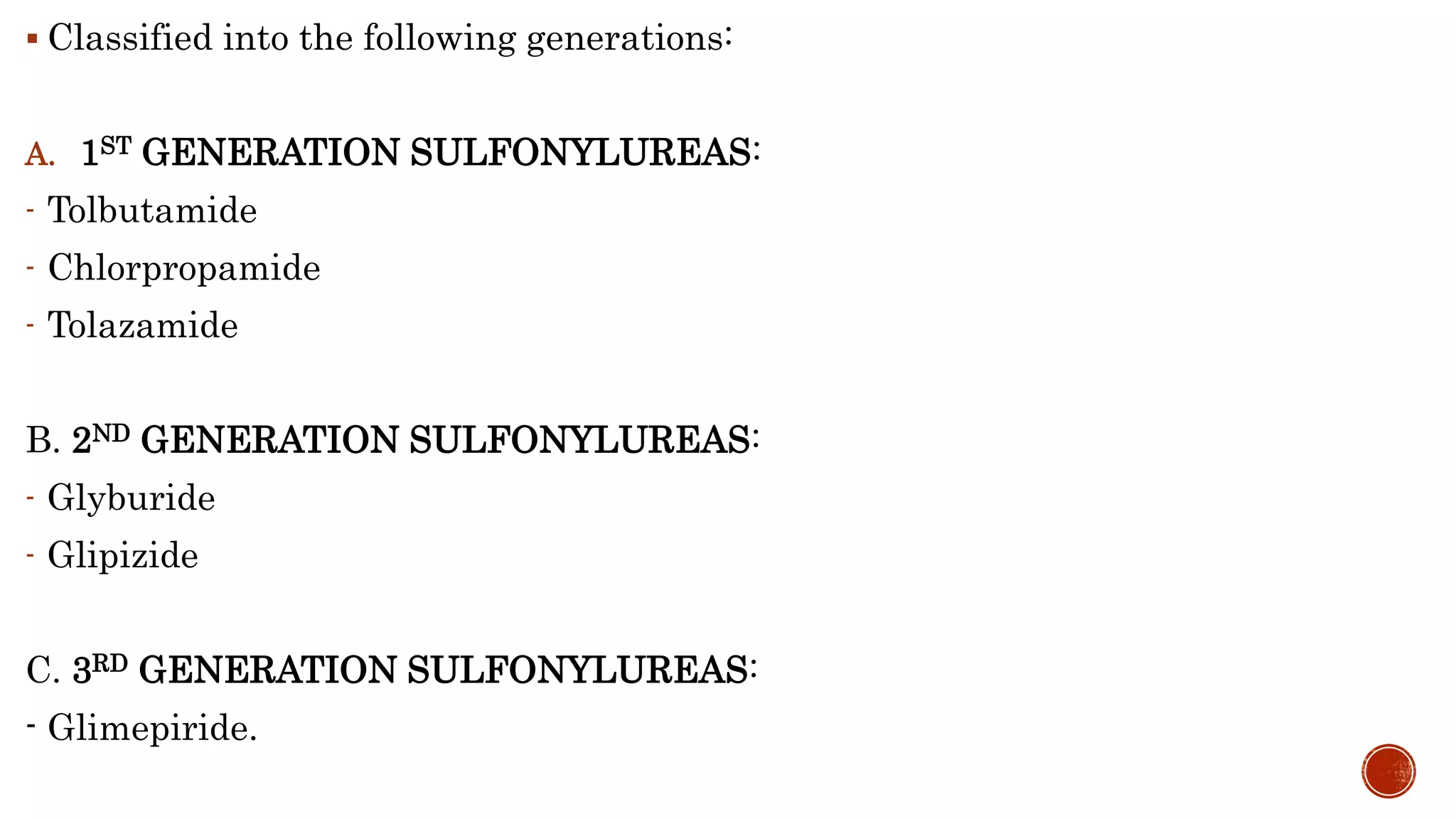
 Classified into the following generations:
A. 1ST GENERATION SULFONYLUREAS:
- Tolbutamide
- Chlorpropamide
- Tolazamide
B. 2ND GENERATION SULFONYLUREAS:
- Glyburide
- Glipizide
C. 3RD GENERATION SULFONYLUREAS:
- Glimepiride.
MECHANISM OF ACTION
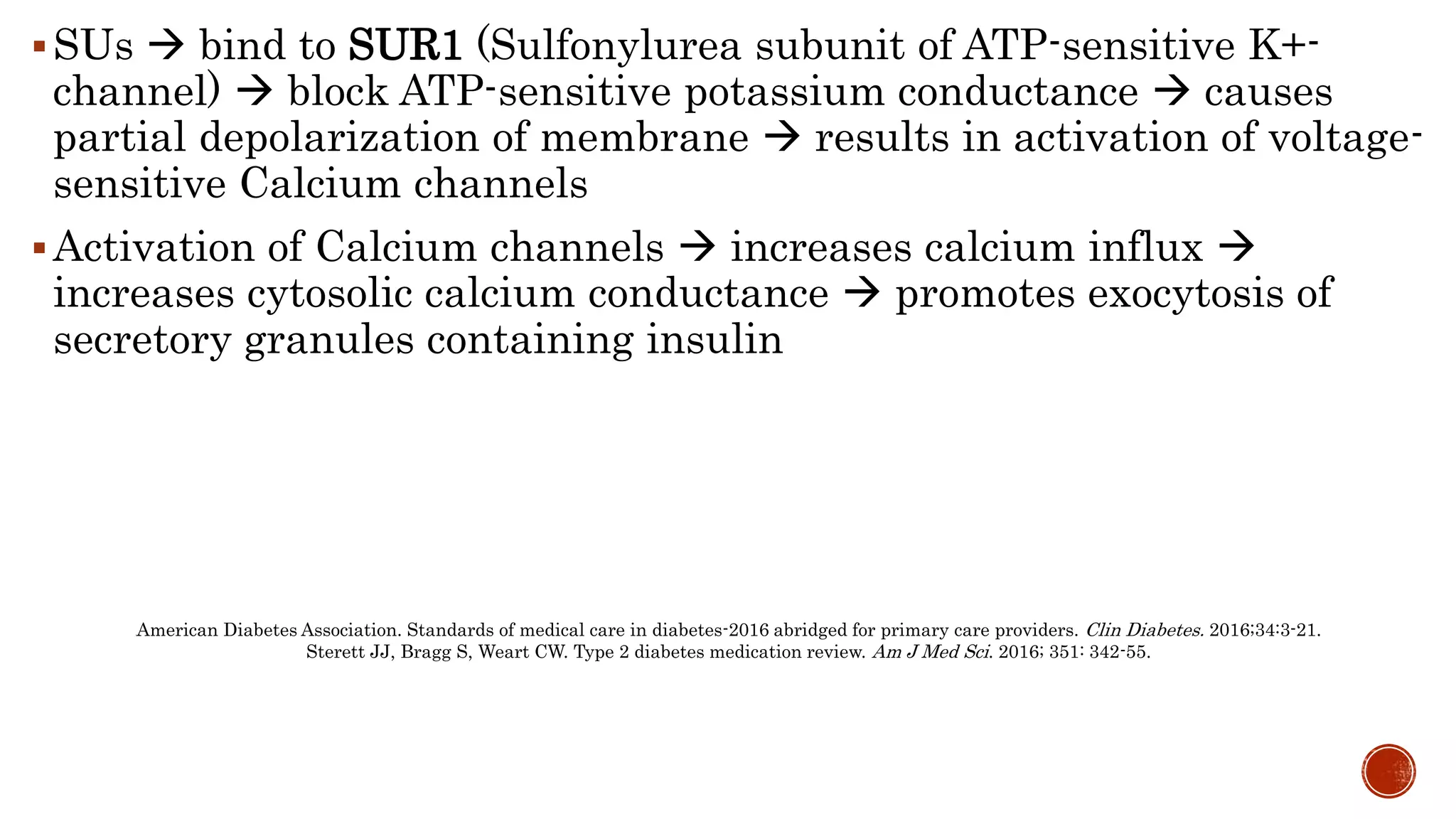
SUs  bind to SUR1 (Sulfonylurea subunit of ATP-sensitive K+-
channel)  block ATP-sensitive potassium conductance  causes
partial depolarization of membrane  results in activation of voltage-
sensitive Calcium channels
Activation of Calcium channels  increases calcium influx 
increases cytosolic calcium conductance  promotes exocytosis of
secretory granules containing insulin
iAmerican Diabetes Association. Standards of medical care in diabetes-2016 abridged for primary care providers. Clin Diabetes. 2016;34:3-21.
Sterett JJ, Bragg S, Weart CW. Type 2 diabetes medication review. Am J Med Sci. 2016; 351: 342-55.
THERAPEUTIC EFFICACY
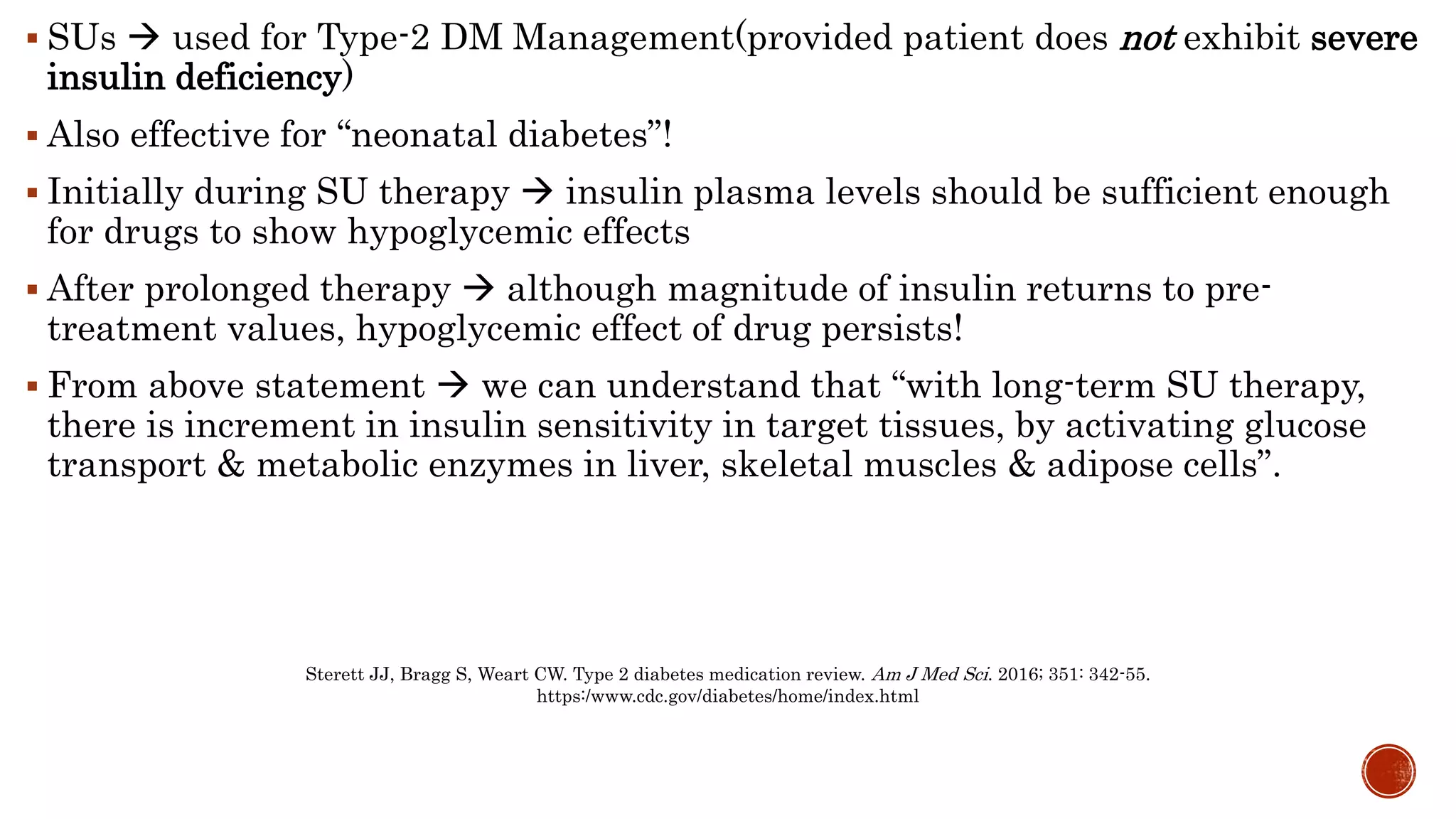
 SUs  used for Type-2 DM Management(provided patient does not exhibit severe
insulin deficiency)
 Also effective for “neonatal diabetes”!
 Initially during SU therapy  insulin plasma levels should be sufficient enough
for drugs to show hypoglycemic effects
 After prolonged therapy  although magnitude of insulin returns to pre-
treatment values, hypoglycemic effect of drug persists!
 From above statement  we can understand that “with long-term SU therapy,
there is increment in insulin sensitivity in target tissues, by activating glucose
transport & metabolic enzymes in liver, skeletal muscles & adipose cells”.
Sterett JJ, Bragg S, Weart CW. Type 2 diabetes medication review. Am J Med Sci. 2016; 351: 342-55.
https:/www.cdc.gov/diabetes/home/index.html
PHARMACOKINETIC PROFILE
Drug Route of
administratio
n
Half-life(in
hrs)
PPB(in %) Duration of
action(in hrs)
Metabolite
activity
Elimination
GLIPIZIDE Oral 3-7 >90% 24 None 90%
metabolized,
renal
excretion
GLYBURIDE Oral 10-16 >90% 24 Weak 50%
metabolized,
renal
excretion
GLIMEPIRID
E
Oral 5-9 >99% 24 Weak 99%
metabolized,
renal
excretion
Sterett JJ, Bragg S, Weart CW. Type 2 diabetes medication review. Am J Med Sci. 2016; 351: 342-55.
PHARMACOVIGILANCE
PARAMETERS
 According to multiple clinical trials :
“Sulfonylureas have maximum potency to cause mild, moderate or severe
hypoglycemia, as compared to other drug classes”
 Hypoglycemia  attributed to:
a. Increased insulin sensitization
b. Dietary pattern changes
c. Increased energy expenditure
 For mild hypoglycemic response  reduce drug dose
 In case of severe hypoglycemia  hypoglycemia may persist for days  warrants
glucose infusions!
Sterett JJ, Bragg S, Weart CW. Type 2 diabetes medication review. Am J Med Sci. 2016; 351: 342-55.
 SUs  increase insulin synthesis  triggers TG(triglyceride) production 
leads to weight gain!
 In a small percent of patients taking SUs  the following were observed :
a. GI disturbance(anorexia, N&V, epigastric disturbances, heartburns)
b. Allergic reactions
c. Dermatological issues
d. Mild anemia
e. Transient leukopenia
f. Vague neurological manifestations(weakness, numbness of extremities)
Sterett JJ, Bragg S, Weart CW. Type 2 diabetes medication review. Am J Med Sci. 2016; 351: 342-55.
https:/www.cdc.gov/diabetes/home/index.html
 1st generation SUs  contraindicated in patients with:
- CAD
- Renal dysfunction
- Hepatic dysfunction.
 Liver dysfunction  prolongs drug’s hypoglycemic effects  thus, other
generation SUs should be used with caution!
Sterett JJ, Bragg S, Weart CW. Type 2 diabetes medication review. Am J Med Sci. 2016; 351: 342-55.
https:/www.cdc.gov/diabetes/home/index.html
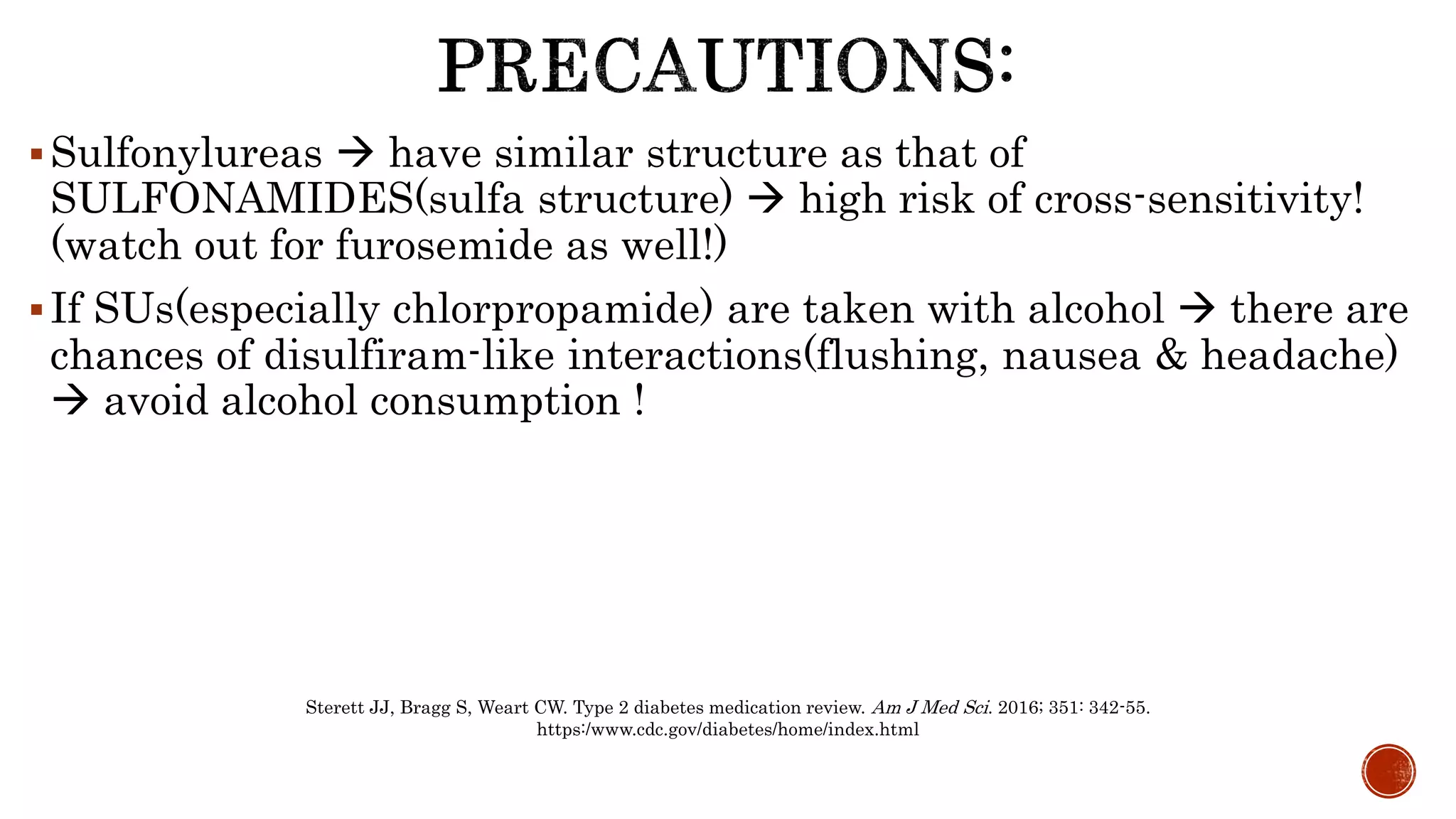
Sulfonylureas  have similar structure as that of
SULFONAMIDES(sulfa structure)  high risk of cross-sensitivity!
(watch out for furosemide as well!)
If SUs(especially chlorpropamide) are taken with alcohol  there are
chances of disulfiram-like interactions(flushing, nausea & headache)
 avoid alcohol consumption !
Sterett JJ, Bragg S, Weart CW. Type 2 diabetes medication review. Am J Med Sci. 2016; 351: 342-55.
https:/www.cdc.gov/diabetes/home/index.html
SUs + (Anticoagulants/ clofibrate/ fluconazole/ H2-receptor blockers/
methyldopa/ MAO-Inhibitors/ NSAIDs/ Salicylates/ Sulfonamides/
TCAs)  enhanced hypoglycemic effects!
SUs + (Beta-blockers/ CCBs/ Cholestyramine/ Corticosteroids/
Estrogens/ Hydantoins/ INH/ Oral contraceptives/ Phenothiazines/
Rifampin/ Thiazides)  reduced hypoglycemic effects!
Sterett JJ, Bragg S, Weart CW. Type 2 diabetes medication review. Am J Med Sci. 2016; 351: 342-55.
https:/www.cdc.gov/diabetes/home/index.html
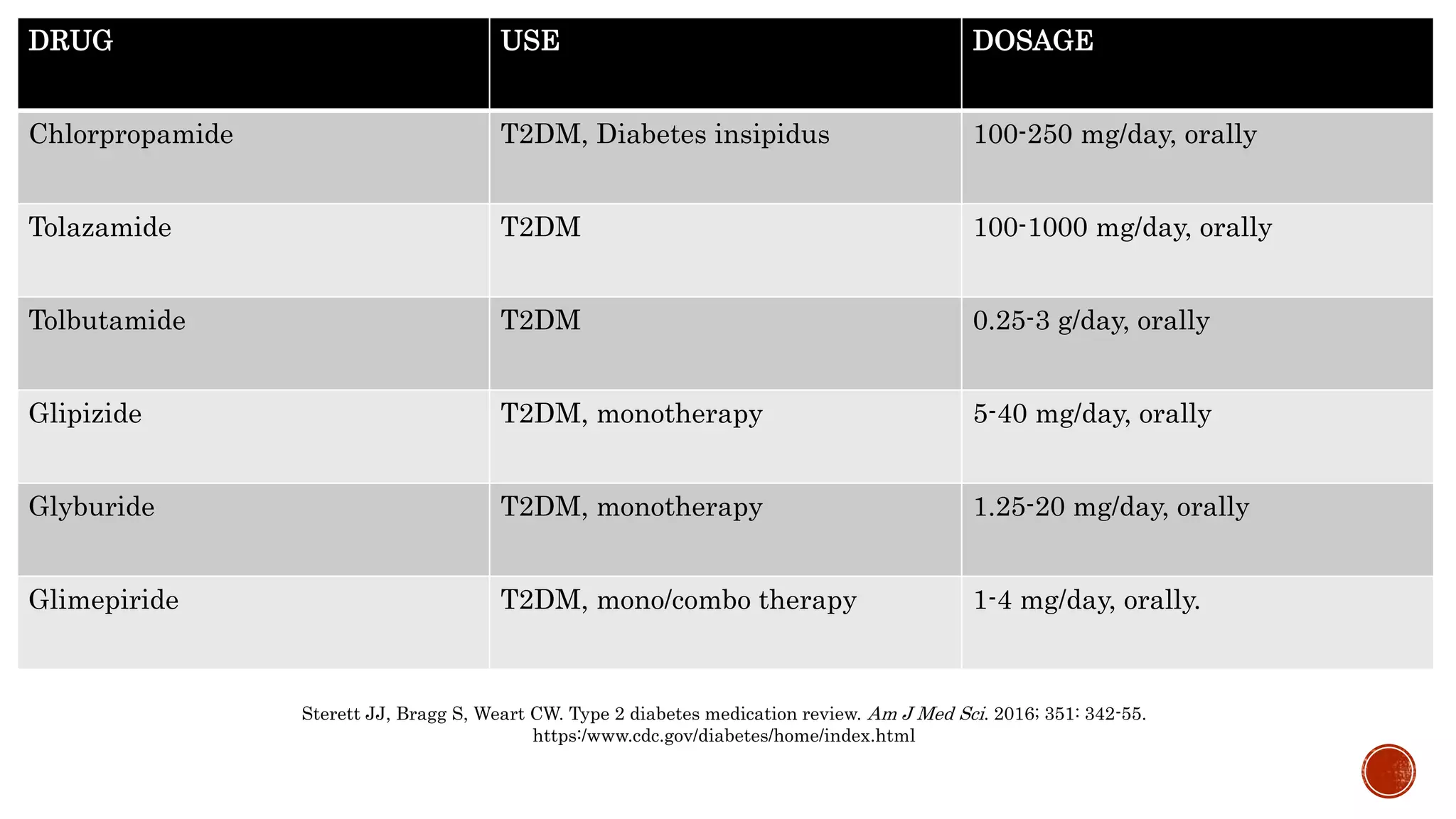
DOSAGE PROFILE
DRUG USE DOSAGE
Chlorpropamide T2DM, Diabetes insipidus 100-250 mg/day, orally
Tolazamide T2DM 100-1000 mg/day, orally
Tolbutamide T2DM 0.25-3 g/day, orally
Glipizide T2DM, monotherapy 5-40 mg/day, orally
Glyburide T2DM, monotherapy 1.25-20 mg/day, orally
Glimepiride T2DM, mono/combo therapy 1-4 mg/day, orally.
Sterett JJ, Bragg S, Weart CW. Type 2 diabetes medication review. Am J Med Sci. 2016; 351: 342-55.
https:/www.cdc.gov/diabetes/home/index.html
IMPORTANT CATCHPOINTS
 Glimepiride  only SU, that can be safely used as combination therapy with
other OHAs!
 Avoid alcohol consumption while taking SUs!
 SUs  cause lowering of HbA1C by 1-2%
 1st generation SUs  rarely used nowadays, owing to:
a. Long duration of action
b. High risk of ADRs
c. Higher propensity for drug interactions
 Never ever skip breakfast when taking 2nd generation SUs!(to prevent
hypoglycemia)
 Consider renal and liver functional status while providing SUs.
SPECIAL MNEMONICS
How to remember the names of drugs, that enhance the hypoglycemic effects of
Sulfonylureas?
Remember the code: “FACT- DOUBLE MS”!!
F: Fluconazole
A: Anticoagulants
C: Clofibrate
T: TCAs
M: MAO-inhibitors
S: Salicylates
M: Methyldopa
S: Sulfonamides!!!
How to remember the names of drugs that block the hypoglycemic effects of
sulfonylureas??
Remember the code: “RIB- POCCET”!!
R: Rifampin
I: INH
B: Beta-blockers
P: Phenothiazines
O: Oral contraceptives
C: CCBs
C: Cholestyramine
E: Estrogens
T: Thiazides!!!
THANK YOU!!!

Sulfonylureas for Diabetes: A deep insight

  • 1.
    PRESENTED TO: DR.SASWATISINHA PRESENTED BY: VISHNU.R.NAIR, PHARM.D INTERN, NATIONAL COLLEGE OF PHARMACY(AMRI HOSPITAL ACADEMIC TRAINEE)
  • 2.
  • 3.
    Sulfonylureas(SUs)  comeunder the class of “antidiabetic drugs”, under the sub-heading “Insulin secretagogues” Insulin secretagogues  refer to those drugs, that PROMOTE INSULIN SECRETION Effectiveness of SU  directly proportional to functional status of pancreatic beta-cells SUs  not effective for patients with severe insulin deficiency! iAmerican Diabetes Association. Standards of medical care in diabetes-2016 abridged for primary care providers. Clin Diabetes. 2016;34:3-21.
  • 4.
  • 5.
     Classified intothe following generations: A. 1ST GENERATION SULFONYLUREAS: - Tolbutamide - Chlorpropamide - Tolazamide B. 2ND GENERATION SULFONYLUREAS: - Glyburide - Glipizide C. 3RD GENERATION SULFONYLUREAS: - Glimepiride.
  • 6.
  • 7.
    SUs  bindto SUR1 (Sulfonylurea subunit of ATP-sensitive K+- channel)  block ATP-sensitive potassium conductance  causes partial depolarization of membrane  results in activation of voltage- sensitive Calcium channels Activation of Calcium channels  increases calcium influx  increases cytosolic calcium conductance  promotes exocytosis of secretory granules containing insulin iAmerican Diabetes Association. Standards of medical care in diabetes-2016 abridged for primary care providers. Clin Diabetes. 2016;34:3-21. Sterett JJ, Bragg S, Weart CW. Type 2 diabetes medication review. Am J Med Sci. 2016; 351: 342-55.
  • 8.
  • 9.
     SUs used for Type-2 DM Management(provided patient does not exhibit severe insulin deficiency)  Also effective for “neonatal diabetes”!  Initially during SU therapy  insulin plasma levels should be sufficient enough for drugs to show hypoglycemic effects  After prolonged therapy  although magnitude of insulin returns to pre- treatment values, hypoglycemic effect of drug persists!  From above statement  we can understand that “with long-term SU therapy, there is increment in insulin sensitivity in target tissues, by activating glucose transport & metabolic enzymes in liver, skeletal muscles & adipose cells”. Sterett JJ, Bragg S, Weart CW. Type 2 diabetes medication review. Am J Med Sci. 2016; 351: 342-55. https:/www.cdc.gov/diabetes/home/index.html
  • 10.
  • 11.
    Drug Route of administratio n Half-life(in hrs) PPB(in%) Duration of action(in hrs) Metabolite activity Elimination GLIPIZIDE Oral 3-7 >90% 24 None 90% metabolized, renal excretion GLYBURIDE Oral 10-16 >90% 24 Weak 50% metabolized, renal excretion GLIMEPIRID E Oral 5-9 >99% 24 Weak 99% metabolized, renal excretion Sterett JJ, Bragg S, Weart CW. Type 2 diabetes medication review. Am J Med Sci. 2016; 351: 342-55.
  • 12.
  • 13.
     According tomultiple clinical trials : “Sulfonylureas have maximum potency to cause mild, moderate or severe hypoglycemia, as compared to other drug classes”  Hypoglycemia  attributed to: a. Increased insulin sensitization b. Dietary pattern changes c. Increased energy expenditure  For mild hypoglycemic response  reduce drug dose  In case of severe hypoglycemia  hypoglycemia may persist for days  warrants glucose infusions! Sterett JJ, Bragg S, Weart CW. Type 2 diabetes medication review. Am J Med Sci. 2016; 351: 342-55.
  • 14.
     SUs increase insulin synthesis  triggers TG(triglyceride) production  leads to weight gain!  In a small percent of patients taking SUs  the following were observed : a. GI disturbance(anorexia, N&V, epigastric disturbances, heartburns) b. Allergic reactions c. Dermatological issues d. Mild anemia e. Transient leukopenia f. Vague neurological manifestations(weakness, numbness of extremities) Sterett JJ, Bragg S, Weart CW. Type 2 diabetes medication review. Am J Med Sci. 2016; 351: 342-55. https:/www.cdc.gov/diabetes/home/index.html
  • 15.
     1st generationSUs  contraindicated in patients with: - CAD - Renal dysfunction - Hepatic dysfunction.  Liver dysfunction  prolongs drug’s hypoglycemic effects  thus, other generation SUs should be used with caution! Sterett JJ, Bragg S, Weart CW. Type 2 diabetes medication review. Am J Med Sci. 2016; 351: 342-55. https:/www.cdc.gov/diabetes/home/index.html
  • 16.
    Sulfonylureas  havesimilar structure as that of SULFONAMIDES(sulfa structure)  high risk of cross-sensitivity! (watch out for furosemide as well!) If SUs(especially chlorpropamide) are taken with alcohol  there are chances of disulfiram-like interactions(flushing, nausea & headache)  avoid alcohol consumption ! Sterett JJ, Bragg S, Weart CW. Type 2 diabetes medication review. Am J Med Sci. 2016; 351: 342-55. https:/www.cdc.gov/diabetes/home/index.html
  • 17.
    SUs + (Anticoagulants/clofibrate/ fluconazole/ H2-receptor blockers/ methyldopa/ MAO-Inhibitors/ NSAIDs/ Salicylates/ Sulfonamides/ TCAs)  enhanced hypoglycemic effects! SUs + (Beta-blockers/ CCBs/ Cholestyramine/ Corticosteroids/ Estrogens/ Hydantoins/ INH/ Oral contraceptives/ Phenothiazines/ Rifampin/ Thiazides)  reduced hypoglycemic effects! Sterett JJ, Bragg S, Weart CW. Type 2 diabetes medication review. Am J Med Sci. 2016; 351: 342-55. https:/www.cdc.gov/diabetes/home/index.html
  • 18.
  • 19.
    DRUG USE DOSAGE ChlorpropamideT2DM, Diabetes insipidus 100-250 mg/day, orally Tolazamide T2DM 100-1000 mg/day, orally Tolbutamide T2DM 0.25-3 g/day, orally Glipizide T2DM, monotherapy 5-40 mg/day, orally Glyburide T2DM, monotherapy 1.25-20 mg/day, orally Glimepiride T2DM, mono/combo therapy 1-4 mg/day, orally. Sterett JJ, Bragg S, Weart CW. Type 2 diabetes medication review. Am J Med Sci. 2016; 351: 342-55. https:/www.cdc.gov/diabetes/home/index.html
  • 20.
  • 21.
     Glimepiride only SU, that can be safely used as combination therapy with other OHAs!  Avoid alcohol consumption while taking SUs!  SUs  cause lowering of HbA1C by 1-2%  1st generation SUs  rarely used nowadays, owing to: a. Long duration of action b. High risk of ADRs c. Higher propensity for drug interactions  Never ever skip breakfast when taking 2nd generation SUs!(to prevent hypoglycemia)  Consider renal and liver functional status while providing SUs.
  • 22.
  • 23.
    How to rememberthe names of drugs, that enhance the hypoglycemic effects of Sulfonylureas? Remember the code: “FACT- DOUBLE MS”!! F: Fluconazole A: Anticoagulants C: Clofibrate T: TCAs M: MAO-inhibitors S: Salicylates M: Methyldopa S: Sulfonamides!!!
  • 24.
    How to rememberthe names of drugs that block the hypoglycemic effects of sulfonylureas?? Remember the code: “RIB- POCCET”!! R: Rifampin I: INH B: Beta-blockers P: Phenothiazines O: Oral contraceptives C: CCBs C: Cholestyramine E: Estrogens T: Thiazides!!!
  • 25.