1
OCCUPATIONAL SAFETY AND HEALTH
      OSHA               ADMINISTRATION

Subpart F – Fire protection and prevention
              1926.150 Fire protection
1926.150(a) General requirements. (1) “The
employer shall be responsible for the development
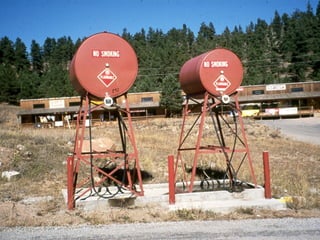
of a fire protection program to be followed
throughout all phases of the construction and
demolition work, and he shall provide for the
firefighting equipment as specified in this subpart.
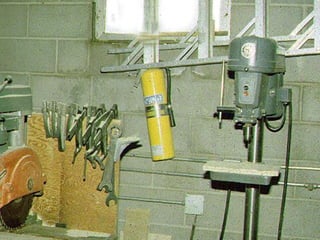
As fire hazards occur, there shall be no delay in
providing the necessary equipment.”
                                                       2
OCCUPATIONAL SAFETY AND HEALTH
      OSHA               ADMINISTRATION

Subpart F – Fire protection and prevention
             1926.150 Fire protection

1926.150(a)(2) “Access to all available firefighting
equipment shall be maintained at all times.”

1926.150(a)(3) “All firefighting equipment, provided
by the employer, shall be conspicuously located.”


                                                       3
4
OCCUPATIONAL SAFETY AND HEALTH
      OSHA               ADMINISTRATION

Subpart F – Fire protection and prevention
             1926.150 Fire protection
1926.150(c) Portable firefighting equipment-(1) Fire
extinguishers and small hose lines. (i) “A fire
extinguisher, rated not less than 2A, shall be provided
for each 3,000 square feet of the protected building
area, or major fraction thereof. Travel distance from
any point of the protected area to the nearest fire
extinguisher shall not exceed 100 feet.”


                                                      5
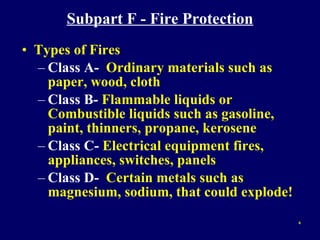
Subpart F - Fire Protection
• Types of Fires
  – Class A- Ordinary materials such as
    paper, wood, cloth
  – Class B- Flammable liquids or
    Combustible liquids such as gasoline,
    paint, thinners, propane, kerosene
  – Class C- Electrical equipment fires,
    appliances, switches, panels
  – Class D- Certain metals such as
    magnesium, sodium, that could explode!
                                             6
Types of Fires
                                         Combustible
  Ordinary      Flammable   Electrical


   A             B
                 Liquids
                             C
                            Equipment
                                            D
Combustibles                               Metals


                                                       7
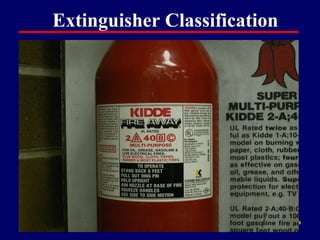
Extinguisher Classification


                              8
OCCUPATIONAL SAFETY AND HEALTH
     OSHA                ADMINISTRATION

Subpart F – Fire protection and prevention
             1926.150 Fire protection
1926.150(c)(1)(ii) “One 55-gallon open drum of water
with two fire pails may be substituted for a fire
extinguisher having a 2A rating.”

1926.150(c)(1)(v) “Extinguishers and water drums,
subject to freezing, shall be protected from freezing.”


                                                      9
OCCUPATIONAL SAFETY AND HEALTH
      OSHA                ADMINISTRATION

Subpart F – Fire protection and prevention
              1926.150 Fire protection
1926.150(c)(1)(vii) “Carbon tetrachloride and other
toxic vaporizing liquid fire extinguishers are
prohibited.”

1926.150(c)(1)(viii) “Portable fire extinguishers shall
be inspected periodically and maintained in
accordance with Maintenance and Use of Portable
Fire Extinguishers, NFPA No. 10A-1970.”

                                                          10
11
OCCUPATIONAL SAFETY AND HEALTH
     OSHA                  ADMINISTRATION

 Subpart F – Fire protection and prevention
               1926.150 Fire protection
1926.150(d)(2) Standpipes. “In all structures in which
standpipes are required, or where standpipes exist in
structures being altered, they shall be brought up as
soon as applicable laws permit, and shall be maintained
as construction progresses in such a manner that they
are always ready for fire protection use. The standpipes
shall be provided with Siamese fire department
connections on the outside of the structure, at the street
level, which shall be conspicuously marked. There shall
be at least one standard hose outlet at each floor.”
13
14
OCCUPATIONAL SAFETY AND HEALTH
      OSHA               ADMINISTRATION

Subpart F – Fire protection and prevention
              1926.150 Fire protection
1926.150(e) Fire alarm devices. (1) “An alarm system e.g.,
telephone system, siren, etc., shall be established by the
employer whereby employees on the site and the local
fire department can be alerted for an emergency.”


                                                      15
OCCUPATIONAL SAFETY AND HEALTH
    OSHA                   ADMINISTRATION

Subpart F – Fire protection and prevention
   1926.152 Flammable and combustible liquids
1926.152(a) General requirements. (1) “Only approved
containers and portable tanks shall be used for storage
and handling of flammable and combustible liquids.
Approved safety cans or Department of Transportation
approved containers shall be used for the handling and
use of flammable liquids in quantities of 5 gallons or less,
except that this shall not apply to those flammable liquid
materials which are highly viscid (extremely hard to
pour), which may be used and handled in original
shipping containers. For quantities of one gallon or less,
the original container may be used, for storage, use and
handling of flammable liquids.”
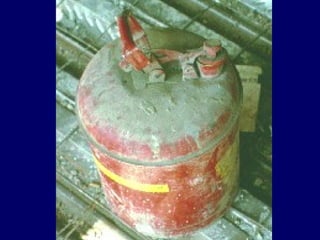
Approved Safety Can


                      17
OCCUPATIONAL SAFETY AND HEALTH
    OSHA                 ADMINISTRATION

Subpart F – Fire protection and prevention
  1926.152 Flammable and combustible liquids
1926.152(b) Indoor storage of flammable and
combustible liquids. (1) “No more than 25 gallons of
flammable liquids shall be stored in a room outside of
an approved storage cabinet. For storage of liquefied
petroleum gas, see 1926.153.”


                                                     19
20
OCCUPATIONAL SAFETY AND HEALTH
    OSHA                  ADMINISTRATION

Subpart F – Fire protection and prevention
  1926.152 Flammable and combustible liquids
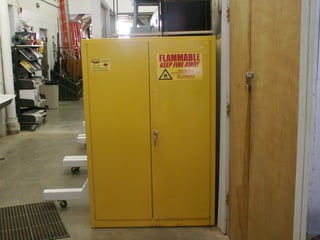
1926.152(b)(2)(iii) “Cabinets shall be labeled in
conspicuous lettering. Flammable-Keep Fire away.”

1926.152(b)(3) “Not more than 60 gallons of flammable
or 120 gallons of combustible liquids shall be stored in
any one storage cabinet. Not more than three such
cabinets may be located in a single storage area.
Quantities in excess of this shall be stored in an inside
storage room.”
                                                       21
22
OCCUPATIONAL SAFETY AND HEALTH
    OSHA                 ADMINISTRATION

Subpart F – Fire protection and prevention
  1926.152 Flammable and combustible liquids
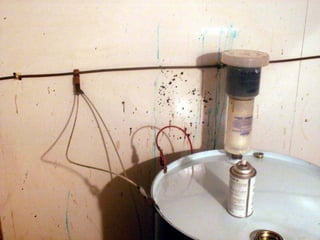
1926.152(e)(2) “Transfer of flammable liquids from one
container to another shall be done only when
containers are electrically interconnected (bonded).”


                                                   23
24
OCCUPATIONAL SAFETY AND HEALTH
    OSHA                 ADMINISTRATION

Subpart F – Fire protection and prevention
  1926.152 Flammable and combustible liquids
1926.152(g) Service and refueling areas. (1)
“Flammable or combustible liquids shall be stored in
approved closed containers, in tanks located
underground, or in aboveground portable tanks.”

1926.152(g)(9) “Conspicuous and legible signs
prohibiting smoking shall be posted.”

1926.152(g)(10) “The motors of all equipment being
fueled shall be shut off during the fueling operation.”
OCCUPATIONAL SAFETY AND HEALTH
    OSHA                ADMINISTRATION

Subpart F – Fire protection and prevention
 1926.155 Definitions applicable to this subpart
1926.155(a) Approved “for the purpose of this
subpart, means equipment that has been listed or
approved by a nationally recognized testing
laboratory such as Factory Mutual Engineering
Corp., or Underwriters’ Laboratories, Inc., or
Federal agencies such as the Bureau of Mines, or
U.S. Coast Guard, which issue approvals for such
equipment.”

                                                   26
OCCUPATIONAL SAFETY AND HEALTH
    OSHA                  ADMINISTRATION

Subpart F – Fire protection and prevention
 1926.155 Definitions applicable to this subpart
1926.155(b) Closed container “means a container so
sealed by means of a lid or other device that neither
liquid nor vapor will escape from it at ordinary
temperatures.”

1926.155(c) Combustible liquids “means any liquid
having a flash point at or above 1400 F. (600 C.), and
below 2000 F (93.40 C).”

                                                         27
OCCUPATIONAL SAFETY AND HEALTH
    OSHA                  ADMINISTRATION

Subpart F – Fire protection and prevention
 1926.155 Definitions applicable to this subpart
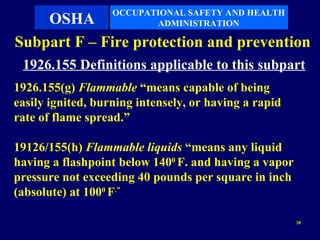
1926.155(g) Flammable “means capable of being
easily ignited, burning intensely, or having a rapid
rate of flame spread.”

19126/155(h) Flammable liquids “means any liquid
having a flashpoint below 1400 F. and having a vapor
pressure not exceeding 40 pounds per square in inch
(absolute) at 1000 F.”

                                                       28
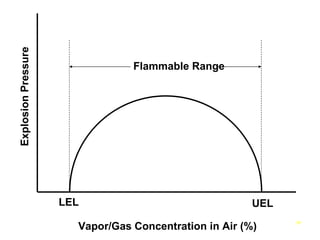
Explosion Pressure


                                 Flammable Range


                     LEL                                UEL

                       Vapor/Gas Concentration in Air (%)
                                                              29
OCCUPATIONAL SAFETY AND HEALTH
    OSHA                 ADMINISTRATION

Subpart F – Fire protection and prevention
 1926.155 Definitions applicable to this subpart
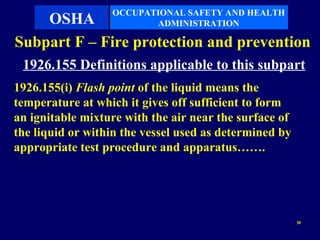
1926.155(i) Flash point of the liquid means the
temperature at which it gives off sufficient to form
an ignitable mixture with the air near the surface of
the liquid or within the vessel used as determined by
appropriate test procedure and apparatus…….


                                                        30
200 Fº
                                 III
                 140 Fº
Flash Point Fº


                                          Combustible
                                 II      Flash point > 100 Fº

                 100 Fº
                                           Flammable
                                 IC      Flash point < 100 Fº
                 73 Fº

                          IA              IB


                               Boiling Point Fº
                                                                31
OCCUPATIONAL SAFETY AND HEALTH
    OSHA                  ADMINISTRATION

Subpart F – Fire protection and prevention
 1926.155 Definitions applicable to this subpart
1926.155(l) Safety can “means an approved closed
container, of not more than 5 gallons capacity,
having a flash-arresting screen, spring-closing lid
and spout cover and so designed that it will safely
relieve internal pressure when subjected to fire
exposure.”


                                                      32
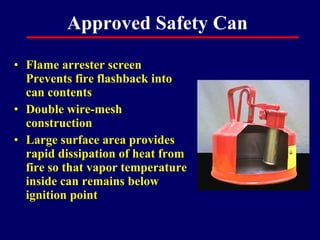
Approved Safety Can

• Flame arrester screen
  Prevents fire flashback into
  can contents
• Double wire-mesh
  construction
• Large surface area provides
  rapid dissipation of heat from
  fire so that vapor temperature
  inside can remains below
  ignition point
34
35
36
37
38
39
40

Subpart F - Fire Protection

  • 1.
  • 2.
    OCCUPATIONAL SAFETY ANDHEALTH OSHA ADMINISTRATION Subpart F – Fire protection and prevention 1926.150 Fire protection 1926.150(a) General requirements. (1) “The employer shall be responsible for the development of a fire protection program to be followed throughout all phases of the construction and demolition work, and he shall provide for the firefighting equipment as specified in this subpart. As fire hazards occur, there shall be no delay in providing the necessary equipment.” 2
  • 3.
    OCCUPATIONAL SAFETY ANDHEALTH OSHA ADMINISTRATION Subpart F – Fire protection and prevention 1926.150 Fire protection 1926.150(a)(2) “Access to all available firefighting equipment shall be maintained at all times.” 1926.150(a)(3) “All firefighting equipment, provided by the employer, shall be conspicuously located.” 3
  • 4.
  • 5.
    OCCUPATIONAL SAFETY ANDHEALTH OSHA ADMINISTRATION Subpart F – Fire protection and prevention 1926.150 Fire protection 1926.150(c) Portable firefighting equipment-(1) Fire extinguishers and small hose lines. (i) “A fire extinguisher, rated not less than 2A, shall be provided for each 3,000 square feet of the protected building area, or major fraction thereof. Travel distance from any point of the protected area to the nearest fire extinguisher shall not exceed 100 feet.” 5
  • 6.
    Subpart F -Fire Protection • Types of Fires – Class A- Ordinary materials such as paper, wood, cloth – Class B- Flammable liquids or Combustible liquids such as gasoline, paint, thinners, propane, kerosene – Class C- Electrical equipment fires, appliances, switches, panels – Class D- Certain metals such as magnesium, sodium, that could explode! 6
  • 7.
    Types of Fires Combustible Ordinary Flammable Electrical A B Liquids C Equipment D Combustibles Metals 7
  • 8.
  • 9.
    OCCUPATIONAL SAFETY ANDHEALTH OSHA ADMINISTRATION Subpart F – Fire protection and prevention 1926.150 Fire protection 1926.150(c)(1)(ii) “One 55-gallon open drum of water with two fire pails may be substituted for a fire extinguisher having a 2A rating.” 1926.150(c)(1)(v) “Extinguishers and water drums, subject to freezing, shall be protected from freezing.” 9
  • 10.
    OCCUPATIONAL SAFETY ANDHEALTH OSHA ADMINISTRATION Subpart F – Fire protection and prevention 1926.150 Fire protection 1926.150(c)(1)(vii) “Carbon tetrachloride and other toxic vaporizing liquid fire extinguishers are prohibited.” 1926.150(c)(1)(viii) “Portable fire extinguishers shall be inspected periodically and maintained in accordance with Maintenance and Use of Portable Fire Extinguishers, NFPA No. 10A-1970.” 10
  • 11.
  • 12.
    OCCUPATIONAL SAFETY ANDHEALTH OSHA ADMINISTRATION Subpart F – Fire protection and prevention 1926.150 Fire protection 1926.150(d)(2) Standpipes. “In all structures in which standpipes are required, or where standpipes exist in structures being altered, they shall be brought up as soon as applicable laws permit, and shall be maintained as construction progresses in such a manner that they are always ready for fire protection use. The standpipes shall be provided with Siamese fire department connections on the outside of the structure, at the street level, which shall be conspicuously marked. There shall be at least one standard hose outlet at each floor.”
  • 13.
  • 14.
  • 15.
    OCCUPATIONAL SAFETY ANDHEALTH OSHA ADMINISTRATION Subpart F – Fire protection and prevention 1926.150 Fire protection 1926.150(e) Fire alarm devices. (1) “An alarm system e.g., telephone system, siren, etc., shall be established by the employer whereby employees on the site and the local fire department can be alerted for an emergency.” 15
  • 16.
    OCCUPATIONAL SAFETY ANDHEALTH OSHA ADMINISTRATION Subpart F – Fire protection and prevention 1926.152 Flammable and combustible liquids 1926.152(a) General requirements. (1) “Only approved containers and portable tanks shall be used for storage and handling of flammable and combustible liquids. Approved safety cans or Department of Transportation approved containers shall be used for the handling and use of flammable liquids in quantities of 5 gallons or less, except that this shall not apply to those flammable liquid materials which are highly viscid (extremely hard to pour), which may be used and handled in original shipping containers. For quantities of one gallon or less, the original container may be used, for storage, use and handling of flammable liquids.”
  • 17.
  • 19.
    OCCUPATIONAL SAFETY ANDHEALTH OSHA ADMINISTRATION Subpart F – Fire protection and prevention 1926.152 Flammable and combustible liquids 1926.152(b) Indoor storage of flammable and combustible liquids. (1) “No more than 25 gallons of flammable liquids shall be stored in a room outside of an approved storage cabinet. For storage of liquefied petroleum gas, see 1926.153.” 19
  • 20.
  • 21.
    OCCUPATIONAL SAFETY ANDHEALTH OSHA ADMINISTRATION Subpart F – Fire protection and prevention 1926.152 Flammable and combustible liquids 1926.152(b)(2)(iii) “Cabinets shall be labeled in conspicuous lettering. Flammable-Keep Fire away.” 1926.152(b)(3) “Not more than 60 gallons of flammable or 120 gallons of combustible liquids shall be stored in any one storage cabinet. Not more than three such cabinets may be located in a single storage area. Quantities in excess of this shall be stored in an inside storage room.” 21
  • 22.
  • 23.
    OCCUPATIONAL SAFETY ANDHEALTH OSHA ADMINISTRATION Subpart F – Fire protection and prevention 1926.152 Flammable and combustible liquids 1926.152(e)(2) “Transfer of flammable liquids from one container to another shall be done only when containers are electrically interconnected (bonded).” 23
  • 24.
  • 25.
    OCCUPATIONAL SAFETY ANDHEALTH OSHA ADMINISTRATION Subpart F – Fire protection and prevention 1926.152 Flammable and combustible liquids 1926.152(g) Service and refueling areas. (1) “Flammable or combustible liquids shall be stored in approved closed containers, in tanks located underground, or in aboveground portable tanks.” 1926.152(g)(9) “Conspicuous and legible signs prohibiting smoking shall be posted.” 1926.152(g)(10) “The motors of all equipment being fueled shall be shut off during the fueling operation.”
  • 26.
    OCCUPATIONAL SAFETY ANDHEALTH OSHA ADMINISTRATION Subpart F – Fire protection and prevention 1926.155 Definitions applicable to this subpart 1926.155(a) Approved “for the purpose of this subpart, means equipment that has been listed or approved by a nationally recognized testing laboratory such as Factory Mutual Engineering Corp., or Underwriters’ Laboratories, Inc., or Federal agencies such as the Bureau of Mines, or U.S. Coast Guard, which issue approvals for such equipment.” 26
  • 27.
    OCCUPATIONAL SAFETY ANDHEALTH OSHA ADMINISTRATION Subpart F – Fire protection and prevention 1926.155 Definitions applicable to this subpart 1926.155(b) Closed container “means a container so sealed by means of a lid or other device that neither liquid nor vapor will escape from it at ordinary temperatures.” 1926.155(c) Combustible liquids “means any liquid having a flash point at or above 1400 F. (600 C.), and below 2000 F (93.40 C).” 27
  • 28.
    OCCUPATIONAL SAFETY ANDHEALTH OSHA ADMINISTRATION Subpart F – Fire protection and prevention 1926.155 Definitions applicable to this subpart 1926.155(g) Flammable “means capable of being easily ignited, burning intensely, or having a rapid rate of flame spread.” 19126/155(h) Flammable liquids “means any liquid having a flashpoint below 1400 F. and having a vapor pressure not exceeding 40 pounds per square in inch (absolute) at 1000 F.” 28
  • 29.
    Explosion Pressure Flammable Range LEL UEL Vapor/Gas Concentration in Air (%) 29
  • 30.
    OCCUPATIONAL SAFETY ANDHEALTH OSHA ADMINISTRATION Subpart F – Fire protection and prevention 1926.155 Definitions applicable to this subpart 1926.155(i) Flash point of the liquid means the temperature at which it gives off sufficient to form an ignitable mixture with the air near the surface of the liquid or within the vessel used as determined by appropriate test procedure and apparatus……. 30
  • 31.
    200 Fº III 140 Fº Flash Point Fº Combustible II Flash point > 100 Fº 100 Fº Flammable IC Flash point < 100 Fº 73 Fº IA IB Boiling Point Fº 31
  • 32.
    OCCUPATIONAL SAFETY ANDHEALTH OSHA ADMINISTRATION Subpart F – Fire protection and prevention 1926.155 Definitions applicable to this subpart 1926.155(l) Safety can “means an approved closed container, of not more than 5 gallons capacity, having a flash-arresting screen, spring-closing lid and spout cover and so designed that it will safely relieve internal pressure when subjected to fire exposure.” 32
  • 33.
    Approved Safety Can •Flame arrester screen Prevents fire flashback into can contents • Double wire-mesh construction • Large surface area provides rapid dissipation of heat from fire so that vapor temperature inside can remains below ignition point
  • 34.
  • 35.
  • 36.
  • 37.
  • 38.
  • 39.
  • 40.