Fall Protection for Construction
       A Survival Guide
          Georgia Tech
Statistics
• Falls are the number one cause of fatalities in the
  construction industry.
• 150-200 workers are killed each year and more
  than 100,000 injured as a result of falls.
• Overall (including general industry) falls are the
  number two biggest cause of fatalities in the U.S.
  (motor vehicle accidents are number one).
Statistics
•   Falls        33%
•   Struck By    18%
•   Electrical   17%
•   Caught In    18%
Statistics
• 40% of the fatalities were from heights over
  40 feet
• Most falls occur on scaffolds or roofs
• 25% of fall fatalities were from heights of
  11-20 feet
• 25% of fall fatalities were from heights of
  20-30 feet
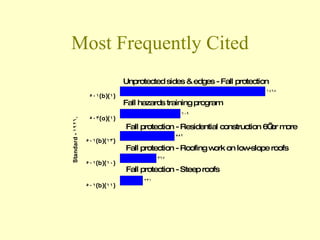
Most Frequently Cited
                                Unprotected sides & edges - Fall protection
                                                                          1468
                    501(b)(1)
                                Fall hazards training program
                                                    609
                    503(a)(1)
Standard - 1926.


                                Fall protection - Residential construction 6’ m
                                                                             or ore
                                                  552
                   501(b)(13)
                                Fall protection - Roofing w on low
                                                           ork    -slope roofs
                                            367
                   501(b)(10)
                                Fall protection - Steep roofs
                                      231
                   501(b)(11)
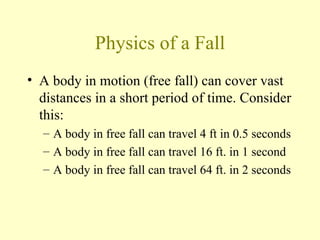
Physics of a Fall
• A body in motion (free fall) can cover vast
  distances in a short period of time. Consider
  this:
  – A body in free fall can travel 4 ft in 0.5 seconds
  – A body in free fall can travel 16 ft. in 1 second
  – A body in free fall can travel 64 ft. in 2 seconds
Application of Regulations
• Subpart M (1926.500) applies to fall
  protection during construction activities.
• There are a few exceptions from this rule
  for the following activities:
  – Inspection
  – Investigation
  – Assessing conditions prior to or after the work
    is performed
Application of Regulations
• Other existing standards for fall protection
  are discussed in different standards (subpart
  M would not cover the following items):
  –   Scaffolds (subpart L)
  –   Cranes (subpart N)
  –   Steel Erection (subpart R)
  –   Stairs and Ladders (subpart X)
  –   Power Transmission (Subpart V)
Contents of Subpart M
• 500: Scope,              • Appendices
  Application and            – A: Roof widths
  definitions                – B: Guardrail systems
• 501: Duty to have fall     – C: Fall arrest systems
  protection                 – D: Positioning device
• 502: Fall protection         systems
  systems                    – E: Fall Protection Plan
• 503: Training
  Requirements
Duty to Have Fall Protection
            1926.501
• Fall protection is required when one or
  more employees have exposure to falls of
  six feet or greater to the lower level.
• Surfaces must be inspected before the work
  begins.
• Employees are only permitted to be on
  surfaces that are strong enough to support
  them.
Duty to have Fall Protection
• The following areas             – Unprotected sides and
  require fall protection           edges
  when employees are              – Above dangerous
                                    equipment (any height)
  exposed to falls (six feet
                                  – Overhand brick laying
  or greater):
                                  – Steep or low slope roofs
   –   Leading edges
                                  – Walking surfaces
   –   Ramps/runways
                                  – Form work and reinforcing
   –   Residential construction     steel
   –   Hoist areas                – Excavations, wells, pits
   –   Wall and floor openings    – Precast concrete
Duty to have Fall Protection
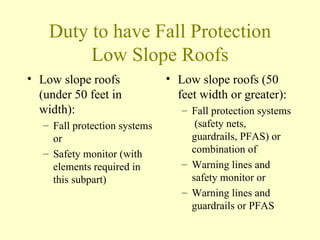
         Low Slope Roofs
• Low slope roofs              • Low slope roofs (50
  (under 50 feet in              feet width or greater):
  width):                         – Fall protection systems
   – Fall protection systems         (safety nets,
     or                             guardrails, PFAS) or
   – Safety monitor (with           combination of
     elements required in         – Warning lines and
     this subpart)                  safety monitor or
                                  – Warning lines and
                                    guardrails or PFAS
Protection from Falling Objects
           1926.501(c)
• Protection from falling objects is a
  requirement.
• Employee working in an area where there is
  a danger of falling objects must wear a hard
  hat.
• Employer must take steps to protect
  employees from hazards (establish
  barricades or build canopies).
Types of Fall Protection
• Passive are protective systems that do not
  involve the actions of employees.

• Active includes systems and components
  that require manipulation by employees to
  make them effective in providing
  protection.
Examples of Fall Protection
• Passive system    • Active systems
  include:            components (personal
  –   Guardrails      fall arrest system-
  –   Safety nets     PFAS) include:
  –   Covers          –   Anchorage points
  –   Fences          –   Lanyard
  –   Barricades      –   Snap hooks
                      –   Life lines
                      –   Body harness
Active Systems
• Designed to operate in free fall situations.
• Must be connected to other
  systems/components or activated to provide
  protection.
• Active systems are designed to protect
  employees from the following items:
  – Falls
  – Forces that can cause injury
Guardrails 1926.502(b)
• Guardrails are the        • Must have top rail,
  most common form of         mid rail, posts and toe
  fall protection.            board
• May be made of wood, • System must be strong
  pipe, structural steel,     enough to support 200
  or wire rope.               pounds of force
   – Flags must be provided   applied to the top rail
     on wire rope to        • Steel or plastic bands
     increase visibility
                              are not acceptable
Guardrails-Design Criteria
           1926.502(b)
• The top rail must be elevated above the surface
  39-45 inches and must be free of jagged edges.
• The mid rail must be located between the top rail
  and the walking surface.
• Posts must be spaced no greater than 8 feet.
• Toe boards must be made of a solid material with
  no openings greater than one inch and be 3.5
  inches high.
• Chains or movable rails must be used near hoists.
Safety Net Systems
              1926.502(c)
• Placed beneath the working surface (not to exceed
  30 feet) to catch personnel or falling material.
• Must be placed as close to the hazard as possible.
• Equipment must be drop tested and certified.
• Must be inspected weekly and after impact.
• Openings can not exceed six inches.
• Defective equipment can not be used.
• Safety nets must extend outward from the outer
  most projection of the work surfaces.
PFAS 1926.502(d)
• PFAS shall not be tied to a guardrail system
  or hoists
• All components of a fall arrest system must
  be inspected before each use and after
  impact.
• Action must be taken promptly to rescue
  fallen employees.
PFAS 1926.502(d)
• When stopping a fall, a PFAS must:
  – Limit the arresting force to 1800 pounds.
  – Be rigid so that an employee can not fall more
    than 6 feet of contact a lower level.
  – Bring an employee to a complete stop and limit
    maximum deceleration distance an employee
    travels to 3.5 feet.
  – Strength to withstand 2X potential impact of
    employee falling 6 ft. or permitted fall distance.
Inspecting Equipment
             1926.502(d)
• Equipment must be        • The following items
  inspected before each      must be inspected:
  use for:                   – Tears or other wear
   – Degradation due to      – Deformed eyelets, D
     ultraviolet light         rings or other parts
   – Any other condition     – Labels/placards
     that is not normal      – Dirt, grease, and oil
PFAS (Harness) 1926.502(d)
• Harness systems consist of either nylon or
  polyester and the best system will
  encompass the entire body (full body
  harness).
• Body belts can not be used for fall
  protection.
• A full body harness will evenly distribute
  weight across the waist, pelvis, and thighs.
PFAS (Lanyard) 1926.502(d)
• Lanyards connect the harness to the anchorage
  point.
• Must have a minimum breaking strength of 5000
  pounds.
• Should be attached to a D ring between the
  shoulder blades above the employee.
• There are several types of lanyards that include:
  synthetic webbing, synthetic rope and shock
  absorbing.
Types of Lanyards
• Self retracting
   – Eliminates excess slack in the lanyard (cable, rope, or
     web)
• Shock absorbing
   – Device slows and eventually stops decent and absorbs
     the forces (i.e.: rip stitch controlled tearing)
• Synthetic rope
   – Absorbs some of the force by stretching
• Synthetic webbing
   – Strong but not flexible (absorbs little force)
PFAS (life Lines) 1926.502(d)
• Life lines consist of flexible material connected at
  one or both ends to an anchorage point.
• There are two types of life lines:
   – Vertical:hangs vertically (5000 pound minimum
     breaking strength)
   – Horizontal: connects at both points to stretch
     horizontally (serves as connection point for other
     components of PFAS-total system must have safety
     factor of two).
PFAS (Snap hooks) 1926.502(d)
• Used to connect lanyards to D rings on a body
  harness.
• D rings must be compatible. Must be connected to
  harness or anchorage point only.
• Snap hooks must have 5,000 tensile strength and
  be proof tested to 3600 pounds.
• When using snap hooks:
   – Use only one snap hook per D ring to prevent rollout
   – All snap hooks must have a locking mechanism
PFAS (Anchorage Points)
          1926.502(d)
• The anchorage point is most effective when
  it is above the employee’s head. Located as
  to not allow an employee fall more than 6
  feet.
• All anchorage points must be a solid
  immovable object that is capable of
  supporting 5000 pounds.
• Must not be used to support anything else.
Positioning Device Systems
            1926.502(e)
• Allows employee to be supported from a vertical
  surface (i.e.: wall or telephone pole).
• Must be inspected before each use for defects.
• Must be rigid for no more than a 2 foot free fall.
• Not a fall arrest system!
• The anchorage point must be capable of
  withstanding twice the potential impact of an
  employee’s fall or 3000 pounds, whichever is
  greater.
Warning Line System
             1926.502(f)
• Rope, wire, or chains are used to warn employees
  of an unprotected edge.
• Used mainly on roofs , where PFAS- impractical.
• Established not less than six feet from the edge.
• Materials must have sufficient strength and
  complete structure must withstand 16 pound
  tipping force.
Controlled Access Zones (CAZ)
         1926.502(g)
• Only qualified personnel involved in the
  operation are allowed to enter the zone.
• Ropes, wires, or chains are used to
  designate the area.
• Must be erected not less than six feet nor
  more than twenty five feet away from edge.
• Shall be connected on each side to wall.
Controlled Access Zones (CAZ)
          1926.502(g)
• CAZ must be defined by a control line
  (strength of 200 pounds) erected 10-15 feet
  from the edge
• Lines must be flagged at six foot intervals.
Safety Monitoring System
            1926.502(h)
• Uses a monitor (competent person) to patrol
  the area and warn employees of the
  dangers.
• All safety monitors must comply with the
  following criteria:
  – Be on the same level the work is being
    performed
  – Be close enough to orally communicate
  – Have no other assigned duties
Safety Monitoring System
            1926.502(h)
• Employees must comply with all instructions from
  the monitor.
• The full attention of the monitor must focus on
  protecting the employees.
• It is recommended that you have a written plan for
  using the safety monitoring system to address:
   – Identification of the monitor
   – Roles of employees in a monitoring system
   – Training for using the monitoring system.
Covers 1926.502(i)
• Used to protect personnel from falling through
  holes in walking surfaces.
• Covers must be secured in place and the word
  “Hole” must be written on the cover.
• Covers must have sufficient strength to support:
   – Twice the weight to be imposed upon it for pedestrians
   – Twice the largest axle weight of vehicle traffic
Falling Objects 1926.502(j)
• Employers are required to protect their
  employees from falling objects.
• Some methods that might have to be used
  (when necessary) consist of:
  – Installation of toe boards (at least 3.5 inches
    wide)
  – Building barricade and restricting entrance
  – Installation of screens
Fall Protection Plan 1926.502(k)
• Fall protection plans are allowed for the following
  operations:
   – Residential construction
   – Leading edge construction
   – Precast concrete erection
• The plan should be strictly enforced.
• The employer must demonstrate that it is
  impractical to use fall protection before a fall
  protection plan can be used as an alternative.
Fall Protection Plan 1926.502(k)
• Plan must be developed by qualified person
  and made specific for each site (also must
  be up to date).
• Only as qualified person can make changes
  to a plan.
• A copy of the plan must be maintained at
  the site.
Elements of a Fall Protection
               Plan
• Statement of Policy   • Accident Investigation
• Fall Protection       • Changes to the Plan
  Systems to be Used
• Implementation of
  Plan
• Enforcement
Training 1926.503
• All employees exposed to fall hazards must
  receive training by a competent person that
  addresses:
  – The nature of fall hazards in the work area
  – Procedures for erecting, maintaining,
    disassembling and inspecting fall arrest
    equipment
  – Use and operation of fall arrest equipment
Training 1926.503
• Training elements:
  – Role of employee in a safety monitoring system
    (when used)
  – Limitations on the use of mechanical equipment
    for low slope roofs
  – Role of employees in fall protection plans
  – Standards contained in 1926.500-503
  – Procedure for handling and storage of
    equipment
Training 1926.503
• Fall protection training must be certified by
  the employer through a written record.
• The latest training certificate must be
  maintained.
• Retraining is required when:
  – There are changes in the work place
  – Changes in the type of fall protection used
  – There are inadequacies in employee’s skills

Fall Protection, Gtech

  • 1.
    Fall Protection forConstruction A Survival Guide Georgia Tech
  • 2.
    Statistics • Falls arethe number one cause of fatalities in the construction industry. • 150-200 workers are killed each year and more than 100,000 injured as a result of falls. • Overall (including general industry) falls are the number two biggest cause of fatalities in the U.S. (motor vehicle accidents are number one).
  • 3.
    Statistics • Falls 33% • Struck By 18% • Electrical 17% • Caught In 18%
  • 4.
    Statistics • 40% ofthe fatalities were from heights over 40 feet • Most falls occur on scaffolds or roofs • 25% of fall fatalities were from heights of 11-20 feet • 25% of fall fatalities were from heights of 20-30 feet
  • 5.
    Most Frequently Cited Unprotected sides & edges - Fall protection 1468 501(b)(1) Fall hazards training program 609 503(a)(1) Standard - 1926. Fall protection - Residential construction 6’ m or ore 552 501(b)(13) Fall protection - Roofing w on low ork -slope roofs 367 501(b)(10) Fall protection - Steep roofs 231 501(b)(11)
  • 6.
    Physics of aFall • A body in motion (free fall) can cover vast distances in a short period of time. Consider this: – A body in free fall can travel 4 ft in 0.5 seconds – A body in free fall can travel 16 ft. in 1 second – A body in free fall can travel 64 ft. in 2 seconds
  • 7.
    Application of Regulations •Subpart M (1926.500) applies to fall protection during construction activities. • There are a few exceptions from this rule for the following activities: – Inspection – Investigation – Assessing conditions prior to or after the work is performed
  • 8.
    Application of Regulations •Other existing standards for fall protection are discussed in different standards (subpart M would not cover the following items): – Scaffolds (subpart L) – Cranes (subpart N) – Steel Erection (subpart R) – Stairs and Ladders (subpart X) – Power Transmission (Subpart V)
  • 9.
    Contents of SubpartM • 500: Scope, • Appendices Application and – A: Roof widths definitions – B: Guardrail systems • 501: Duty to have fall – C: Fall arrest systems protection – D: Positioning device • 502: Fall protection systems systems – E: Fall Protection Plan • 503: Training Requirements
  • 10.
    Duty to HaveFall Protection 1926.501 • Fall protection is required when one or more employees have exposure to falls of six feet or greater to the lower level. • Surfaces must be inspected before the work begins. • Employees are only permitted to be on surfaces that are strong enough to support them.
  • 11.
    Duty to haveFall Protection • The following areas – Unprotected sides and require fall protection edges when employees are – Above dangerous equipment (any height) exposed to falls (six feet – Overhand brick laying or greater): – Steep or low slope roofs – Leading edges – Walking surfaces – Ramps/runways – Form work and reinforcing – Residential construction steel – Hoist areas – Excavations, wells, pits – Wall and floor openings – Precast concrete
  • 12.
    Duty to haveFall Protection Low Slope Roofs • Low slope roofs • Low slope roofs (50 (under 50 feet in feet width or greater): width): – Fall protection systems – Fall protection systems (safety nets, or guardrails, PFAS) or – Safety monitor (with combination of elements required in – Warning lines and this subpart) safety monitor or – Warning lines and guardrails or PFAS
  • 13.
    Protection from FallingObjects 1926.501(c) • Protection from falling objects is a requirement. • Employee working in an area where there is a danger of falling objects must wear a hard hat. • Employer must take steps to protect employees from hazards (establish barricades or build canopies).
  • 14.
    Types of FallProtection • Passive are protective systems that do not involve the actions of employees. • Active includes systems and components that require manipulation by employees to make them effective in providing protection.
  • 15.
    Examples of FallProtection • Passive system • Active systems include: components (personal – Guardrails fall arrest system- – Safety nets PFAS) include: – Covers – Anchorage points – Fences – Lanyard – Barricades – Snap hooks – Life lines – Body harness
  • 16.
    Active Systems • Designedto operate in free fall situations. • Must be connected to other systems/components or activated to provide protection. • Active systems are designed to protect employees from the following items: – Falls – Forces that can cause injury
  • 17.
    Guardrails 1926.502(b) • Guardrailsare the • Must have top rail, most common form of mid rail, posts and toe fall protection. board • May be made of wood, • System must be strong pipe, structural steel, enough to support 200 or wire rope. pounds of force – Flags must be provided applied to the top rail on wire rope to • Steel or plastic bands increase visibility are not acceptable
  • 18.
    Guardrails-Design Criteria 1926.502(b) • The top rail must be elevated above the surface 39-45 inches and must be free of jagged edges. • The mid rail must be located between the top rail and the walking surface. • Posts must be spaced no greater than 8 feet. • Toe boards must be made of a solid material with no openings greater than one inch and be 3.5 inches high. • Chains or movable rails must be used near hoists.
  • 19.
    Safety Net Systems 1926.502(c) • Placed beneath the working surface (not to exceed 30 feet) to catch personnel or falling material. • Must be placed as close to the hazard as possible. • Equipment must be drop tested and certified. • Must be inspected weekly and after impact. • Openings can not exceed six inches. • Defective equipment can not be used. • Safety nets must extend outward from the outer most projection of the work surfaces.
  • 20.
    PFAS 1926.502(d) • PFASshall not be tied to a guardrail system or hoists • All components of a fall arrest system must be inspected before each use and after impact. • Action must be taken promptly to rescue fallen employees.
  • 21.
    PFAS 1926.502(d) • Whenstopping a fall, a PFAS must: – Limit the arresting force to 1800 pounds. – Be rigid so that an employee can not fall more than 6 feet of contact a lower level. – Bring an employee to a complete stop and limit maximum deceleration distance an employee travels to 3.5 feet. – Strength to withstand 2X potential impact of employee falling 6 ft. or permitted fall distance.
  • 22.
    Inspecting Equipment 1926.502(d) • Equipment must be • The following items inspected before each must be inspected: use for: – Tears or other wear – Degradation due to – Deformed eyelets, D ultraviolet light rings or other parts – Any other condition – Labels/placards that is not normal – Dirt, grease, and oil
  • 23.
    PFAS (Harness) 1926.502(d) •Harness systems consist of either nylon or polyester and the best system will encompass the entire body (full body harness). • Body belts can not be used for fall protection. • A full body harness will evenly distribute weight across the waist, pelvis, and thighs.
  • 24.
    PFAS (Lanyard) 1926.502(d) •Lanyards connect the harness to the anchorage point. • Must have a minimum breaking strength of 5000 pounds. • Should be attached to a D ring between the shoulder blades above the employee. • There are several types of lanyards that include: synthetic webbing, synthetic rope and shock absorbing.
  • 25.
    Types of Lanyards •Self retracting – Eliminates excess slack in the lanyard (cable, rope, or web) • Shock absorbing – Device slows and eventually stops decent and absorbs the forces (i.e.: rip stitch controlled tearing) • Synthetic rope – Absorbs some of the force by stretching • Synthetic webbing – Strong but not flexible (absorbs little force)
  • 26.
    PFAS (life Lines)1926.502(d) • Life lines consist of flexible material connected at one or both ends to an anchorage point. • There are two types of life lines: – Vertical:hangs vertically (5000 pound minimum breaking strength) – Horizontal: connects at both points to stretch horizontally (serves as connection point for other components of PFAS-total system must have safety factor of two).
  • 27.
    PFAS (Snap hooks)1926.502(d) • Used to connect lanyards to D rings on a body harness. • D rings must be compatible. Must be connected to harness or anchorage point only. • Snap hooks must have 5,000 tensile strength and be proof tested to 3600 pounds. • When using snap hooks: – Use only one snap hook per D ring to prevent rollout – All snap hooks must have a locking mechanism
  • 28.
    PFAS (Anchorage Points) 1926.502(d) • The anchorage point is most effective when it is above the employee’s head. Located as to not allow an employee fall more than 6 feet. • All anchorage points must be a solid immovable object that is capable of supporting 5000 pounds. • Must not be used to support anything else.
  • 29.
    Positioning Device Systems 1926.502(e) • Allows employee to be supported from a vertical surface (i.e.: wall or telephone pole). • Must be inspected before each use for defects. • Must be rigid for no more than a 2 foot free fall. • Not a fall arrest system! • The anchorage point must be capable of withstanding twice the potential impact of an employee’s fall or 3000 pounds, whichever is greater.
  • 30.
    Warning Line System 1926.502(f) • Rope, wire, or chains are used to warn employees of an unprotected edge. • Used mainly on roofs , where PFAS- impractical. • Established not less than six feet from the edge. • Materials must have sufficient strength and complete structure must withstand 16 pound tipping force.
  • 31.
    Controlled Access Zones(CAZ) 1926.502(g) • Only qualified personnel involved in the operation are allowed to enter the zone. • Ropes, wires, or chains are used to designate the area. • Must be erected not less than six feet nor more than twenty five feet away from edge. • Shall be connected on each side to wall.
  • 32.
    Controlled Access Zones(CAZ) 1926.502(g) • CAZ must be defined by a control line (strength of 200 pounds) erected 10-15 feet from the edge • Lines must be flagged at six foot intervals.
  • 33.
    Safety Monitoring System 1926.502(h) • Uses a monitor (competent person) to patrol the area and warn employees of the dangers. • All safety monitors must comply with the following criteria: – Be on the same level the work is being performed – Be close enough to orally communicate – Have no other assigned duties
  • 34.
    Safety Monitoring System 1926.502(h) • Employees must comply with all instructions from the monitor. • The full attention of the monitor must focus on protecting the employees. • It is recommended that you have a written plan for using the safety monitoring system to address: – Identification of the monitor – Roles of employees in a monitoring system – Training for using the monitoring system.
  • 35.
    Covers 1926.502(i) • Usedto protect personnel from falling through holes in walking surfaces. • Covers must be secured in place and the word “Hole” must be written on the cover. • Covers must have sufficient strength to support: – Twice the weight to be imposed upon it for pedestrians – Twice the largest axle weight of vehicle traffic
  • 36.
    Falling Objects 1926.502(j) •Employers are required to protect their employees from falling objects. • Some methods that might have to be used (when necessary) consist of: – Installation of toe boards (at least 3.5 inches wide) – Building barricade and restricting entrance – Installation of screens
  • 37.
    Fall Protection Plan1926.502(k) • Fall protection plans are allowed for the following operations: – Residential construction – Leading edge construction – Precast concrete erection • The plan should be strictly enforced. • The employer must demonstrate that it is impractical to use fall protection before a fall protection plan can be used as an alternative.
  • 38.
    Fall Protection Plan1926.502(k) • Plan must be developed by qualified person and made specific for each site (also must be up to date). • Only as qualified person can make changes to a plan. • A copy of the plan must be maintained at the site.
  • 39.
    Elements of aFall Protection Plan • Statement of Policy • Accident Investigation • Fall Protection • Changes to the Plan Systems to be Used • Implementation of Plan • Enforcement
  • 40.
    Training 1926.503 • Allemployees exposed to fall hazards must receive training by a competent person that addresses: – The nature of fall hazards in the work area – Procedures for erecting, maintaining, disassembling and inspecting fall arrest equipment – Use and operation of fall arrest equipment
  • 41.
    Training 1926.503 • Trainingelements: – Role of employee in a safety monitoring system (when used) – Limitations on the use of mechanical equipment for low slope roofs – Role of employees in fall protection plans – Standards contained in 1926.500-503 – Procedure for handling and storage of equipment
  • 42.
    Training 1926.503 • Fallprotection training must be certified by the employer through a written record. • The latest training certificate must be maintained. • Retraining is required when: – There are changes in the work place – Changes in the type of fall protection used – There are inadequacies in employee’s skills