1
OCCUPATIONAL SAFETY AND HEALTH
       OSHA               ADMINISTRATION

            Subpart R – Steel Erection
                 1926.750 Scope
1926.750(a) “This subpart sets forth requirements to
protect employees from the hazards associated with
steel erection activities involved in the construction,
alteration, and/or repair of single and multi-story
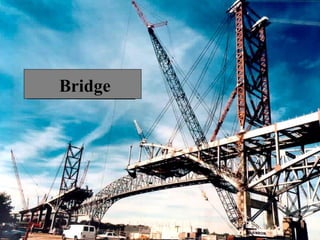
buildings, bridges, and other structures where steel
erection occurs. The requirements of this subpart
apply to employees engaged in steel erection unless
otherwise specified. This subpart does not cover
electrical transmission towers, communication and
broadcast towers, or tanks.”                              2
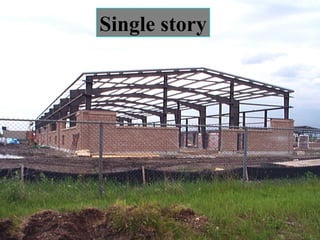
Single story


               3
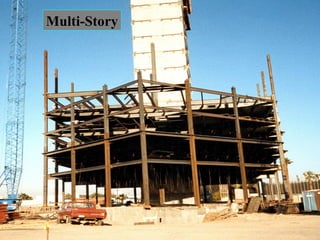
Multi-Story


              4
Bridge


         5
OCCUPATIONAL SAFETY AND HEALTH
 OSHA               ADMINISTRATION

      Subpart R – Steel Erection
           1926.750 Scope
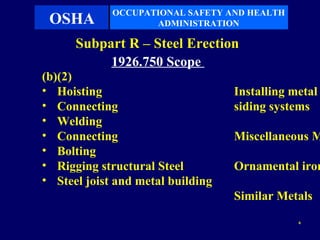
(b)(2)
• Hoisting                         Installing metal
• Connecting                       siding systems
• Welding
• Connecting                       Miscellaneous M
• Bolting
• Rigging structural Steel         Ornamental iron
• Steel joist and metal building
                                   Similar Metals
                                               6
OCCUPATIONAL SAFETY AND HEALTH
       OSHA               ADMINISTRATION

          Subpart R – Steel Erection
 1926.752 Site Layout. Site-specific erection plan
           and construction sequence
1926.752(a) Approval to begin steel erection. “Before
authorizing the commencement of steel erection, the
controlling contractor shall ensure that the steel
erector is provided with the following notifications;”


                                                         7
OCCUPATIONAL SAFETY AND HEALTH
      OSHA               ADMINISTRATION

         Subpart R – Steel Erection
1926.752 Site Layout. Site-specific erection plan
          and construction sequence
1926.752(a)(1) “The concrete in the footings, piers,
and walls and the mortar in the masonry piers and
walls has attained, on the basis of an appropriate
ASTM standard test method of field-curved samples,
either 75 percent of the intended minimum
compressive design strength or sufficient strength to
support the loads imposed during steel erection.”

                                                        8
OCCUPATIONAL SAFETY AND HEALTH
      OSHA               ADMINISTRATION

         Subpart R – Steel Erection
1926.752 Site Layout. Site-specific erection plan
          and construction sequence
1926.752(a)(2) “Any repairs, replacements and
modifications to the anchor bolts were conducted in
accordance with 1926.755(b).”


                                                      9
OCCUPATIONAL SAFETY AND HEALTH
       OSHA               ADMINISTRATION

         Subpart R – Steel Erection
1926.752 Site Layout. Site-specific erection plan
          and construction sequence
1926.752(b) Commencement of steel erection. “A steel
erection contractor shall not erect steel unless it has
received written notification that the concrete in the
footings, piers, and walls or the mortar in the
masonry piers and walls has attained, on the basis of
an appropriate ASTM standard test method of field-
cured samples, either 75 percent of the intended
minimum compressive design strength or sufficient
strength to support the loads imposed during steel        10


erection.”
OCCUPATIONAL SAFETY AND HEALTH
       OSHA                ADMINISTRATION

          Subpart R – Steel Erection
 1926.752 Site Layout. Site-specific erection plan
           and construction sequence
1926.752(c) Site layout. “The controlling contractor shall
ensure that the following is provided and maintained;”

1926.752(c)(1) “Adequate access roads into and through
the site for the safe delivery and movement of derricks,
cranes, trucks, other necessary equipment, and the
material to be erected and means and methods for
pedestrian and vehicular control. Exception: this
requirement does not apply to roads outside of the
construction site.”                                          11
OCCUPATIONAL SAFETY AND HEALTH
       OSHA               ADMINISTRATION

         Subpart R – Steel Erection
1926.752 Site Layout. Site-specific erection plan
          and construction sequence
1926.752(c)(2) “A firm, properly graded, drained
area, readily accessible to the work with adequate
space for the safe storage of materials and the safe
operation of the erector’s equipment.”


                                                       12
OCCUPATIONAL SAFETY AND HEALTH
       OSHA               ADMINISTRATION

            Subpart R – Steel Erection
           1926.753 Hoisting and rigging
1926.753(c) General. (1) “Pre-shift visual inspection
of cranes.”

1926.753(c)(1)(i) Cranes being used in steel erection
activities shall be visually inspected prior to each
shift by a competent person; the inspection shall
include observation for deficiencies during
operation……..

                                                        13
OCCUPATIONAL SAFETY AND HEALTH
       OSHA               ADMINISTRATION

            Subpart R – Steel Erection
           1926.753 Hoisting and rigging
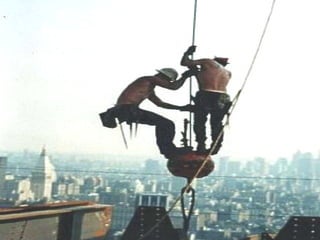
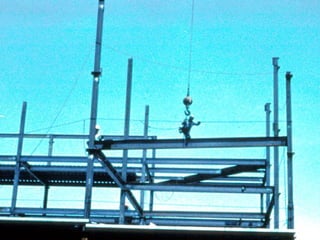
1926.753(c)(3) “The headache ball, hook or load shall
not be used to transport personnel except as provided
in paragraph (c)(4) of this section.”

1926.753(c)(4) “Cranes or derricks may be used to
hoist employees on a personnel platform when work
under this subpart is being conducted, provided that
all provisions of 1926.550 (except for 1926.550(g)(2))
are met.”
                                                         14
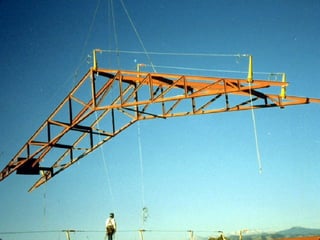
15
OCCUPATIONAL SAFETY AND HEALTH
       OSHA               ADMINISTRATION

            Subpart R – Steel Erection
           1926.753 Hoisting and rigging
1926.753(d) Working under loads.

1926.753(d)(1) “Routes for suspended loads shall be
pre-planned to ensure that no employee is required to
work directly below a suspended load except for;”

1926.753(d)(1)(i) “Employees engaged in the initial
connection of the steel; or”

1926.753(d)(1)(ii) “Employees necessary for the         16

hooking or unhooking of the load.”
17
OCCUPATIONAL SAFETY AND HEALTH
        OSHA                ADMINISTRATION

             Subpart R – Steel Erection
            1926.753 Hoisting and rigging
1926.753(d)(2) “When working under suspended loads, the
following criteria shall be met:”

1926.753(d)(2)(i) “Materials being hoisted shall be rigged
to prevent unintentional displacement:”

1926.753(d)(2)(ii) “Hooks with self-closing safety latches or
their equivalent shall be used to prevent components from
slipping out of the hook; and”

1926.753(d)(2)(iii) “All loads shall be rigged by a qualified
rigger.”
OCCUPATIONAL SAFETY AND HEALTH
       OSHA               ADMINISTRATION

            Subpart R – Steel Erection
           1926.753 Hoisting and rigging
1926.753(e) “Multiple lift rigging procedures.”

1926.753(e)(1) “A multiple lift shall only be performed
if the following criteria are met:”

1926.753(e)(1)(i) “A multiple lift rigging assembly is
used.”

1926.753(e)(1)(ii) “A maximum of five members are
hoisted per lift;”                                       19
OCCUPATIONAL SAFETY AND HEALTH
       OSHA               ADMINISTRATION

            Subpart R – Steel Erection
           1926.753 Hoisting and rigging
1926.753(e)(1)(iii) “Only beams and similar structural
members are lifted; and”

1926.753(e)(1)(iv) “All employees engaged in the
multiple lift have been trained in these procedures in
accordance with 1926.761(c)(1).”


                                                         20
21
22
OCCUPATIONAL SAFETY AND HEALTH
       OSHA                ADMINISTRATION

            Subpart R – Steel Erection
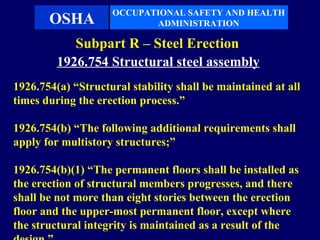
         1926.754 Structural steel assembly
1926.754(a) “Structural stability shall be maintained at all
times during the erection process.”

1926.754(b) “The following additional requirements shall
apply for multistory structures;”

1926.754(b)(1) “The permanent floors shall be installed as
the erection of structural members progresses, and there
shall be not more than eight stories between the erection
floor and the upper-most permanent floor, except where
the structural integrity is maintained as a result of the
OCCUPATIONAL SAFETY AND HEALTH
       OSHA               ADMINISTRATION

           Subpart R – Steel Erection
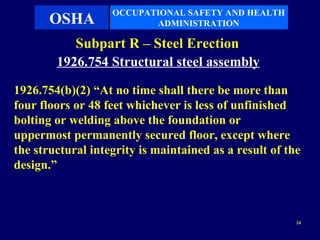
        1926.754 Structural steel assembly

1926.754(b)(2) “At no time shall there be more than
four floors or 48 feet whichever is less of unfinished
bolting or welding above the foundation or
uppermost permanently secured floor, except where
the structural integrity is maintained as a result of the
design.”


                                                        24
OCCUPATIONAL SAFETY AND HEALTH
       OSHA               ADMINISTRATION

            Subpart R – Steel Erection
         1926.754 Structural steel assembly
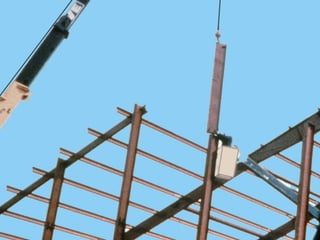
1926.754(b)(3) “A fully planked or decked floor or
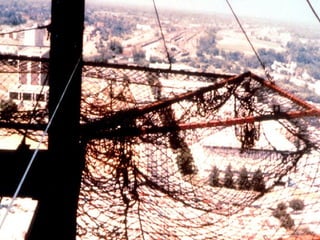
nets shall be maintained within two stories or 30 feet,
whichever is less, directly under any erection work
being performed.”


                                                          25
26
OCCUPATIONAL SAFETY AND HEALTH
       OSHA               ADMINISTRATION

           Subpart R – Steel Erection
        1926.754 Structural steel assembly
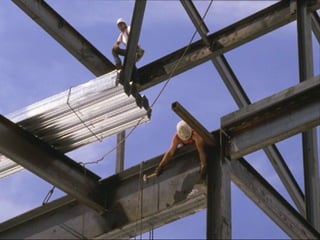
1926.754(e) Metal decking – (1) Hoisting, landing and
placing of metal decking bundles.

1926.754(e)(1)(i) “Bundle packaging and strapping
shall not be used for hoisting unless specifically
designed for that purpose.”

1926.754(e)(1)(ii) “If loose items such as dunnage,
flashing, or other materials are placed on the top of
metal decking bundles to be hoisted, such items shall   27


be secured to the bundles.”
OCCUPATIONAL SAFETY AND HEALTH
       OSHA               ADMINISTRATION

           Subpart R – Steel Erection
        1926.754 Structural steel assembly
1926.754(e)(1)(iv) “Metal decking bundles shall be
landed on framing members so that enough support is
provided to allow the bundles to be unbanded without
dislodging the bundles from the supports.”

1926.754(e)(1)(v) “At the end of the shift or when
environmental or jobsite conditions require, metal
decking shall be secured against displacement.”

                                                     28
29
OCCUPATIONAL SAFETY AND HEALTH
       OSHA               ADMINISTRATION

           Subpart R – Steel Erection
        1926.754 Structural steel assembly
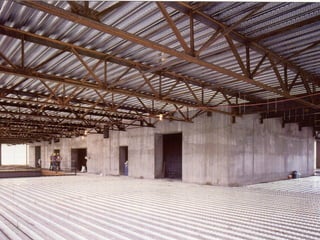
1926.754(e)(5) Installation of metal decking. (i) “Except
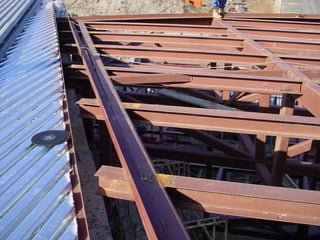
as provided in `1926.760(c), metal decking shall be laid
tightly and immediately secured upon placement to
prevent accidental movement or displacement.”

1926.754(e)(5)(ii) “During initial placement, metal
decking panels shall be placed to ensure full support by
structural members.”

                                                       30
31
OCCUPATIONAL SAFETY AND HEALTH
       OSHA               ADMINISTRATION

            Subpart R – Steel Erection
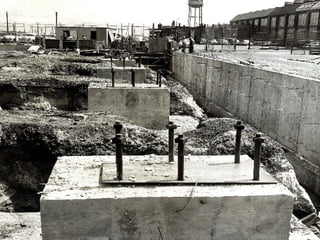
            1926.755 Column anchorage
1926.755(a) General requirements for erection stability.
(1) “All columns shall be anchored by a minimum of 4
anchor rods (anchor bolts).”

1926.755(a)(2) “Each column anchor rod (anchor bolt)
assembly, including the column-to-base plate weld and
the column foundation, shall be designed to resist a
minimum eccentric gravity load of 300 pounds located
18 inches from the extreme outer face of the column in
each direction at the top of the column shaft.”        32
OCCUPATIONAL SAFETY AND HEALTH
       OSHA               ADMINISTRATION

           Subpart R – Steel Erection
           1926.755 Column anchorage
1926.755(a)(3) “Columns shall be set on level finished
floors, pre-grouted leveling plates, leveling nuts, or
shim packs which are adequate to transfer the
construction loads.”

1926.755(a)(4) “All columns shall be evaluated by a
competent person to determine whether guying or
bracing is needed; if guying or bracing is needed, it
shall be installed.”
                                                         33
34
OCCUPATIONAL SAFETY AND HEALTH
       OSHA                ADMINISTRATION

             Subpart R – Steel Erection
            1926.756 Beams and columns
1926.756(a) General. (1) “During the final placing of
solid web structural members, the load shall not be
released from the hoisting line until the members are
secured with at least two bolts per connection, of the
same size and strength as shown in the erection
drawings, drawn up wrench-tight or the equivalent as
specified by the project structural engineer of record,
except as specified in paragraph (b) of this section.”

                                                          35
OCCUPATIONAL SAFETY AND HEALTH
       OSHA              ADMINISTRATION

            Subpart R – Steel Erection
           1926.756 Beams and columns
1926.756(b) Diagonal bracing. “Solid web structural
members used a diagonal bracing shall be secured by
at least one bolt per connection drawn up wrench-
tight or the equivalent as specified by the project
structural engineer of record.”


                                                      36
37
OCCUPATIONAL SAFETY AND HEALTH
      OSHA               ADMINISTRATION

            Subpart R – Steel Erection
           1926.756 Beams and columns
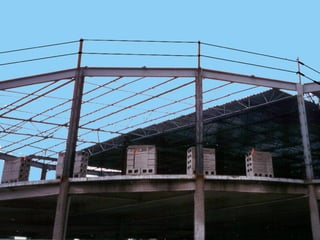
1926.756(e) Perimeter columns. “Perimeter columns
shall not be erected unless;”

1926.756(e)(1) “The perimeter columns extend a
minimum of 48 inches above the finished floor to
permit installation of perimeter safety cables prior to
erection of the next tier, except where constructability
does not allow (see Appendix F to this subpart);”

                                                      38
OCCUPATIONAL SAFETY AND HEALTH
       OSHA               ADMINISTRATION

            Subpart R – Steel Erection
           1926.756 Beams and columns
1926.756(e)(2) “The perimeter columns have holes or
other devices in or attached to perimeter columns at
42-45 inches above the finished floor and the midpoint
between the finished floor and the top cable to permit
installation of perimeter safety cables required by
1926.760(a)(2), except where constructability does not
allow. (See Appendix F to this subpart).”


                                                     39
40
OCCUPATIONAL SAFETY AND HEALTH
       OSHA               ADMINISTRATION

            Subpart R – Steel Erection
           1926.757 Open web steel joists
1926.757(a) General. (1) Except as provided in
paragraph (a)(2) of this section, where steel joists are
used and columns are not framed in at least two
directions with solid web structural steel members, a
steel joist shall be field-bolted at the column to provide
lateral stability to the column during erection……


                                                        41
OCCUPATIONAL SAFETY AND HEALTH
      OSHA               ADMINISTRATION

           Subpart R – Steel Erection
          1926.757 Open web steel joists
1926.757(b) Attachment of steel joists and steel joist
girders. (1) “Each end of “K” series steel joists shall
be attached to the support structure with a minimum
of two 1/8-inch fillet welds 1 inch long or with two ¾
-inch bolts, or the equivalent.”

1926.757(c) Erection of steel joists. See Tables A and
B………

                                                         42
OCCUPATIONAL SAFETY AND HEALTH
       OSHA                ADMINISTRATION

            Subpart R – Steel Erection
           1926.757 Open web steel joists
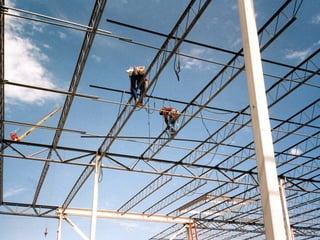
1926.757(d) Erection bridging. (1) See Tables A and
B…………………………

1926.757(e) Landing and placing loads. (1) “During
construction period, the employer placing a load on
steel joists shall ensure that the load is distributed so
as not to exceed the carrying capacity of any steel
joist.”

                                                            43
44
OCCUPATIONAL SAFETY AND HEALTH
      OSHA               ADMINISTRATION

           Subpart R – Steel Erection
        1926.759 Falling object protection
1926.759(a) Securing loose items aloft. “All materials,
equipment, and tools, which are not in use while
aloft, shall be secured against accidental
displacement.”

1926.759(b) Protection from falling objects other than
materials being hoisted. “The controlling contractor
shall bar other construction processes below steel
erection unless overhead protection for the
employees below is provided.”                            45
46
47
OCCUPATIONAL SAFETY AND HEALTH
       OSHA               ADMINISTRATION

            Subpart R – Steel Erection
             1926.760 Fall protection
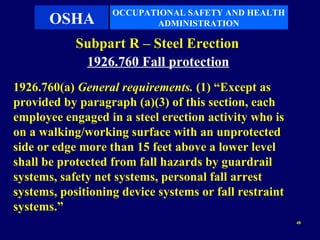
1926.760(a) General requirements. (1) “Except as
provided by paragraph (a)(3) of this section, each
employee engaged in a steel erection activity who is
on a walking/working surface with an unprotected
side or edge more than 15 feet above a lower level
shall be protected from fall hazards by guardrail
systems, safety net systems, personal fall arrest
systems, positioning device systems or fall restraint
systems.”
                                                        48
OCCUPATIONAL SAFETY AND HEALTH
      OSHA                ADMINISTRATION

            Subpart R – Steel Erection
             1926.760 Fall protection
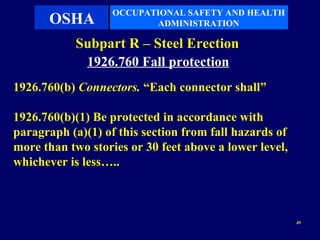
1926.760(b) Connectors. “Each connector shall”

1926.760(b)(1) Be protected in accordance with
paragraph (a)(1) of this section from fall hazards of
more than two stories or 30 feet above a lower level,
whichever is less…..


                                                        49
50
OCCUPATIONAL SAFETY AND HEALTH
      OSHA               ADMINISTRATION

           Subpart R – Steel Erection
            1926.760 Fall protection
1926.760(c) Controlled Decking Zone (CDZ). A
controlled decking zone may be established in that
area of the structure over 15 and up to 30 feet above
a lower level where metal decking is initially being
installed and forms the leading edge of a work
area……

1926.760(c)(1) “Each employee working at the
leading edge in a CDZ shall be protected from fall
hazards of more than two stories or 30 feet whichever   51


is less.”
52
54
55
56
OCCUPATIONAL SAFETY AND HEALTH
      OSHA               ADMINISTRATION

           Subpart R – Steel Erection
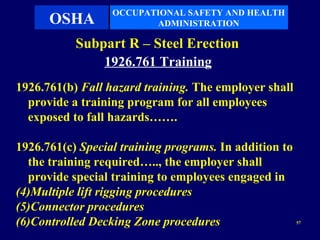
               1926.761 Training
1926.761(b) Fall hazard training. The employer shall
  provide a training program for all employees
  exposed to fall hazards…….

1926.761(c) Special training programs. In addition to
  the training required….., the employer shall
  provide special training to employees engaged in
(4)Multiple lift rigging procedures
(5)Connector procedures
(6)Controlled Decking Zone procedures                   57

Subpart R - Steel Erection

  • 1.
  • 2.
    OCCUPATIONAL SAFETY ANDHEALTH OSHA ADMINISTRATION Subpart R – Steel Erection 1926.750 Scope 1926.750(a) “This subpart sets forth requirements to protect employees from the hazards associated with steel erection activities involved in the construction, alteration, and/or repair of single and multi-story buildings, bridges, and other structures where steel erection occurs. The requirements of this subpart apply to employees engaged in steel erection unless otherwise specified. This subpart does not cover electrical transmission towers, communication and broadcast towers, or tanks.” 2
  • 3.
  • 4.
  • 5.
  • 6.
    OCCUPATIONAL SAFETY ANDHEALTH OSHA ADMINISTRATION Subpart R – Steel Erection 1926.750 Scope (b)(2) • Hoisting Installing metal • Connecting siding systems • Welding • Connecting Miscellaneous M • Bolting • Rigging structural Steel Ornamental iron • Steel joist and metal building Similar Metals 6
  • 7.
    OCCUPATIONAL SAFETY ANDHEALTH OSHA ADMINISTRATION Subpart R – Steel Erection 1926.752 Site Layout. Site-specific erection plan and construction sequence 1926.752(a) Approval to begin steel erection. “Before authorizing the commencement of steel erection, the controlling contractor shall ensure that the steel erector is provided with the following notifications;” 7
  • 8.
    OCCUPATIONAL SAFETY ANDHEALTH OSHA ADMINISTRATION Subpart R – Steel Erection 1926.752 Site Layout. Site-specific erection plan and construction sequence 1926.752(a)(1) “The concrete in the footings, piers, and walls and the mortar in the masonry piers and walls has attained, on the basis of an appropriate ASTM standard test method of field-curved samples, either 75 percent of the intended minimum compressive design strength or sufficient strength to support the loads imposed during steel erection.” 8
  • 9.
    OCCUPATIONAL SAFETY ANDHEALTH OSHA ADMINISTRATION Subpart R – Steel Erection 1926.752 Site Layout. Site-specific erection plan and construction sequence 1926.752(a)(2) “Any repairs, replacements and modifications to the anchor bolts were conducted in accordance with 1926.755(b).” 9
  • 10.
    OCCUPATIONAL SAFETY ANDHEALTH OSHA ADMINISTRATION Subpart R – Steel Erection 1926.752 Site Layout. Site-specific erection plan and construction sequence 1926.752(b) Commencement of steel erection. “A steel erection contractor shall not erect steel unless it has received written notification that the concrete in the footings, piers, and walls or the mortar in the masonry piers and walls has attained, on the basis of an appropriate ASTM standard test method of field- cured samples, either 75 percent of the intended minimum compressive design strength or sufficient strength to support the loads imposed during steel 10 erection.”
  • 11.
    OCCUPATIONAL SAFETY ANDHEALTH OSHA ADMINISTRATION Subpart R – Steel Erection 1926.752 Site Layout. Site-specific erection plan and construction sequence 1926.752(c) Site layout. “The controlling contractor shall ensure that the following is provided and maintained;” 1926.752(c)(1) “Adequate access roads into and through the site for the safe delivery and movement of derricks, cranes, trucks, other necessary equipment, and the material to be erected and means and methods for pedestrian and vehicular control. Exception: this requirement does not apply to roads outside of the construction site.” 11
  • 12.
    OCCUPATIONAL SAFETY ANDHEALTH OSHA ADMINISTRATION Subpart R – Steel Erection 1926.752 Site Layout. Site-specific erection plan and construction sequence 1926.752(c)(2) “A firm, properly graded, drained area, readily accessible to the work with adequate space for the safe storage of materials and the safe operation of the erector’s equipment.” 12
  • 13.
    OCCUPATIONAL SAFETY ANDHEALTH OSHA ADMINISTRATION Subpart R – Steel Erection 1926.753 Hoisting and rigging 1926.753(c) General. (1) “Pre-shift visual inspection of cranes.” 1926.753(c)(1)(i) Cranes being used in steel erection activities shall be visually inspected prior to each shift by a competent person; the inspection shall include observation for deficiencies during operation…….. 13
  • 14.
    OCCUPATIONAL SAFETY ANDHEALTH OSHA ADMINISTRATION Subpart R – Steel Erection 1926.753 Hoisting and rigging 1926.753(c)(3) “The headache ball, hook or load shall not be used to transport personnel except as provided in paragraph (c)(4) of this section.” 1926.753(c)(4) “Cranes or derricks may be used to hoist employees on a personnel platform when work under this subpart is being conducted, provided that all provisions of 1926.550 (except for 1926.550(g)(2)) are met.” 14
  • 15.
  • 16.
    OCCUPATIONAL SAFETY ANDHEALTH OSHA ADMINISTRATION Subpart R – Steel Erection 1926.753 Hoisting and rigging 1926.753(d) Working under loads. 1926.753(d)(1) “Routes for suspended loads shall be pre-planned to ensure that no employee is required to work directly below a suspended load except for;” 1926.753(d)(1)(i) “Employees engaged in the initial connection of the steel; or” 1926.753(d)(1)(ii) “Employees necessary for the 16 hooking or unhooking of the load.”
  • 17.
  • 18.
    OCCUPATIONAL SAFETY ANDHEALTH OSHA ADMINISTRATION Subpart R – Steel Erection 1926.753 Hoisting and rigging 1926.753(d)(2) “When working under suspended loads, the following criteria shall be met:” 1926.753(d)(2)(i) “Materials being hoisted shall be rigged to prevent unintentional displacement:” 1926.753(d)(2)(ii) “Hooks with self-closing safety latches or their equivalent shall be used to prevent components from slipping out of the hook; and” 1926.753(d)(2)(iii) “All loads shall be rigged by a qualified rigger.”
  • 19.
    OCCUPATIONAL SAFETY ANDHEALTH OSHA ADMINISTRATION Subpart R – Steel Erection 1926.753 Hoisting and rigging 1926.753(e) “Multiple lift rigging procedures.” 1926.753(e)(1) “A multiple lift shall only be performed if the following criteria are met:” 1926.753(e)(1)(i) “A multiple lift rigging assembly is used.” 1926.753(e)(1)(ii) “A maximum of five members are hoisted per lift;” 19
  • 20.
    OCCUPATIONAL SAFETY ANDHEALTH OSHA ADMINISTRATION Subpart R – Steel Erection 1926.753 Hoisting and rigging 1926.753(e)(1)(iii) “Only beams and similar structural members are lifted; and” 1926.753(e)(1)(iv) “All employees engaged in the multiple lift have been trained in these procedures in accordance with 1926.761(c)(1).” 20
  • 21.
  • 22.
  • 23.
    OCCUPATIONAL SAFETY ANDHEALTH OSHA ADMINISTRATION Subpart R – Steel Erection 1926.754 Structural steel assembly 1926.754(a) “Structural stability shall be maintained at all times during the erection process.” 1926.754(b) “The following additional requirements shall apply for multistory structures;” 1926.754(b)(1) “The permanent floors shall be installed as the erection of structural members progresses, and there shall be not more than eight stories between the erection floor and the upper-most permanent floor, except where the structural integrity is maintained as a result of the
  • 24.
    OCCUPATIONAL SAFETY ANDHEALTH OSHA ADMINISTRATION Subpart R – Steel Erection 1926.754 Structural steel assembly 1926.754(b)(2) “At no time shall there be more than four floors or 48 feet whichever is less of unfinished bolting or welding above the foundation or uppermost permanently secured floor, except where the structural integrity is maintained as a result of the design.” 24
  • 25.
    OCCUPATIONAL SAFETY ANDHEALTH OSHA ADMINISTRATION Subpart R – Steel Erection 1926.754 Structural steel assembly 1926.754(b)(3) “A fully planked or decked floor or nets shall be maintained within two stories or 30 feet, whichever is less, directly under any erection work being performed.” 25
  • 26.
  • 27.
    OCCUPATIONAL SAFETY ANDHEALTH OSHA ADMINISTRATION Subpart R – Steel Erection 1926.754 Structural steel assembly 1926.754(e) Metal decking – (1) Hoisting, landing and placing of metal decking bundles. 1926.754(e)(1)(i) “Bundle packaging and strapping shall not be used for hoisting unless specifically designed for that purpose.” 1926.754(e)(1)(ii) “If loose items such as dunnage, flashing, or other materials are placed on the top of metal decking bundles to be hoisted, such items shall 27 be secured to the bundles.”
  • 28.
    OCCUPATIONAL SAFETY ANDHEALTH OSHA ADMINISTRATION Subpart R – Steel Erection 1926.754 Structural steel assembly 1926.754(e)(1)(iv) “Metal decking bundles shall be landed on framing members so that enough support is provided to allow the bundles to be unbanded without dislodging the bundles from the supports.” 1926.754(e)(1)(v) “At the end of the shift or when environmental or jobsite conditions require, metal decking shall be secured against displacement.” 28
  • 29.
  • 30.
    OCCUPATIONAL SAFETY ANDHEALTH OSHA ADMINISTRATION Subpart R – Steel Erection 1926.754 Structural steel assembly 1926.754(e)(5) Installation of metal decking. (i) “Except as provided in `1926.760(c), metal decking shall be laid tightly and immediately secured upon placement to prevent accidental movement or displacement.” 1926.754(e)(5)(ii) “During initial placement, metal decking panels shall be placed to ensure full support by structural members.” 30
  • 31.
  • 32.
    OCCUPATIONAL SAFETY ANDHEALTH OSHA ADMINISTRATION Subpart R – Steel Erection 1926.755 Column anchorage 1926.755(a) General requirements for erection stability. (1) “All columns shall be anchored by a minimum of 4 anchor rods (anchor bolts).” 1926.755(a)(2) “Each column anchor rod (anchor bolt) assembly, including the column-to-base plate weld and the column foundation, shall be designed to resist a minimum eccentric gravity load of 300 pounds located 18 inches from the extreme outer face of the column in each direction at the top of the column shaft.” 32
  • 33.
    OCCUPATIONAL SAFETY ANDHEALTH OSHA ADMINISTRATION Subpart R – Steel Erection 1926.755 Column anchorage 1926.755(a)(3) “Columns shall be set on level finished floors, pre-grouted leveling plates, leveling nuts, or shim packs which are adequate to transfer the construction loads.” 1926.755(a)(4) “All columns shall be evaluated by a competent person to determine whether guying or bracing is needed; if guying or bracing is needed, it shall be installed.” 33
  • 34.
  • 35.
    OCCUPATIONAL SAFETY ANDHEALTH OSHA ADMINISTRATION Subpart R – Steel Erection 1926.756 Beams and columns 1926.756(a) General. (1) “During the final placing of solid web structural members, the load shall not be released from the hoisting line until the members are secured with at least two bolts per connection, of the same size and strength as shown in the erection drawings, drawn up wrench-tight or the equivalent as specified by the project structural engineer of record, except as specified in paragraph (b) of this section.” 35
  • 36.
    OCCUPATIONAL SAFETY ANDHEALTH OSHA ADMINISTRATION Subpart R – Steel Erection 1926.756 Beams and columns 1926.756(b) Diagonal bracing. “Solid web structural members used a diagonal bracing shall be secured by at least one bolt per connection drawn up wrench- tight or the equivalent as specified by the project structural engineer of record.” 36
  • 37.
  • 38.
    OCCUPATIONAL SAFETY ANDHEALTH OSHA ADMINISTRATION Subpart R – Steel Erection 1926.756 Beams and columns 1926.756(e) Perimeter columns. “Perimeter columns shall not be erected unless;” 1926.756(e)(1) “The perimeter columns extend a minimum of 48 inches above the finished floor to permit installation of perimeter safety cables prior to erection of the next tier, except where constructability does not allow (see Appendix F to this subpart);” 38
  • 39.
    OCCUPATIONAL SAFETY ANDHEALTH OSHA ADMINISTRATION Subpart R – Steel Erection 1926.756 Beams and columns 1926.756(e)(2) “The perimeter columns have holes or other devices in or attached to perimeter columns at 42-45 inches above the finished floor and the midpoint between the finished floor and the top cable to permit installation of perimeter safety cables required by 1926.760(a)(2), except where constructability does not allow. (See Appendix F to this subpart).” 39
  • 40.
  • 41.
    OCCUPATIONAL SAFETY ANDHEALTH OSHA ADMINISTRATION Subpart R – Steel Erection 1926.757 Open web steel joists 1926.757(a) General. (1) Except as provided in paragraph (a)(2) of this section, where steel joists are used and columns are not framed in at least two directions with solid web structural steel members, a steel joist shall be field-bolted at the column to provide lateral stability to the column during erection…… 41
  • 42.
    OCCUPATIONAL SAFETY ANDHEALTH OSHA ADMINISTRATION Subpart R – Steel Erection 1926.757 Open web steel joists 1926.757(b) Attachment of steel joists and steel joist girders. (1) “Each end of “K” series steel joists shall be attached to the support structure with a minimum of two 1/8-inch fillet welds 1 inch long or with two ¾ -inch bolts, or the equivalent.” 1926.757(c) Erection of steel joists. See Tables A and B……… 42
  • 43.
    OCCUPATIONAL SAFETY ANDHEALTH OSHA ADMINISTRATION Subpart R – Steel Erection 1926.757 Open web steel joists 1926.757(d) Erection bridging. (1) See Tables A and B………………………… 1926.757(e) Landing and placing loads. (1) “During construction period, the employer placing a load on steel joists shall ensure that the load is distributed so as not to exceed the carrying capacity of any steel joist.” 43
  • 44.
  • 45.
    OCCUPATIONAL SAFETY ANDHEALTH OSHA ADMINISTRATION Subpart R – Steel Erection 1926.759 Falling object protection 1926.759(a) Securing loose items aloft. “All materials, equipment, and tools, which are not in use while aloft, shall be secured against accidental displacement.” 1926.759(b) Protection from falling objects other than materials being hoisted. “The controlling contractor shall bar other construction processes below steel erection unless overhead protection for the employees below is provided.” 45
  • 46.
  • 47.
  • 48.
    OCCUPATIONAL SAFETY ANDHEALTH OSHA ADMINISTRATION Subpart R – Steel Erection 1926.760 Fall protection 1926.760(a) General requirements. (1) “Except as provided by paragraph (a)(3) of this section, each employee engaged in a steel erection activity who is on a walking/working surface with an unprotected side or edge more than 15 feet above a lower level shall be protected from fall hazards by guardrail systems, safety net systems, personal fall arrest systems, positioning device systems or fall restraint systems.” 48
  • 49.
    OCCUPATIONAL SAFETY ANDHEALTH OSHA ADMINISTRATION Subpart R – Steel Erection 1926.760 Fall protection 1926.760(b) Connectors. “Each connector shall” 1926.760(b)(1) Be protected in accordance with paragraph (a)(1) of this section from fall hazards of more than two stories or 30 feet above a lower level, whichever is less….. 49
  • 50.
  • 51.
    OCCUPATIONAL SAFETY ANDHEALTH OSHA ADMINISTRATION Subpart R – Steel Erection 1926.760 Fall protection 1926.760(c) Controlled Decking Zone (CDZ). A controlled decking zone may be established in that area of the structure over 15 and up to 30 feet above a lower level where metal decking is initially being installed and forms the leading edge of a work area…… 1926.760(c)(1) “Each employee working at the leading edge in a CDZ shall be protected from fall hazards of more than two stories or 30 feet whichever 51 is less.”
  • 52.
  • 54.
  • 55.
  • 56.
  • 57.
    OCCUPATIONAL SAFETY ANDHEALTH OSHA ADMINISTRATION Subpart R – Steel Erection 1926.761 Training 1926.761(b) Fall hazard training. The employer shall provide a training program for all employees exposed to fall hazards……. 1926.761(c) Special training programs. In addition to the training required….., the employer shall provide special training to employees engaged in (4)Multiple lift rigging procedures (5)Connector procedures (6)Controlled Decking Zone procedures 57