The document discusses OSHA requirements for emergency response and preparedness in the construction industry according to 29 CFR 1926. It outlines general requirements for all workplaces including developing emergency action plans, ensuring means of egress, and providing fire protection. It also details additional requirements for specific workplaces and operations such as excavations, underground construction, and power transmission. The standards aim to ensure workplaces establish procedures, training, and equipment to effectively respond to emergencies.
In this document
Powered by AI
Presentation by José A. Carpena, PE, Area Director of OSHA, focusing on emergency response.
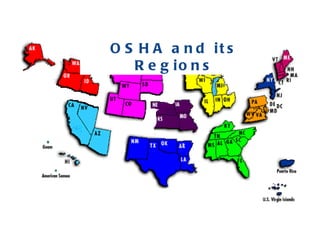
Introduction to OSHA and its regional structure for managing workplace safety and emergencies.
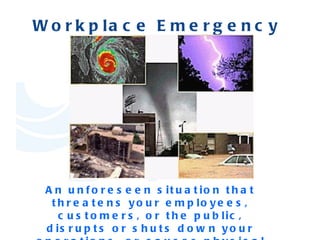
Emergency defined as situations threatening employees or public, disrupting operations, or causing damage.
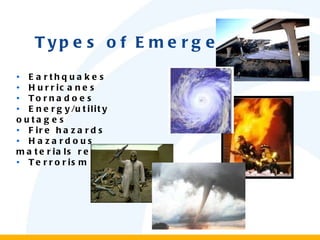
Common emergencies include earthquakes, hurricanes, tornadoes, utility outages, fires, and terrorism.
Guidance on how employees should report emergencies, emphasizing the use of '911'.
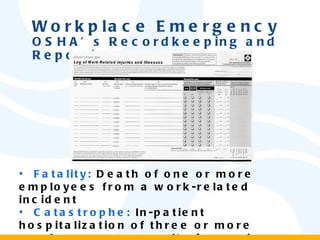
Details on reporting fatalities and catastrophes resulting from work-related incidents as per OSHA guidelines.
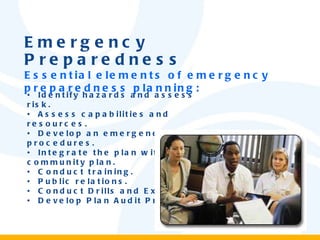
Key elements include hazard identification, resource assessment, emergency plan development, and training.
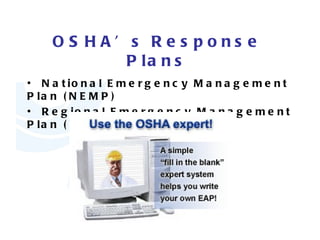
OSHA's National and Regional Emergency Management Plans (NEMP and REMP) for coordinated response.
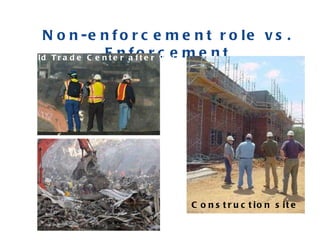
OSHA assists local response agencies and conducts workplace investigations in emergencies.
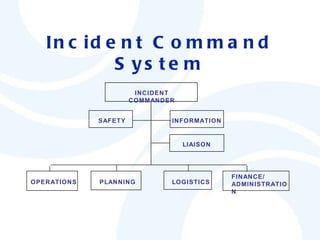
Overview of an Incident Command System outlining roles and responsibilities during emergencies.
OSHA's specific safety requirements for emergency response and preparedness in the construction industry.
Standards for medical services, first aid availability, and training under regulations 29 CFR 1926.
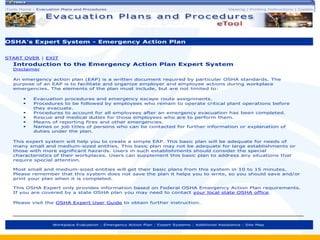
Requirements for written action plans including emergency escape and accountability procedures.
Procedures for maintaining unobstructed egress and clearly marking exits in construction sites.
Development of fire protection programs, availability of equipment, and training requirements.
Regulations on exposure control, communication of hazards, and ensuring safety of employees.
Requirements for MDA including emergency escape routes and PPE for specific chemical situations.
Emergency planning and training necessary for dealing with cadmium exposure in construction.
Standards for personal protective equipment usage and maintenance in construction environments.
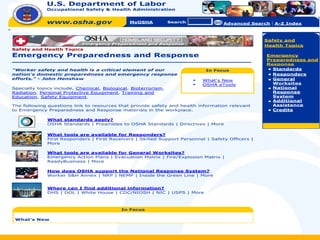
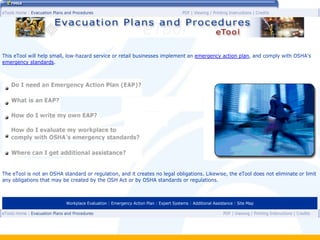
Information on accessing additional OSHA resources for emergency preparedness on their website.
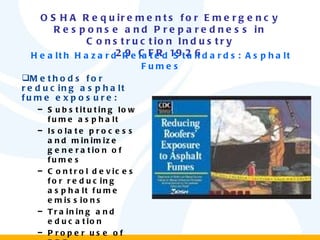
Methods for minimizing asphalt fume exposure including substitution, isolation of processes, and PPE use.
Workplace Emergency An unforeseen situation that threatens your employees, customers, or the public, disrupts or shuts down your operations, or causes physical or environmental damage.
4.
Types of Emergency• Earthquakes • Hurricanes • Tornadoes • Energy/utility outages • Fire hazards • Hazardous materials releases • Terrorism
5.
Employees must knowhow to report emergencies "911" is a common method for reporting emergencies if external emergency personnel are used at your workplace Workplace Emergency Reporting and alerting emergencies
6.
Workplace Emergency OSHA’sRecordkeeping and Reporting Fatality: Death of one or more employees from a work-related incident Catastrophe: In-patient hospitalization of three or more employees as a result of a work-related incident
7.
Emergency Preparedness Essentialelements of emergency preparedness planning: • Identify hazards and assess risk. • Assess capabilities and resources. • Develop an emergency plan and procedures. • Integrate the plan with the community plan. • Conduct training. • Public relations. • Conduct Drills and Exercises. • Develop Plan Audit Procedures.
8.
OSHA’s Response PlansNational Emergency Management Plan (NEMP) Regional Emergency Management Plan (REMP)
9.
OSHA’s Response to Emergency To assist local response agencies in any way possible within agency capabilities (Non-enforcement) To initiate workplace investigation (Enforcement)
OSHA Requirements forEmergency Response and Preparedness in Construction Industry 29 CFR 1926
13.
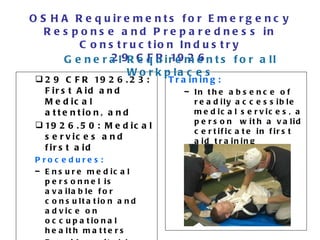
OSHA Requirements forEmergency Response and Preparedness in Construction Industry 29 CFR 1926 29 CFR 1926.23: First Aid and Medical attention, and 1926.50: Medical services and first aid Procedures: Ensure medical personnel is available for consultation and advice on occupational health matters Provide suitable facilities for quick drenching and flushing of the eye Training: In the absence of readily accessible medical services, a person with a valid certificate in first aid training General Requirements for all Workplaces
14.
OSHA Requirements forEmergency Response and Preparedness in Construction Industry 29 CFR 1926 Additional Requirements for Workplaces referenced in other standards 29 CFR 1926.35: Employee emergency action plan Procedures: Prepare and implement a written action plan that includes: Emergency escape procedures Procedures for those who remain to conduct critical operations Means of reporting fires and emergencies Procedures to account for employees after the emergency Training: Review emergency action plan with each employee when the plan is developed, responsibilities shift, or the emergency procedures change. Provide specific training to employees who are expected to assist in evacuation
15.
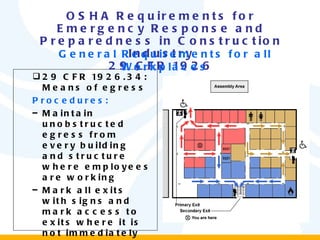
29 CFR 1926.34:Means of egress Procedures: Maintain unobstructed egress from every building and structure where employees are working Mark all exits with signs and mark access to exits where it is not immediately apparent how to exit OSHA Requirements for Emergency Response and Preparedness in Construction Industry 29 CFR 1926 General Requirements for all Workplaces
16.
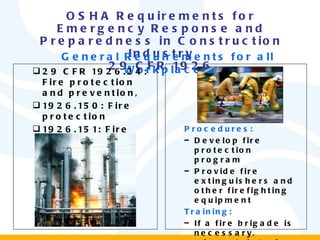
OSHA Requirements forEmergency Response and Preparedness in Construction Industry 29 CFR 1926 General Requirements for all Workplaces 29 CFR 1926.24: Fire protection and prevention, 1926.150: Fire protection 1926.151: Fire prevention Procedures: Develop fire protection program Provide fire extinguishers and other firefighting equipment Training: If a fire brigade is necessary, adequately train them.
17.
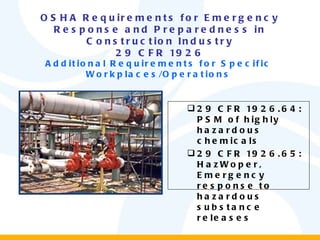
OSHA Requirements forEmergency Response and Preparedness in Construction Industry 29 CFR 1926 Additional Requirements for Specific Workplaces/Operations 29 CFR 1926.64: PSM of highly hazardous chemicals 29 CFR 1926.65: HazWoper, Emergency response to hazardous substance releases
18.
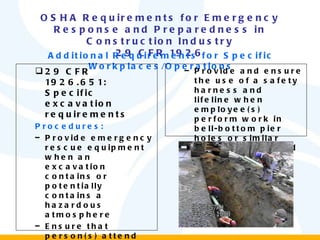
OSHA Requirements forEmergency Response and Preparedness in Construction Industry 29 CFR 1926 Additional Requirements for Specific Workplaces/Operations 29 CFR 1926.651: Specific excavation requirements Procedures: Provide emergency rescue equipment when an excavation contains or potentially contains a hazardous atmosphere Ensure that person(s) attend the equipment in case of emergency. Provide and ensure the use of a safety harness and lifeline when employee(s) perform work in bell-bottom pier holes or similar deep and confined footing excavations
19.
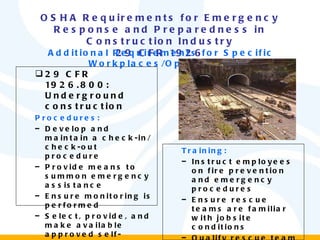
OSHA Requirements forEmergency Response and Preparedness in Construction Industry 29 CFR 1926 Additional Requirements for Specific Workplaces/Operations 29 CFR 1926.800: Underground construction Procedures: Develop and maintain a check-in/check-out procedure Provide means to summon emergency assistance Ensure monitoring is performed Select, provide, and make available approved self-rescuers Training: Instruct employees on fire prevention and emergency procedures Ensure rescue teams are familiar with jobsite conditions Qualify rescue team members at least annually
20.
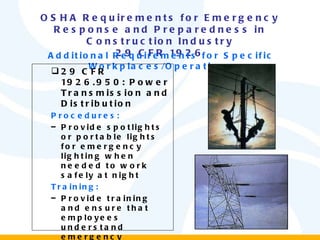
OSHA Requirements forEmergency Response and Preparedness in Construction Industry 29 CFR 1926 Additional Requirements for Specific Workplaces/Operations 29 CFR 1926.950: Power Transmission and Distribution Procedures: Provide spotlights or portable lights for emergency lighting when needed to work safely at night Training: Provide training and ensure that employees understand emergency procedures and first aid fundamentals, including CPR
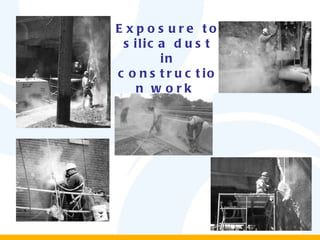
OSHA Requirements forEmergency Response and Preparedness in Construction Industry 29 CFR 1926 Requirements that Support Emergency Response and Preparedness 29 CFR 1926.55: Gases, vapors, fumes, dust, and mists Procedures: Ensure that employee exposures do not exceed the limits provided by the standard. Exposures should be limited through engineering controls, administrative controls, and, as a last resort, PPE 29 CFR 1926.59: Hazard Communication 29 CFR 1926.103: Respiratory Protection 29 CFR 1926.1103: 13 Carcinogens 29 CFR1926.1117: Vinyl chloride
23.
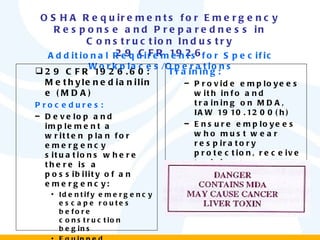
OSHA Requirements forEmergency Response and Preparedness in Construction Industry 29 CFR 1926 Additional Requirements for Specific Workplaces/Operations 29 CFR 1926.60: Methylenedianiline (MDA) Procedures: Develop and implement a written plan for emergency situations where there is a possibility of an emergency: Identify emergency escape routes before construction begins Equipped employees with PPE and clothing until emergency is abated Include elements prescribed in 1910.38 and 1910.39 Training: Provide employees with info and training on MDA, IAW 1910.1200(h) Ensure employees who must wear respiratory protection, receive training as per 1910.134
24.
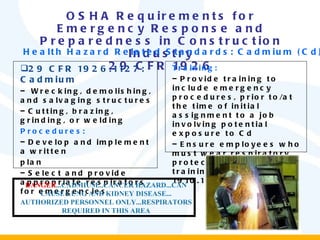
OSHA Requirements forEmergency Response and Preparedness in Construction Industry 29 CFR 1926 29 CFR 1926.1127: Cadmium Wrecking, demolishing, and salvaging structures Cutting, brazing, grinding, or welding Procedures: Develop and implement a written plan Select and provide appropriate respirators for emergencies Training: Provide training to include emergency procedures, prior to/at the time of initial assignment to a job involving potential exposure to Cd Ensure employees who must wear respiratory protection receive training (29 CFR 1910.134) Health Hazard Related Standards: Cadmium (Cd) DANGER ...CADMIUM...CANCER HAZARD...CAN CAUSE LUNG AND KIDNEY DISEASE... AUTHORIZED PERSONNEL ONLY...RESPIRATORS REQUIRED IN THIS AREA
25.
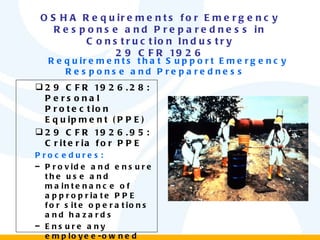
OSHA Requirements forEmergency Response and Preparedness in Construction Industry 29 CFR 1926 Requirements that Support Emergency Response and Preparedness 29 CFR 1926.28: Personal Protection Equipment (PPE) 29 CFR 1926.95: Criteria for PPE Procedures: Provide and ensure the use and maintenance of appropriate PPE for site operations and hazards Ensure any employee-owned equipment is adequately and properly maintained
26.
OSHA Requirements forEmergency Response and Preparedness in Construction Industry 29 CFR 1926 For additional information on Emergency Preparedness, visit OSHA’s web site at www.osha.gov and select “Safety and Health Topics” Emergency preparedness
27.
28.
29.
30.
31.
OSHA Requirements forEmergency Response and Preparedness in Construction Industry 29 CFR 1926 Methods for reducing asphalt fume exposure: Substituting low fume asphalt Isolate process and minimize generation of fumes Control devices for reducing asphalt fume emissions Training and education Proper use of PPE Health Hazard Related Standards: Asphalt Fumes