Hazardous
Materials
Subpart H
Subpart H Standards
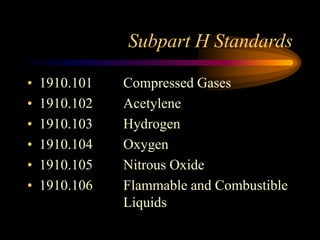
• 1910.101 Compressed Gases
• 1910.102 Acetylene
• 1910.103 Hydrogen
• 1910.104 Oxygen
• 1910.105 Nitrous Oxide
• 1910.106 Flammable and Combustible
Liquids
Subpart H Standards
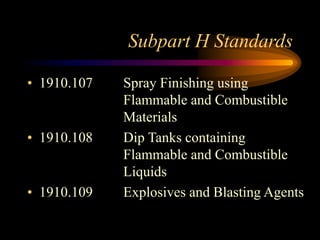
• 1910.107 Spray Finishing using
Flammable and Combustible
Materials
• 1910.108 Dip Tanks containing
Flammable and Combustible
Liquids
• 1910.109 Explosives and Blasting Agents
Subpart H Standards
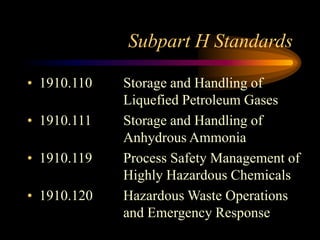
• 1910.110 Storage and Handling of
Liquefied Petroleum Gases
• 1910.111 Storage and Handling of
Anhydrous Ammonia
• 1910.119 Process Safety Management of
Highly Hazardous Chemicals
• 1910.120 Hazardous Waste Operations
and Emergency Response
Subpart H Standards
• 1910.123 Dipping and coating
operations: Coverage and
Definitions
• 1910.124 General Requirements for
Dipping and Coating
Operations
Subpart H Standards
• 1910.125 Additional Requirements for
Dipping and Coating
Operations that use Flammable
or Combustible Liquids
• 1910.126 Additional Requirements for
Special Dipping and Coating
Operations
Definitions
• Hazardous Chemical
• Occupational Safety & Health Act (OSHA)
term that denotes any chemical that would be a
risk to employees if exposed in the work place
Definition
• Highly Hazardous Chemical
• OSHA term that denotes any chemical that
would posses toxic, reactive, flammable or
explosive properties
Definitions
• Aerosol
• Aerosol shall mean a material which is
dispensed from its container as a mist,
spray, or foam by a propellant under
pressure
Definitions
• Container
• Container shall mean any can, barrel, or drum
Definitions
• Closed Container
• Closed container shall mean a container so
sealed by means of a lid or other device that
neither liquid or vapor will escape from it at
ordinary temperatures
Definitions
• Fire Area
• Fire area shall mean an area of a building
separated from the remainder of the
building by construction having a fire
resistance of at least 1 hour and having all
communicating openings properly protected
by an assembly having a fire resistance
rating of at least one hour.
Definitions
• Flash Point
• Flash point means the minimum
temperature at which a liquid gives off
vapor within a test vessel in sufficient
concentration to form an ignitable mixture
with air near the surface of the liquid. The
flash point is normally an indication of
susceptibility to ignition.
Definitions
• Combustible Liquid
• Combustible liquid means any liquid having
a flash point at above 100°F (37.8 °C).
• Combustible liquids are divided into two
classes:
– Class II
– Class III
Definitions
• Flammable Liquid
• Flammable liquid means any liquid having
a flash point below 100 °F (37.8 °C) or
higher, the total of which make up 99
percent or more of the total volume of the
mixture.
Definitions
• Portable Tank
• Portable tank shall mean a closed container
having a liquid capacity over 60 U.S.
gallons and not intended for fixed
installation
Definitions
• Safety Can
• Safety can means an approved container, of not
more than 5 gallons capacity, having a spring-
closing lid and spout cover and so designed that it
will safely relieve internal pressure when subject to
fire exposure
Flammable (Explosive) Limits
• Flammable Range
• The range of a combustible vapor or gas-air
mixture between the upper and lower flammable
limits.
• Also, known as the “explosive range.”
Flammable (Explosive) Limits
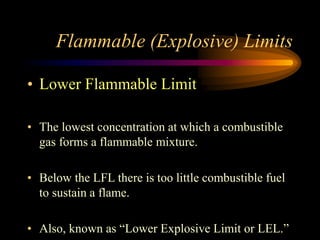
• Lower Flammable Limit
• The lowest concentration at which a combustible
gas forms a flammable mixture.
• Below the LFL there is too little combustible fuel
to sustain a flame.
• Also, known as “Lower Explosive Limit or LEL.”
Flammable (Explosive) Limits
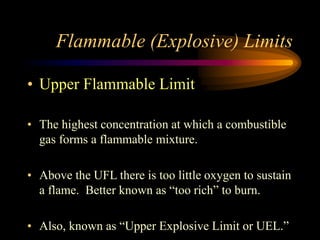
• Upper Flammable Limit
• The highest concentration at which a combustible
gas forms a flammable mixture.
• Above the UFL there is too little oxygen to sustain
a flame. Better known as “too rich” to burn.
• Also, known as “Upper Explosive Limit or UEL.”
Flammable (Explosive) Limits
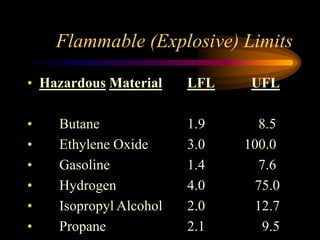
• Hazardous Material LFL UFL
• Butane 1.9 8.5
• Ethylene Oxide 3.0 100.0
• Gasoline 1.4 7.6
• Hydrogen 4.0 75.0
• Isopropyl Alcohol 2.0 12.7
• Propane 2.1 9.5
Container and Portable Tank
Storage
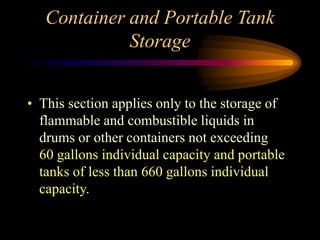
• This section applies only to the storage of
flammable and combustible liquids in
drums or other containers not exceeding
60 gallons individual capacity and portable
tanks of less than 660 gallons individual
capacity.
Fire Control
• At least one portable fire extinguisher having a
rating of not less than 12-B units shall be located
outside of, but not more than 10 feet from, the
door opening into any room used for storage.

Flammable_Hazardous_Materials free download

  • 1.
  • 2.
    Subpart H Standards •1910.101 Compressed Gases • 1910.102 Acetylene • 1910.103 Hydrogen • 1910.104 Oxygen • 1910.105 Nitrous Oxide • 1910.106 Flammable and Combustible Liquids
  • 3.
    Subpart H Standards •1910.107 Spray Finishing using Flammable and Combustible Materials • 1910.108 Dip Tanks containing Flammable and Combustible Liquids • 1910.109 Explosives and Blasting Agents
  • 4.
    Subpart H Standards •1910.110 Storage and Handling of Liquefied Petroleum Gases • 1910.111 Storage and Handling of Anhydrous Ammonia • 1910.119 Process Safety Management of Highly Hazardous Chemicals • 1910.120 Hazardous Waste Operations and Emergency Response
  • 5.
    Subpart H Standards •1910.123 Dipping and coating operations: Coverage and Definitions • 1910.124 General Requirements for Dipping and Coating Operations
  • 6.
    Subpart H Standards •1910.125 Additional Requirements for Dipping and Coating Operations that use Flammable or Combustible Liquids • 1910.126 Additional Requirements for Special Dipping and Coating Operations
  • 7.
    Definitions • Hazardous Chemical •Occupational Safety & Health Act (OSHA) term that denotes any chemical that would be a risk to employees if exposed in the work place
  • 8.
    Definition • Highly HazardousChemical • OSHA term that denotes any chemical that would posses toxic, reactive, flammable or explosive properties
  • 9.
    Definitions • Aerosol • Aerosolshall mean a material which is dispensed from its container as a mist, spray, or foam by a propellant under pressure
  • 10.
    Definitions • Container • Containershall mean any can, barrel, or drum
  • 11.
    Definitions • Closed Container •Closed container shall mean a container so sealed by means of a lid or other device that neither liquid or vapor will escape from it at ordinary temperatures
  • 12.
    Definitions • Fire Area •Fire area shall mean an area of a building separated from the remainder of the building by construction having a fire resistance of at least 1 hour and having all communicating openings properly protected by an assembly having a fire resistance rating of at least one hour.
  • 13.
    Definitions • Flash Point •Flash point means the minimum temperature at which a liquid gives off vapor within a test vessel in sufficient concentration to form an ignitable mixture with air near the surface of the liquid. The flash point is normally an indication of susceptibility to ignition.
  • 14.
    Definitions • Combustible Liquid •Combustible liquid means any liquid having a flash point at above 100°F (37.8 °C). • Combustible liquids are divided into two classes: – Class II – Class III
  • 15.
    Definitions • Flammable Liquid •Flammable liquid means any liquid having a flash point below 100 °F (37.8 °C) or higher, the total of which make up 99 percent or more of the total volume of the mixture.
  • 16.
    Definitions • Portable Tank •Portable tank shall mean a closed container having a liquid capacity over 60 U.S. gallons and not intended for fixed installation
  • 17.
    Definitions • Safety Can •Safety can means an approved container, of not more than 5 gallons capacity, having a spring- closing lid and spout cover and so designed that it will safely relieve internal pressure when subject to fire exposure
  • 18.
    Flammable (Explosive) Limits •Flammable Range • The range of a combustible vapor or gas-air mixture between the upper and lower flammable limits. • Also, known as the “explosive range.”
  • 19.
    Flammable (Explosive) Limits •Lower Flammable Limit • The lowest concentration at which a combustible gas forms a flammable mixture. • Below the LFL there is too little combustible fuel to sustain a flame. • Also, known as “Lower Explosive Limit or LEL.”
  • 20.
    Flammable (Explosive) Limits •Upper Flammable Limit • The highest concentration at which a combustible gas forms a flammable mixture. • Above the UFL there is too little oxygen to sustain a flame. Better known as “too rich” to burn. • Also, known as “Upper Explosive Limit or UEL.”
  • 21.
    Flammable (Explosive) Limits •Hazardous Material LFL UFL • Butane 1.9 8.5 • Ethylene Oxide 3.0 100.0 • Gasoline 1.4 7.6 • Hydrogen 4.0 75.0 • Isopropyl Alcohol 2.0 12.7 • Propane 2.1 9.5
  • 22.
    Container and PortableTank Storage • This section applies only to the storage of flammable and combustible liquids in drums or other containers not exceeding 60 gallons individual capacity and portable tanks of less than 660 gallons individual capacity.
  • 23.
    Fire Control • Atleast one portable fire extinguisher having a rating of not less than 12-B units shall be located outside of, but not more than 10 feet from, the door opening into any room used for storage.