1
OCCUPATIONAL SAFETY AND HEALTH
     OSHA               ADMINISTRATION

 Subpart I – Tools-Hand and Power
        1926.300 General requirements
1926.300(a) Condition of tools. “All hand and power
tools and similar equipment, whether furnished by
the employer or the employee, shall be maintained in
a safe condition.”

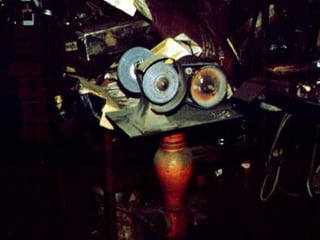
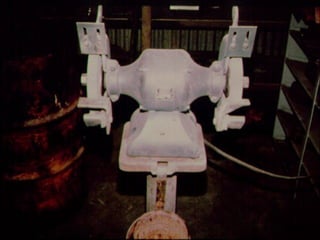
1926.300(b) Guarding. (1) “When power operated
tools are designed to accommodate guards, they shall
be equipped with such guards when in use.”

                                                   2
OCCUPATIONAL SAFETY AND HEALTH
     OSHA               ADMINISTRATION

  Subpart I – Tools-Hand and Power
        1926.300 General requirements
1926.300(b)(3) Types of guarding. “One or more
methods of machine guarding shall be provided to
protect the operator and other employees in the
machine area from hazards such as those created
by point of operation, ingoing nip points, rotating
parts, flying chips and sparks. Examples of
guarding methods are-barrier guards, two-hand
tripping devices, electronic safety devices. etc.”
                                                      3
4
5
6
OCCUPATIONAL SAFETY AND HEALTH
       OSHA               ADMINISTRATION

   Subpart I – Tools-Hand and Power
          1926.300 General requirements
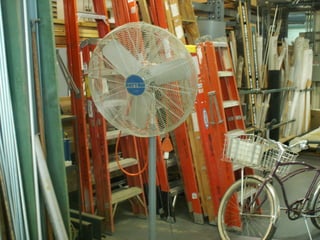
1926.300(b)(5) Exposure of blades. “When the periphery
of a blade of a fan is less than 7 feet above the floor or
working level, the blades shall be guarded. The guard
shall have openings no larger than ½ inch.”

1926.300(b)(6) Anchoring fixed machinery. “Machines
designed for a fixed location shall be securely anchored
to prevent walking or moving.”
                                                        7
8
OCCUPATIONAL SAFETY AND HEALTH
       OSHA                 ADMINISTRATION

   Subpart I – Tools-Hand and Power
           1926.300 General requirements
1926.300(b)(7) …………...................................and the
distance between the wheel periphery and the
adjustable tongue or the end of the peripheral
member at the top shall never exceed ¼ inch.


                                                                9
OCCUPATIONAL SAFETY AND HEALTH
       OSHA              ADMINISTRATION

   Subpart I – Tools-Hand and Power
          1926.300 General requirements
1926.300(b)(9) Cylindrical grinders. The maximum
angular exposure of the grinding wheel periphery and
sides for safety guards used on cylindrical grinding
machines shall not exceed 1800 ………………………


                                                       10
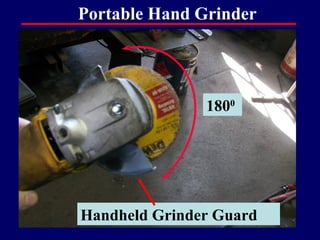
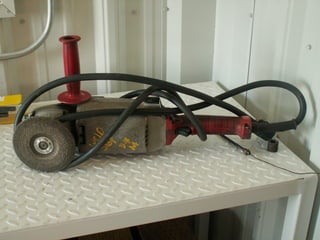
Portable Hand Grinder


               1800


Handheld Grinder Guard
OCCUPATIONAL SAFETY AND HEALTH
        OSHA               ADMINISTRATION

    Subpart I – Tools-Hand and Power
           1926.300 General requirements
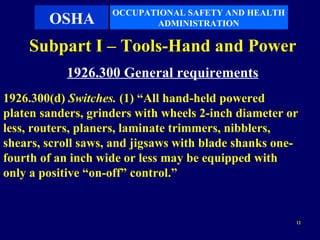
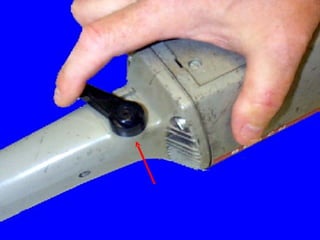
1926.300(d) Switches. (1) “All hand-held powered
platen sanders, grinders with wheels 2-inch diameter or
less, routers, planers, laminate trimmers, nibblers,
shears, scroll saws, and jigsaws with blade shanks one-
fourth of an inch wide or less may be equipped with
only a positive “on-off” control.”


                                                      12
13
OCCUPATIONAL SAFETY AND HEALTH
       OSHA               ADMINISTRATION

   Subpart I – Tools-Hand and Power
          1926.300 General requirements
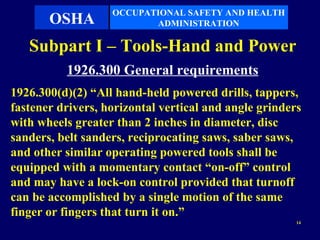
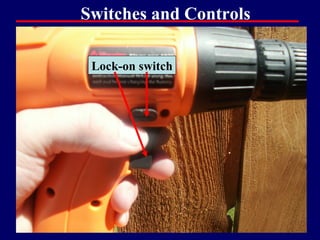
1926.300(d)(2) “All hand-held powered drills, tappers,
fastener drivers, horizontal vertical and angle grinders
with wheels greater than 2 inches in diameter, disc
sanders, belt sanders, reciprocating saws, saber saws,
and other similar operating powered tools shall be
equipped with a momentary contact “on-off” control
and may have a lock-on control provided that turnoff
can be accomplished by a single motion of the same
finger or fingers that turn it on.”
                                                       14
Switches and Controls

 Lock-on switch


                        15
OCCUPATIONAL SAFETY AND HEALTH
      OSHA               ADMINISTRATION

  Subpart I – Tools-Hand and Power
         1926.300 General requirements
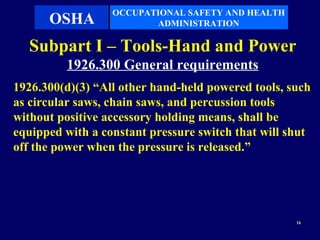
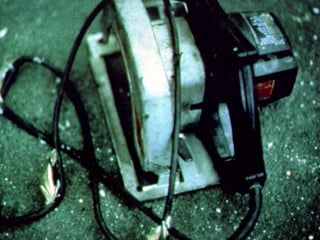
1926.300(d)(3) “All other hand-held powered tools, such
as circular saws, chain saws, and percussion tools
without positive accessory holding means, shall be
equipped with a constant pressure switch that will shut
off the power when the pressure is released.”


                                                    16
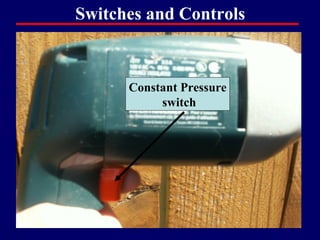
Switches and Controls


      Constant Pressure
           switch


                          17
OCCUPATIONAL SAFETY AND HEALTH
       OSHA                ADMINISTRATION

   Subpart I – Tools-Hand and Power
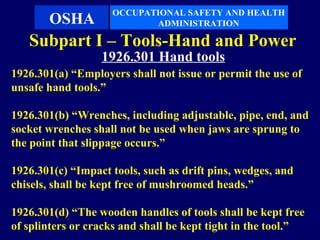
                  1926.301 Hand tools
1926.301(a) “Employers shall not issue or permit the use of
unsafe hand tools.”

1926.301(b) “Wrenches, including adjustable, pipe, end, and
socket wrenches shall not be used when jaws are sprung to
the point that slippage occurs.”

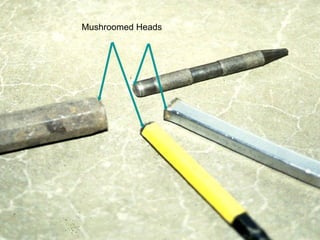
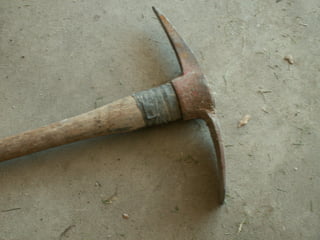
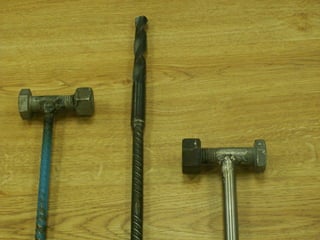
1926.301(c) “Impact tools, such as drift pins, wedges, and
chisels, shall be kept free of mushroomed heads.”

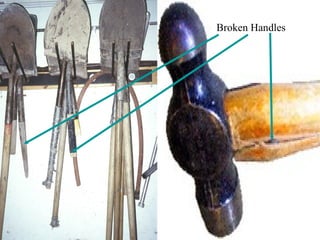
1926.301(d) “The wooden handles of tools shall be kept free
of splinters or cracks and shall be kept tight in the tool.”
Mushroomed Heads


                   19
Broken Handles


                 20
OCCUPATIONAL SAFETY AND HEALTH
      OSHA               ADMINISTRATION

  Subpart I – Tools-Hand and Power
         1926.302 Power-operated tools
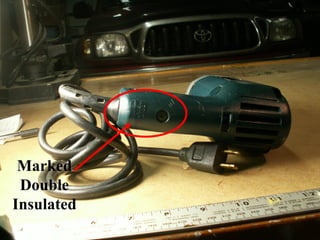
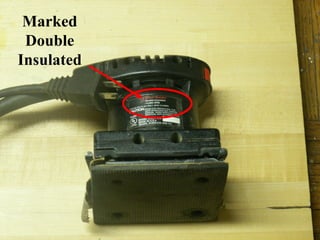
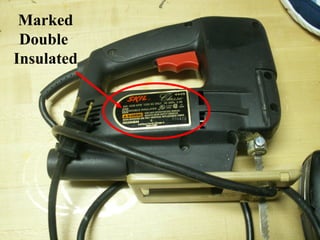
1926.302(a) Electric power-operated tools. (1) “Electric
power operated tools shall either be of the approved
double-insulated type or grounded in accordance with
subpart K of this part.”

1926.302(a)(2) “The use of electric cords for hoisting
or lowering tools shall not be permitted.”


                                                      21
Marked
 Double
Insulated
            22
Marked
 Double
Insulated


            23
Marked
 Double
Insulated


            24
OCCUPATIONAL SAFETY AND HEALTH
      OSHA               ADMINISTRATION

  Subpart I – Tools-Hand and Power
          1926.302 Power-operated tools
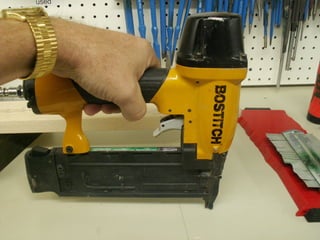
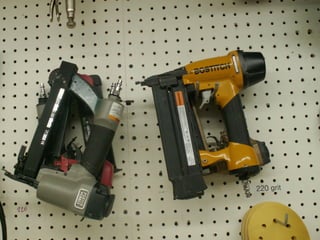
1926.302(b)(3) “All pneumatically driven nailers,
staplers, and other similar equipment provided with
automatic fastener feed which operate at more than
100 p.s.i. pressure at the tool shall have a safety device
on the muzzle to prevent the tool from ejecting
fasteners, unless the muzzle is in contact with the
work surface.”


                                                        25
26
27
OCCUPATIONAL SAFETY AND HEALTH
      OSHA               ADMINISTRATION

  Subpart I – Tools-Hand and Power
          1926.302 Power-operated tools
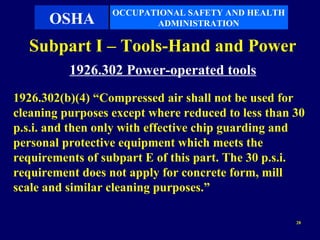
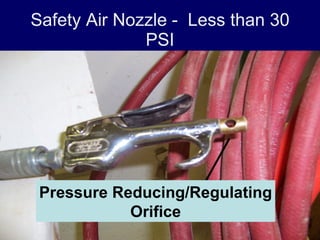
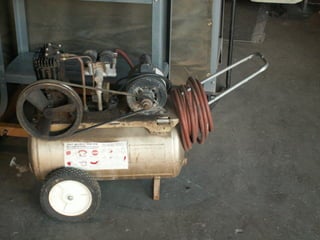
1926.302(b)(4) “Compressed air shall not be used for
cleaning purposes except where reduced to less than 30
p.s.i. and then only with effective chip guarding and
personal protective equipment which meets the
requirements of subpart E of this part. The 30 p.s.i.
requirement does not apply for concrete form, mill
scale and similar cleaning purposes.”

                                                    28
Safety Air Nozzle - Less than 30
              PSI


 Pressure Reducing/Regulating
            Orifice
OCCUPATIONAL SAFETY AND HEALTH
     OSHA                ADMINISTRATION

 Subpart I – Tools-Hand and Power
         1926.302 Power-operated tools
1926.302(b)(8) “Airless spray guns of the type which
atomizes paints and fluids at high pressures(1,000
pounds or more per square inch shall be equipped
with automatic or visible manual safety devices
which will prevent pulling of the trigger to prevent
release of the paint or fluid until the safety device is
manually released.”


                                                       30
OCCUPATIONAL SAFETY AND HEALTH
       OSHA               ADMINISTRATION

   Subpart I – Tools-Hand and Power
           1926.302 Power-operated tools
1926.302(b)(9) “In lieu of the above, a diffuser nut
which will prevent high pressure, high velocity
release, while the nozzle tip is removed, plus a nozzle
tip guard which will prevent the tip from coming into
contact with the operator, or other equivalent
protection, shall be provided.”


                                                          31
OCCUPATIONAL SAFETY AND HEALTH
       OSHA               ADMINISTRATION

   Subpart I – Tools-Hand and Power
           1926.302 Power-operated tools
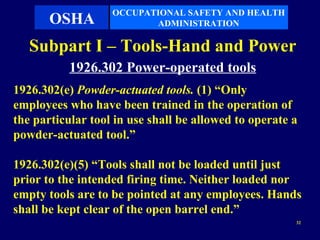
1926.302(e) Powder-actuated tools. (1) “Only
employees who have been trained in the operation of
the particular tool in use shall be allowed to operate a
powder-actuated tool.”

1926.302(e)(5) “Tools shall not be loaded until just
prior to the intended firing time. Neither loaded nor
empty tools are to be pointed at any employees. Hands
shall be kept clear of the open barrel end.”
                                                       32
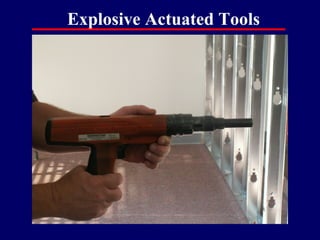
Explosive Actuated Tools
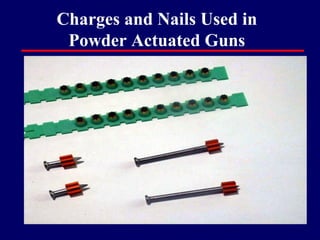
Charges and Nails Used in
 Powder Actuated Guns
OCCUPATIONAL SAFETY AND HEALTH
      OSHA                ADMINISTRATION

  Subpart I – Tools-Hand and Power
          1926.302 Power-operated tools
1926.302(e)(6) “Loaded tools shall not be left
unattended.”

1926.302(e)(7) “Fasteners shall not be driven into
very hard or brittle material including, but not
limited to, cast iron, glazed tile, surface-hardened
steel, glass block, live rock, or hollow tile.”

                                                       35
OCCUPATIONAL SAFETY AND HEALTH
       OSHA               ADMINISTRATION

   Subpart I – Tools-Hand and Power
        1926.303 Abrasive wheels and tools
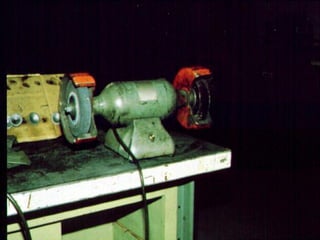
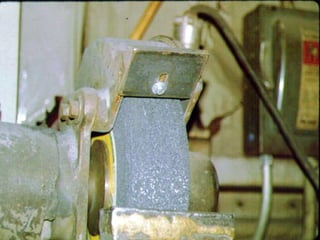
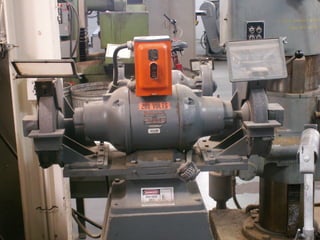
1926.303(c)(2) “Floor and bench-mounted grinders
shall be provided with work rests which are ridgley
supported and readily adjustable. Such work rests
shall be kept at a distance not to exceed one-eighth
inch from the surface of the wheel.”

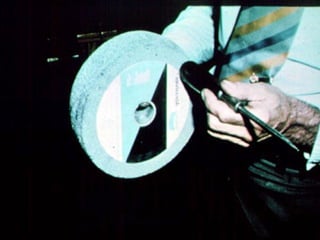
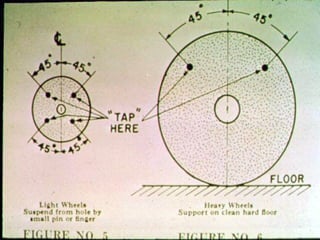
1926.303(c)(7) “All abrasive wheels shall be closely
inspected and ring-tested before mounting to ensure
that they are free from cracks or defects.”
                                                       36
37
38
39


SLIDE 7 - ABRASIVE WHEEL MACHINERY   COPYRIGHT 1999 - UNIVERSAL SAFETY CONSULTING
40


SLIDE 8 - ABRASIVE WHEEL MACHINERY   COPYRIGHT 1999 - UNIVERSAL SAFETY CONSULTING
OCCUPATIONAL SAFETY AND HEALTH
      OSHA               ADMINISTRATION

   Subpart I – Tools-Hand and Power
           1926.304 Woodworking tools
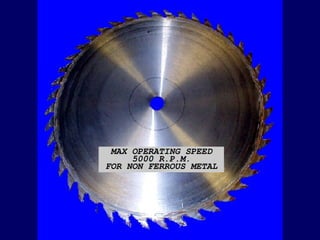
1926.304(b) Speeds. “The operating speed shall be
etched or otherwise permanently marked on all
circular saws over 20 inches in diameter or operating
at over 10,000 peripheral feet per minute. Any saw so
marked shall not be operated at a speed other than
that marked on the blade. When a marked saw is
retensioned for a different speed, the marking shall be
corrected to show the new speed.”
                                                      41
MAX OPERATING SPEED
     5000 R.P.M.
FOR NON FERROUS METAL
OCCUPATIONAL SAFETY AND HEALTH
       OSHA               ADMINISTRATION

   Subpart I – Tools-Hand and Power
            1926.304 Woodworking tools
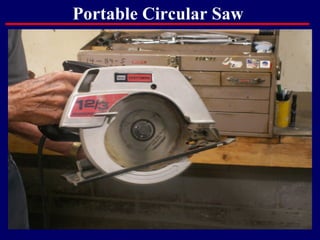
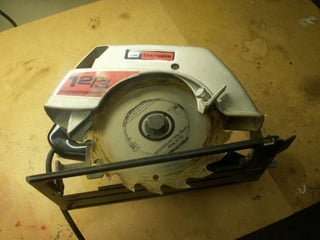
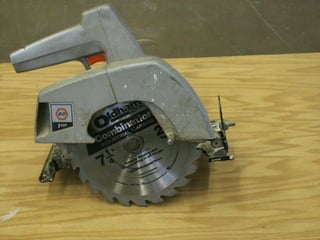
1926.304(d) Guarding. “All portable, power-driven
circular saws shall be equipped with guards above and
below the base plate or shoe. The upper guard shall
cover the saw to the depth of the teeth, except for the
minimum arc required to permit the base to be tilted
for bevel cuts. The lower guard shall cover the saw to
the depth of the teeth, except for the minimum arc
required to allow proper retraction and contact with
the work. When the tool is withdrawn from the work,
the lower guard shall automatically and instantly
return to the covering position.”
Portable Circular Saw


                        44
OCCUPATIONAL SAFETY AND HEALTH
       OSHA               ADMINISTRATION

   Subpart I – Tools-Hand and Power
           1926.304 Woodworking tools
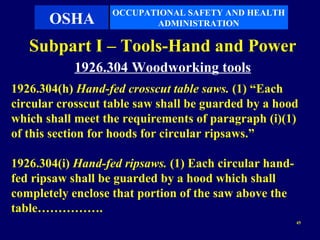
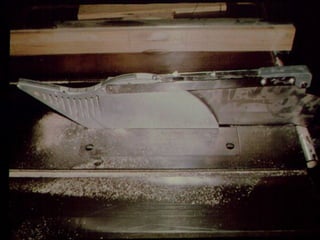
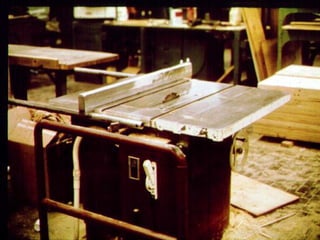
1926.304(h) Hand-fed crosscut table saws. (1) “Each
circular crosscut table saw shall be guarded by a hood
which shall meet the requirements of paragraph (i)(1)
of this section for hoods for circular ripsaws.”

1926.304(i) Hand-fed ripsaws. (1) Each circular hand-
fed ripsaw shall be guarded by a hood which shall
completely enclose that portion of the saw above the
table…………….
                                                        45
46


SLIDE 6 - WOODWORKING MACHINERY   COPYRIGHT 1999 - UNIVERSAL SAFETY CONSULTING
OCCUPATIONAL SAFETY AND HEALTH
       OSHA               ADMINISTRATION

   Subpart I – Tools-Hand and Power
          1926.305 Jacks-lever and ratchet,
                Screw, and hydraulic
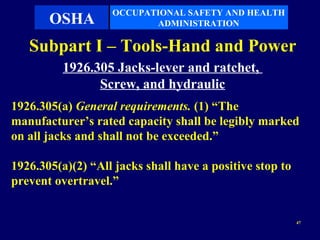
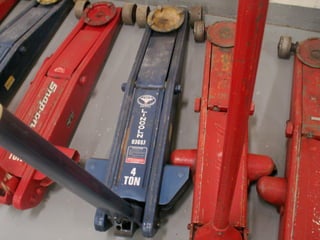
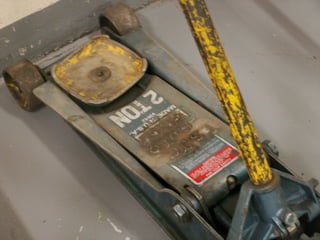
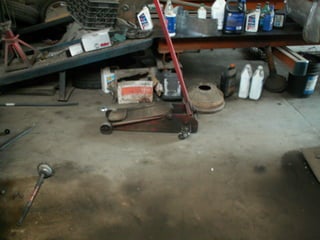
1926.305(a) General requirements. (1) “The
manufacturer’s rated capacity shall be legibly marked
on all jacks and shall not be exceeded.”

1926.305(a)(2) “All jacks shall have a positive stop to
prevent overtravel.”


                                                          47
48
49
OCCUPATIONAL SAFETY AND HEALTH
       OSHA               ADMINISTRATION

   Subpart I – Tools-Hand and Power
          1926.305 Jacks-lever and ratchet,
                Screw, and hydraulic
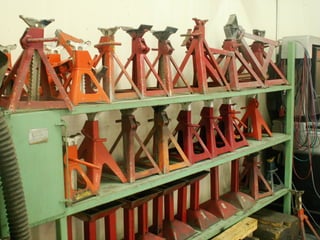
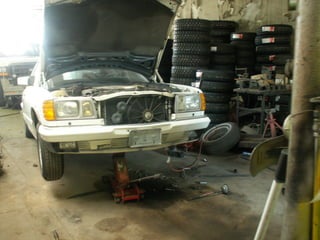
1926.305(d)(1) Operation and maintenance. (i) “After
the load has been raised, it shall be cribbed, blocked, or
otherwise secured at once

1926.305(d)(1)(ii) “Hydraulic jacks exposed to freezing
temperatures shall be supplied with an adequate
antifreeze liquid.”
                                                        50
51
OCCUPATIONAL SAFETY AND HEALTH
       OSHA               ADMINISTRATION

   Subpart I – Tools-Hand and Power
1926.307 Mechanical power-transmission apparatus
1926.307(a) General requirements. (1) “This section
covers all types and shapes of power-transmission belts,
except the following when operating at two hundred
and fifty (250) feet per minute or less: (i) Flat belts 1
inch or less in width, (ii) flat belts 2 inches or less in
width which are free from metal lacings or fasteners,
(iii) round belts ½ inch or less in diameter, and (iv)
single strand V-belts, the width of which is thirteen
thirty-seconds inch or less.”
                                                       52
OCCUPATIONAL SAFETY AND HEALTH
       OSHA               ADMINISTRATION

   Subpart I – Tools-Hand and Power
1926.307 Mechanical power-transmission apparatus
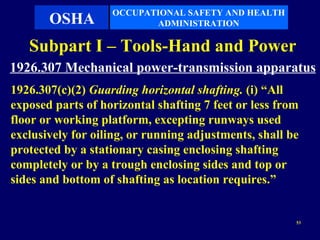
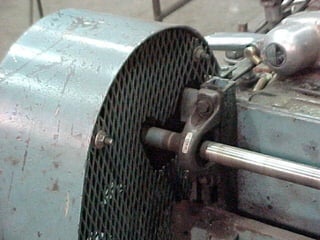
1926.307(c)(2) Guarding horizontal shafting. (i) “All
exposed parts of horizontal shafting 7 feet or less from
floor or working platform, excepting runways used
exclusively for oiling, or running adjustments, shall be
protected by a stationary casing enclosing shafting
completely or by a trough enclosing sides and top or
sides and bottom of shafting as location requires.”


                                                       53
54
OCCUPATIONAL SAFETY AND HEALTH
      OSHA               ADMINISTRATION

   Subpart I – Tools-Hand and Power
1926.307 Mechanical power-transmission apparatus
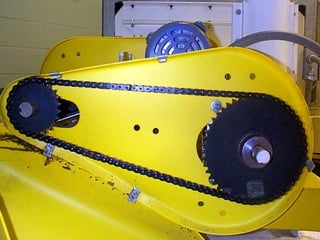
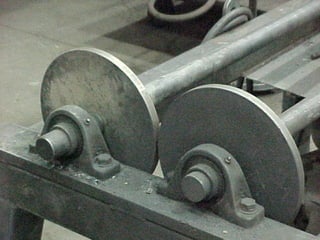
1926.307(c)(4) Projecting shaft ends. (i) “Projecting
shaft ends shall present a smooth edge and end and
shall not project more than one-half the diameter of
the shaft unless guarded by nonrotating caps or
safety sleeves.”

1926.307(p) Care of equipment-(1) General. “All
power-transmission equipment shall be inspected at
intervals not exceeding 60 days and be kept in good
working condition at all times.”
56
57
58
59
60
61


SLIDE 4 - WOODWORKING MACHINERY   COPYRIGHT 1999 - UNIVERSAL SAFETY CONSULTING
62


SLIDE 32 - MACHINE GUARDING   COPYRIGHT 1999 - UNIVERSAL SAFETY CONSULTING
64
65


SLIDE 8 - WOODWORKING MACHINERY   COPYRIGHT 1999 - UNIVERSAL SAFETY CONSULTING
66


SLIDE 22 - ABRASIVE WHEEL MACHINERY   COPYRIGHT 1999 - UNIVERSAL SAFETY CONSULTING
67


SLIDE 6 - ABRASIVE WHEEL MACHINERY   COPYRIGHT 1999 - UNIVERSAL SAFETY CONSULTING
68


SLIDE 13 - ABRASIVE WHEEL MACHINERY   COPYRIGHT 1999 - UNIVERSAL SAFETY CONSULTING
69


SLIDE 13 - ABRASIVE WHEEL MACHINERY
70
71
72
73
74
75
76

Subpart I - Tools

  • 1.
  • 2.
    OCCUPATIONAL SAFETY ANDHEALTH OSHA ADMINISTRATION Subpart I – Tools-Hand and Power 1926.300 General requirements 1926.300(a) Condition of tools. “All hand and power tools and similar equipment, whether furnished by the employer or the employee, shall be maintained in a safe condition.” 1926.300(b) Guarding. (1) “When power operated tools are designed to accommodate guards, they shall be equipped with such guards when in use.” 2
  • 3.
    OCCUPATIONAL SAFETY ANDHEALTH OSHA ADMINISTRATION Subpart I – Tools-Hand and Power 1926.300 General requirements 1926.300(b)(3) Types of guarding. “One or more methods of machine guarding shall be provided to protect the operator and other employees in the machine area from hazards such as those created by point of operation, ingoing nip points, rotating parts, flying chips and sparks. Examples of guarding methods are-barrier guards, two-hand tripping devices, electronic safety devices. etc.” 3
  • 4.
  • 5.
  • 6.
  • 7.
    OCCUPATIONAL SAFETY ANDHEALTH OSHA ADMINISTRATION Subpart I – Tools-Hand and Power 1926.300 General requirements 1926.300(b)(5) Exposure of blades. “When the periphery of a blade of a fan is less than 7 feet above the floor or working level, the blades shall be guarded. The guard shall have openings no larger than ½ inch.” 1926.300(b)(6) Anchoring fixed machinery. “Machines designed for a fixed location shall be securely anchored to prevent walking or moving.” 7
  • 8.
  • 9.
    OCCUPATIONAL SAFETY ANDHEALTH OSHA ADMINISTRATION Subpart I – Tools-Hand and Power 1926.300 General requirements 1926.300(b)(7) …………...................................and the distance between the wheel periphery and the adjustable tongue or the end of the peripheral member at the top shall never exceed ¼ inch. 9
  • 10.
    OCCUPATIONAL SAFETY ANDHEALTH OSHA ADMINISTRATION Subpart I – Tools-Hand and Power 1926.300 General requirements 1926.300(b)(9) Cylindrical grinders. The maximum angular exposure of the grinding wheel periphery and sides for safety guards used on cylindrical grinding machines shall not exceed 1800 ……………………… 10
  • 11.
    Portable Hand Grinder 1800 Handheld Grinder Guard
  • 12.
    OCCUPATIONAL SAFETY ANDHEALTH OSHA ADMINISTRATION Subpart I – Tools-Hand and Power 1926.300 General requirements 1926.300(d) Switches. (1) “All hand-held powered platen sanders, grinders with wheels 2-inch diameter or less, routers, planers, laminate trimmers, nibblers, shears, scroll saws, and jigsaws with blade shanks one- fourth of an inch wide or less may be equipped with only a positive “on-off” control.” 12
  • 13.
  • 14.
    OCCUPATIONAL SAFETY ANDHEALTH OSHA ADMINISTRATION Subpart I – Tools-Hand and Power 1926.300 General requirements 1926.300(d)(2) “All hand-held powered drills, tappers, fastener drivers, horizontal vertical and angle grinders with wheels greater than 2 inches in diameter, disc sanders, belt sanders, reciprocating saws, saber saws, and other similar operating powered tools shall be equipped with a momentary contact “on-off” control and may have a lock-on control provided that turnoff can be accomplished by a single motion of the same finger or fingers that turn it on.” 14
  • 15.
    Switches and Controls Lock-on switch 15
  • 16.
    OCCUPATIONAL SAFETY ANDHEALTH OSHA ADMINISTRATION Subpart I – Tools-Hand and Power 1926.300 General requirements 1926.300(d)(3) “All other hand-held powered tools, such as circular saws, chain saws, and percussion tools without positive accessory holding means, shall be equipped with a constant pressure switch that will shut off the power when the pressure is released.” 16
  • 17.
    Switches and Controls Constant Pressure switch 17
  • 18.
    OCCUPATIONAL SAFETY ANDHEALTH OSHA ADMINISTRATION Subpart I – Tools-Hand and Power 1926.301 Hand tools 1926.301(a) “Employers shall not issue or permit the use of unsafe hand tools.” 1926.301(b) “Wrenches, including adjustable, pipe, end, and socket wrenches shall not be used when jaws are sprung to the point that slippage occurs.” 1926.301(c) “Impact tools, such as drift pins, wedges, and chisels, shall be kept free of mushroomed heads.” 1926.301(d) “The wooden handles of tools shall be kept free of splinters or cracks and shall be kept tight in the tool.”
  • 19.
  • 20.
  • 21.
    OCCUPATIONAL SAFETY ANDHEALTH OSHA ADMINISTRATION Subpart I – Tools-Hand and Power 1926.302 Power-operated tools 1926.302(a) Electric power-operated tools. (1) “Electric power operated tools shall either be of the approved double-insulated type or grounded in accordance with subpart K of this part.” 1926.302(a)(2) “The use of electric cords for hoisting or lowering tools shall not be permitted.” 21
  • 22.
  • 23.
  • 24.
  • 25.
    OCCUPATIONAL SAFETY ANDHEALTH OSHA ADMINISTRATION Subpart I – Tools-Hand and Power 1926.302 Power-operated tools 1926.302(b)(3) “All pneumatically driven nailers, staplers, and other similar equipment provided with automatic fastener feed which operate at more than 100 p.s.i. pressure at the tool shall have a safety device on the muzzle to prevent the tool from ejecting fasteners, unless the muzzle is in contact with the work surface.” 25
  • 26.
  • 27.
  • 28.
    OCCUPATIONAL SAFETY ANDHEALTH OSHA ADMINISTRATION Subpart I – Tools-Hand and Power 1926.302 Power-operated tools 1926.302(b)(4) “Compressed air shall not be used for cleaning purposes except where reduced to less than 30 p.s.i. and then only with effective chip guarding and personal protective equipment which meets the requirements of subpart E of this part. The 30 p.s.i. requirement does not apply for concrete form, mill scale and similar cleaning purposes.” 28
  • 29.
    Safety Air Nozzle- Less than 30 PSI Pressure Reducing/Regulating Orifice
  • 30.
    OCCUPATIONAL SAFETY ANDHEALTH OSHA ADMINISTRATION Subpart I – Tools-Hand and Power 1926.302 Power-operated tools 1926.302(b)(8) “Airless spray guns of the type which atomizes paints and fluids at high pressures(1,000 pounds or more per square inch shall be equipped with automatic or visible manual safety devices which will prevent pulling of the trigger to prevent release of the paint or fluid until the safety device is manually released.” 30
  • 31.
    OCCUPATIONAL SAFETY ANDHEALTH OSHA ADMINISTRATION Subpart I – Tools-Hand and Power 1926.302 Power-operated tools 1926.302(b)(9) “In lieu of the above, a diffuser nut which will prevent high pressure, high velocity release, while the nozzle tip is removed, plus a nozzle tip guard which will prevent the tip from coming into contact with the operator, or other equivalent protection, shall be provided.” 31
  • 32.
    OCCUPATIONAL SAFETY ANDHEALTH OSHA ADMINISTRATION Subpart I – Tools-Hand and Power 1926.302 Power-operated tools 1926.302(e) Powder-actuated tools. (1) “Only employees who have been trained in the operation of the particular tool in use shall be allowed to operate a powder-actuated tool.” 1926.302(e)(5) “Tools shall not be loaded until just prior to the intended firing time. Neither loaded nor empty tools are to be pointed at any employees. Hands shall be kept clear of the open barrel end.” 32
  • 33.
  • 34.
    Charges and NailsUsed in Powder Actuated Guns
  • 35.
    OCCUPATIONAL SAFETY ANDHEALTH OSHA ADMINISTRATION Subpart I – Tools-Hand and Power 1926.302 Power-operated tools 1926.302(e)(6) “Loaded tools shall not be left unattended.” 1926.302(e)(7) “Fasteners shall not be driven into very hard or brittle material including, but not limited to, cast iron, glazed tile, surface-hardened steel, glass block, live rock, or hollow tile.” 35
  • 36.
    OCCUPATIONAL SAFETY ANDHEALTH OSHA ADMINISTRATION Subpart I – Tools-Hand and Power 1926.303 Abrasive wheels and tools 1926.303(c)(2) “Floor and bench-mounted grinders shall be provided with work rests which are ridgley supported and readily adjustable. Such work rests shall be kept at a distance not to exceed one-eighth inch from the surface of the wheel.” 1926.303(c)(7) “All abrasive wheels shall be closely inspected and ring-tested before mounting to ensure that they are free from cracks or defects.” 36
  • 37.
  • 38.
  • 39.
    39 SLIDE 7 -ABRASIVE WHEEL MACHINERY COPYRIGHT 1999 - UNIVERSAL SAFETY CONSULTING
  • 40.
    40 SLIDE 8 -ABRASIVE WHEEL MACHINERY COPYRIGHT 1999 - UNIVERSAL SAFETY CONSULTING
  • 41.
    OCCUPATIONAL SAFETY ANDHEALTH OSHA ADMINISTRATION Subpart I – Tools-Hand and Power 1926.304 Woodworking tools 1926.304(b) Speeds. “The operating speed shall be etched or otherwise permanently marked on all circular saws over 20 inches in diameter or operating at over 10,000 peripheral feet per minute. Any saw so marked shall not be operated at a speed other than that marked on the blade. When a marked saw is retensioned for a different speed, the marking shall be corrected to show the new speed.” 41
  • 42.
    MAX OPERATING SPEED 5000 R.P.M. FOR NON FERROUS METAL
  • 43.
    OCCUPATIONAL SAFETY ANDHEALTH OSHA ADMINISTRATION Subpart I – Tools-Hand and Power 1926.304 Woodworking tools 1926.304(d) Guarding. “All portable, power-driven circular saws shall be equipped with guards above and below the base plate or shoe. The upper guard shall cover the saw to the depth of the teeth, except for the minimum arc required to permit the base to be tilted for bevel cuts. The lower guard shall cover the saw to the depth of the teeth, except for the minimum arc required to allow proper retraction and contact with the work. When the tool is withdrawn from the work, the lower guard shall automatically and instantly return to the covering position.”
  • 44.
  • 45.
    OCCUPATIONAL SAFETY ANDHEALTH OSHA ADMINISTRATION Subpart I – Tools-Hand and Power 1926.304 Woodworking tools 1926.304(h) Hand-fed crosscut table saws. (1) “Each circular crosscut table saw shall be guarded by a hood which shall meet the requirements of paragraph (i)(1) of this section for hoods for circular ripsaws.” 1926.304(i) Hand-fed ripsaws. (1) Each circular hand- fed ripsaw shall be guarded by a hood which shall completely enclose that portion of the saw above the table……………. 45
  • 46.
    46 SLIDE 6 -WOODWORKING MACHINERY COPYRIGHT 1999 - UNIVERSAL SAFETY CONSULTING
  • 47.
    OCCUPATIONAL SAFETY ANDHEALTH OSHA ADMINISTRATION Subpart I – Tools-Hand and Power 1926.305 Jacks-lever and ratchet, Screw, and hydraulic 1926.305(a) General requirements. (1) “The manufacturer’s rated capacity shall be legibly marked on all jacks and shall not be exceeded.” 1926.305(a)(2) “All jacks shall have a positive stop to prevent overtravel.” 47
  • 48.
  • 49.
  • 50.
    OCCUPATIONAL SAFETY ANDHEALTH OSHA ADMINISTRATION Subpart I – Tools-Hand and Power 1926.305 Jacks-lever and ratchet, Screw, and hydraulic 1926.305(d)(1) Operation and maintenance. (i) “After the load has been raised, it shall be cribbed, blocked, or otherwise secured at once 1926.305(d)(1)(ii) “Hydraulic jacks exposed to freezing temperatures shall be supplied with an adequate antifreeze liquid.” 50
  • 51.
  • 52.
    OCCUPATIONAL SAFETY ANDHEALTH OSHA ADMINISTRATION Subpart I – Tools-Hand and Power 1926.307 Mechanical power-transmission apparatus 1926.307(a) General requirements. (1) “This section covers all types and shapes of power-transmission belts, except the following when operating at two hundred and fifty (250) feet per minute or less: (i) Flat belts 1 inch or less in width, (ii) flat belts 2 inches or less in width which are free from metal lacings or fasteners, (iii) round belts ½ inch or less in diameter, and (iv) single strand V-belts, the width of which is thirteen thirty-seconds inch or less.” 52
  • 53.
    OCCUPATIONAL SAFETY ANDHEALTH OSHA ADMINISTRATION Subpart I – Tools-Hand and Power 1926.307 Mechanical power-transmission apparatus 1926.307(c)(2) Guarding horizontal shafting. (i) “All exposed parts of horizontal shafting 7 feet or less from floor or working platform, excepting runways used exclusively for oiling, or running adjustments, shall be protected by a stationary casing enclosing shafting completely or by a trough enclosing sides and top or sides and bottom of shafting as location requires.” 53
  • 54.
  • 55.
    OCCUPATIONAL SAFETY ANDHEALTH OSHA ADMINISTRATION Subpart I – Tools-Hand and Power 1926.307 Mechanical power-transmission apparatus 1926.307(c)(4) Projecting shaft ends. (i) “Projecting shaft ends shall present a smooth edge and end and shall not project more than one-half the diameter of the shaft unless guarded by nonrotating caps or safety sleeves.” 1926.307(p) Care of equipment-(1) General. “All power-transmission equipment shall be inspected at intervals not exceeding 60 days and be kept in good working condition at all times.”
  • 56.
  • 57.
  • 58.
  • 59.
  • 60.
  • 61.
    61 SLIDE 4 -WOODWORKING MACHINERY COPYRIGHT 1999 - UNIVERSAL SAFETY CONSULTING
  • 62.
    62 SLIDE 32 -MACHINE GUARDING COPYRIGHT 1999 - UNIVERSAL SAFETY CONSULTING
  • 64.
  • 65.
    65 SLIDE 8 -WOODWORKING MACHINERY COPYRIGHT 1999 - UNIVERSAL SAFETY CONSULTING
  • 66.
    66 SLIDE 22 -ABRASIVE WHEEL MACHINERY COPYRIGHT 1999 - UNIVERSAL SAFETY CONSULTING
  • 67.
    67 SLIDE 6 -ABRASIVE WHEEL MACHINERY COPYRIGHT 1999 - UNIVERSAL SAFETY CONSULTING
  • 68.
    68 SLIDE 13 -ABRASIVE WHEEL MACHINERY COPYRIGHT 1999 - UNIVERSAL SAFETY CONSULTING
  • 69.
    69 SLIDE 13 -ABRASIVE WHEEL MACHINERY
  • 70.
  • 71.
  • 72.
  • 73.
  • 74.
  • 75.
  • 76.