2001
Overview: Background 1. Treating HIV/AIDS is expensive (20k/p/y in '96) 2. A majority of people in care for HIV are covered by public insurance that requires them to demonstrate disability. 3. Any savings in reduced inpatient or ambulatory care resulting from early treatment may not accrue to the public program that covers them. (Medicaid covers expensive drugs, but Medicare enjoys the savings from reduced hospitalization rates)
Overview: Methodology Use HIV Cost and Services Utilization Study (HCSUS), the “first nationally representative probability sample of HIV-infected adults receiving care in the US who were followed over 3 years” (1994-2000). The resulting model can be used to assess the likely consequences of policy changes, such as those that expand coverage of Medicare or Medicaid.  Model is a microsimulation-- used to predict the impact of policy changes on a variety of demographic subgroups, including women and minorities.
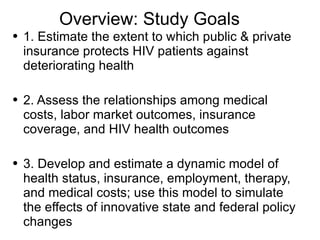
Overview: Study Goals 1. Estimate the extent to which public & private insurance protects HIV patients against deteriorating health 2. Assess the relationships among medical costs, labor market outcomes, insurance coverage, and HIV health outcomes 3. Develop and estimate a dynamic model of health status, insurance, employment, therapy, and medical costs; use this model to simulate the effects of innovative state and federal policy changes
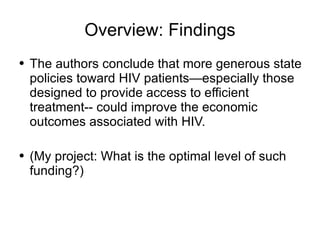
Overview: Findings The authors conclude that more generous state policies toward HIV patients—especially those designed to provide access to efficient treatment-- could improve the economic outcomes associated with HIV. (My project: What is the optimal level of such funding?)
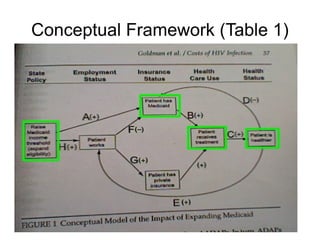
Conceptual Framework To look at impact of state policy on medical costs is complicated because changes can affect work status and health, which are linked back to program participation. In the following diagram,we can see the indirect effects of raising the medicaid income threshold.
Conceptual Framework (Table 1)
Variables Input Variables: state-level variation in program eligibility and generosity Outcome Variables: total monthly expenditures on outpatient and inpatient care, emergency room (ER) visits, and pharmaceutical products Indirect Outcome Variables: full-time work status, earnings (represents indirect economic benefits or negative costs) Control variables: ADAP ranking, prescription limits, income thresholds, disability threshold
Model: First Stage Because costs are highly variable and contain many zeros, it is appropriate to use a two-part model with a log transformation to estimate earnings or expenditures. STATA transformations to data. In the first stage, they regress whether the patient had any expenditures (or earnings) on control variables
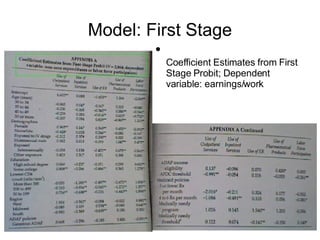
Model: First Stage Coefficient Estimates from First Stage Probit; Dependent variable: earnings/work
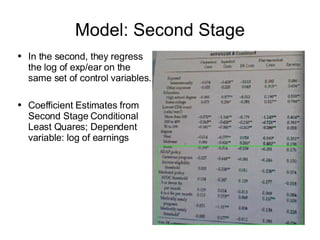
Model: Second Stage In the second, they regress the log of exp/ear on the same set of control variables. Coefficient Estimates from Second Stage Conditional Least Quares; Dependent variable: log of earnings
Model Clarification With the resulting coefficients from the two-part model, they predict the impact of various state policies on the outcomes for a patient.  To obtain the predicted effects of these policies, they calculated the expected probability of participation or use of services for each patient in the data set, using the results from the first-state probit regression under each alternative policy scenario.
Model Then, they calculated the expected log expenditures and earnings using the results from the second stage regression, also under each policy exponentiated residuals from the second stage—to retransform expected log exp/ear into predicted exp/ear. Finally, they averaged those predictions using HCSUS population weights to estimate the impact of the state policy on the representative patient.
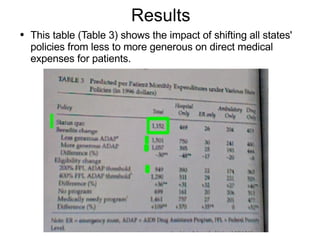
Results This table (Table 3) shows the impact of shifting all states' policies from less to more generous on direct medical expenses for patients.
Conclusion Economic benefits follow the clinical benefits of improved access to HIV care for those with a clear need for HAART therapy. Increased costs would purchase needed care that will likely increase longevity and improve quality of life. (States would spend more on drugs, less on hospitalization cost)
Problem Not all the savings accrue to the programs providing therapy (for people eligible for both Medicaid and Medicare, which is 13% of people receiving federal assistance).

Article

  • 1.
  • 2.
    Overview: Background 1.Treating HIV/AIDS is expensive (20k/p/y in '96) 2. A majority of people in care for HIV are covered by public insurance that requires them to demonstrate disability. 3. Any savings in reduced inpatient or ambulatory care resulting from early treatment may not accrue to the public program that covers them. (Medicaid covers expensive drugs, but Medicare enjoys the savings from reduced hospitalization rates)
  • 3.
    Overview: Methodology UseHIV Cost and Services Utilization Study (HCSUS), the “first nationally representative probability sample of HIV-infected adults receiving care in the US who were followed over 3 years” (1994-2000). The resulting model can be used to assess the likely consequences of policy changes, such as those that expand coverage of Medicare or Medicaid. Model is a microsimulation-- used to predict the impact of policy changes on a variety of demographic subgroups, including women and minorities.
  • 4.
    Overview: Study Goals1. Estimate the extent to which public & private insurance protects HIV patients against deteriorating health 2. Assess the relationships among medical costs, labor market outcomes, insurance coverage, and HIV health outcomes 3. Develop and estimate a dynamic model of health status, insurance, employment, therapy, and medical costs; use this model to simulate the effects of innovative state and federal policy changes
  • 5.
    Overview: Findings Theauthors conclude that more generous state policies toward HIV patients—especially those designed to provide access to efficient treatment-- could improve the economic outcomes associated with HIV. (My project: What is the optimal level of such funding?)
  • 6.
    Conceptual Framework Tolook at impact of state policy on medical costs is complicated because changes can affect work status and health, which are linked back to program participation. In the following diagram,we can see the indirect effects of raising the medicaid income threshold.
  • 7.
  • 8.
    Variables Input Variables:state-level variation in program eligibility and generosity Outcome Variables: total monthly expenditures on outpatient and inpatient care, emergency room (ER) visits, and pharmaceutical products Indirect Outcome Variables: full-time work status, earnings (represents indirect economic benefits or negative costs) Control variables: ADAP ranking, prescription limits, income thresholds, disability threshold
  • 9.
    Model: First StageBecause costs are highly variable and contain many zeros, it is appropriate to use a two-part model with a log transformation to estimate earnings or expenditures. STATA transformations to data. In the first stage, they regress whether the patient had any expenditures (or earnings) on control variables
  • 10.
    Model: First StageCoefficient Estimates from First Stage Probit; Dependent variable: earnings/work
  • 11.
    Model: Second StageIn the second, they regress the log of exp/ear on the same set of control variables. Coefficient Estimates from Second Stage Conditional Least Quares; Dependent variable: log of earnings
  • 12.
    Model Clarification Withthe resulting coefficients from the two-part model, they predict the impact of various state policies on the outcomes for a patient. To obtain the predicted effects of these policies, they calculated the expected probability of participation or use of services for each patient in the data set, using the results from the first-state probit regression under each alternative policy scenario.
  • 13.
    Model Then, theycalculated the expected log expenditures and earnings using the results from the second stage regression, also under each policy exponentiated residuals from the second stage—to retransform expected log exp/ear into predicted exp/ear. Finally, they averaged those predictions using HCSUS population weights to estimate the impact of the state policy on the representative patient.
  • 14.
    Results This table(Table 3) shows the impact of shifting all states' policies from less to more generous on direct medical expenses for patients.
  • 15.
    Conclusion Economic benefitsfollow the clinical benefits of improved access to HIV care for those with a clear need for HAART therapy. Increased costs would purchase needed care that will likely increase longevity and improve quality of life. (States would spend more on drugs, less on hospitalization cost)
  • 16.
    Problem Not allthe savings accrue to the programs providing therapy (for people eligible for both Medicaid and Medicare, which is 13% of people receiving federal assistance).