Study Set-Up:
11/20/201
7
Katalyst Healthcares & Life Sciences
Icons Used
Questions
Demonstration
Hands on
Exercise
Coding
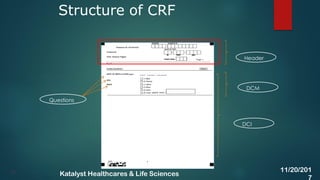
Standards
A Welcome
Break
Tools
2
Referenc
e
Test Your
Understandi
ng
Contacts
11/20/201
7
Katalyst Healthcares & Life Sciences
Receipt of Good copy of study protocol marks the beginning of study
setup activities for Data Management.
Study set-up activities are critical in a clinical study trial, as it provides
the platform to capture clinical data.
Overview
3
11/20/201
7
Katalyst Healthcares & Life Sciences
After completing this chapter you will be able to understand:
– DM Activities in Study Set up
– Study Set-up process flow
– CRF designing process flow
– Roles and Responsibilities for CRF designing
– Database designing process flow
– Roles and Responsibilities for DB designing
– Creation of Data Validation Specifications
– Programming of procedures
– Roles and Responsibilities for programming and testing of
procedures
– UAT
Objectives
4
11/20/201
7
Katalyst Healthcares & Life Sciences
• It take approximately 16 weeks to complete all the set-up activities
for a Phase 2 paper study without using standard templates.
• The time to design a database is reduced by 40% if standard
templates are available in the library.
Do You Know
5
11/20/201
7
Katalyst Healthcares & Life Sciences
Overview of the Study Set-up Process in Clinical Data Management
includes:
– CRF (Case Report Form) Design
– Database design
– Programming Procedures (Validation and Derivation procedures)
– UAT (User Acceptance Testing) / Database testing
DM Activities in Study Set up
6
11/20/201
7
Katalyst Healthcares & Life Sciences
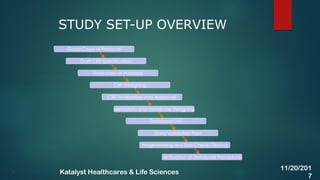
STUDY SET-UP OVERVIEW
7
Good Copy of Protocol
Draft CRF specification
Final copy of Protocol
CRF Designing
CRF Finalization and Approval
Metadata and Database Designing
Database UAT
Data Validation Plan
Programming and Edit Checks Testing
Activation of Database Procedure
11/20/201
7
Katalyst Healthcares & Life Sciences
• A Case Report Form (CRF) is a paper or electronic questionnaire
specifically used in clinical trial research.
• The Case Report Form is the tool used by Clinical Trial Sponsor to
collect data from each participating site.
• All data on each patient participating in a clinical trial are held
and/or documented in the CRF, including adverse events.
• The Clinical Trial Sponsor funds the development of CRF to collect
the specific data they need in order to test their hypotheses or
answer their research questions.
• The size of a CRF can range from a handwritten one-time 'snapshot'
of a patient's physical condition to hundreds of pages of
electronically captured data obtained over a period of weeks or
months.
CRF
8
11/20/201
7
Katalyst Healthcares & Life Sciences
Objective of CRF Designing
– Capture all information required by the protocol
– Capture precise, accurate and quality data
– Provide answers to the objectives of the study
– Meet the needs of different clients and end users
– Collect the core data for input into Annual Reports
CRF Designing
9
11/20/201
7
Katalyst Healthcares & Life Sciences
The 3 Principle Of Designing CRF (3 C’s): Clear, Concise and Consistent
Elements of the CRF:
• CRF Case Book: Collection of CRFs / DCIs forms a CRF Case Book. CRFs
in the casebook are arranged as per protocol visit schedule (Clinically
Planned Event)
• CRF / DCI: One or more DCM forms a CRF/DCI (Case report form/Data
collection instrument).
• DCM/CRF Section: Data Collection Module is a group of specific
questions collected as per protocol. There are two types of modules i.e.
Safety and Efficacy modules
• Question Groups: A set of related questions grouped together
• Questions: Individual Questions
Principle Of Designing CRF
10
11/20/201
7
Katalyst Healthcares & Life Sciences
Structure of CRF
11
Questions
DCI
Header
DCM
11/20/201
7
Katalyst Healthcares & Life Sciences
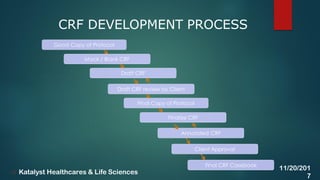
CRF DEVELOPMENT PROCESS
12
Good Copy of Protocol
Mock / Blank CRF
Draft CRF
Draft CRF review by Client
Final Copy of Protocol
Finalize CRF
Annotated CRF
Final CRF Casebook
Client Approval
11/20/201
7
Katalyst Healthcares & Life Sciences
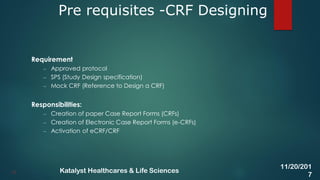
Requirement
– Approved protocol
– SPS (Study Design specification)
– Mock CRF (Reference to Design a CRF)
Responsibilities:
– Creation of paper Case Report Forms (CRFs)
– Creation of Electronic Case Report Forms (e-CRFs)
– Activation of eCRF/CRF
Pre requisites -CRF Designing
13
11/20/201
7
Katalyst Healthcares & Life Sciences
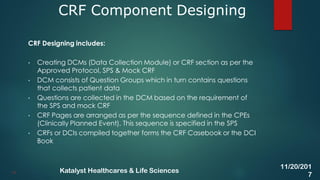
CRF Designing includes:
• Creating DCMs (Data Collection Module) or CRF section as per the
Approved Protocol, SPS & Mock CRF
• DCM consists of Question Groups which in turn contains questions
that collects patient data
• Questions are collected in the DCM based on the requirement of
the SPS and mock CRF
• CRF Pages are arranged as per the sequence defined in the CPEs
(Clinically Planned Event). This sequence is specified in the SPS
• CRFs or DCIs compiled together forms the CRF Casebook or the DCI
Book
CRF Component Designing
14
11/20/201
7
Katalyst Healthcares & Life Sciences
Post CRF Designing activities includes:
– The CRF Casebook is sent for the Study Team review and approval
– The review may result in some changes and are taken care by adhering
to the Standards to be followed which are set by the Regulatory
Authorities
– This Casebook is again sent to the Study Team for approval
– Once approved, the CRF is posted into a central repository to be
available for Data Collection. This is specific for Paper CRFs.
– In case of e-CRFs, the questions(fields) are mapped in the database.
This process is not followed for Paper CRFs.
– This marks the closure of the CRF Designing Activity and beginning of
Database Designing activity
CRF Approval
15
11/20/201
7
Katalyst Healthcares & Life Sciences
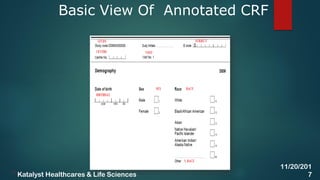
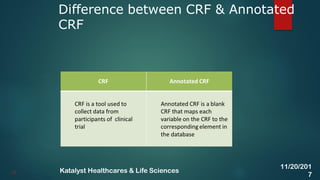
• The annotated CRF is a blank CRF including treatment assignment
forms that maps each blank on the CRF to the corresponding
element in the database.
• The annotated CRF should provide the variable names and coding.

Each page and each blank of the CRF is represented in an
annotated CRF.
• An annotated e-CRF is required when submitting case report
tabulations (CRTs) in an electronic submission for an EDC study.
Annotated CRF
16
11/20/201
7
Katalyst Healthcares & Life Sciences
Basic View Of Annotated CRF
17
11/20/201
7Katalyst Healthcares & Life Sciences
Difference between CRF & Annotated
CRF
18
11/20/201
7
Katalyst Healthcares & Life Sciences
Deliverables:
– CRF Case Book
– CRF Design QC Checklist (Process specific - May or may not be required
/ present)
CRF Design Deliverables
19
11/20/201
7
Katalyst Healthcares & Life Sciences
The CRF designing team usually comprises of the following members.
1. CRF Designer: Member of the DM team. Initiates the draft CRF
preparation.
2. Review Team: Comprises of the LDM, Statistician, DB designer and
sponsor/client. These members will review the draft CRF and
provide inputs or comments if any.
3. Data Manager: Prepares CRF Completion guidelines for the
investigator sites.
Documentation:
Once the CRF has been finalized it is essential to complete the
documentation activities such as filling up the CRF designing checklist, CRF
approval form with appropriate signatures etc. if any.
Roles and Responsibilities
20
11/20/201
7
Katalyst Healthcares & Life Sciences
Based on the protocol and CRF a database design document is
prepared also known as the Data Standards Document (DSD) or the
Study Data Specifications (SPS). This may also be referred to as CRF
annotation. The document serves as a guide while designing the data
entry screens.
Pre-requisites for DB designing:
• Data Standards Document
• Active/Final CRF for paper and draft CRF for RDC studies
• Approved protocol
Database Designing
21
11/20/201
7
Katalyst Healthcares & Life Sciences
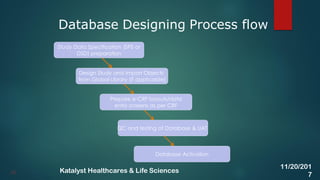
Database Designing Process flow
22
Study Data Specification (SPS or
DSD) preparation
Design Study and Import Objects
from Global Library (if applicable)
Prepare e-CRF layouts/data
entry screens as per CRF
QC and testing of Database & UAT
Database Activation
11/20/201
7
Katalyst Healthcares & Life Sciences
Requirements for RDC Study:
– Final SPS (Study Design Specification)
– Mock CRF
– Approved Protocol
Requirements for non-RDC Study:
– Activated CRF
– Approved Protocol
– Final SPS
Responsibilities :
– Defining Events
– Creation of Data Collection Points and Modules
– Quality check of deliverables
Database Design
23
11/20/201
7
Katalyst Healthcares & Life Sciences
Database Designing includes :
• Check that the Study (Protocol Number) and the Intervals are defined
in the Database (e.g. OC – Oracle Clinical)
• Define the CPEs/Visit Matrix and map them to the defined intervals for
the study as per the activated CRF for non-RDC study or as per the SPS
for RDC study
• Defining and Linking Investigators, Sites and Patients to appropriate
centers as per the data provided by the Client
• Select and Create Data Collection Point and DCMs as per the SPS (RDC
Study) or activated CRF (non-RDC Study)
Database Designing
24
11/20/201
7
Katalyst Healthcares & Life Sciences
• Compile DCMs to form DCIs (Data Collection Instrument) as per the SPS
(RDC Study) or activated CRF (non-RDC Study)
• Arrange all the DCIs to form a DCI Book as per the SPS (RDC Study) or
activated CRF (non-RDC Study)
• The screenshots are printed for RDC Study and sent to the Study Team
for review
OR
• Once the Database is ready for non-RDC Study it is available to the
Study Team for Review
• The Database is Activated once the approval from the Study Team is
received
Database Designing
25
11/20/201
7
Katalyst Healthcares & Life Sciences
Deliverables:
• Database designer QC checklist
• Compiled form of database collection components (Modules)
• Data Entry Guidelines
Database Design Deliverables
26
11/20/201
7
Katalyst Healthcares & Life Sciences
DB Designer: Designs the database as per final CRF and SPS/DSD.
Data Manager: Prepares the DSD/SPS and provides it to DB designer.
Tests the database prior to activation and provides findings if any. Is
also responsible for preparing Data Entry guidelines for DE team in case
of paper studies.
Sponsor: Provides approval for DB activation.
Documentation:
On activation of database it is essential to complete all the
documentation such as DB testing findings document, DB testing
checklist, DB QC checklist etc.
Roles and Responsibilities
27
11/20/201
7
Katalyst Healthcares & Life Sciences
Objective:
• Automated edit checks are required to flag errors / discrepancies in
the data present on the CRF / database. These checks are referred
to as Validation Procedures or Edit checks.
• Programming these Validation procedures/Edit checks which may
include both Standard and Study specific checks is an important
activity to be completed during Study Set up phase.
Requirements:
• Final DQS/DRP (Data Quality Specification) / DQR (Data Quality
Report)
• DQS / DQR consist of checks that needs to be programmed
Programming Procedures
28
11/20/201
7
Katalyst Healthcares & Life Sciences
Responsibilities:
• Programming Validation/Derivation Procedures
• Test Data entry (clean as well as dirty data)
• Retiring and Creation of new version in case of modification
• Activating Validation/Derivation Procedures
Programming Procedures
29
11/20/201
7
Katalyst Healthcares & Life Sciences
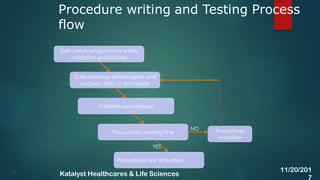
Procedure writing and Testing Process
flow
30
Edit check programmer writes
validation procedures
Data reviewer enters clean and
unclean data in test mode
Validates procedures
Procedures working fine
Procedures are activated
YES
NO Procedures
modified
11/20/201
7
Katalyst Healthcares & Life Sciences
• Consist of computer checks on data to assure validity & accuracy of
data
• Validate data against predetermined specifications
• Primarily used to check safety and efficacy data unique to current
study
Data Validation Specification (DVS):
A document that describes Data Quality Checks / Derivation for the fields
in the Case Report Form (CRF) to generate electronic errors when
procedures are executed on the data entered in the database.
Procedures:
The computerized program written by Edit Check Programmer (EC
Programmer) for all edits mentioned in the DVP. This program is used to
identify discrepancies in the data.
– Validation procedures are those that will validate the entered data to
generate discrepancies.
– Derivation procedures are those that derive a value from the entered data
Edit checks/Procedures
31
11/20/201
7
Katalyst Healthcares & Life Sciences
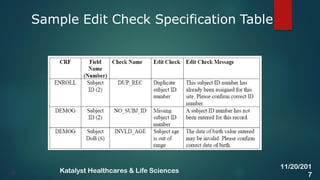
Sample Edit Check Specification Table
32
11/20/201
7
Katalyst Healthcares & Life Sciences
Programming Procedure includes:
• Programming edit checks for Validation and Derivation Procedures
• Perform test data entry (by entering good as well as dirty data) for the
dummy patients created during database build
• Test the programmed Validation and Derivation Procedures and send it
for approval to the client
• Approved procedures are then activated and is available to be run on
the Production Data
• Activated procedures may require some changes based on the
modification of the requirements or if there is a modification to the
protocol
• In such scenarios retire and create new version of the procedures
• Activate the modified Validation and Derivation procedures once
reviewed and approved
Programming Procedures
33
11/20/201
7
Katalyst Healthcares & Life Sciences
Deliverables:
• DQS / DQR containing details of the validation procedures and
derivation procedures
Programming Procedures Deliverables
34
11/20/201
7
Katalyst Healthcares & Life Sciences
Requirements:
• Final Data Validation Specifications (DVS)
• DVS consist of checks that needs to be programmed
Responsibilities
• Programmer:
– Programming Validation/Derivation Procedures
– Retiring and Creation of new version in case of modification
– Activating Validation/Derivation Procedures
• Data Manager:
– Test Data entry (clean as well as dirty data)/ i.e. Unit Testing (to
check if implemented programs are working properly. Performed in
Development environment)
Roles and Responsibilities
35
11/20/201
7
Katalyst Healthcares & Life Sciences
What is User Acceptance Testing (UAT)
• User Acceptance Testing is often the final step before releasing the
application / database to sites for capturing clinical trial data.
• Usually the end users (Data Manager) who will be using the
applications test the application before ‘accepting’ the
application.
• This type of testing gives the end users the confidence that the
application being delivered to them meets the study and their
requirements.
• This testing is performed by both the technical group designing the
database as well as the Data Managers.
User Acceptance Testing
36
11/20/201
7
Katalyst Healthcares & Life Sciences
Clean Data:
Data that is not identified by Validation Procedures as discrepant (i.e.
data that meets the requirement of validation procedures, is without
problems or inconsistencies and therefore should cause no
discrepancies).
Dirty Data:
Data that is identified by validation procedures as discrepant (i.e. Data
which should cause discrepancies).
Definitions
37
11/20/201
7
Katalyst Healthcares & Life Sciences
Prerequisites
– Test Scripts / Test cases
– UAT Checklist / DB testing checklist
User Acceptance Testing
38
11/20/201
7
Katalyst Healthcares & Life Sciences
What to Test ?
• To ensure an effective User Acceptance Testing Test cases are
created.
• These Test cases can be created using various use cases identified
during the Requirements definition stage.
• The Test cases ensure proper coverage of all the scenarios during
testing.
• During this type of testing the specific focus is the exact real life
usage of the application.
• The Testing is done in an environment that simulates the production
environment.
• The Test cases are written using real life scenarios for the application
User Acceptance Testing
39
11/20/201
7
Katalyst Healthcares & Life Sciences
How to Test ?
• The user acceptance testing is usually a black box type of testing. In
other words, the focus is on the functionality and the usability of the
application rather than the technical aspects. It is generally
assumed that the application would have already undergone Unit,
Integration and System Level Testing.
• However, it is useful if the User Acceptance Testing is carried out in
an environment that closely resembles the real life or production
environment.
User Acceptance Testing
40
UAT
11/20/201
7
Katalyst Healthcares & Life Sciences
The steps taken for User Acceptance Testing typically involve one or
more of the following:
– Designing UA Test Cases
– Executing Test Cases
– Documenting the Defects found during UAT
– Resolving the issues/Bug Fixing
– Sign Off
User Acceptance Testing
41
11/20/201
7
Katalyst Healthcares & Life Sciences
Questions
42
11/20/201
7
Katalyst Healthcares & Life Sciences
1. What are essential elements of CRF designing?
2. What does DSD/SPS stand for?
3. Who is responsible for preparing a SPS/DSD document?
4. What is collection of DCMs known as?
5. Collection of question groups is known as DCI. True or False?
Test Your Understanding
43
11/20/201
7
Katalyst Healthcares & Life Sciences
At the end of this session we are now able to understand:
• The processes involved at the study start up.
• CRF designing process.
• Database designing process.
• Procedure writing and testing process.
• Roles and Responsibilities of every individual involved in
the above activities.
Summary
44
11/20/201
7
Katalyst Healthcares & Life Sciences
You have successfully completed Study Set-Up
Thank You
&
Questions
11/20/20
17
Contact:
Katalyst Healthcare’s & Life Sciences
South Plainfield, NJ, USA 07080.
E-Mail: info@KatalystHLS.com

Study Setup_Katalyst HLS

  • 1.
  • 2.
    Icons Used Questions Demonstration Hands on Exercise Coding Standards AWelcome Break Tools 2 Referenc e Test Your Understandi ng Contacts 11/20/201 7 Katalyst Healthcares & Life Sciences
  • 3.
    Receipt of Goodcopy of study protocol marks the beginning of study setup activities for Data Management. Study set-up activities are critical in a clinical study trial, as it provides the platform to capture clinical data. Overview 3 11/20/201 7 Katalyst Healthcares & Life Sciences
  • 4.
    After completing thischapter you will be able to understand: – DM Activities in Study Set up – Study Set-up process flow – CRF designing process flow – Roles and Responsibilities for CRF designing – Database designing process flow – Roles and Responsibilities for DB designing – Creation of Data Validation Specifications – Programming of procedures – Roles and Responsibilities for programming and testing of procedures – UAT Objectives 4 11/20/201 7 Katalyst Healthcares & Life Sciences
  • 5.
    • It takeapproximately 16 weeks to complete all the set-up activities for a Phase 2 paper study without using standard templates. • The time to design a database is reduced by 40% if standard templates are available in the library. Do You Know 5 11/20/201 7 Katalyst Healthcares & Life Sciences
  • 6.
    Overview of theStudy Set-up Process in Clinical Data Management includes: – CRF (Case Report Form) Design – Database design – Programming Procedures (Validation and Derivation procedures) – UAT (User Acceptance Testing) / Database testing DM Activities in Study Set up 6 11/20/201 7 Katalyst Healthcares & Life Sciences
  • 7.
    STUDY SET-UP OVERVIEW 7 GoodCopy of Protocol Draft CRF specification Final copy of Protocol CRF Designing CRF Finalization and Approval Metadata and Database Designing Database UAT Data Validation Plan Programming and Edit Checks Testing Activation of Database Procedure 11/20/201 7 Katalyst Healthcares & Life Sciences
  • 8.
    • A CaseReport Form (CRF) is a paper or electronic questionnaire specifically used in clinical trial research. • The Case Report Form is the tool used by Clinical Trial Sponsor to collect data from each participating site. • All data on each patient participating in a clinical trial are held and/or documented in the CRF, including adverse events. • The Clinical Trial Sponsor funds the development of CRF to collect the specific data they need in order to test their hypotheses or answer their research questions. • The size of a CRF can range from a handwritten one-time 'snapshot' of a patient's physical condition to hundreds of pages of electronically captured data obtained over a period of weeks or months. CRF 8 11/20/201 7 Katalyst Healthcares & Life Sciences
  • 9.
    Objective of CRFDesigning – Capture all information required by the protocol – Capture precise, accurate and quality data – Provide answers to the objectives of the study – Meet the needs of different clients and end users – Collect the core data for input into Annual Reports CRF Designing 9 11/20/201 7 Katalyst Healthcares & Life Sciences
  • 10.
    The 3 PrincipleOf Designing CRF (3 C’s): Clear, Concise and Consistent Elements of the CRF: • CRF Case Book: Collection of CRFs / DCIs forms a CRF Case Book. CRFs in the casebook are arranged as per protocol visit schedule (Clinically Planned Event) • CRF / DCI: One or more DCM forms a CRF/DCI (Case report form/Data collection instrument). • DCM/CRF Section: Data Collection Module is a group of specific questions collected as per protocol. There are two types of modules i.e. Safety and Efficacy modules • Question Groups: A set of related questions grouped together • Questions: Individual Questions Principle Of Designing CRF 10 11/20/201 7 Katalyst Healthcares & Life Sciences
  • 11.
  • 12.
    CRF DEVELOPMENT PROCESS 12 GoodCopy of Protocol Mock / Blank CRF Draft CRF Draft CRF review by Client Final Copy of Protocol Finalize CRF Annotated CRF Final CRF Casebook Client Approval 11/20/201 7 Katalyst Healthcares & Life Sciences
  • 13.
    Requirement – Approved protocol –SPS (Study Design specification) – Mock CRF (Reference to Design a CRF) Responsibilities: – Creation of paper Case Report Forms (CRFs) – Creation of Electronic Case Report Forms (e-CRFs) – Activation of eCRF/CRF Pre requisites -CRF Designing 13 11/20/201 7 Katalyst Healthcares & Life Sciences
  • 14.
    CRF Designing includes: •Creating DCMs (Data Collection Module) or CRF section as per the Approved Protocol, SPS & Mock CRF • DCM consists of Question Groups which in turn contains questions that collects patient data • Questions are collected in the DCM based on the requirement of the SPS and mock CRF • CRF Pages are arranged as per the sequence defined in the CPEs (Clinically Planned Event). This sequence is specified in the SPS • CRFs or DCIs compiled together forms the CRF Casebook or the DCI Book CRF Component Designing 14 11/20/201 7 Katalyst Healthcares & Life Sciences
  • 15.
    Post CRF Designingactivities includes: – The CRF Casebook is sent for the Study Team review and approval – The review may result in some changes and are taken care by adhering to the Standards to be followed which are set by the Regulatory Authorities – This Casebook is again sent to the Study Team for approval – Once approved, the CRF is posted into a central repository to be available for Data Collection. This is specific for Paper CRFs. – In case of e-CRFs, the questions(fields) are mapped in the database. This process is not followed for Paper CRFs. – This marks the closure of the CRF Designing Activity and beginning of Database Designing activity CRF Approval 15 11/20/201 7 Katalyst Healthcares & Life Sciences
  • 16.
    • The annotatedCRF is a blank CRF including treatment assignment forms that maps each blank on the CRF to the corresponding element in the database. • The annotated CRF should provide the variable names and coding. Each page and each blank of the CRF is represented in an annotated CRF. • An annotated e-CRF is required when submitting case report tabulations (CRTs) in an electronic submission for an EDC study. Annotated CRF 16 11/20/201 7 Katalyst Healthcares & Life Sciences
  • 17.
    Basic View OfAnnotated CRF 17 11/20/201 7Katalyst Healthcares & Life Sciences
  • 18.
    Difference between CRF& Annotated CRF 18 11/20/201 7 Katalyst Healthcares & Life Sciences
  • 19.
    Deliverables: – CRF CaseBook – CRF Design QC Checklist (Process specific - May or may not be required / present) CRF Design Deliverables 19 11/20/201 7 Katalyst Healthcares & Life Sciences
  • 20.
    The CRF designingteam usually comprises of the following members. 1. CRF Designer: Member of the DM team. Initiates the draft CRF preparation. 2. Review Team: Comprises of the LDM, Statistician, DB designer and sponsor/client. These members will review the draft CRF and provide inputs or comments if any. 3. Data Manager: Prepares CRF Completion guidelines for the investigator sites. Documentation: Once the CRF has been finalized it is essential to complete the documentation activities such as filling up the CRF designing checklist, CRF approval form with appropriate signatures etc. if any. Roles and Responsibilities 20 11/20/201 7 Katalyst Healthcares & Life Sciences
  • 21.
    Based on theprotocol and CRF a database design document is prepared also known as the Data Standards Document (DSD) or the Study Data Specifications (SPS). This may also be referred to as CRF annotation. The document serves as a guide while designing the data entry screens. Pre-requisites for DB designing: • Data Standards Document • Active/Final CRF for paper and draft CRF for RDC studies • Approved protocol Database Designing 21 11/20/201 7 Katalyst Healthcares & Life Sciences
  • 22.
    Database Designing Processflow 22 Study Data Specification (SPS or DSD) preparation Design Study and Import Objects from Global Library (if applicable) Prepare e-CRF layouts/data entry screens as per CRF QC and testing of Database & UAT Database Activation 11/20/201 7 Katalyst Healthcares & Life Sciences
  • 23.
    Requirements for RDCStudy: – Final SPS (Study Design Specification) – Mock CRF – Approved Protocol Requirements for non-RDC Study: – Activated CRF – Approved Protocol – Final SPS Responsibilities : – Defining Events – Creation of Data Collection Points and Modules – Quality check of deliverables Database Design 23 11/20/201 7 Katalyst Healthcares & Life Sciences
  • 24.
    Database Designing includes: • Check that the Study (Protocol Number) and the Intervals are defined in the Database (e.g. OC – Oracle Clinical) • Define the CPEs/Visit Matrix and map them to the defined intervals for the study as per the activated CRF for non-RDC study or as per the SPS for RDC study • Defining and Linking Investigators, Sites and Patients to appropriate centers as per the data provided by the Client • Select and Create Data Collection Point and DCMs as per the SPS (RDC Study) or activated CRF (non-RDC Study) Database Designing 24 11/20/201 7 Katalyst Healthcares & Life Sciences
  • 25.
    • Compile DCMsto form DCIs (Data Collection Instrument) as per the SPS (RDC Study) or activated CRF (non-RDC Study) • Arrange all the DCIs to form a DCI Book as per the SPS (RDC Study) or activated CRF (non-RDC Study) • The screenshots are printed for RDC Study and sent to the Study Team for review OR • Once the Database is ready for non-RDC Study it is available to the Study Team for Review • The Database is Activated once the approval from the Study Team is received Database Designing 25 11/20/201 7 Katalyst Healthcares & Life Sciences
  • 26.
    Deliverables: • Database designerQC checklist • Compiled form of database collection components (Modules) • Data Entry Guidelines Database Design Deliverables 26 11/20/201 7 Katalyst Healthcares & Life Sciences
  • 27.
    DB Designer: Designsthe database as per final CRF and SPS/DSD. Data Manager: Prepares the DSD/SPS and provides it to DB designer. Tests the database prior to activation and provides findings if any. Is also responsible for preparing Data Entry guidelines for DE team in case of paper studies. Sponsor: Provides approval for DB activation. Documentation: On activation of database it is essential to complete all the documentation such as DB testing findings document, DB testing checklist, DB QC checklist etc. Roles and Responsibilities 27 11/20/201 7 Katalyst Healthcares & Life Sciences
  • 28.
    Objective: • Automated editchecks are required to flag errors / discrepancies in the data present on the CRF / database. These checks are referred to as Validation Procedures or Edit checks. • Programming these Validation procedures/Edit checks which may include both Standard and Study specific checks is an important activity to be completed during Study Set up phase. Requirements: • Final DQS/DRP (Data Quality Specification) / DQR (Data Quality Report) • DQS / DQR consist of checks that needs to be programmed Programming Procedures 28 11/20/201 7 Katalyst Healthcares & Life Sciences
  • 29.
    Responsibilities: • Programming Validation/DerivationProcedures • Test Data entry (clean as well as dirty data) • Retiring and Creation of new version in case of modification • Activating Validation/Derivation Procedures Programming Procedures 29 11/20/201 7 Katalyst Healthcares & Life Sciences
  • 30.
    Procedure writing andTesting Process flow 30 Edit check programmer writes validation procedures Data reviewer enters clean and unclean data in test mode Validates procedures Procedures working fine Procedures are activated YES NO Procedures modified 11/20/201 7 Katalyst Healthcares & Life Sciences
  • 31.
    • Consist ofcomputer checks on data to assure validity & accuracy of data • Validate data against predetermined specifications • Primarily used to check safety and efficacy data unique to current study Data Validation Specification (DVS): A document that describes Data Quality Checks / Derivation for the fields in the Case Report Form (CRF) to generate electronic errors when procedures are executed on the data entered in the database. Procedures: The computerized program written by Edit Check Programmer (EC Programmer) for all edits mentioned in the DVP. This program is used to identify discrepancies in the data. – Validation procedures are those that will validate the entered data to generate discrepancies. – Derivation procedures are those that derive a value from the entered data Edit checks/Procedures 31 11/20/201 7 Katalyst Healthcares & Life Sciences
  • 32.
    Sample Edit CheckSpecification Table 32 11/20/201 7 Katalyst Healthcares & Life Sciences
  • 33.
    Programming Procedure includes: •Programming edit checks for Validation and Derivation Procedures • Perform test data entry (by entering good as well as dirty data) for the dummy patients created during database build • Test the programmed Validation and Derivation Procedures and send it for approval to the client • Approved procedures are then activated and is available to be run on the Production Data • Activated procedures may require some changes based on the modification of the requirements or if there is a modification to the protocol • In such scenarios retire and create new version of the procedures • Activate the modified Validation and Derivation procedures once reviewed and approved Programming Procedures 33 11/20/201 7 Katalyst Healthcares & Life Sciences
  • 34.
    Deliverables: • DQS /DQR containing details of the validation procedures and derivation procedures Programming Procedures Deliverables 34 11/20/201 7 Katalyst Healthcares & Life Sciences
  • 35.
    Requirements: • Final DataValidation Specifications (DVS) • DVS consist of checks that needs to be programmed Responsibilities • Programmer: – Programming Validation/Derivation Procedures – Retiring and Creation of new version in case of modification – Activating Validation/Derivation Procedures • Data Manager: – Test Data entry (clean as well as dirty data)/ i.e. Unit Testing (to check if implemented programs are working properly. Performed in Development environment) Roles and Responsibilities 35 11/20/201 7 Katalyst Healthcares & Life Sciences
  • 36.
    What is UserAcceptance Testing (UAT) • User Acceptance Testing is often the final step before releasing the application / database to sites for capturing clinical trial data. • Usually the end users (Data Manager) who will be using the applications test the application before ‘accepting’ the application. • This type of testing gives the end users the confidence that the application being delivered to them meets the study and their requirements. • This testing is performed by both the technical group designing the database as well as the Data Managers. User Acceptance Testing 36 11/20/201 7 Katalyst Healthcares & Life Sciences
  • 37.
    Clean Data: Data thatis not identified by Validation Procedures as discrepant (i.e. data that meets the requirement of validation procedures, is without problems or inconsistencies and therefore should cause no discrepancies). Dirty Data: Data that is identified by validation procedures as discrepant (i.e. Data which should cause discrepancies). Definitions 37 11/20/201 7 Katalyst Healthcares & Life Sciences
  • 38.
    Prerequisites – Test Scripts/ Test cases – UAT Checklist / DB testing checklist User Acceptance Testing 38 11/20/201 7 Katalyst Healthcares & Life Sciences
  • 39.
    What to Test? • To ensure an effective User Acceptance Testing Test cases are created. • These Test cases can be created using various use cases identified during the Requirements definition stage. • The Test cases ensure proper coverage of all the scenarios during testing. • During this type of testing the specific focus is the exact real life usage of the application. • The Testing is done in an environment that simulates the production environment. • The Test cases are written using real life scenarios for the application User Acceptance Testing 39 11/20/201 7 Katalyst Healthcares & Life Sciences
  • 40.
    How to Test? • The user acceptance testing is usually a black box type of testing. In other words, the focus is on the functionality and the usability of the application rather than the technical aspects. It is generally assumed that the application would have already undergone Unit, Integration and System Level Testing. • However, it is useful if the User Acceptance Testing is carried out in an environment that closely resembles the real life or production environment. User Acceptance Testing 40 UAT 11/20/201 7 Katalyst Healthcares & Life Sciences
  • 41.
    The steps takenfor User Acceptance Testing typically involve one or more of the following: – Designing UA Test Cases – Executing Test Cases – Documenting the Defects found during UAT – Resolving the issues/Bug Fixing – Sign Off User Acceptance Testing 41 11/20/201 7 Katalyst Healthcares & Life Sciences
  • 42.
  • 43.
    1. What areessential elements of CRF designing? 2. What does DSD/SPS stand for? 3. Who is responsible for preparing a SPS/DSD document? 4. What is collection of DCMs known as? 5. Collection of question groups is known as DCI. True or False? Test Your Understanding 43 11/20/201 7 Katalyst Healthcares & Life Sciences
  • 44.
    At the endof this session we are now able to understand: • The processes involved at the study start up. • CRF designing process. • Database designing process. • Procedure writing and testing process. • Roles and Responsibilities of every individual involved in the above activities. Summary 44 11/20/201 7 Katalyst Healthcares & Life Sciences
  • 45.
    You have successfullycompleted Study Set-Up Thank You & Questions 11/20/20 17 Contact: Katalyst Healthcare’s & Life Sciences South Plainfield, NJ, USA 07080. E-Mail: info@KatalystHLS.com