CDISC SDTM
Implementation
Process
Michael Todd
President
Nth Analytics
2
Overview
• CDISC has several initiatives
• Only SDTM will have the force of law
– The FDA announced plans to require
implementation of SDTM as a federal
regulation
• Therefore, near-term, only one will have
significant impact
• We will focus on SDTM in this
presentation
3
Pace of Change
• The pharmaceutical industry changes very
slowly
– Regulated industry
– Two powerful groups: Government / Industry
stasis
• Slow implementation of SDTM is entirely
expected
• Probability of other CDISC initiatives
having near-term impact is low
4
Convergence of Forces
• Post Vioxx era is unique time when significant
forces converge to produce change
– FDA: Focus on safety
– Industry:
• Generic competition, cost pressures, resistance to price
increases, resistance to me-too drugs, costly, safety-related
failures
• Increased efficiency becomes important
• Perceived benefits from investment in new methodologies
• Cost-effective only with widespread implementation
5
FDA: Focus on Safety
• FDA has been hammered by Congress and
media (including blogosphere) for high-profile
safety failures
• We see an increased emphasis on cross-
compound class effects:
– Epilepsy compounds and suicidality
– Tumor necrosis factor (TNF) blockers and cancer
• Analyses of the sponsors’ entire clinical
database required to address these concerns
6
Regulatory Basis for use of SDTM
7
FDA to Mandate Use of SDTM
• Federal Register
– Vol. 71, No. 237 /Monday, December 11, 2006 / The Regulatory
Plan / Page 72784
– “The Food and Drug Administration is proposing to amend the
regulations governing the format in which clinical study data and
bioequivalence data are required to be submitted”
– “…The proposal would also require the use of standardized data
structure, terminology, and code sets contained in current FDA
guidance (the Study Data Tabulation Model (SDTM) developed
by the Clinical Data Interchange Standards Consortium) to allow
for more efficient and comprehensive data review.”
– 2 year implementation period
• A federal regulation has the force of law
8
eCTD Guidance
• The eCTD guidance is the current regulatory basis for
the use of SDTM in FDA submissions
• FDA Guidance: “Providing Regulatory Submissions in
Electronic Format – Human and Pharmaceutical Product
Applications and Related Submissions Using the eCTD
Specifications
– http://www.fda.gov/cder/guidance/7087rev.pdf
– Module 5 Datasets: ‘See associated document “Study Data
Specifications” for details on providing datasets and related files
(e.g., data definition files, program files).’
• Study Data Specifications
– http://www.fda.gov/cder/regulatory/ersr/Studydata.pdf
9
eCTD: Study Data Specifications
SDTM
• Regulatory basis for use of SDTM:
– “Specifications for the Data Tabulation datasets of
human drug product clinical studies, are located in the
Study Data Tabulation Model (SDTM) developed by
the Submission Data Standard working group of the
Clinical Data Interchange Standard Consortium
(CDISC).”
– “This folder is reserved for the datasets conforming to
the SDTM standard.”
– “The latest release of the SDTM and implementation
guides for using the model in clinical trials is available
from the CDISC web site.”
10
eCTD: Study Data Specifications
DEFINE.XML
• “The data definition file describes the format and content
of the submitted datasets.”
• “The specification for the data definitions for datasets
provided using the CDISC SDTM is included in the Case
Report Tabulation Data Definition (define.xml).”
• “The latest release of the Case Report Tabulation Data
Definition Specification is available from the CDISC web
site (http://www.cdisc.org/models/def/v1.0/index.html).”
• “Include a reference to the style sheet as defined in the
specification and place the corresponding style sheet in
the same folder as the define.xml file.”
11
eCTD: Study Data Specifications
Annotated CRF
• “This is a blank case report form annotations that document the
location of the data with the corresponding names of the datasets
and the names of those variables included in the submitted
datasets.”
• “The annotated CRF is a blank CRF that includes treatment
assignment forms and maps each item on the CRF to the
corresponding variables in the database.”
• “The annotated CRF should provide the variable names and coding
for each CRF item included in the data tabulation datasets.”
• “All of the pages and each item in the CRF should be included.”
• “The sponsor should write ‘not entered in database’ in all items
where this applies.”
• “The annotated CRF should be provided as a PDF file. Name the
file blankcrf.pdf.”
12
SDTM Implementation
13
SDTM Implementation:
Costs and Benefits
• Staggering cost of compliance
– Analogous to Y2K
– Will require a federal mandate to achieve critical mass
• However, with widespread implementation, industry
should realize substantial cost savings:
– ETL tools will largely automate creation of reporting and analysis
datasets
– Industry-wide standard databases will enable development of
commercial reporting and analysis tools
• Will shave weeks off timelines
– SDTM will greatly simplify data transfer between clients and
CROs
14
SDTM Implementation: Phases
• Phase I: understand the rules of STDM
– that has been done.
• Phase II: tool implementation
– ongoing
• Tools cannot do it all
• Implementation requires individuals with
data management and SDTM experience to
map with authority
15
The Role of the Data Manager
16
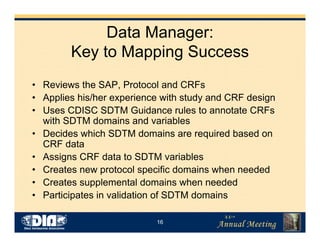
Data Manager:
Key to Mapping Success
• Reviews the SAP, Protocol and CRFs
• Applies his/her experience with study and CRF design
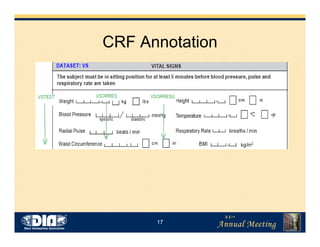
• Uses CDISC SDTM Guidance rules to annotate CRFs
with SDTM domains and variables
• Decides which SDTM domains are required based on
CRF data
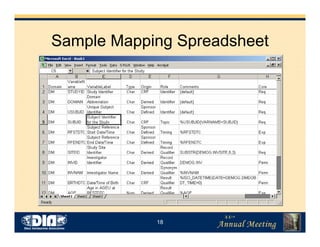
• Assigns CRF data to SDTM variables
• Creates new protocol specific domains when needed
• Creates supplemental domains when needed
• Participates in validation of SDTM domains
17
CRF Annotation
18
Sample Mapping Spreadsheet
19
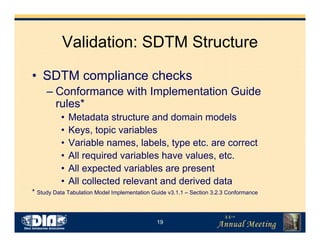
Validation: SDTM Structure
• SDTM compliance checks
– Conformance with Implementation Guide
rules*
• Metadata structure and domain models
• Keys, topic variables
• Variable names, labels, type etc. are correct
• All required variables have values, etc.
• All expected variables are present
• All collected relevant and derived data
* Study Data Tabulation Model Implementation Guide v3.1.1 – Section 3.2.3 Conformance
20
Validation: Source Data
• Verify metadata
– Data manager is the expert for this task
– Includes a manual review process
• Techniques
– Independent programming
– For each source dataset, verify data
converted correctly to SDTM for a random
sample of subjects
21
Validation: All Source Data
Mapped?
• Leverage metadata
• Use metadata to query source data
structure and determine differences
– List of source data variables not mapped
– List of source data values not mapped
– Source data variables differing from SDTM
variables
22
SDTM: New Job Roles
23
Mapping Specialist
• New role, but really an old role in a new
time
• The mapping specialist decides how to
convert the raw data into SDTM domains
and variables
• Senior position
• Historically done by SAS programmers or
statisticians
24
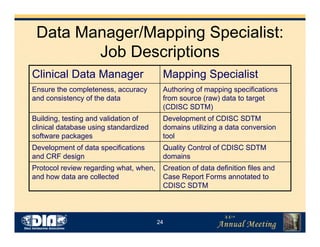
Data Manager/Mapping Specialist:
Job Descriptions
Creation of data definition files and
Case Report Forms annotated to
CDISC SDTM
Protocol review regarding what, when,
and how data are collected
Quality Control of CDISC SDTM
domains
Development of data specifications
and CRF design
Development of CDISC SDTM
domains utilizing a data conversion
tool
Building, testing and validation of
clinical database using standardized
software packages
Authoring of mapping specifications
from source (raw) data to target
(CDISC SDTM)
Ensure the completeness, accuracy
and consistency of the data
Mapping SpecialistClinical Data Manager
25
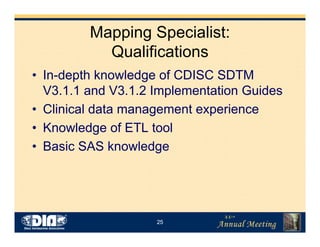
Mapping Specialist:
Qualifications
• In-depth knowledge of CDISC SDTM
V3.1.1 and V3.1.2 Implementation Guides
• Clinical data management experience
• Knowledge of ETL tool
• Basic SAS knowledge
26
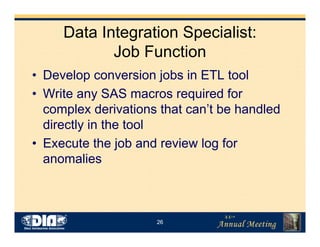
Data Integration Specialist:
Job Function
• Develop conversion jobs in ETL tool
• Write any SAS macros required for
complex derivations that can’t be handled
directly in the tool
• Execute the job and review log for
anomalies
27
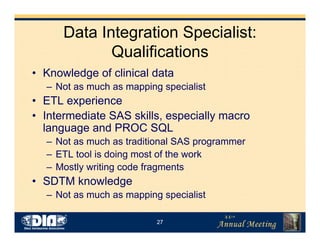
Data Integration Specialist:
Qualifications
• Knowledge of clinical data
– Not as much as mapping specialist
• ETL experience
• Intermediate SAS skills, especially macro
language and PROC SQL
– Not as much as traditional SAS programmer
– ETL tool is doing most of the work
– Mostly writing code fragments
• SDTM knowledge
– Not as much as mapping specialist
28
Summary
• Convergence of forces will drive SDTM
implementation
• As implementation becomes widespread,
organizations using ETL tools will have a
decided edge
• Data management expertise is critical to
successful SDTM automation

Cdisc sdtm implementation_process _v1

  • 1.
  • 2.
    2 Overview • CDISC hasseveral initiatives • Only SDTM will have the force of law – The FDA announced plans to require implementation of SDTM as a federal regulation • Therefore, near-term, only one will have significant impact • We will focus on SDTM in this presentation
  • 3.
    3 Pace of Change •The pharmaceutical industry changes very slowly – Regulated industry – Two powerful groups: Government / Industry stasis • Slow implementation of SDTM is entirely expected • Probability of other CDISC initiatives having near-term impact is low
  • 4.
    4 Convergence of Forces •Post Vioxx era is unique time when significant forces converge to produce change – FDA: Focus on safety – Industry: • Generic competition, cost pressures, resistance to price increases, resistance to me-too drugs, costly, safety-related failures • Increased efficiency becomes important • Perceived benefits from investment in new methodologies • Cost-effective only with widespread implementation
  • 5.
    5 FDA: Focus onSafety • FDA has been hammered by Congress and media (including blogosphere) for high-profile safety failures • We see an increased emphasis on cross- compound class effects: – Epilepsy compounds and suicidality – Tumor necrosis factor (TNF) blockers and cancer • Analyses of the sponsors’ entire clinical database required to address these concerns
  • 6.
  • 7.
    7 FDA to MandateUse of SDTM • Federal Register – Vol. 71, No. 237 /Monday, December 11, 2006 / The Regulatory Plan / Page 72784 – “The Food and Drug Administration is proposing to amend the regulations governing the format in which clinical study data and bioequivalence data are required to be submitted” – “…The proposal would also require the use of standardized data structure, terminology, and code sets contained in current FDA guidance (the Study Data Tabulation Model (SDTM) developed by the Clinical Data Interchange Standards Consortium) to allow for more efficient and comprehensive data review.” – 2 year implementation period • A federal regulation has the force of law
  • 8.
    8 eCTD Guidance • TheeCTD guidance is the current regulatory basis for the use of SDTM in FDA submissions • FDA Guidance: “Providing Regulatory Submissions in Electronic Format – Human and Pharmaceutical Product Applications and Related Submissions Using the eCTD Specifications – http://www.fda.gov/cder/guidance/7087rev.pdf – Module 5 Datasets: ‘See associated document “Study Data Specifications” for details on providing datasets and related files (e.g., data definition files, program files).’ • Study Data Specifications – http://www.fda.gov/cder/regulatory/ersr/Studydata.pdf
  • 9.
    9 eCTD: Study DataSpecifications SDTM • Regulatory basis for use of SDTM: – “Specifications for the Data Tabulation datasets of human drug product clinical studies, are located in the Study Data Tabulation Model (SDTM) developed by the Submission Data Standard working group of the Clinical Data Interchange Standard Consortium (CDISC).” – “This folder is reserved for the datasets conforming to the SDTM standard.” – “The latest release of the SDTM and implementation guides for using the model in clinical trials is available from the CDISC web site.”
  • 10.
    10 eCTD: Study DataSpecifications DEFINE.XML • “The data definition file describes the format and content of the submitted datasets.” • “The specification for the data definitions for datasets provided using the CDISC SDTM is included in the Case Report Tabulation Data Definition (define.xml).” • “The latest release of the Case Report Tabulation Data Definition Specification is available from the CDISC web site (http://www.cdisc.org/models/def/v1.0/index.html).” • “Include a reference to the style sheet as defined in the specification and place the corresponding style sheet in the same folder as the define.xml file.”
  • 11.
    11 eCTD: Study DataSpecifications Annotated CRF • “This is a blank case report form annotations that document the location of the data with the corresponding names of the datasets and the names of those variables included in the submitted datasets.” • “The annotated CRF is a blank CRF that includes treatment assignment forms and maps each item on the CRF to the corresponding variables in the database.” • “The annotated CRF should provide the variable names and coding for each CRF item included in the data tabulation datasets.” • “All of the pages and each item in the CRF should be included.” • “The sponsor should write ‘not entered in database’ in all items where this applies.” • “The annotated CRF should be provided as a PDF file. Name the file blankcrf.pdf.”
  • 12.
  • 13.
    13 SDTM Implementation: Costs andBenefits • Staggering cost of compliance – Analogous to Y2K – Will require a federal mandate to achieve critical mass • However, with widespread implementation, industry should realize substantial cost savings: – ETL tools will largely automate creation of reporting and analysis datasets – Industry-wide standard databases will enable development of commercial reporting and analysis tools • Will shave weeks off timelines – SDTM will greatly simplify data transfer between clients and CROs
  • 14.
    14 SDTM Implementation: Phases •Phase I: understand the rules of STDM – that has been done. • Phase II: tool implementation – ongoing • Tools cannot do it all • Implementation requires individuals with data management and SDTM experience to map with authority
  • 15.
    15 The Role ofthe Data Manager
  • 16.
    16 Data Manager: Key toMapping Success • Reviews the SAP, Protocol and CRFs • Applies his/her experience with study and CRF design • Uses CDISC SDTM Guidance rules to annotate CRFs with SDTM domains and variables • Decides which SDTM domains are required based on CRF data • Assigns CRF data to SDTM variables • Creates new protocol specific domains when needed • Creates supplemental domains when needed • Participates in validation of SDTM domains
  • 17.
  • 18.
  • 19.
    19 Validation: SDTM Structure •SDTM compliance checks – Conformance with Implementation Guide rules* • Metadata structure and domain models • Keys, topic variables • Variable names, labels, type etc. are correct • All required variables have values, etc. • All expected variables are present • All collected relevant and derived data * Study Data Tabulation Model Implementation Guide v3.1.1 – Section 3.2.3 Conformance
  • 20.
    20 Validation: Source Data •Verify metadata – Data manager is the expert for this task – Includes a manual review process • Techniques – Independent programming – For each source dataset, verify data converted correctly to SDTM for a random sample of subjects
  • 21.
    21 Validation: All SourceData Mapped? • Leverage metadata • Use metadata to query source data structure and determine differences – List of source data variables not mapped – List of source data values not mapped – Source data variables differing from SDTM variables
  • 22.
  • 23.
    23 Mapping Specialist • Newrole, but really an old role in a new time • The mapping specialist decides how to convert the raw data into SDTM domains and variables • Senior position • Historically done by SAS programmers or statisticians
  • 24.
    24 Data Manager/Mapping Specialist: JobDescriptions Creation of data definition files and Case Report Forms annotated to CDISC SDTM Protocol review regarding what, when, and how data are collected Quality Control of CDISC SDTM domains Development of data specifications and CRF design Development of CDISC SDTM domains utilizing a data conversion tool Building, testing and validation of clinical database using standardized software packages Authoring of mapping specifications from source (raw) data to target (CDISC SDTM) Ensure the completeness, accuracy and consistency of the data Mapping SpecialistClinical Data Manager
  • 25.
    25 Mapping Specialist: Qualifications • In-depthknowledge of CDISC SDTM V3.1.1 and V3.1.2 Implementation Guides • Clinical data management experience • Knowledge of ETL tool • Basic SAS knowledge
  • 26.
    26 Data Integration Specialist: JobFunction • Develop conversion jobs in ETL tool • Write any SAS macros required for complex derivations that can’t be handled directly in the tool • Execute the job and review log for anomalies
  • 27.
    27 Data Integration Specialist: Qualifications •Knowledge of clinical data – Not as much as mapping specialist • ETL experience • Intermediate SAS skills, especially macro language and PROC SQL – Not as much as traditional SAS programmer – ETL tool is doing most of the work – Mostly writing code fragments • SDTM knowledge – Not as much as mapping specialist
  • 28.
    28 Summary • Convergence offorces will drive SDTM implementation • As implementation becomes widespread, organizations using ETL tools will have a decided edge • Data management expertise is critical to successful SDTM automation