5/21/2019 1DR G.K.SHARMA PHARMD
 A Clinical Data Management System or CDMS is used in clinical research to manage the data generated
by the conduction of a clinical trial. The clinical trial data gathered at the investigator site in the Case Report
Form(CRF) is stored in the CDMS.
 CRF is a paper or electronic questionnaire, used as a tool by the sponsor of the clinical trial to collect data on
each patient from each participating site.
 Data management includes all aspects of data planning, handling, analysis, documentation and
storage, and takes place during all stages of a study. The objective is to create a reliable data base
containing high quality data. Data management is a too often neglected part of study design, and includes:
1. Planning the data needs of the study
2. Data collection
3. Data entry
4. Data validation and checking
5. Data manipulation
6. Data files backup
7. Data documentation
5/21/2019 2DR G.K.SHARMA PHARMD
 The main element of data management are database files. Database files contain text, numerical,
images, and other data in machine readable form. Such files should be viewed as part of a database
management systems (DBMs) which allows for a broad range of data functions, including data
entry, checking, updating, documentation, and analysis.
 Clinical Data Management is the process of handling data from clinical trials. The inherent goal of
any clinical data management system is to produce and maintain quality data.
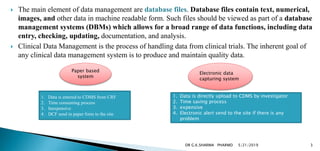
Paper based
system
Electronic data
capturing system
1. Data is entered to CDMS from CRF
2. Time consuming process
3. Inexpensive
4. DCF send in paper form to the site
1. Data is directly upload to CDMS by investigator
2. Time saving process
3. expensive
4. Electronic alert send to the site if there is any
problem
5/21/2019 3DR G.K.SHARMA PHARMD
1. Many software tools are available for data management, and these are called Clinical Data Management Systems.
2. In multicentric trials, a CDMS has become essential to handle the huge amount of data. Most of the CDMS used
in pharmaceutical companies are commercial, but a few open source tools are available as well.
3. Commonly used CDM tools: are ORACLE CLINICAL, CLINTRIAL, MACRO, RAVE, and eClinical Suite.
these software tools are more or less similar and there is no significant advantage of one system over the other.
These software tools are expensive.
4. Among the open source tools: the most prominent ones are OpenClinica, openCDMS, TrialDB, and PhOSCo.
These CDM software are available free of cost. These open source software can be downloaded from their
respective websites.
5. These CDM tools ensure the audit trail and help in the management of discrepancies.
6. According to the roles and responsibilities, multiple user IDs can be created with access limitation to data entry,
medical coding, database designing, or quality check. This ensures that each user can access only the respective
functionalities allotted to that user ID and cannot make any other change in the database. For responsibilities
where changes are permitted to be made in the data, the software will record the change made, the user ID that
made the change and the time and date of change, for audit purposes (audit trail).
7. During a regulatory audit, the auditors can verify the discrepancy management process; the changes made and can
confirm that no unauthorized or false changes were made.
5/21/2019DR G.K.SHARMA PHARMD 4
1. CDM has guidelines and standards that must be followed.
2. Electronically captured data: for the evaluation of medicines, there is a need to follow good practices in CDM and maintain standards in
electronic data capture. These electronic records have to comply with a Code of Federal Regulations (CFR), 21 CFR Part 11. This regulation
is applicable to records in electronic format that are created, modified, maintained, archived, retrieved, or transmitted. This demands the use
of validated systems to ensure accuracy, reliability, and consistency of data with the use of secure, computer-generated, time-stamped audit
trails to independently record the date and time of operator entries and actions that create, modify, or delete electronic records.
3. Society for Clinical Data Management (SCDM) publishes the Good Clinical Data Management Practices (GCDMP) guidelines, a
document providing the standards of good practice within CDM.
4. GCDMP was initially published in September 2000. The July 2009 version is the currently followed GCDMP document.
5. Clinical Data Interchange Standards Consortium (CDISC), a multidisciplinary non-profit organization, has developed standards to
support acquisition, exchange, submission, and archival of clinical research data and metadata.
6. Metadata: is the data of the data entered. This includes data about the individual who made the entry or a change in the clinical data, the
date and time of entry/change and details of the changes that have been made.
7. Study Data Tabulation Model Implementation Guide (SDTMIG) for Human Clinical Trials and the Clinical Data Acquisition Standards
Harmonization (CDASH) standards, available free of cost from the CDISC website (www.cdisc.org).
8. The SDTMIG standard describes the details of model and standard terminologies for the data and serves as a guide to the organization.
CDASH.
5/21/2019 5DR G.K.SHARMA PHARMD
 The CDM process, like a clinical trial, begins with the end in mind. This means that the whole
process is designed keeping the deliverable in view. As a clinical trial is designed to answer the
research question, the CDM process is designed to deliver an error-free, valid, and statistically
sound database. To meet this objective, the CDM process starts early, even before the finalization of
the study protocol.
5/21/2019 6DR G.K.SHARMA PHARMD
 The protocol is reviewed from a database designing perspective, for clarity and consistency. During
this review, the CDM personnel will identify the data items to be collected and the frequency of
collection with respect to the visit schedule.
 A Case Report Form (CRF) is designed by the CDM team, as this is the first step in translating the
protocol-specific activities into data being generated. The data fields should be clearly defined and
be consistent throughout.
 The type of data to be entered should be evident from the CRF. Similarly, the units in which
measurements have to be made should also be mentioned next to the data field. The CRF should be
concise, self-explanatory, and user-friendly (unless you are the one entering data into the CRF).
Along with the CRF, the filling instructions (called CRF Completion Guidelines) should also be
provided to study investigators for error-free data acquisition.
5/21/2019 7DR G.K.SHARMA PHARMD
 Databases are the clinical software applications, which are built to facilitate the CDM tasks to carry
out multiple studies. Generally, these tools have built-in compliance with regulatory requirements
and are easy to use.
 “System validation” is conducted to ensure data security, during which system specifications, user
requirements, and regulatory compliance are evaluated before implementation. Study details like
objectives, intervals, visits, investigators, sites, and patients are defined in the database and CRF
layouts are designed for data entry. These entry screens are tested with dummy data before moving
them to the real data capture.
 Data from clinical trial will be collected and stored in the CDMS. A database is simply a structure
set of data.
5/21/2019 8DR G.K.SHARMA PHARMD
 Data collection is done using the CRF that may exist in the form of a paper or an electronic
version. The traditional method is to employ paper CRFs to collect the data responses,
which are translated to the database by means of data entry done in-house. These paper
CRFs are filled up by the investigator according to the completion guidelines. In the e-CRF-
based CDM, the investigator or a designee will be logging into the CDM system and
entering the data directly at the site. In e-CRF method, chances of errors are less, and the
resolution of discrepancies happens faster. Since pharmaceutical companies try to reduce the
time taken for drug development processes by enhancing the speed of processes involved,
many pharmaceutical companies are opting for e-CRF options (also called remote data
entry).
5/21/2019 9DR G.K.SHARMA PHARMD
 The entries made in the CRF will be monitored by the Clinical Research Associate (CRA)
for completeness and filled up CRFs are retrieved and handed over to the CDM team. The
CDM team will track the retrieved CRFs and maintain their record. CRFs are tracked for
missing pages and illegible data manually to assure that the data are not lost. In case of
missing or illegible data, a clarification is obtained from the investigator and the issue is
resolved.
 Paper based study. electronic data capture if it is e-CRF
5/21/2019 10DR G.K.SHARMA PHARMD
 Data entry takes place according to the guidelines prepared along with the DMP. This is applicable
only in the case of paper CRF retrieved from the sites.
 Data entry is a process of entering or transferring data from case record form to the clinical data
management system. data entry
 Single data entry
 Double data entry: performed wherein the data is entered by two operators separately. (entry made
by the second person) helps in verification and reconciliation by identifying the transcription errors
and discrepancies caused by illegible data.
 Double data entry helps in getting a cleaner database compared to a single data entry. Earlier studies
have shown that double data entry ensures better consistency with paper CRF as denoted by a lesser
error rate.
5/21/2019 11DR G.K.SHARMA PHARMD
1. Data validation is the process of testing the validity of data in accordance with the protocol
specifications.
2. Edit check programs are written to identify the discrepancies in the entered data, which are embedded in
the database, to ensure data validity. These edit check programs are initially tested with dummy data
containing discrepancies.
3. Discrepancy is defined as a data point that fails to pass a validation check.
4. Discrepancy may be due to inconsistent data, missing data, range checks, and deviations from the
protocol.
5. In e-CRF based studies, data validation process will be run frequently for identifying discrepancies.
These discrepancies will be resolved by investigators after logging into the system. Ongoing quality
control of data processing is undertaken at regular intervals during the course of CDM. For example, if
the inclusion criteria specify that the age of the patient should be between 18 and 65 years (both
inclusive), an edit program will be written for two conditions viz. age <18 and >65. If for any patient, the
condition becomes TRUE, a discrepancy will be generated.
6. These discrepancies will be highlighted in the system and Data Clarification Forms (DCFs) can be
generated. DCFs are documents containing queries pertaining to the discrepancies identified.
5/21/2019 12DR G.K.SHARMA PHARMD
 This is also called query resolution. Discrepancy management includes reviewing discrepancies,
investigating the reason, and resolving them with documentary proof.
 Discrepancy management helps in cleaning the data and gathers enough evidence for the deviations
observed in data.
 Almost all CDMS have a discrepancy database where all discrepancies will be recorded and stored
with audit trail.
 For discrepancies that require clarifications from the investigator, DCFs will be sent to the site. The
CDM tools help in the creation and printing of DCFs. Investigators will write the resolution or
explain the circumstances that led to the discrepancy in data. When a resolution is provided by the
investigator, the same will be updated in the database. In case of e-CRFs, the investigator can access
the discrepancies flagged to him and will be able to provide the resolutions online.
5/21/2019 13DR G.K.SHARMA PHARMD
1. Medical coding helps in identifying and properly classifying the medical terminologies associated with
the clinical trial.
2. For classification of events, medical dictionaries available online are used.
3. Technically, this activity needs the knowledge of medical terminology, understanding of disease entities,
drugs used, and a basic knowledge of the pathological processes involved.
4. Adverse events occurring during the study, prior to and concomitantly administered medications and
pre-or co-existing illnesses are coded using the available medical dictionaries.
5. Commonly, Medical Dictionary for Regulatory Activities (MedDRA) is used for the coding of adverse
events as well as other illnesses and World Health Organization–Drug Dictionary Enhanced (WHO-
DDE) is used for coding the medications.
6. These dictionaries contain the respective classifications of adverse events and drugs in proper classes.
7. Other dictionaries are also available for use in data management (eg, WHO-ART is a dictionary that
deals with adverse reactions terminology).
8. The right coding and classification of adverse events and medication is crucial as an incorrect coding
may lead to masking of safety issues or highlight the wrong safety concerns related to the drug.
5/21/2019 14DR G.K.SHARMA PHARMD
1. After a proper quality check and assurance, the final data validation is run.
2. All data management activities should have been completed prior to database lock.
3. A pre-lock checklist: checklist is used and completion of all activities is confirmed. This is done as
the database cannot be changed in any manner after locking. Once the approval for locking is
obtained from all stakeholders, the database is locked and clean data is extracted for statistical
analysis.
4. Generally, no modification in the database is possible. But in case of a critical issue or for other
important operational reasons, privileged users can modify the data even after the database is
locked.
5. Requires proper documentation and an audit trail has to be maintained with sufficient justification
for updating the locked database.
5/21/2019 15DR G.K.SHARMA PHARMD
 The minimum educational requirement for a team member in CDM should be graduation in life
science and knowledge of computer applications.
 medical coders should be medical graduates. however, in the industry, paramedical graduates are
also recruited as medical coders. Some key roles are essential to all CDM teams. The list of roles
given below can be considered as minimum requirements for a CDM team:
1. Data Manager
2. Database Programmer/Designer
3. Medical Coder
4. Clinical Data Coordinator
5. Quality Control Associate
6. Data Entry Associate
5/21/2019 16DR G.K.SHARMA PHARMD
 Data Manager
1) Supervising the entire CDM process.
2) The data manager prepares the DMP, approves the CDM procedures and all internal documents
related to CDM activities.
3) Controlling and allocating the database access to team members
 Database Programmer/Designer:
 Performs the CRF annotation, creates the study database, and programs the edit checks for data
validation.
 He/she is also responsible for designing of data entry screens in the database and validating the edit
checks with dummy data.
 Medical Coder:
 coding for adverse events, medical history, co-illnesses, and concomitant medication administered
during the study.
5/21/2019 17DR G.K.SHARMA PHARMD
 Clinical Data Coordinator:
 designs the CRF, prepares the CRF filling instructions, and is responsible for developing the DVP
and discrepancy management.
 All other CDM-related documents, checklists, and guideline documents are prepared by the clinical
data coordinator.
 Quality Control Associate:
 Checks the accuracy of data entry and conducts data audits.
 Quality control associate verifies the documentation pertaining to the procedures being followed.
 Data Entry Associate: will be tracking the receipt of CRF pages and performs the data entry into
the database.
5/21/2019 18DR G.K.SHARMA PHARMD

Clinical data management

  • 1.
  • 2.
     A ClinicalData Management System or CDMS is used in clinical research to manage the data generated by the conduction of a clinical trial. The clinical trial data gathered at the investigator site in the Case Report Form(CRF) is stored in the CDMS.  CRF is a paper or electronic questionnaire, used as a tool by the sponsor of the clinical trial to collect data on each patient from each participating site.  Data management includes all aspects of data planning, handling, analysis, documentation and storage, and takes place during all stages of a study. The objective is to create a reliable data base containing high quality data. Data management is a too often neglected part of study design, and includes: 1. Planning the data needs of the study 2. Data collection 3. Data entry 4. Data validation and checking 5. Data manipulation 6. Data files backup 7. Data documentation 5/21/2019 2DR G.K.SHARMA PHARMD
  • 3.
     The mainelement of data management are database files. Database files contain text, numerical, images, and other data in machine readable form. Such files should be viewed as part of a database management systems (DBMs) which allows for a broad range of data functions, including data entry, checking, updating, documentation, and analysis.  Clinical Data Management is the process of handling data from clinical trials. The inherent goal of any clinical data management system is to produce and maintain quality data. Paper based system Electronic data capturing system 1. Data is entered to CDMS from CRF 2. Time consuming process 3. Inexpensive 4. DCF send in paper form to the site 1. Data is directly upload to CDMS by investigator 2. Time saving process 3. expensive 4. Electronic alert send to the site if there is any problem 5/21/2019 3DR G.K.SHARMA PHARMD
  • 4.
    1. Many softwaretools are available for data management, and these are called Clinical Data Management Systems. 2. In multicentric trials, a CDMS has become essential to handle the huge amount of data. Most of the CDMS used in pharmaceutical companies are commercial, but a few open source tools are available as well. 3. Commonly used CDM tools: are ORACLE CLINICAL, CLINTRIAL, MACRO, RAVE, and eClinical Suite. these software tools are more or less similar and there is no significant advantage of one system over the other. These software tools are expensive. 4. Among the open source tools: the most prominent ones are OpenClinica, openCDMS, TrialDB, and PhOSCo. These CDM software are available free of cost. These open source software can be downloaded from their respective websites. 5. These CDM tools ensure the audit trail and help in the management of discrepancies. 6. According to the roles and responsibilities, multiple user IDs can be created with access limitation to data entry, medical coding, database designing, or quality check. This ensures that each user can access only the respective functionalities allotted to that user ID and cannot make any other change in the database. For responsibilities where changes are permitted to be made in the data, the software will record the change made, the user ID that made the change and the time and date of change, for audit purposes (audit trail). 7. During a regulatory audit, the auditors can verify the discrepancy management process; the changes made and can confirm that no unauthorized or false changes were made. 5/21/2019DR G.K.SHARMA PHARMD 4
  • 5.
    1. CDM hasguidelines and standards that must be followed. 2. Electronically captured data: for the evaluation of medicines, there is a need to follow good practices in CDM and maintain standards in electronic data capture. These electronic records have to comply with a Code of Federal Regulations (CFR), 21 CFR Part 11. This regulation is applicable to records in electronic format that are created, modified, maintained, archived, retrieved, or transmitted. This demands the use of validated systems to ensure accuracy, reliability, and consistency of data with the use of secure, computer-generated, time-stamped audit trails to independently record the date and time of operator entries and actions that create, modify, or delete electronic records. 3. Society for Clinical Data Management (SCDM) publishes the Good Clinical Data Management Practices (GCDMP) guidelines, a document providing the standards of good practice within CDM. 4. GCDMP was initially published in September 2000. The July 2009 version is the currently followed GCDMP document. 5. Clinical Data Interchange Standards Consortium (CDISC), a multidisciplinary non-profit organization, has developed standards to support acquisition, exchange, submission, and archival of clinical research data and metadata. 6. Metadata: is the data of the data entered. This includes data about the individual who made the entry or a change in the clinical data, the date and time of entry/change and details of the changes that have been made. 7. Study Data Tabulation Model Implementation Guide (SDTMIG) for Human Clinical Trials and the Clinical Data Acquisition Standards Harmonization (CDASH) standards, available free of cost from the CDISC website (www.cdisc.org). 8. The SDTMIG standard describes the details of model and standard terminologies for the data and serves as a guide to the organization. CDASH. 5/21/2019 5DR G.K.SHARMA PHARMD
  • 6.
     The CDMprocess, like a clinical trial, begins with the end in mind. This means that the whole process is designed keeping the deliverable in view. As a clinical trial is designed to answer the research question, the CDM process is designed to deliver an error-free, valid, and statistically sound database. To meet this objective, the CDM process starts early, even before the finalization of the study protocol. 5/21/2019 6DR G.K.SHARMA PHARMD
  • 7.
     The protocolis reviewed from a database designing perspective, for clarity and consistency. During this review, the CDM personnel will identify the data items to be collected and the frequency of collection with respect to the visit schedule.  A Case Report Form (CRF) is designed by the CDM team, as this is the first step in translating the protocol-specific activities into data being generated. The data fields should be clearly defined and be consistent throughout.  The type of data to be entered should be evident from the CRF. Similarly, the units in which measurements have to be made should also be mentioned next to the data field. The CRF should be concise, self-explanatory, and user-friendly (unless you are the one entering data into the CRF). Along with the CRF, the filling instructions (called CRF Completion Guidelines) should also be provided to study investigators for error-free data acquisition. 5/21/2019 7DR G.K.SHARMA PHARMD
  • 8.
     Databases arethe clinical software applications, which are built to facilitate the CDM tasks to carry out multiple studies. Generally, these tools have built-in compliance with regulatory requirements and are easy to use.  “System validation” is conducted to ensure data security, during which system specifications, user requirements, and regulatory compliance are evaluated before implementation. Study details like objectives, intervals, visits, investigators, sites, and patients are defined in the database and CRF layouts are designed for data entry. These entry screens are tested with dummy data before moving them to the real data capture.  Data from clinical trial will be collected and stored in the CDMS. A database is simply a structure set of data. 5/21/2019 8DR G.K.SHARMA PHARMD
  • 9.
     Data collectionis done using the CRF that may exist in the form of a paper or an electronic version. The traditional method is to employ paper CRFs to collect the data responses, which are translated to the database by means of data entry done in-house. These paper CRFs are filled up by the investigator according to the completion guidelines. In the e-CRF- based CDM, the investigator or a designee will be logging into the CDM system and entering the data directly at the site. In e-CRF method, chances of errors are less, and the resolution of discrepancies happens faster. Since pharmaceutical companies try to reduce the time taken for drug development processes by enhancing the speed of processes involved, many pharmaceutical companies are opting for e-CRF options (also called remote data entry). 5/21/2019 9DR G.K.SHARMA PHARMD
  • 10.
     The entriesmade in the CRF will be monitored by the Clinical Research Associate (CRA) for completeness and filled up CRFs are retrieved and handed over to the CDM team. The CDM team will track the retrieved CRFs and maintain their record. CRFs are tracked for missing pages and illegible data manually to assure that the data are not lost. In case of missing or illegible data, a clarification is obtained from the investigator and the issue is resolved.  Paper based study. electronic data capture if it is e-CRF 5/21/2019 10DR G.K.SHARMA PHARMD
  • 11.
     Data entrytakes place according to the guidelines prepared along with the DMP. This is applicable only in the case of paper CRF retrieved from the sites.  Data entry is a process of entering or transferring data from case record form to the clinical data management system. data entry  Single data entry  Double data entry: performed wherein the data is entered by two operators separately. (entry made by the second person) helps in verification and reconciliation by identifying the transcription errors and discrepancies caused by illegible data.  Double data entry helps in getting a cleaner database compared to a single data entry. Earlier studies have shown that double data entry ensures better consistency with paper CRF as denoted by a lesser error rate. 5/21/2019 11DR G.K.SHARMA PHARMD
  • 12.
    1. Data validationis the process of testing the validity of data in accordance with the protocol specifications. 2. Edit check programs are written to identify the discrepancies in the entered data, which are embedded in the database, to ensure data validity. These edit check programs are initially tested with dummy data containing discrepancies. 3. Discrepancy is defined as a data point that fails to pass a validation check. 4. Discrepancy may be due to inconsistent data, missing data, range checks, and deviations from the protocol. 5. In e-CRF based studies, data validation process will be run frequently for identifying discrepancies. These discrepancies will be resolved by investigators after logging into the system. Ongoing quality control of data processing is undertaken at regular intervals during the course of CDM. For example, if the inclusion criteria specify that the age of the patient should be between 18 and 65 years (both inclusive), an edit program will be written for two conditions viz. age <18 and >65. If for any patient, the condition becomes TRUE, a discrepancy will be generated. 6. These discrepancies will be highlighted in the system and Data Clarification Forms (DCFs) can be generated. DCFs are documents containing queries pertaining to the discrepancies identified. 5/21/2019 12DR G.K.SHARMA PHARMD
  • 13.
     This isalso called query resolution. Discrepancy management includes reviewing discrepancies, investigating the reason, and resolving them with documentary proof.  Discrepancy management helps in cleaning the data and gathers enough evidence for the deviations observed in data.  Almost all CDMS have a discrepancy database where all discrepancies will be recorded and stored with audit trail.  For discrepancies that require clarifications from the investigator, DCFs will be sent to the site. The CDM tools help in the creation and printing of DCFs. Investigators will write the resolution or explain the circumstances that led to the discrepancy in data. When a resolution is provided by the investigator, the same will be updated in the database. In case of e-CRFs, the investigator can access the discrepancies flagged to him and will be able to provide the resolutions online. 5/21/2019 13DR G.K.SHARMA PHARMD
  • 14.
    1. Medical codinghelps in identifying and properly classifying the medical terminologies associated with the clinical trial. 2. For classification of events, medical dictionaries available online are used. 3. Technically, this activity needs the knowledge of medical terminology, understanding of disease entities, drugs used, and a basic knowledge of the pathological processes involved. 4. Adverse events occurring during the study, prior to and concomitantly administered medications and pre-or co-existing illnesses are coded using the available medical dictionaries. 5. Commonly, Medical Dictionary for Regulatory Activities (MedDRA) is used for the coding of adverse events as well as other illnesses and World Health Organization–Drug Dictionary Enhanced (WHO- DDE) is used for coding the medications. 6. These dictionaries contain the respective classifications of adverse events and drugs in proper classes. 7. Other dictionaries are also available for use in data management (eg, WHO-ART is a dictionary that deals with adverse reactions terminology). 8. The right coding and classification of adverse events and medication is crucial as an incorrect coding may lead to masking of safety issues or highlight the wrong safety concerns related to the drug. 5/21/2019 14DR G.K.SHARMA PHARMD
  • 15.
    1. After aproper quality check and assurance, the final data validation is run. 2. All data management activities should have been completed prior to database lock. 3. A pre-lock checklist: checklist is used and completion of all activities is confirmed. This is done as the database cannot be changed in any manner after locking. Once the approval for locking is obtained from all stakeholders, the database is locked and clean data is extracted for statistical analysis. 4. Generally, no modification in the database is possible. But in case of a critical issue or for other important operational reasons, privileged users can modify the data even after the database is locked. 5. Requires proper documentation and an audit trail has to be maintained with sufficient justification for updating the locked database. 5/21/2019 15DR G.K.SHARMA PHARMD
  • 16.
     The minimumeducational requirement for a team member in CDM should be graduation in life science and knowledge of computer applications.  medical coders should be medical graduates. however, in the industry, paramedical graduates are also recruited as medical coders. Some key roles are essential to all CDM teams. The list of roles given below can be considered as minimum requirements for a CDM team: 1. Data Manager 2. Database Programmer/Designer 3. Medical Coder 4. Clinical Data Coordinator 5. Quality Control Associate 6. Data Entry Associate 5/21/2019 16DR G.K.SHARMA PHARMD
  • 17.
     Data Manager 1)Supervising the entire CDM process. 2) The data manager prepares the DMP, approves the CDM procedures and all internal documents related to CDM activities. 3) Controlling and allocating the database access to team members  Database Programmer/Designer:  Performs the CRF annotation, creates the study database, and programs the edit checks for data validation.  He/she is also responsible for designing of data entry screens in the database and validating the edit checks with dummy data.  Medical Coder:  coding for adverse events, medical history, co-illnesses, and concomitant medication administered during the study. 5/21/2019 17DR G.K.SHARMA PHARMD
  • 18.
     Clinical DataCoordinator:  designs the CRF, prepares the CRF filling instructions, and is responsible for developing the DVP and discrepancy management.  All other CDM-related documents, checklists, and guideline documents are prepared by the clinical data coordinator.  Quality Control Associate:  Checks the accuracy of data entry and conducts data audits.  Quality control associate verifies the documentation pertaining to the procedures being followed.  Data Entry Associate: will be tracking the receipt of CRF pages and performs the data entry into the database. 5/21/2019 18DR G.K.SHARMA PHARMD