
1
Data Management Plan
Clinical Data Management
11/20/2017Katalyst Healthcares & Life Sciences
A data management plan ensures compliance with good clinical data
management practices throughout the entire clinical trial.
Data Management plan is a document which defines all data management
activities, to promote consistent, efficient and effective data management
practices for each individual study.
Data management plan not only describes data management activities, but also
provide an agreement among all parties concerning responsibilities and
deliverables related to clinical data management.
Data Management Plan : Overview
2
11/20/201
7Katalyst Healthcares & Life Sciences
• After completing this training you will be able to:
– Understand how a Data Management Plan is created in compliance with
good clinical data management practices
– Describe all study specific data management activities, roles and
responsibilities
– Understand how DMP acts as central reference for the supporting
documentation and processes used during the life cycle of the study
Data Management Plan : Objectives
3
11/20/201
7Katalyst Healthcares & Life Sciences
The DMP describes the database structure and the procedures that will be used for
system testing and validation and also for data entry, edit checks, data coding, data
queries and query resolution.
• It serves as a document for planning, communication and reference tools for clinical
study teams
• It provides continuity for data management activities when personnel changes
occur
• It also provides a record of the data handling activities to be performed for a given
study along with the timelines
• It also define Roles & responsibility of the different stake-holders involved in DM
Activities
What is Data Management Plan?
4
11/20/201
7Katalyst Healthcares & Life Sciences
• The DMP components will be made available to all members of the Study
team throughout the study
• This document is a global reference, is to be read thoroughly once and used as
a reference on an ongoing basis
• The components once created will be distributed to the study team for review
and approval
• The DMP components are living documents and will be updated as study
circumstances evolve, and will only be complete when the study has been
terminated or closeout activities are completed
• The Lead Data Manger is responsible for creating the components of the DMP
DMP Creation and Distribution
5
11/20/201
7Katalyst Healthcares & Life Sciences
DMP Components vary from 1 study/client to another.
On a broader level, information on the following areas need to be collected within the
DMP:
— Data Flow
— Data Capture
— Study Setup
— Data Entry
— Data Transfer
— Data Processing/ Management
— Coding
— Safety Data (Serious Adverse Events)
— External data
— Any milestones if applicable or Database Lock and Unlock process
— Archival of Clinical Data
— Reports
— Quality
DMP Components
6
11/20/201
7Katalyst Healthcares & Life Sciences
Data Flow
7
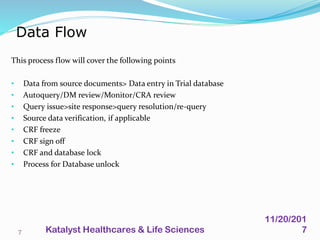
This process flow will cover the following points
• Data from source documents> Data entry in Trial database
• Autoquery/DM review/Monitor/CRA review
• Query issue>site response>query resolution/re-query
• Source data verification, if applicable
• CRF freeze
• CRF sign off
• CRF and database lock
• Process for Database unlock
11/20/201
7Katalyst Healthcares & Life Sciences
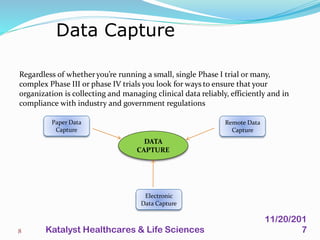
Regardless of whetheryou’re running a small, single Phase I trial or many,
complex Phase III or phase IV trials you look for ways to ensure that your
organization is collecting and managing clinical data reliably, efficiently and in
compliance with industry and government regulations
Data Capture
8
DATA
CAPTURE
Paper Data
Capture
Remote Data
Capture
Electronic
Data Capture
11/20/201
7Katalyst Healthcares & Life Sciences
Types of Data Capture
9
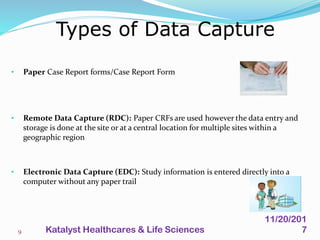
• Paper Case Report forms/Case Report Form
• Remote Data Capture (RDC): Paper CRFs are used however the data entry and
storage is done at the site or at a central location for multiple sites within a
geographic region
• Electronic Data Capture (EDC): Study information is entered directly into a
computer without any paper trail
11/20/201
7Katalyst Healthcares & Life Sciences
This covers all the documents that are required for setting up/building a study:
• CRF Creation Guidelines: Provide guidance to CRF designer on creation of eCRF.
• CRF data standards: Provides details of standard to be used while designing a CRF
to CRF designer.
• Annotated CRF: Blank CRF with marking, or annotations that coordinate each data
point in the eCRF form with its corresponding dataset name.
• Paper Case Report Form: Data collection tool used in clinical trials to support
investigators and coordinators in capturing all protocol-required information.
• CRF Completion guidelines: Provides detailed guidelines to the site staff to fill in
the paper CRFs. Guidelines help to bridge the gap between the study protocol and
the users in regards to CRF completion, correction, signing and handling
procedures.
Study Set Up
10
11/20/201
7Katalyst Healthcares & Life Sciences
• Monitoring Plan: Provides detailed guidelines to Monitor/CRA on how to
review CRFs and provides reference to Study specific monitoring plan where
monitoring method(s), intervals between on-site visits, and other details
associated with monitoring are provided.
• Database design manual/eCRF specification: Provides guidance to Clinical
Programmers by the DM on the Edit Checks for each data point on the CRF
• Edit Check Specifications: Describes all checks (manual and electronic) that
will be applied to the study data to ensure that data is fit for reporting
purposes
Study Set Up
11
11/20/201
7Katalyst Healthcares & Life Sciences
This session of the DMP describe the data entry guidelines which will be
followed throughout the study conduct
Data Entry
Data Entry Guidelines: Describes the process to enter data into the Database
Data Entry
12
11/20/201
7Katalyst Healthcares & Life Sciences
For external data transfers, the DMP should describe the data type (e.g.,
safety lab data), the entity providing or receiving the data and any
applicable agreements, the format, the frequency of transfers, and contact
information for all those involved with the data transfer
Data Transfer
• Data Load Specification: Variable/element specifications used in the study
• Type of the Data to be received: for example PK, Biomarker, ECG, etc
• Source of the data: Recipient of data (site, sponsor, data safety monitoring
board (DSMB),statisticians, etc.)
• Reference Ranges: Reference range used in the study in case of local Lab
• Quality control processes to be followed: Validation steps performed to
maintain the integrity of the data
Data Transfer
13
11/20/201
7Katalyst Healthcares & Life Sciences
This section of the DMP describes the Data Management documents used to
ensure that the data is accurate and clean throughout the course of the study.
This review allows data analysis to be performed at pre-defined study
timelines as defined in the study protocol.
This section enlist:
- the essential requirements on Data review
- Provides variables for cleaning or provides reference of Data review
plan/Data Review guidelines where instructions on data cleaning activities are
captured for DM/CRA/Monitor/safety review.
- This should also mention how queries are tracked
Eg. DM review: If action taken is Concomitant medication on AE form, check if
Medication form is updated.
Data
Processing/Management
14
11/20/201
7Katalyst Healthcares & Life Sciences
This section of the DMP give the details about how the Coding and Safety data will
be
handled during the study conduct
Coding Procedures
• Terms to be coded: Indicate which terms will be coded, e.g. Adverse Events, Medications and
Medical History, and in which modules they are found
• Dictionaries used: Indicate which dictionaries (and version numbers) will be used
• Coding method and Responsibilities: Indicate the method and responsibility of a coder
• Coding Tools: Name of the tool used for the study for coding activity
Safety Data
• Handling Safety Data: Indicates the frequency at which SAE reconciliation will be performed, for
e.g. (monthly, weekly etc)
• Handling SAE queries: Indicate the process of how the SAE queries will be handled during the
study conduct
Coding and Safety Data
15
11/20/201
7Katalyst Healthcares & Life Sciences
This section of the DMP give the details about how external data will be
handled during the study conduct
• External data type: Type of data collected & maintained by external vendor
• External data vendors: The point of contact, TPV details etc will be provided
• Data transfer specifications: The attributes of the data which will be received
by the vendor
• Frequency of reconciliations: The rounds of review of to be done & Frequency
of the external data review
• Any primary or secondary reconciliation variables
• Escalation path: How to follow up for unresolved issues
• Trackers & Metrics if any: If any template to be followed or metrics to be
generated post reconciliation
• Quality control: Any QC involved in the External data reconciliation will be
included here
External data handling
16
11/20/201
7Katalyst Healthcares & Life Sciences
This section of the DMP give the details about the process to lock and
unlock the database.
• This section provides details on how and when to have interim and final
database lock by listing the different endpoints in the study. Also provides
reference to DB lock checklist that need to be used to ensure all the activities
related to lock are completed.
Interim locks can be used to track the level of cleanliness for the study.
• It lists the milestones that need to be included in DB lock timelines.
• It provides details on which level the lock should be performed eg. Datapoint/
CRF/casebook
• It also provides the process to be followed when DB need to be unlocked,
Database lock and Unlock
17
11/20/201
7Katalyst Healthcares & Life Sciences
This session of the DMP gives the information regarding the organization’s procedures for
archiving the electronic records and list of availablereports for dissemination throughout
the life of the study
Archivalof Data
• Method of archiving original documents: Describe when and how the archival process
followed for original documents. e.g. CRFs
• Method to archive documents or data related to account and database access management:
document process when and how the archival process occur for account and database related
access
• Method to access and retrieve the audit trail-Access management and retrieval process
Reports: Details about lists of available reports available of a particularstudy for use or
DM/CRA/etc
Archival of Data and Reports
18
11/20/201
7Katalyst Healthcares & Life Sciences
This session of the DMP give the details regarding the quality assurance
(QA) plans and
quality control (QC) process steps
Quality
• QC Plan: Helps in fulfilling both regulatory and GCP requirement by creating
the plan and detailing what documents will record the conduct of the study
• Percentage of patients to be involved in QC: Sample size
• Data points that will be audited: data point to be checked during quality check
• Acceptable error rate: acceptable allowable error rate
• Action plan for resolution of audit: Details about process to handling post
QC/QA findings
Quality
19
11/20/201
7Katalyst Healthcares & Life Sciences
This section speak about the related documents such as quality control plan sent
along
with the DMP as appendix
• Study Specific Data handling document/Study Decision log - Dynamic
• Self Evident corrections (SEC)
• Quality control plan
• CRF Completion Guidelines (CCGs)
• Study Design/eCRF Specification
• Database Testing Plan
• Edit Check Specifications
• Data Entry Guidelines
• Data Flow Activities
DMP Documents/Elements
20
11/20/201
7Katalyst Healthcares & Life Sciences
• Protocol
A Clinical Trial Protocol is a document that describes the objective(s), design,
methodology, statistical considerations, and organization of a clinical trial.
The protocol also contains a study plan on which the clinical trial is based. The
protocol describes, among other things, details on patient population; the
schedule of tests, procedures, medications, and dosages/ devices; and the
length of the study.
DMP Documents/Elements
21
11/20/201
7Katalyst Healthcares & Life Sciences
• Study specific Data handling Document/Study Decision log
Details decisions made in agreement with the study team, around the
handling of certain data items whose resolution either no longer requires a
DCF to be sent to the site and is specific to the study
• Self Evidence Corrections
Details permissible corrections or changes that can be made to subject data
without issuing a Data Clarification Form (DCF) to the Site. These are
changes that use data that already exists in the CRF and/or source documents
attached to the CRF, e.g., laboratory report and do not impact the meaning of
the data
DMP Documents/Elements
22
11/20/201
7Katalyst Healthcares & Life Sciences
• Quality Control Plan
Describes the process to perform a quality review or audit in order to ensure
consistent quality of the database
• CRF completion Guidelines
Provides detailed guidelines to the site staff to fill in the paper CRFs
• Study Design/eCRF Specification
Provides specifications for each data point to design database
Details decisions made in agreement with the study team, around the design of the
Case Report Form and study database
DMP Documents/Elements
23
11/20/201
7Katalyst Healthcares & Life Sciences
• Database Testing Plan
Contains the plan and checklist to Qc the database that has been built
• Edit check Specifications
Describes all edit checks that will be applied to the study data to ensure that
data is clean and fit for reporting purposes
• Data Entry Guide
Describes the process to enter data into the Database
DMP Documents/Elements
24
11/20/201
7Katalyst Healthcares & Life Sciences
Sample DMP documents will be discussed by the Trainer
(You can also use the search engine to look up more samples)
Lets see how these look?
25
11/20/201
7Katalyst Healthcares & Life Sciences
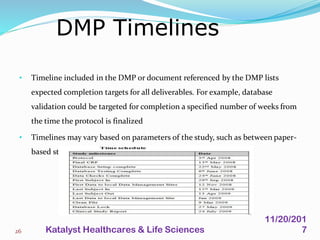
• Timeline included in the DMP or document referenced by the DMP lists
expected completion targets for all deliverables. For example, database
validation could be targeted for completion a specified number of weeks from
the time the protocol is finalized
• Timelines may vary based on parameters of the study, such as between paper-
based studies and those utilizing electronic data capture (EDC)
DMP Timelines
26
11/20/201
7Katalyst Healthcares & Life Sciences
• Work to be done and responsibilities are clearly stated at the start of the study
so that everyone knows what is expected
• Expected documents are listed at the start of the study so they can be
produced during the course of, rather than after, the conduct of the study
• Document helps everyone fulfill regulatory requirements.
• Data management tasks become more visible to other groups when the DMP
is made available to the project team
• Provides continuity of process and a history of a project.
• Particularly useful for long-term studies and growing data management
groups
DMP Benefits
27
11/20/201
7Katalyst Healthcares & Life Sciences
• What do you mean by DMP?
• Why is DMP essential in the CDM process?
• Name and explain any 5 Components in DMP?
• Name and explain any 3 DMP Documents?
• How may types of Data Capture are there? Name them
Test Your Understanding
28
11/20/201
7Katalyst Healthcares & Life Sciences
In summary the DMP Documents helps:
• Act as a backbone of overall Quality System of Data Management (DM)
• In study planning
• In having SOPs and Working Instructions in place
• Provide a focus for identifying work to be performed
• Provide details on the Roles and responsibilities
• Provide details of documentation or output to be collected
• In communicating with the entire study team
Summary
29
11/20/201
7Katalyst Healthcares & Life Sciences
Thank You
&
Questions
11/20/2017
30
Contact:
Katalyst Healthcare’s & Life Sciences
South Plainfield, NJ, USA 07080.
E-Mail: info@KatalystHLS.com

Data Management Plan_Katalyst HLS

  • 1.
    1 Data Management Plan ClinicalData Management 11/20/2017Katalyst Healthcares & Life Sciences
  • 2.
    A data managementplan ensures compliance with good clinical data management practices throughout the entire clinical trial. Data Management plan is a document which defines all data management activities, to promote consistent, efficient and effective data management practices for each individual study. Data management plan not only describes data management activities, but also provide an agreement among all parties concerning responsibilities and deliverables related to clinical data management. Data Management Plan : Overview 2 11/20/201 7Katalyst Healthcares & Life Sciences
  • 3.
    • After completingthis training you will be able to: – Understand how a Data Management Plan is created in compliance with good clinical data management practices – Describe all study specific data management activities, roles and responsibilities – Understand how DMP acts as central reference for the supporting documentation and processes used during the life cycle of the study Data Management Plan : Objectives 3 11/20/201 7Katalyst Healthcares & Life Sciences
  • 4.
    The DMP describesthe database structure and the procedures that will be used for system testing and validation and also for data entry, edit checks, data coding, data queries and query resolution. • It serves as a document for planning, communication and reference tools for clinical study teams • It provides continuity for data management activities when personnel changes occur • It also provides a record of the data handling activities to be performed for a given study along with the timelines • It also define Roles & responsibility of the different stake-holders involved in DM Activities What is Data Management Plan? 4 11/20/201 7Katalyst Healthcares & Life Sciences
  • 5.
    • The DMPcomponents will be made available to all members of the Study team throughout the study • This document is a global reference, is to be read thoroughly once and used as a reference on an ongoing basis • The components once created will be distributed to the study team for review and approval • The DMP components are living documents and will be updated as study circumstances evolve, and will only be complete when the study has been terminated or closeout activities are completed • The Lead Data Manger is responsible for creating the components of the DMP DMP Creation and Distribution 5 11/20/201 7Katalyst Healthcares & Life Sciences
  • 6.
    DMP Components varyfrom 1 study/client to another. On a broader level, information on the following areas need to be collected within the DMP: — Data Flow — Data Capture — Study Setup — Data Entry — Data Transfer — Data Processing/ Management — Coding — Safety Data (Serious Adverse Events) — External data — Any milestones if applicable or Database Lock and Unlock process — Archival of Clinical Data — Reports — Quality DMP Components 6 11/20/201 7Katalyst Healthcares & Life Sciences
  • 7.
    Data Flow 7 This processflow will cover the following points • Data from source documents> Data entry in Trial database • Autoquery/DM review/Monitor/CRA review • Query issue>site response>query resolution/re-query • Source data verification, if applicable • CRF freeze • CRF sign off • CRF and database lock • Process for Database unlock 11/20/201 7Katalyst Healthcares & Life Sciences
  • 8.
    Regardless of whetheryou’rerunning a small, single Phase I trial or many, complex Phase III or phase IV trials you look for ways to ensure that your organization is collecting and managing clinical data reliably, efficiently and in compliance with industry and government regulations Data Capture 8 DATA CAPTURE Paper Data Capture Remote Data Capture Electronic Data Capture 11/20/201 7Katalyst Healthcares & Life Sciences
  • 9.
    Types of DataCapture 9 • Paper Case Report forms/Case Report Form • Remote Data Capture (RDC): Paper CRFs are used however the data entry and storage is done at the site or at a central location for multiple sites within a geographic region • Electronic Data Capture (EDC): Study information is entered directly into a computer without any paper trail 11/20/201 7Katalyst Healthcares & Life Sciences
  • 10.
    This covers allthe documents that are required for setting up/building a study: • CRF Creation Guidelines: Provide guidance to CRF designer on creation of eCRF. • CRF data standards: Provides details of standard to be used while designing a CRF to CRF designer. • Annotated CRF: Blank CRF with marking, or annotations that coordinate each data point in the eCRF form with its corresponding dataset name. • Paper Case Report Form: Data collection tool used in clinical trials to support investigators and coordinators in capturing all protocol-required information. • CRF Completion guidelines: Provides detailed guidelines to the site staff to fill in the paper CRFs. Guidelines help to bridge the gap between the study protocol and the users in regards to CRF completion, correction, signing and handling procedures. Study Set Up 10 11/20/201 7Katalyst Healthcares & Life Sciences
  • 11.
    • Monitoring Plan:Provides detailed guidelines to Monitor/CRA on how to review CRFs and provides reference to Study specific monitoring plan where monitoring method(s), intervals between on-site visits, and other details associated with monitoring are provided. • Database design manual/eCRF specification: Provides guidance to Clinical Programmers by the DM on the Edit Checks for each data point on the CRF • Edit Check Specifications: Describes all checks (manual and electronic) that will be applied to the study data to ensure that data is fit for reporting purposes Study Set Up 11 11/20/201 7Katalyst Healthcares & Life Sciences
  • 12.
    This session ofthe DMP describe the data entry guidelines which will be followed throughout the study conduct Data Entry Data Entry Guidelines: Describes the process to enter data into the Database Data Entry 12 11/20/201 7Katalyst Healthcares & Life Sciences
  • 13.
    For external datatransfers, the DMP should describe the data type (e.g., safety lab data), the entity providing or receiving the data and any applicable agreements, the format, the frequency of transfers, and contact information for all those involved with the data transfer Data Transfer • Data Load Specification: Variable/element specifications used in the study • Type of the Data to be received: for example PK, Biomarker, ECG, etc • Source of the data: Recipient of data (site, sponsor, data safety monitoring board (DSMB),statisticians, etc.) • Reference Ranges: Reference range used in the study in case of local Lab • Quality control processes to be followed: Validation steps performed to maintain the integrity of the data Data Transfer 13 11/20/201 7Katalyst Healthcares & Life Sciences
  • 14.
    This section ofthe DMP describes the Data Management documents used to ensure that the data is accurate and clean throughout the course of the study. This review allows data analysis to be performed at pre-defined study timelines as defined in the study protocol. This section enlist: - the essential requirements on Data review - Provides variables for cleaning or provides reference of Data review plan/Data Review guidelines where instructions on data cleaning activities are captured for DM/CRA/Monitor/safety review. - This should also mention how queries are tracked Eg. DM review: If action taken is Concomitant medication on AE form, check if Medication form is updated. Data Processing/Management 14 11/20/201 7Katalyst Healthcares & Life Sciences
  • 15.
    This section ofthe DMP give the details about how the Coding and Safety data will be handled during the study conduct Coding Procedures • Terms to be coded: Indicate which terms will be coded, e.g. Adverse Events, Medications and Medical History, and in which modules they are found • Dictionaries used: Indicate which dictionaries (and version numbers) will be used • Coding method and Responsibilities: Indicate the method and responsibility of a coder • Coding Tools: Name of the tool used for the study for coding activity Safety Data • Handling Safety Data: Indicates the frequency at which SAE reconciliation will be performed, for e.g. (monthly, weekly etc) • Handling SAE queries: Indicate the process of how the SAE queries will be handled during the study conduct Coding and Safety Data 15 11/20/201 7Katalyst Healthcares & Life Sciences
  • 16.
    This section ofthe DMP give the details about how external data will be handled during the study conduct • External data type: Type of data collected & maintained by external vendor • External data vendors: The point of contact, TPV details etc will be provided • Data transfer specifications: The attributes of the data which will be received by the vendor • Frequency of reconciliations: The rounds of review of to be done & Frequency of the external data review • Any primary or secondary reconciliation variables • Escalation path: How to follow up for unresolved issues • Trackers & Metrics if any: If any template to be followed or metrics to be generated post reconciliation • Quality control: Any QC involved in the External data reconciliation will be included here External data handling 16 11/20/201 7Katalyst Healthcares & Life Sciences
  • 17.
    This section ofthe DMP give the details about the process to lock and unlock the database. • This section provides details on how and when to have interim and final database lock by listing the different endpoints in the study. Also provides reference to DB lock checklist that need to be used to ensure all the activities related to lock are completed. Interim locks can be used to track the level of cleanliness for the study. • It lists the milestones that need to be included in DB lock timelines. • It provides details on which level the lock should be performed eg. Datapoint/ CRF/casebook • It also provides the process to be followed when DB need to be unlocked, Database lock and Unlock 17 11/20/201 7Katalyst Healthcares & Life Sciences
  • 18.
    This session ofthe DMP gives the information regarding the organization’s procedures for archiving the electronic records and list of availablereports for dissemination throughout the life of the study Archivalof Data • Method of archiving original documents: Describe when and how the archival process followed for original documents. e.g. CRFs • Method to archive documents or data related to account and database access management: document process when and how the archival process occur for account and database related access • Method to access and retrieve the audit trail-Access management and retrieval process Reports: Details about lists of available reports available of a particularstudy for use or DM/CRA/etc Archival of Data and Reports 18 11/20/201 7Katalyst Healthcares & Life Sciences
  • 19.
    This session ofthe DMP give the details regarding the quality assurance (QA) plans and quality control (QC) process steps Quality • QC Plan: Helps in fulfilling both regulatory and GCP requirement by creating the plan and detailing what documents will record the conduct of the study • Percentage of patients to be involved in QC: Sample size • Data points that will be audited: data point to be checked during quality check • Acceptable error rate: acceptable allowable error rate • Action plan for resolution of audit: Details about process to handling post QC/QA findings Quality 19 11/20/201 7Katalyst Healthcares & Life Sciences
  • 20.
    This section speakabout the related documents such as quality control plan sent along with the DMP as appendix • Study Specific Data handling document/Study Decision log - Dynamic • Self Evident corrections (SEC) • Quality control plan • CRF Completion Guidelines (CCGs) • Study Design/eCRF Specification • Database Testing Plan • Edit Check Specifications • Data Entry Guidelines • Data Flow Activities DMP Documents/Elements 20 11/20/201 7Katalyst Healthcares & Life Sciences
  • 21.
    • Protocol A ClinicalTrial Protocol is a document that describes the objective(s), design, methodology, statistical considerations, and organization of a clinical trial. The protocol also contains a study plan on which the clinical trial is based. The protocol describes, among other things, details on patient population; the schedule of tests, procedures, medications, and dosages/ devices; and the length of the study. DMP Documents/Elements 21 11/20/201 7Katalyst Healthcares & Life Sciences
  • 22.
    • Study specificData handling Document/Study Decision log Details decisions made in agreement with the study team, around the handling of certain data items whose resolution either no longer requires a DCF to be sent to the site and is specific to the study • Self Evidence Corrections Details permissible corrections or changes that can be made to subject data without issuing a Data Clarification Form (DCF) to the Site. These are changes that use data that already exists in the CRF and/or source documents attached to the CRF, e.g., laboratory report and do not impact the meaning of the data DMP Documents/Elements 22 11/20/201 7Katalyst Healthcares & Life Sciences
  • 23.
    • Quality ControlPlan Describes the process to perform a quality review or audit in order to ensure consistent quality of the database • CRF completion Guidelines Provides detailed guidelines to the site staff to fill in the paper CRFs • Study Design/eCRF Specification Provides specifications for each data point to design database Details decisions made in agreement with the study team, around the design of the Case Report Form and study database DMP Documents/Elements 23 11/20/201 7Katalyst Healthcares & Life Sciences
  • 24.
    • Database TestingPlan Contains the plan and checklist to Qc the database that has been built • Edit check Specifications Describes all edit checks that will be applied to the study data to ensure that data is clean and fit for reporting purposes • Data Entry Guide Describes the process to enter data into the Database DMP Documents/Elements 24 11/20/201 7Katalyst Healthcares & Life Sciences
  • 25.
    Sample DMP documentswill be discussed by the Trainer (You can also use the search engine to look up more samples) Lets see how these look? 25 11/20/201 7Katalyst Healthcares & Life Sciences
  • 26.
    • Timeline includedin the DMP or document referenced by the DMP lists expected completion targets for all deliverables. For example, database validation could be targeted for completion a specified number of weeks from the time the protocol is finalized • Timelines may vary based on parameters of the study, such as between paper- based studies and those utilizing electronic data capture (EDC) DMP Timelines 26 11/20/201 7Katalyst Healthcares & Life Sciences
  • 27.
    • Work tobe done and responsibilities are clearly stated at the start of the study so that everyone knows what is expected • Expected documents are listed at the start of the study so they can be produced during the course of, rather than after, the conduct of the study • Document helps everyone fulfill regulatory requirements. • Data management tasks become more visible to other groups when the DMP is made available to the project team • Provides continuity of process and a history of a project. • Particularly useful for long-term studies and growing data management groups DMP Benefits 27 11/20/201 7Katalyst Healthcares & Life Sciences
  • 28.
    • What doyou mean by DMP? • Why is DMP essential in the CDM process? • Name and explain any 5 Components in DMP? • Name and explain any 3 DMP Documents? • How may types of Data Capture are there? Name them Test Your Understanding 28 11/20/201 7Katalyst Healthcares & Life Sciences
  • 29.
    In summary theDMP Documents helps: • Act as a backbone of overall Quality System of Data Management (DM) • In study planning • In having SOPs and Working Instructions in place • Provide a focus for identifying work to be performed • Provide details on the Roles and responsibilities • Provide details of documentation or output to be collected • In communicating with the entire study team Summary 29 11/20/201 7Katalyst Healthcares & Life Sciences
  • 30.
    Thank You & Questions 11/20/2017 30 Contact: Katalyst Healthcare’s& Life Sciences South Plainfield, NJ, USA 07080. E-Mail: info@KatalystHLS.com