CLINICAL DATA MANAGEMENT
Clinical Data Management is involved in all
aspects of processing the clinical data, working
with a range of computer applications,
database systems to support collection,
cleaning and management of subject or trial
data.
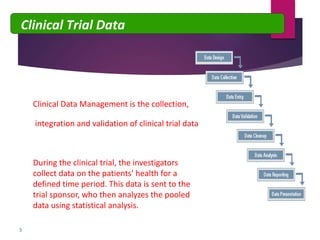
➢Clinical Data Management is the collection,
integration and validation of clinical trial data
➢During the clinical trial, the investigators
collect data on the patients' health for a
defined time period. This data is sent to the
trial sponsor, who then analyzes the pooled
data using statistical analysis.
3
Clinical Trial Data
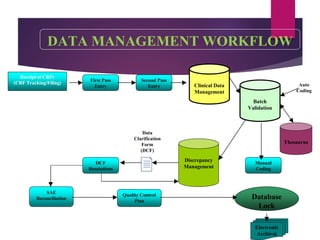
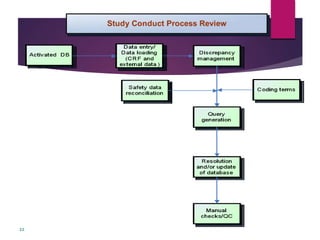
DATA MANAGEMENT WORKFLOW
Receipt of CRFs
(CRF Tracking/Filing)
First Pass
Entry
Second Pass
Entry Clinical Data
Management
Batch
Validation
Thesaurus
Manual
Coding
Discrepancy
Management
DCF
Resolutions
SAE
Reconciliation
Quality Control
Plan
Database
Lock
Auto
Coding
Electronic
Archival
Data
Clarification
Form
(DCF)
WHY CDM
● Review & approval of new drugs by Regulatory
Agencies is dependent upon a trust that clinical
trials data presented are of sufficient integrity to
ensure confidence in results & conclusions
presented by pharma company
● Important to obtaining that trust is adherence to
quality standards & practices.
KEY MEMEBERS:
The Key members involved in
Data Management:
➢Clinical Data Manager
➢Database Administrator
➢Database Programmer
➢Clinical Data Coordinator
➢Clinical Data Associate
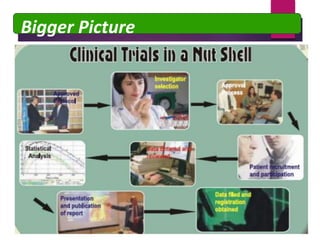
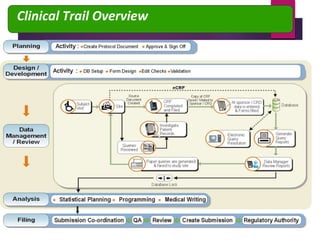
Bigger Picture
Clinical Trail Overview
9
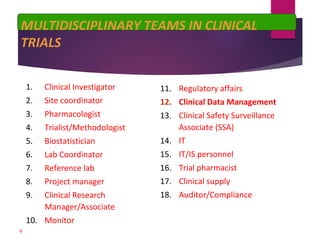
1. Clinical Investigator
2. Site coordinator
3. Pharmacologist
4. Trialist/Methodologist
5. Biostatistician
6. Lab Coordinator
7. Reference lab
8. Project manager
9. Clinical Research
Manager/Associate
10. Monitor
11. Regulatory affairs
12. Clinical Data Management
13. Clinical Safety Surveillance
Associate (SSA)
14. IT
15. IT/IS personnel
16. Trial pharmacist
17. Clinical supply
18. Auditor/Compliance
MULTIDISCIPLINARY TEAMS IN CLINICAL
TRIALS
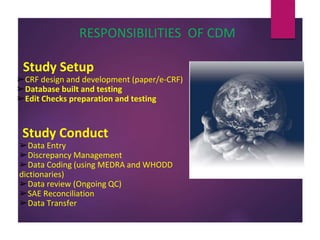
RESPONSIBILITIES OF CDM
Study Setup
➢CRF design and development (paper/e-CRF)
➢Database built and testing
➢Edit Checks preparation and testing
Study Conduct
➢Data Entry
➢Discrepancy Management
➢Data Coding (using MEDRA and WHODD
dictionaries)
➢Data review (Ongoing QC)
➢SAE Reconciliation
➢Data Transfer
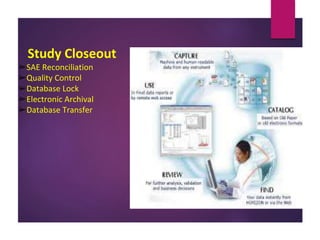
Study Closeout
➢SAE Reconciliation
➢Quality Control
➢Database Lock
➢Electronic Archival
➢Database Transfer
12
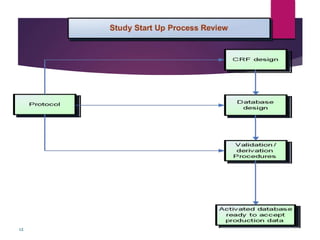
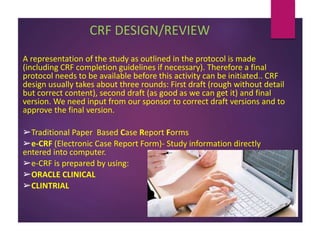
CRF DESIGN/REVIEW
A representation of the study as outlined in the protocol is made
(including CRF completion guidelines if necessary). Therefore a final
protocol needs to be available before this activity can be initiated.. CRF
design usually takes about three rounds: First draft (rough without detail
but correct content), second draft (as good as we can get it) and final
version. We need input from our sponsor to correct draft versions and to
approve the final version.
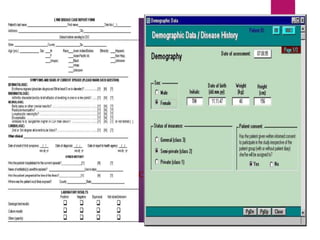
➢Traditional Paper Based Case Report Forms
➢e-CRF (Electronic Case Report Form)- Study information directly
entered into computer.
➢e-CRF is prepared by using:
➢ORACLE CLINICAL
➢CLINTRIAL
Paper CRF e-CRF
HOW MANY CRFS DO YOU NEED?
•Eligibility or Screening form
•Physical Exam form
•Enrollment form
•Medical History form
•AE form/ SAE form
•Concomitant therapy form
•Blood test form
•Laboratory test form
•Follow-up Visit form
DATA BASE DESIGN
Data from a clinical trial will be collected
and stored in some kind of computer
system.
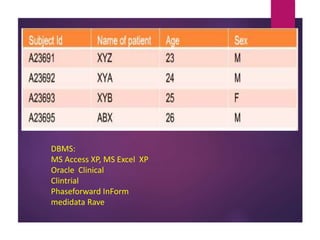
A database is simply a structured set of
data.
A collection of rows and columns.
--Excel Spreadsheet
--Oracle application
DBMS:
MS Access XP, MS Excel XP
Oracle Clinical
Clintrial
Phaseforward InForm
medidata Rave
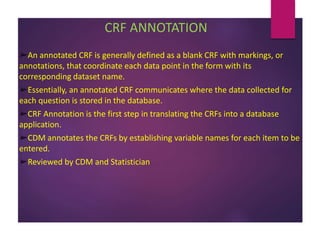
CRF ANNOTATION
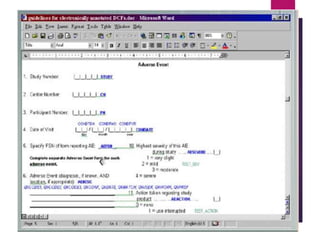
➢An annotated CRF is generally defined as a blank CRF with markings, or
annotations, that coordinate each data point in the form with its
corresponding dataset name.
➢Essentially, an annotated CRF communicates where the data collected for
each question is stored in the database.
➢CRF Annotation is the first step in translating the CRFs into a database
application.
➢CDM annotates the CRFs by establishing variable names for each item to be
entered.
➢Reviewed by CDM and Statistician
VALIDATION CHECKLIST:
Validation Checklist describes in detail which data shall be checked and
queried if necessary. The programming of the checks occurs
according to this checklist. Before the programming starts, the
sponsor will be asked to give approval of this Validation Checklist.
UAT: User Acceptance Test
Test subjects are entered in the database to test the entry screens and
the programming. The exact number of test subjects is not standard,
but every check has to pass and fail (negative and positive proof) at
least once.
DATABASE SET UP AND TESTING
Database setup and testing are always performed in a secure, non study data
environment. Only when a database has been reviewed and fully tested,
will it be set in ‘production’, a separate environment where only study data
will be entered. Changes in structure or programming will always first be
performed and tested in the non study data environment before they are
made effective in the ‘production’ database.
22
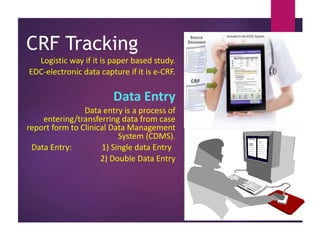
CRF Tracking
Logistic way if it is paper based study.
EDC-electronic data capture if it is e-CRF.
Data Entry
Data entry is a process of
entering/transferring data from case
report form to Clinical Data Management
System (CDMS).
Data Entry: 1) Single data Entry
2) Double Data Entry
DISCREPANCY MANAGEMENT
Discrepancy management is a process of cleaning
subject data in the Clinical Data Management System
(CDMS), it includes manual checks and programmed
checks.
Trivial discrepancies are closed as per self evident
correction method or Universal ruling and discrepancies
which require response from the site are queried by
raising Data Clarification Forms (DCF).
MEDICAL CODING
The medical coding for a study is done as per the
project specific protocol requirement. The
dictionaries used for a study are:
Adverse Events: MedDRA (Medical Dictionary for
Regulatory Activities)
Medications: WHODD (World Health Organization –
Drug Dictionary)
Manual coding is performed using Thesaurus
Management System (TMS) which is integrated with
our Clinical Data Management System (CDMS).
SAE RECONCILIATION
● Serious Adverse Event (SAE) data reconciliation is the comparison of key
safety data variables between Clinical Data Management System
(CDMS) and Master Drug Safety Database (MDSD). Reconciliation is
performed to ensure that events residing in both systems are
consistent.
27
QUALITY CONTROL
● Quality Should be maintained for overall study by performing Quality checks
at intervals for all data points (Critical & Non-Critical) prior to database lock.
● QC helps to ensure that all the data processed is accurate, clean and Correct.
DATABASE LOCK
The database lock for a study is done to ensure
no manipulation of study data during the final
analysis.
Database lock for a study is done once all data
management activities are completed. This
includes the database lock checklist which
ensures the same. Some of the activities
included in database lock checklist are All
discrepancies closed, DCFs received and
updated, coding complete, SAE Reconciliation
process complete etc.
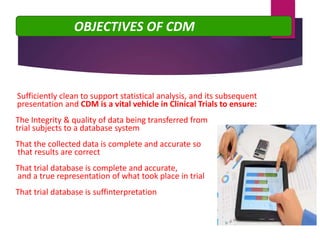
Sufficiently clean to support statistical analysis, and its subsequent
presentation and CDM is a vital vehicle in Clinical Trials to ensure:
➢The Integrity & quality of data being transferred from
➢trial subjects to a database system
➢That the collected data is complete and accurate so
➢ that results are correct
➢That trial database is complete and accurate,
➢ and a true representation of what took place in trial
➢That trial database is suffinterpretation
OBJECTIVES OF CDM
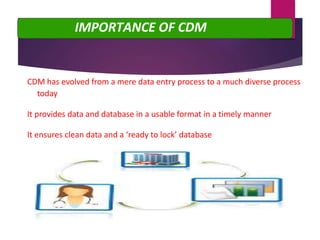
CDM has evolved from a mere data entry process to a much diverse process
today
It provides data and database in a usable format in a timely manner
It ensures clean data and a ‘ready to lock’ database
IMPORTANCE OF CDM
➢CDM Professionals:
o Pharmacists
o Graduates/Post graduates in Life Sciences, IT, Statistics
o Graduates with post graduation diploma in Clinical Research
o Licensed Medical Practitioners
➢Utilize qualified individuals to:
o Supervise overall conduct of trial (Project Manager)
o To handle and verify the data (Data Manager)
o To conduct the statistical analysis (Biostatistician)
o To prepare study reports (Medical Writer)32
CDM PROFESSIONALS
Data Management Role in Clinical Research:
DM ROLE IN CLINICAL RESEARCH
➢ The data management function provides all data collection and data
validation for a clinical trial program
➢ Data management is essential to the overall clinical research function, as
its key deliverable is the data to support the submission
➢ Assuring the overall accuracy and integrity of the clinical trial data is the
core business of the data management function
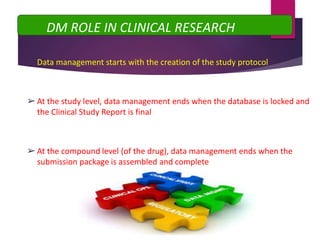
➢Data management starts with the creation of the study protocol
➢At the study level, data management ends when the database is locked and
the Clinical Study Report is final
➢At the compound level (of the drug), data management ends when the
submission package is assembled and complete
DM ROLE IN CLINICAL RESEARCH
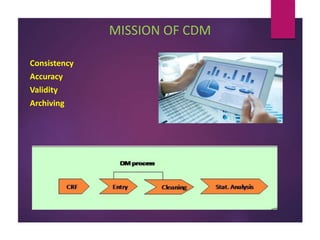
MISSION OF CDM
Consistency
Accuracy
Validity
Archiving
Clinical data-management-overview

Clinical data-management-overview

  • 2.
    CLINICAL DATA MANAGEMENT ClinicalData Management is involved in all aspects of processing the clinical data, working with a range of computer applications, database systems to support collection, cleaning and management of subject or trial data.
  • 3.
    ➢Clinical Data Managementis the collection, integration and validation of clinical trial data ➢During the clinical trial, the investigators collect data on the patients' health for a defined time period. This data is sent to the trial sponsor, who then analyzes the pooled data using statistical analysis. 3 Clinical Trial Data
  • 4.
    DATA MANAGEMENT WORKFLOW Receiptof CRFs (CRF Tracking/Filing) First Pass Entry Second Pass Entry Clinical Data Management Batch Validation Thesaurus Manual Coding Discrepancy Management DCF Resolutions SAE Reconciliation Quality Control Plan Database Lock Auto Coding Electronic Archival Data Clarification Form (DCF)
  • 5.
    WHY CDM ● Review& approval of new drugs by Regulatory Agencies is dependent upon a trust that clinical trials data presented are of sufficient integrity to ensure confidence in results & conclusions presented by pharma company ● Important to obtaining that trust is adherence to quality standards & practices.
  • 6.
    KEY MEMEBERS: The Keymembers involved in Data Management: ➢Clinical Data Manager ➢Database Administrator ➢Database Programmer ➢Clinical Data Coordinator ➢Clinical Data Associate
  • 7.
  • 8.
  • 9.
    9 1. Clinical Investigator 2.Site coordinator 3. Pharmacologist 4. Trialist/Methodologist 5. Biostatistician 6. Lab Coordinator 7. Reference lab 8. Project manager 9. Clinical Research Manager/Associate 10. Monitor 11. Regulatory affairs 12. Clinical Data Management 13. Clinical Safety Surveillance Associate (SSA) 14. IT 15. IT/IS personnel 16. Trial pharmacist 17. Clinical supply 18. Auditor/Compliance MULTIDISCIPLINARY TEAMS IN CLINICAL TRIALS
  • 10.
    RESPONSIBILITIES OF CDM StudySetup ➢CRF design and development (paper/e-CRF) ➢Database built and testing ➢Edit Checks preparation and testing Study Conduct ➢Data Entry ➢Discrepancy Management ➢Data Coding (using MEDRA and WHODD dictionaries) ➢Data review (Ongoing QC) ➢SAE Reconciliation ➢Data Transfer
  • 11.
    Study Closeout ➢SAE Reconciliation ➢QualityControl ➢Database Lock ➢Electronic Archival ➢Database Transfer
  • 12.
  • 13.
    CRF DESIGN/REVIEW A representationof the study as outlined in the protocol is made (including CRF completion guidelines if necessary). Therefore a final protocol needs to be available before this activity can be initiated.. CRF design usually takes about three rounds: First draft (rough without detail but correct content), second draft (as good as we can get it) and final version. We need input from our sponsor to correct draft versions and to approve the final version. ➢Traditional Paper Based Case Report Forms ➢e-CRF (Electronic Case Report Form)- Study information directly entered into computer. ➢e-CRF is prepared by using: ➢ORACLE CLINICAL ➢CLINTRIAL
  • 14.
  • 15.
    HOW MANY CRFSDO YOU NEED? •Eligibility or Screening form •Physical Exam form •Enrollment form •Medical History form •AE form/ SAE form •Concomitant therapy form •Blood test form •Laboratory test form •Follow-up Visit form
  • 16.
    DATA BASE DESIGN Datafrom a clinical trial will be collected and stored in some kind of computer system. A database is simply a structured set of data. A collection of rows and columns. --Excel Spreadsheet --Oracle application
  • 17.
    DBMS: MS Access XP,MS Excel XP Oracle Clinical Clintrial Phaseforward InForm medidata Rave
  • 18.
    CRF ANNOTATION ➢An annotatedCRF is generally defined as a blank CRF with markings, or annotations, that coordinate each data point in the form with its corresponding dataset name. ➢Essentially, an annotated CRF communicates where the data collected for each question is stored in the database. ➢CRF Annotation is the first step in translating the CRFs into a database application. ➢CDM annotates the CRFs by establishing variable names for each item to be entered. ➢Reviewed by CDM and Statistician
  • 20.
    VALIDATION CHECKLIST: Validation Checklistdescribes in detail which data shall be checked and queried if necessary. The programming of the checks occurs according to this checklist. Before the programming starts, the sponsor will be asked to give approval of this Validation Checklist. UAT: User Acceptance Test Test subjects are entered in the database to test the entry screens and the programming. The exact number of test subjects is not standard, but every check has to pass and fail (negative and positive proof) at least once.
  • 21.
    DATABASE SET UPAND TESTING Database setup and testing are always performed in a secure, non study data environment. Only when a database has been reviewed and fully tested, will it be set in ‘production’, a separate environment where only study data will be entered. Changes in structure or programming will always first be performed and tested in the non study data environment before they are made effective in the ‘production’ database.
  • 22.
  • 23.
    CRF Tracking Logistic wayif it is paper based study. EDC-electronic data capture if it is e-CRF. Data Entry Data entry is a process of entering/transferring data from case report form to Clinical Data Management System (CDMS). Data Entry: 1) Single data Entry 2) Double Data Entry
  • 24.
    DISCREPANCY MANAGEMENT Discrepancy managementis a process of cleaning subject data in the Clinical Data Management System (CDMS), it includes manual checks and programmed checks. Trivial discrepancies are closed as per self evident correction method or Universal ruling and discrepancies which require response from the site are queried by raising Data Clarification Forms (DCF).
  • 25.
    MEDICAL CODING The medicalcoding for a study is done as per the project specific protocol requirement. The dictionaries used for a study are: Adverse Events: MedDRA (Medical Dictionary for Regulatory Activities) Medications: WHODD (World Health Organization – Drug Dictionary) Manual coding is performed using Thesaurus Management System (TMS) which is integrated with our Clinical Data Management System (CDMS).
  • 26.
    SAE RECONCILIATION ● SeriousAdverse Event (SAE) data reconciliation is the comparison of key safety data variables between Clinical Data Management System (CDMS) and Master Drug Safety Database (MDSD). Reconciliation is performed to ensure that events residing in both systems are consistent.
  • 27.
  • 28.
    QUALITY CONTROL ● QualityShould be maintained for overall study by performing Quality checks at intervals for all data points (Critical & Non-Critical) prior to database lock. ● QC helps to ensure that all the data processed is accurate, clean and Correct.
  • 29.
    DATABASE LOCK The databaselock for a study is done to ensure no manipulation of study data during the final analysis. Database lock for a study is done once all data management activities are completed. This includes the database lock checklist which ensures the same. Some of the activities included in database lock checklist are All discrepancies closed, DCFs received and updated, coding complete, SAE Reconciliation process complete etc.
  • 30.
    Sufficiently clean tosupport statistical analysis, and its subsequent presentation and CDM is a vital vehicle in Clinical Trials to ensure: ➢The Integrity & quality of data being transferred from ➢trial subjects to a database system ➢That the collected data is complete and accurate so ➢ that results are correct ➢That trial database is complete and accurate, ➢ and a true representation of what took place in trial ➢That trial database is suffinterpretation OBJECTIVES OF CDM
  • 31.
    CDM has evolvedfrom a mere data entry process to a much diverse process today It provides data and database in a usable format in a timely manner It ensures clean data and a ‘ready to lock’ database IMPORTANCE OF CDM
  • 32.
    ➢CDM Professionals: o Pharmacists oGraduates/Post graduates in Life Sciences, IT, Statistics o Graduates with post graduation diploma in Clinical Research o Licensed Medical Practitioners ➢Utilize qualified individuals to: o Supervise overall conduct of trial (Project Manager) o To handle and verify the data (Data Manager) o To conduct the statistical analysis (Biostatistician) o To prepare study reports (Medical Writer)32 CDM PROFESSIONALS
  • 33.
    Data Management Rolein Clinical Research: DM ROLE IN CLINICAL RESEARCH ➢ The data management function provides all data collection and data validation for a clinical trial program ➢ Data management is essential to the overall clinical research function, as its key deliverable is the data to support the submission ➢ Assuring the overall accuracy and integrity of the clinical trial data is the core business of the data management function
  • 34.
    ➢Data management startswith the creation of the study protocol ➢At the study level, data management ends when the database is locked and the Clinical Study Report is final ➢At the compound level (of the drug), data management ends when the submission package is assembled and complete DM ROLE IN CLINICAL RESEARCH
  • 35.