Database Lock &
Unlock Procedure
1 11/20/2017Katalyst Healthcares & Life Sciences
Icons Used
Questions
Demonstration
Hands on
Exercise
Coding
Standards
A Welcome
Break
Tools
ReferenceTestYour
Understanding
Contacts
• After the last patient’s data has been collected from the sites, the race is on to
close and “lock” the study. Once a study has been locked, the final analysis can be
made and conclusions drawn.There is usually high pressure to make those
analyses (and related decisions) as soon as possible.
• Companies frequently keep track of “time to database lock” and work constantly
to minimize that time.The pressure to quickly lock a database for analysis comes
up against a long list of time-consuming tasks that need to be performed first.The
list involves many individual steps, including: collecting the final data, resolving
outstanding queries, reconciling against other databases, and performing final
quality control (QC).
• Once these tasks are performed the study is considered locked. (That is, no data
value will be changed) and the data is now considered ready for Bio statistical
analysis.
• There are usually specific conditions that can lead to unlocking a database,
restrictions on what can be changed during the time it is unlocked, and
requirements that must be met before it can be relocked.
4
• After completing this module you will be able to:
– Understand Database Lock and Unlock Procedures
▪ What is Database Lock & why its needed?
▪ What is Database Unlock & why its needed?
▪ Steps involved in Database Lock & Unlock
– Dealing with errors found after Database Lock
– Critical and Non Critical Errors
5
Unlocking of database may change
the fate of the product
By delaying the product release into the market
6
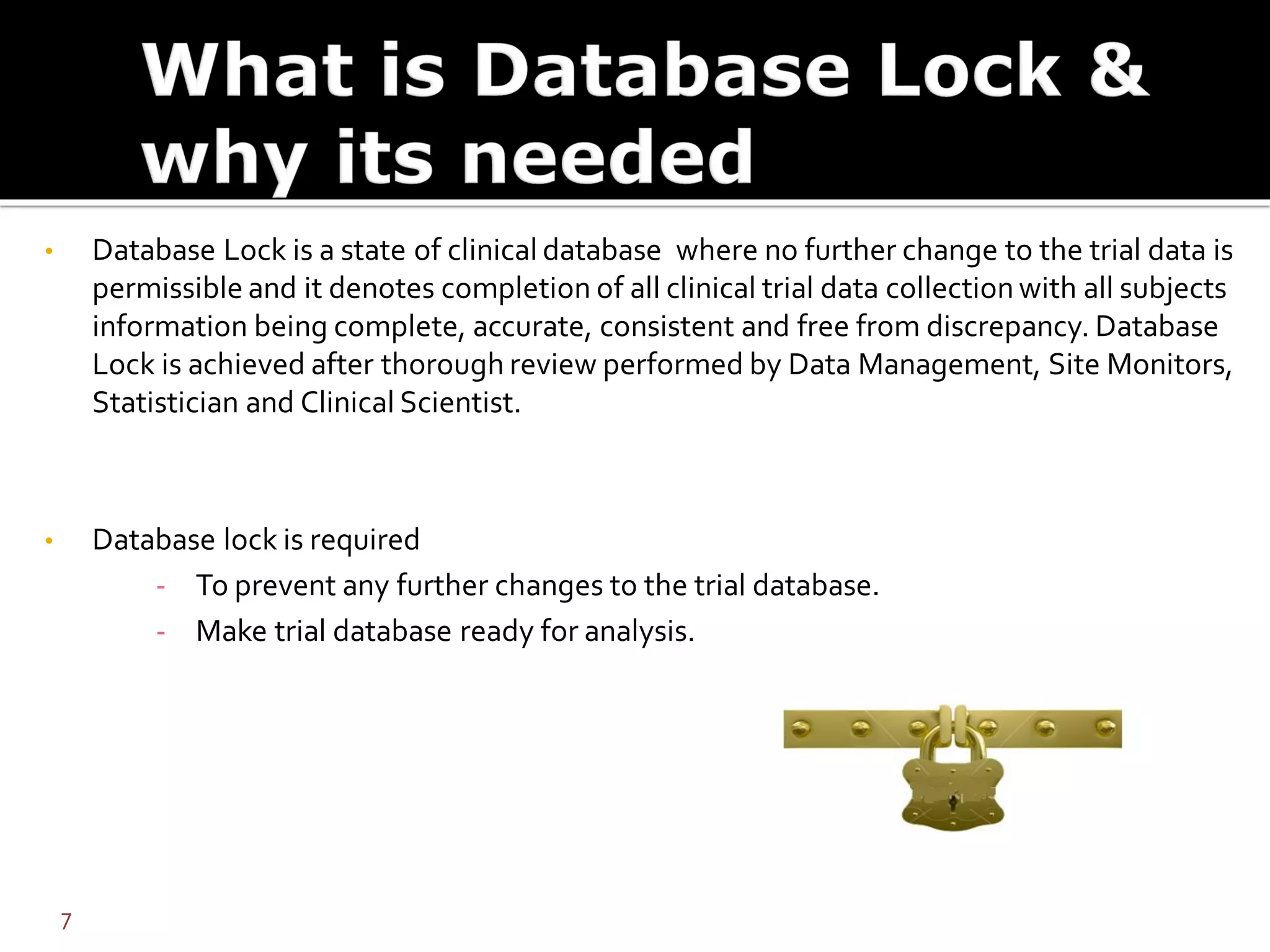
• Database Lock is a state of clinical database where no further change to the trial data is
permissible and it denotes completion of all clinical trial data collection with all subjects
information being complete, accurate, consistent and free from discrepancy. Database
Lock is achieved after thorough review performed by Data Management, Site Monitors,
Statistician and Clinical Scientist.
• Database lock is required
- To prevent any further changes to the trial database.
- Make trial database ready for analysis.
7
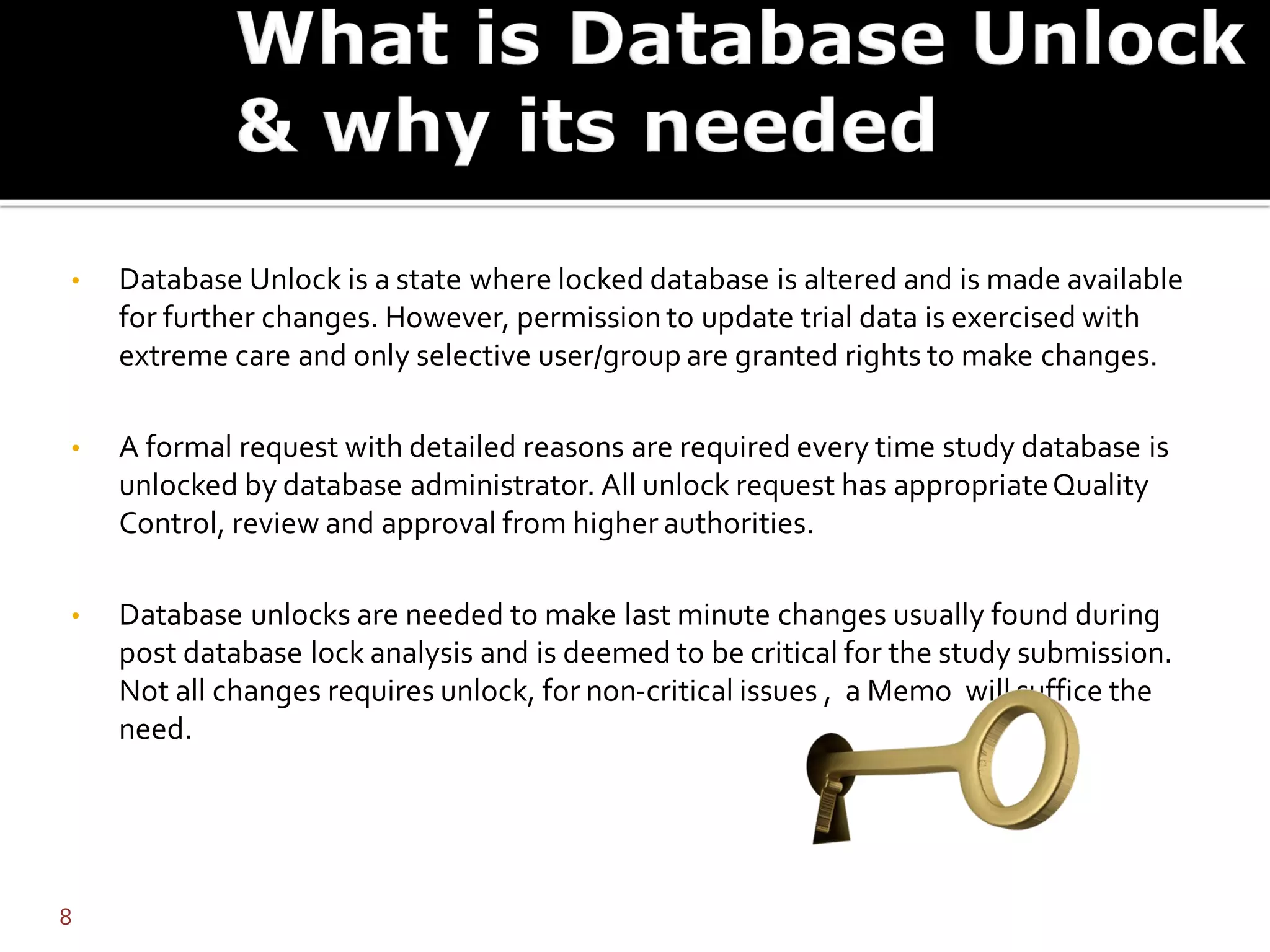
• Database Unlock is a state where locked database is altered and is made available
for further changes. However, permission to update trial data is exercised with
extreme care and only selective user/group are granted rights to make changes.
• A formal request with detailed reasons are required every time study database is
unlocked by database administrator. All unlock request has appropriateQuality
Control, review and approval from higher authorities.
• Database unlocks are needed to make last minute changes usually found during
post database lock analysis and is deemed to be critical for the study submission.
Not all changes requires unlock, for non-critical issues , a Memo will suffice the
need.
8
9
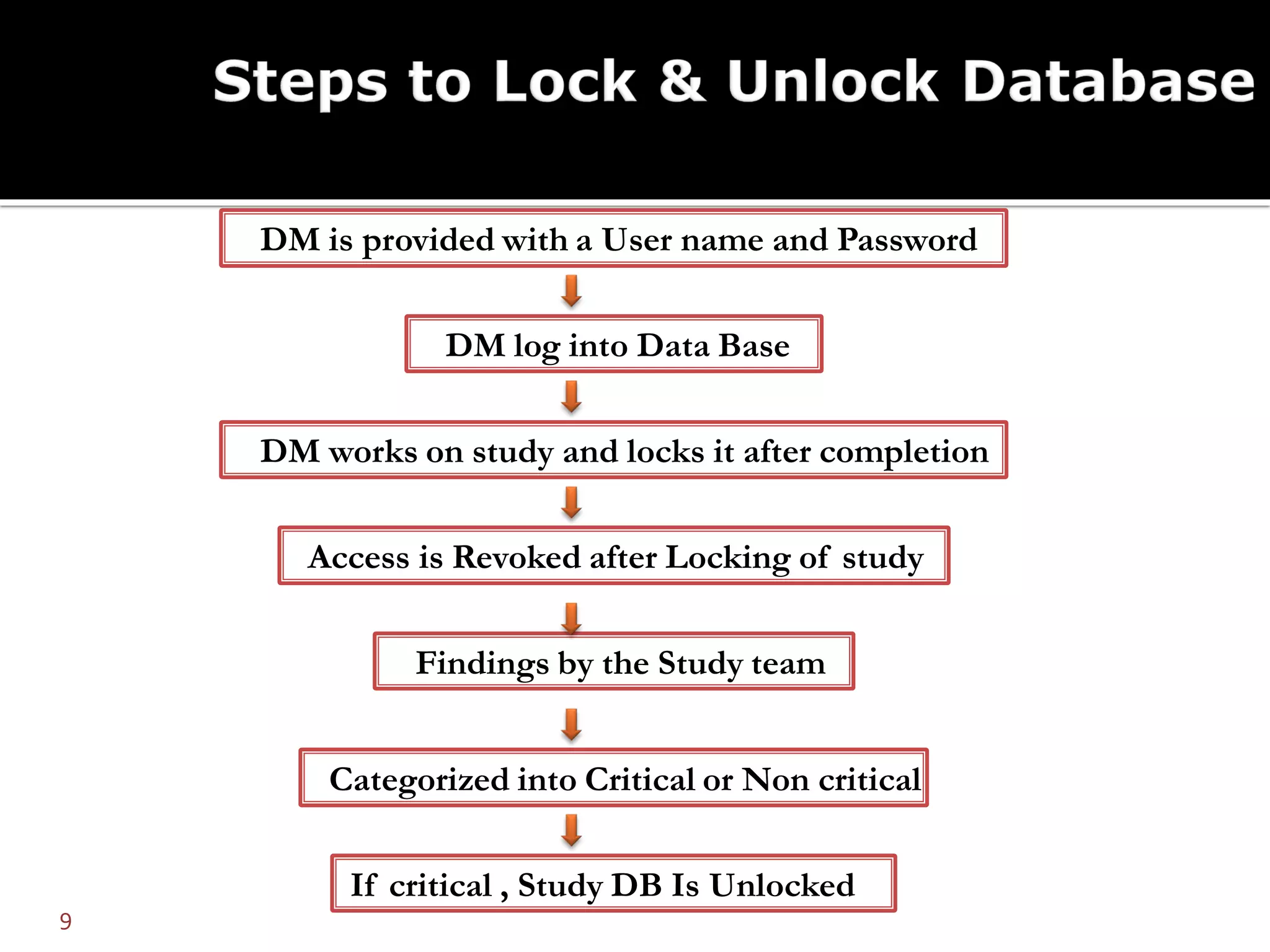
DM is provided with a User name and Password
DM log into Data Base
DM works on study and locks it after completion
Access is Revoked after Locking of study
Findings by the Study team
Categorized into Critical or Non critical
If critical , Study DB Is Unlocked
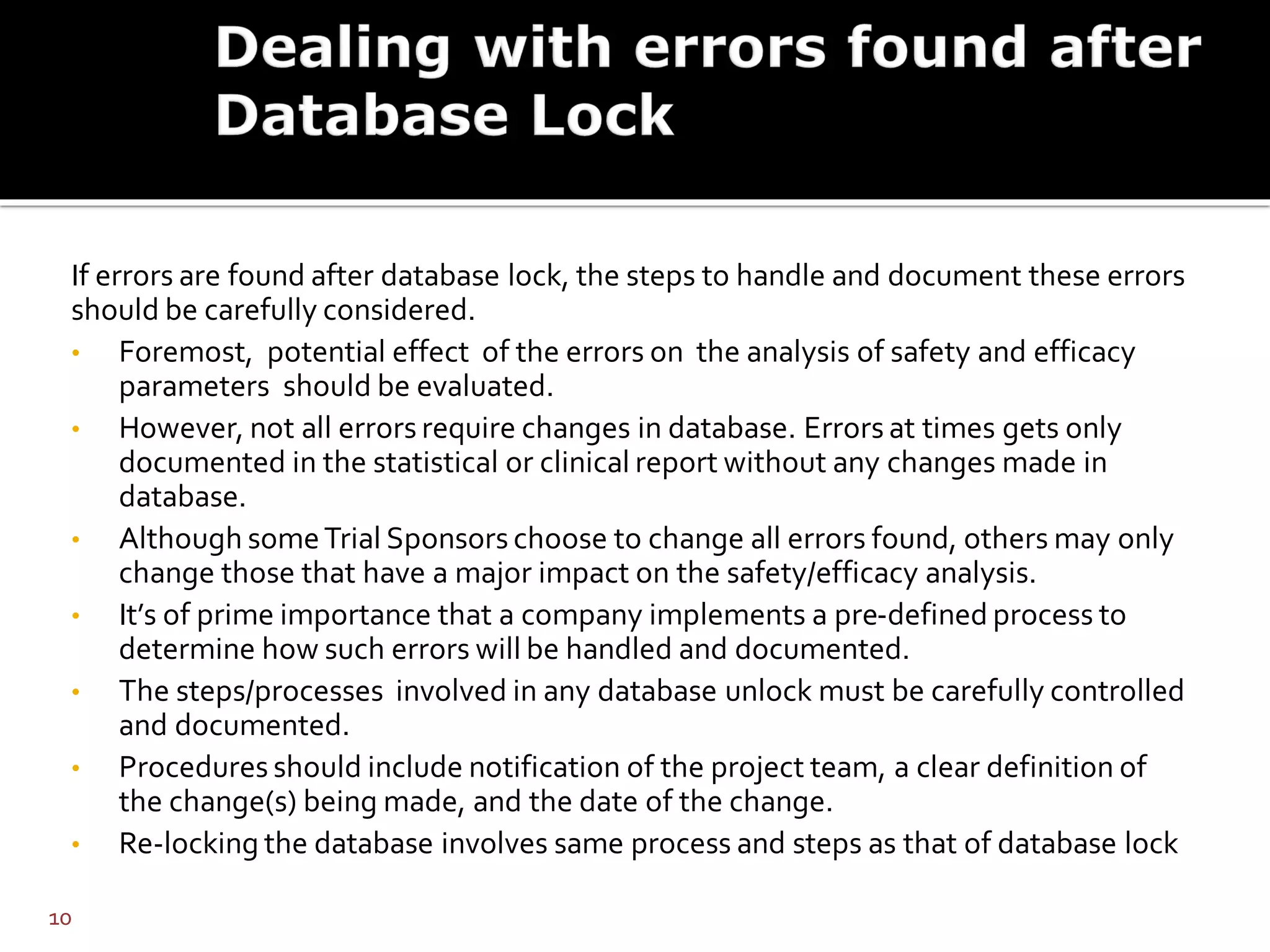
If errors are found after database lock, the steps to handle and document these errors
should be carefully considered.
• Foremost, potential effect of the errors on the analysis of safety and efficacy
parameters should be evaluated.
• However, not all errors require changes in database. Errors at times gets only
documented in the statistical or clinical report without any changes made in
database.
• Although someTrial Sponsors choose to change all errors found, others may only
change those that have a major impact on the safety/efficacy analysis.
• It’s of prime importance that a company implements a pre-defined process to
determine how such errors will be handled and documented.
• The steps/processes involved in any database unlock must be carefully controlled
and documented.
• Procedures should include notification of the project team, a clear definition of
the change(s) being made, and the date of the change.
• Re-locking the database involves same process and steps as that of database lock
10
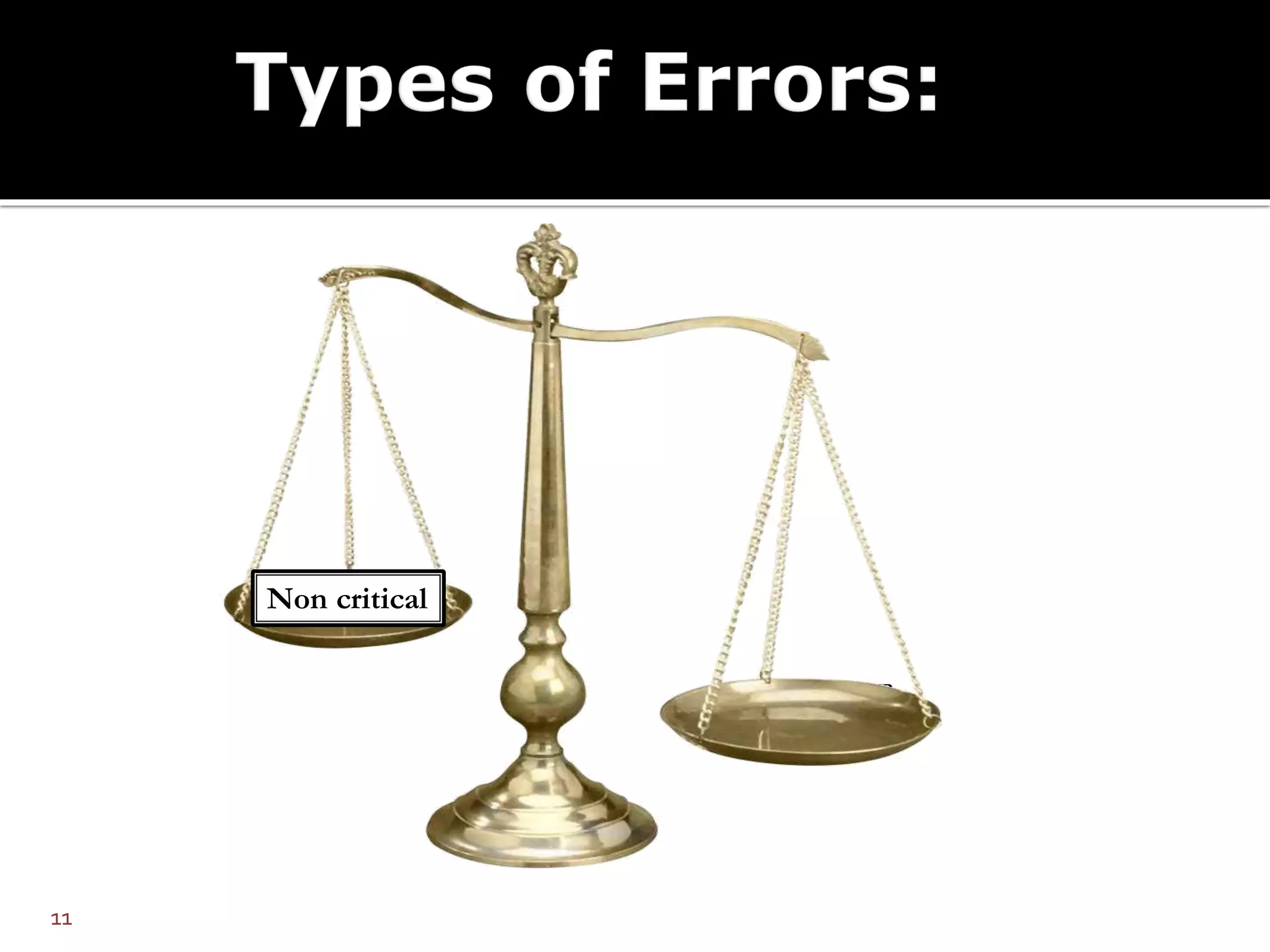
Critical
11
Non critical
12
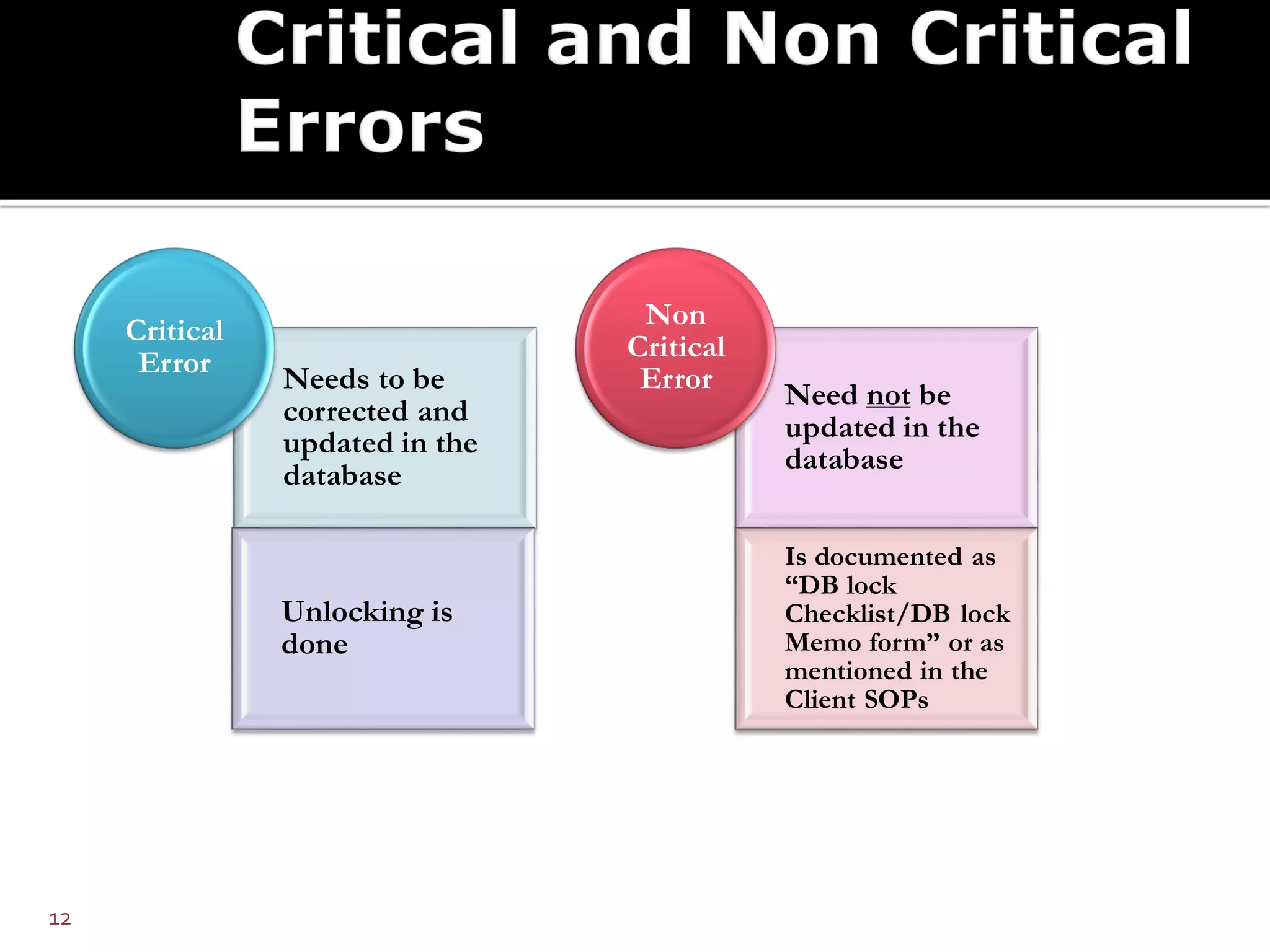
Needs to be
corrected and
updated in the
database
Unlocking is
done
Critical
Error
Need not be
updated in the
database
Is documented as
“DB lock
Checklist/DB lock
Memo form” or as
mentioned in the
Client SOPs
Non
Critical
Error
• Adverse Event
• Medication
• Lab
• Vital Signs
• Any error on these modules usually subject to a critical error and critical error form
should be filed in.
13
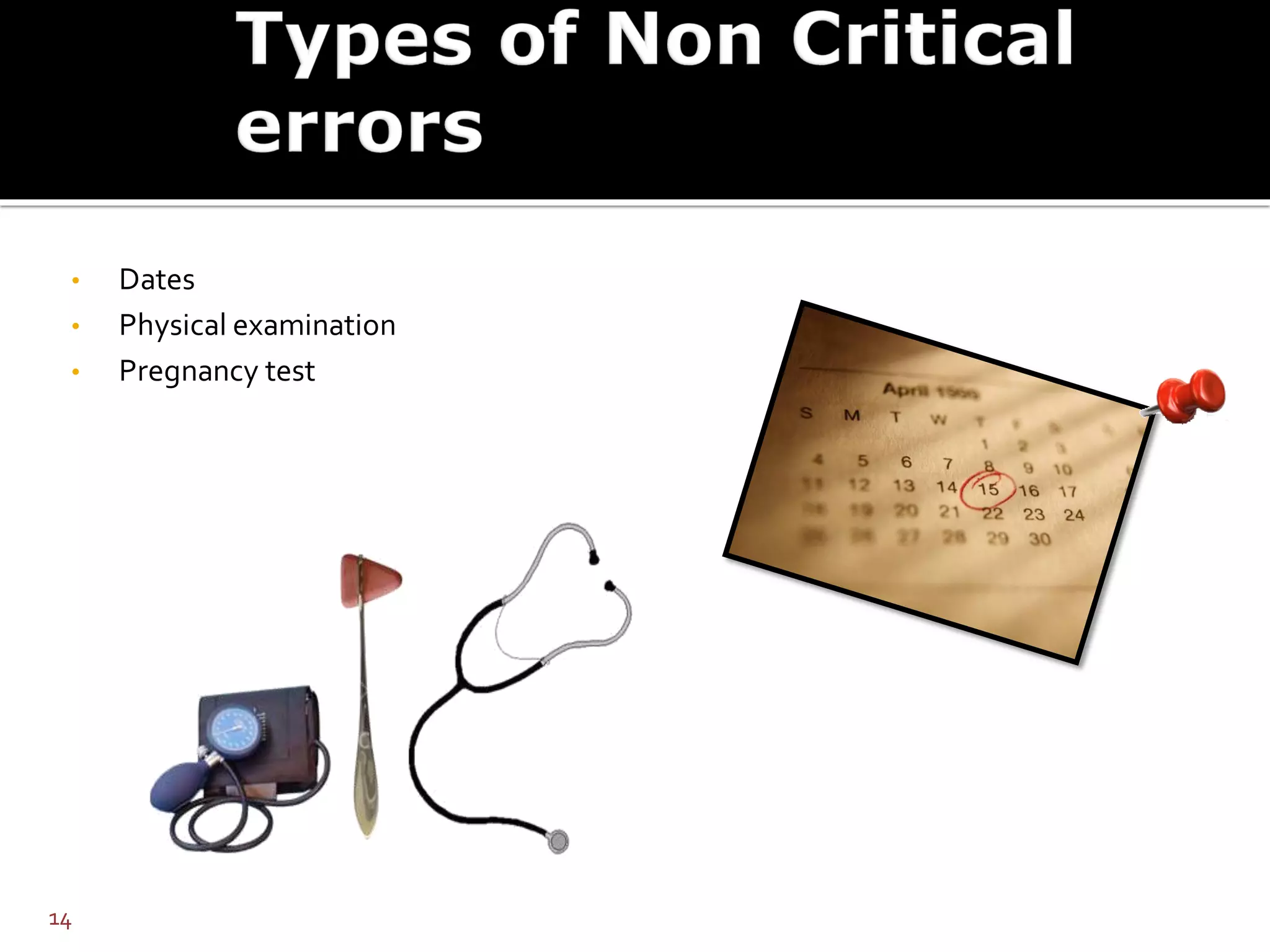
• Dates
• Physical examination
• Pregnancy test
14
15
16
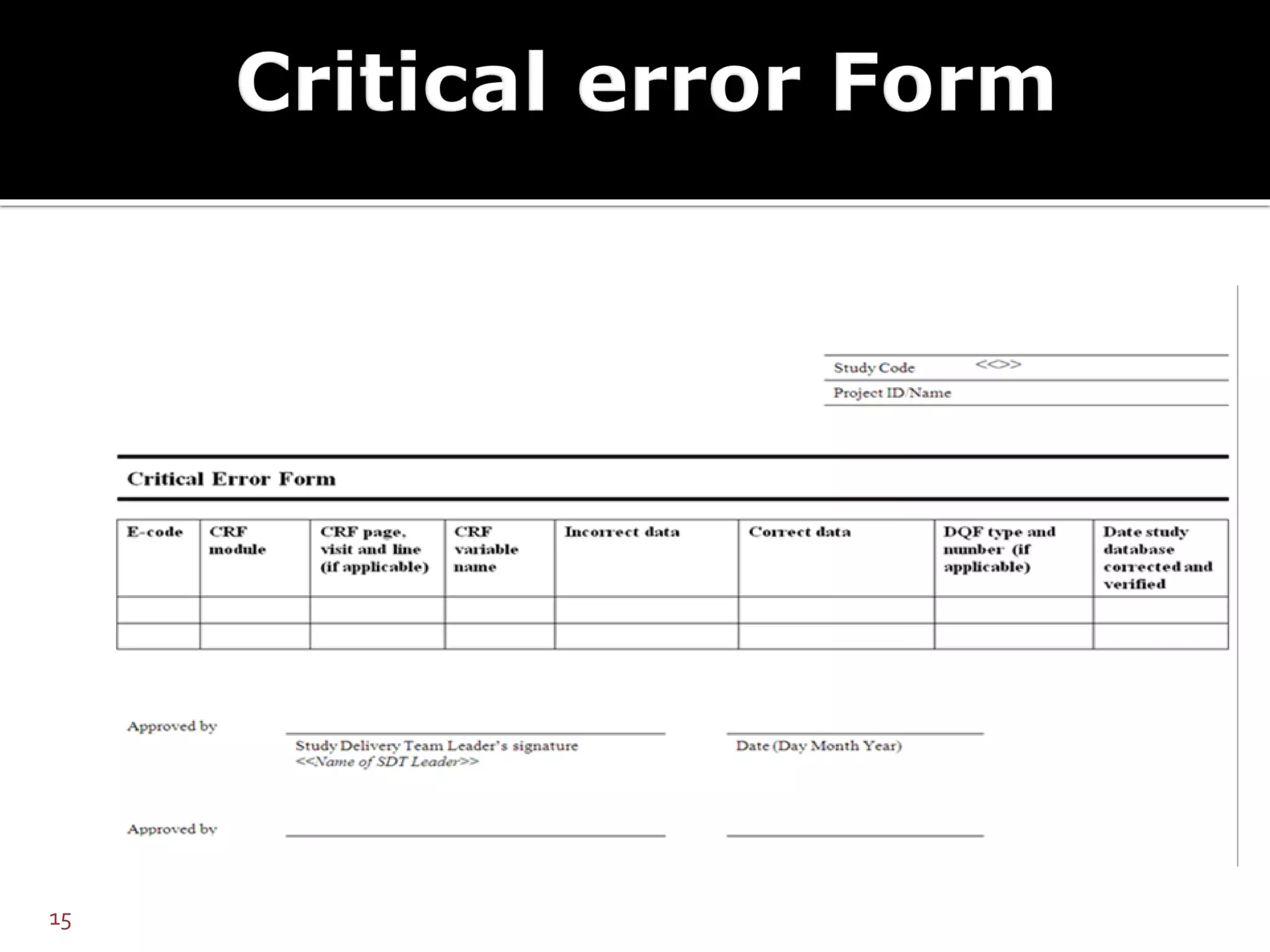
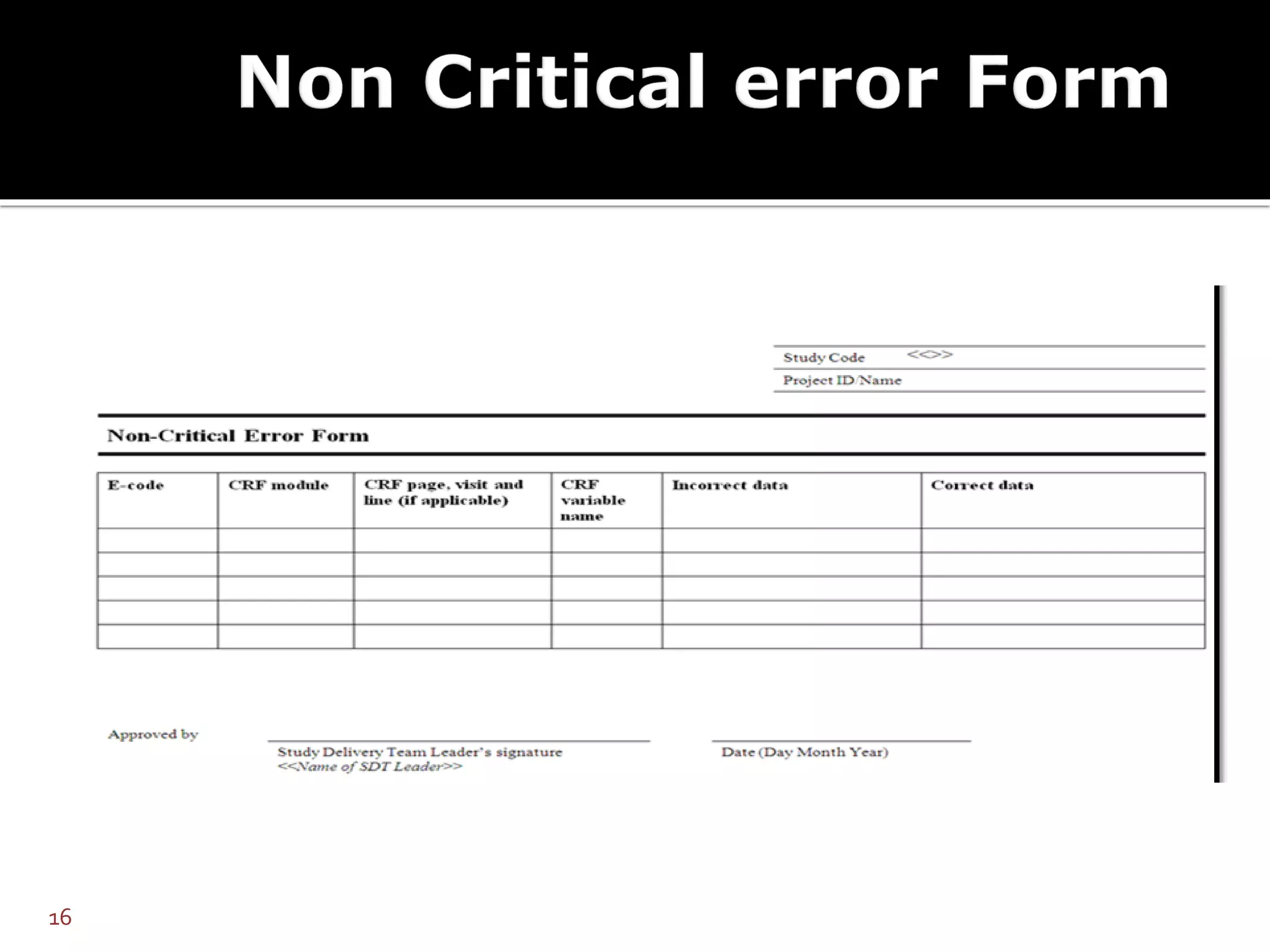
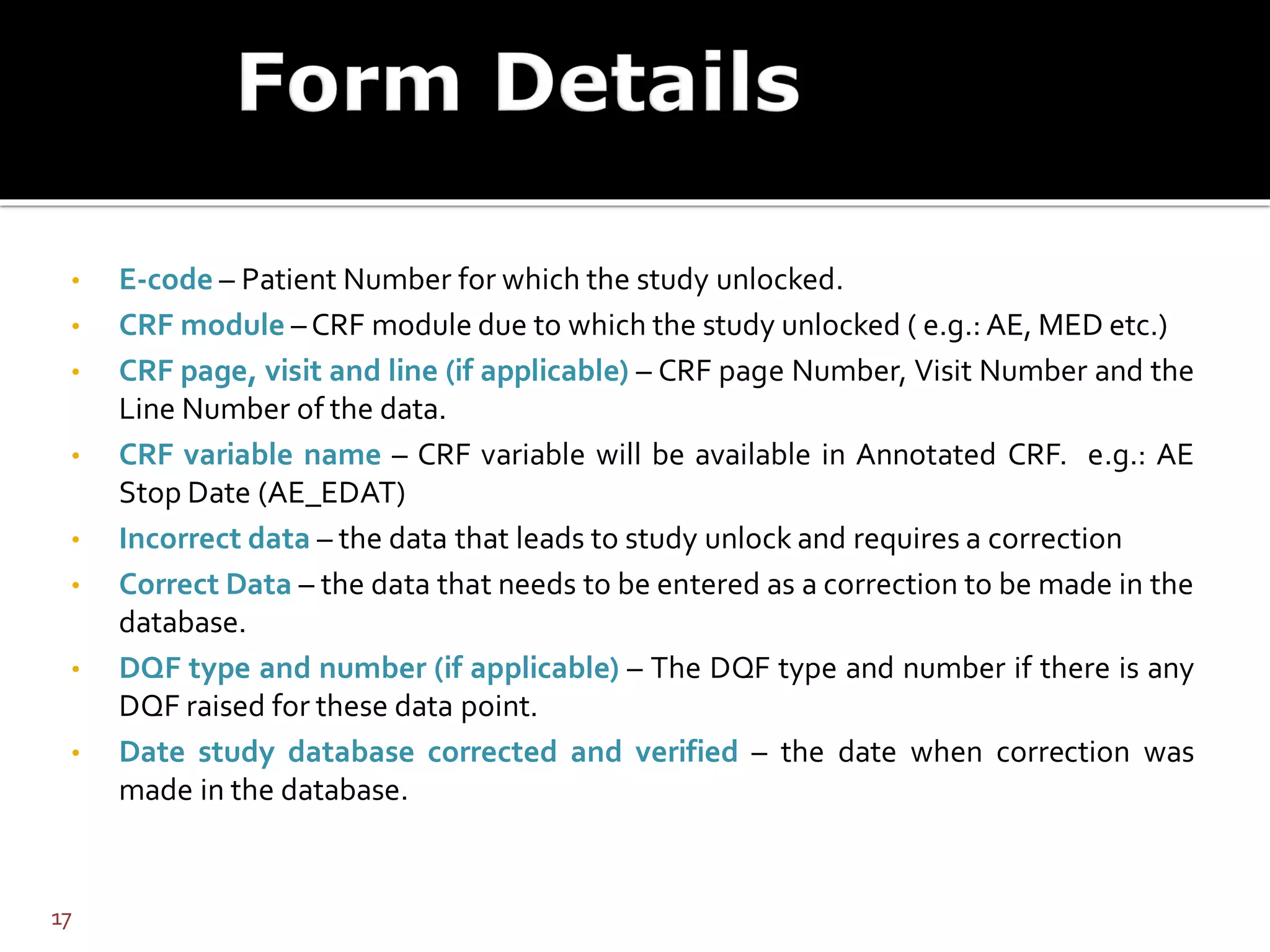
• E-code – Patient Number for which the study unlocked.
• CRF module – CRF module due to which the study unlocked ( e.g.: AE, MED etc.)
• CRF page, visit and line (if applicable) – CRF page Number, Visit Number and the
Line Number of the data.
• CRF variable name – CRF variable will be available in Annotated CRF. e.g.: AE
Stop Date (AE_EDAT)
• Incorrect data – the data that leads to study unlock and requires a correction
• Correct Data – the data that needs to be entered as a correction to be made in the
database.
• DQF type and number (if applicable) – The DQF type and number if there is any
DQF raised for these data point.
• Date study database corrected and verified – the date when correction was
made in the database.
17
• Critical error found post database lock leads
to______
• Document that contain or refer to other SOPs
for the unlocking and relocking processes is
know as______
• Will a spelling error lead to database unlock
• Give example of critical error leading to
database unlock
18
• Locking a study database is fundamental to preventing inadvertent or
unauthorized changes once the final analysis and reporting of the data have
begun.
• Ensure that a procedure defines database Lock methodology.
• Prior to database lock, document completion of all defined tasks or criteria.
• At final database lock, ensure that all team members are notified and edit access
is removed and documented.
• After lock, have written procedures with clear criteria for unlocking the database.
• Best practices - develop and use a database lock checklist.
19
ThankYou
&
Questions
11/20/2017
Contact:
Katalyst Healthcare’s& Life Sciences
South Plainfield, NJ, USA 07080.
E-Mail: info@KatalystHLS.com

Database Lock _ Unlock Procedure_Katalyst HLS

  • 1.
    Database Lock & UnlockProcedure 1 11/20/2017Katalyst Healthcares & Life Sciences
  • 2.
    Icons Used Questions Demonstration Hands on Exercise Coding Standards AWelcome Break Tools ReferenceTestYour Understanding Contacts
  • 3.
    • After thelast patient’s data has been collected from the sites, the race is on to close and “lock” the study. Once a study has been locked, the final analysis can be made and conclusions drawn.There is usually high pressure to make those analyses (and related decisions) as soon as possible. • Companies frequently keep track of “time to database lock” and work constantly to minimize that time.The pressure to quickly lock a database for analysis comes up against a long list of time-consuming tasks that need to be performed first.The list involves many individual steps, including: collecting the final data, resolving outstanding queries, reconciling against other databases, and performing final quality control (QC).
  • 4.
    • Once thesetasks are performed the study is considered locked. (That is, no data value will be changed) and the data is now considered ready for Bio statistical analysis. • There are usually specific conditions that can lead to unlocking a database, restrictions on what can be changed during the time it is unlocked, and requirements that must be met before it can be relocked. 4
  • 5.
    • After completingthis module you will be able to: – Understand Database Lock and Unlock Procedures ▪ What is Database Lock & why its needed? ▪ What is Database Unlock & why its needed? ▪ Steps involved in Database Lock & Unlock – Dealing with errors found after Database Lock – Critical and Non Critical Errors 5
  • 6.
    Unlocking of databasemay change the fate of the product By delaying the product release into the market 6
  • 7.
    • Database Lockis a state of clinical database where no further change to the trial data is permissible and it denotes completion of all clinical trial data collection with all subjects information being complete, accurate, consistent and free from discrepancy. Database Lock is achieved after thorough review performed by Data Management, Site Monitors, Statistician and Clinical Scientist. • Database lock is required - To prevent any further changes to the trial database. - Make trial database ready for analysis. 7
  • 8.
    • Database Unlockis a state where locked database is altered and is made available for further changes. However, permission to update trial data is exercised with extreme care and only selective user/group are granted rights to make changes. • A formal request with detailed reasons are required every time study database is unlocked by database administrator. All unlock request has appropriateQuality Control, review and approval from higher authorities. • Database unlocks are needed to make last minute changes usually found during post database lock analysis and is deemed to be critical for the study submission. Not all changes requires unlock, for non-critical issues , a Memo will suffice the need. 8
  • 9.
    9 DM is providedwith a User name and Password DM log into Data Base DM works on study and locks it after completion Access is Revoked after Locking of study Findings by the Study team Categorized into Critical or Non critical If critical , Study DB Is Unlocked
  • 10.
    If errors arefound after database lock, the steps to handle and document these errors should be carefully considered. • Foremost, potential effect of the errors on the analysis of safety and efficacy parameters should be evaluated. • However, not all errors require changes in database. Errors at times gets only documented in the statistical or clinical report without any changes made in database. • Although someTrial Sponsors choose to change all errors found, others may only change those that have a major impact on the safety/efficacy analysis. • It’s of prime importance that a company implements a pre-defined process to determine how such errors will be handled and documented. • The steps/processes involved in any database unlock must be carefully controlled and documented. • Procedures should include notification of the project team, a clear definition of the change(s) being made, and the date of the change. • Re-locking the database involves same process and steps as that of database lock 10
  • 11.
  • 12.
    12 Needs to be correctedand updated in the database Unlocking is done Critical Error Need not be updated in the database Is documented as “DB lock Checklist/DB lock Memo form” or as mentioned in the Client SOPs Non Critical Error
  • 13.
    • Adverse Event •Medication • Lab • Vital Signs • Any error on these modules usually subject to a critical error and critical error form should be filed in. 13
  • 14.
    • Dates • Physicalexamination • Pregnancy test 14
  • 15.
  • 16.
  • 17.
    • E-code –Patient Number for which the study unlocked. • CRF module – CRF module due to which the study unlocked ( e.g.: AE, MED etc.) • CRF page, visit and line (if applicable) – CRF page Number, Visit Number and the Line Number of the data. • CRF variable name – CRF variable will be available in Annotated CRF. e.g.: AE Stop Date (AE_EDAT) • Incorrect data – the data that leads to study unlock and requires a correction • Correct Data – the data that needs to be entered as a correction to be made in the database. • DQF type and number (if applicable) – The DQF type and number if there is any DQF raised for these data point. • Date study database corrected and verified – the date when correction was made in the database. 17
  • 18.
    • Critical errorfound post database lock leads to______ • Document that contain or refer to other SOPs for the unlocking and relocking processes is know as______ • Will a spelling error lead to database unlock • Give example of critical error leading to database unlock 18
  • 19.
    • Locking astudy database is fundamental to preventing inadvertent or unauthorized changes once the final analysis and reporting of the data have begun. • Ensure that a procedure defines database Lock methodology. • Prior to database lock, document completion of all defined tasks or criteria. • At final database lock, ensure that all team members are notified and edit access is removed and documented. • After lock, have written procedures with clear criteria for unlocking the database. • Best practices - develop and use a database lock checklist. 19
  • 20.
    ThankYou & Questions 11/20/2017 Contact: Katalyst Healthcare’s& LifeSciences South Plainfield, NJ, USA 07080. E-Mail: info@KatalystHLS.com