
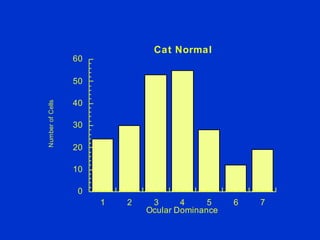
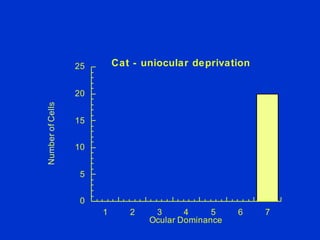
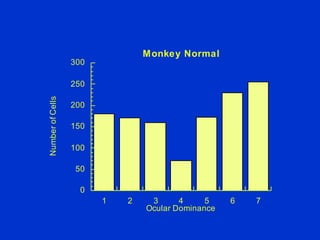
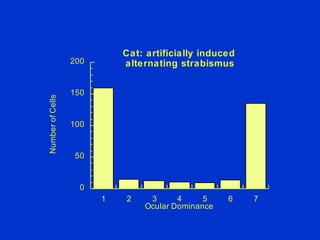


Lecture 3 : Studies of abnormal visual development
Aim To understand abnormal development of Binocular Vision from animal and human studies
Critical Periods the period of development during which the anatomy and physiology of the visual system is plastic
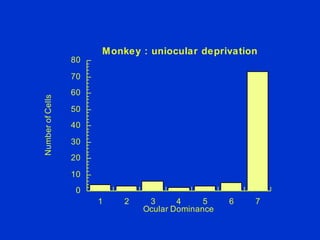
Critical Periods term first coined by Hubel and Wiesel  to refer to the period of age during which suturing the eyelids of a kitten closed had an effect on the ocular dominance of cells in the visual cortex


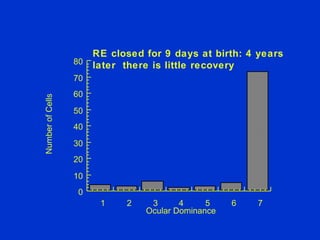
Number of Cells Ocular Dominance 0 10 20 30 40 50 60 70 80 1 2 3 4 5 6 7 RE closed for 9 days at birth: 4 years  later  there is little recovery
 
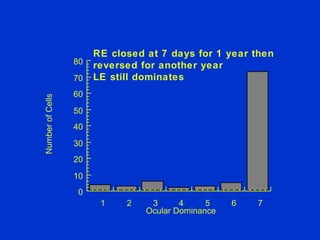
Number of Cells Ocular Dominance 0 10 20 30 40 50 60 70 80 1 2 3 4 5 6 7 RE closed at 7 days for 1 year then reversed for another year LE still dominates
 
 
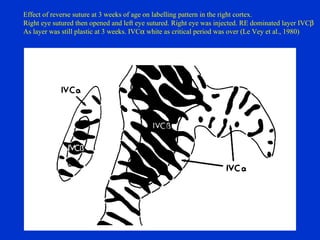
Effect of reverse suture at 3 weeks of age on labelling pattern in the right cortex. Right eye sutured then opened and left eye sutured. Right eye was injected. RE dominated layer IVC    As layer was still plastic at 3 weeks. IVC   white as critical period was over (Le Vey et al., 1980)
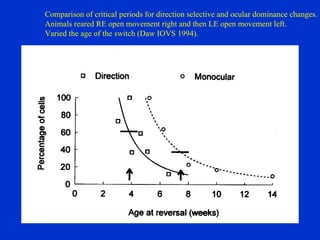
Comparison of critical periods for direction selective and ocular dominance changes. Animals reared RE open movement right and then LE open movement left.  Varied the age of the switch (Daw IOVS 1994).
It has become apparent the critical period depends on factors such as The species  Part of the visual system being recorded Type of deprivation Previous history  Therefore one can not talk about one critical period
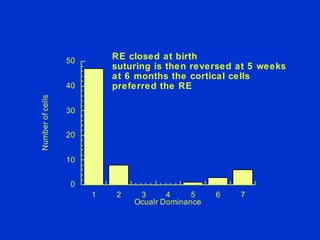
These results show that ocular dominance changes can be produced after the initial development of ocular dominance columns has largely finished This seems to be the case in all visual properties
Visual properties usually approach the adult level in an exponential manner making it difficult to say exactly when adult level is reached However we can say that modifications can occur after the time that they are so close to adult level that one cannot tell that they are different from the adult value
Daw - 3 stages in  the development of each visual property Sensitivity of property is refined to adult level (or no measurable difference) Cells in visual cortex can still be changed by a deprivation that affects the property Properties cannot be changed by visual deprivation except if previously changed during steps 1 or 2 then may be altered again
The visual system is more plastic and remains plastic for a longer period of time at higher levels of processing Retina is largely  hard wired at birth Some plasticity in the LGN Output layers of the primary visual cortex are more plastic than the input layers
The visual cortex projects to the inferior temporal cortex where faces and objects are recognised and plasticity continues for a substantial period of time Visual memories are also stored in the temporal cortex and plasticity continues indefinitely Temporal cortex projects to the hippocampus which is known to be plastic in the adult Different visual properties have different critical periods eg direction and ocular dominance
Examination of Children Recommedation on Vision Screening American Optometric Association Board of Trustees (1993) Infants/Toddlers (birth-2yrs): examine by 6 months Pre-school (2-5years): examine at age 3 and age 5 School age : examine annually
Examination of Children Must be able to properly examine children of all ages Appreciate what constitutes normal and abnormal visual development  MAXIMUM information SHORTEST time
Examination of a <1 year old History and Symptoms Gain as much information from the parent History of patient Reason for visit Difficulties with birth General health Patients ocular history Family ocular history
Preliminary testing Pupils: small until 6-12 months Visual field: confrontation difficult Bruckner test: pupil of the most turned eye will be brighter and whiter Tonometry: tonopen
Visual acuity <6 months: alteration of fixation - vertical prism dissociation > 6 months Preferential looking Child will look at a patterned target rather than a blank screen No difference in average brightness between targets and its background If child looks at towards target consistently then they can resolve the detail within
Preferential looking Series of grey cards with a central peephole Black and white grating is positioned at one side of the peephole Grating varies in SF throughout the series Examiner views the child’s responses Proceed down the card series until examiner cannot make the right judgement (2 correct responses mean that you proceed to the next scale)
Preferential looking Teller Cards Have a square wave grating format than can give rise to an edge artifact - edge of grating is visible even when individual stripes are not Keeler Cards Grating lies within a narrow white circular band (blank white band on other side) Takes longer as examiner has to allow time for child to look at both sides of the card Judges position of the grating from the length of time fixated
Alternate Occlusion If there is a big difference in acuity between the two eyes Occlude each eye in turn and gauge the child’s response
Hirschberg technique
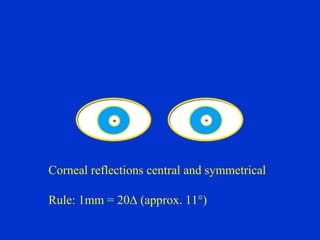
Corneal reflections central and symmetrical Rule: 1mm = 20∆ (approx. 11°)
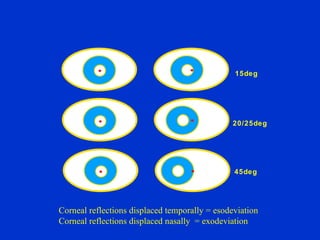
15deg 20/25deg 45deg Corneal reflections displaced temporally = esodeviation Corneal reflections displaced nasally  = exodeviation
Convergence Use an interesting detailed target
Motility Use toy of some kind  Get parent to hold the child’s head
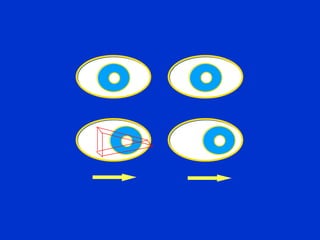
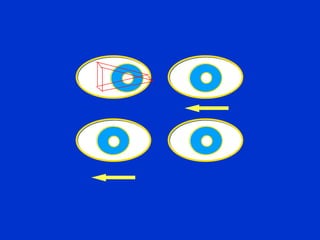
Presence of Binocular Vision 20 prism dioptre test Infants  Young, unco-operative children Mentally handicapped
 
 
Cover Test Use an interesting detailed target Change target frequently Use hand as occluder
Stereopsis Lang test Dissociates images from the right and left eyes with the use of tiny cylinders on surface Binocularly 3D figure “pop out” of the background In 1year onwards children will enjoy touching (or naming) the pictures Less than 1 year you will have to watch the child’s eye movements Check if movements are consistent with the position of the test figures
Stereopsis Lang Test Stereotargets become invisible when presented vertically - useful for comparison 1200 - 200 seconds of arc Frisby Stereotest Uses real depth cues With minor modifications can be used to test infants from 7 months
Retinoscopy Be quick Looking for gross differences between the eyes or large refractive errors  Near retinoscopy Cycloplegia Usually cyclopentolate will do Use when non-cycloplegia failed Fixation/accm unsteady Convergent strabismus Esophoria (significant or symptom producing) Significant difference between ret and subjective
Examination of a 1-2 year old Family history from parent Cover test Motility Retinoscopy Ophthalmoscopy Visual acuity Stereopsis Get better results with this than VA
Visual Acuity Cardiff Acuity Test 1-3 years old Preferential looking Picture instead of gratings 50cm or 1m viewing 3 cards at each acuity level Keep toddlers motivated Must assess only the eye movements
Visual Acuity Kay Picture Test Single black pictures on a white background 8 different pictures used Snellen progressionsome experience required by the child Examiner must assess what is correct
Examination of a child greater than 3 years old History and symptoms Visual acuity (67% compliance with letter testing at 3 years old) Motility Stereopsis (TNO, Frisby, Titmus) Retinoscopy - cycloplegic Ophthalmoscopy
Visual Acuity Sheridan Gardner Single letter presentation in Snellen progression Has a keycard No crowding present
Visual Acuity Cambridge Crowing Cards Aimed especially at the detection of amblyopia Can be performed on children as young as 2 years Snellen letter progression Greater reduction than one line between singles and crowded card would indicate amblyopia Control of contour interaction
Visual Acuity Logmar Crowded test 3m test distance Equal number of letters per line letters of approxiamtely equal legibility Letters symmetrical about vertical midline Acuity scale 3/19 to 3/1.5 Geometric progression of letter size Screening cards Control of contour interaction

Studies of abnormal visual development

  • 1.
    Lecture 3 :Studies of abnormal visual development
  • 2.
    Aim To understandabnormal development of Binocular Vision from animal and human studies
  • 3.
    Critical Periods theperiod of development during which the anatomy and physiology of the visual system is plastic
  • 4.
    Critical Periods termfirst coined by Hubel and Wiesel to refer to the period of age during which suturing the eyelids of a kitten closed had an effect on the ocular dominance of cells in the visual cortex
  • 5.
  • 6.
  • 7.
  • 8.
  • 9.
  • 10.
    Number of CellsOcular Dominance 0 10 20 30 40 50 60 70 80 1 2 3 4 5 6 7 RE closed for 9 days at birth: 4 years later there is little recovery
  • 11.
  • 12.
    Number of CellsOcular Dominance 0 10 20 30 40 50 60 70 80 1 2 3 4 5 6 7 RE closed at 7 days for 1 year then reversed for another year LE still dominates
  • 13.
  • 14.
  • 15.
    Effect of reversesuture at 3 weeks of age on labelling pattern in the right cortex. Right eye sutured then opened and left eye sutured. Right eye was injected. RE dominated layer IVC  As layer was still plastic at 3 weeks. IVC  white as critical period was over (Le Vey et al., 1980)
  • 16.
    Comparison of criticalperiods for direction selective and ocular dominance changes. Animals reared RE open movement right and then LE open movement left. Varied the age of the switch (Daw IOVS 1994).
  • 17.
    It has becomeapparent the critical period depends on factors such as The species Part of the visual system being recorded Type of deprivation Previous history Therefore one can not talk about one critical period
  • 18.
    These results showthat ocular dominance changes can be produced after the initial development of ocular dominance columns has largely finished This seems to be the case in all visual properties
  • 19.
    Visual properties usuallyapproach the adult level in an exponential manner making it difficult to say exactly when adult level is reached However we can say that modifications can occur after the time that they are so close to adult level that one cannot tell that they are different from the adult value
  • 20.
    Daw - 3stages in the development of each visual property Sensitivity of property is refined to adult level (or no measurable difference) Cells in visual cortex can still be changed by a deprivation that affects the property Properties cannot be changed by visual deprivation except if previously changed during steps 1 or 2 then may be altered again
  • 21.
    The visual systemis more plastic and remains plastic for a longer period of time at higher levels of processing Retina is largely hard wired at birth Some plasticity in the LGN Output layers of the primary visual cortex are more plastic than the input layers
  • 22.
    The visual cortexprojects to the inferior temporal cortex where faces and objects are recognised and plasticity continues for a substantial period of time Visual memories are also stored in the temporal cortex and plasticity continues indefinitely Temporal cortex projects to the hippocampus which is known to be plastic in the adult Different visual properties have different critical periods eg direction and ocular dominance
  • 23.
    Examination of ChildrenRecommedation on Vision Screening American Optometric Association Board of Trustees (1993) Infants/Toddlers (birth-2yrs): examine by 6 months Pre-school (2-5years): examine at age 3 and age 5 School age : examine annually
  • 24.
    Examination of ChildrenMust be able to properly examine children of all ages Appreciate what constitutes normal and abnormal visual development MAXIMUM information SHORTEST time
  • 25.
    Examination of a<1 year old History and Symptoms Gain as much information from the parent History of patient Reason for visit Difficulties with birth General health Patients ocular history Family ocular history
  • 26.
    Preliminary testing Pupils:small until 6-12 months Visual field: confrontation difficult Bruckner test: pupil of the most turned eye will be brighter and whiter Tonometry: tonopen
  • 27.
    Visual acuity <6months: alteration of fixation - vertical prism dissociation > 6 months Preferential looking Child will look at a patterned target rather than a blank screen No difference in average brightness between targets and its background If child looks at towards target consistently then they can resolve the detail within
  • 28.
    Preferential looking Seriesof grey cards with a central peephole Black and white grating is positioned at one side of the peephole Grating varies in SF throughout the series Examiner views the child’s responses Proceed down the card series until examiner cannot make the right judgement (2 correct responses mean that you proceed to the next scale)
  • 29.
    Preferential looking TellerCards Have a square wave grating format than can give rise to an edge artifact - edge of grating is visible even when individual stripes are not Keeler Cards Grating lies within a narrow white circular band (blank white band on other side) Takes longer as examiner has to allow time for child to look at both sides of the card Judges position of the grating from the length of time fixated
  • 30.
    Alternate Occlusion Ifthere is a big difference in acuity between the two eyes Occlude each eye in turn and gauge the child’s response
  • 31.
  • 32.
    Corneal reflections centraland symmetrical Rule: 1mm = 20∆ (approx. 11°)
  • 33.
    15deg 20/25deg 45degCorneal reflections displaced temporally = esodeviation Corneal reflections displaced nasally = exodeviation
  • 34.
    Convergence Use aninteresting detailed target
  • 35.
    Motility Use toyof some kind Get parent to hold the child’s head
  • 36.
    Presence of BinocularVision 20 prism dioptre test Infants Young, unco-operative children Mentally handicapped
  • 37.
  • 38.
  • 39.
    Cover Test Usean interesting detailed target Change target frequently Use hand as occluder
  • 40.
    Stereopsis Lang testDissociates images from the right and left eyes with the use of tiny cylinders on surface Binocularly 3D figure “pop out” of the background In 1year onwards children will enjoy touching (or naming) the pictures Less than 1 year you will have to watch the child’s eye movements Check if movements are consistent with the position of the test figures
  • 41.
    Stereopsis Lang TestStereotargets become invisible when presented vertically - useful for comparison 1200 - 200 seconds of arc Frisby Stereotest Uses real depth cues With minor modifications can be used to test infants from 7 months
  • 42.
    Retinoscopy Be quickLooking for gross differences between the eyes or large refractive errors Near retinoscopy Cycloplegia Usually cyclopentolate will do Use when non-cycloplegia failed Fixation/accm unsteady Convergent strabismus Esophoria (significant or symptom producing) Significant difference between ret and subjective
  • 43.
    Examination of a1-2 year old Family history from parent Cover test Motility Retinoscopy Ophthalmoscopy Visual acuity Stereopsis Get better results with this than VA
  • 44.
    Visual Acuity CardiffAcuity Test 1-3 years old Preferential looking Picture instead of gratings 50cm or 1m viewing 3 cards at each acuity level Keep toddlers motivated Must assess only the eye movements
  • 45.
    Visual Acuity KayPicture Test Single black pictures on a white background 8 different pictures used Snellen progressionsome experience required by the child Examiner must assess what is correct
  • 46.
    Examination of achild greater than 3 years old History and symptoms Visual acuity (67% compliance with letter testing at 3 years old) Motility Stereopsis (TNO, Frisby, Titmus) Retinoscopy - cycloplegic Ophthalmoscopy
  • 47.
    Visual Acuity SheridanGardner Single letter presentation in Snellen progression Has a keycard No crowding present
  • 48.
    Visual Acuity CambridgeCrowing Cards Aimed especially at the detection of amblyopia Can be performed on children as young as 2 years Snellen letter progression Greater reduction than one line between singles and crowded card would indicate amblyopia Control of contour interaction
  • 49.
    Visual Acuity LogmarCrowded test 3m test distance Equal number of letters per line letters of approxiamtely equal legibility Letters symmetrical about vertical midline Acuity scale 3/19 to 3/1.5 Geometric progression of letter size Screening cards Control of contour interaction