Development of Eye
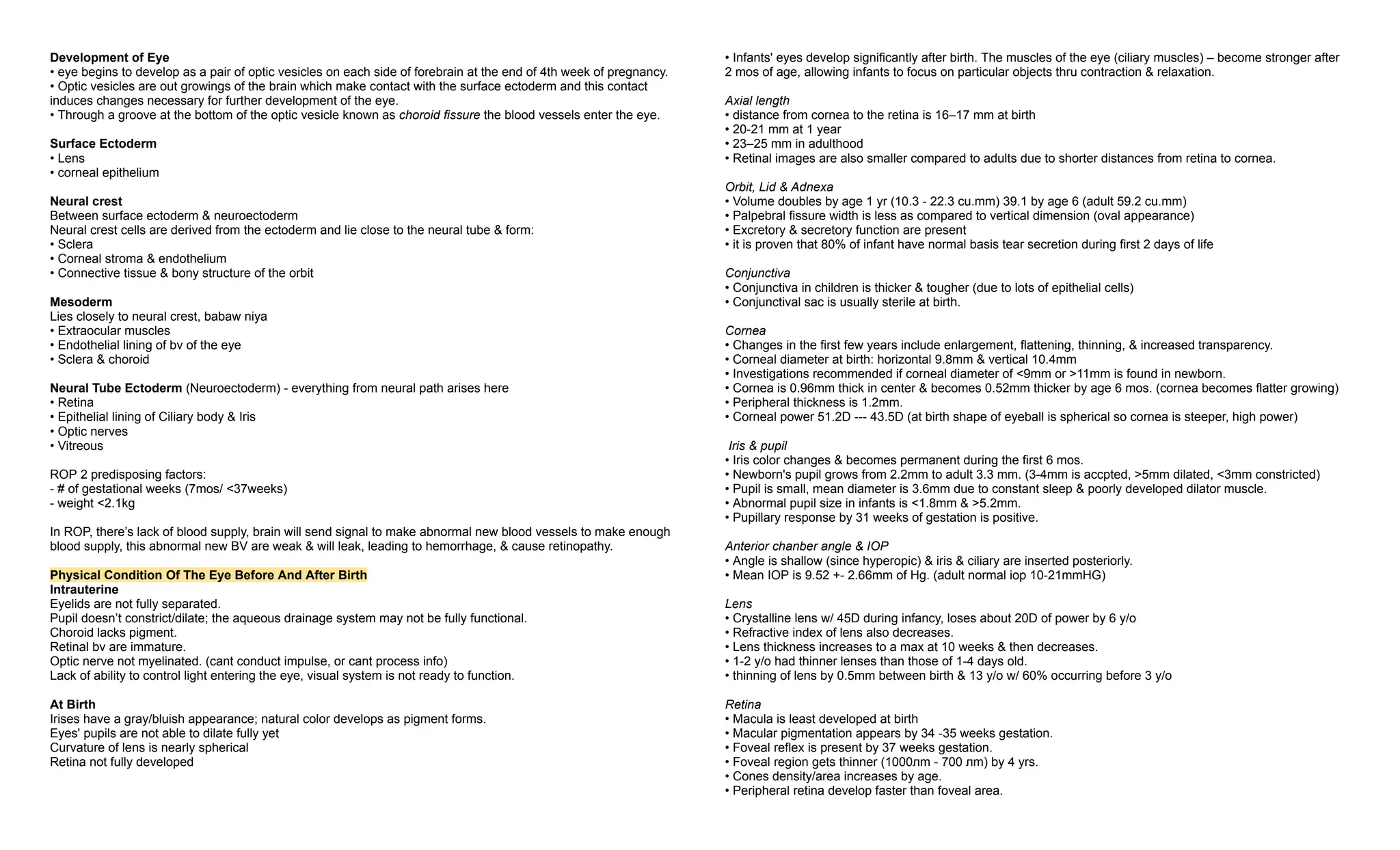
• eye begins to develop as a pair of optic vesicles on each side of forebrain at the end of 4th week of pregnancy.
• Optic vesicles are out growings of the brain which make contact with the surface ectoderm and this contact
induces changes necessary for further development of the eye.
• Through a groove at the bottom of the optic vesicle known as choroid fissure the blood vessels enter the eye.
Surface Ectoderm
• Lens
• corneal epithelium
Neural crest
Between surface ectoderm & neuroectoderm
Neural crest cells are derived from the ectoderm and lie close to the neural tube & form:
• Sclera
• Corneal stroma & endothelium
• Connective tissue & bony structure of the orbit
Mesoderm
Lies closely to neural crest, babaw niya
• Extraocular muscles
• Endothelial lining of bv of the eye
• Sclera & choroid
Neural Tube Ectoderm (Neuroectoderm) - everything from neural path arises here
• Retina
• Epithelial lining of Ciliary body & Iris
• Optic nerves
• Vitreous
ROP 2 predisposing factors:
- # of gestational weeks (7mos/ <37weeks)
- weight <2.1kg
In ROP, there’s lack of blood supply, brain will send signal to make abnormal new blood vessels to make enough
blood supply, this abnormal new BV are weak & will leak, leading to hemorrhage, & cause retinopathy.
Physical Condition Of The Eye Before And After Birth
Intrauterine
Eyelids are not fully separated.
Pupil doesn’t constrict/dilate; the aqueous drainage system may not be fully functional.
Choroid lacks pigment.
Retinal bv are immature.
Optic nerve not myelinated. (cant conduct impulse, or cant process info)
Lack of ability to control light entering the eye, visual system is not ready to function.
At Birth
Irises have a gray/bluish appearance; natural color develops as pigment forms.
Eyes' pupils are not able to dilate fully yet
Curvature of lens is nearly spherical
Retina not fully developed
• Infants' eyes develop significantly after birth. The muscles of the eye (ciliary muscles) – become stronger after
2 mos of age, allowing infants to focus on particular objects thru contraction & relaxation.
Axial length
• distance from cornea to the retina is 16–17 mm at birth
• 20-21 mm at 1 year
• 23–25 mm in adulthood
• Retinal images are also smaller compared to adults due to shorter distances from retina to cornea.
Orbit, Lid & Adnexa
• Volume doubles by age 1 yr (10.3 - 22.3 cu.mm) 39.1 by age 6 (adult 59.2 cu.mm)
• Palpebral fissure width is less as compared to vertical dimension (oval appearance)
• Excretory & secretory function are present
• it is proven that 80% of infant have normal basis tear secretion during first 2 days of life
Conjunctiva
• Conjunctiva in children is thicker & tougher (due to lots of epithelial cells)
• Conjunctival sac is usually sterile at birth.
Cornea
• Changes in the first few years include enlargement, flattening, thinning, & increased transparency.
• Corneal diameter at birth: horizontal 9.8mm & vertical 10.4mm
• Investigations recommended if corneal diameter of <9mm or >11mm is found in newborn.
• Cornea is 0.96mm thick in center & becomes 0.52mm thicker by age 6 mos. (cornea becomes flatter growing)
• Peripheral thickness is 1.2mm.
• Corneal power 51.2D --- 43.5D (at birth shape of eyeball is spherical so cornea is steeper, high power)
Iris & pupil
• Iris color changes & becomes permanent during the first 6 mos.
• Newborn's pupil grows from 2.2mm to adult 3.3 mm. (3-4mm is accpted, >5mm dilated, <3mm constricted)
• Pupil is small, mean diameter is 3.6mm due to constant sleep & poorly developed dilator muscle.
• Abnormal pupil size in infants is <1.8mm & >5.2mm.
• Pupillary response by 31 weeks of gestation is positive.
Anterior chanber angle & IOP
• Angle is shallow (since hyperopic) & iris & ciliary are inserted posteriorly.
• Mean IOP is 9.52 +- 2.66mm of Hg. (adult normal iop 10-21mmHG)
Lens
• Crystalline lens w/ 45D during infancy, loses about 20D of power by 6 y/o
• Refractive index of lens also decreases.
• Lens thickness increases to a max at 10 weeks & then decreases.
• 1-2 y/o had thinner lenses than those of 1-4 days old.
• thinning of lens by 0.5mm between birth & 13 y/o w/ 60% occurring before 3 y/o
Retina
• Macula is least developed at birth
• Macular pigmentation appears by 34 -35 weeks gestation.
• Foveal reflex is present by 37 weeks gestation.
• Foveal region gets thinner (1000лm - 700 лm) by 4 yrs.
• Cones density/area increases by age.
• Peripheral retina develop faster than foveal area.
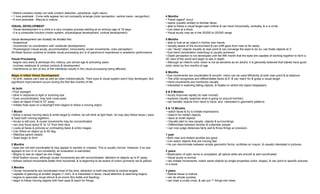
• Retina contains mostly rod cells (motion detection, peripheral, night vision)
• 1 mos postnatal - Cone cells appear but not compactly arrange (color perception, central vision, recognition)
• 8 mos postnatal - Macula is mature
VISUAL DEVELOPMENT
- Visual development in a child is a very complex process starting at an embryo age of 18 days.
- It is a composite function (motor system, physiological development, cortical development)
Visual development can broadly be divided into:
- Anatomical
- Oculomotor (in coordination with vestibular development)
- Physiological (visual acuity, accommodation, binocularity, ocular movements, color perception)
All these factors combine to enable visual processing w/c is of paramount importance in academic performance.
Visual Processing
- begins very early & develops thru infancy, pre school age & schooling years
- involves vestibular & cortical controls & development
- Interference w/ dev of any of the interfaces results in the visual processing being affected.
Steps in Infant Vision Development
• At birth, babies can't see as well as older children/adults. Their eyes & visual system aren't fully developed. But
significant improvement occurs during the first few months of life.
At birth
• Poor eyesight
• blink in response to light or touching eye
• Eyes uncoordinated, may look cross-eyed
• stare at object if held 8-10” away
• Initially fixes eyes on a face/light then begins to follow a moving object
1 Month
• follow a slowly moving black & white target to midline; he will blink at light flash, he may also follow faces ( eyes
& head both moving together).
• Acuity is still poor, & ocular movements may be uncoordinated.
• can only focus about 8” to 12” from their face
• Looks at faces & pictures w/ contrasting black & white images
• Can follow an object up to 90 deg
• Watches parent closely
• Tears begin to form
2 Months
• eyes are not well coordinated & may appear to wander or crossed. This is usually normal. However, if an eye
appears to turn in or out constantly, an evaluation is warranted.
• Begins to see an object as one image
• Brief fixation occurs, although ocular movements are still uncoordinated. attention to objects up to 6″ away.
• follows vertical movements better than horizontal, & is beginning to be aware of colors (primarily red & yellow)
3 Months
• Ocular movements are coordinated most of the time; attraction to both blac/white & colored targets.
• capable of glancing at smaller targets (1 inch), & is interested in faces; visual attention & searching begins.
• begins to associate visual stimuli & an event (the bottle and feeding).
• begin to follow moving objects with their eyes & reach for things
4 Months
• "Hand regard" occur
• reacts (usually smiles) to familiar faces.
• able to follow a visual target past midline & can track horizontally, vertically, & in a circle
• Can stare at a block
• Visual acuity may be in the 20/200 to 20/300 range.
5 Months
• able to look at an object in his/her own hands.
• visually aware of the environment & can shift gaze from near to far easily
• can "study" objects visually at near point & can converge the eyes to do so; can fixate objects at 3”
• Eye-hand coordination (reaching) is usually achieved
• Depth perception is not developed until the fifth month that the eyes are capable of working together to form a
3D view of the world and begin to see in depth.
• Although an infant's color vision is not as sensitive as an adult's, it is generally believed that babies have good
color vision by five months of age.
6 Months
• Eye movements are coordinated & smooth; vision can be used efficiently at both near point & at distance.
• The child recognizes and differentiates faces at 6” & can reach for & grasp a visual target.
• Hand movements are monitored visually
• interested in watching falling objects, & fixates on where the object disappears.
6 & 9 Months
• Acuity improves rapidly (to near normal).
• explores visually (watches what is going on around him/her).
• can transfer objects from hand to hand, and interested in geometric patterns.
9 & 12 Months
• watch faces & try to imitate expressions.
• Search for hidden objects
• stare at small objects
• Visually alert to new people, objects & surroundings
• Differentiate between familiar & unfamiliar people
• can now judge distances fairly well & throw things w/ precision.
1 year
• Both near and distant acuities are good.
• Can watch objects that are moving fast
• He can discriminate between simple geometric forms, scribbles w/ crayon, & visually interested in pictures.
2 years
• Myelination of optic nerve is completed; all optical skills are smooth & well coordinated.
• Visual acuity is normal.
• can imitate movements, match same objects by single properties (color, shape), & can point to specific pictures
in a book.
3 years
• Retinal tissue is mature.
• can do simple puzzles,
• can draw a crude circle, & can put 1" things into holes
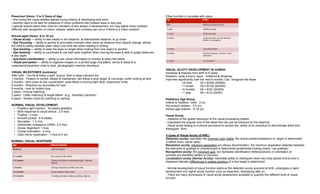
Preschool Vision: 3 to 5 Years of Age
• fine-tuning the visual abilities gained during infancy & developing new ones.
• parents need to be alert for presence of vision problems like crossed eyes or lazy eye.
• parents should watch their child for indication of any delays in development, w/c may signal vision problem.
Difficulty with recognition of colors, shapes, letters and numbers can occur if there is a vision problem.
School-aged Vision: 6 to 18 y/o
• Visual acuity — ability to see clearly in the distance, at intermediate distance, & up close
• Eye Focusing — ability to quickly & accurately maintain clear vision as distance from objects change. allows
the child to easily maintain clear vision over time like when reading or writing.
• Eye tracking — ability to keep the eyes on target when looking from one object to another
• Eye teaming — ability to coordinate & use both eyes together when moving the eyes & able to judge distances
& see depth
• Eye-hand coordination — ability to use visual information to monitor & direct the hands
• Visual perception — ability to organize images on a printed page into letters, words & ideas & to
understand/remember what is read. (photographic memory develops)
VISUAL MILESTONES (summary)
After birth - Can fix & follow a light source, face or large colourful toy
1 months - Fixation is central, steady & maintained, can follow a slow target, & converge, prefer looking at face
3 months - bino vision & eye coordination, eyes follow a moving light/ face, responsive smile.
6 months - Reaches out accurately for toys.
9 months - look for hidden toys.
2 years - Picture matching
3 years - Letter matching of single letters (e.g., Sheridan Gardiner)
5 years - Snellen chart by matching or naming
NORMAL VISUAL DEVELOPMENT
• Pupillary light reaction : 30 weeks gestation
• Blink response to visual stimuli : 2-5 mos
• Fixation - 2 mos
• Smooth pursuit : 6-8 weeks
• Saccades : 1-3 mos
• Optokinetic nystagmus (OKN): 2-4 mos
• Ocular Alignment: 1 mos
• Foveal maturation : 4 mos
• Optic nerve myelination : 7 mos to 2 yrs
NORMAL VISUAL RESPONSE
Other function in correlate with vision
VISUAL ACUITY DEVELOPMENT IN HUMAN
Develops & matures from birth to 6 years
Newborn: quite a blurry vision : Indistinct & Shadowy
Improves significantly over the next 6 months: Can recognize the faces
• At birth VA = 6/240 (20/800)
• 1 month VA = 6/120 (20/400)
• 6 months VA = 6/30 (20/200)
• 1 year VA = 6/15 (20/50)
Pediatrics Age Group
Infants & Toddlers - birth - 2 y/o
Pre-school children - 3-5 y/o
School age children - 6-18 y/o
Visual Acuity
- measure of the spatial resolution of the visual processing system
- Expresses the angular size of the detail that can just be resolved by the observer
- Visual acuity testing is a clinical procedure to access the ability of an individual to discriminate detail and
distinguish form.
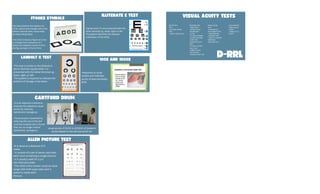
4 types of Visual Acuity (D-RRL)
Detection acuity: estimates the minimum size visible. the actual presence/absence of target is determined
(Catford drum, stycar balls)
Resolution acuity: minimum separation w/c allows discrimination. the minimum separation detected between
the elements of gratings or checkerboard is determined (preferential looking charts, Lea gratings)
Recognition acuity: the minimum size, w/c facilitates identification (letters/pictures or orientation of
symbols are identified (letters or pictures)
Localization acuity (Vernier Acuity): estimates ability to distinguish when two lines placed end-to-end is
displaced laterally (differences in spatial position) of a test target is determined
- Normal development of visual function starts w/ the detection acuity acquired at birth, undergoes a rapid
development into higher acuity function such as resolution, developing later on.
- There are many techniques of visual acuity assessment available to quantify the different level of visual
function
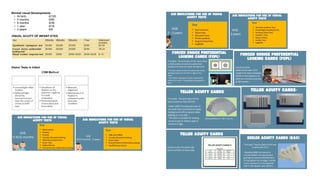
Normal visual Developments
• At birth 6/120
• 4 months 6/60
• 6 months 6/36
• 1 year 6/18
• 2 years 6/6
VISUAL ACUITY OF INFANT EYES
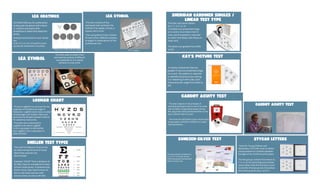
Vision Tests in Infant
PEDIATRICs.   eye growth and development

PEDIATRICs. eye growth and development

  • 1.
    Development of Eye •eye begins to develop as a pair of optic vesicles on each side of forebrain at the end of 4th week of pregnancy. • Optic vesicles are out growings of the brain which make contact with the surface ectoderm and this contact induces changes necessary for further development of the eye. • Through a groove at the bottom of the optic vesicle known as choroid fissure the blood vessels enter the eye. Surface Ectoderm • Lens • corneal epithelium Neural crest Between surface ectoderm & neuroectoderm Neural crest cells are derived from the ectoderm and lie close to the neural tube & form: • Sclera • Corneal stroma & endothelium • Connective tissue & bony structure of the orbit Mesoderm Lies closely to neural crest, babaw niya • Extraocular muscles • Endothelial lining of bv of the eye • Sclera & choroid Neural Tube Ectoderm (Neuroectoderm) - everything from neural path arises here • Retina • Epithelial lining of Ciliary body & Iris • Optic nerves • Vitreous ROP 2 predisposing factors: - # of gestational weeks (7mos/ <37weeks) - weight <2.1kg In ROP, there’s lack of blood supply, brain will send signal to make abnormal new blood vessels to make enough blood supply, this abnormal new BV are weak & will leak, leading to hemorrhage, & cause retinopathy. Physical Condition Of The Eye Before And After Birth Intrauterine Eyelids are not fully separated. Pupil doesn’t constrict/dilate; the aqueous drainage system may not be fully functional. Choroid lacks pigment. Retinal bv are immature. Optic nerve not myelinated. (cant conduct impulse, or cant process info) Lack of ability to control light entering the eye, visual system is not ready to function. At Birth Irises have a gray/bluish appearance; natural color develops as pigment forms. Eyes' pupils are not able to dilate fully yet Curvature of lens is nearly spherical Retina not fully developed • Infants' eyes develop significantly after birth. The muscles of the eye (ciliary muscles) – become stronger after 2 mos of age, allowing infants to focus on particular objects thru contraction & relaxation. Axial length • distance from cornea to the retina is 16–17 mm at birth • 20-21 mm at 1 year • 23–25 mm in adulthood • Retinal images are also smaller compared to adults due to shorter distances from retina to cornea. Orbit, Lid & Adnexa • Volume doubles by age 1 yr (10.3 - 22.3 cu.mm) 39.1 by age 6 (adult 59.2 cu.mm) • Palpebral fissure width is less as compared to vertical dimension (oval appearance) • Excretory & secretory function are present • it is proven that 80% of infant have normal basis tear secretion during first 2 days of life Conjunctiva • Conjunctiva in children is thicker & tougher (due to lots of epithelial cells) • Conjunctival sac is usually sterile at birth. Cornea • Changes in the first few years include enlargement, flattening, thinning, & increased transparency. • Corneal diameter at birth: horizontal 9.8mm & vertical 10.4mm • Investigations recommended if corneal diameter of <9mm or >11mm is found in newborn. • Cornea is 0.96mm thick in center & becomes 0.52mm thicker by age 6 mos. (cornea becomes flatter growing) • Peripheral thickness is 1.2mm. • Corneal power 51.2D --- 43.5D (at birth shape of eyeball is spherical so cornea is steeper, high power) Iris & pupil • Iris color changes & becomes permanent during the first 6 mos. • Newborn's pupil grows from 2.2mm to adult 3.3 mm. (3-4mm is accpted, >5mm dilated, <3mm constricted) • Pupil is small, mean diameter is 3.6mm due to constant sleep & poorly developed dilator muscle. • Abnormal pupil size in infants is <1.8mm & >5.2mm. • Pupillary response by 31 weeks of gestation is positive. Anterior chanber angle & IOP • Angle is shallow (since hyperopic) & iris & ciliary are inserted posteriorly. • Mean IOP is 9.52 +- 2.66mm of Hg. (adult normal iop 10-21mmHG) Lens • Crystalline lens w/ 45D during infancy, loses about 20D of power by 6 y/o • Refractive index of lens also decreases. • Lens thickness increases to a max at 10 weeks & then decreases. • 1-2 y/o had thinner lenses than those of 1-4 days old. • thinning of lens by 0.5mm between birth & 13 y/o w/ 60% occurring before 3 y/o Retina • Macula is least developed at birth • Macular pigmentation appears by 34 -35 weeks gestation. • Foveal reflex is present by 37 weeks gestation. • Foveal region gets thinner (1000лm - 700 лm) by 4 yrs. • Cones density/area increases by age. • Peripheral retina develop faster than foveal area.
  • 2.
    • Retina containsmostly rod cells (motion detection, peripheral, night vision) • 1 mos postnatal - Cone cells appear but not compactly arrange (color perception, central vision, recognition) • 8 mos postnatal - Macula is mature VISUAL DEVELOPMENT - Visual development in a child is a very complex process starting at an embryo age of 18 days. - It is a composite function (motor system, physiological development, cortical development) Visual development can broadly be divided into: - Anatomical - Oculomotor (in coordination with vestibular development) - Physiological (visual acuity, accommodation, binocularity, ocular movements, color perception) All these factors combine to enable visual processing w/c is of paramount importance in academic performance. Visual Processing - begins very early & develops thru infancy, pre school age & schooling years - involves vestibular & cortical controls & development - Interference w/ dev of any of the interfaces results in the visual processing being affected. Steps in Infant Vision Development • At birth, babies can't see as well as older children/adults. Their eyes & visual system aren't fully developed. But significant improvement occurs during the first few months of life. At birth • Poor eyesight • blink in response to light or touching eye • Eyes uncoordinated, may look cross-eyed • stare at object if held 8-10” away • Initially fixes eyes on a face/light then begins to follow a moving object 1 Month • follow a slowly moving black & white target to midline; he will blink at light flash, he may also follow faces ( eyes & head both moving together). • Acuity is still poor, & ocular movements may be uncoordinated. • can only focus about 8” to 12” from their face • Looks at faces & pictures w/ contrasting black & white images • Can follow an object up to 90 deg • Watches parent closely • Tears begin to form 2 Months • eyes are not well coordinated & may appear to wander or crossed. This is usually normal. However, if an eye appears to turn in or out constantly, an evaluation is warranted. • Begins to see an object as one image • Brief fixation occurs, although ocular movements are still uncoordinated. attention to objects up to 6″ away. • follows vertical movements better than horizontal, & is beginning to be aware of colors (primarily red & yellow) 3 Months • Ocular movements are coordinated most of the time; attraction to both blac/white & colored targets. • capable of glancing at smaller targets (1 inch), & is interested in faces; visual attention & searching begins. • begins to associate visual stimuli & an event (the bottle and feeding). • begin to follow moving objects with their eyes & reach for things 4 Months • "Hand regard" occur • reacts (usually smiles) to familiar faces. • able to follow a visual target past midline & can track horizontally, vertically, & in a circle • Can stare at a block • Visual acuity may be in the 20/200 to 20/300 range. 5 Months • able to look at an object in his/her own hands. • visually aware of the environment & can shift gaze from near to far easily • can "study" objects visually at near point & can converge the eyes to do so; can fixate objects at 3” • Eye-hand coordination (reaching) is usually achieved • Depth perception is not developed until the fifth month that the eyes are capable of working together to form a 3D view of the world and begin to see in depth. • Although an infant's color vision is not as sensitive as an adult's, it is generally believed that babies have good color vision by five months of age. 6 Months • Eye movements are coordinated & smooth; vision can be used efficiently at both near point & at distance. • The child recognizes and differentiates faces at 6” & can reach for & grasp a visual target. • Hand movements are monitored visually • interested in watching falling objects, & fixates on where the object disappears. 6 & 9 Months • Acuity improves rapidly (to near normal). • explores visually (watches what is going on around him/her). • can transfer objects from hand to hand, and interested in geometric patterns. 9 & 12 Months • watch faces & try to imitate expressions. • Search for hidden objects • stare at small objects • Visually alert to new people, objects & surroundings • Differentiate between familiar & unfamiliar people • can now judge distances fairly well & throw things w/ precision. 1 year • Both near and distant acuities are good. • Can watch objects that are moving fast • He can discriminate between simple geometric forms, scribbles w/ crayon, & visually interested in pictures. 2 years • Myelination of optic nerve is completed; all optical skills are smooth & well coordinated. • Visual acuity is normal. • can imitate movements, match same objects by single properties (color, shape), & can point to specific pictures in a book. 3 years • Retinal tissue is mature. • can do simple puzzles, • can draw a crude circle, & can put 1" things into holes
  • 3.
    Preschool Vision: 3to 5 Years of Age • fine-tuning the visual abilities gained during infancy & developing new ones. • parents need to be alert for presence of vision problems like crossed eyes or lazy eye. • parents should watch their child for indication of any delays in development, w/c may signal vision problem. Difficulty with recognition of colors, shapes, letters and numbers can occur if there is a vision problem. School-aged Vision: 6 to 18 y/o • Visual acuity — ability to see clearly in the distance, at intermediate distance, & up close • Eye Focusing — ability to quickly & accurately maintain clear vision as distance from objects change. allows the child to easily maintain clear vision over time like when reading or writing. • Eye tracking — ability to keep the eyes on target when looking from one object to another • Eye teaming — ability to coordinate & use both eyes together when moving the eyes & able to judge distances & see depth • Eye-hand coordination — ability to use visual information to monitor & direct the hands • Visual perception — ability to organize images on a printed page into letters, words & ideas & to understand/remember what is read. (photographic memory develops) VISUAL MILESTONES (summary) After birth - Can fix & follow a light source, face or large colourful toy 1 months - Fixation is central, steady & maintained, can follow a slow target, & converge, prefer looking at face 3 months - bino vision & eye coordination, eyes follow a moving light/ face, responsive smile. 6 months - Reaches out accurately for toys. 9 months - look for hidden toys. 2 years - Picture matching 3 years - Letter matching of single letters (e.g., Sheridan Gardiner) 5 years - Snellen chart by matching or naming NORMAL VISUAL DEVELOPMENT • Pupillary light reaction : 30 weeks gestation • Blink response to visual stimuli : 2-5 mos • Fixation - 2 mos • Smooth pursuit : 6-8 weeks • Saccades : 1-3 mos • Optokinetic nystagmus (OKN): 2-4 mos • Ocular Alignment: 1 mos • Foveal maturation : 4 mos • Optic nerve myelination : 7 mos to 2 yrs NORMAL VISUAL RESPONSE Other function in correlate with vision VISUAL ACUITY DEVELOPMENT IN HUMAN Develops & matures from birth to 6 years Newborn: quite a blurry vision : Indistinct & Shadowy Improves significantly over the next 6 months: Can recognize the faces • At birth VA = 6/240 (20/800) • 1 month VA = 6/120 (20/400) • 6 months VA = 6/30 (20/200) • 1 year VA = 6/15 (20/50) Pediatrics Age Group Infants & Toddlers - birth - 2 y/o Pre-school children - 3-5 y/o School age children - 6-18 y/o Visual Acuity - measure of the spatial resolution of the visual processing system - Expresses the angular size of the detail that can just be resolved by the observer - Visual acuity testing is a clinical procedure to access the ability of an individual to discriminate detail and distinguish form. 4 types of Visual Acuity (D-RRL) Detection acuity: estimates the minimum size visible. the actual presence/absence of target is determined (Catford drum, stycar balls) Resolution acuity: minimum separation w/c allows discrimination. the minimum separation detected between the elements of gratings or checkerboard is determined (preferential looking charts, Lea gratings) Recognition acuity: the minimum size, w/c facilitates identification (letters/pictures or orientation of symbols are identified (letters or pictures) Localization acuity (Vernier Acuity): estimates ability to distinguish when two lines placed end-to-end is displaced laterally (differences in spatial position) of a test target is determined - Normal development of visual function starts w/ the detection acuity acquired at birth, undergoes a rapid development into higher acuity function such as resolution, developing later on. - There are many techniques of visual acuity assessment available to quantify the different level of visual function
  • 4.
    Normal visual Developments •At birth 6/120 • 4 months 6/60 • 6 months 6/36 • 1 year 6/18 • 2 years 6/6 VISUAL ACUITY OF INFANT EYES Vision Tests in Infant