Pearls to prescribing
Challenging Refraction
Indra P Sharma
Optometrist10/28/2016
Refractive Error
• Result of a mismatch between optics and the
growth of the eye
• Combination of genetic and environmental
influences
• NOT considered an eye disease
• Treatment includes spectacles, contact
lenses, and refractive surgery
10/28/2016
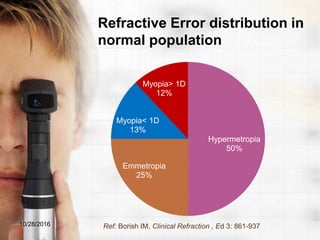
Hypermetropia
50%
Emmetropia
25%
Myopia< 1D
13%
Myopia> 1D
12%
Ref: Borish IM, Clinical Refraction , Ed 3: 861-937
Refractive Error distribution in
normal population
10/28/2016
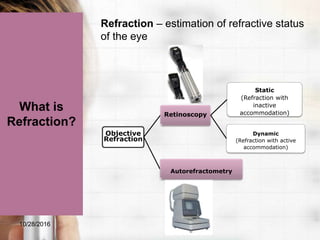
What is
Refraction?
10/28/2016
Objective
Refraction
Retinoscopy
Static
(Refraction with
inactive
accommodation)
Dynamic
(Refraction with active
accommodation)
Autorefractometry
Refraction – estimation of refractive status
of the eye
Objective refraction
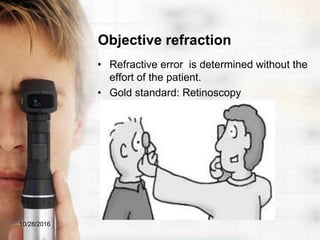
• Refractive error is determined without the
effort of the patient.
• Gold standard: Retinoscopy
10/28/2016
Retinoscopy –The name
• Commonly used synonyms for retinoscopy
are “skiascopy” and “skiametry”
• Other synonyms seen in literatures were
“umbrascopy”,“pupilloscopy” and
“retinoskiascopy”
• The term “retinoscopy” (vision of the retina)
was initiated by Parent in 1881.It has been
generally accepted in English-speaking
countries.
10/28/2016
Why is retinoscopy important?
• First technique that determines the patient’s
refractive status.
• Serves as a starting point for subjective
refraction.
• It can be performed on infants, mentally
infirm, low vision patients, uncooperative or
malingering patients.
• Heavily reliable for the prescription of optical
correction.10/28/2016
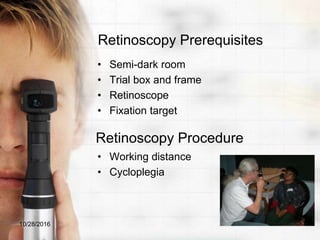
Retinoscopy Prerequisites
• Semi-dark room
• Trial box and frame
• Retinoscope
• Fixation target
• Working distance
• Cycloplegia
10/28/2016
Retinoscopy Procedure
10/28/2016
Troubleshooting
Difficulties during
retinoscopy
10/28/2016
Difficulties in retinoscopy
• Some refractions are easy; some are
extremely difficult
• It is an art that requires practice and can’t
be totally learnt from books
• Certain difficulties encountered during
retinoscopy.
10/28/2016
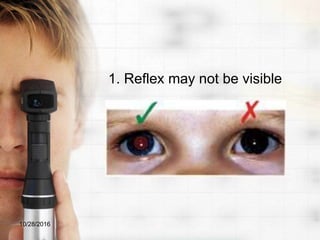
1. Reflex may not be visible
10/28/2016
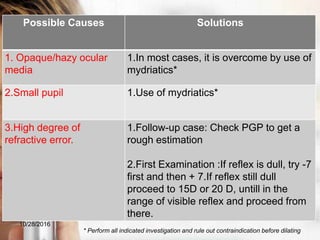
Possible Causes Solutions
1. Opaque/hazy ocular
media
1.In most cases, it is overcome by use of
mydriatics*
2.Small pupil 1.Use of mydriatics*
3.High degree of
refractive error.
1.Follow-up case: Check PGP to get a
rough estimation
2.First Examination :If reflex is dull, try -7
first and then + 7.If reflex still dull
proceed to 15D or 20 D, untill in the
range of visible reflex and proceed from
there.
* Perform all indicated investigation and rule out contraindication before dilating
10/28/2016
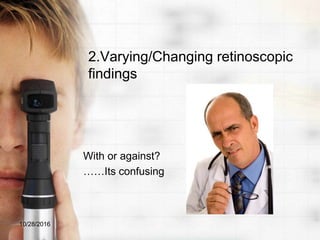
2.Varying/Changing retinoscopic
findings
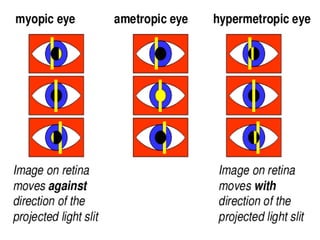
With or against?
……Its confusing
10/28/2016
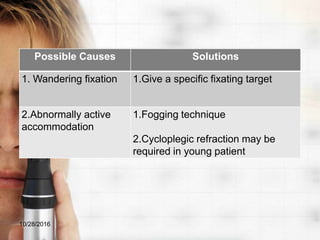
Possible Causes Solutions
1. Wandering fixation 1.Give a specific fixating target
2.Abnormally active
accommodation
1.Fogging technique
2.Cycloplegic refraction may be
required in young patient
10/28/2016
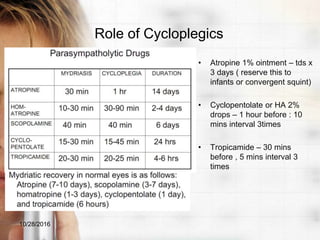
Role of Cycloplegics
• Atropine 1% ointment – tds x
3 days ( reserve this to
infants or convergent squint)
• Cyclopentolate or HA 2%
drops – 1 hour before : 10
mins interval 3times
• Tropicamide – 30 mins
before , 5 mins interval 3
times
10/28/2016
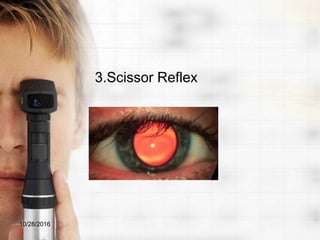
3.Scissor Reflex
10/28/2016
Possible Causes Solutions
1. High Astigmatism 1.Rotate the retinoscopic beam to find
angle where scissor reflex is minimum.
2.Nebular corneal
opacties
1.Increase retinoscopic illumination
to decrease pupil diameter.
2. Spot retinoscopy may help
10/28/2016
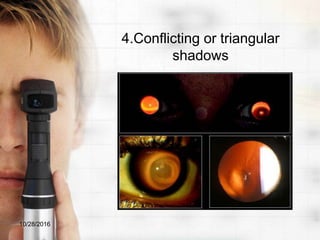
4.Conflicting or triangular
shadows
10/28/2016
Possible Causes Solutions
1.Irregular astigmatism 1.Do keratometry and subjective
refraction and prescribe minimum
power that gives maximum visual
acuity
2.Keratoconous 1. Relate refraction to visual acuity.
2. Perform corneal topography
3. Perform keratometry and
subjective refraction
10/28/2016
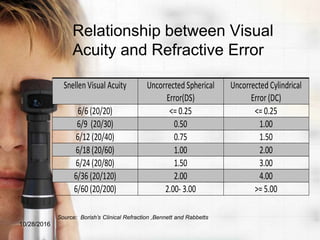
Relationship between Visual
Acuity and Refractive Error
Relationship between Visual acuity and refractive error
Snellen Visual Acuity Uncorrected Spherical
Error(DS)
Uncorrected Cylindrical
Error (DC)
6/6 (20/20) <= 0.25 <= 0.25
6/9 (20/30) 0.50 1.00
6/12 (20/40) 0.75 1.50
6/18 (20/60) 1.00 2.00
6/24 (20/80) 1.50 3.00
6/36 (20/120) 2.00 4.00
6/60 (20/200) 2.00- 3.00 >= 5.00
Source: Borish’s Clinical Refraction ,Bennett and Rabbetts
10/28/2016
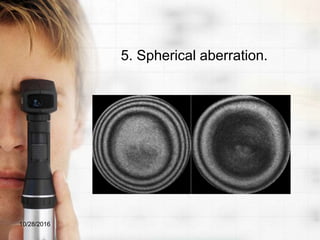
5. Spherical aberration.
10/28/2016
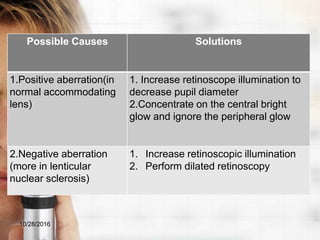
Possible Causes Solutions
1.Positive aberration(in
normal accommodating
lens)
1. Increase retinoscope illumination to
decrease pupil diameter
2.Concentrate on the central bright
glow and ignore the peripheral glow
2.Negative aberration
(more in lenticular
nuclear sclerosis)
1. Increase retinoscopic illumination
2. Perform dilated retinoscopy
10/28/2016
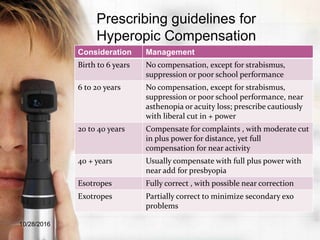
Prescribing guidelines for
Hyperopic Compensation
Consideration Management
Birth to 6 years No compensation, except for strabismus,
suppression or poor school performance
6 to 20 years No compensation, except for strabismus,
suppression or poor school performance, near
asthenopia or acuity loss; prescribe cautiously
with liberal cut in + power
20 to 40 years Compensate for complaints , with moderate cut
in plus power for distance, yet full
compensation for near activity
40 + years Usually compensate with full plus power with
near add for presbyopia
Esotropes Fully correct , with possible near correction
Exotropes Partially correct to minimize secondary exo
problems
10/28/2016
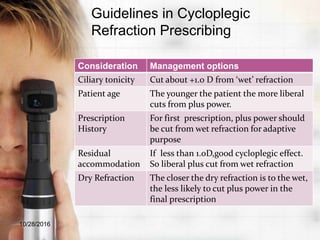
Consideration Management options
Ciliary tonicity Cut about +1.0 D from ‘wet’ refraction
Patient age The younger the patient the more liberal
cuts from plus power.
Prescription
History
For first prescription, plus power should
be cut from wet refraction for adaptive
purpose
Residual
accommodation
If less than 1.oD,good cycloplegic effect.
So liberal plus cut from wet refraction
Dry Refraction The closer the dry refraction is to the wet,
the less likely to cut plus power in the
final prescription
Guidelines in Cycloplegic
Refraction Prescribing
10/28/2016
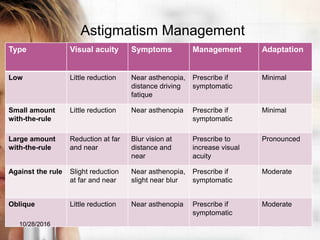
Astigmatism Management
Type Visual acuity Symptoms Management Adaptation
Low Little reduction Near asthenopia,
distance driving
fatique
Prescribe if
symptomatic
Minimal
Small amount
with-the-rule
Little reduction Near asthenopia Prescribe if
symptomatic
Minimal
Large amount
with-the-rule
Reduction at far
and near
Blur vision at
distance and
near
Prescribe to
increase visual
acuity
Pronounced
Against the rule Slight reduction
at far and near
Near asthenopia,
slight near blur
Prescribe if
symptomatic
Moderate
Oblique Little reduction Near asthenopia Prescribe if
symptomatic
Moderate
10/28/2016
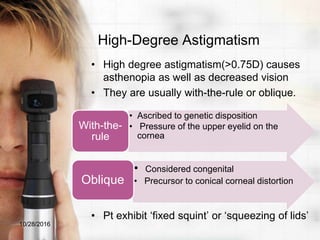
High-Degree Astigmatism
• High degree astigmatism(>0.75D) causes
asthenopia as well as decreased vision
• They are usually with-the-rule or oblique.
• Pt exhibit ‘fixed squint’ or ‘squeezing of lids’
• Ascribed to genetic disposition
• Pressure of the upper eyelid on the
cornea
With-the-
rule
• Considered congenital
• Precursor to conical corneal distortionOblique
10/28/2016
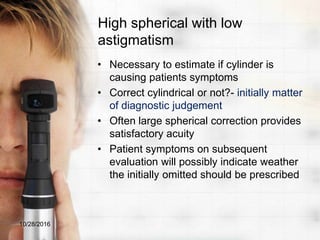
High spherical with low
astigmatism
• Necessary to estimate if cylinder is
causing patients symptoms
• Correct cylindrical or not?- initially matter
of diagnostic judgement
• Often large spherical correction provides
satisfactory acuity
• Patient symptoms on subsequent
evaluation will possibly indicate weather
the initially omitted should be prescribed
10/28/2016
General guidelines to glass
prescription
• Aim for 6/9 or better.
• If less than one line improvement in vision there is
no real benefit in prescribing new glasses.
• Convergence insufficiency/ exophoria
Low myopic full correction
Hypermetropia- Undercorrect
• Low hyperopes, especially the young-Do not
prescribe until symptomatic.
• Patient must always be counselled about the
intention of lens correction
10/28/2016
Points to Ponder
• Retinoscopy is a combination of art and
science.
• The importance of a good refraction can
never be undermined.
• There is NO SUSBTITUTE to retinoscopy.
10/28/2016
10/28/2016
indrapsharma@gmail.com
optomindra.blogspot.in
10/28/2016

Challenging Refraction

  • 1.
    Pearls to prescribing ChallengingRefraction Indra P Sharma Optometrist10/28/2016
  • 2.
    Refractive Error • Resultof a mismatch between optics and the growth of the eye • Combination of genetic and environmental influences • NOT considered an eye disease • Treatment includes spectacles, contact lenses, and refractive surgery 10/28/2016
  • 3.
    Hypermetropia 50% Emmetropia 25% Myopia< 1D 13% Myopia> 1D 12% Ref:Borish IM, Clinical Refraction , Ed 3: 861-937 Refractive Error distribution in normal population 10/28/2016
  • 4.
    What is Refraction? 10/28/2016 Objective Refraction Retinoscopy Static (Refraction with inactive accommodation) Dynamic (Refractionwith active accommodation) Autorefractometry Refraction – estimation of refractive status of the eye
  • 5.
    Objective refraction • Refractiveerror is determined without the effort of the patient. • Gold standard: Retinoscopy 10/28/2016
  • 6.
    Retinoscopy –The name •Commonly used synonyms for retinoscopy are “skiascopy” and “skiametry” • Other synonyms seen in literatures were “umbrascopy”,“pupilloscopy” and “retinoskiascopy” • The term “retinoscopy” (vision of the retina) was initiated by Parent in 1881.It has been generally accepted in English-speaking countries. 10/28/2016
  • 7.
    Why is retinoscopyimportant? • First technique that determines the patient’s refractive status. • Serves as a starting point for subjective refraction. • It can be performed on infants, mentally infirm, low vision patients, uncooperative or malingering patients. • Heavily reliable for the prescription of optical correction.10/28/2016
  • 8.
    Retinoscopy Prerequisites • Semi-darkroom • Trial box and frame • Retinoscope • Fixation target • Working distance • Cycloplegia 10/28/2016 Retinoscopy Procedure
  • 9.
  • 10.
  • 11.
    Difficulties in retinoscopy •Some refractions are easy; some are extremely difficult • It is an art that requires practice and can’t be totally learnt from books • Certain difficulties encountered during retinoscopy. 10/28/2016
  • 12.
    1. Reflex maynot be visible 10/28/2016
  • 13.
    Possible Causes Solutions 1.Opaque/hazy ocular media 1.In most cases, it is overcome by use of mydriatics* 2.Small pupil 1.Use of mydriatics* 3.High degree of refractive error. 1.Follow-up case: Check PGP to get a rough estimation 2.First Examination :If reflex is dull, try -7 first and then + 7.If reflex still dull proceed to 15D or 20 D, untill in the range of visible reflex and proceed from there. * Perform all indicated investigation and rule out contraindication before dilating 10/28/2016
  • 14.
    2.Varying/Changing retinoscopic findings With oragainst? ……Its confusing 10/28/2016
  • 15.
    Possible Causes Solutions 1.Wandering fixation 1.Give a specific fixating target 2.Abnormally active accommodation 1.Fogging technique 2.Cycloplegic refraction may be required in young patient 10/28/2016
  • 16.
    Role of Cycloplegics •Atropine 1% ointment – tds x 3 days ( reserve this to infants or convergent squint) • Cyclopentolate or HA 2% drops – 1 hour before : 10 mins interval 3times • Tropicamide – 30 mins before , 5 mins interval 3 times 10/28/2016
  • 17.
  • 18.
    Possible Causes Solutions 1.High Astigmatism 1.Rotate the retinoscopic beam to find angle where scissor reflex is minimum. 2.Nebular corneal opacties 1.Increase retinoscopic illumination to decrease pupil diameter. 2. Spot retinoscopy may help 10/28/2016
  • 19.
  • 20.
    Possible Causes Solutions 1.Irregularastigmatism 1.Do keratometry and subjective refraction and prescribe minimum power that gives maximum visual acuity 2.Keratoconous 1. Relate refraction to visual acuity. 2. Perform corneal topography 3. Perform keratometry and subjective refraction 10/28/2016
  • 21.
    Relationship between Visual Acuityand Refractive Error Relationship between Visual acuity and refractive error Snellen Visual Acuity Uncorrected Spherical Error(DS) Uncorrected Cylindrical Error (DC) 6/6 (20/20) <= 0.25 <= 0.25 6/9 (20/30) 0.50 1.00 6/12 (20/40) 0.75 1.50 6/18 (20/60) 1.00 2.00 6/24 (20/80) 1.50 3.00 6/36 (20/120) 2.00 4.00 6/60 (20/200) 2.00- 3.00 >= 5.00 Source: Borish’s Clinical Refraction ,Bennett and Rabbetts 10/28/2016
  • 22.
  • 23.
    Possible Causes Solutions 1.Positiveaberration(in normal accommodating lens) 1. Increase retinoscope illumination to decrease pupil diameter 2.Concentrate on the central bright glow and ignore the peripheral glow 2.Negative aberration (more in lenticular nuclear sclerosis) 1. Increase retinoscopic illumination 2. Perform dilated retinoscopy 10/28/2016
  • 24.
    Prescribing guidelines for HyperopicCompensation Consideration Management Birth to 6 years No compensation, except for strabismus, suppression or poor school performance 6 to 20 years No compensation, except for strabismus, suppression or poor school performance, near asthenopia or acuity loss; prescribe cautiously with liberal cut in + power 20 to 40 years Compensate for complaints , with moderate cut in plus power for distance, yet full compensation for near activity 40 + years Usually compensate with full plus power with near add for presbyopia Esotropes Fully correct , with possible near correction Exotropes Partially correct to minimize secondary exo problems 10/28/2016
  • 25.
    Consideration Management options Ciliarytonicity Cut about +1.0 D from ‘wet’ refraction Patient age The younger the patient the more liberal cuts from plus power. Prescription History For first prescription, plus power should be cut from wet refraction for adaptive purpose Residual accommodation If less than 1.oD,good cycloplegic effect. So liberal plus cut from wet refraction Dry Refraction The closer the dry refraction is to the wet, the less likely to cut plus power in the final prescription Guidelines in Cycloplegic Refraction Prescribing 10/28/2016
  • 26.
    Astigmatism Management Type Visualacuity Symptoms Management Adaptation Low Little reduction Near asthenopia, distance driving fatique Prescribe if symptomatic Minimal Small amount with-the-rule Little reduction Near asthenopia Prescribe if symptomatic Minimal Large amount with-the-rule Reduction at far and near Blur vision at distance and near Prescribe to increase visual acuity Pronounced Against the rule Slight reduction at far and near Near asthenopia, slight near blur Prescribe if symptomatic Moderate Oblique Little reduction Near asthenopia Prescribe if symptomatic Moderate 10/28/2016
  • 27.
    High-Degree Astigmatism • Highdegree astigmatism(>0.75D) causes asthenopia as well as decreased vision • They are usually with-the-rule or oblique. • Pt exhibit ‘fixed squint’ or ‘squeezing of lids’ • Ascribed to genetic disposition • Pressure of the upper eyelid on the cornea With-the- rule • Considered congenital • Precursor to conical corneal distortionOblique 10/28/2016
  • 28.
    High spherical withlow astigmatism • Necessary to estimate if cylinder is causing patients symptoms • Correct cylindrical or not?- initially matter of diagnostic judgement • Often large spherical correction provides satisfactory acuity • Patient symptoms on subsequent evaluation will possibly indicate weather the initially omitted should be prescribed 10/28/2016
  • 29.
    General guidelines toglass prescription • Aim for 6/9 or better. • If less than one line improvement in vision there is no real benefit in prescribing new glasses. • Convergence insufficiency/ exophoria Low myopic full correction Hypermetropia- Undercorrect • Low hyperopes, especially the young-Do not prescribe until symptomatic. • Patient must always be counselled about the intention of lens correction 10/28/2016
  • 30.
    Points to Ponder •Retinoscopy is a combination of art and science. • The importance of a good refraction can never be undermined. • There is NO SUSBTITUTE to retinoscopy. 10/28/2016
  • 31.
  • 32.