VISUAL ACUITY
ASSESSMENT
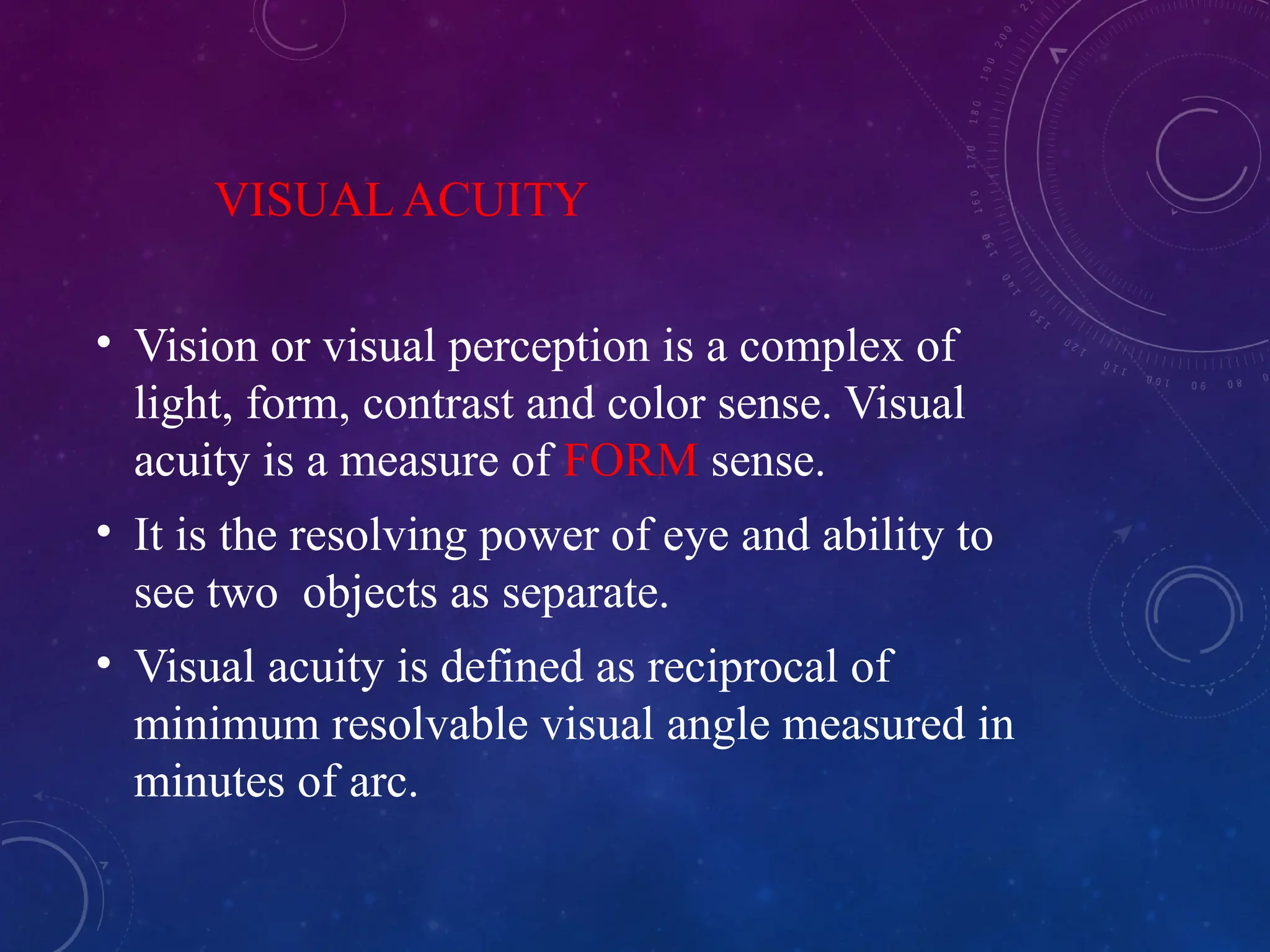
VISUAL ACUITY
• Vision or visual perception is a complex of
light, form, contrast and color sense. Visual
acuity is a measure of FORM sense.
• It is the resolving power of eye and ability to
see two objects as separate.
• Visual acuity is defined as reciprocal of
minimum resolvable visual angle measured in
minutes of arc.
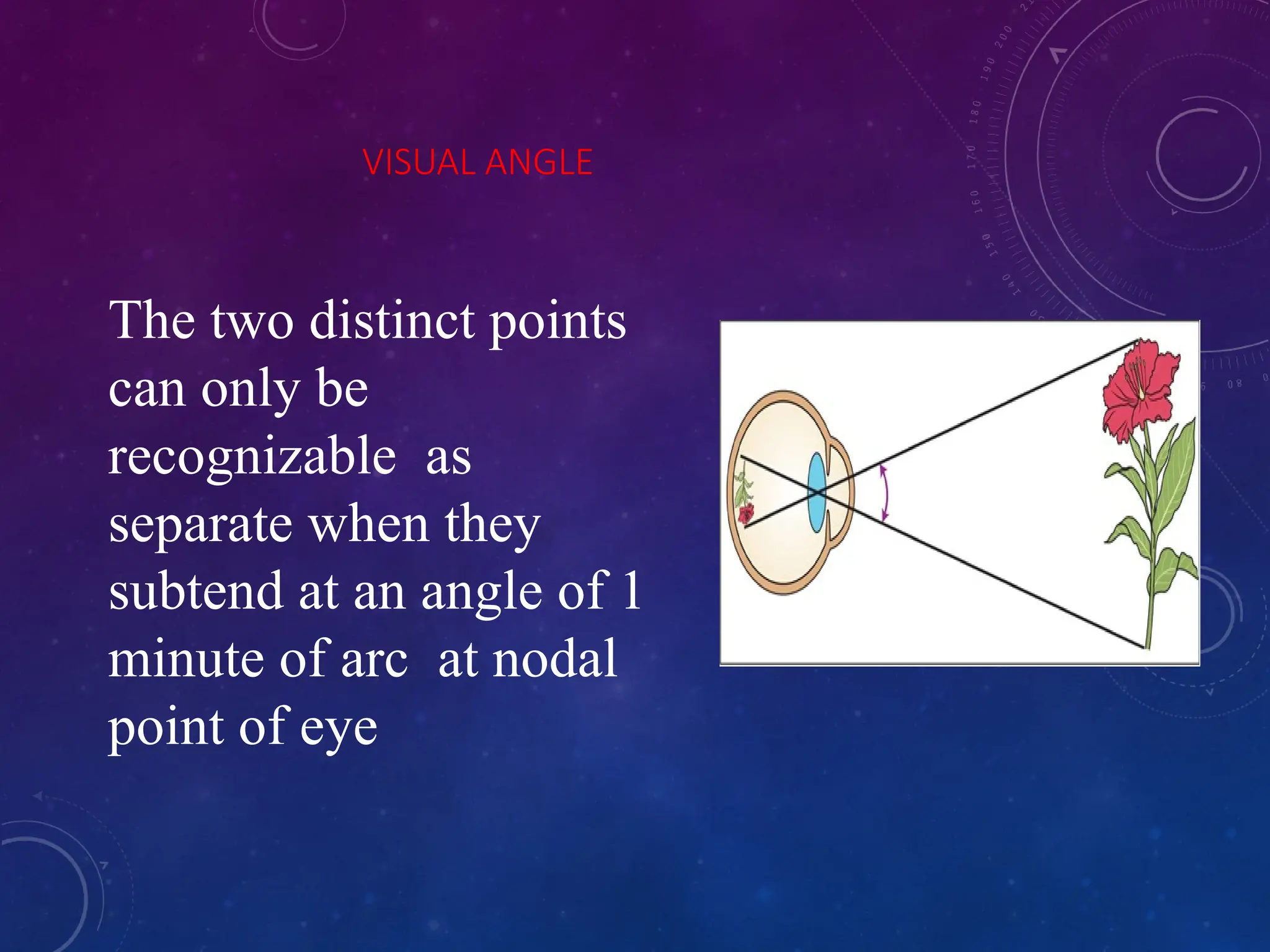
VISUAL ANGLE
The two distinct points
can only be
recognizable as
separate when they
subtend at an angle of 1
minute of arc at nodal
point of eye
COMPONENTS OF VISUAL ACUITY
• MINIMUM VISIBLE: ability to determine whether or
not an object is present in an otherwise empty visual
field. It depends on the stimulus such as size, shape,
illumination.
• RESOLUTION: (ordinary visual acuity)
• RECOGNITION: Involves cognitive components such
as recognition of faces.
• MINIMUM DESCRIMINABLE OR HYPER ACUITY
Spatial distinction by observer when threshold is
much lower than ordinary acuity.
VISUAL ACUITY TESTS
Detection acuity tests:
• Dot visual acuity test
• Catford drum test
• Boek candy bead test
• STYCAR graded balls test
• Schwarting metronome test.
Resolution acuity tests
-OKN test
-TAC test
-PLT test
Rcognition acuity
tests:
• Snellens chart test
• Landolts chart test
• Sjogrens hand test
• Arrows test
• Sheridans letter test
• Flooks symbol test
• Lipmans HOTV test
• Allen picture cards test
• Miniature toy test
• Cardiff acuity cards test
• OKN test
• VER test
MILESTONES IN DEVELOPMENT
OF VISION
NEW BORN PUPILLARY REACTION TO LIGHT
Blinking to light reflex
Conjugate horizontal gaze
6/360 – 6/120 (OKN)
1 WEEK Vestibulo ocular Reflex
2 WEEKS Small saccades develop
Follows HORIZONTAL moving objects
1 MONTH Fixation development,6/480-6/120
watch mothers face for prolonged time
2 MONTHS BIFOVEAL fixation ,large saccades
Pursuits and convergence movements
6/120-6/60
3 MONTHS Watches movements of own hands
RESPONSIVE SMILE
reaches out
ASSESSMENT OF VISUAL ACUITY
FROM BIRTH TO 3 MONTHS
1. BLINK REFLEX TEST: present since birth(after 30 wks of GA) When a
bright light is shown normal infant should respond by blinking.
2.PUPILLARY LIGHT REFLEX TEST: Most reliable test to determine
presence of vision except in cortical blindness.
• Indicates intact neurological pathways till superior colliculus,and efferent
pathways to iris sphincter.
• Present after 29 to 31 wks of GA.
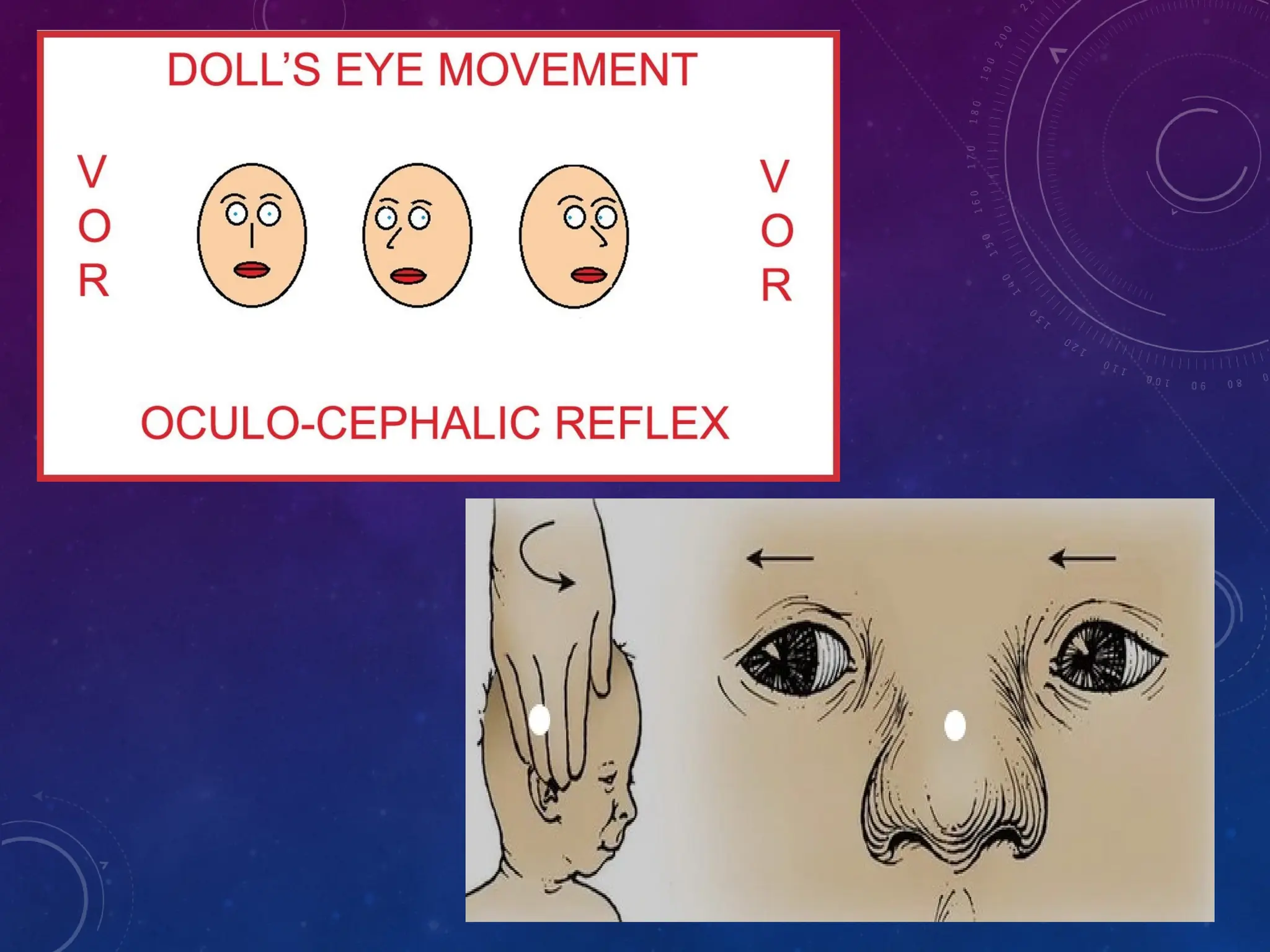
3.VESTIBULO OCULAR REFLEX : Tested by turning newborn head on
long axis observe eye deviation in opposite direction.
4.EYE POPPING TEST:
• room lights are suddenly dimmed - upper eye lids of baby pop open wide
for a moment.This is POSITIVE EYE POPPING
CONTINUATION…
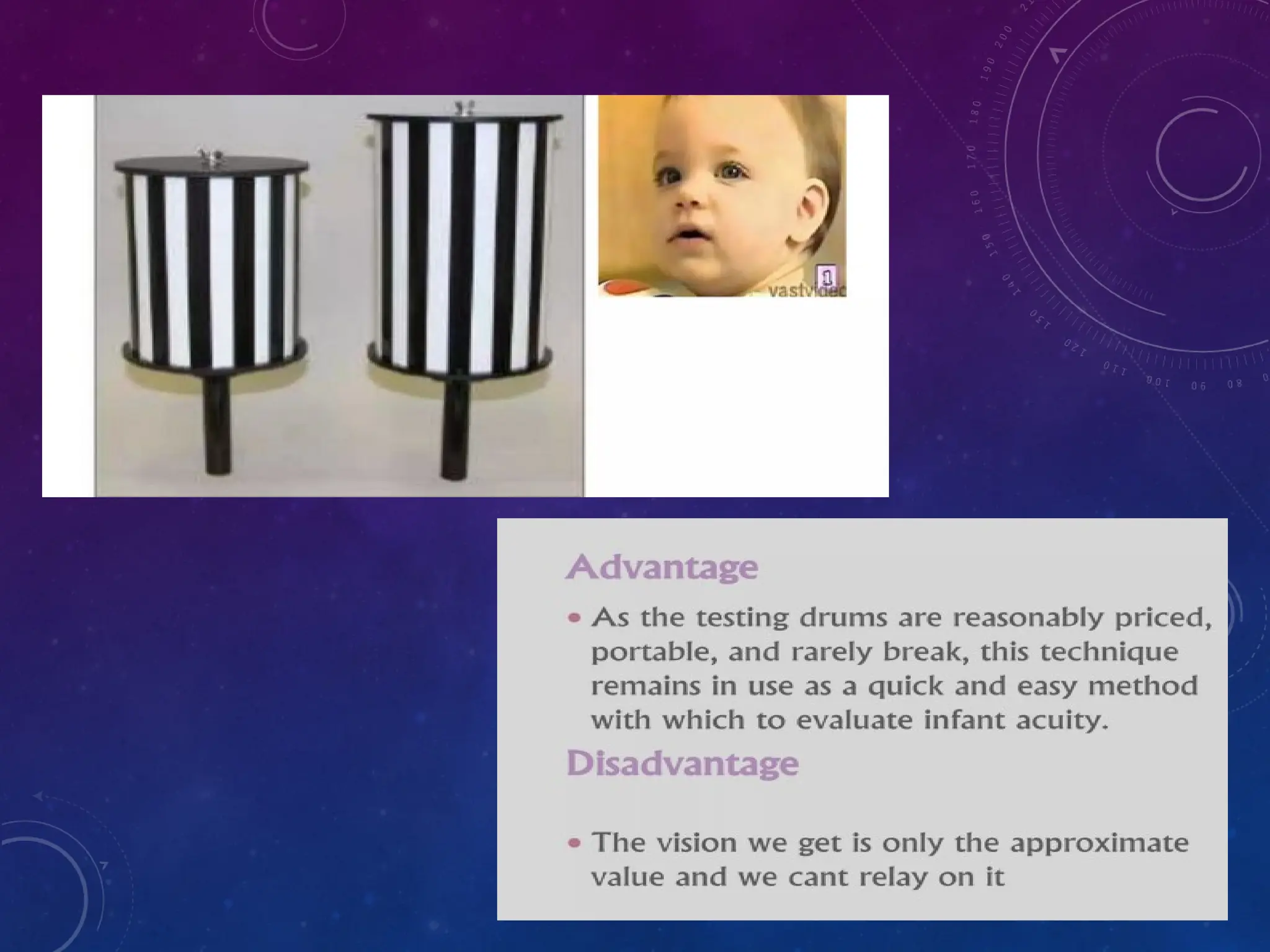
5. OKN TEST: (optokinetic nystagmus)
• Nystagmus is elicited by passing a succession of black and
white stripes through patients field of vision.
• OKN drum used of size 10*8 inches in diameter,rotated in
8 to 10 rpm.
• Slow movement in direction of drum lasting for 0.2 secs &
fast phase in reverse direction for 0.1 secs.
• OKN acuity is atleast 6/120 in newborns .
• Asymmetric in newborns ,becomes symmetric by 4 to 6
months of age
• Objective assessment of visual acuity in children, adults
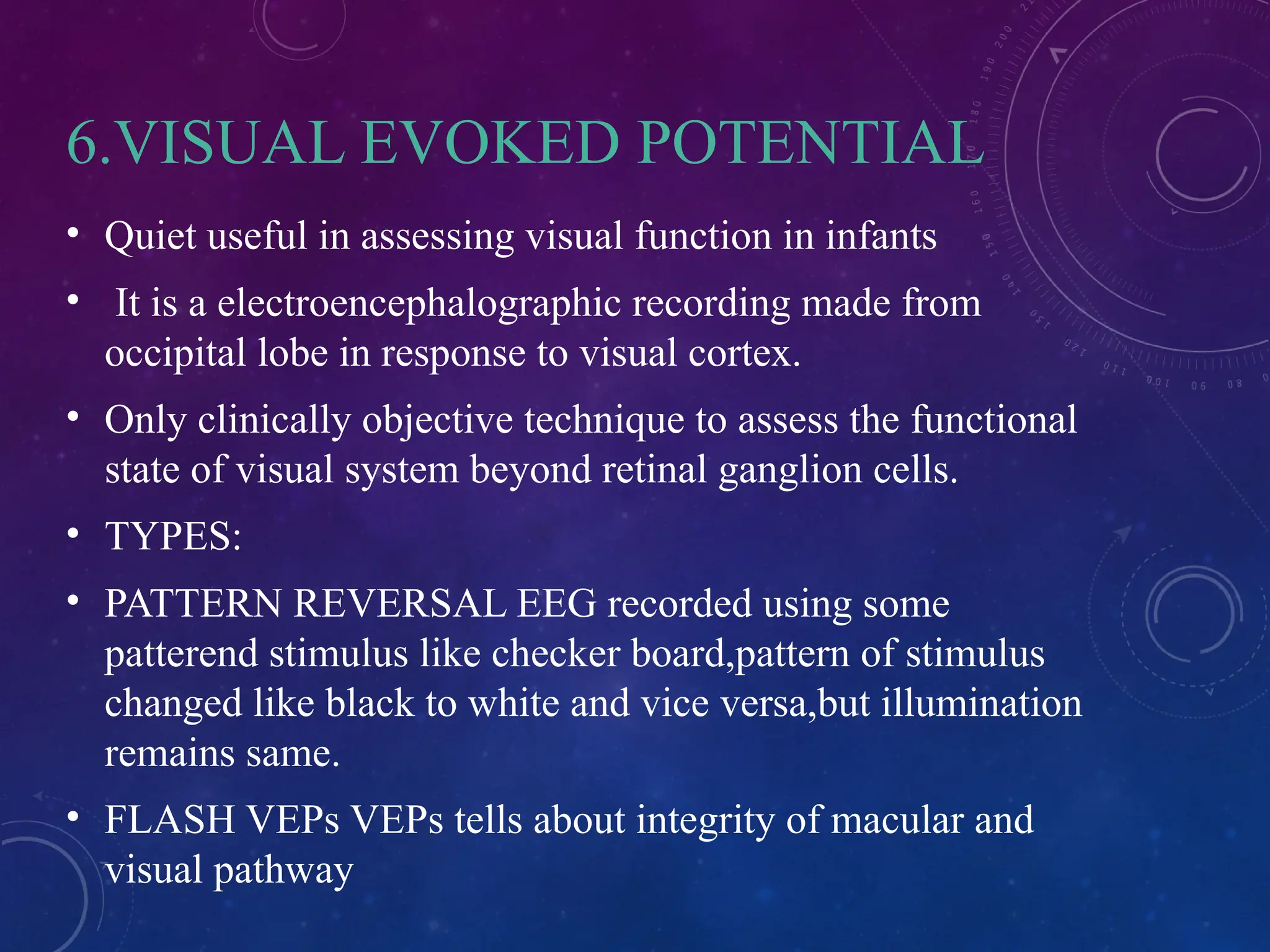
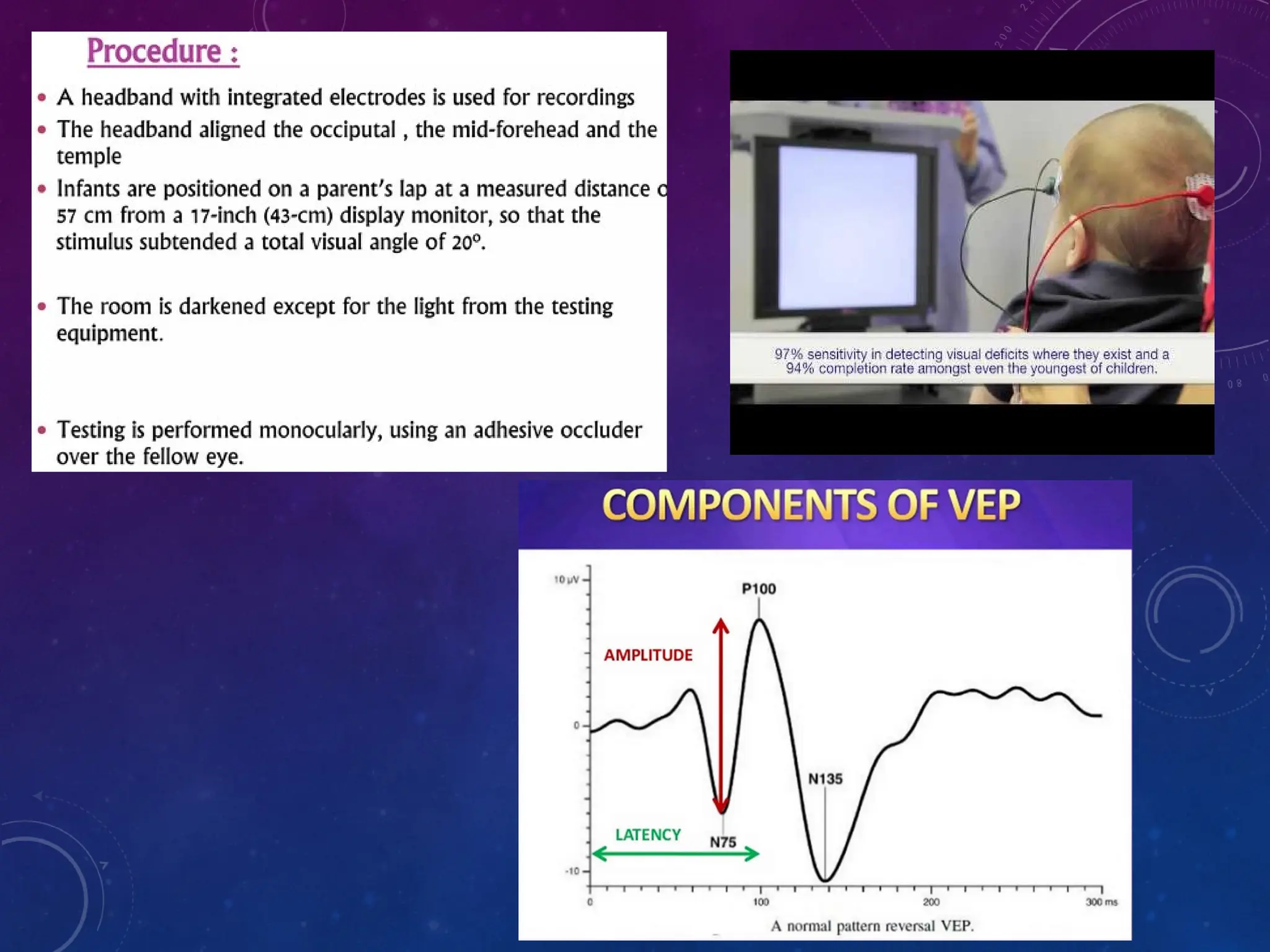
6.VISUAL EVOKED POTENTIAL
• Quiet useful in assessing visual function in infants
• It is a electroencephalographic recording made from
occipital lobe in response to visual cortex.
• Only clinically objective technique to assess the functional
state of visual system beyond retinal ganglion cells.
• TYPES:
• PATTERN REVERSAL EEG recorded using some
patterend stimulus like checker board,pattern of stimulus
changed like black to white and vice versa,but illumination
remains same.
• FLASH VEPs VEPs tells about integrity of macular and
visual pathway
ASSESSMENT OF VISUAL ACUITY
IN 3 TO 6 MONTHS
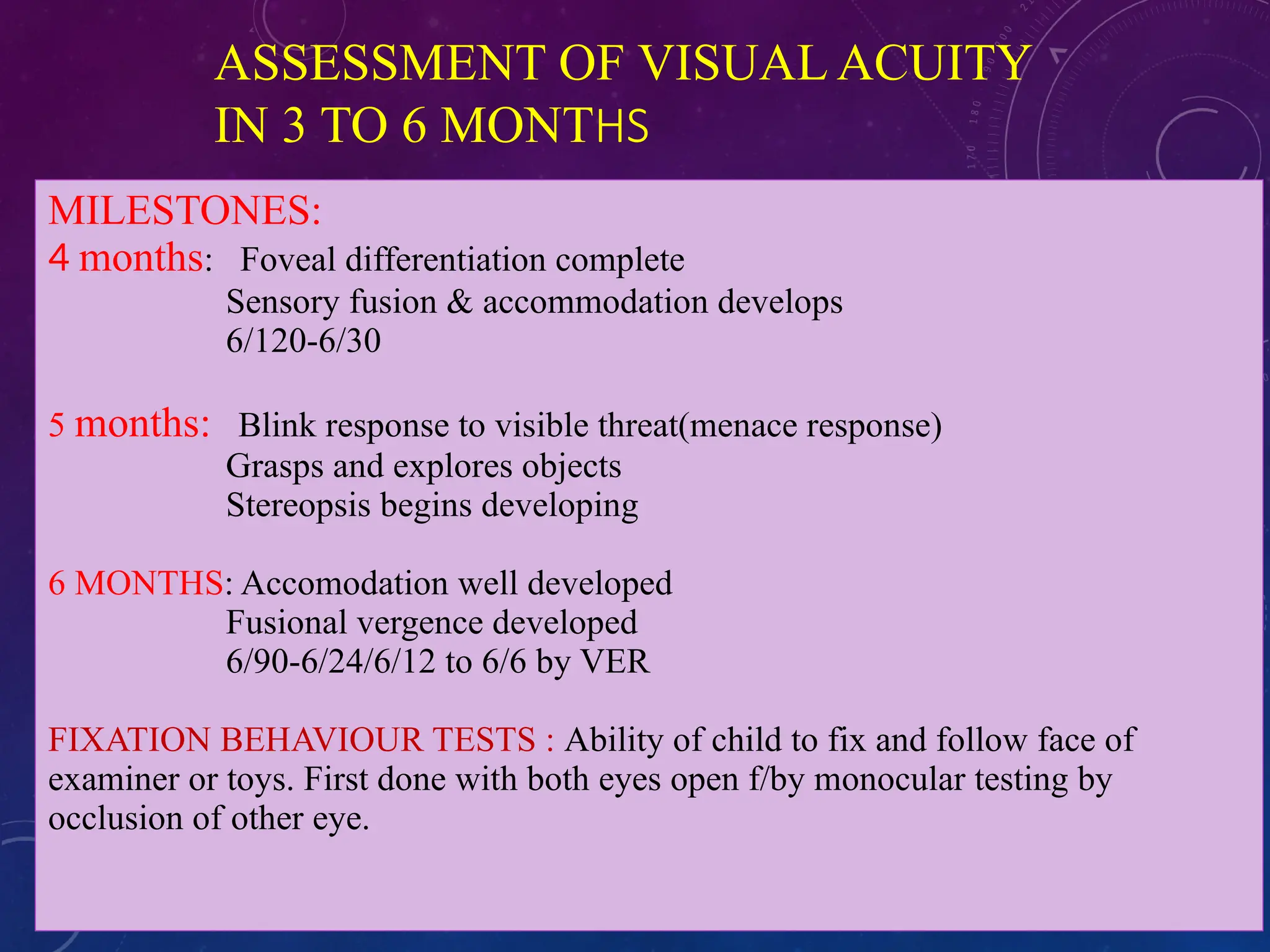
MILESTONES:
4 months: Foveal differentiation complete
Sensory fusion & accommodation develops
6/120-6/30
5 months: Blink response to visible threat(menace response)
Grasps and explores objects
Stereopsis begins developing
6 MONTHS: Accomodation well developed
Fusional vergence developed
6/90-6/24/6/12 to 6/6 by VER
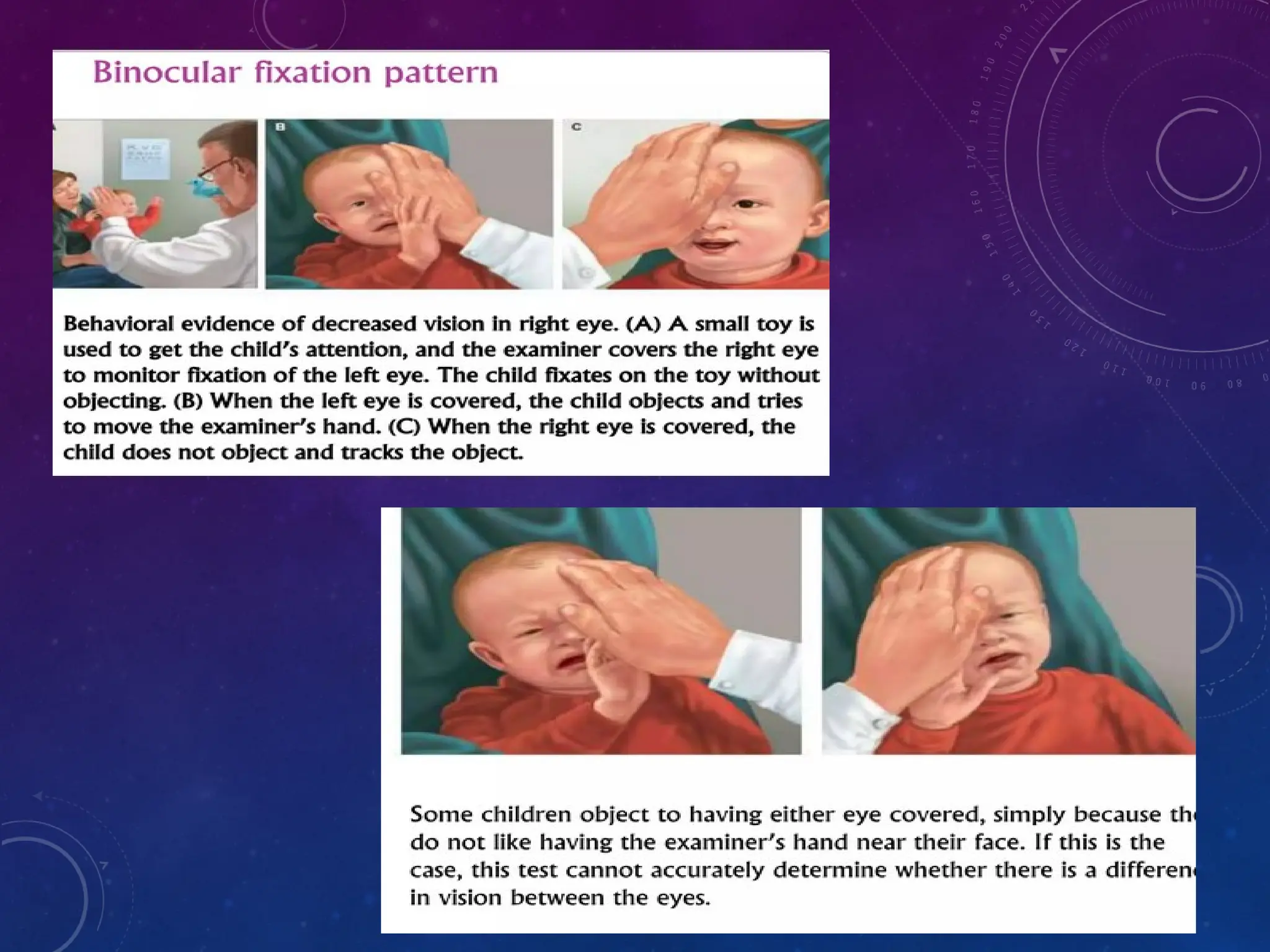
FIXATION BEHAVIOUR TESTS : Ability of child to fix and follow face of
examiner or toys. First done with both eyes open f/by monocular testing by
occlusion of other eye.
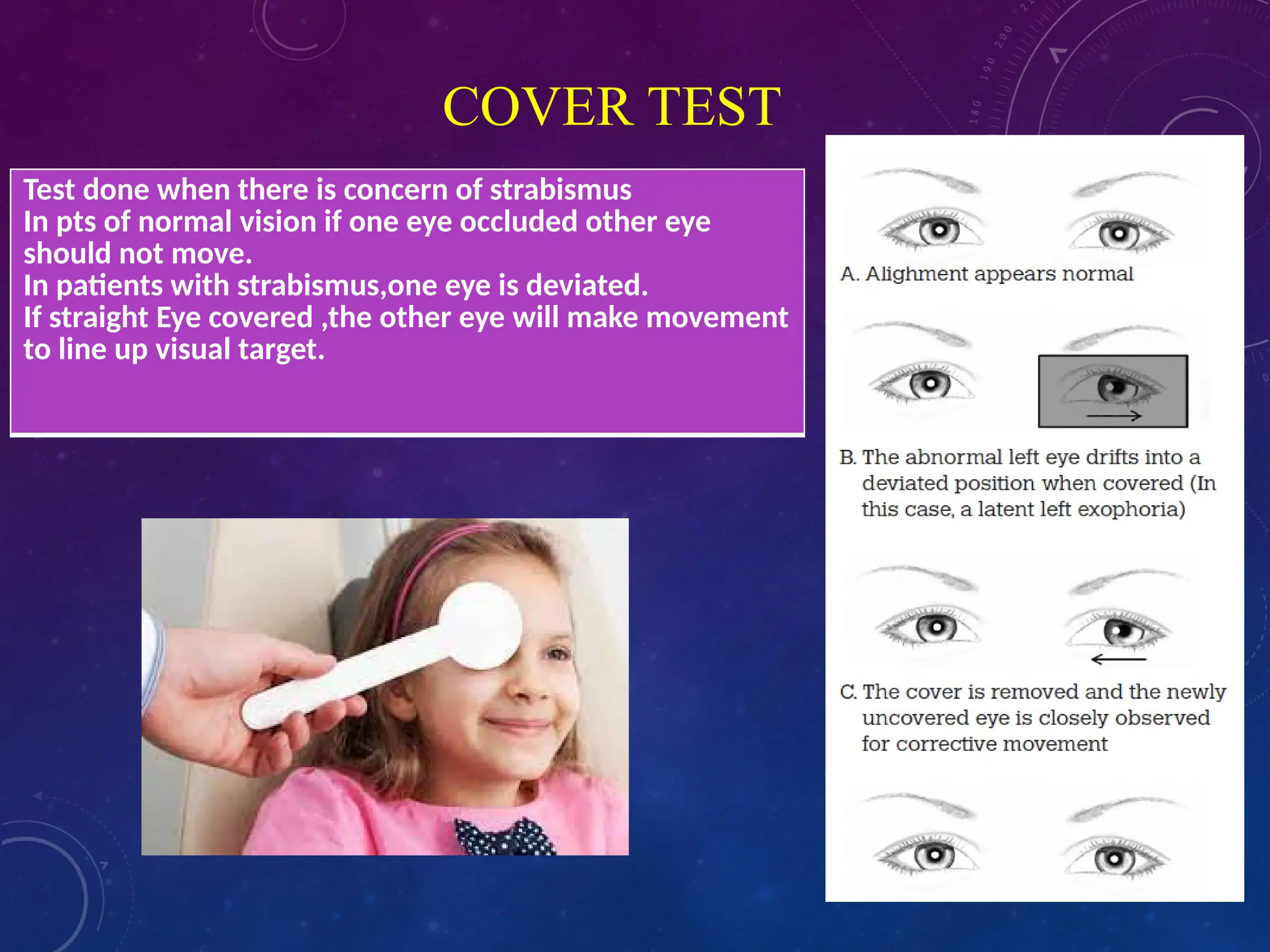
COVER TEST
Test done when there is concern of strabismus
In pts of normal vision if one eye occluded other eye
should not move.
In patients with strabismus,one eye is deviated.
If straight Eye covered ,the other eye will make movement
to line up visual target.
ASSESSMENT OF VISUAL ACUITY FROM
6 TO 12 MONTHS
SIX MONTHS
NINE MONTHS
RESOLUTION ACUITY & DETECTION
ACUITY CHECKED
ACCOMODATION
,FUSION VERGENCE
WELL DEVELOPED
VISUAL DIFFERENTIATION OF OBJECTS
PICKS UP SMALL OBJECTS
PREFERENTIAL LOOKING TEST
CATFORD DRUM TEST
TELLER ACUITY CARD TEST (TAC)
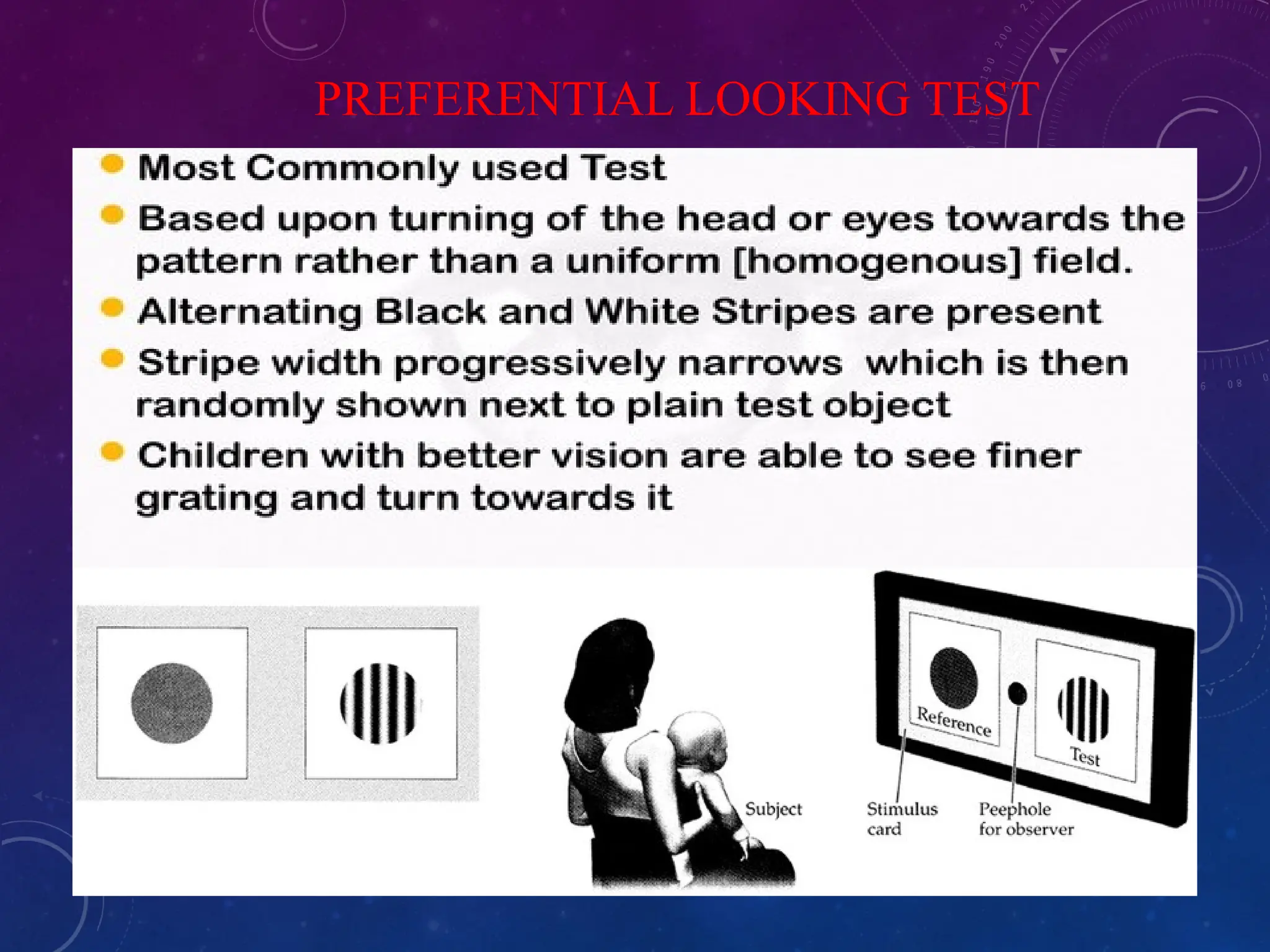
PREFERENTIAL LOOKING TEST
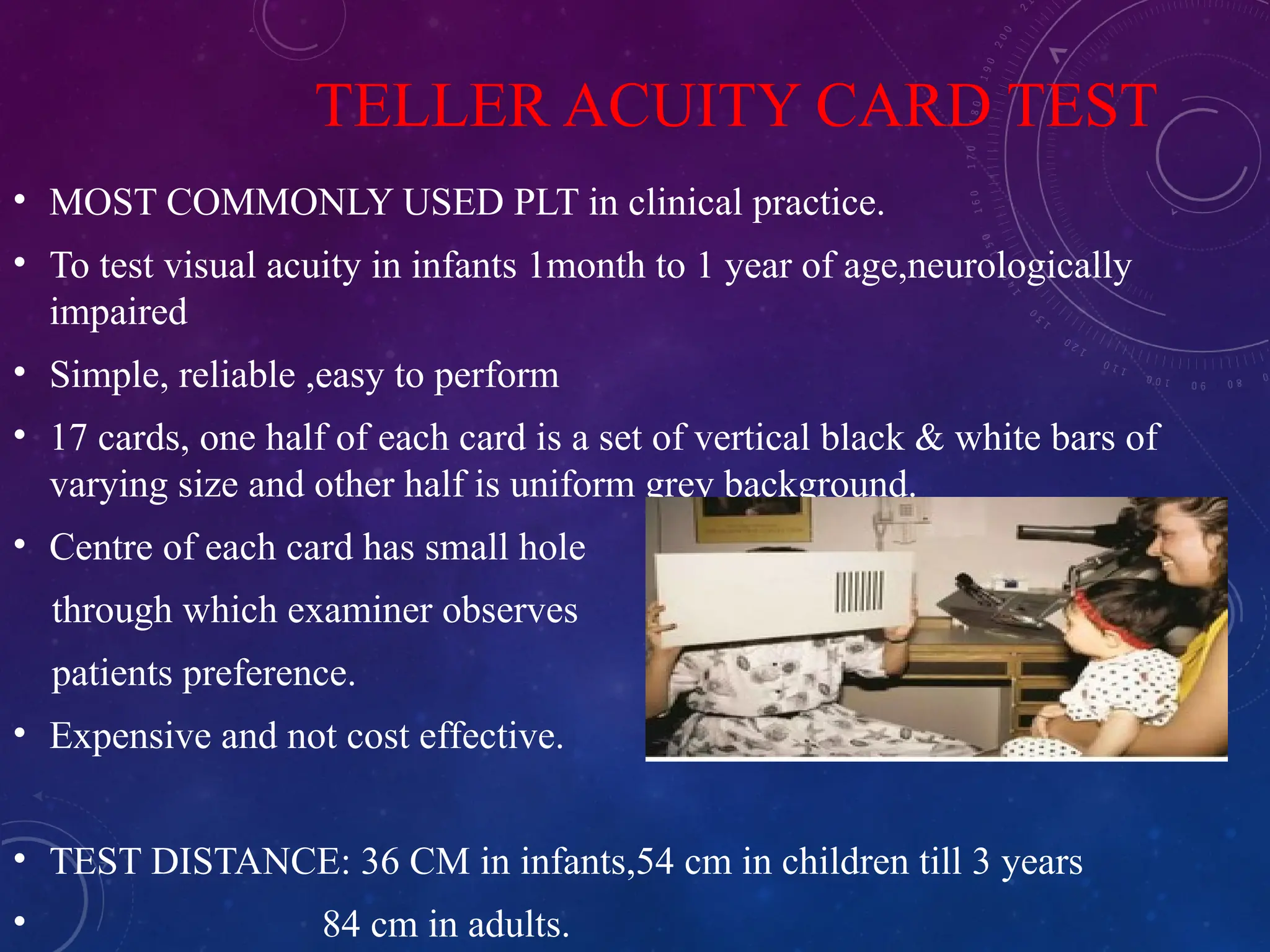
TELLER ACUITY CARD TEST
• MOST COMMONLY USED PLT in clinical practice.
• To test visual acuity in infants 1month to 1 year of age,neurologically
impaired
• Simple, reliable ,easy to perform
• 17 cards, one half of each card is a set of vertical black & white bars of
varying size and other half is uniform grey background.
• Centre of each card has small hole
through which examiner observes
patients preference.
• Expensive and not cost effective.
• TEST DISTANCE: 36 CM in infants,54 cm in children till 3 years
• 84 cm in adults.
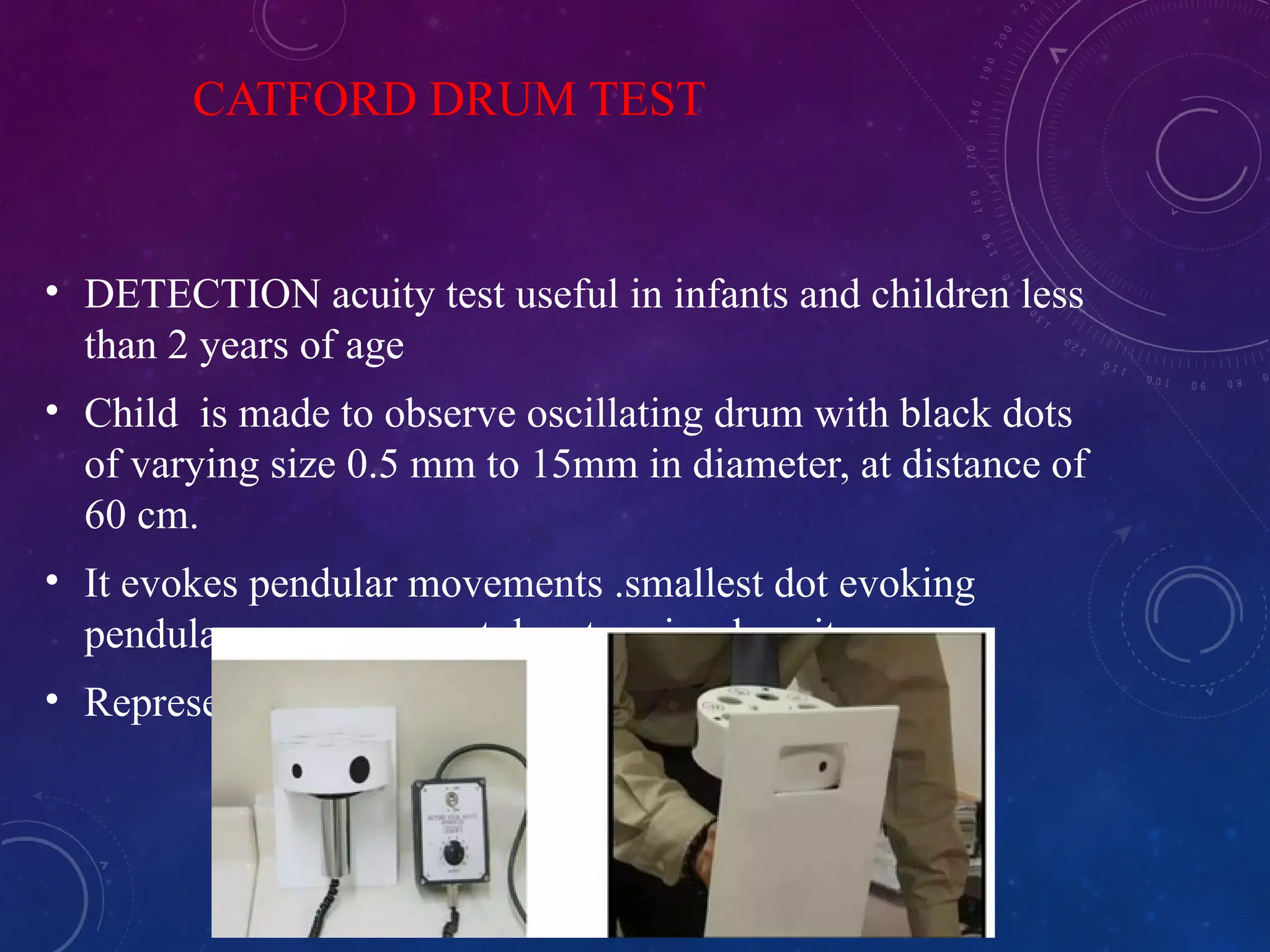
CATFORD DRUM TEST
• DETECTION acuity test useful in infants and children less
than 2 years of age
• Child is made to observe oscillating drum with black dots
of varying size 0.5 mm to 15mm in diameter, at distance of
60 cm.
• It evokes pendular movements .smallest dot evoking
pendular eye movement denotes visual acuity.
• Represents vision b/w 6/6 to 2/60
ASSESSMENT OF VISUAL ACUITY
FROM 1 TO 3 YEARS
• 1 year of age - child able to visually differentiate small
objects and able to reach out for toys.
• 2-3 years -visual acuity approaches near adult levels.
play picture or letter recognition games,
responds to some binocular vision tests,
contrast sensitivity well developed.
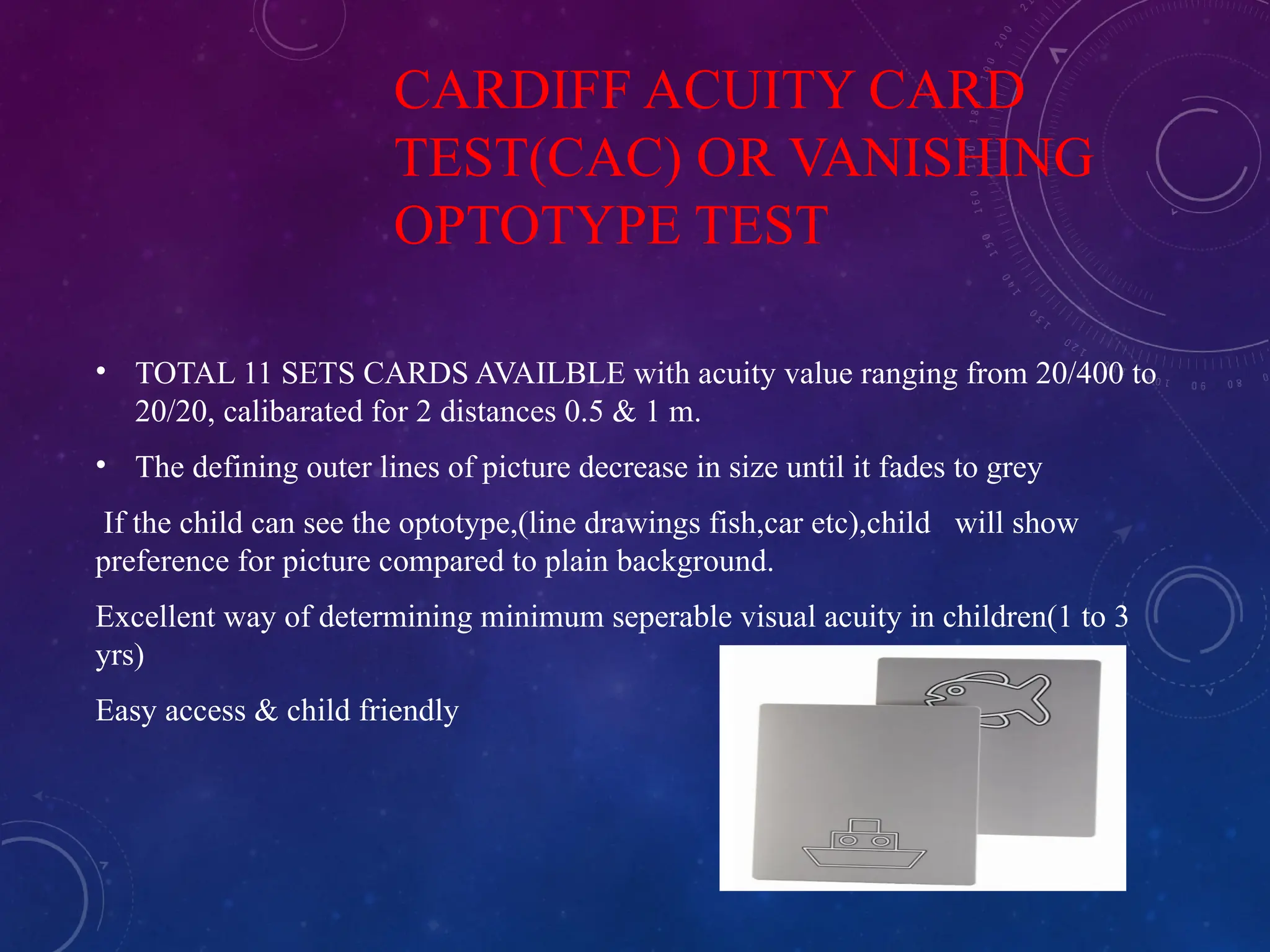
CARDIFF ACUITY CARD
TEST(CAC) OR VANISHING
OPTOTYPE TEST
• TOTAL 11 SETS CARDS AVAILBLE with acuity value ranging from 20/400 to
20/20, calibarated for 2 distances 0.5 & 1 m.
• The defining outer lines of picture decrease in size until it fades to grey
If the child can see the optotype,(line drawings fish,car etc),child will show
preference for picture compared to plain background.
Excellent way of determining minimum seperable visual acuity in children(1 to 3
yrs)
Easy access & child friendly
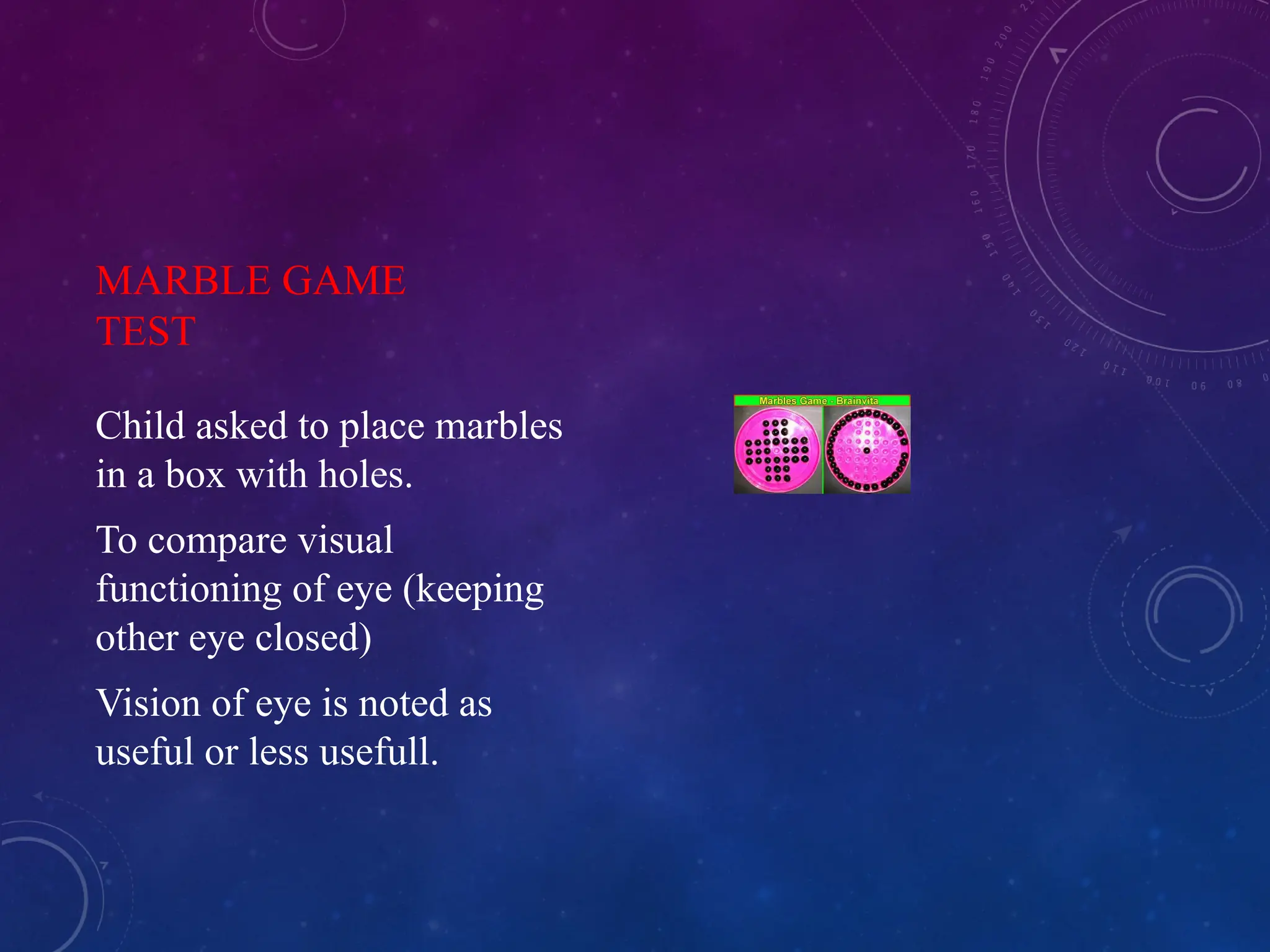
MARBLE GAME
TEST
Child asked to place marbles
in a box with holes.
To compare visual
functioning of eye (keeping
other eye closed)
Vision of eye is noted as
useful or less usefull.
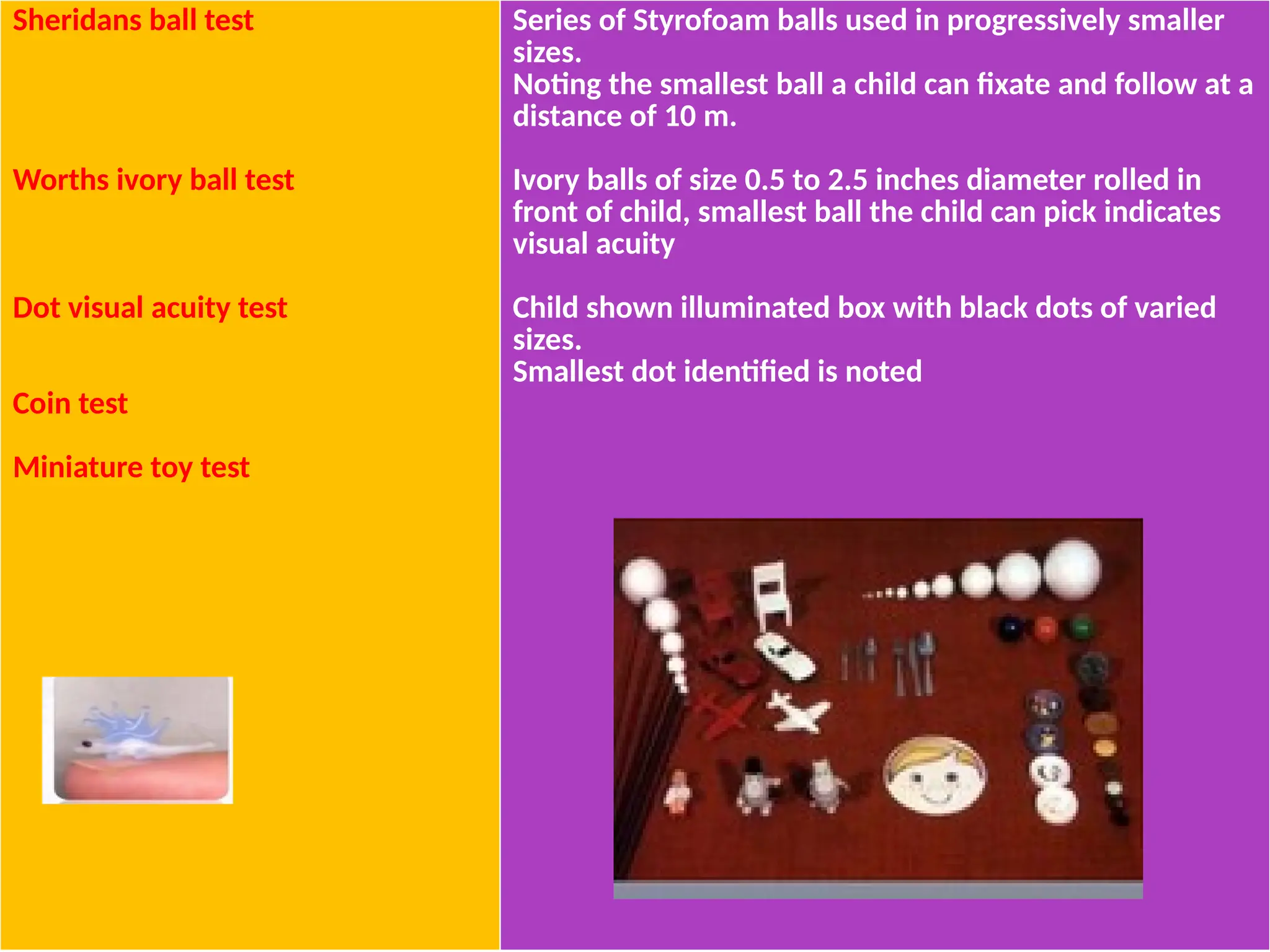
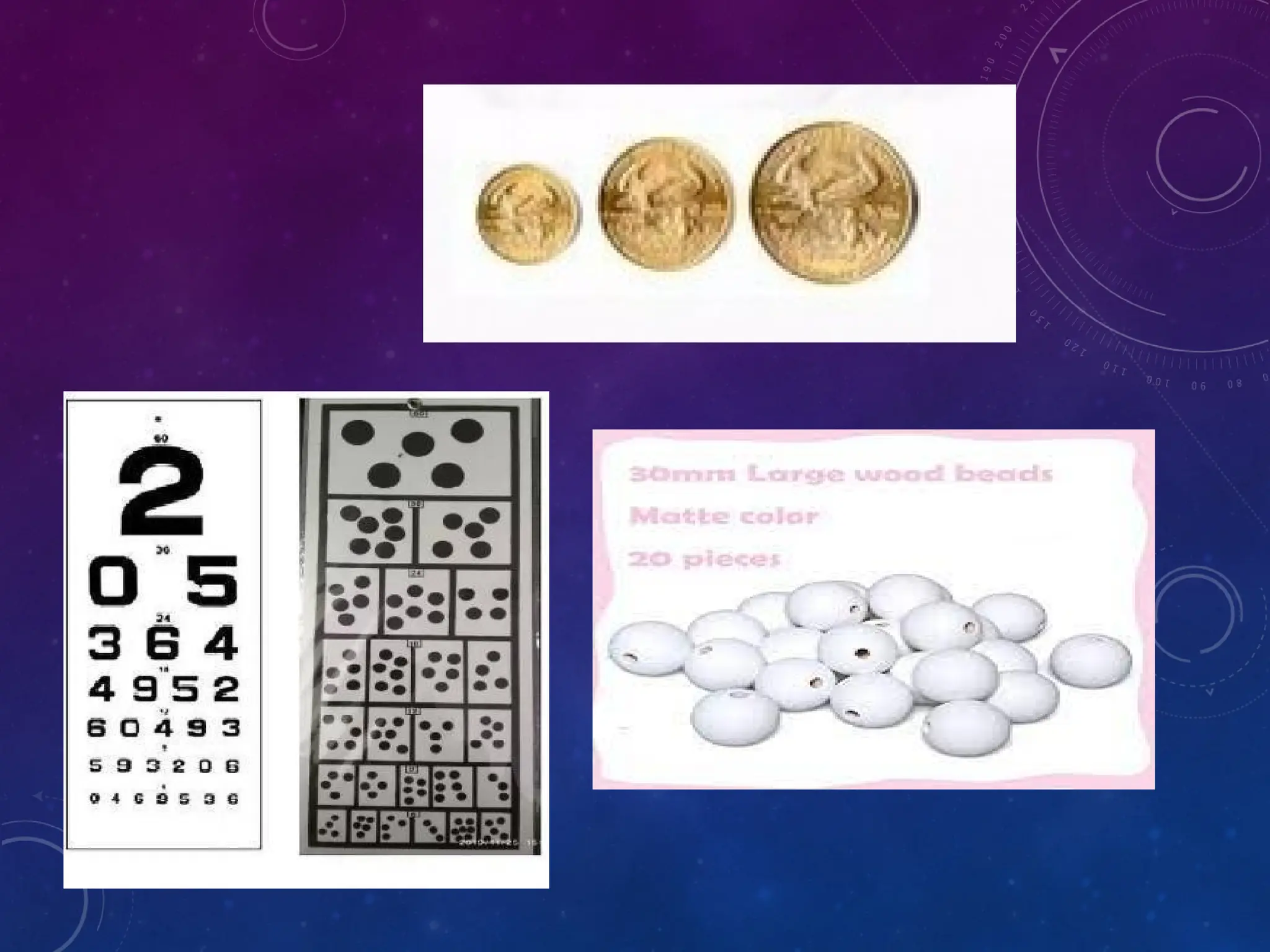
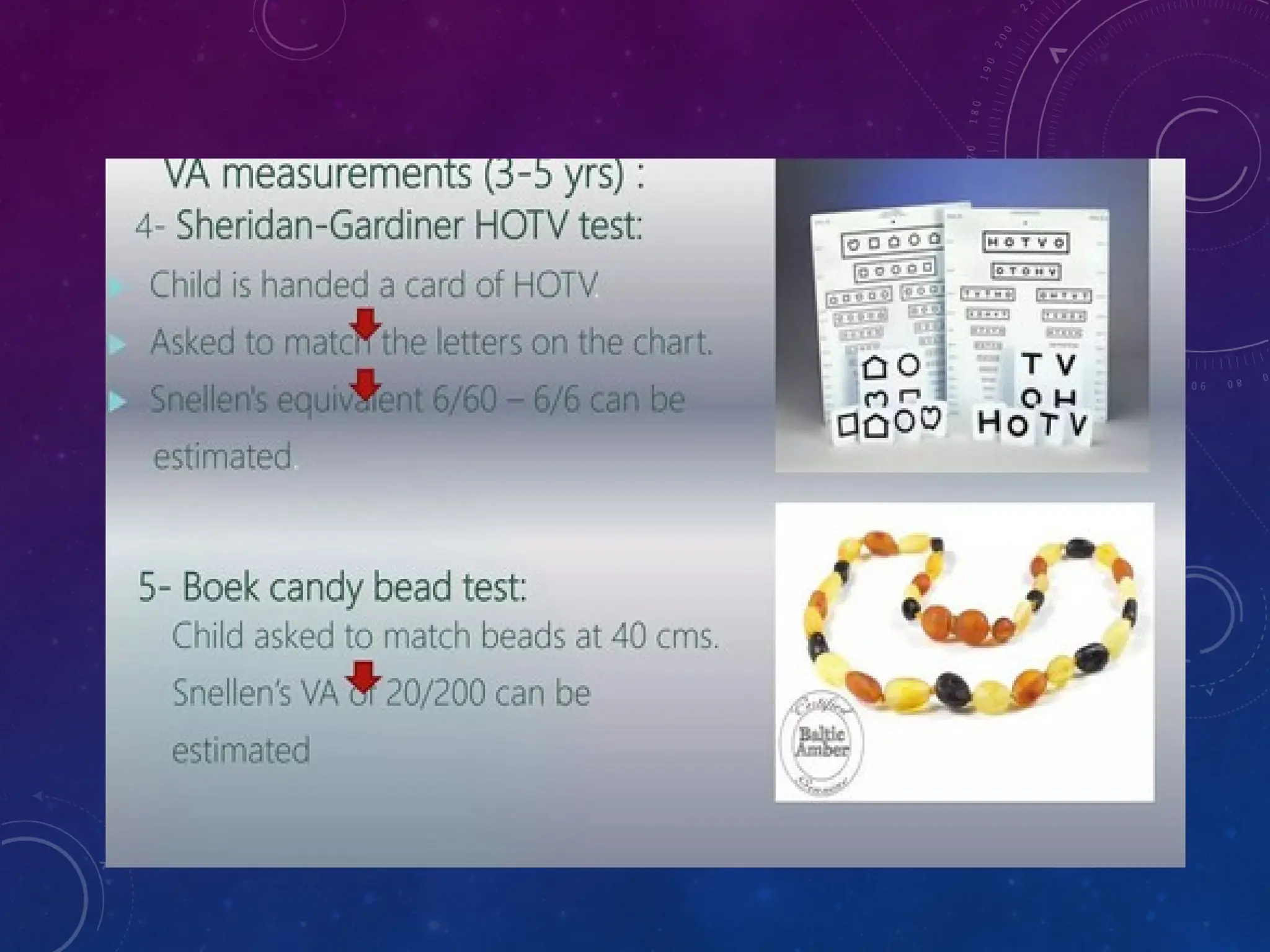
Sheridans ball test
Worths ivory ball test
Dot visual acuity test
Coin test
Miniature toy test
Series of Styrofoam balls used in progressively smaller
sizes.
Noting the smallest ball a child can fixate and follow at a
distance of 10 m.
Ivory balls of size 0.5 to 2.5 inches diameter rolled in
front of child, smallest ball the child can pick indicates
visual acuity
Child shown illuminated box with black dots of varied
sizes.
Smallest dot identified is noted
ASSESSMENT OF VISUAL
ACUITY IN 3 TO 5 YEARS.
• Child able to verbalizes,stereopsis fully developed by 5 yrs.
• Visual assessment based on recognition acuity
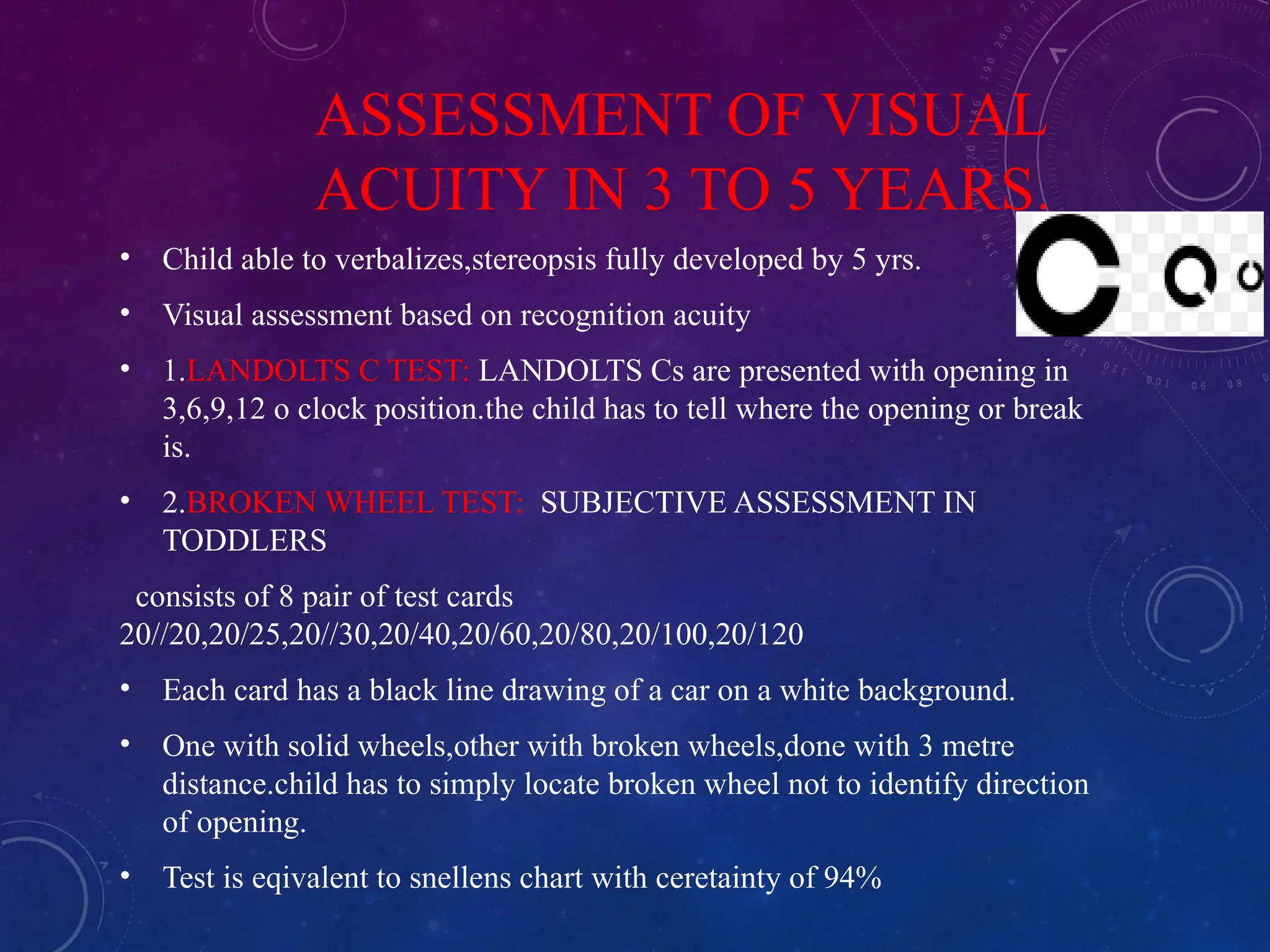
• 1.LANDOLTS C TEST: LANDOLTS Cs are presented with opening in
3,6,9,12 o clock position.the child has to tell where the opening or break
is.
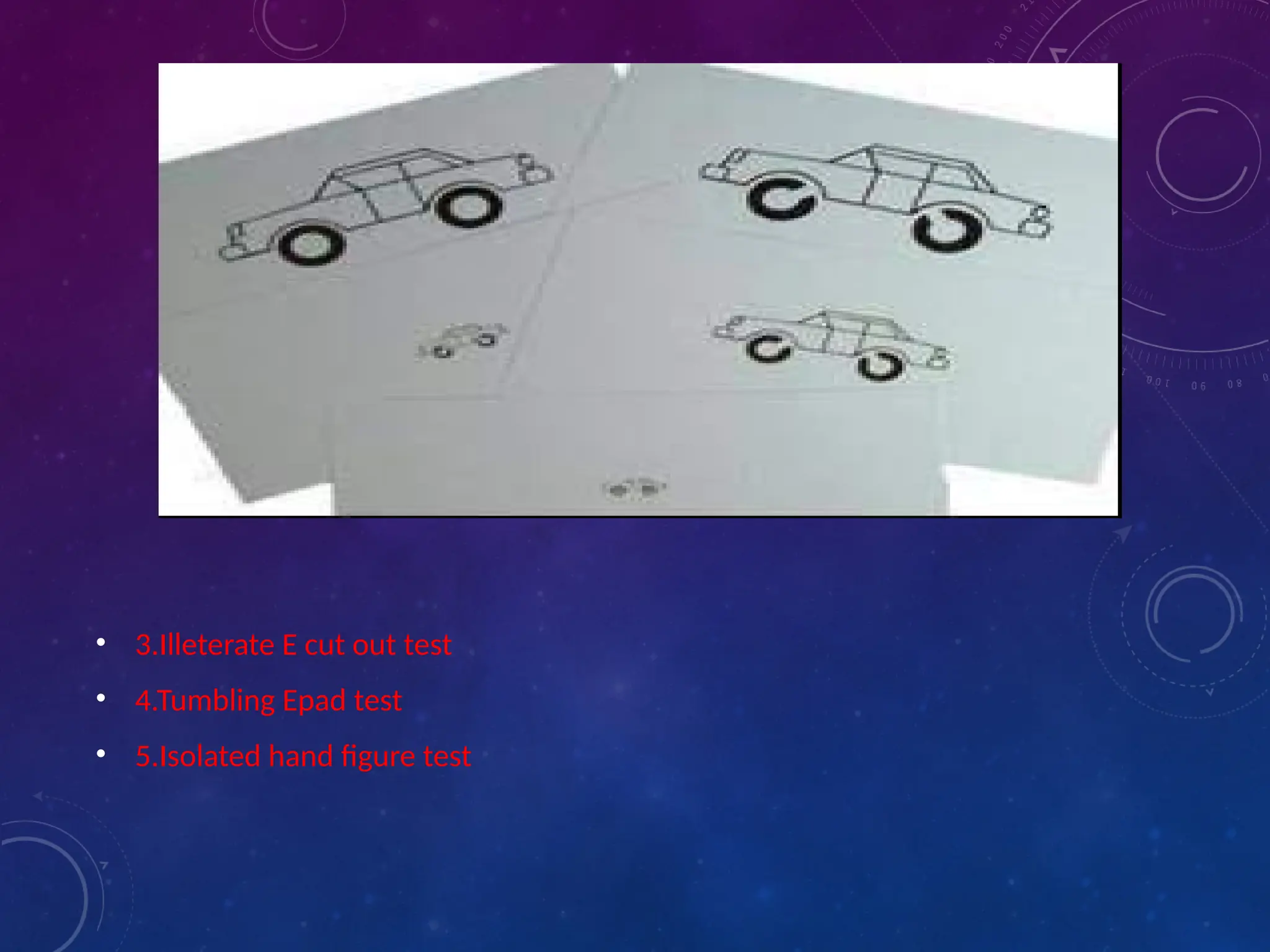
• 2.BROKEN WHEEL TEST: SUBJECTIVE ASSESSMENT IN
TODDLERS
consists of 8 pair of test cards
20//20,20/25,20//30,20/40,20/60,20/80,20/100,20/120
• Each card has a black line drawing of a car on a white background.
• One with solid wheels,other with broken wheels,done with 3 metre
distance.child has to simply locate broken wheel not to identify direction
of opening.
• Test is eqivalent to snellens chart with ceretainty of 94%
• 3.Illeterate E cut out test
• 4.Tumbling Epad test
• 5.Isolated hand figure test
PICTORIAL VISION CHARTS
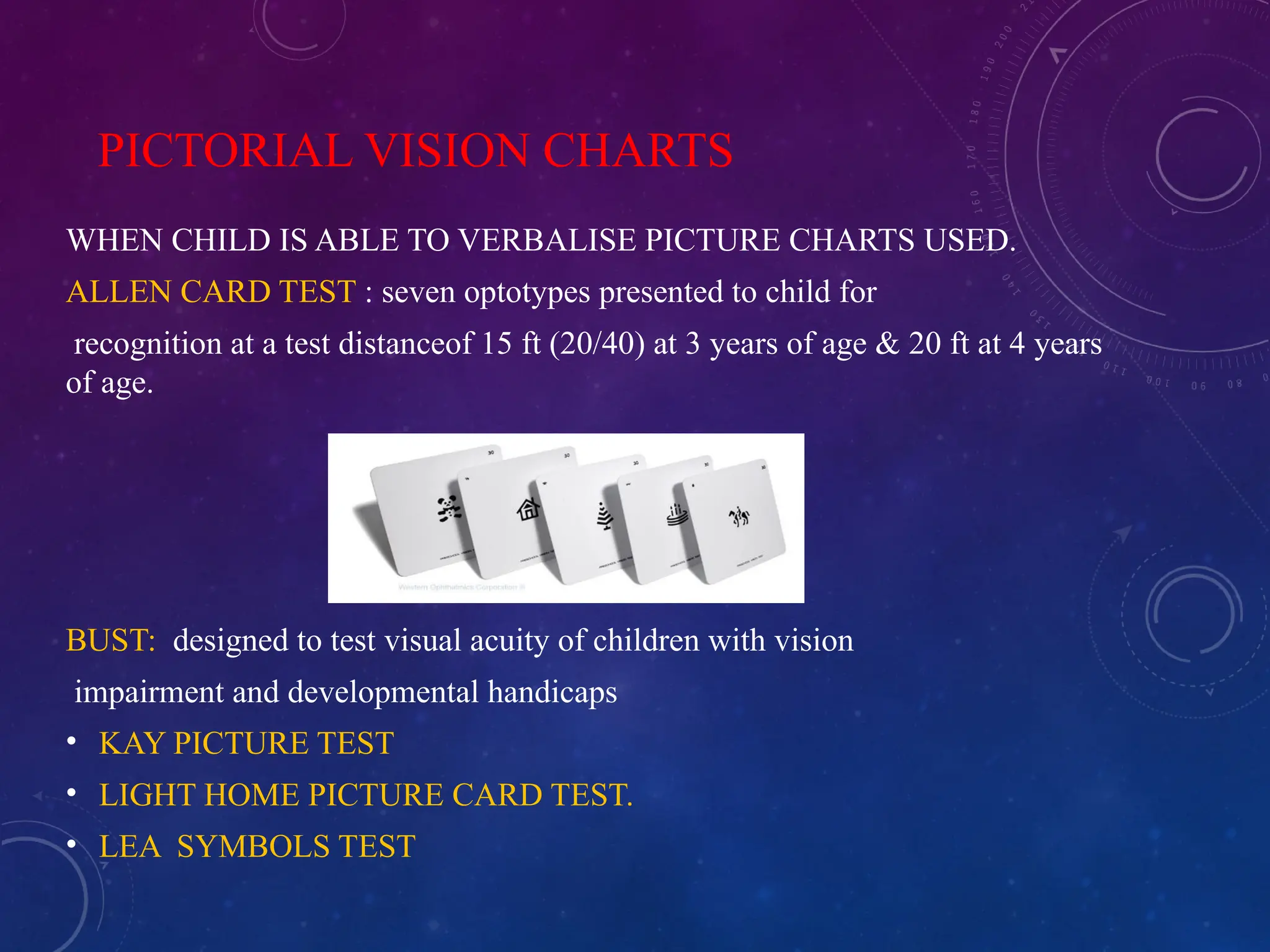
WHEN CHILD IS ABLE TO VERBALISE PICTURE CHARTS USED.
ALLEN CARD TEST : seven optotypes presented to child for
recognition at a test distanceof 15 ft (20/40) at 3 years of age & 20 ft at 4 years
of age.
BUST: designed to test visual acuity of children with vision
impairment and developmental handicaps
• KAY PICTURE TEST
• LIGHT HOME PICTURE CARD TEST.
• LEA SYMBOLS TEST
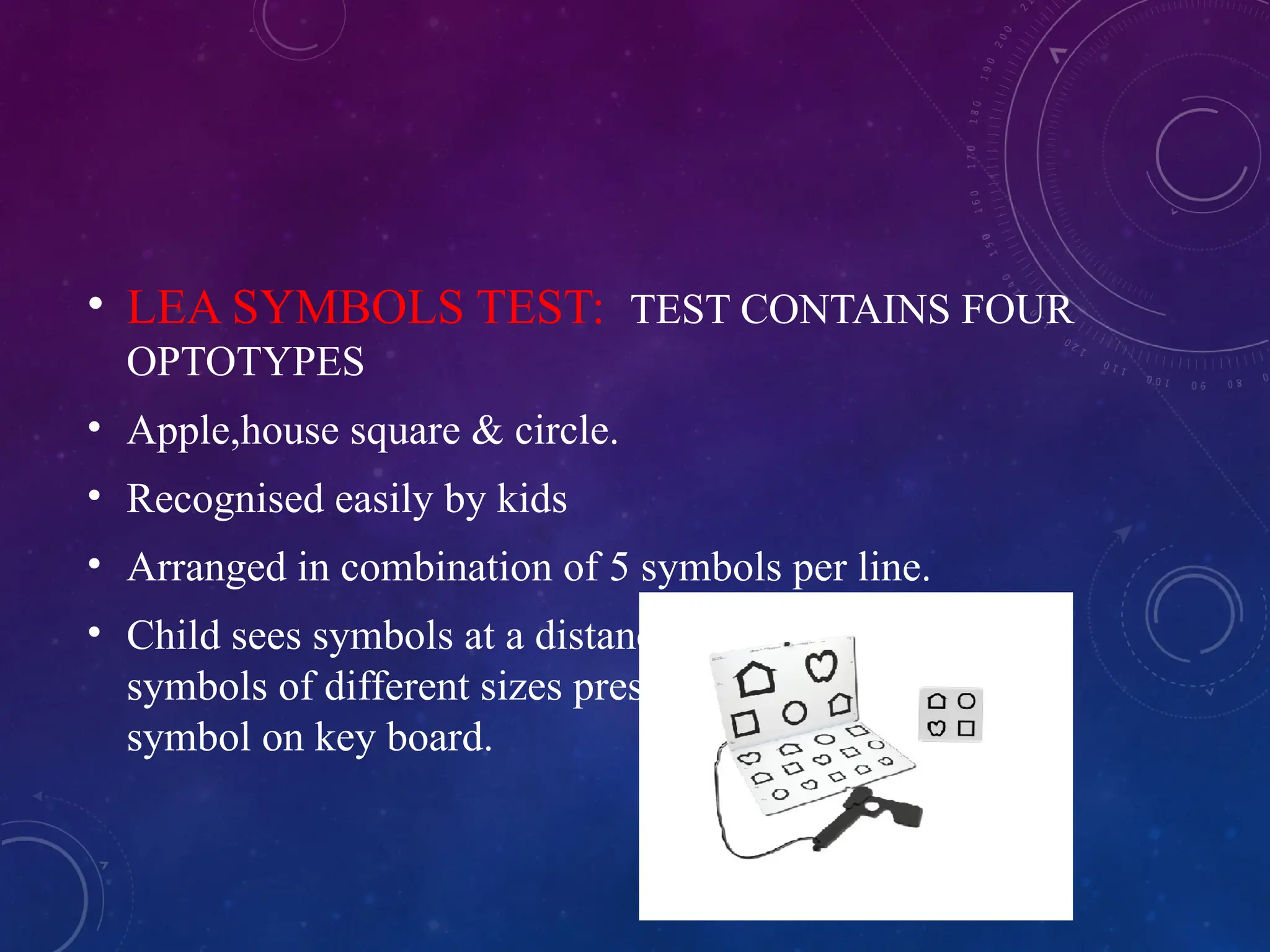
• LEA SYMBOLS TEST: TEST CONTAINS FOUR
OPTOTYPES
• Apple,house square & circle.
• Recognised easily by kids
• Arranged in combination of 5 symbols per line.
• Child sees symbols at a distance chart and matches
symbols of different sizes presented on it to similar
symbol on key board.
VISUAL ASSESSMENT IN SCHOOL CHILDREN AND
ADULTS
• SNELLENS ACUITY CHART
• Consists series of black capital letters on white board
arranged in lines each progressively dimnishing size.
• Each letter subtend at an angle of 1 min at nodal point
• At given distance each letter subsides at an angle of 5
min at nodal point of eye.
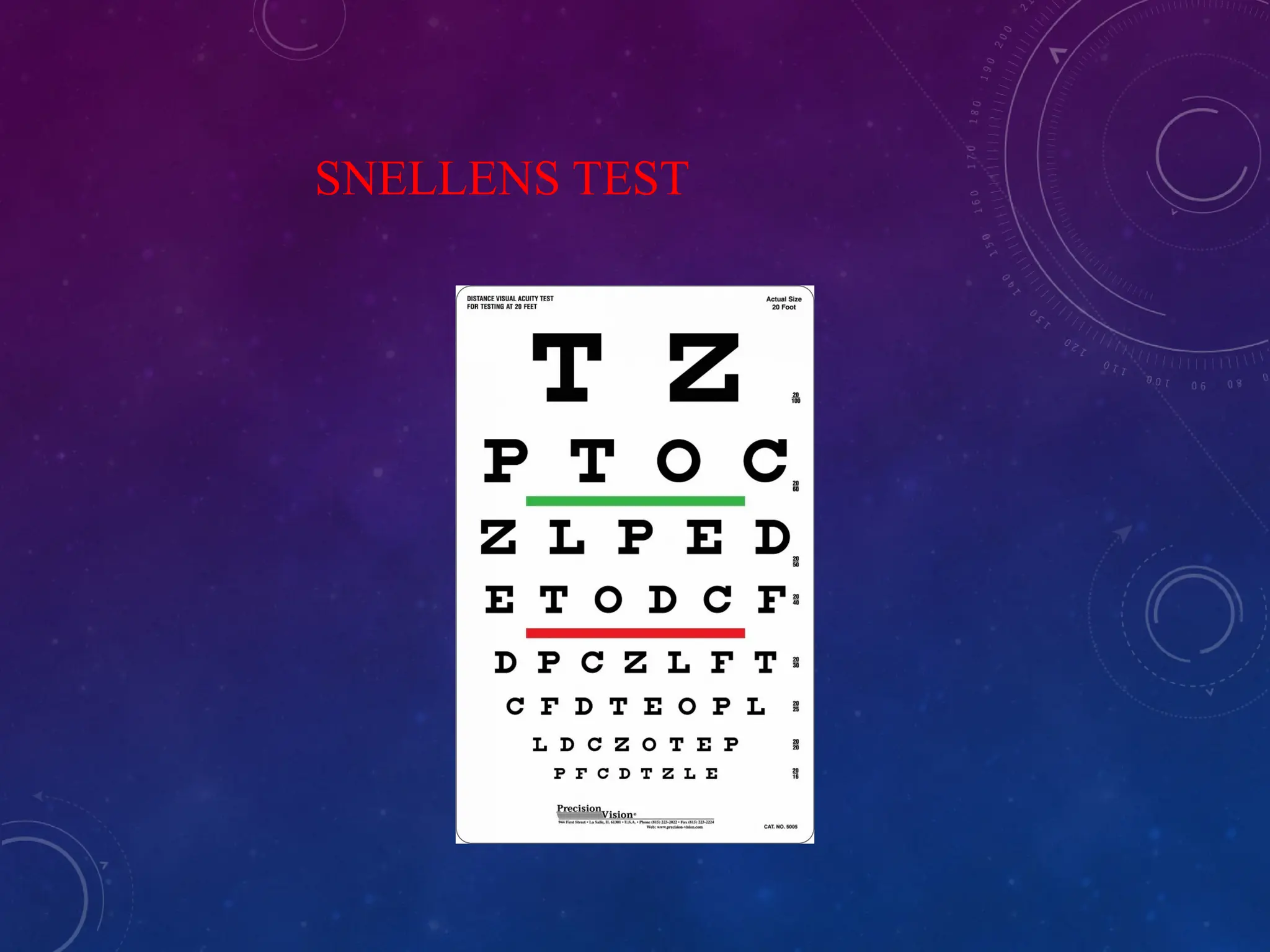
• Testing distance is 6 m , centre visual acuity is checked.
SNELLENS TEST
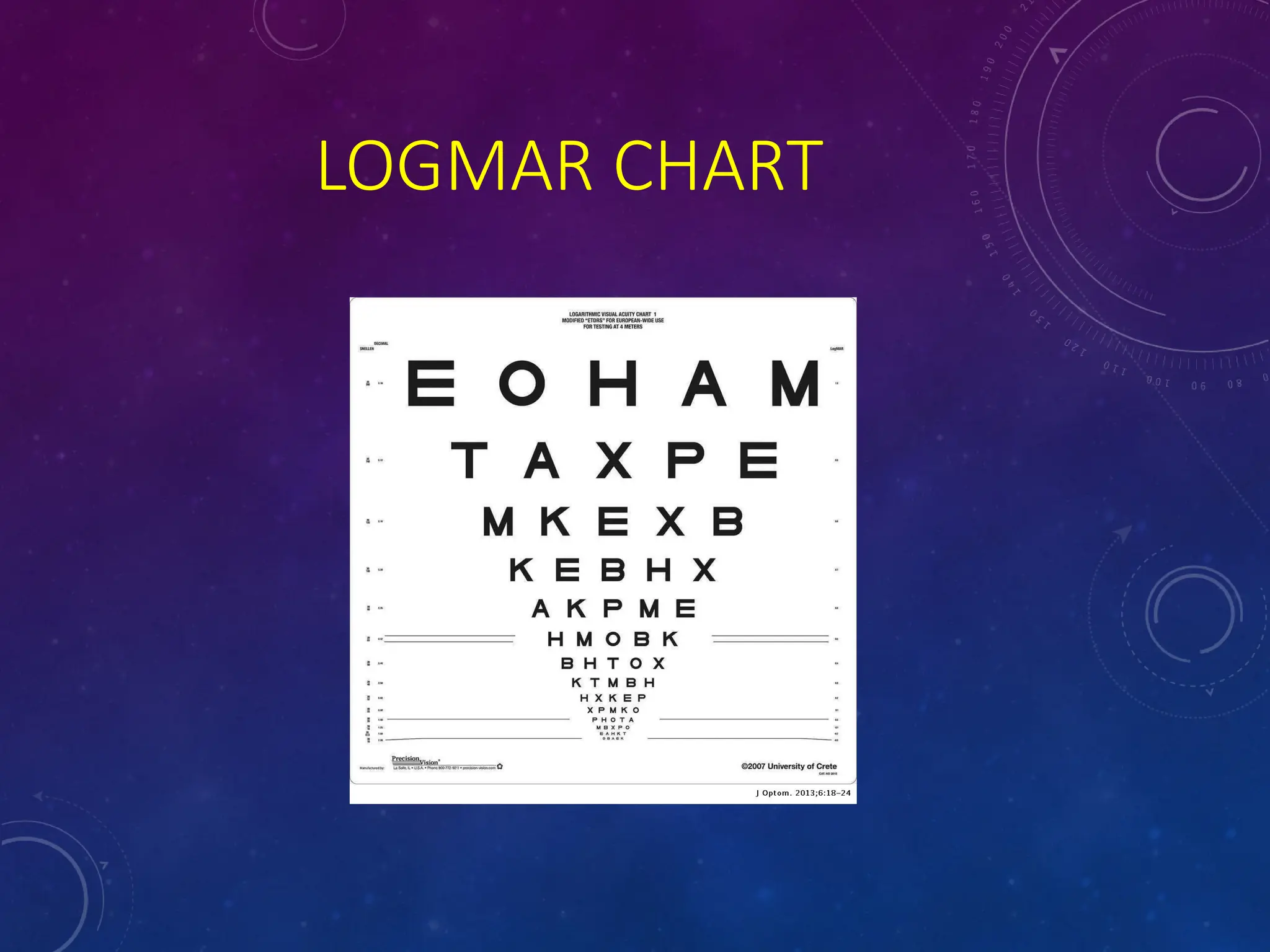
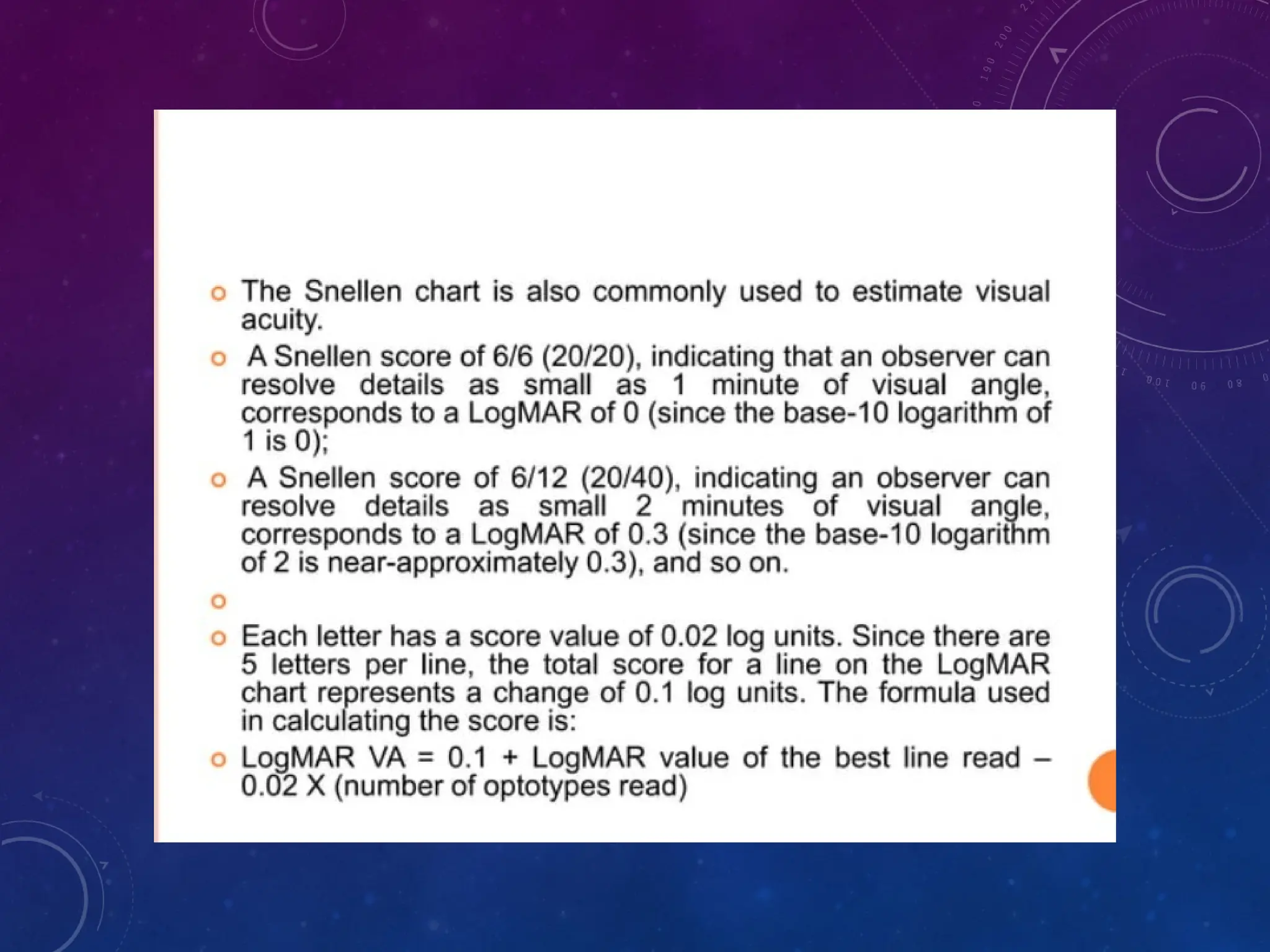
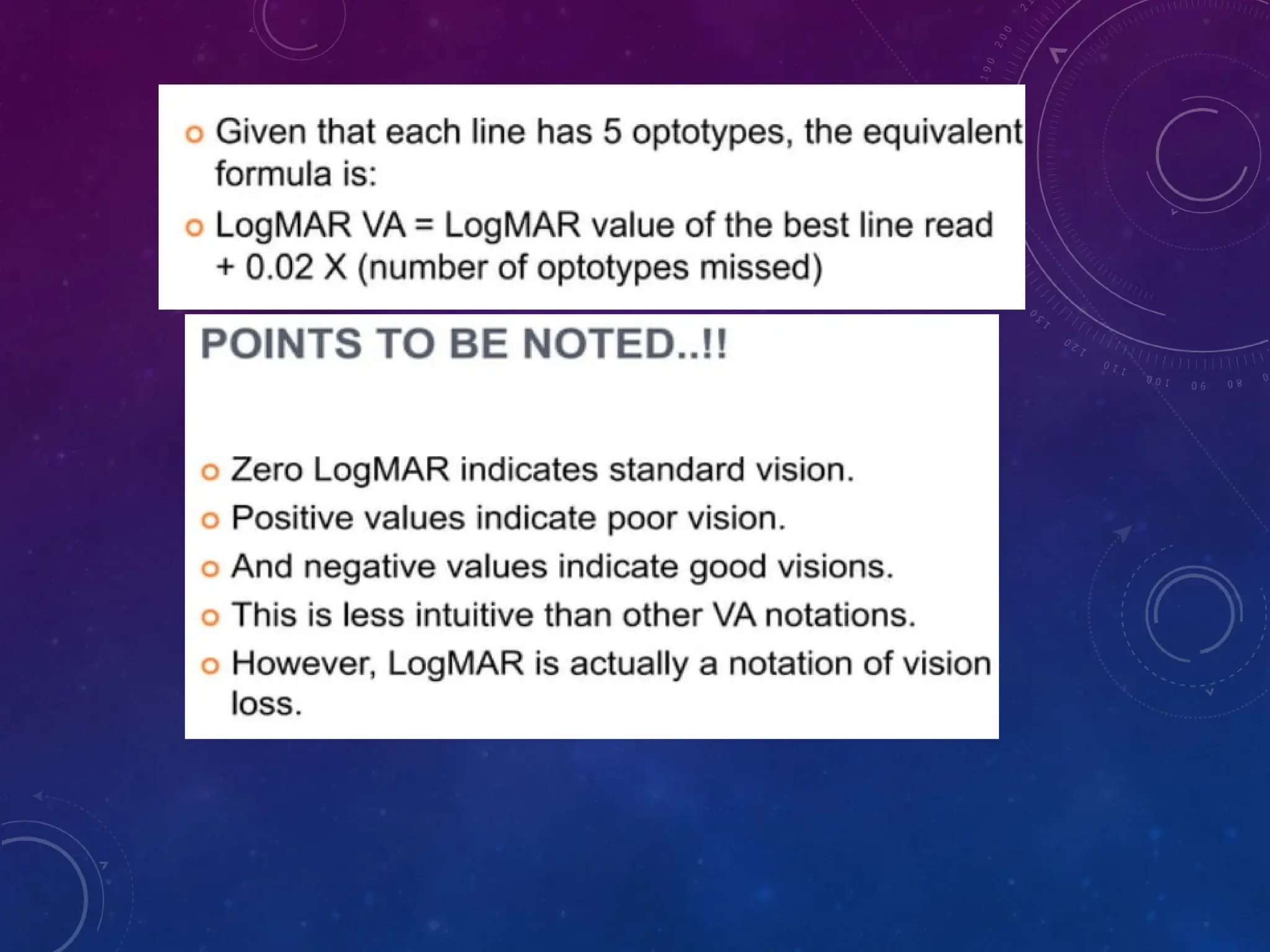
LOGMAR VISUAL ACUITY CHART
• Logarithm of the Minimum Angle of Resolution
• It comprises of rows of letters,equal number of letters in
each line.
• Have regular progression in size and spacing of letters from
one line to next.
• At a distance of 4 metre.
• Gives more acuity than other charts
• Useful in research settings
• An observer who can resolve details as small as 1 min of
visual angle scores LOGMAR 0.(base 10 logarithm of 1 is
0)
LOGMAR CHART
THANK YOU

Measurement of visual acuity in children (1).pptx

  • 1.
  • 2.
    VISUAL ACUITY • Visionor visual perception is a complex of light, form, contrast and color sense. Visual acuity is a measure of FORM sense. • It is the resolving power of eye and ability to see two objects as separate. • Visual acuity is defined as reciprocal of minimum resolvable visual angle measured in minutes of arc.
  • 3.
    VISUAL ANGLE The twodistinct points can only be recognizable as separate when they subtend at an angle of 1 minute of arc at nodal point of eye
  • 4.
    COMPONENTS OF VISUALACUITY • MINIMUM VISIBLE: ability to determine whether or not an object is present in an otherwise empty visual field. It depends on the stimulus such as size, shape, illumination. • RESOLUTION: (ordinary visual acuity) • RECOGNITION: Involves cognitive components such as recognition of faces. • MINIMUM DESCRIMINABLE OR HYPER ACUITY Spatial distinction by observer when threshold is much lower than ordinary acuity.
  • 5.
    VISUAL ACUITY TESTS Detectionacuity tests: • Dot visual acuity test • Catford drum test • Boek candy bead test • STYCAR graded balls test • Schwarting metronome test. Resolution acuity tests -OKN test -TAC test -PLT test Rcognition acuity tests: • Snellens chart test • Landolts chart test • Sjogrens hand test • Arrows test • Sheridans letter test • Flooks symbol test • Lipmans HOTV test • Allen picture cards test • Miniature toy test • Cardiff acuity cards test • OKN test • VER test
  • 6.
    MILESTONES IN DEVELOPMENT OFVISION NEW BORN PUPILLARY REACTION TO LIGHT Blinking to light reflex Conjugate horizontal gaze 6/360 – 6/120 (OKN) 1 WEEK Vestibulo ocular Reflex 2 WEEKS Small saccades develop Follows HORIZONTAL moving objects 1 MONTH Fixation development,6/480-6/120 watch mothers face for prolonged time 2 MONTHS BIFOVEAL fixation ,large saccades Pursuits and convergence movements 6/120-6/60 3 MONTHS Watches movements of own hands RESPONSIVE SMILE reaches out
  • 7.
    ASSESSMENT OF VISUALACUITY FROM BIRTH TO 3 MONTHS 1. BLINK REFLEX TEST: present since birth(after 30 wks of GA) When a bright light is shown normal infant should respond by blinking. 2.PUPILLARY LIGHT REFLEX TEST: Most reliable test to determine presence of vision except in cortical blindness. • Indicates intact neurological pathways till superior colliculus,and efferent pathways to iris sphincter. • Present after 29 to 31 wks of GA. 3.VESTIBULO OCULAR REFLEX : Tested by turning newborn head on long axis observe eye deviation in opposite direction. 4.EYE POPPING TEST: • room lights are suddenly dimmed - upper eye lids of baby pop open wide for a moment.This is POSITIVE EYE POPPING
  • 9.
    CONTINUATION… 5. OKN TEST:(optokinetic nystagmus) • Nystagmus is elicited by passing a succession of black and white stripes through patients field of vision. • OKN drum used of size 10*8 inches in diameter,rotated in 8 to 10 rpm. • Slow movement in direction of drum lasting for 0.2 secs & fast phase in reverse direction for 0.1 secs. • OKN acuity is atleast 6/120 in newborns . • Asymmetric in newborns ,becomes symmetric by 4 to 6 months of age • Objective assessment of visual acuity in children, adults
  • 11.
    6.VISUAL EVOKED POTENTIAL •Quiet useful in assessing visual function in infants • It is a electroencephalographic recording made from occipital lobe in response to visual cortex. • Only clinically objective technique to assess the functional state of visual system beyond retinal ganglion cells. • TYPES: • PATTERN REVERSAL EEG recorded using some patterend stimulus like checker board,pattern of stimulus changed like black to white and vice versa,but illumination remains same. • FLASH VEPs VEPs tells about integrity of macular and visual pathway
  • 13.
    ASSESSMENT OF VISUALACUITY IN 3 TO 6 MONTHS MILESTONES: 4 months: Foveal differentiation complete Sensory fusion & accommodation develops 6/120-6/30 5 months: Blink response to visible threat(menace response) Grasps and explores objects Stereopsis begins developing 6 MONTHS: Accomodation well developed Fusional vergence developed 6/90-6/24/6/12 to 6/6 by VER FIXATION BEHAVIOUR TESTS : Ability of child to fix and follow face of examiner or toys. First done with both eyes open f/by monocular testing by occlusion of other eye.
  • 19.
    COVER TEST Test donewhen there is concern of strabismus In pts of normal vision if one eye occluded other eye should not move. In patients with strabismus,one eye is deviated. If straight Eye covered ,the other eye will make movement to line up visual target.
  • 20.
    ASSESSMENT OF VISUALACUITY FROM 6 TO 12 MONTHS SIX MONTHS NINE MONTHS RESOLUTION ACUITY & DETECTION ACUITY CHECKED ACCOMODATION ,FUSION VERGENCE WELL DEVELOPED VISUAL DIFFERENTIATION OF OBJECTS PICKS UP SMALL OBJECTS PREFERENTIAL LOOKING TEST CATFORD DRUM TEST TELLER ACUITY CARD TEST (TAC)
  • 21.
  • 22.
    TELLER ACUITY CARDTEST • MOST COMMONLY USED PLT in clinical practice. • To test visual acuity in infants 1month to 1 year of age,neurologically impaired • Simple, reliable ,easy to perform • 17 cards, one half of each card is a set of vertical black & white bars of varying size and other half is uniform grey background. • Centre of each card has small hole through which examiner observes patients preference. • Expensive and not cost effective. • TEST DISTANCE: 36 CM in infants,54 cm in children till 3 years • 84 cm in adults.
  • 23.
    CATFORD DRUM TEST •DETECTION acuity test useful in infants and children less than 2 years of age • Child is made to observe oscillating drum with black dots of varying size 0.5 mm to 15mm in diameter, at distance of 60 cm. • It evokes pendular movements .smallest dot evoking pendular eye movement denotes visual acuity. • Represents vision b/w 6/6 to 2/60
  • 24.
    ASSESSMENT OF VISUALACUITY FROM 1 TO 3 YEARS • 1 year of age - child able to visually differentiate small objects and able to reach out for toys. • 2-3 years -visual acuity approaches near adult levels. play picture or letter recognition games, responds to some binocular vision tests, contrast sensitivity well developed.
  • 25.
    CARDIFF ACUITY CARD TEST(CAC)OR VANISHING OPTOTYPE TEST • TOTAL 11 SETS CARDS AVAILBLE with acuity value ranging from 20/400 to 20/20, calibarated for 2 distances 0.5 & 1 m. • The defining outer lines of picture decrease in size until it fades to grey If the child can see the optotype,(line drawings fish,car etc),child will show preference for picture compared to plain background. Excellent way of determining minimum seperable visual acuity in children(1 to 3 yrs) Easy access & child friendly
  • 26.
    MARBLE GAME TEST Child askedto place marbles in a box with holes. To compare visual functioning of eye (keeping other eye closed) Vision of eye is noted as useful or less usefull.
  • 27.
    Sheridans ball test Worthsivory ball test Dot visual acuity test Coin test Miniature toy test Series of Styrofoam balls used in progressively smaller sizes. Noting the smallest ball a child can fixate and follow at a distance of 10 m. Ivory balls of size 0.5 to 2.5 inches diameter rolled in front of child, smallest ball the child can pick indicates visual acuity Child shown illuminated box with black dots of varied sizes. Smallest dot identified is noted
  • 29.
    ASSESSMENT OF VISUAL ACUITYIN 3 TO 5 YEARS. • Child able to verbalizes,stereopsis fully developed by 5 yrs. • Visual assessment based on recognition acuity • 1.LANDOLTS C TEST: LANDOLTS Cs are presented with opening in 3,6,9,12 o clock position.the child has to tell where the opening or break is. • 2.BROKEN WHEEL TEST: SUBJECTIVE ASSESSMENT IN TODDLERS consists of 8 pair of test cards 20//20,20/25,20//30,20/40,20/60,20/80,20/100,20/120 • Each card has a black line drawing of a car on a white background. • One with solid wheels,other with broken wheels,done with 3 metre distance.child has to simply locate broken wheel not to identify direction of opening. • Test is eqivalent to snellens chart with ceretainty of 94%
  • 30.
    • 3.Illeterate Ecut out test • 4.Tumbling Epad test • 5.Isolated hand figure test
  • 32.
    PICTORIAL VISION CHARTS WHENCHILD IS ABLE TO VERBALISE PICTURE CHARTS USED. ALLEN CARD TEST : seven optotypes presented to child for recognition at a test distanceof 15 ft (20/40) at 3 years of age & 20 ft at 4 years of age. BUST: designed to test visual acuity of children with vision impairment and developmental handicaps • KAY PICTURE TEST • LIGHT HOME PICTURE CARD TEST. • LEA SYMBOLS TEST
  • 34.
    • LEA SYMBOLSTEST: TEST CONTAINS FOUR OPTOTYPES • Apple,house square & circle. • Recognised easily by kids • Arranged in combination of 5 symbols per line. • Child sees symbols at a distance chart and matches symbols of different sizes presented on it to similar symbol on key board.
  • 35.
    VISUAL ASSESSMENT INSCHOOL CHILDREN AND ADULTS • SNELLENS ACUITY CHART • Consists series of black capital letters on white board arranged in lines each progressively dimnishing size. • Each letter subtend at an angle of 1 min at nodal point • At given distance each letter subsides at an angle of 5 min at nodal point of eye. • Testing distance is 6 m , centre visual acuity is checked.
  • 36.
  • 37.
    LOGMAR VISUAL ACUITYCHART • Logarithm of the Minimum Angle of Resolution • It comprises of rows of letters,equal number of letters in each line. • Have regular progression in size and spacing of letters from one line to next. • At a distance of 4 metre. • Gives more acuity than other charts • Useful in research settings • An observer who can resolve details as small as 1 min of visual angle scores LOGMAR 0.(base 10 logarithm of 1 is 0)
  • 38.
  • 41.