
 changes in family dynamics/units
 There is more stress in the home
 Exposure to stress at an early age and unable
to cope up with it
 Research says that students with chronic
behavior problems have also experienced
chronic life stress.
 An epidemiological study of mental health
children found that adjustment problems of
children correlate with the stressful life
events occurred in the previous year. (1974)
 Chandler (1985) argues that the maladaptive
behavior observed in school is the direct
result of stressful events a child is facing
both in and out of school.
 Before teaching children/youth stress
management, it is recommended to teach
them some basic concepts which are as
follows:
 Define the term “stress,” “stressor,”
“eustress,” and “distress.”
 Not all stress is bad
 The physiological changes occur during
stress (fight or flight response)
 we can’t always escape from the stress by
running away from the stressor
 Stress management requires a holistic
approach such as Somatic (Physiological),
Cognitive (Psychological) and Social
(Behavioral) interventions together.
 Work on one stress at a time
 Illustrate Ellis’s A-B-C Model (It is not A but B
produces stress)
 Hold a brainstorming session to generate the
list of stressors
 In order to reduce your stress first you must
become aware of it, and the sooner you
become aware of it, the easier will be to
reduce it.
 Keeping logs to be aware of stressors and
which one produce more stress.
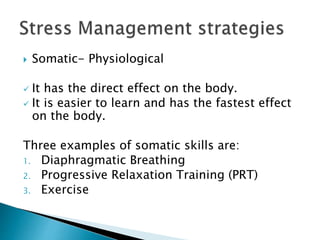
 Somatic- Physiological
 It has the direct effect on the body.
 It is easier to learn and has the fastest effect
on the body.
Three examples of somatic skills are:
1. Diaphragmatic Breathing
2. Progressive Relaxation Training (PRT)
3. Exercise
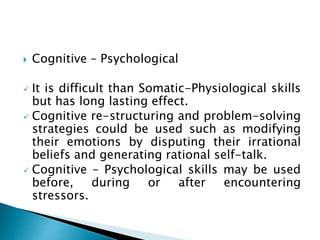
 Cognitive – Psychological
 It is difficult than Somatic-Physiological skills
but has long lasting effect.
 Cognitive re-structuring and problem-solving
strategies could be used such as modifying
their emotions by disputing their irrational
beliefs and generating rational self-talk.
 Cognitive – Psychological skills may be used
before, during or after encountering
stressors.
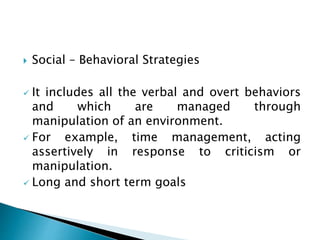
 Social – Behavioral Strategies
 It includes all the verbal and overt behaviors
and which are managed through
manipulation of an environment.
 For example, time management, acting
assertively in response to criticism or
manipulation.
 Long and short term goals
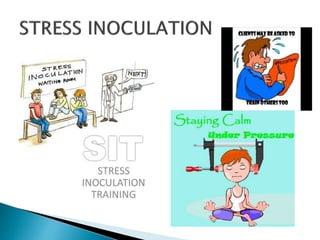
Is a relatively new intervention which appears to
be effective in managing anger and anxiety as
well as depression in children and youth.
 It is an integrative strategy that uses a
combinations of several different skills for
example, it combines relaxation, cognitive
restructuring and behavior rehearsals or role
play.
1. The conceptual framework stage:
◦ Where the student is taught basic concepts
regarding stress and stress management.
2. Relaxation stage:
◦ Where the student learns to master some form of
relaxation training, usually PRT.
3. Cognitive restructuring stage:
◦ Where the student disputes any irrational beliefs
that might be contributing to his high levels of
anxiety or anger.
4. The stress script stage:
◦ Where the student writes down everything he
needs to say and/or do to manage his stress
before, during and after being exposed to the
stressor.
5. The stress inoculation stage:
◦ In which he uses his stress script as he is gradually
exposed to larger and larger “doses” of the
stressor.
 There are a number of ways to measure
the efficacy of a stress management
program. Assuming the stress is
manifested in a maladaptive behavior.
 Another way to measure the efficacy of a
stress management program involves the
use of pencil and paper, self report
questionnaires.
These include:
 The Child Anxiety Scale.
 The Children’s Depression Inventory.
 The Child Depression Scale.
 Reynold’s Adolescent Depression Scale.
 Beck Depression Inventory, etc
Stress management ppt

Stress management ppt

  • 3.
     changes infamily dynamics/units  There is more stress in the home  Exposure to stress at an early age and unable to cope up with it
  • 4.
     Research saysthat students with chronic behavior problems have also experienced chronic life stress.  An epidemiological study of mental health children found that adjustment problems of children correlate with the stressful life events occurred in the previous year. (1974)
  • 5.
     Chandler (1985)argues that the maladaptive behavior observed in school is the direct result of stressful events a child is facing both in and out of school.
  • 6.
     Before teachingchildren/youth stress management, it is recommended to teach them some basic concepts which are as follows:  Define the term “stress,” “stressor,” “eustress,” and “distress.”  Not all stress is bad  The physiological changes occur during stress (fight or flight response)
  • 7.
     we can’talways escape from the stress by running away from the stressor  Stress management requires a holistic approach such as Somatic (Physiological), Cognitive (Psychological) and Social (Behavioral) interventions together.  Work on one stress at a time  Illustrate Ellis’s A-B-C Model (It is not A but B produces stress)  Hold a brainstorming session to generate the list of stressors
  • 8.
     In orderto reduce your stress first you must become aware of it, and the sooner you become aware of it, the easier will be to reduce it.  Keeping logs to be aware of stressors and which one produce more stress.
  • 9.
     Somatic- Physiological It has the direct effect on the body.  It is easier to learn and has the fastest effect on the body. Three examples of somatic skills are: 1. Diaphragmatic Breathing 2. Progressive Relaxation Training (PRT) 3. Exercise
  • 10.
     Cognitive –Psychological  It is difficult than Somatic-Physiological skills but has long lasting effect.  Cognitive re-structuring and problem-solving strategies could be used such as modifying their emotions by disputing their irrational beliefs and generating rational self-talk.  Cognitive – Psychological skills may be used before, during or after encountering stressors.
  • 11.
     Social –Behavioral Strategies  It includes all the verbal and overt behaviors and which are managed through manipulation of an environment.  For example, time management, acting assertively in response to criticism or manipulation.  Long and short term goals
  • 13.
    Is a relativelynew intervention which appears to be effective in managing anger and anxiety as well as depression in children and youth.
  • 14.
     It isan integrative strategy that uses a combinations of several different skills for example, it combines relaxation, cognitive restructuring and behavior rehearsals or role play.
  • 15.
    1. The conceptualframework stage: ◦ Where the student is taught basic concepts regarding stress and stress management. 2. Relaxation stage: ◦ Where the student learns to master some form of relaxation training, usually PRT.
  • 16.
    3. Cognitive restructuringstage: ◦ Where the student disputes any irrational beliefs that might be contributing to his high levels of anxiety or anger. 4. The stress script stage: ◦ Where the student writes down everything he needs to say and/or do to manage his stress before, during and after being exposed to the stressor.
  • 17.
    5. The stressinoculation stage: ◦ In which he uses his stress script as he is gradually exposed to larger and larger “doses” of the stressor.
  • 18.
     There area number of ways to measure the efficacy of a stress management program. Assuming the stress is manifested in a maladaptive behavior.  Another way to measure the efficacy of a stress management program involves the use of pencil and paper, self report questionnaires.
  • 19.
    These include:  TheChild Anxiety Scale.  The Children’s Depression Inventory.  The Child Depression Scale.  Reynold’s Adolescent Depression Scale.  Beck Depression Inventory, etc