Manage stress before it manages you! Office of Health Education and PromotionHealth Services, University of New Hampshire(603) 862-3823www.unh.edu/health-servicesFacebook/Twitter
Stress is your physical, emotional and mental response to all external influences.
Not all stress is bad! Without some stress, people wouldn’t get a lot done. Insufficient positive stress may leave us feeling bored. The extra burst of adrenaline that helps you finish your final paper, win at sports, or meet any other challenge is positive stress.If you can’t return to a relaxed state, this stress becomes negative. It can leave us feeling overwhelmed.  The changes in your body start to take their toll, often leading to mental and physical exhaustion and illness.Hang in there!
What are possible symptoms of negative stress?Sleep disturbances Tension or migraine headaches Constipation or diarrhea Sweaty palms or hands Fatigue Nervousness “Butterflies” Memory problems Lack of concentration Substance abuse Overreactions Back, shoulder or neck pain
Upset stomach
Weight gain or loss
Skin problems (hives, eczema, tics)
Hair loss
Depression, moodiness
Irritability, frustration
Phobias
Trouble thinking clearly
Feeling out of control **Physical and emotional symptoms may be the result of a serious physical illness too. It is important to have a medical clinician check you first.
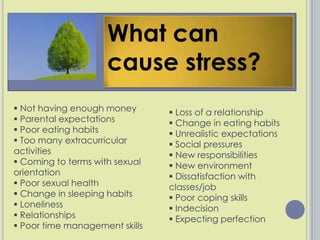
What can cause stress?
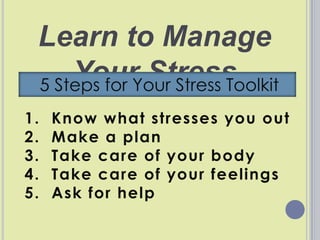
Learn to Manage Your Stress5 Steps for Your Stress Toolkit 1.  Know what stresses you out2.  Make a plan3.  Take care of your body4.  Take care of your feelings5.  Ask for help
Step 1:know what stresses you out! Everyone is differentSomething that bothers someone else may not be a issue for you.
Learning what stresses you out, is the first step to dealing with stress. Notice your stressIs it good or bad stress?
What caused it?
Is it likely to happen again?
Can you do anything to change it?Step 1:know what stresses you out! Make a listWrite down times you feel stressed.
Notice what you do.
What helps? What makes it worse? Set goals Which problems or stresses go away by themselves?
Which need attention? Step 2:Make a PlanResults take timeCreating a plan can help you manage your stress.
Keep a journal to track your stress levels and record your thoughts and feelings.Stay on trackKeep your goals realistic.

Stress Management

  • 1.
    Manage stress beforeit manages you! Office of Health Education and PromotionHealth Services, University of New Hampshire(603) 862-3823www.unh.edu/health-servicesFacebook/Twitter
  • 2.
    Stress is yourphysical, emotional and mental response to all external influences.
  • 3.
    Not all stressis bad! Without some stress, people wouldn’t get a lot done. Insufficient positive stress may leave us feeling bored. The extra burst of adrenaline that helps you finish your final paper, win at sports, or meet any other challenge is positive stress.If you can’t return to a relaxed state, this stress becomes negative. It can leave us feeling overwhelmed. The changes in your body start to take their toll, often leading to mental and physical exhaustion and illness.Hang in there!
  • 4.
    What are possiblesymptoms of negative stress?Sleep disturbances Tension or migraine headaches Constipation or diarrhea Sweaty palms or hands Fatigue Nervousness “Butterflies” Memory problems Lack of concentration Substance abuse Overreactions Back, shoulder or neck pain
  • 5.
  • 6.
  • 7.
    Skin problems (hives,eczema, tics)
  • 8.
  • 9.
  • 10.
  • 11.
  • 12.
  • 13.
    Feeling out ofcontrol **Physical and emotional symptoms may be the result of a serious physical illness too. It is important to have a medical clinician check you first.
  • 14.
  • 15.
    Learn to ManageYour Stress5 Steps for Your Stress Toolkit 1. Know what stresses you out2. Make a plan3. Take care of your body4. Take care of your feelings5. Ask for help
  • 16.
    Step 1:know whatstresses you out! Everyone is differentSomething that bothers someone else may not be a issue for you.
  • 17.
    Learning what stressesyou out, is the first step to dealing with stress. Notice your stressIs it good or bad stress?
  • 18.
  • 19.
    Is it likelyto happen again?
  • 20.
    Can you doanything to change it?Step 1:know what stresses you out! Make a listWrite down times you feel stressed.
  • 21.
  • 22.
    What helps? Whatmakes it worse? Set goals Which problems or stresses go away by themselves?
  • 23.
    Which need attention?Step 2:Make a PlanResults take timeCreating a plan can help you manage your stress.
  • 24.
    Keep a journalto track your stress levels and record your thoughts and feelings.Stay on trackKeep your goals realistic.