STRESS AND ADAPTATION ;CRISIS
AND INTERVENTION
BY :-
MANISHA RANI
M.Sc NURSING
1ST
YEAR
STRESS  Stress is a state
produced by
change in the
environment
that is perceived
as a challenging,
threatening or
damaging to the
person’s
dynamic
balance.
STRESS-DEFINITION
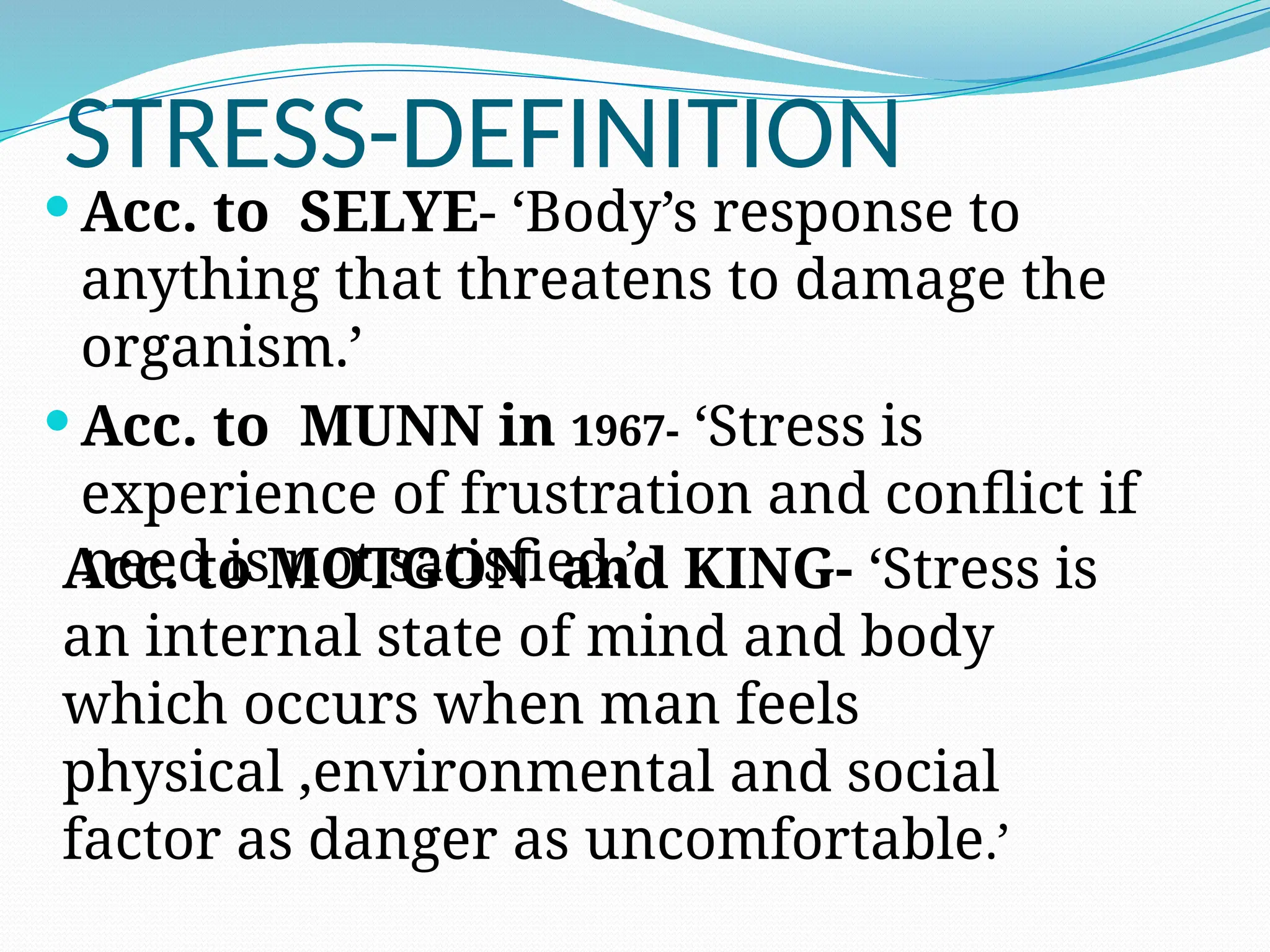
 Acc. to SELYE- ‘Body’s response to
anything that threatens to damage the
organism.’
 Acc. to MUNN in 1967- ‘Stress is
experience of frustration and conflict if
need is not satisfied.’
Acc. to MOTGON and KING- ‘Stress is
an internal state of mind and body
which occurs when man feels
physical ,environmental and social
factor as danger as uncomfortable.’
Stress, Homeostasis and Allostasis
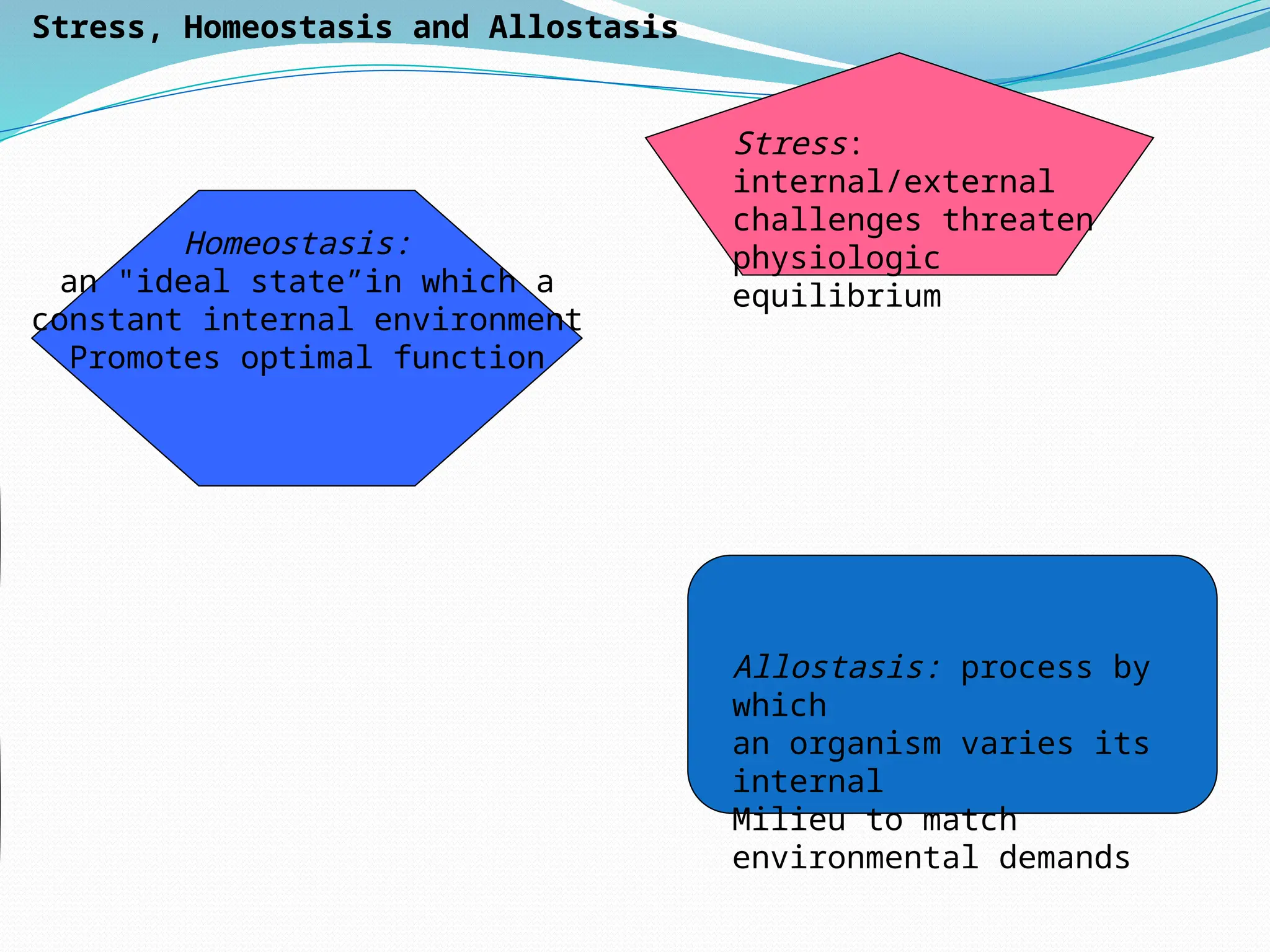
Stress:
internal/external
challenges threaten
physiologic
equilibrium
Homeostasis:
an "ideal state”in which a
constant internal environment
Promotes optimal function
Allostasis: process by
which
an organism varies its
internal
Milieu to match
environmental demands
5
2. DISTRESS is negative and harmful and causes us to adapt
to changing situations; there is the short-term variety of acute
stress that passes quickly, and long-term chronic stress.
3. HYPERSTRESS is when we get so stressed out that we just
overload because it is just too much for us to handle.
4. HYPOSTRESS means just not enough stress. We need a
little bit in our lives, otherwise we feel bored and have nothing
challenging us.
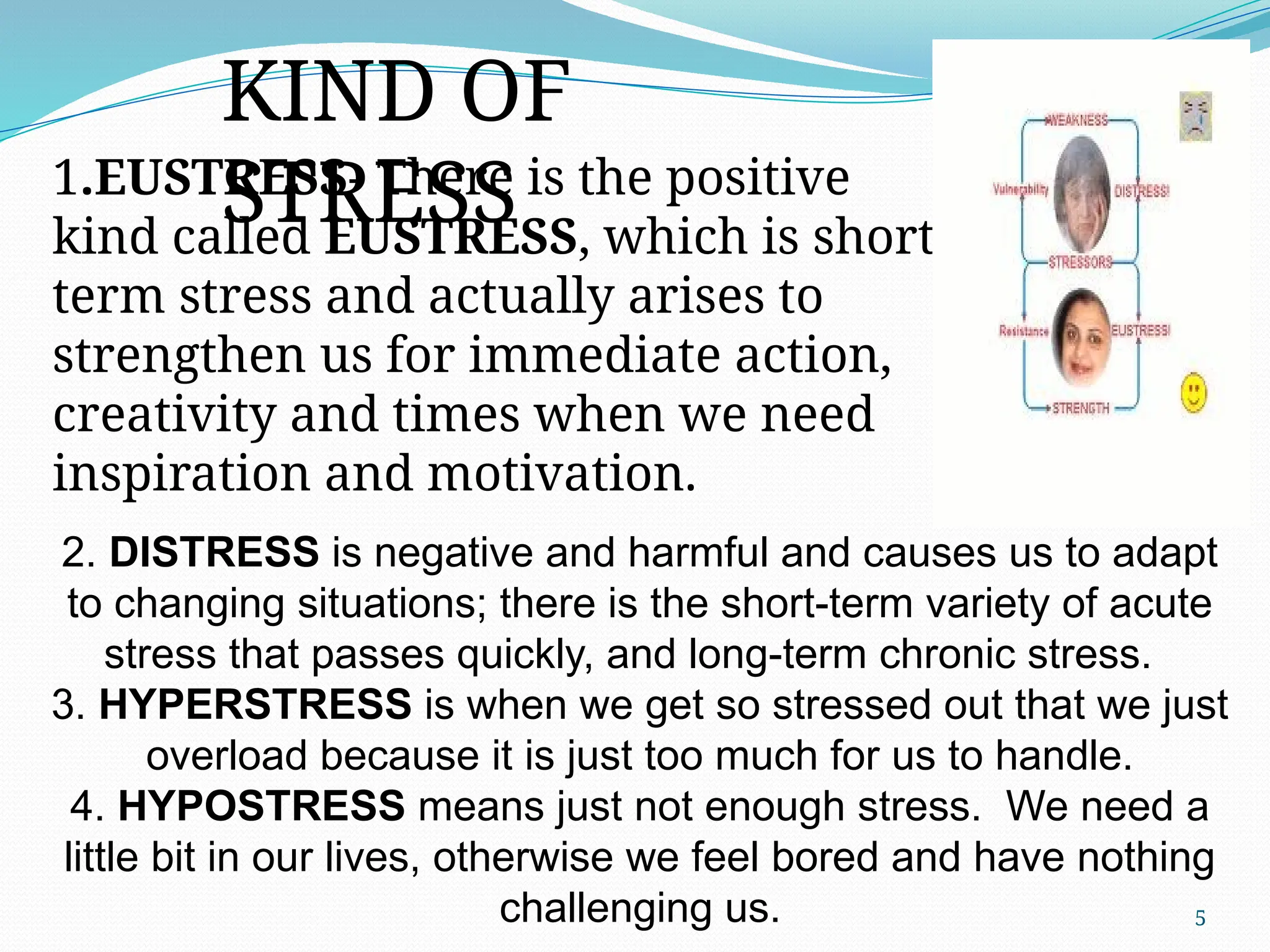
1.EUSTRESS- There is the positive
kind called EUSTRESS, which is short
term stress and actually arises to
strengthen us for immediate action,
creativity and times when we need
inspiration and motivation.
KIND OF
STRESS
OTHER CLASSIFICATION-KINDS OF STRESS
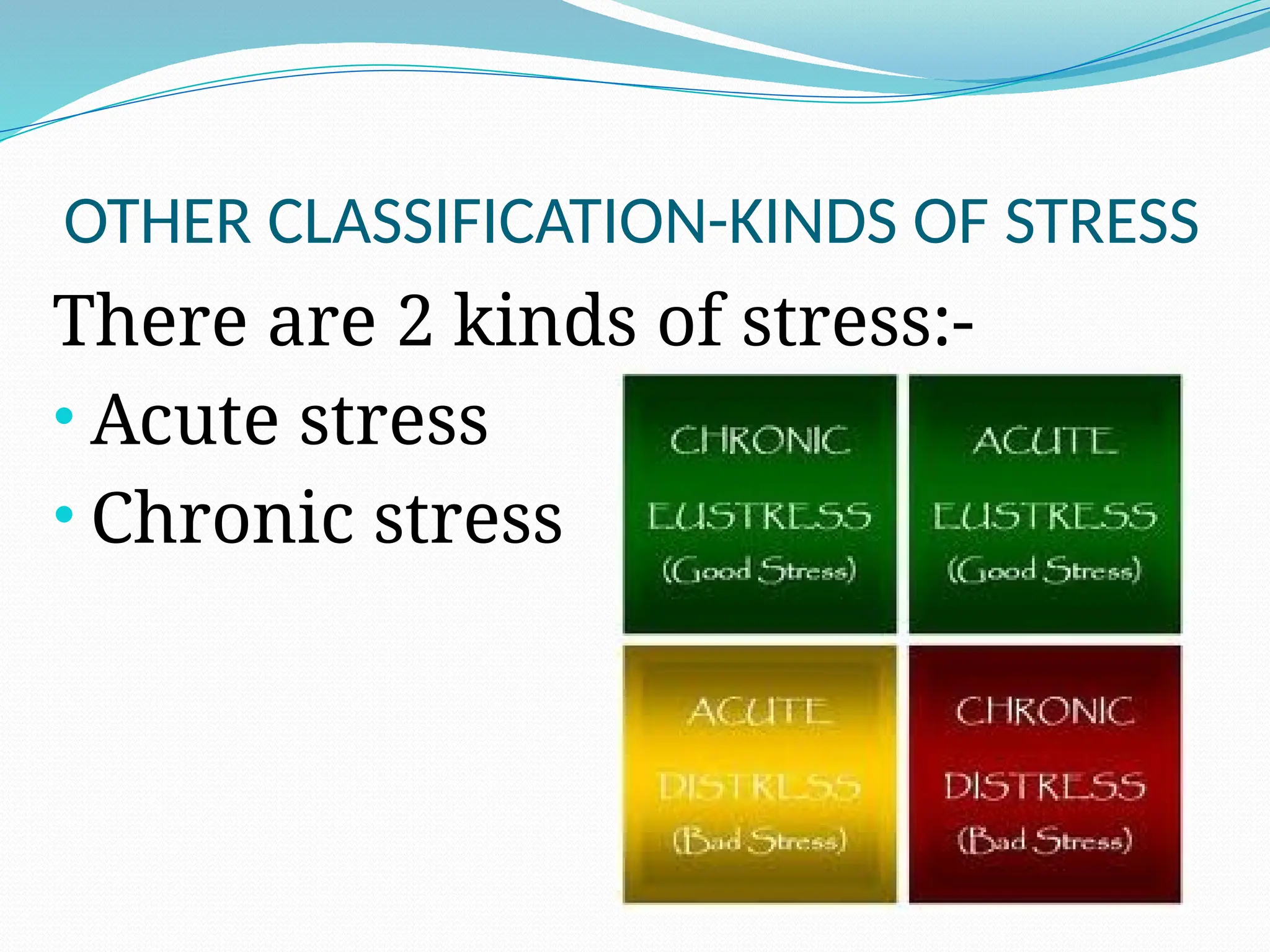
There are 2 kinds of stress:-
• Acute stress
• Chronic stress
ACUTE STRESS
 It is the most common stress.It comes from
demands and pressure of recent past and
anticipated demands and pressure of near
future.It exist for small time.It includes:-
Emotional-anger,anxiety
Muscular-backpain,headache
Stomach-constipation,diahorrea
Others-rapid heart rate,heart
palpitation,dizziness,migrane
headache, chest pain.
CHRONIC STRESS
 The stress the people wears away day after
day,year after year.It destroy body and lives.It
is a stress of unrelated demands.It is because
of stress of poverty,dysfunctioning
family,unhappy marriage,loss of job.It
include:-
Suicide
Violence
Heart attack
Stroke
Cancer
CONSEQUENCES OF STRESS
PHYSIOLOGICAL-It can threat person’s
physiological homeostasis
EMOTIONAL-It can produce negative and
unconstructive feeling about self
INTELLECTUAL-It can influence person’s
perceptual and problem solving ability.
SOCIALLY-It can alter person’s relationship with
other
SPIRITUALLY-It can challenge one’s believes
and values
WHO ARE EASILY STRESSED
Type A vrs. Type B
Personalities
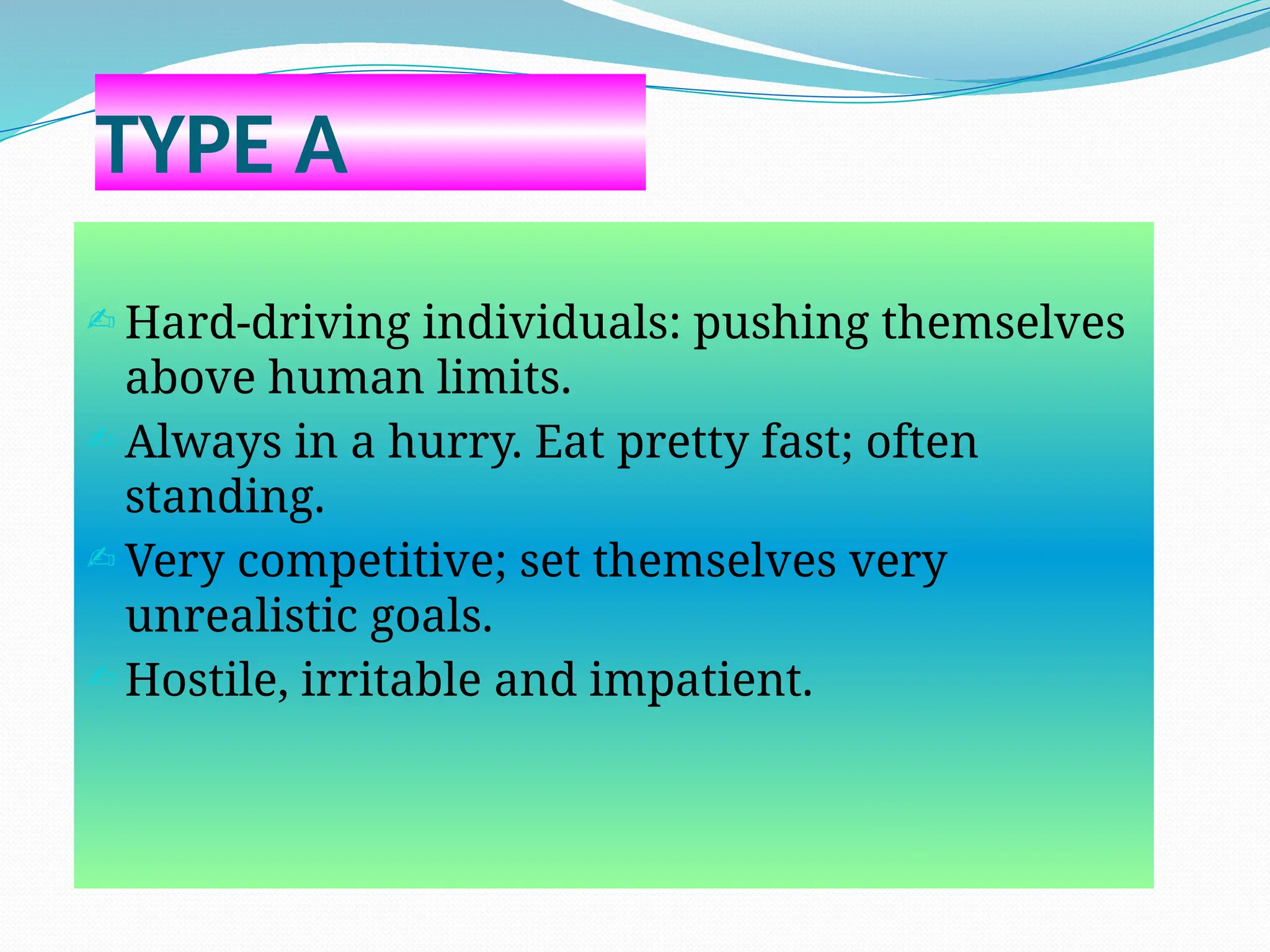
TYPE A
 Hard-driving individuals: pushing themselves
above human limits.
 Always in a hurry. Eat pretty fast; often
standing.
 Very competitive; set themselves very
unrealistic goals.
 Hostile, irritable and impatient.
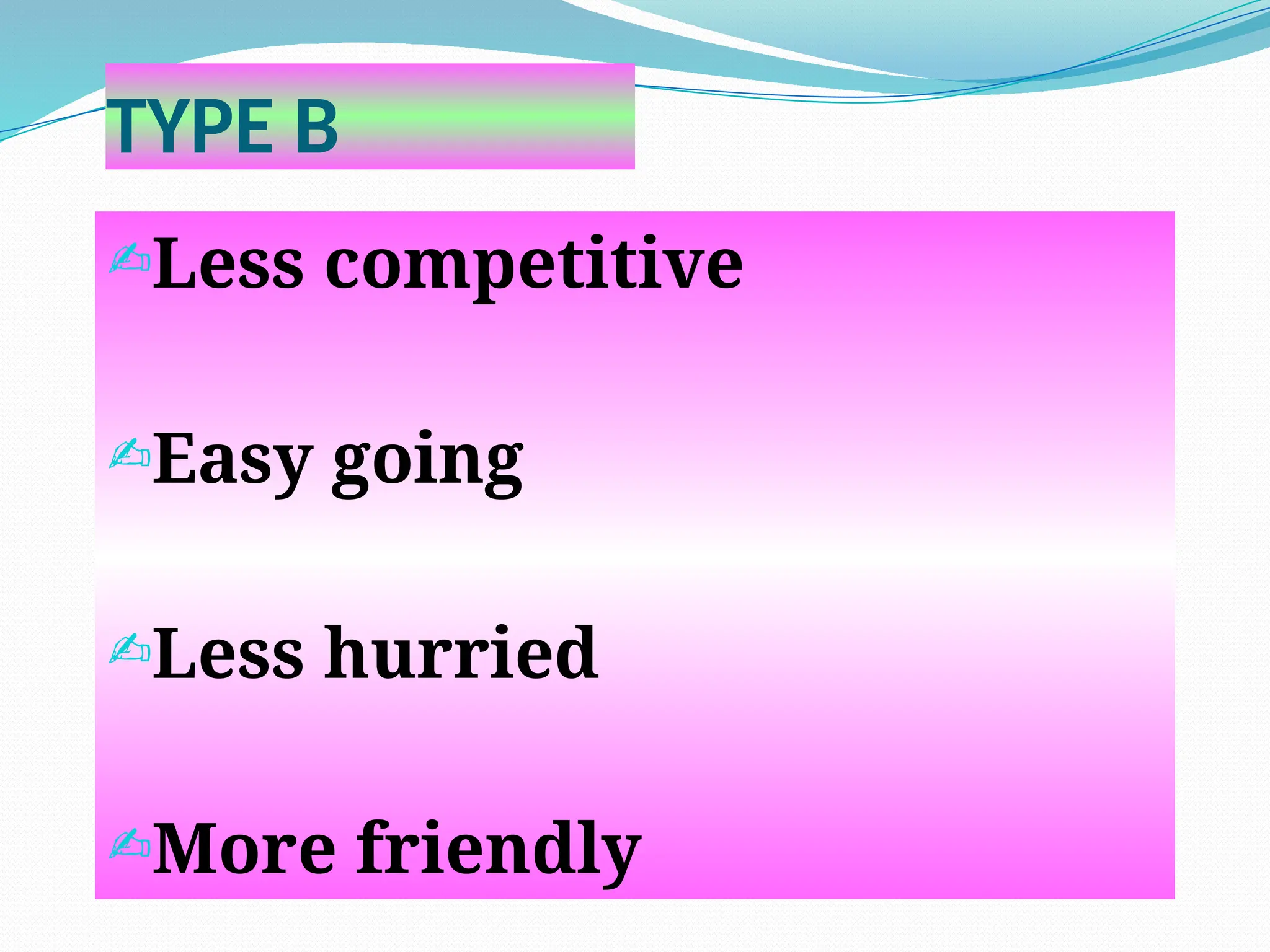
TYPE B
Less competitive
Easy going
Less hurried
More friendly
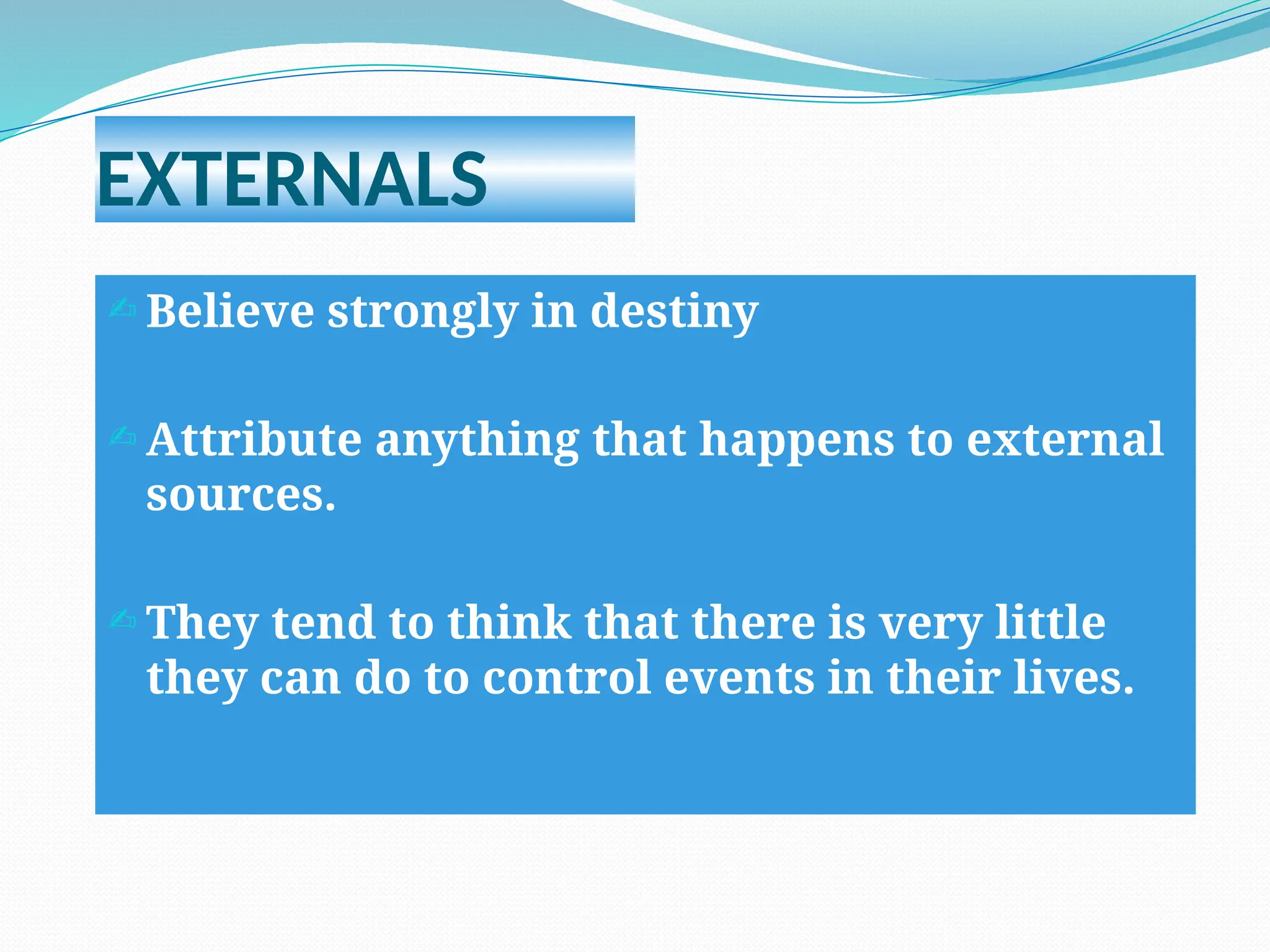
EXTERNALS
 Believe strongly in destiny
 Attribute anything that happens to external
sources.
 They tend to think that there is very little
they can do to control events in their lives.
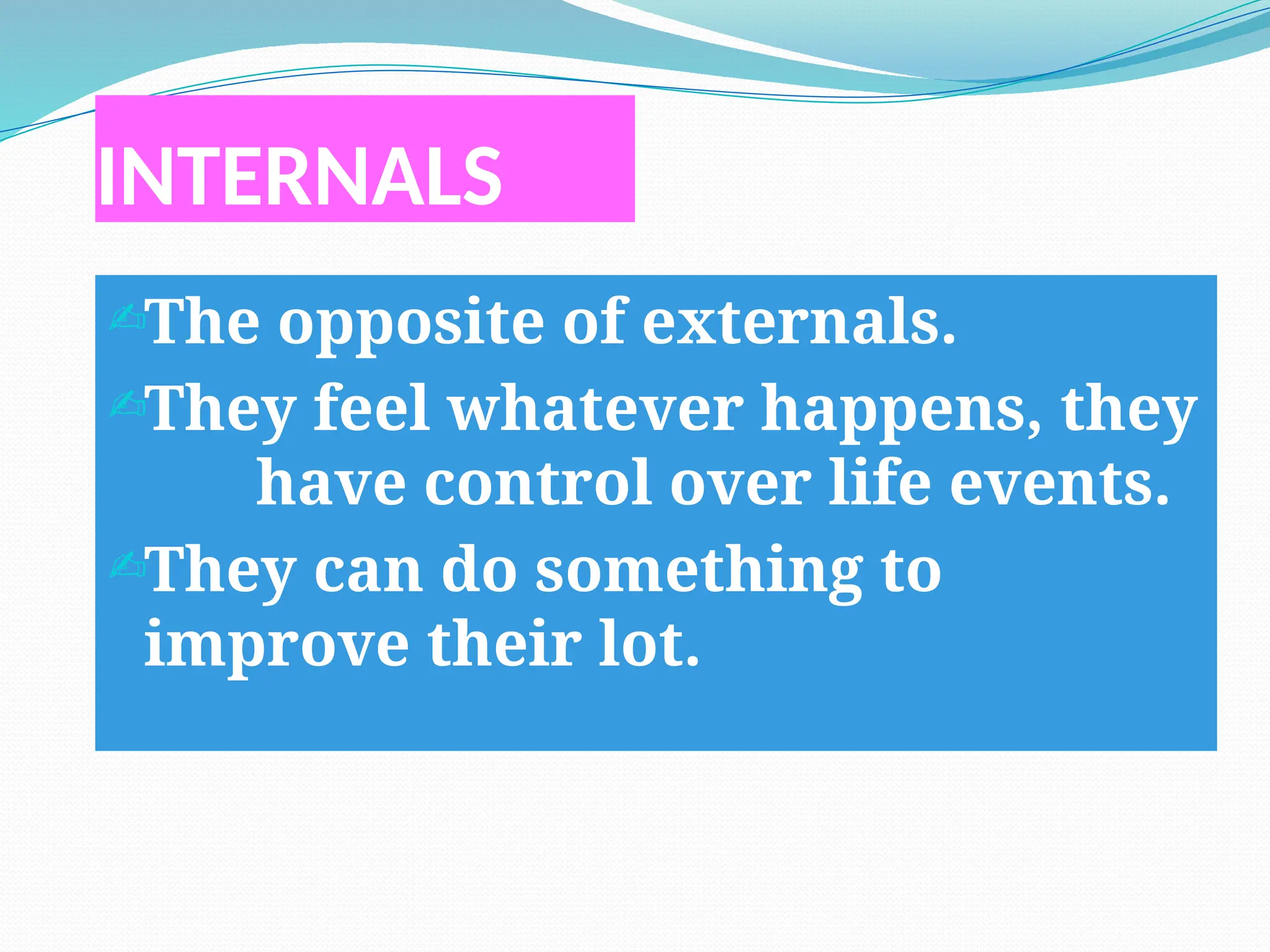
INTERNALS
The opposite of externals.
They feel whatever happens, they
have control over life events.
They can do something to
improve their lot.
THE HARDY PERSONALITY
Such people go through very
stressful events but are not
affected by them.
They see life as a challenge.
Life threatening events seem
to them as opportunities to
prove themselves.
TYPES OF STRESSOR
Physical stressors include
cold,heat and chemical agents.
Physiologic include pain and
fatigue
 Psychosocial include failing
in examination or loss of job
Other classification is:-
a) Day to day frustration stressors
b) Major complex occurrences
involving large group
c) Stressor that occurs less
frequently and involves few
people
 1st
group the day to day stressors includes
such common occurrences as getting caught
in traffic jam or having an argument with
spouse.
 2nd
group influences the large group of
people.This include the events of
history,experience in the war or terrorism
3rd
group include the situation that
directly affects the individual.This
include the influences of life events
such as
death,birth,marriage,divorce and
retirement.
FACTORS INFLUENCES STRESS RESPONSE
INTENSITY-Greater the perception of
stressor greater the response.
DURATION-Greater the duration of
the stressor greater the stress
response.
SOCIAL SUPPORT-Support of other
people reduce the negative effects of
stressful events.
 PREDICTABILITY-Being able to anticipate
the occurrence of the event ,generally result
in a less experience of stress.
 LEVEL OF PERSONAL CONTROL-control
over unpleasant experience ,reduce the level
of associated stress and anxiety
FEELING OF COMPETENCE-Greater self
confidence to manage stressful condition
results in less tension and anxiety.
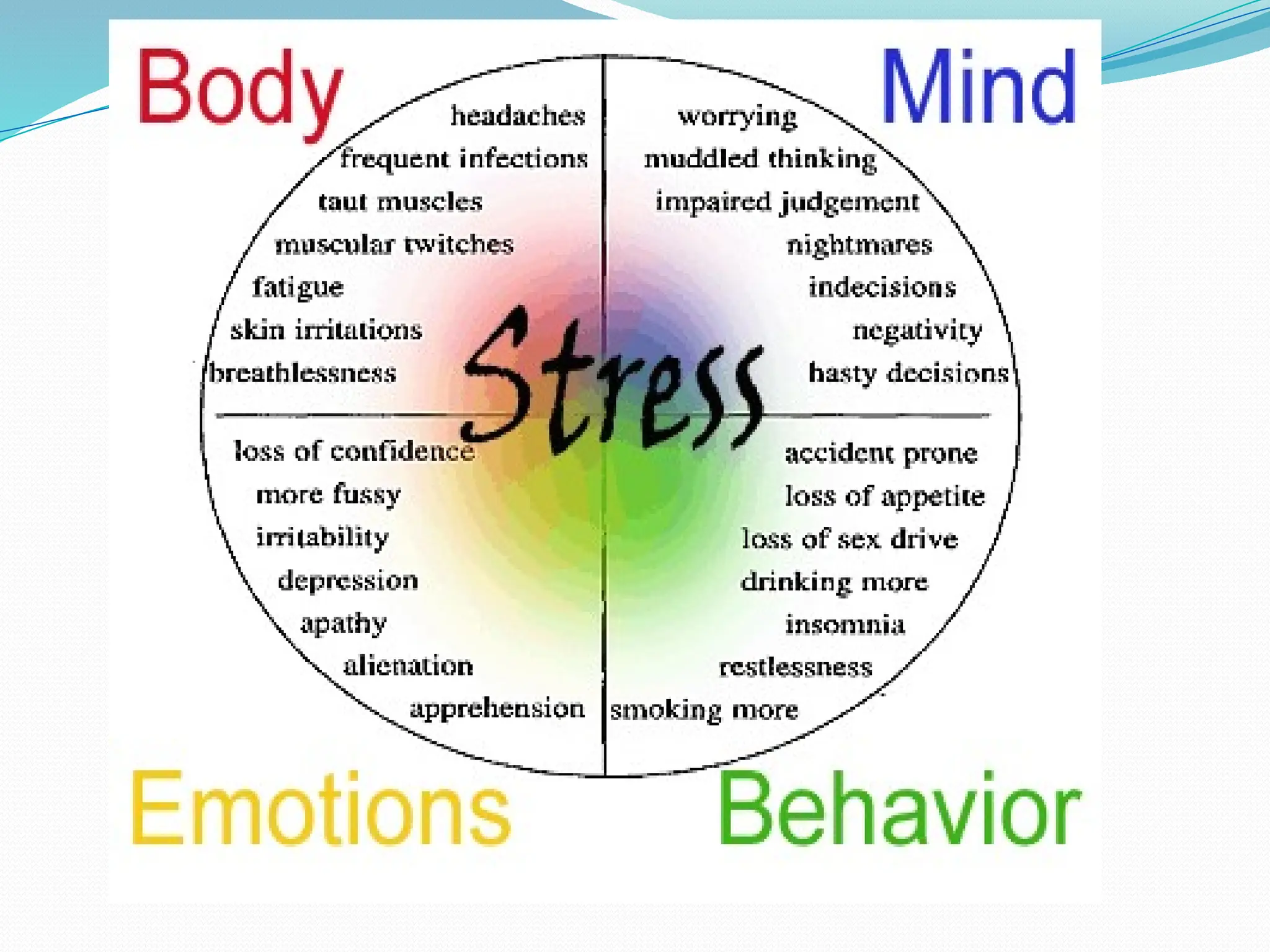
EFFECTS OF STRESS
4 types of effects that are:-
Physical effect
Mental effect
Emotional effect
Behavior effect
DISEASES CAUSED BY STRESS
Ischemic heart
diseases
Irritable bowel
sound
Acid peptic
diseases
Tension
Insomnia
Alcoholism
Insomnia
Hypertension
Fatigue
Asthma
Obesity
Depression
General Adaptation Syndrome
Alarm
“Fight or Flight” reaction: body mobilizes resources to combat threat;
activates the sympathetic nervous system.
Resistance
Enhanced ability to fight stressor via moderate physiological arousal;
ability to withstand additional stressors (e.g., infection) is reduced.
Exhaustion
Depletion of resources brings on diseases and disorders (e.g., chronically high
heart rate and blood pressure increase chances of heart attack and stroke).
Alarm Reaction
 Person perceives stressor, defense mechanisms activated
 Fight-or-flight response
 Hormone levels rise, body prepares to react
 Shock and counter-shock phases (1 min - 24 hrs)
Body attempts to adapt to stressor.
Vital signs, hormone levels, and energy production
return to normal.
Body regains homeostasis or adaptive mechanisms
fail.
Resistance
Exhaustion
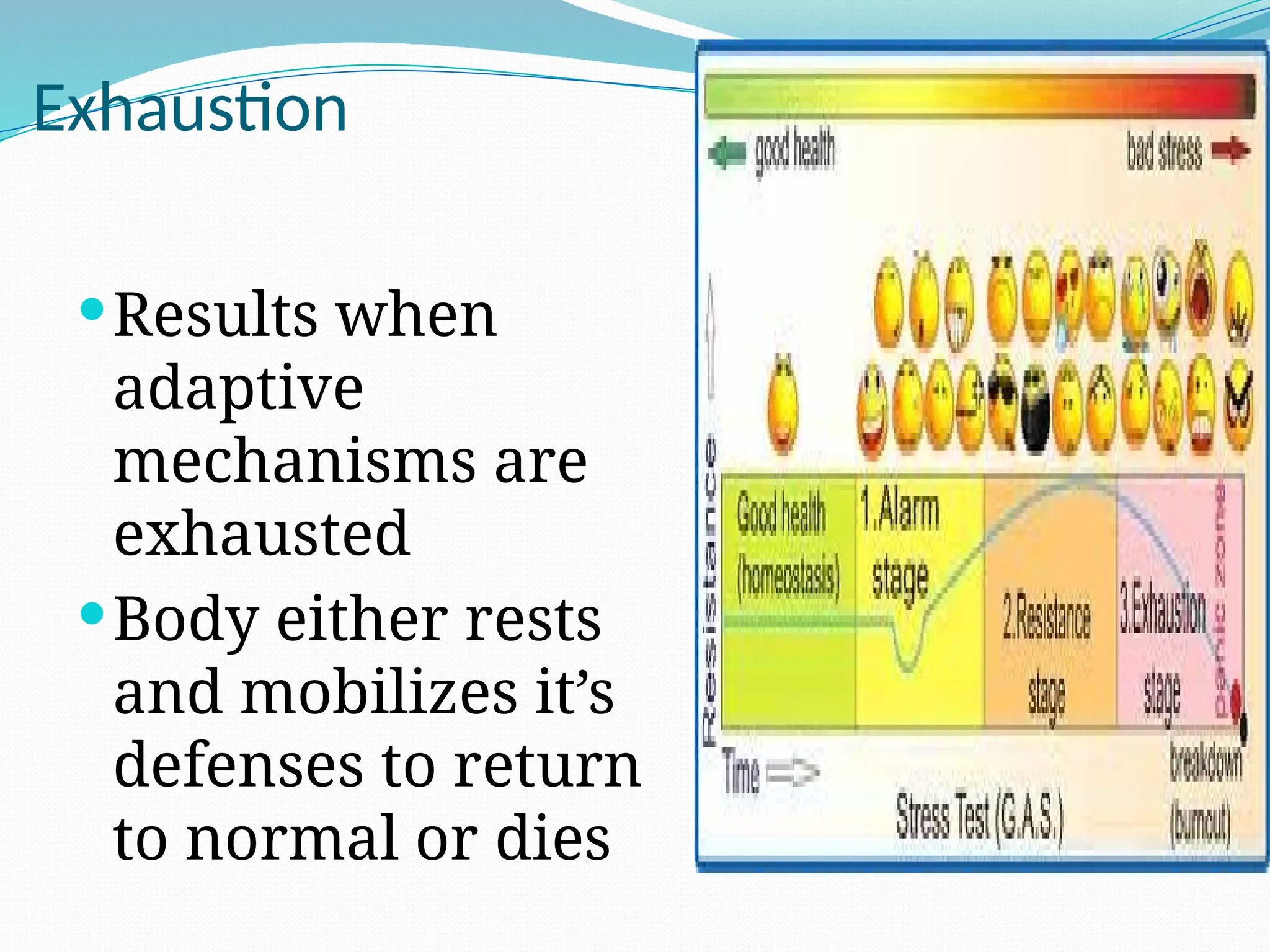
Results when
adaptive
mechanisms are
exhausted
Body either rests
and mobilizes it’s
defenses to return
to normal or dies
STRESS AND ADAPTATION
Adaptation is ongoing process that
require a change in structure,function
and behavior so that person is better
suited to environment.
Adaptation occurs through out the life
spans the individual encounters many
developmental and situational
challenges
COPING
It is the action stage when most
appropriate plan of action is
carried out to meet the
challenge of stress.
STRESS MANAGEMENT TIPS
Recognize the problem
Reduce exposure to stressor
Learn to adjust properly in four
areas(family,friends,work and
leisure)
Organize life a little more
efficiently
Learn to relax body by some quick
relievers i.e breathing exercise can help
to turn off the body stress.
Learn to relax mind
Exercise,eat and sleep properly
Make time for fun
Express and share your feeling
Learn to tackle life changing events
31
Play Sports and
Exercise
EAT A
HEALTHY
DIET
Physical Exercise
 Exercise is a major component of
comprehensive stress management
programme and of overall good health.
 People who exercise regularly are much
less likely to suffer from fatigue and
depression.
 With regular exercise depression, tension,
feelings of inadequacy and worries greatly
diminish.
33
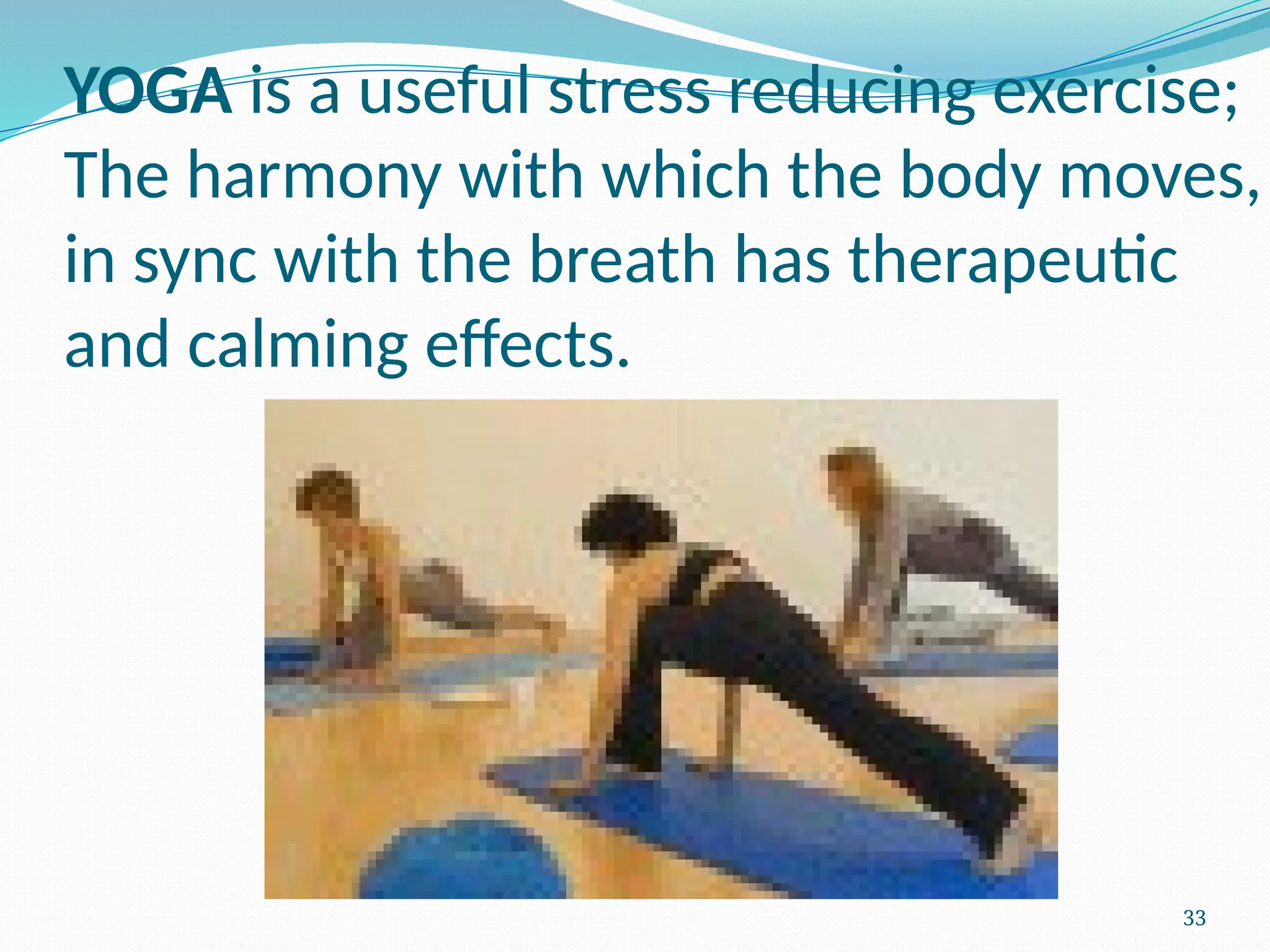
YOGA is a useful stress reducing exercise;
The harmony with which the body moves,
in sync with the breath has therapeutic
and calming effects.
Mental relaxation
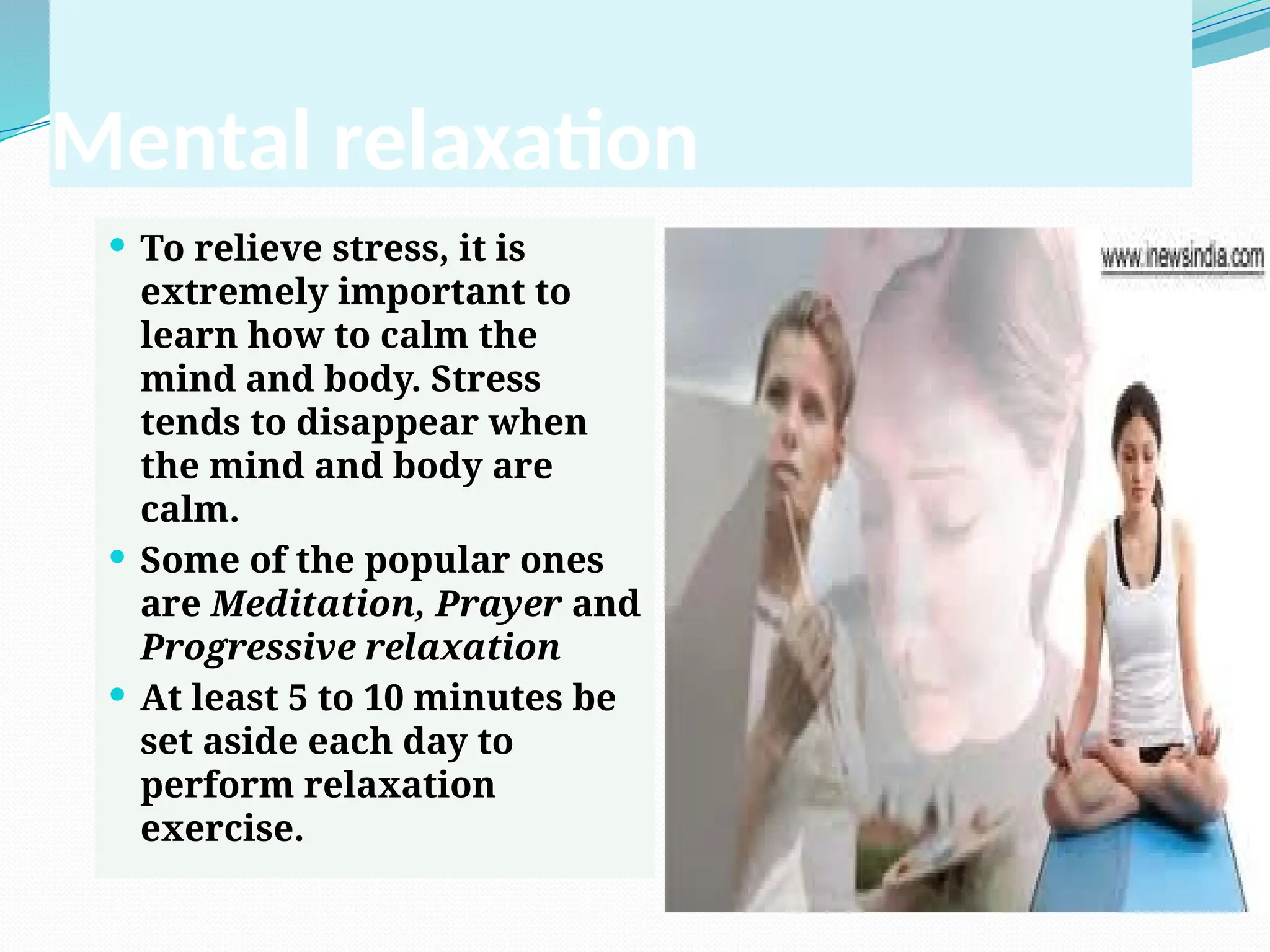
 To relieve stress, it is
extremely important to
learn how to calm the
mind and body. Stress
tends to disappear when
the mind and body are
calm.
 Some of the popular ones
are Meditation, Prayer and
Progressive relaxation
 At least 5 to 10 minutes be
set aside each day to
perform relaxation
exercise.
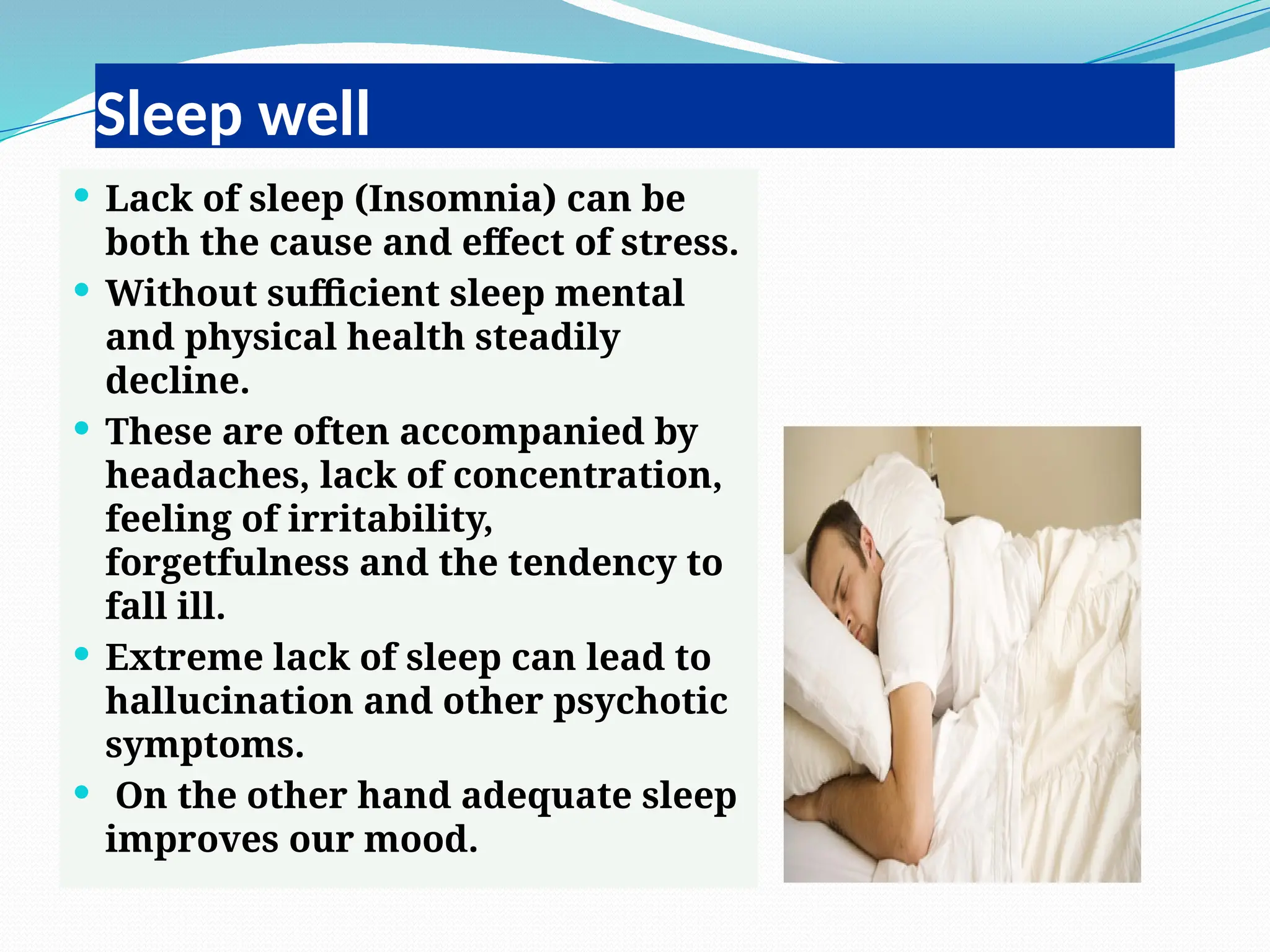
Sleep well
 Lack of sleep (Insomnia) can be
both the cause and effect of stress.
 Without sufficient sleep mental
and physical health steadily
decline.
 These are often accompanied by
headaches, lack of concentration,
feeling of irritability,
forgetfulness and the tendency to
fall ill.
 Extreme lack of sleep can lead to
hallucination and other psychotic
symptoms.
 On the other hand adequate sleep
improves our mood.
36
 AROMATHERAPY Essential oils work because of
their small molecular size which allows them to
penetrate bodily tissues easily. They also create a
pleasant smell that emotionally lifts the user. The
neurochemical makeup of the brain is altered
through the olfactory sense.
And Bach
Flowers
Time management
¨Set priorities: Limit your
efforts to the most important
goal, realising that you can
only achieve so much in a day
¨Organise your day: Make a
definite plan for the day.
¨Delegate as much authority
and work as you can.
¨Tackle difficult jobs first,
handling the most important
tasks first, while your energy
level is still high.
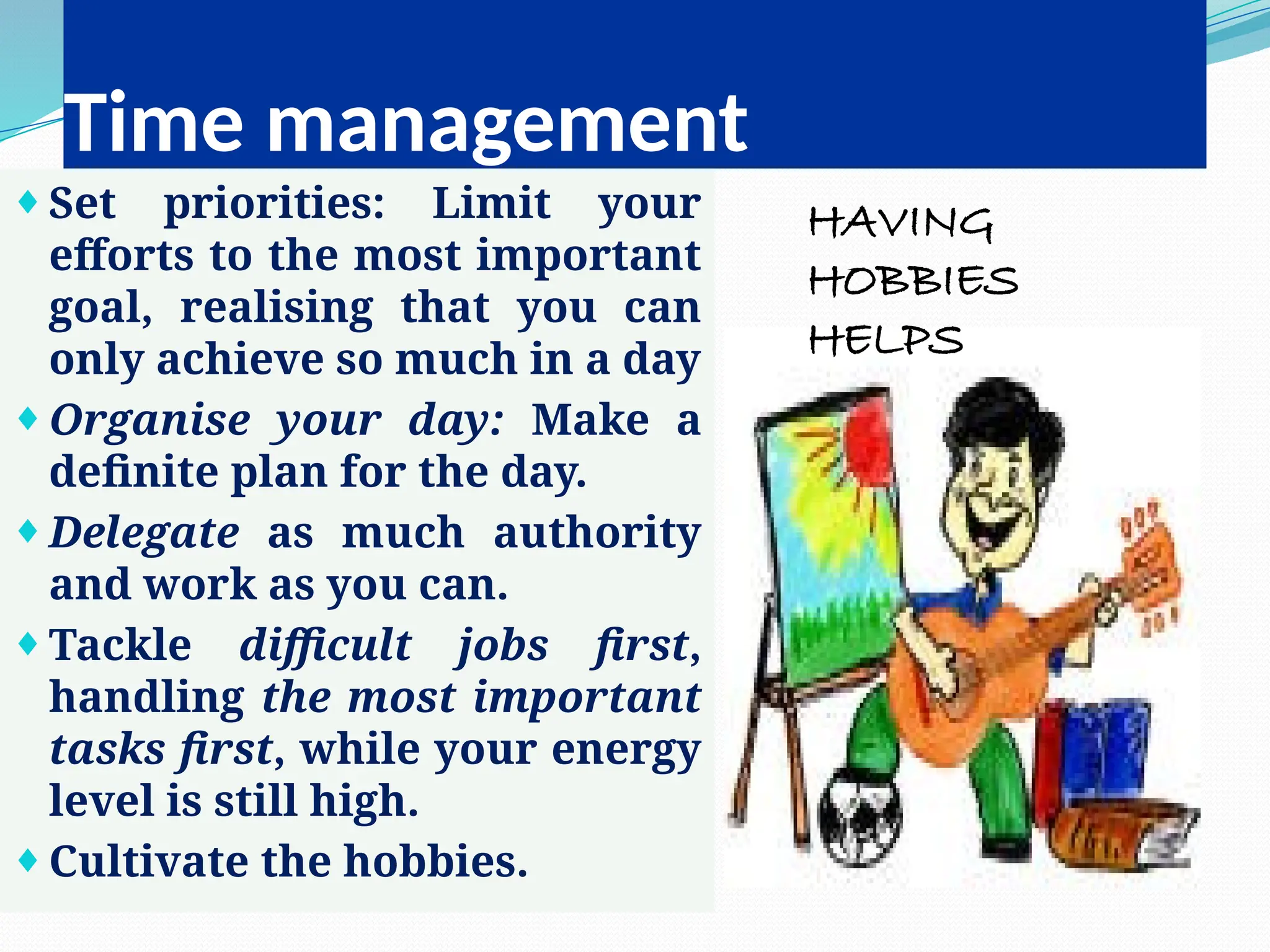
¨Cultivate the hobbies.
HAVING
HOBBIES
HELPS
STEPS TO COPE WITH STRESS
Keep stress diary
a) Write each stressful event
b) Write source of stress
c) Your initial reaction to stress
d) How your body respond
e) How did your mind respond
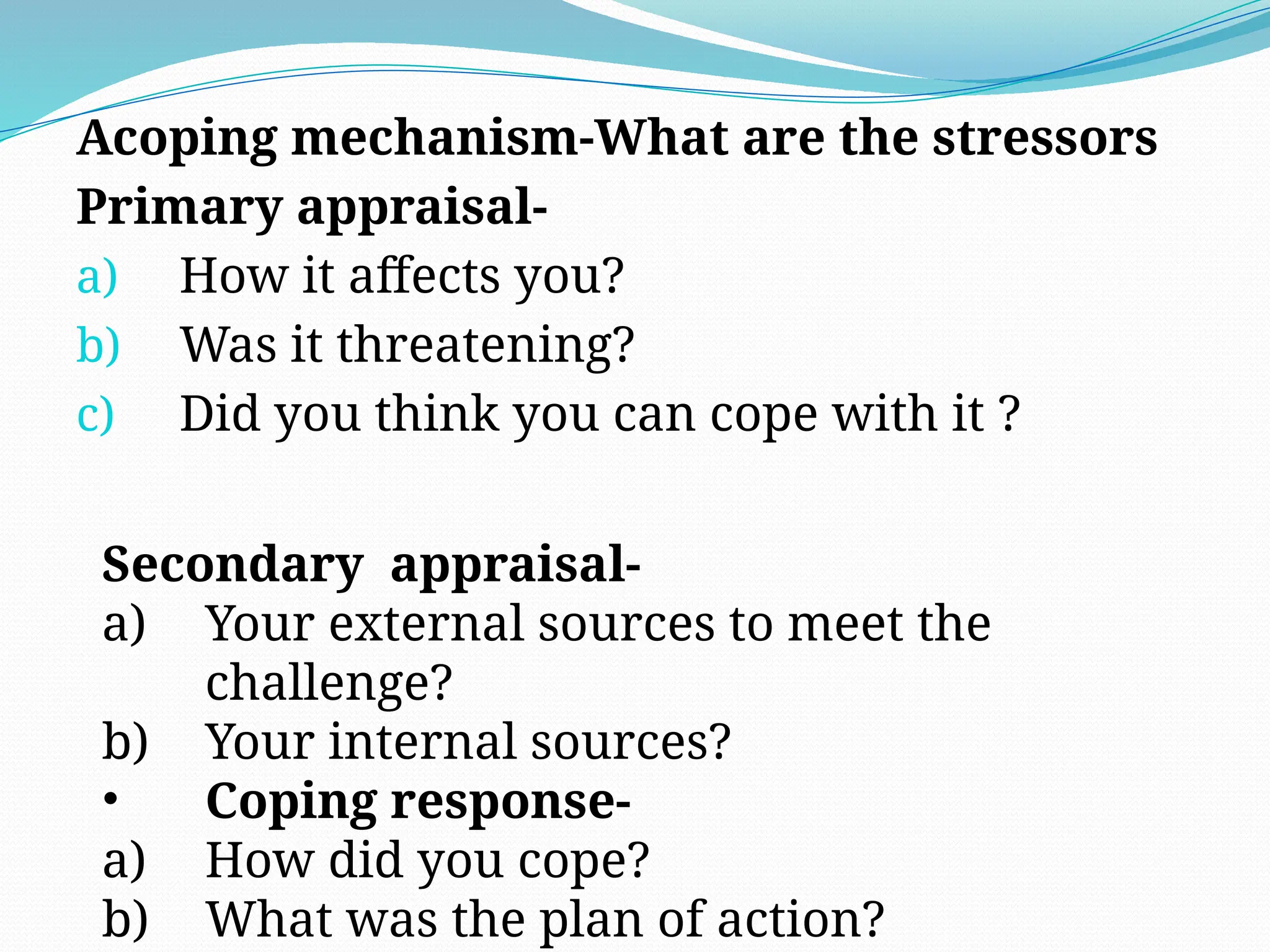
Acoping mechanism-What are the stressors
Primary appraisal-
a) How it affects you?
b) Was it threatening?
c) Did you think you can cope with it ?
Secondary appraisal-
a) Your external sources to meet the
challenge?
b) Your internal sources?
• Coping response-
a) How did you cope?
b) What was the plan of action?
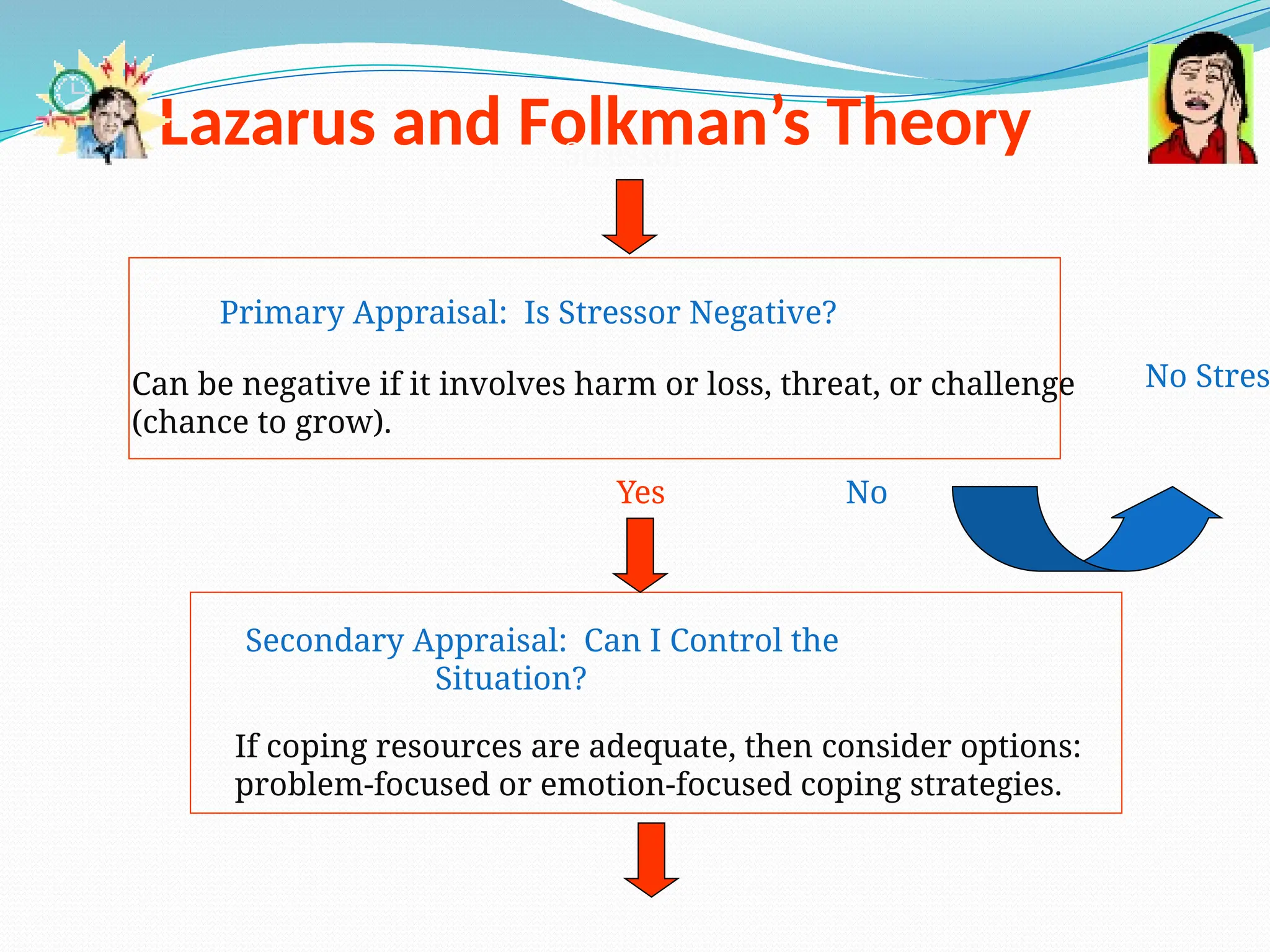
Lazarus and Folkman’s Theory
Stressor
Primary Appraisal: Is Stressor Negative?
Can be negative if it involves harm or loss, threat, or challenge
(chance to grow).
Secondary Appraisal: Can I Control the
Situation?
If coping resources are adequate, then consider options:
problem-focused or emotion-focused coping strategies.
Yes No
No Stres
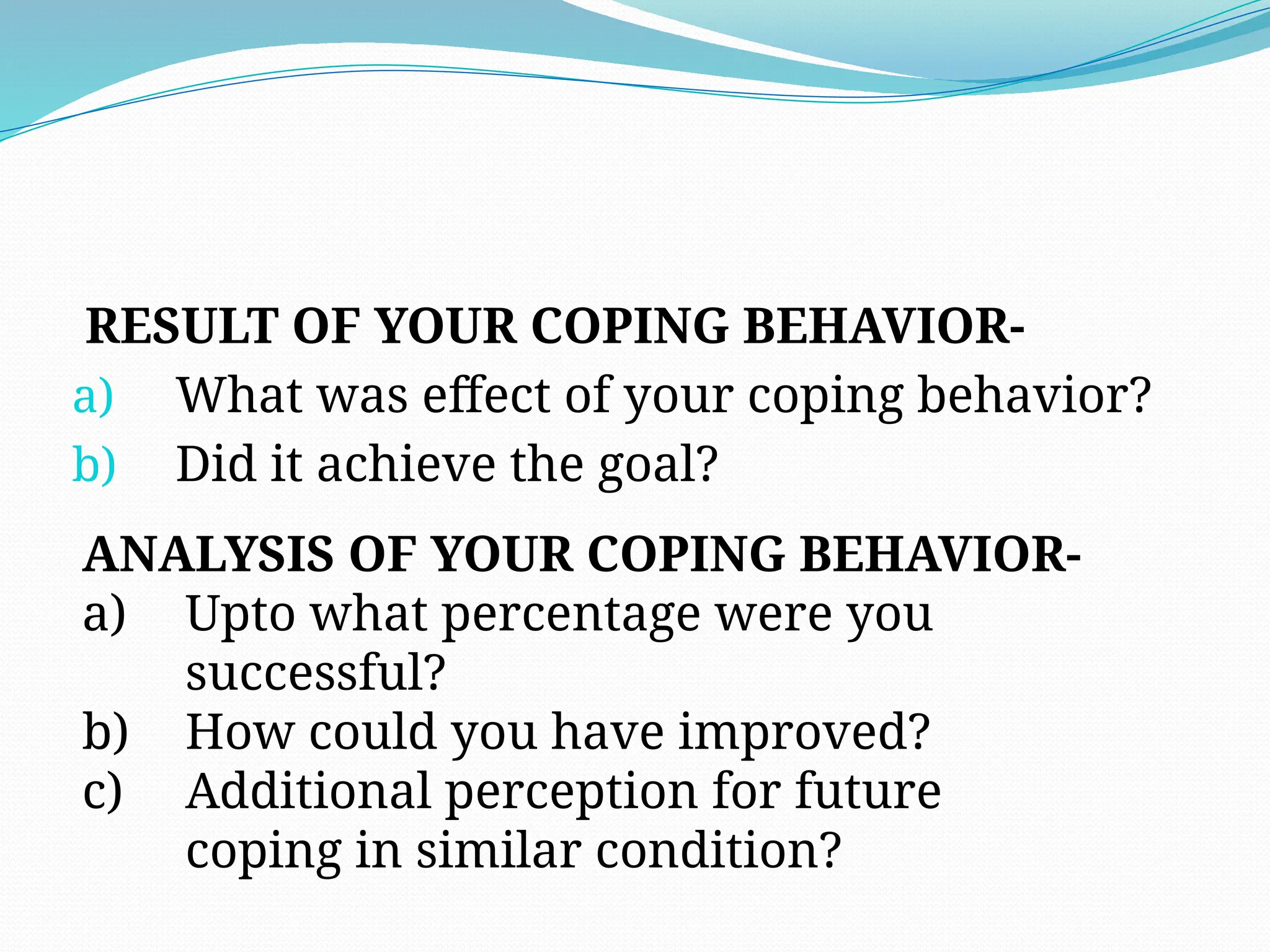
RESULT OF YOUR COPING BEHAVIOR-
a) What was effect of your coping behavior?
b) Did it achieve the goal?
ANALYSIS OF YOUR COPING BEHAVIOR-
a) Upto what percentage were you
successful?
b) How could you have improved?
c) Additional perception for future
coping in similar condition?
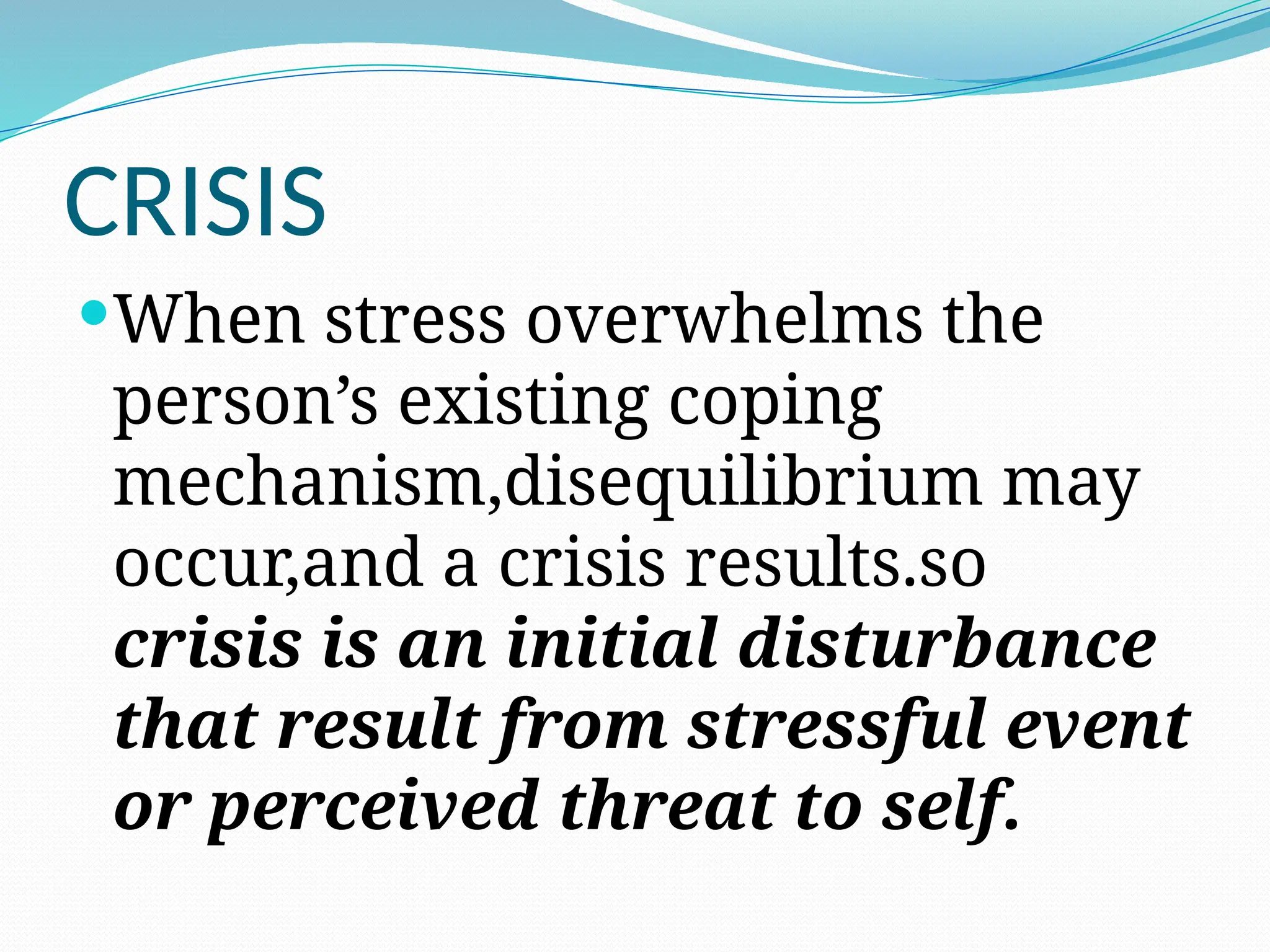
CRISIS
When stress overwhelms the
person’s existing coping
mechanism,disequilibrium may
occur,and a crisis results.so
crisis is an initial disturbance
that result from stressful event
or perceived threat to self.
TYPES OF CRISIS
 MATURATIONAL-It demands for various stages
of development which an individual need to
cope with ,e.g-adolescence,adult,old age
 SITUATIONAL-such as loss of
employment ,severe suicidal ideation,marital
dispute,change from rural to urban
setting,technology changes.
 ADVENTITIOUS CRISIS-Accidental or
unexpected crisis,for example,both the parents
die and child is left alone.
CRISIS INTERVENTION
 Crisis intervention is process by which
an individual is helped to cope with a
crisis in his life situation,so as to bring
his level of functioning to that of the
precrisis stage.
Crisis Intervention
Identify the problem
List alternatives
Choose from alternatives
Implement the plan
Evaluate the outcome
THE FAMOUS
SERENITY
PRAYER:
“Grant me the
serenity to accept
the things I
cannot change,
the courage to
change the things
I can, and the
wisdom to know
the difference.”
CHANGING THE
SITUATION
OR
LEARNING TO
ACCEPT IT
WITHOUT
FEELING STRESS
OPTIONS FOR
CONTROLING
STRESS
THANK YOU

STRESS AND ADAPTATION.pptxstress and adaptation

  • 1.
    STRESS AND ADAPTATION;CRISIS AND INTERVENTION BY :- MANISHA RANI M.Sc NURSING 1ST YEAR
  • 2.
    STRESS  Stressis a state produced by change in the environment that is perceived as a challenging, threatening or damaging to the person’s dynamic balance.
  • 3.
    STRESS-DEFINITION  Acc. toSELYE- ‘Body’s response to anything that threatens to damage the organism.’  Acc. to MUNN in 1967- ‘Stress is experience of frustration and conflict if need is not satisfied.’ Acc. to MOTGON and KING- ‘Stress is an internal state of mind and body which occurs when man feels physical ,environmental and social factor as danger as uncomfortable.’
  • 4.
    Stress, Homeostasis andAllostasis Stress: internal/external challenges threaten physiologic equilibrium Homeostasis: an "ideal state”in which a constant internal environment Promotes optimal function Allostasis: process by which an organism varies its internal Milieu to match environmental demands
  • 5.
    5 2. DISTRESS isnegative and harmful and causes us to adapt to changing situations; there is the short-term variety of acute stress that passes quickly, and long-term chronic stress. 3. HYPERSTRESS is when we get so stressed out that we just overload because it is just too much for us to handle. 4. HYPOSTRESS means just not enough stress. We need a little bit in our lives, otherwise we feel bored and have nothing challenging us. 1.EUSTRESS- There is the positive kind called EUSTRESS, which is short term stress and actually arises to strengthen us for immediate action, creativity and times when we need inspiration and motivation. KIND OF STRESS
  • 6.
    OTHER CLASSIFICATION-KINDS OFSTRESS There are 2 kinds of stress:- • Acute stress • Chronic stress
  • 7.
    ACUTE STRESS  Itis the most common stress.It comes from demands and pressure of recent past and anticipated demands and pressure of near future.It exist for small time.It includes:- Emotional-anger,anxiety Muscular-backpain,headache Stomach-constipation,diahorrea Others-rapid heart rate,heart palpitation,dizziness,migrane headache, chest pain.
  • 8.
    CHRONIC STRESS  Thestress the people wears away day after day,year after year.It destroy body and lives.It is a stress of unrelated demands.It is because of stress of poverty,dysfunctioning family,unhappy marriage,loss of job.It include:- Suicide Violence Heart attack Stroke Cancer
  • 9.
    CONSEQUENCES OF STRESS PHYSIOLOGICAL-Itcan threat person’s physiological homeostasis EMOTIONAL-It can produce negative and unconstructive feeling about self INTELLECTUAL-It can influence person’s perceptual and problem solving ability. SOCIALLY-It can alter person’s relationship with other SPIRITUALLY-It can challenge one’s believes and values
  • 10.
    WHO ARE EASILYSTRESSED Type A vrs. Type B Personalities
  • 11.
    TYPE A  Hard-drivingindividuals: pushing themselves above human limits.  Always in a hurry. Eat pretty fast; often standing.  Very competitive; set themselves very unrealistic goals.  Hostile, irritable and impatient.
  • 12.
    TYPE B Less competitive Easygoing Less hurried More friendly
  • 13.
    EXTERNALS  Believe stronglyin destiny  Attribute anything that happens to external sources.  They tend to think that there is very little they can do to control events in their lives.
  • 14.
    INTERNALS The opposite ofexternals. They feel whatever happens, they have control over life events. They can do something to improve their lot.
  • 15.
    THE HARDY PERSONALITY Suchpeople go through very stressful events but are not affected by them. They see life as a challenge. Life threatening events seem to them as opportunities to prove themselves.
  • 16.
    TYPES OF STRESSOR Physicalstressors include cold,heat and chemical agents. Physiologic include pain and fatigue  Psychosocial include failing in examination or loss of job
  • 17.
    Other classification is:- a)Day to day frustration stressors b) Major complex occurrences involving large group c) Stressor that occurs less frequently and involves few people
  • 18.
     1st group theday to day stressors includes such common occurrences as getting caught in traffic jam or having an argument with spouse.  2nd group influences the large group of people.This include the events of history,experience in the war or terrorism 3rd group include the situation that directly affects the individual.This include the influences of life events such as death,birth,marriage,divorce and retirement.
  • 19.
    FACTORS INFLUENCES STRESSRESPONSE INTENSITY-Greater the perception of stressor greater the response. DURATION-Greater the duration of the stressor greater the stress response. SOCIAL SUPPORT-Support of other people reduce the negative effects of stressful events.
  • 20.
     PREDICTABILITY-Being ableto anticipate the occurrence of the event ,generally result in a less experience of stress.  LEVEL OF PERSONAL CONTROL-control over unpleasant experience ,reduce the level of associated stress and anxiety FEELING OF COMPETENCE-Greater self confidence to manage stressful condition results in less tension and anxiety.
  • 21.
    EFFECTS OF STRESS 4types of effects that are:- Physical effect Mental effect Emotional effect Behavior effect
  • 23.
    DISEASES CAUSED BYSTRESS Ischemic heart diseases Irritable bowel sound Acid peptic diseases Tension Insomnia Alcoholism Insomnia Hypertension Fatigue Asthma Obesity Depression
  • 24.
    General Adaptation Syndrome Alarm “Fightor Flight” reaction: body mobilizes resources to combat threat; activates the sympathetic nervous system. Resistance Enhanced ability to fight stressor via moderate physiological arousal; ability to withstand additional stressors (e.g., infection) is reduced. Exhaustion Depletion of resources brings on diseases and disorders (e.g., chronically high heart rate and blood pressure increase chances of heart attack and stroke).
  • 25.
    Alarm Reaction  Personperceives stressor, defense mechanisms activated  Fight-or-flight response  Hormone levels rise, body prepares to react  Shock and counter-shock phases (1 min - 24 hrs) Body attempts to adapt to stressor. Vital signs, hormone levels, and energy production return to normal. Body regains homeostasis or adaptive mechanisms fail. Resistance
  • 26.
    Exhaustion Results when adaptive mechanisms are exhausted Bodyeither rests and mobilizes it’s defenses to return to normal or dies
  • 27.
    STRESS AND ADAPTATION Adaptationis ongoing process that require a change in structure,function and behavior so that person is better suited to environment. Adaptation occurs through out the life spans the individual encounters many developmental and situational challenges
  • 28.
    COPING It is theaction stage when most appropriate plan of action is carried out to meet the challenge of stress.
  • 29.
    STRESS MANAGEMENT TIPS Recognizethe problem Reduce exposure to stressor Learn to adjust properly in four areas(family,friends,work and leisure) Organize life a little more efficiently
  • 30.
    Learn to relaxbody by some quick relievers i.e breathing exercise can help to turn off the body stress. Learn to relax mind Exercise,eat and sleep properly Make time for fun Express and share your feeling Learn to tackle life changing events
  • 31.
  • 32.
    Physical Exercise  Exerciseis a major component of comprehensive stress management programme and of overall good health.  People who exercise regularly are much less likely to suffer from fatigue and depression.  With regular exercise depression, tension, feelings of inadequacy and worries greatly diminish.
  • 33.
    33 YOGA is auseful stress reducing exercise; The harmony with which the body moves, in sync with the breath has therapeutic and calming effects.
  • 34.
    Mental relaxation  Torelieve stress, it is extremely important to learn how to calm the mind and body. Stress tends to disappear when the mind and body are calm.  Some of the popular ones are Meditation, Prayer and Progressive relaxation  At least 5 to 10 minutes be set aside each day to perform relaxation exercise.
  • 35.
    Sleep well  Lackof sleep (Insomnia) can be both the cause and effect of stress.  Without sufficient sleep mental and physical health steadily decline.  These are often accompanied by headaches, lack of concentration, feeling of irritability, forgetfulness and the tendency to fall ill.  Extreme lack of sleep can lead to hallucination and other psychotic symptoms.  On the other hand adequate sleep improves our mood.
  • 36.
    36  AROMATHERAPY Essentialoils work because of their small molecular size which allows them to penetrate bodily tissues easily. They also create a pleasant smell that emotionally lifts the user. The neurochemical makeup of the brain is altered through the olfactory sense. And Bach Flowers
  • 37.
    Time management ¨Set priorities:Limit your efforts to the most important goal, realising that you can only achieve so much in a day ¨Organise your day: Make a definite plan for the day. ¨Delegate as much authority and work as you can. ¨Tackle difficult jobs first, handling the most important tasks first, while your energy level is still high. ¨Cultivate the hobbies. HAVING HOBBIES HELPS
  • 38.
    STEPS TO COPEWITH STRESS Keep stress diary a) Write each stressful event b) Write source of stress c) Your initial reaction to stress d) How your body respond e) How did your mind respond
  • 39.
    Acoping mechanism-What arethe stressors Primary appraisal- a) How it affects you? b) Was it threatening? c) Did you think you can cope with it ? Secondary appraisal- a) Your external sources to meet the challenge? b) Your internal sources? • Coping response- a) How did you cope? b) What was the plan of action?
  • 40.
    Lazarus and Folkman’sTheory Stressor Primary Appraisal: Is Stressor Negative? Can be negative if it involves harm or loss, threat, or challenge (chance to grow). Secondary Appraisal: Can I Control the Situation? If coping resources are adequate, then consider options: problem-focused or emotion-focused coping strategies. Yes No No Stres
  • 41.
    RESULT OF YOURCOPING BEHAVIOR- a) What was effect of your coping behavior? b) Did it achieve the goal? ANALYSIS OF YOUR COPING BEHAVIOR- a) Upto what percentage were you successful? b) How could you have improved? c) Additional perception for future coping in similar condition?
  • 42.
    CRISIS When stress overwhelmsthe person’s existing coping mechanism,disequilibrium may occur,and a crisis results.so crisis is an initial disturbance that result from stressful event or perceived threat to self.
  • 43.
    TYPES OF CRISIS MATURATIONAL-It demands for various stages of development which an individual need to cope with ,e.g-adolescence,adult,old age  SITUATIONAL-such as loss of employment ,severe suicidal ideation,marital dispute,change from rural to urban setting,technology changes.  ADVENTITIOUS CRISIS-Accidental or unexpected crisis,for example,both the parents die and child is left alone.
  • 44.
    CRISIS INTERVENTION  Crisisintervention is process by which an individual is helped to cope with a crisis in his life situation,so as to bring his level of functioning to that of the precrisis stage. Crisis Intervention Identify the problem List alternatives Choose from alternatives Implement the plan Evaluate the outcome
  • 45.
    THE FAMOUS SERENITY PRAYER: “Grant methe serenity to accept the things I cannot change, the courage to change the things I can, and the wisdom to know the difference.” CHANGING THE SITUATION OR LEARNING TO ACCEPT IT WITHOUT FEELING STRESS OPTIONS FOR CONTROLING STRESS
  • 46.