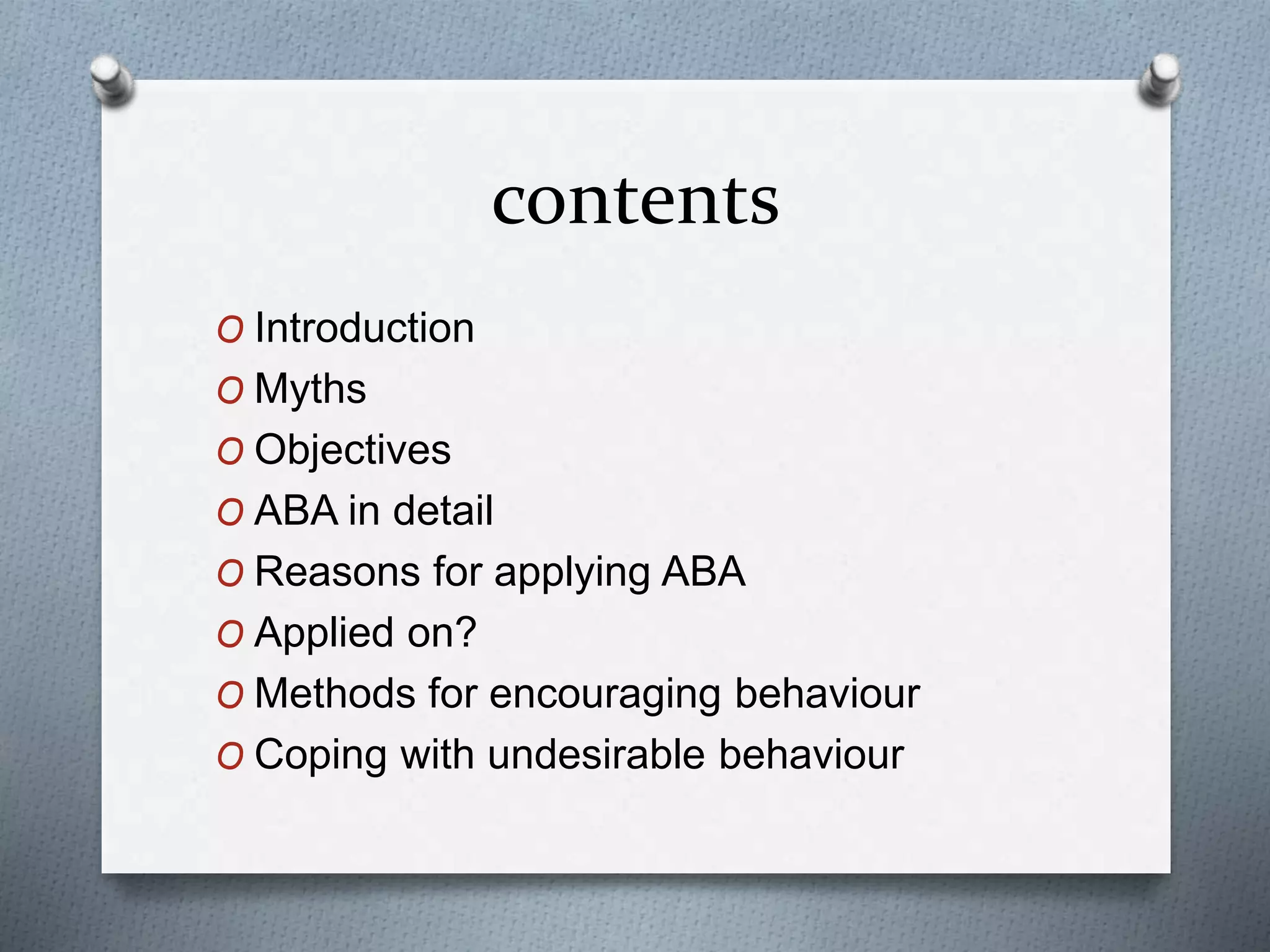
contents 
O Introduction 
O Myths 
O Objectives 
O ABA in detail 
O Reasons for applying ABA 
O Applied on? 
O Methods for encouraging behaviour 
O Coping with undesirable behaviour
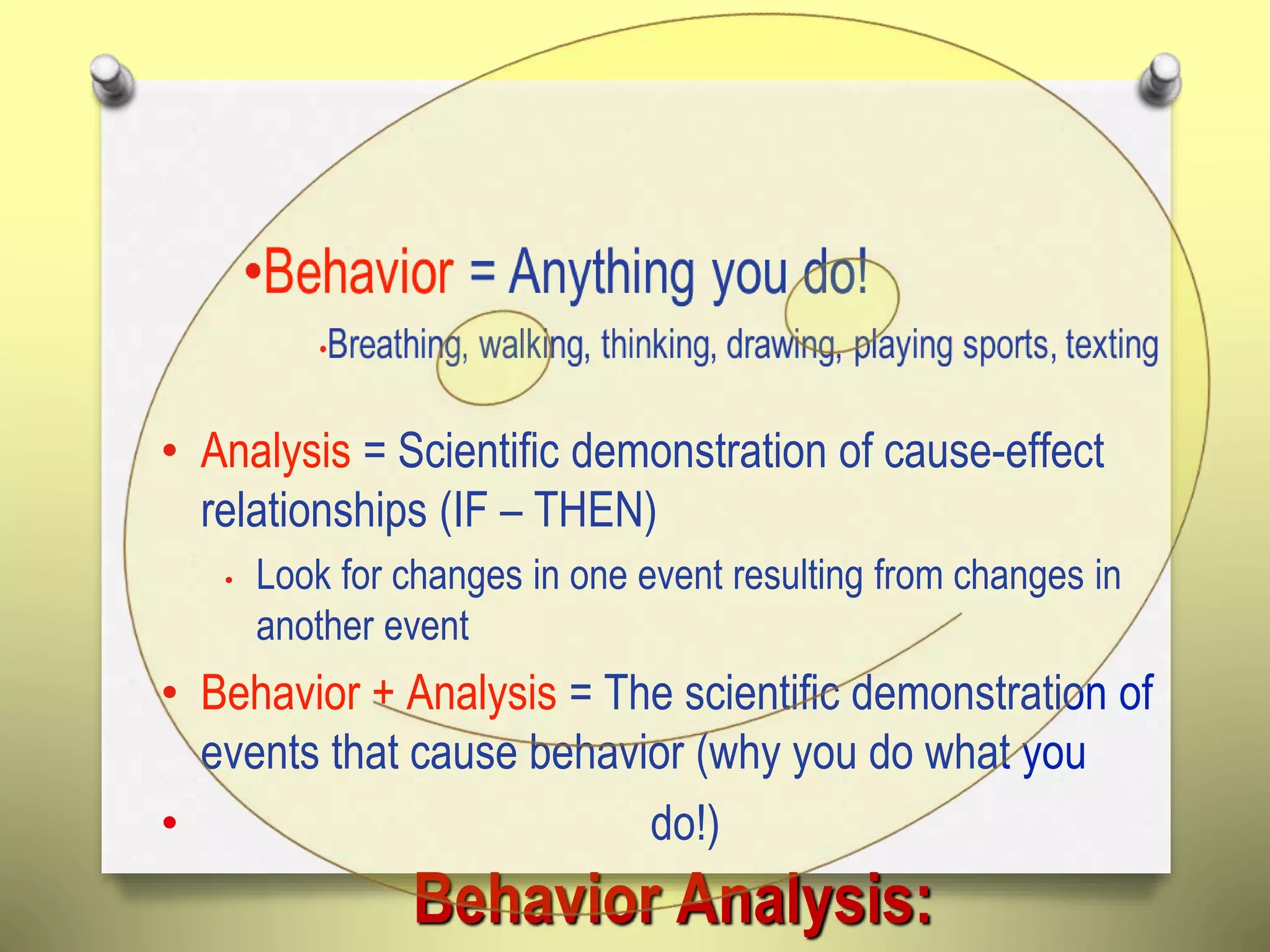
• Analysis = Scientific demonstration of cause-effect 
relationships (IF – THEN) 
• Look for changes in one event resulting from changes in 
another event 
• Behavior + Analysis = The scientific demonstration of 
events that cause behavior (why you do what you 
• do!) 
Behavior Analysis:
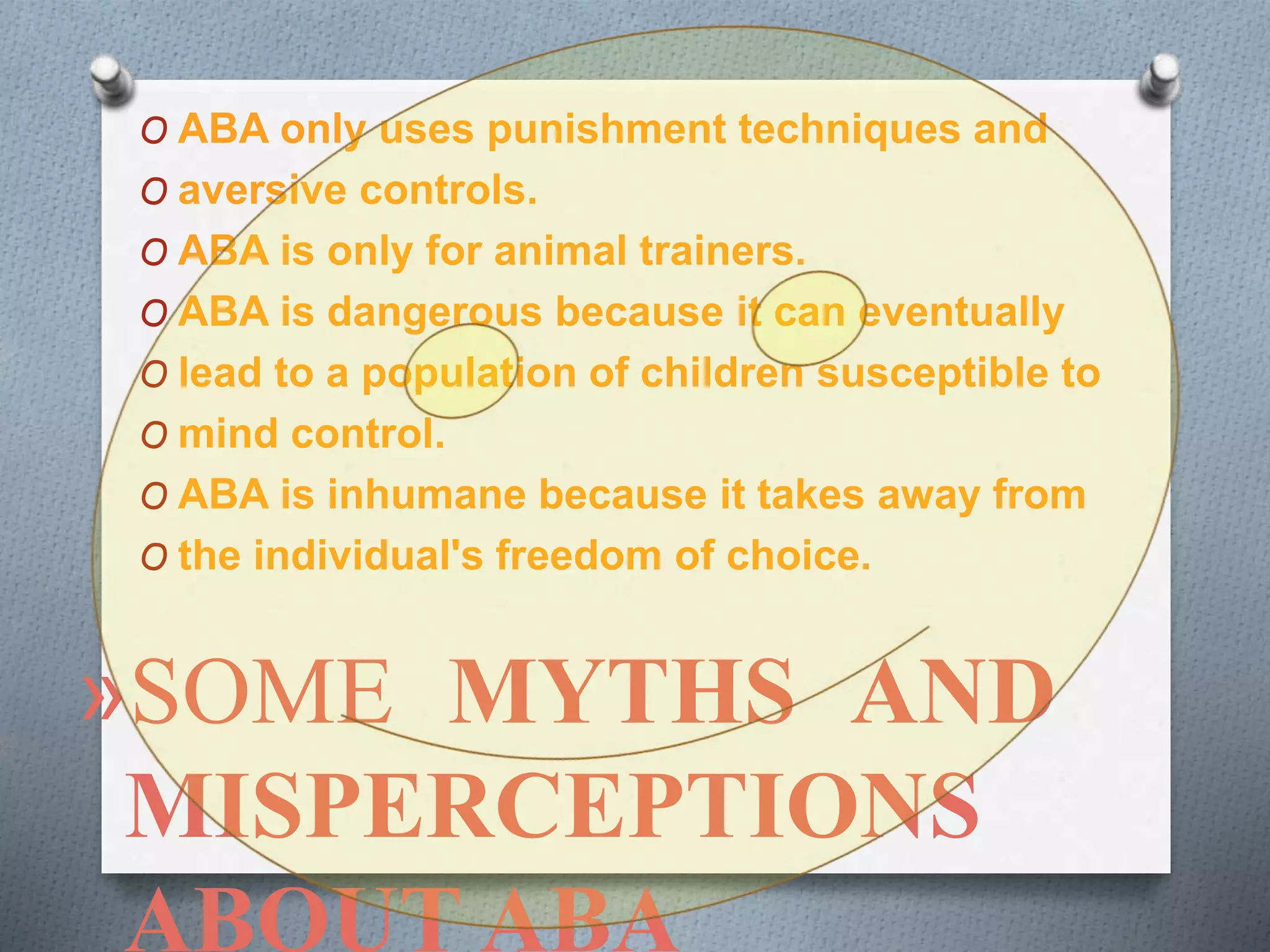
O ABA only uses punishment techniques and 
O aversive controls. 
O ABA is only for animal trainers. 
O ABA is dangerous because it can eventually 
O lead to a population of children susceptible to 
O mind control. 
O ABA is inhumane because it takes away from 
O the individual's freedom of choice. 
»SOME MYTHS AND 
MISPERCEPTIONS 
ABOUTABA
O ABA is only token reinforcement. 
O ABA is when you ignore all student misbehavior 
O and only reward good behavior. 
O ABA is equivalent to bribery. 
O ABA reinforcement programs undermine intrinsic 
O motivation. 
More Myths
Objectives 
O To identify behavior and its causes and 
effects and to control it. 
O By manipulating individuals behavior a 
balance in the environment can be 
maintained.
How does ABA investigate? 
O By looking at the relationship between 
O the environment, behavior and 
O consequences. 
O This relationship has 3 parts! 
O Environment 
O Behavior 
O Consequence
What does ABA investigate? 
O Environment (or antecedent) 
O „ Internal or external factors that may 
cause or 
O influence behavior 
O Behavior 
O „ What someone says or does 
O Consequences 
O „ What happens after the behavior 
O „ Planned and unplanned consequences
A-B-Cs of Behavior Analysis 
O A = Antecedent 
O An event that comes before a behavior 
O B = Behavior 
O C = Consequence 
O An event (good or bad) that follows a 
behavior
Main Functions of Behavior 
O To Gain To Escape (or Avoid) 
O • Attention (People or 
specific interactions) 
• Attention (People or 
p ) specific interactions) 
• Things, Activities or Things, Activities or places that are unpleasant 
O p laces that are pleasant 
• Input from sensory 
Experiences • Input from unpleasant 
O sensory experiences
Types of abnormal behavior 
O Lack 
A student is not proficient in speaking 
English. 
Excess 
A student shouts at other student for 
bargaining notes.
ABA applied on 
• Clients include anyone who engages in behavior! 
(Kids, adults, athletes, pets, animals, workers, teachers, 
etc.) 
• Private practice consultation 
• To families, school districts, agencies 
• Clinical psychology & interventions 
• School psychology and education 
• Behavioral safety, health, and nutrition 
• Pet therapy and animal training 
• Research (basic, translational, and applied) 
• Academia (professor)
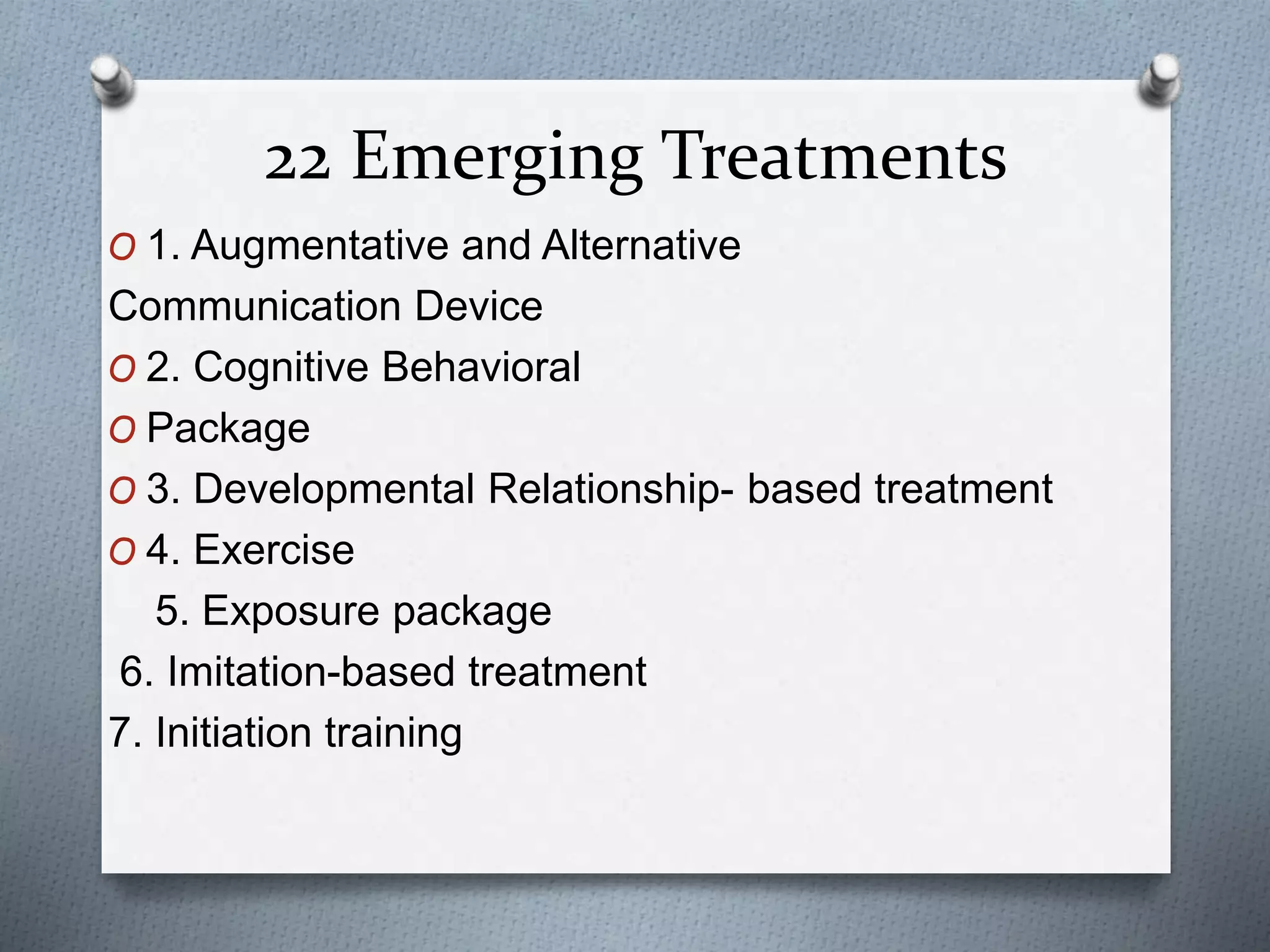
22 Emerging Treatments 
O 1. Augmentative and Alternative 
Communication Device 
O 2. Cognitive Behavioral 
O Package 
O 3. Developmental Relationship- based treatment 
O 4. Exercise 
5. Exposure package 
6. Imitation-based treatment 
7. Initiation training
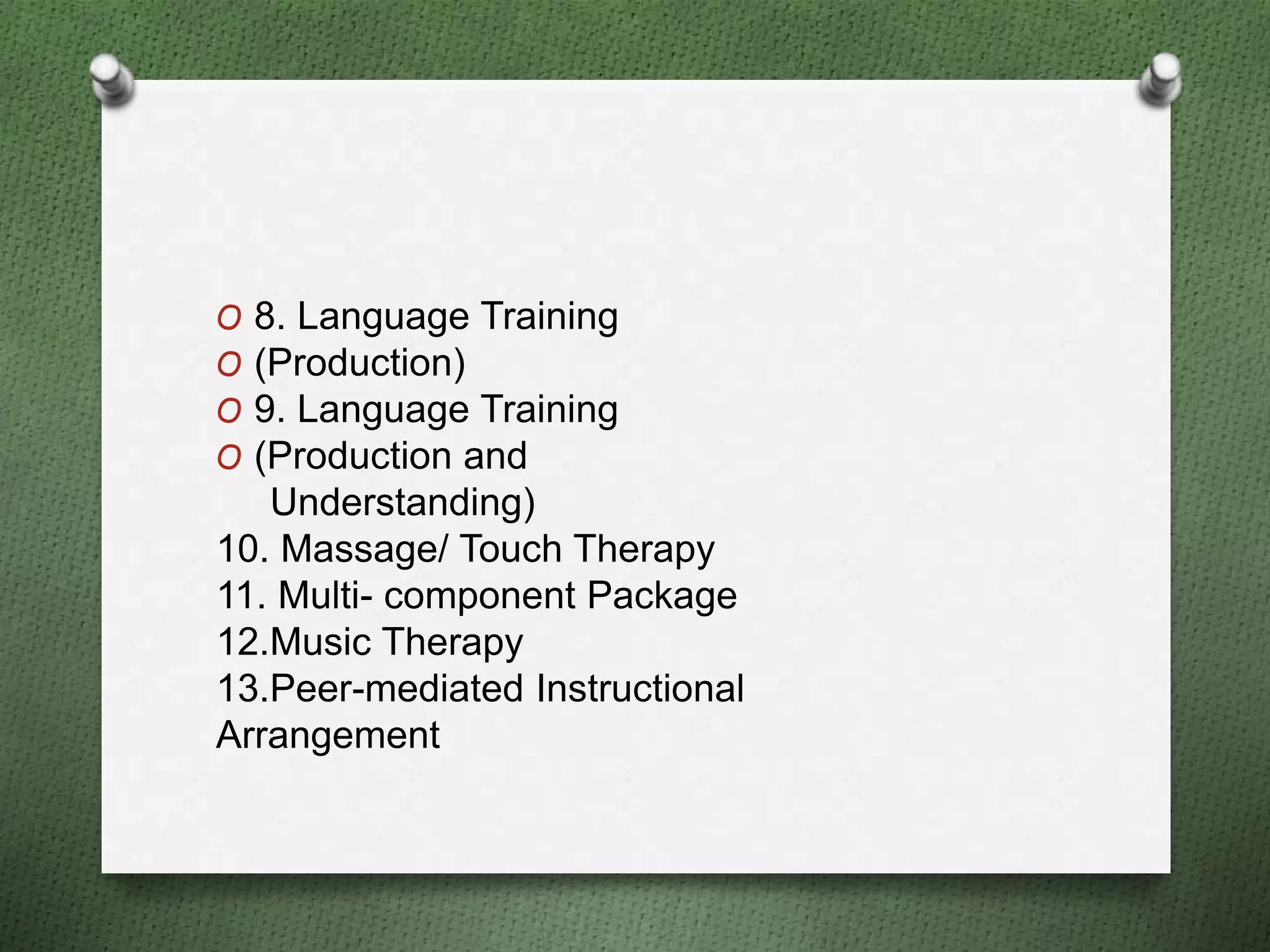
O 8. Language Training 
O (Production) 
O 9. Language Training 
O (Production and 
Understanding) 
10. Massage/ Touch Therapy 
11. Multi- component Package 
12.Music Therapy 
13.Peer-mediated Instructional 
Arrangement
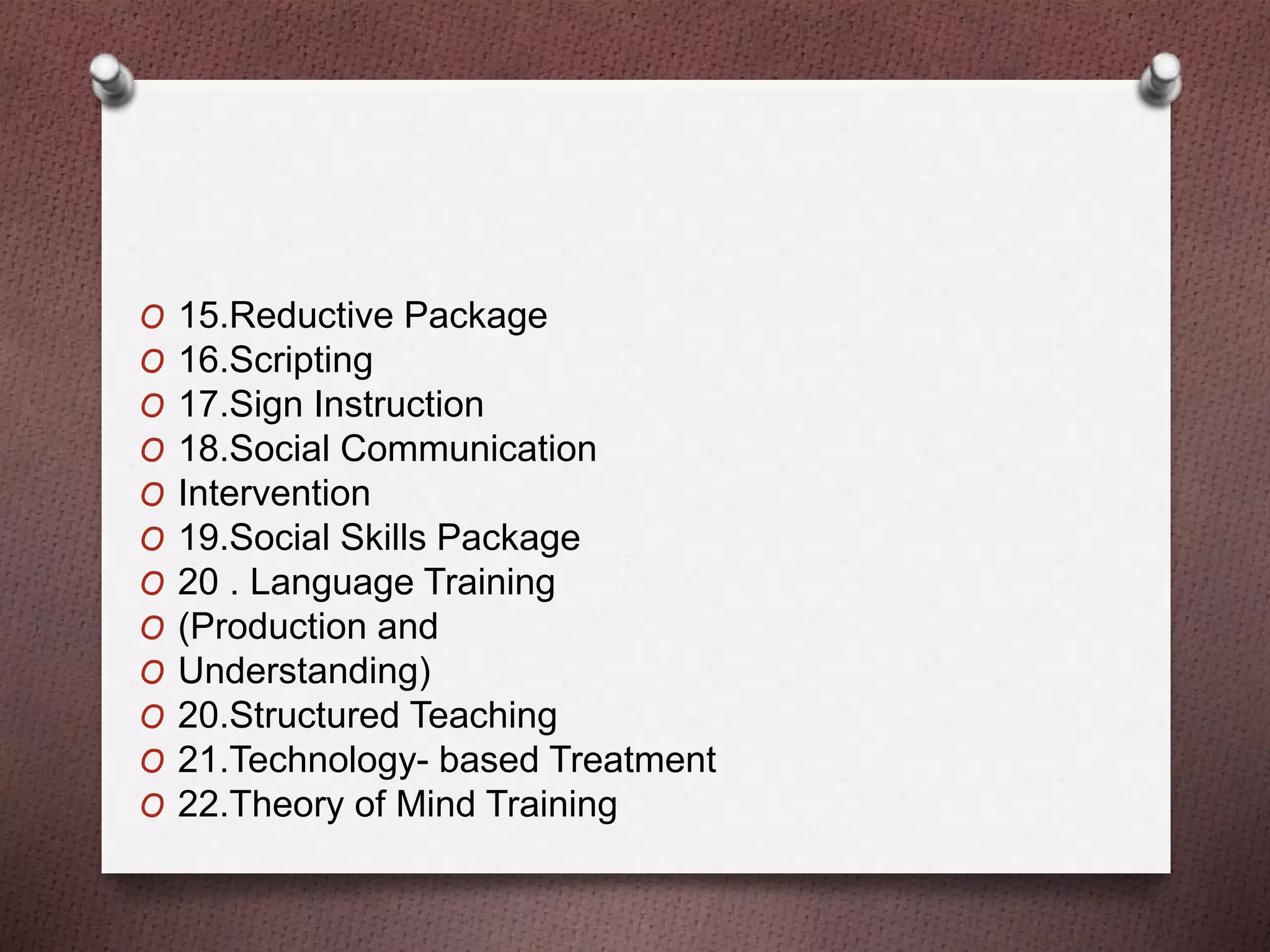
O 15.Reductive Package 
O 16.Scripting 
O 17.Sign Instruction 
O 18.Social Communication 
O Intervention 
O 19.Social Skills Package 
O 20 . Language Training 
O (Production and 
O Understanding) 
O 20.Structured Teaching 
O 21.Technology- based Treatment 
O 22.Theory of Mind Training
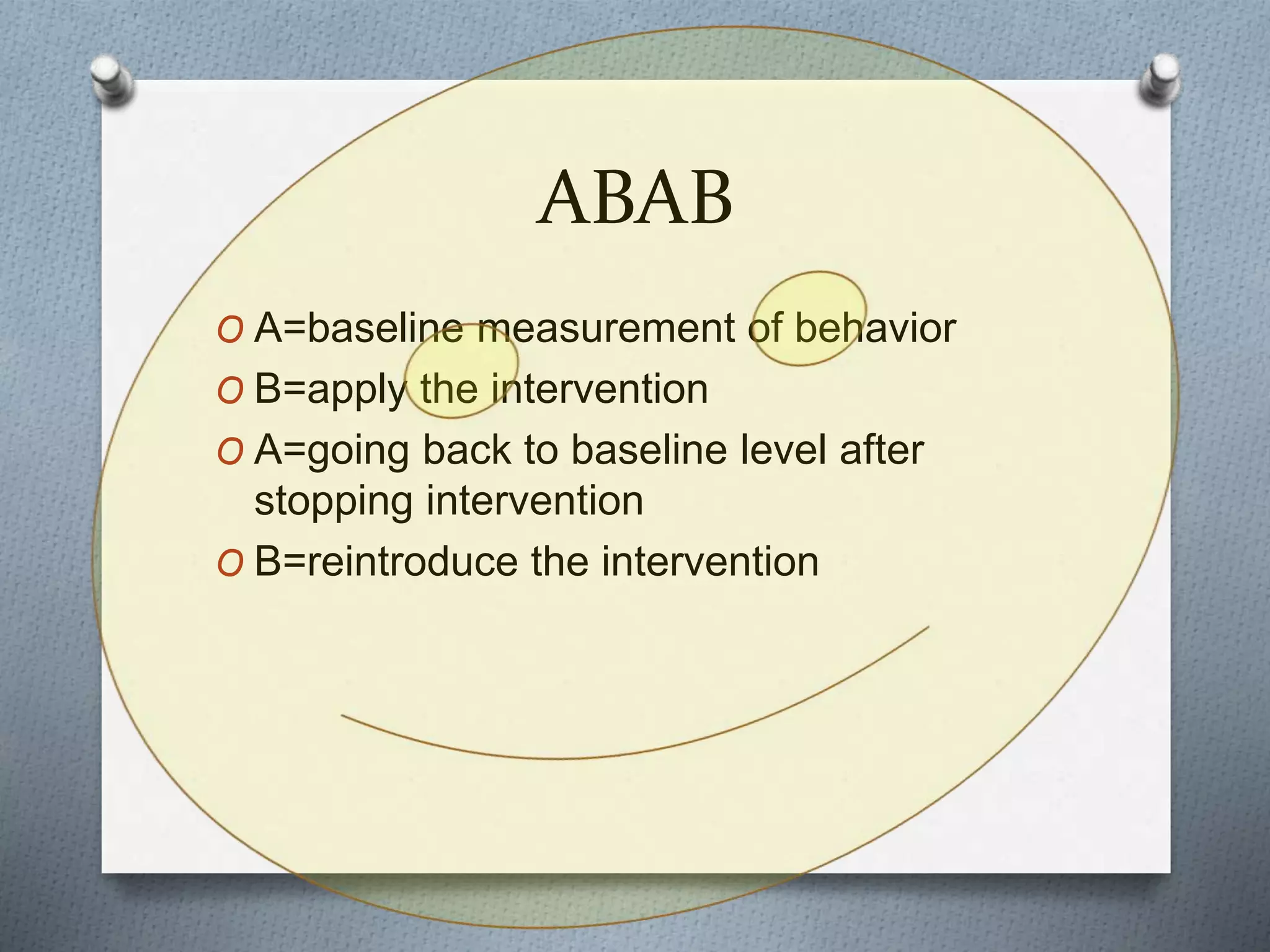
ABAB 
O A=baseline measurement of behavior 
O B=apply the intervention 
O A=going back to baseline level after 
stopping intervention 
O B=reintroduce the intervention
In classroom 
O Clearly specify the behavior to be 
changed 
O Plan a specific intervention using A, C OR 
Both 
O Keep track of the results, and modify the 
plan.
O Reinforcing with Teacher Attention 
O Selecting Reinforcers: The Premack 
Principle 
O Shaping 
O Positive Practice 
Methods for encouraging behaviors
excellent 
O U have got my attention!
Types of Reinforcers 
O The different types of reinforcers are 
activity, edible, sensory, social and tangible.
O Some activity reinforcers include playing 
ball or having lunch with a friend. 
O Edible reinforcers include food, drinks, and 
candy. 
O Sensory reinforcers can be things like 
music, sparkling lights and tactile 
stimulation. 
O Social reinforcers include physical contact 
and attention. 
O Lastly tangible reinforcers are things like 
stickers and toys. Each person is different 
in their preferences of things that might be 
potential reinforcers.
Activity 
O Find out reinforcers for children and 
adolescents and young adults
Reinforcement & Reinforcers 
OThe ‘rules’….can be remembered 
using 
Othe following acronym: 
OV.E.R.M.I.
V.E.R.M.I. 
O Value 
O Effort 
O Rate 
O Magnitude 
O Immediacy
V.E.R.M.I 
O VALUE 
O Value of the reinforcer should be high 
O Deprivation <-------------------------- 
Satiation
Favorite game
V.E.R.M.I 
O EFFORT 
O The effort a student has to put forth should 
be equal to the reinforcement 
O Is what is asked of me worth what is 
O available if I do it?
V.E.R.M.I 
O RATE 
O The rate of reinforcement should 
perpetuate and maintain high levels of 
accurate responding. 
O Continuous vs. Intermittent 
O Generalization is key!
V.E.R.M.I 
O MAGNITUDE 
O Staff must ensure that the reinforcement 
isn’t too big or too small. 
OWe want the individual to learn that better 
responses = better/more reinforcement 
O Caution - if the magnitude/amount is too 
big, satiation is likely to occur.
Common ABA techniques 
O Backward chaining 
O Token economy
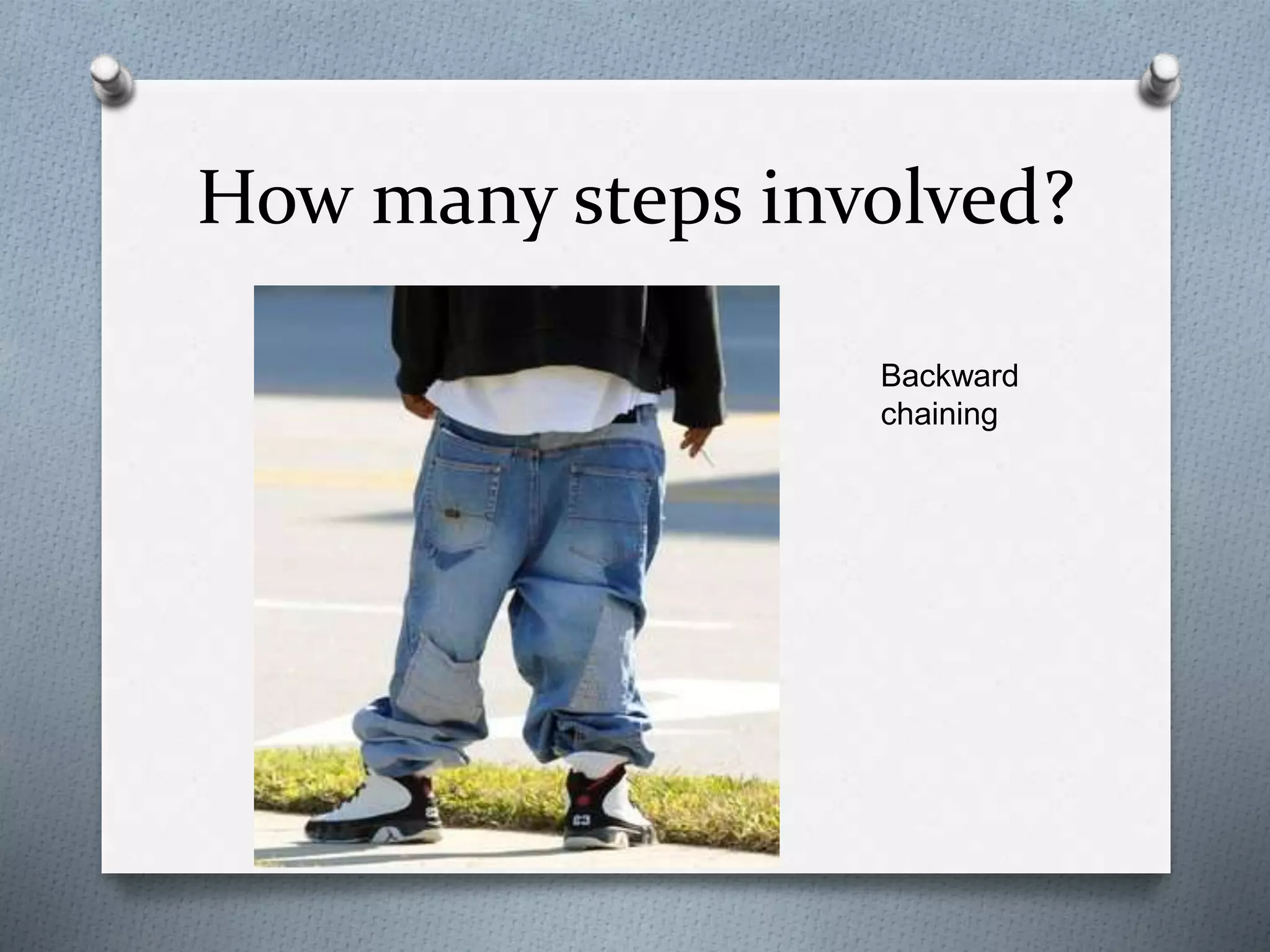
How many steps involved? 
Backward 
chaining
1 WORKS (and we have the evidence to prove it) 
2 and parents can do it 
3 affects what matters most to you! 
(meaningful behaviour skills) 
4 recommended by NIMH ,NAC! 
5 improves relationships 
6 teaching communication and socialization! 
7 increases flexibility 
8 the proof is in the pudding! -you can see it work! 
9 individualized and inductive. 
10 builds competence and confidence. 
(a competent and confident learner)
Recent work
O Danielle Lyons MSc., BCBA and Louise Heffernan 
MSc., BCBA 
O The current intervention was implemented with a 3 year 
old with a diagnosis of autism who displayed severe 
challenging behaviour in the form of physical 
aggression, self injury, and severe tantrum behaviour 
and non-compliance with instructions and 
transitions. A functional analysis was conducted under 
the following conditions: 1) Alone, 2) Toy 
Play, 3) Escape (from transition), 4) Escape (from 
instruction), 5) Escape (from peer), 6) Attention. 
Effect of chaining (2014)
O The results of the functional analysis indicated 
that the primary function of the client’s 
behavior was to escape from transitioning 
between daily activities. A potential 
secondary function of escape from demand 
and to gain attention were also noted in the 
analysis. As part of the individualized 
behavior support plan a transition program 
was implemented which employed backward 
chaining and an adapted visual schedule to 
promote independent transitioning between 
daily activities.
O Baseline data indicated significant 
duration and frequency of challenging 
behaviour during transitions between 
activities. Intervention data indicates a 
decrease to zero levels in the duration of 
independent transitions Functional 
Communication Training and other 
environmental changes were also 
introduced to support the client during 
their daily routine.
Coping with Undesirable Behavior 
negative reinforcement 
response cost
social isolation 
(time out) 
O Isolate from all possible reinforcers
Coping with Undesirable Behavior 
O satiation 
O reprimand
Cautions 
O First goal is to carryout punishment and 
suppress the undesirable behaviour. 
O Second goal is to make clear what the 
student should be doing instead and to 
provide reinforcement for those desirable 
actions.
Quiz 
O VERMI stands for 
O Evaluate which of the above mentioned 
methods is the most effective method of 
coping with undesirable behavior. 
O Determine the role of teacher in shaping 
students’ behavior. 
O Apply ABA to cope up with your 
undesirable behavior.
Critique 
O Criticize as much as you can
Thank you

Applied behavioral analysis (introduction)

  • 2.
    contents O Introduction O Myths O Objectives O ABA in detail O Reasons for applying ABA O Applied on? O Methods for encouraging behaviour O Coping with undesirable behaviour
  • 3.
    • Analysis =Scientific demonstration of cause-effect relationships (IF – THEN) • Look for changes in one event resulting from changes in another event • Behavior + Analysis = The scientific demonstration of events that cause behavior (why you do what you • do!) Behavior Analysis:
  • 4.
    O ABA onlyuses punishment techniques and O aversive controls. O ABA is only for animal trainers. O ABA is dangerous because it can eventually O lead to a population of children susceptible to O mind control. O ABA is inhumane because it takes away from O the individual's freedom of choice. »SOME MYTHS AND MISPERCEPTIONS ABOUTABA
  • 5.
    O ABA isonly token reinforcement. O ABA is when you ignore all student misbehavior O and only reward good behavior. O ABA is equivalent to bribery. O ABA reinforcement programs undermine intrinsic O motivation. More Myths
  • 6.
    Objectives O Toidentify behavior and its causes and effects and to control it. O By manipulating individuals behavior a balance in the environment can be maintained.
  • 7.
    How does ABAinvestigate? O By looking at the relationship between O the environment, behavior and O consequences. O This relationship has 3 parts! O Environment O Behavior O Consequence
  • 8.
    What does ABAinvestigate? O Environment (or antecedent) O „ Internal or external factors that may cause or O influence behavior O Behavior O „ What someone says or does O Consequences O „ What happens after the behavior O „ Planned and unplanned consequences
  • 9.
    A-B-Cs of BehaviorAnalysis O A = Antecedent O An event that comes before a behavior O B = Behavior O C = Consequence O An event (good or bad) that follows a behavior
  • 10.
    Main Functions ofBehavior O To Gain To Escape (or Avoid) O • Attention (People or specific interactions) • Attention (People or p ) specific interactions) • Things, Activities or Things, Activities or places that are unpleasant O p laces that are pleasant • Input from sensory Experiences • Input from unpleasant O sensory experiences
  • 11.
    Types of abnormalbehavior O Lack A student is not proficient in speaking English. Excess A student shouts at other student for bargaining notes.
  • 12.
    ABA applied on • Clients include anyone who engages in behavior! (Kids, adults, athletes, pets, animals, workers, teachers, etc.) • Private practice consultation • To families, school districts, agencies • Clinical psychology & interventions • School psychology and education • Behavioral safety, health, and nutrition • Pet therapy and animal training • Research (basic, translational, and applied) • Academia (professor)
  • 13.
    22 Emerging Treatments O 1. Augmentative and Alternative Communication Device O 2. Cognitive Behavioral O Package O 3. Developmental Relationship- based treatment O 4. Exercise 5. Exposure package 6. Imitation-based treatment 7. Initiation training
  • 14.
    O 8. LanguageTraining O (Production) O 9. Language Training O (Production and Understanding) 10. Massage/ Touch Therapy 11. Multi- component Package 12.Music Therapy 13.Peer-mediated Instructional Arrangement
  • 15.
    O 15.Reductive Package O 16.Scripting O 17.Sign Instruction O 18.Social Communication O Intervention O 19.Social Skills Package O 20 . Language Training O (Production and O Understanding) O 20.Structured Teaching O 21.Technology- based Treatment O 22.Theory of Mind Training
  • 16.
    ABAB O A=baselinemeasurement of behavior O B=apply the intervention O A=going back to baseline level after stopping intervention O B=reintroduce the intervention
  • 17.
    In classroom OClearly specify the behavior to be changed O Plan a specific intervention using A, C OR Both O Keep track of the results, and modify the plan.
  • 18.
    O Reinforcing withTeacher Attention O Selecting Reinforcers: The Premack Principle O Shaping O Positive Practice Methods for encouraging behaviors
  • 19.
    excellent O Uhave got my attention!
  • 20.
    Types of Reinforcers O The different types of reinforcers are activity, edible, sensory, social and tangible.
  • 21.
    O Some activityreinforcers include playing ball or having lunch with a friend. O Edible reinforcers include food, drinks, and candy. O Sensory reinforcers can be things like music, sparkling lights and tactile stimulation. O Social reinforcers include physical contact and attention. O Lastly tangible reinforcers are things like stickers and toys. Each person is different in their preferences of things that might be potential reinforcers.
  • 22.
    Activity O Findout reinforcers for children and adolescents and young adults
  • 23.
    Reinforcement & Reinforcers OThe ‘rules’….can be remembered using Othe following acronym: OV.E.R.M.I.
  • 24.
    V.E.R.M.I. O Value O Effort O Rate O Magnitude O Immediacy
  • 25.
    V.E.R.M.I O VALUE O Value of the reinforcer should be high O Deprivation <-------------------------- Satiation
  • 26.
  • 27.
    V.E.R.M.I O EFFORT O The effort a student has to put forth should be equal to the reinforcement O Is what is asked of me worth what is O available if I do it?
  • 28.
    V.E.R.M.I O RATE O The rate of reinforcement should perpetuate and maintain high levels of accurate responding. O Continuous vs. Intermittent O Generalization is key!
  • 29.
    V.E.R.M.I O MAGNITUDE O Staff must ensure that the reinforcement isn’t too big or too small. OWe want the individual to learn that better responses = better/more reinforcement O Caution - if the magnitude/amount is too big, satiation is likely to occur.
  • 30.
    Common ABA techniques O Backward chaining O Token economy
  • 31.
    How many stepsinvolved? Backward chaining
  • 32.
    1 WORKS (andwe have the evidence to prove it) 2 and parents can do it 3 affects what matters most to you! (meaningful behaviour skills) 4 recommended by NIMH ,NAC! 5 improves relationships 6 teaching communication and socialization! 7 increases flexibility 8 the proof is in the pudding! -you can see it work! 9 individualized and inductive. 10 builds competence and confidence. (a competent and confident learner)
  • 33.
  • 34.
    O Danielle LyonsMSc., BCBA and Louise Heffernan MSc., BCBA O The current intervention was implemented with a 3 year old with a diagnosis of autism who displayed severe challenging behaviour in the form of physical aggression, self injury, and severe tantrum behaviour and non-compliance with instructions and transitions. A functional analysis was conducted under the following conditions: 1) Alone, 2) Toy Play, 3) Escape (from transition), 4) Escape (from instruction), 5) Escape (from peer), 6) Attention. Effect of chaining (2014)
  • 35.
    O The resultsof the functional analysis indicated that the primary function of the client’s behavior was to escape from transitioning between daily activities. A potential secondary function of escape from demand and to gain attention were also noted in the analysis. As part of the individualized behavior support plan a transition program was implemented which employed backward chaining and an adapted visual schedule to promote independent transitioning between daily activities.
  • 36.
    O Baseline dataindicated significant duration and frequency of challenging behaviour during transitions between activities. Intervention data indicates a decrease to zero levels in the duration of independent transitions Functional Communication Training and other environmental changes were also introduced to support the client during their daily routine.
  • 37.
    Coping with UndesirableBehavior negative reinforcement response cost
  • 38.
    social isolation (timeout) O Isolate from all possible reinforcers
  • 39.
    Coping with UndesirableBehavior O satiation O reprimand
  • 40.
    Cautions O Firstgoal is to carryout punishment and suppress the undesirable behaviour. O Second goal is to make clear what the student should be doing instead and to provide reinforcement for those desirable actions.
  • 41.
    Quiz O VERMIstands for O Evaluate which of the above mentioned methods is the most effective method of coping with undesirable behavior. O Determine the role of teacher in shaping students’ behavior. O Apply ABA to cope up with your undesirable behavior.
  • 42.
    Critique O Criticizeas much as you can
  • 43.