PRESENTED BY GURURAJ KULKARNI
GUEST FACULTY KARNATAKA POLICE
TRAINING COLLEGE GULBARGA.
STRESS MANAGEMENT
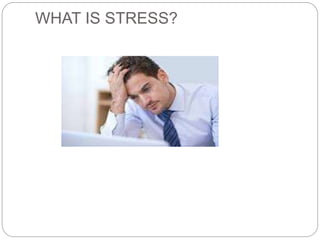
WHAT IS STRESS?
MEANING OF STRESS:
 Stress is derived from the Latin word stringere
which means to draw tight, strain, to exert and
strait.
 The term stress was first used as topic of
scientific study in the early part of the twentieth
century in the works of Cannon and Selye.
 During the nineteenth century, French
physiologist Bernard realized that it was important
for the body to maintain a relatively constant
internal state while being challenged with
continuously changing external environment.
 In the twentieth century, American physiologist,
Walter Cannon used the term “homeostasis” in
discussing the complex processes that the body
must perform to survive and developed the idea
of the flight or fight response.
 The flight or fight response commonly referred to
as the sympatho-adrenal response.
 It s the component of stress response that
enables an individual to act immediately to a
stressor.
 Because the neurons in the hypothalamus area
are activated leading to the release of
epinephrine from the adrenal medulla.
 Lazarus and Folkman have provided one of the
most generally accepted relational definition of
stress. “Psychological stress is a particular
relationship between the person and environment
that is appraised by the person as taxing or
exceeding his or her resources and endangering
his or her well-being.”
 According to Taylor, “Stress is the process of
appraising events (as harmful, threatening, or
challenging) of assessing potential responses
and of responding to those events responses
may include physiological, cognitive, emotional
and behavioral changes”
SOURCES OF STRESS
 Stress mainly comes from two sources:
 From the outside world
 From within oneself
 From the outside world: Stress from the outside
world or environment comes in the shape of
unexpected life events, the tension of constant,
unsatisfactory circumstances and from daily
hassles.
 From within oneself: Stress can also equally
come from internal sources, many of which are
unintentionally self-imposed.

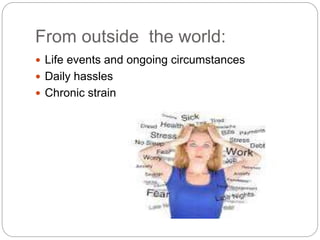
From outside the world:
 Life events and ongoing circumstances
 Daily hassles
 Chronic strain
 A. Life Events and ongoing circumstances:
 It has been established that life events are
precursors and at least in part determinants of
many physical and psychological problems.
 B.Daily Hassles
 Stress also comes through daily hassles which
are the little problems of daily living that are not
significant in themselves but can pile up to
become a major source of stress. They are
 Time pressures.
 Problem with family.
 Change in finances,
 Child care arrangements
 Longer work hours
 Divorce.
 C. Chronic Strain
 Chronic strain is a stressful experience that is a
usual but continually stressful aspect of life.
 It can happen because of number of reasons.
 A long term but unsatisfying relationship
 A work situation that is stressful.
 Long standing financial concerns.
INTERNAL SOURCES OF STRESS
 Internal stressors can come from an ill-
maintained, sensitive, or sick body, from faulty
learning which results in problem behaviors and
habits, and also maladaptive patterns of thinking
and mistaken beliefs about oneself of one’s world.
 The Body
 Behavior and faulty learning
 Faulty Thinking
 By Biasing One’s Interpretation of everyday
situation and events.
 Erroneous and maladaptive beliefs.
 The Body.- it has long been recognized that the
body has an effect on the well-being of the mind.
 Major psychiatric illnesses- Schizophrenia,
endogenous depression and manic depression
are recognized as being related to changes in the
body’s biochemistry.
 Other states such as premenstrual syndrome,
menopause and pregnancy can also influence
psychological condition and mood.
 Behavior and faulty learning: Behaviors such as
driving, cooking, expressing feelings, showing
affection, dealing with other people having fun are
mainly learn by association by consequences and
by observation.
 Sometimes learning takes place but is
maladaptive mainly because of defective
associations, problematic reinforcements or
unreliable observation
 Traumatic experiences involve high levels of
anxiety and generally lead to avoidance behavior.
 People can also learn inappropriate emotional
responses through observation.
 Faulty Thinking: If thinking is faulty, the
consequences can be extensive not only through
how one responds but also through how one
reacts emotionally.
 Faulty Thinking can act as a stressor in two ways.
 By biasing one’s interpretation of everyday
situations and events.
 The people are the creators of their own moods
and feelings.
 “Alphabet of the mind” will illustrate this.
 This alphabet consists of three letters, A, B, and
C.
 “A” stands for Antecedent-an event.
 “B” stands for Blob or Blank-thoughts.
 “C” stands for Consequence-mood and feelings.
 When something happens(A)-people often find
themselves in poor or low meeds (C) later and
they do not know why.
 Individuals can get into the habit of consistently
misinterpreting situations.
 Aaron Beck a well-known Americans psychiatrist
has listed a number of “Cognitive Distortions”, or
common ways in which people distort their reality
and thus cause more stress for themselves.
 Some of the cognitive distortions are
overgeneralization, selective abstraction and
magnification and so on.
 Misinterpretation of any one situation can involve
a number of these distortions and hundreds of
minor events and situations constitute an average
day. Therefore , the more that people misinterpret
the more they set themselves up for further
misinterpretations.
Erroneous and Maladaptive Beliefs
 This leads to unrealistic expectations of oneself
and others and in turn to emotional experiences
such as frustration, anger, disappointment and
guilt.
Common signs of stress
 • irritable, aggressive, impatient or wound up •
over-burdened
 • anxious, nervous or afraid
 • like your thoughts are racing and you can't
switch off
 • neglected or lonely
 depressed
 uninterested in life
 like you've lost your sense of humour
 a sense of dread
 worried about your health
 unable to enjoy yourself
How you might behave
 1. finding it hard to make decisions
2. avoiding situations that are troubling you 3.
Snapping at people
4. biting your nails
5. picking at your skin
1. unable to concentrate
2. eating too much or too little
3. smoking or drinking alcohol more than usual
4. restless, like you can't sit still
5. feeling tearful or crying
How you might be physically affected
1.shallow breathing or hyperventilating
2. you might have a panic attack
3. blurred eyesight or sore eyes
4. problems getting to sleep, staying asleep or
having nightmares
5. sexual problems, such as losing interest in sex or
being unable to enjoy sex
 6. tired all the time
 7. grinding your teeth or clenching your jaw 8.
headaches
 9. chest pains
 10. high blood pressure
 11. indigestion or heartburn
 12. constipation or diarrhoea
 13. feeling sick, dizzy or fainting
SITUATION CAUSES STRESS
 Personal issues ;
 illness or injury
 pregnancy and becoming a parent
 bereavement
 long-term health problems
 organizing a complicated event, like a family
holiday
 Friends and family:
 getting married or civil partnered
 going through a break-up or getting divorced
 difficult relationships with parents, siblings,
friends or children
 being a carer for a friend or relative who needs
lots of support
 Employment and study:
 losing your job
 long-term unemployment
 retiring • exams and deadlines
 difficult issues at work
 starting a new job
 Housing:
 poor housing conditions
 moving house •
 problems with neighbours
 Money:
 worries about money or benefits
 poverty
 debt
Stress Management Techniques
 There are some techniques which helps to
manage stress. They are:
1. Breath.
2. Freeze-Frame Technique.
3. Technique for Physical Tension
4. Technique for Racing Mind
Breath
 In breathing technique these following steps to be
followed:
1. Deep Breathing
2. Abdominal breathing or 3 part breathing
3. Breath Counting
Deep Breathing
 Deep breathing is a simple but very effective
method of relaxation.
 It works well in conjunction with other relaxation
techniques such as
 Progressive Muscular Relaxation.
 relaxation imagery and meditation to reduce
stress.
 To use the technique, take a number of deep
breaths and relax your body further with each
breath
Abdominal breathing or 3 part
breathing:
 Place hands on belly.
 Hands should go out with your belly on inhale, in
on the exhale.
 Repeat until feeling relaxed.
 Alternative: start with abdomen and expand to
chest and shoulders, then reverse on exhale.
Breath Counting
 It may be helpful to count on inhale and exhale:
 5 seconds of inhale 5 seconds of exhale
 OR 4/7/8 Inhale for 4 seconds, Hold for 7
seconds, Exhale for 8 seconds
Freeze-Frame! Technique
 Transforming Stress by Doc Childre this takes
some practice and works great for people that are
able to visualize well.
 Step 1 SEE and PAUSE: Recognize the stressful
feeling, see it-visualize it, then pause it, like
pushing the Pause button on your DVD or taking
a time-out!
 Step 2 HEART BREATH: Take a deep breath.
Make a sincere effort to Shift your focus away
from the racing mind or disturbed emotions to the
area around your heart. Pretend you’ve breathing
through your heart to help focus your energy in
this area. Keep your focus there for ten second or
more.
 Step 3 RECALL and FEEL: Recall a positive, fun
feeling or time you’ve had in your life and attempt
to re-experience it. Focus on the feeling rather
than the thoughts or visual image. Activate the
positive emotion.
 OPTIONAL Step 4 Using your intuition, common
sense and sincerity Ask your heart, what would
be a more efficient response to the situation you
are Freeze-Framing, one that will minimize future
stress?
 OPTIONAL Step 5 Listen to what your heart says
in answer to your question.
Technique for Physical Tension
 Progressive Muscular Relaxation (PMR):
Progressive Muscular Relaxation is useful for
relaxing your body when your muscles are tense.
 The idea behind PMR is that you tense up a
group of muscles so that they are as tightly
contracted as possible.
 Hold them in a state of extreme tension for a few
seconds.
 Then, relax the muscles to their previous state.
 Finally, consciously relax the muscles even
further so that you are as relaxed as possible.
 By tensing your muscles first, you will probably
find that you are able to relax your muscles more
than would be the case if you tried to relax your
muscles directly.
 Experiment with PMR by forming a fist, and
clenching your hand as tight as you can for a few
seconds.
 Then relax your hand to its previous tension, and
then consciously relax it again so that it is as
loose as possible.
 You should feel deep relaxation in your hand
muscles.
 For maximum relaxation you can use PMR in
conjunction with breathing techniques and
imagery.
Technique for Racing Mind
 The “Relaxation Response”:
 Try the following 6-step relaxation response from
the book called “The Relaxation Response,” by
Dr. Herbert Benson the next time you feel anxiety
or stress:
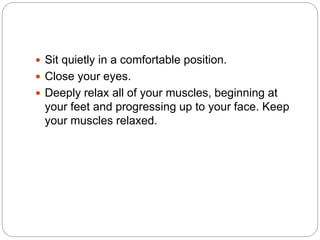
 Sit quietly in a comfortable position.
 Close your eyes.
 Deeply relax all of your muscles, beginning at
your feet and progressing up to your face. Keep
your muscles relaxed.
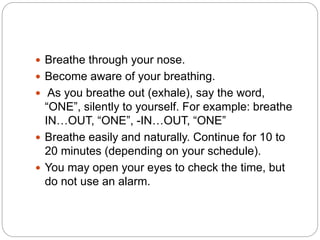
 Breathe through your nose.
 Become aware of your breathing.
 As you breathe out (exhale), say the word,
“ONE”, silently to yourself. For example: breathe
IN…OUT, “ONE”, -IN…OUT, “ONE”
 Breathe easily and naturally. Continue for 10 to
20 minutes (depending on your schedule).
 You may open your eyes to check the time, but
do not use an alarm.
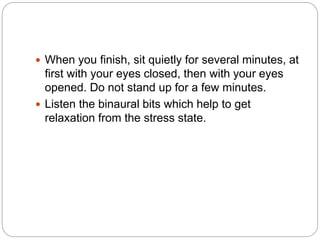
 When you finish, sit quietly for several minutes, at
first with your eyes closed, then with your eyes
opened. Do not stand up for a few minutes.
 Listen the binaural bits which help to get
relaxation from the stress state.

Stress management presented by gururaj

  • 1.
    PRESENTED BY GURURAJKULKARNI GUEST FACULTY KARNATAKA POLICE TRAINING COLLEGE GULBARGA. STRESS MANAGEMENT
  • 2.
  • 3.
    MEANING OF STRESS: Stress is derived from the Latin word stringere which means to draw tight, strain, to exert and strait.  The term stress was first used as topic of scientific study in the early part of the twentieth century in the works of Cannon and Selye.
  • 4.
     During thenineteenth century, French physiologist Bernard realized that it was important for the body to maintain a relatively constant internal state while being challenged with continuously changing external environment.
  • 5.
     In thetwentieth century, American physiologist, Walter Cannon used the term “homeostasis” in discussing the complex processes that the body must perform to survive and developed the idea of the flight or fight response.  The flight or fight response commonly referred to as the sympatho-adrenal response.  It s the component of stress response that enables an individual to act immediately to a stressor.
  • 6.
     Because theneurons in the hypothalamus area are activated leading to the release of epinephrine from the adrenal medulla.  Lazarus and Folkman have provided one of the most generally accepted relational definition of stress. “Psychological stress is a particular relationship between the person and environment that is appraised by the person as taxing or exceeding his or her resources and endangering his or her well-being.”
  • 7.
     According toTaylor, “Stress is the process of appraising events (as harmful, threatening, or challenging) of assessing potential responses and of responding to those events responses may include physiological, cognitive, emotional and behavioral changes”
  • 8.
    SOURCES OF STRESS Stress mainly comes from two sources:  From the outside world  From within oneself  From the outside world: Stress from the outside world or environment comes in the shape of unexpected life events, the tension of constant, unsatisfactory circumstances and from daily hassles.  From within oneself: Stress can also equally come from internal sources, many of which are unintentionally self-imposed. 
  • 9.
    From outside theworld:  Life events and ongoing circumstances  Daily hassles  Chronic strain
  • 10.
     A. LifeEvents and ongoing circumstances:  It has been established that life events are precursors and at least in part determinants of many physical and psychological problems.
  • 11.
     B.Daily Hassles Stress also comes through daily hassles which are the little problems of daily living that are not significant in themselves but can pile up to become a major source of stress. They are
  • 12.
     Time pressures. Problem with family.  Change in finances,  Child care arrangements  Longer work hours  Divorce.
  • 13.
     C. ChronicStrain  Chronic strain is a stressful experience that is a usual but continually stressful aspect of life.  It can happen because of number of reasons.  A long term but unsatisfying relationship  A work situation that is stressful.  Long standing financial concerns.
  • 14.
    INTERNAL SOURCES OFSTRESS  Internal stressors can come from an ill- maintained, sensitive, or sick body, from faulty learning which results in problem behaviors and habits, and also maladaptive patterns of thinking and mistaken beliefs about oneself of one’s world.  The Body  Behavior and faulty learning  Faulty Thinking  By Biasing One’s Interpretation of everyday situation and events.  Erroneous and maladaptive beliefs.
  • 15.
     The Body.-it has long been recognized that the body has an effect on the well-being of the mind.  Major psychiatric illnesses- Schizophrenia, endogenous depression and manic depression are recognized as being related to changes in the body’s biochemistry.  Other states such as premenstrual syndrome, menopause and pregnancy can also influence psychological condition and mood.
  • 16.
     Behavior andfaulty learning: Behaviors such as driving, cooking, expressing feelings, showing affection, dealing with other people having fun are mainly learn by association by consequences and by observation.  Sometimes learning takes place but is maladaptive mainly because of defective associations, problematic reinforcements or unreliable observation  Traumatic experiences involve high levels of anxiety and generally lead to avoidance behavior.  People can also learn inappropriate emotional responses through observation.
  • 17.
     Faulty Thinking:If thinking is faulty, the consequences can be extensive not only through how one responds but also through how one reacts emotionally.
  • 18.
     Faulty Thinkingcan act as a stressor in two ways.  By biasing one’s interpretation of everyday situations and events.  The people are the creators of their own moods and feelings.  “Alphabet of the mind” will illustrate this.  This alphabet consists of three letters, A, B, and C.  “A” stands for Antecedent-an event.  “B” stands for Blob or Blank-thoughts.  “C” stands for Consequence-mood and feelings.
  • 19.
     When somethinghappens(A)-people often find themselves in poor or low meeds (C) later and they do not know why.  Individuals can get into the habit of consistently misinterpreting situations.  Aaron Beck a well-known Americans psychiatrist has listed a number of “Cognitive Distortions”, or common ways in which people distort their reality and thus cause more stress for themselves.
  • 20.
     Some ofthe cognitive distortions are overgeneralization, selective abstraction and magnification and so on.  Misinterpretation of any one situation can involve a number of these distortions and hundreds of minor events and situations constitute an average day. Therefore , the more that people misinterpret the more they set themselves up for further misinterpretations.
  • 21.
    Erroneous and MaladaptiveBeliefs  This leads to unrealistic expectations of oneself and others and in turn to emotional experiences such as frustration, anger, disappointment and guilt.
  • 22.
    Common signs ofstress  • irritable, aggressive, impatient or wound up • over-burdened  • anxious, nervous or afraid  • like your thoughts are racing and you can't switch off  • neglected or lonely
  • 23.
     depressed  uninterestedin life  like you've lost your sense of humour  a sense of dread  worried about your health  unable to enjoy yourself
  • 24.
    How you mightbehave  1. finding it hard to make decisions 2. avoiding situations that are troubling you 3. Snapping at people 4. biting your nails 5. picking at your skin
  • 25.
    1. unable toconcentrate 2. eating too much or too little 3. smoking or drinking alcohol more than usual 4. restless, like you can't sit still 5. feeling tearful or crying
  • 26.
    How you mightbe physically affected 1.shallow breathing or hyperventilating 2. you might have a panic attack 3. blurred eyesight or sore eyes 4. problems getting to sleep, staying asleep or having nightmares 5. sexual problems, such as losing interest in sex or being unable to enjoy sex
  • 27.
     6. tiredall the time  7. grinding your teeth or clenching your jaw 8. headaches  9. chest pains  10. high blood pressure  11. indigestion or heartburn  12. constipation or diarrhoea  13. feeling sick, dizzy or fainting
  • 28.
    SITUATION CAUSES STRESS Personal issues ;  illness or injury  pregnancy and becoming a parent  bereavement  long-term health problems  organizing a complicated event, like a family holiday
  • 29.
     Friends andfamily:  getting married or civil partnered  going through a break-up or getting divorced  difficult relationships with parents, siblings, friends or children  being a carer for a friend or relative who needs lots of support
  • 30.
     Employment andstudy:  losing your job  long-term unemployment  retiring • exams and deadlines  difficult issues at work  starting a new job
  • 31.
     Housing:  poorhousing conditions  moving house •  problems with neighbours
  • 32.
     Money:  worriesabout money or benefits  poverty  debt
  • 33.
    Stress Management Techniques There are some techniques which helps to manage stress. They are: 1. Breath. 2. Freeze-Frame Technique. 3. Technique for Physical Tension 4. Technique for Racing Mind
  • 34.
    Breath  In breathingtechnique these following steps to be followed: 1. Deep Breathing 2. Abdominal breathing or 3 part breathing 3. Breath Counting
  • 35.
    Deep Breathing  Deepbreathing is a simple but very effective method of relaxation.  It works well in conjunction with other relaxation techniques such as  Progressive Muscular Relaxation.  relaxation imagery and meditation to reduce stress.  To use the technique, take a number of deep breaths and relax your body further with each breath
  • 36.
    Abdominal breathing or3 part breathing:  Place hands on belly.  Hands should go out with your belly on inhale, in on the exhale.  Repeat until feeling relaxed.  Alternative: start with abdomen and expand to chest and shoulders, then reverse on exhale.
  • 37.
    Breath Counting  Itmay be helpful to count on inhale and exhale:  5 seconds of inhale 5 seconds of exhale  OR 4/7/8 Inhale for 4 seconds, Hold for 7 seconds, Exhale for 8 seconds
  • 38.
    Freeze-Frame! Technique  TransformingStress by Doc Childre this takes some practice and works great for people that are able to visualize well.  Step 1 SEE and PAUSE: Recognize the stressful feeling, see it-visualize it, then pause it, like pushing the Pause button on your DVD or taking a time-out!
  • 39.
     Step 2HEART BREATH: Take a deep breath. Make a sincere effort to Shift your focus away from the racing mind or disturbed emotions to the area around your heart. Pretend you’ve breathing through your heart to help focus your energy in this area. Keep your focus there for ten second or more.
  • 40.
     Step 3RECALL and FEEL: Recall a positive, fun feeling or time you’ve had in your life and attempt to re-experience it. Focus on the feeling rather than the thoughts or visual image. Activate the positive emotion.
  • 41.
     OPTIONAL Step4 Using your intuition, common sense and sincerity Ask your heart, what would be a more efficient response to the situation you are Freeze-Framing, one that will minimize future stress?  OPTIONAL Step 5 Listen to what your heart says in answer to your question.
  • 42.
    Technique for PhysicalTension  Progressive Muscular Relaxation (PMR): Progressive Muscular Relaxation is useful for relaxing your body when your muscles are tense.  The idea behind PMR is that you tense up a group of muscles so that they are as tightly contracted as possible.  Hold them in a state of extreme tension for a few seconds.
  • 43.
     Then, relaxthe muscles to their previous state.  Finally, consciously relax the muscles even further so that you are as relaxed as possible.  By tensing your muscles first, you will probably find that you are able to relax your muscles more than would be the case if you tried to relax your muscles directly.
  • 44.
     Experiment withPMR by forming a fist, and clenching your hand as tight as you can for a few seconds.  Then relax your hand to its previous tension, and then consciously relax it again so that it is as loose as possible.  You should feel deep relaxation in your hand muscles.
  • 45.
     For maximumrelaxation you can use PMR in conjunction with breathing techniques and imagery.
  • 46.
    Technique for RacingMind  The “Relaxation Response”:  Try the following 6-step relaxation response from the book called “The Relaxation Response,” by Dr. Herbert Benson the next time you feel anxiety or stress:
  • 47.
     Sit quietlyin a comfortable position.  Close your eyes.  Deeply relax all of your muscles, beginning at your feet and progressing up to your face. Keep your muscles relaxed.
  • 48.
     Breathe throughyour nose.  Become aware of your breathing.  As you breathe out (exhale), say the word, “ONE”, silently to yourself. For example: breathe IN…OUT, “ONE”, -IN…OUT, “ONE”  Breathe easily and naturally. Continue for 10 to 20 minutes (depending on your schedule).  You may open your eyes to check the time, but do not use an alarm.
  • 49.
     When youfinish, sit quietly for several minutes, at first with your eyes closed, then with your eyes opened. Do not stand up for a few minutes.  Listen the binaural bits which help to get relaxation from the stress state.