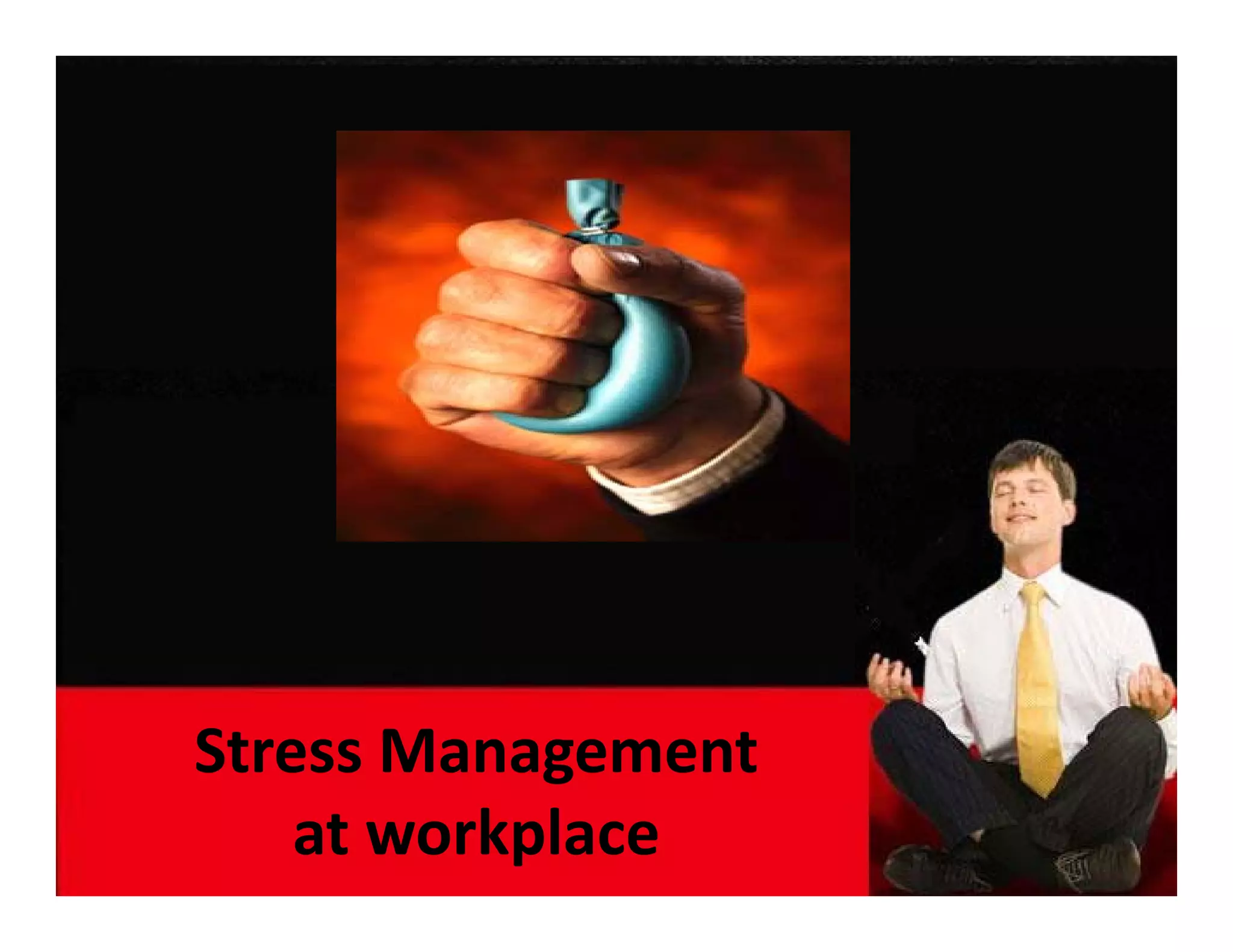
Stress Management 
            g
    at workplace
What Is Stress?
What Is Stress?
Stress is the emotional and physical strain caused 
by our response to pressure from the outside 
world. Common stress reactions include tension, 
irritability, inability to concentrate, and a variety of 
physical symptoms that include headache and a fast 
physical symptoms that include headache and a fast
heartbeat.
Quote:‐
Man should not try to avoid stress any more than 
Man should not try to avoid stress any more than
he would shun food, love or exercise.  
                                    Hans Selye
Stress at workplace
Employers should provide a stress‐free work environment, 
E l           h ld      id    t     f        k     i        t
recognize where stress is becoming a problem for staff, and 
take action to reduce stress. Stress in the workplace reduces 
productivity, increases management pressures, and makes 
people ill in many ways, evidence of which is still increasing. 
Workplace stress affects the performance of the brain, 
Workplace stress affects the performance of the brain
including functions of work performance; memory, 
concentration, and learning.
How to avoid or control Stress?
Here are some 
         Here are some
best Stress reducing Techniques
What you do?
If you are stressed, do one or all of these things, in 
If you are stressed do one or all of these things in
       whatever order that takes your fancy. 
What you do?
 The key to de‐stressing in the moment is getting 
away from or removing yourself from the stressor.
What you do?
Developing new habits which regularly remove you 
   and distract you from stressors and stressful 
   situations and pressures is essentially how to 
    manage stress on a more permanent basis.
              t                           tb i
What you do?
In this modern world it is difficult if not impossible 
  to change stressful situations. What we can do 
  however is change and reduce our exposure to 
            those stressful situations. 
            th      t     f l it ti
Stress reduction Techniques
       St       d ti T h i
 These stress reduction techniques are based on the 
    simple principle. These tips won t change the 
    simple principle These tips won't change the
   situation causing the stress, but they will, more 
importantly, enable you to change your reaction and 
importantly, enable you to change your reaction and
        relationship to the stressful situations.
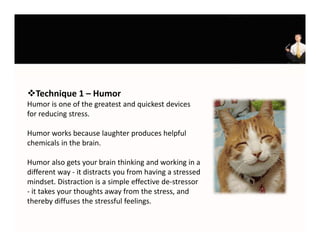
Technique 1 – Humor
Humor is one of the greatest and quickest devices 
                      g          q
for reducing stress. 

Humor works because laughter produces helpful 
chemicals in the brain.

Humor also gets your brain thinking and working in a 
different way ‐ it di t t
diff     t       it distracts you from having a stressed 
                                  f    h i       t     d
mindset. Distraction is a simple effective de‐stressor 
‐ it takes your thoughts away from the stress, and 
thereby diffuses the stressful feelings.
thereby diffuses the stressful feelings
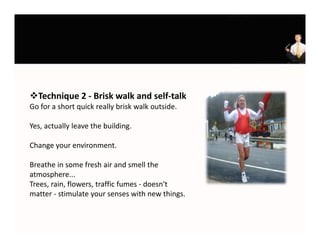
Technique 2 ‐ Brisk walk and self‐talk
Go for a short quick really brisk walk outside. 
Go for a short quick really brisk walk outside

Yes, actually leave the building.

Change your environment. 

Breathe in some fresh air and smell the 
atmosphere...
Trees, rain, flowers, traffic fumes ‐ doesn't 
matter ‐ stimulate your senses with new things.
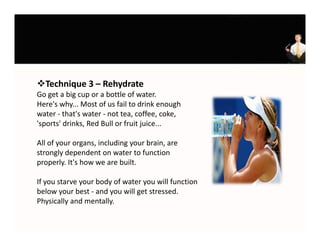
Technique 3 – Rehydrate
Go get a big cup or a bottle of water. 
Here's why... Most of us fail to drink enough 
           y                                g
water ‐ that's water ‐ not tea, coffee, coke, 
'sports' drinks, Red Bull or fruit juice...

All of your organs, including your brain, are 
strongly dependent on water to function 
properly. It's how we are built.

If you starve your body of water you will function 
below your best ‐ and you will get stressed. 
Physically and mentally.
Physically and mentally
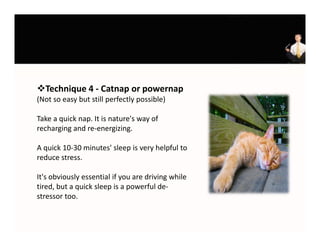
Technique 4 ‐ Catnap or powernap
(Not so easy but still perfectly possible) 

Take a quick nap. It is nature's way of 
recharging and re‐energizing.

A quick 10‐30 minutes' sleep is very helpful to 
reduce stress. 

It's obviously essential if you are driving while 
tired, but a quick sleep is a powerful de‐
stressor too.
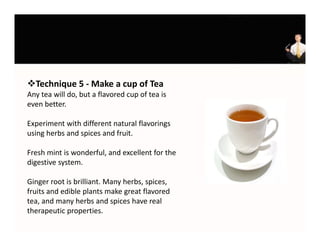
Technique 5 ‐ Make a cup of Tea
Any tea will do, but a flavored cup of tea is 
even better. 

Experiment with different natural flavorings 
using herbs and spices and fruit.

Fresh mint is wonderful, and excellent for the 
digestive system. 

Ginger root is brilliant. Many herbs, spices, 
fruits and edible plants make great flavored 
tea, and many herbs and spices have real 
tea and many herbs and spices have real
therapeutic properties.
Technique 6 ‐ Crying
Not much is known about the physiology of crying 
and tears, although many find that crying ‐ weeping 
   d         lh    h      fi d h       i         i
proper tears ‐ has a powerful helpful effect on 
stress levels. 

Whatever the science behind crying, but when you 
cry you feel lighter from the stress (burden). 

Of course how and where you choose to submit to 
this most basic of emotional impulses is up to you. 
Quote:
                     Quote:‐
Adopting the right attitude can convert a negative 
           stress into a positive one. 
                                        Hans Selye
Thank your for your time.
  Thank your for your time.

www.amirsaiftaz.blogspot.com
  amirsaiftaz@gmail.com

Stress Management At Workplace