Learning Objectives of this topic Know  the meaning of stress. Be able to identify individual dispositions of stress. Learn  the effects of stress.  Know  some strategies for managing stress
1.. Can you say ‘no’ to friends and colleagues?  2.  Are you organized? 3.  Can you priorities?  5. Do you enjoy a healthy balanced diet?  6. Can you seek help when you need it?   7.Do you have a low caffeine and alcohol /tea consumption?  8.     Can you manage your time well? uncertainties?    
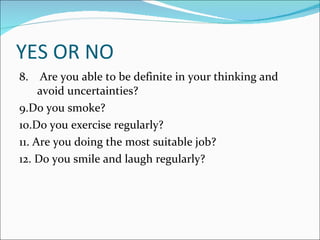
YES OR NO 8.    Are you able to be definite in your thinking and avoid uncertainties?  9.Do you smoke?     10.Do you exercise regularly?  11. Are you doing the most suitable job?  12. Do you smile and laugh regularly?
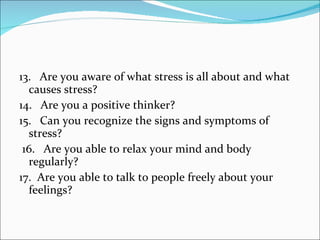
13.   Are you aware of what stress is all about and what causes stress?  14.   Are you a positive thinker?  15.   Can you recognize the signs and symptoms of stress?    16.   Are you able to relax your mind and body regularly?  17.  Are you able to talk to people freely about your feelings?
18.  Are you in a good state of health?  19.  Do you feel secure and value yourself?
  STRESS  The response to events that are threatening or challenging   Stress is a general term that includes all  the , physical, behavioral, emotional, and  cognitive responses we make to a disruptive internal or external event.
. Stress is a part of being alive. Stress becomes a problem for us when we have too much stress and not enough resources to cope with it.
Should WE Eliminate Stress from OUR Lives? Our goal is not to eliminate stress but, to learn how to manage it and how to use it to help us  What we need to do is find the optimal level of stress which will individually motivate but not overwhelm each of us
Kinds of effects associated with the stressed state Psychologists have argued that there are four major kinds of effects associated with the stressed state, Emotional effects Feelings of anxiety and depression Increased physical tension Increased psychological tension
2.  Physiological effects Release of adrenaline and noradrenalin shut-down of digestive system Expansion of air passages In lungs Increased heart rate Constriction of blood vessels
3.  Cognitive effects Poor concentration Increased distractibility Reduced short term memory capacity 4.  Behavioral effects Increased absenteeism Disrupted sleep patterns Reduced work performance
What determines our stress level? Stress is uniquely personal. Our response to stress is a unique combination of bodily reactions, thoughts feelings and behaviors. Factors Affecting our personal stress level Internal factors Physical health Genetic vulnerabilities
External factors Medical care Finances Skills and training Support systems Counseling Frequency of stressors occurrence Intensity of stress's occurrence
Mental health Self-esteem Temperament Self confidence Cultural expectations Cultural definitions
Theories According to engineering model ,stress is something that happens to us when we are exposed to a stressor. Transactional model says stress occurs when, the perceived demands of a situation exceed the individuals perceived ability to handle those demands.
Psychology of stress There are various psychological processes or coping strategies which can be used to reduce stress. Task oriented strategies  ,involves obtaining information about the stressful situation and about alternative course of action and their probable outcomes.
Emotion oriented strategies ,involves efforts to maintain hope and to control emotions. Avoidance oriented strategies , involves denying or minimizing the seriousness of situation .
Causes of stress Stressful life events Noise Heat Technological threats Architecture Uneven distribution of life facilities
How Can we Manage Stress Better?   1. Become aware of your stressors and your emotional and physical reactions.   Notice your distress. Don't ignore it.  Don't cover or hide your problems.  Determine what events distress you. What are you telling yourself about meaning of these events?
Determine how your body responds to the stress. Do you become nervous or physically upset? If so, in what specific ways?
Recognize what you can change.  Can you change your stressors by avoiding or eliminating them completely?  Can you reduce their intensity (manage them over a period of time instead of on a daily or weekly basis)?
Can you shorten your exposure to stress (take a break, leave the physical premises)? Can you devote the time and energy necessary to making a change (goal setting, time management techniques, and delayed gratification strategies may be helpful here)?
Reduce the intensity of your emotional reactions to stress The stress reaction is triggered by your perception of danger...physical danger and/or emotional danger. Are you viewing your stressors in exaggerated terms and/or taking a difficult situation and making it a disaster? Are you expecting to please everyone?
Are you overreacting and viewing things as absolutely critical and urgent? Do you feel you must always prevail in every situation?  Work at adopting more moderate views; try to see the stress as something you can cope with rather than something that overpowers you.  Try to temper your excess emotions. Put the situation in perspective. Do not labor on the negative aspects and the "what if's."
Learn to moderate your physical reactions to stress.  Slow, deep breathing will bring your heart rate and respiration back to normal.
Build your physical reserves.  Exercise for cardiovascular fitness three to four times a week (moderate, prolonged rhythmic exercise is best, such as walking, swimming, cycling, or jogging). Eat well-balanced, nutritious meals.  Maintain your ideal weight.
Avoid nicotine, excessive caffeine, and other stimulants.  Mix leisure with work. Take breaks and get away when you can.  Get enough sleep. Be as consistent with your sleep schedule as possible.
Maintain your emotional reserves.  Develop some mutually supportive friendships/relationships.  Pursue realistic goals which are meaningful to you, rather than goals others have for you that you do not share.
Expect some frustrations, failures, and sorrows. Always be kind and gentle with yourself -- be a friend to yourself.
10 stress busters Exercise three to five times for at least 30 minutes. Work off your anger by doing something physical. Use relaxation techniques ,yoga meditation or deep breathing. Watch out funny movie a week, more during stressful times.
5. Maintain a regular sleep schedule. 6. Don’t procrastinate. 7.Avoid caffeine,sugar,and tobacco when you are stressed 8. Volunteer once a month,  ,helping others is an incredible stress reliever. 9.Set priorities weekly and make sure to schedule in leisure time. 10.Talk with others. A support system is one of the greatest stress busters.

Session 14 stress ( SMS )

  • 1.
  • 2.
    Learning Objectives ofthis topic Know the meaning of stress. Be able to identify individual dispositions of stress. Learn the effects of stress. Know some strategies for managing stress
  • 3.
    1.. Can you say‘no’ to friends and colleagues?  2.  Are you organized? 3.  Can you priorities?  5. Do you enjoy a healthy balanced diet?  6. Can you seek help when you need it?   7.Do you have a low caffeine and alcohol /tea consumption?  8.     Can you manage your time well? uncertainties?    
  • 4.
    YES OR NO8.    Are you able to be definite in your thinking and avoid uncertainties?  9.Do you smoke?     10.Do you exercise regularly?  11. Are you doing the most suitable job?  12. Do you smile and laugh regularly?
  • 5.
    13.   Are youaware of what stress is all about and what causes stress?  14.   Are you a positive thinker?  15.   Can you recognize the signs and symptoms of stress?    16.   Are you able to relax your mind and body regularly?  17.  Are you able to talk to people freely about your feelings?
  • 6.
    18.  Are you ina good state of health?  19.  Do you feel secure and value yourself?
  • 7.
    STRESS The response to events that are threatening or challenging Stress is a general term that includes all the , physical, behavioral, emotional, and cognitive responses we make to a disruptive internal or external event.
  • 8.
    . Stress isa part of being alive. Stress becomes a problem for us when we have too much stress and not enough resources to cope with it.
  • 9.
    Should WE EliminateStress from OUR Lives? Our goal is not to eliminate stress but, to learn how to manage it and how to use it to help us What we need to do is find the optimal level of stress which will individually motivate but not overwhelm each of us
  • 10.
    Kinds of effectsassociated with the stressed state Psychologists have argued that there are four major kinds of effects associated with the stressed state, Emotional effects Feelings of anxiety and depression Increased physical tension Increased psychological tension
  • 11.
    2. Physiologicaleffects Release of adrenaline and noradrenalin shut-down of digestive system Expansion of air passages In lungs Increased heart rate Constriction of blood vessels
  • 12.
    3. Cognitiveeffects Poor concentration Increased distractibility Reduced short term memory capacity 4. Behavioral effects Increased absenteeism Disrupted sleep patterns Reduced work performance
  • 13.
    What determines ourstress level? Stress is uniquely personal. Our response to stress is a unique combination of bodily reactions, thoughts feelings and behaviors. Factors Affecting our personal stress level Internal factors Physical health Genetic vulnerabilities
  • 14.
    External factors Medicalcare Finances Skills and training Support systems Counseling Frequency of stressors occurrence Intensity of stress's occurrence
  • 15.
    Mental health Self-esteemTemperament Self confidence Cultural expectations Cultural definitions
  • 16.
    Theories According toengineering model ,stress is something that happens to us when we are exposed to a stressor. Transactional model says stress occurs when, the perceived demands of a situation exceed the individuals perceived ability to handle those demands.
  • 17.
    Psychology of stressThere are various psychological processes or coping strategies which can be used to reduce stress. Task oriented strategies ,involves obtaining information about the stressful situation and about alternative course of action and their probable outcomes.
  • 18.
    Emotion oriented strategies,involves efforts to maintain hope and to control emotions. Avoidance oriented strategies , involves denying or minimizing the seriousness of situation .
  • 19.
    Causes of stressStressful life events Noise Heat Technological threats Architecture Uneven distribution of life facilities
  • 20.
    How Can weManage Stress Better? 1. Become aware of your stressors and your emotional and physical reactions. Notice your distress. Don't ignore it. Don't cover or hide your problems. Determine what events distress you. What are you telling yourself about meaning of these events?
  • 21.
    Determine how yourbody responds to the stress. Do you become nervous or physically upset? If so, in what specific ways?
  • 22.
    Recognize what youcan change. Can you change your stressors by avoiding or eliminating them completely? Can you reduce their intensity (manage them over a period of time instead of on a daily or weekly basis)?
  • 23.
    Can you shortenyour exposure to stress (take a break, leave the physical premises)? Can you devote the time and energy necessary to making a change (goal setting, time management techniques, and delayed gratification strategies may be helpful here)?
  • 24.
    Reduce the intensityof your emotional reactions to stress The stress reaction is triggered by your perception of danger...physical danger and/or emotional danger. Are you viewing your stressors in exaggerated terms and/or taking a difficult situation and making it a disaster? Are you expecting to please everyone?
  • 25.
    Are you overreactingand viewing things as absolutely critical and urgent? Do you feel you must always prevail in every situation? Work at adopting more moderate views; try to see the stress as something you can cope with rather than something that overpowers you. Try to temper your excess emotions. Put the situation in perspective. Do not labor on the negative aspects and the "what if's."
  • 26.
    Learn to moderateyour physical reactions to stress. Slow, deep breathing will bring your heart rate and respiration back to normal.
  • 27.
    Build your physicalreserves. Exercise for cardiovascular fitness three to four times a week (moderate, prolonged rhythmic exercise is best, such as walking, swimming, cycling, or jogging). Eat well-balanced, nutritious meals. Maintain your ideal weight.
  • 28.
    Avoid nicotine, excessivecaffeine, and other stimulants. Mix leisure with work. Take breaks and get away when you can. Get enough sleep. Be as consistent with your sleep schedule as possible.
  • 29.
    Maintain your emotionalreserves. Develop some mutually supportive friendships/relationships. Pursue realistic goals which are meaningful to you, rather than goals others have for you that you do not share.
  • 30.
    Expect some frustrations,failures, and sorrows. Always be kind and gentle with yourself -- be a friend to yourself.
  • 31.
    10 stress bustersExercise three to five times for at least 30 minutes. Work off your anger by doing something physical. Use relaxation techniques ,yoga meditation or deep breathing. Watch out funny movie a week, more during stressful times.
  • 32.
    5. Maintain aregular sleep schedule. 6. Don’t procrastinate. 7.Avoid caffeine,sugar,and tobacco when you are stressed 8. Volunteer once a month, ,helping others is an incredible stress reliever. 9.Set priorities weekly and make sure to schedule in leisure time. 10.Talk with others. A support system is one of the greatest stress busters.